The headline in Japan on the Japanese Ministry of Foreign Affairs latest data on Japanese nationals living overseas was that the number of Japanese living in China had dipped below 100,000 for the first time. This meant China was overtaken by Australia as the second largest host of Japanese nationals, below the USA, also for the first time.
The USA is still overwhelmingly the largest host, with over 413,000 Japanese nationals living there on permanent or long term visas, but there has been a gentle decline in numbers since 2018. Similarly, the UK, which has the sixth largest number of Japanese nationals (just over 64,000) peaked in 2019 and is now around 1% down on 2016. Germany, #8, has 12% more Japanese residents than it had in 2016 – a similar growth rate to Australia, and looks to be catching up with Brazil, which has had a 13% decline in Japanese nationals.
It may seem odd that Brazil and the USA have so many Japanese nationals considering the major migrations from Japan to those countries were at the end of the 19th and beginning of the 20th century, but this is because in many cases, the Japanese nationals are actually third or even fourth generation. Japan does not allow dual nationality, and nationality is determined by ‘jus sanguinis’ – at least one of the parents being Japanese, rather than being born in Japan. So many children of Japanese immigrants keep their parents’ nationality despite their birthplace. This is why the Ministry of Foreign Affairs data needs to be treated with caution. The data shows those Japanese who have registered with the embassy or consulate. Clearly, if you want your children to have Japanese nationality, despite being born overseas, you would need to register them. I suspect however, that many parents both register their children as Japanese nationals, but also enable their children to take the nationality of the country they were born in, if that is legally allowed – ‘jus soli’. Others may not register with the Embassy at all, to try to stay under the radar.
There would be no way for the Japanese Ministry of Foreign Affairs to check whether there were conflicting nationalities being claimed, until something forces the issue, such as inheritance tax to be paid in Japan, a pandemic or a change in the immigration and nationalization laws in the host country.
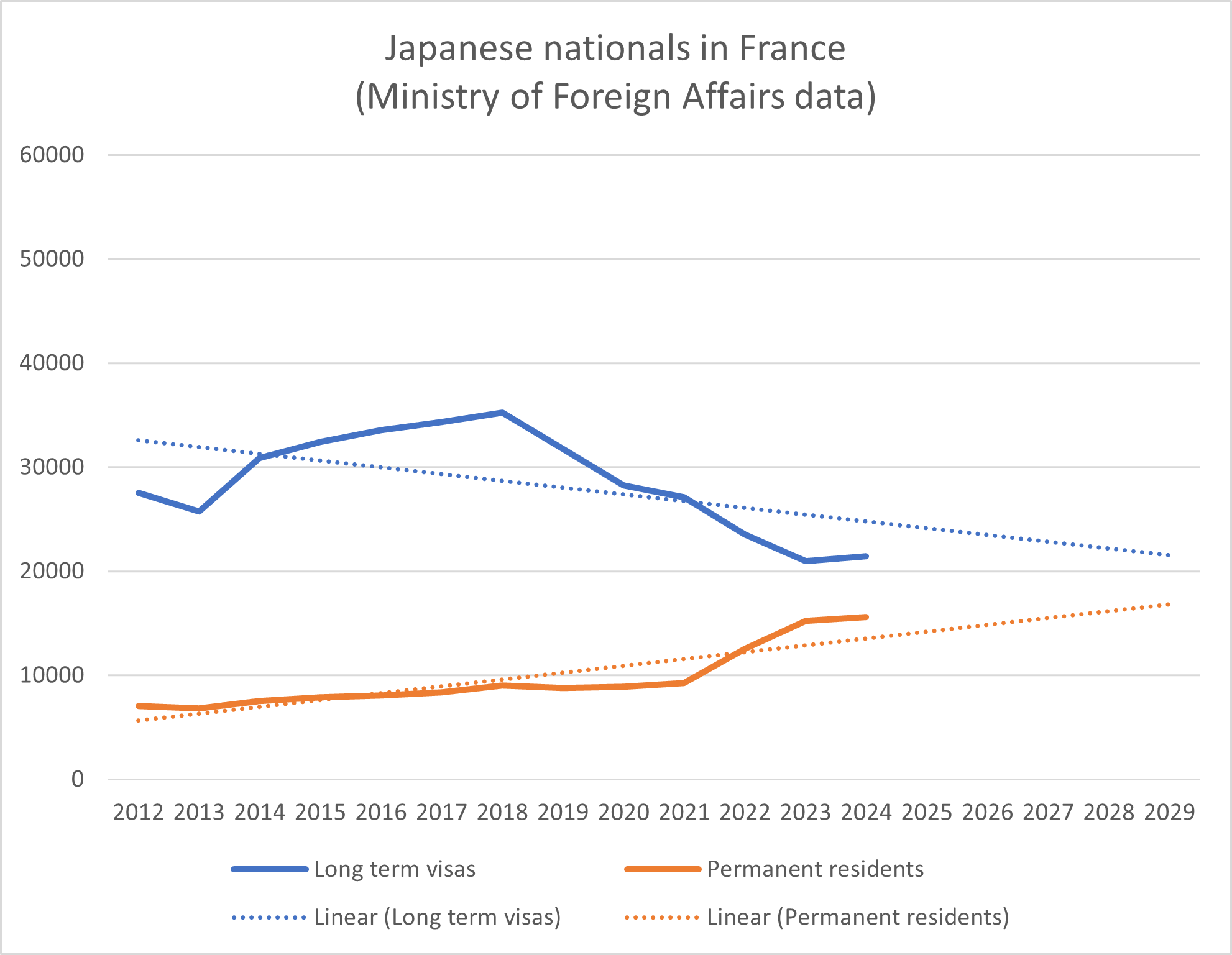
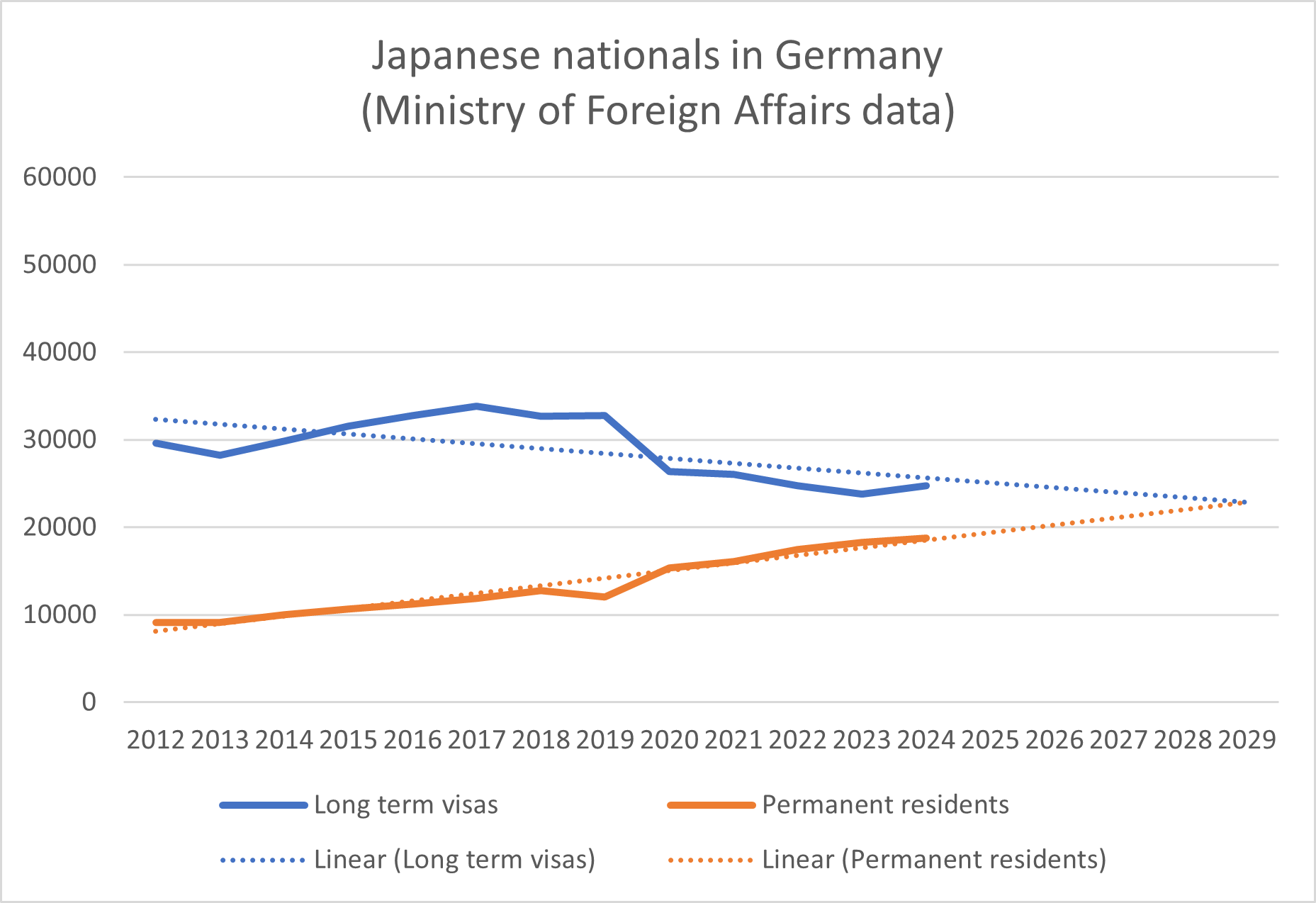
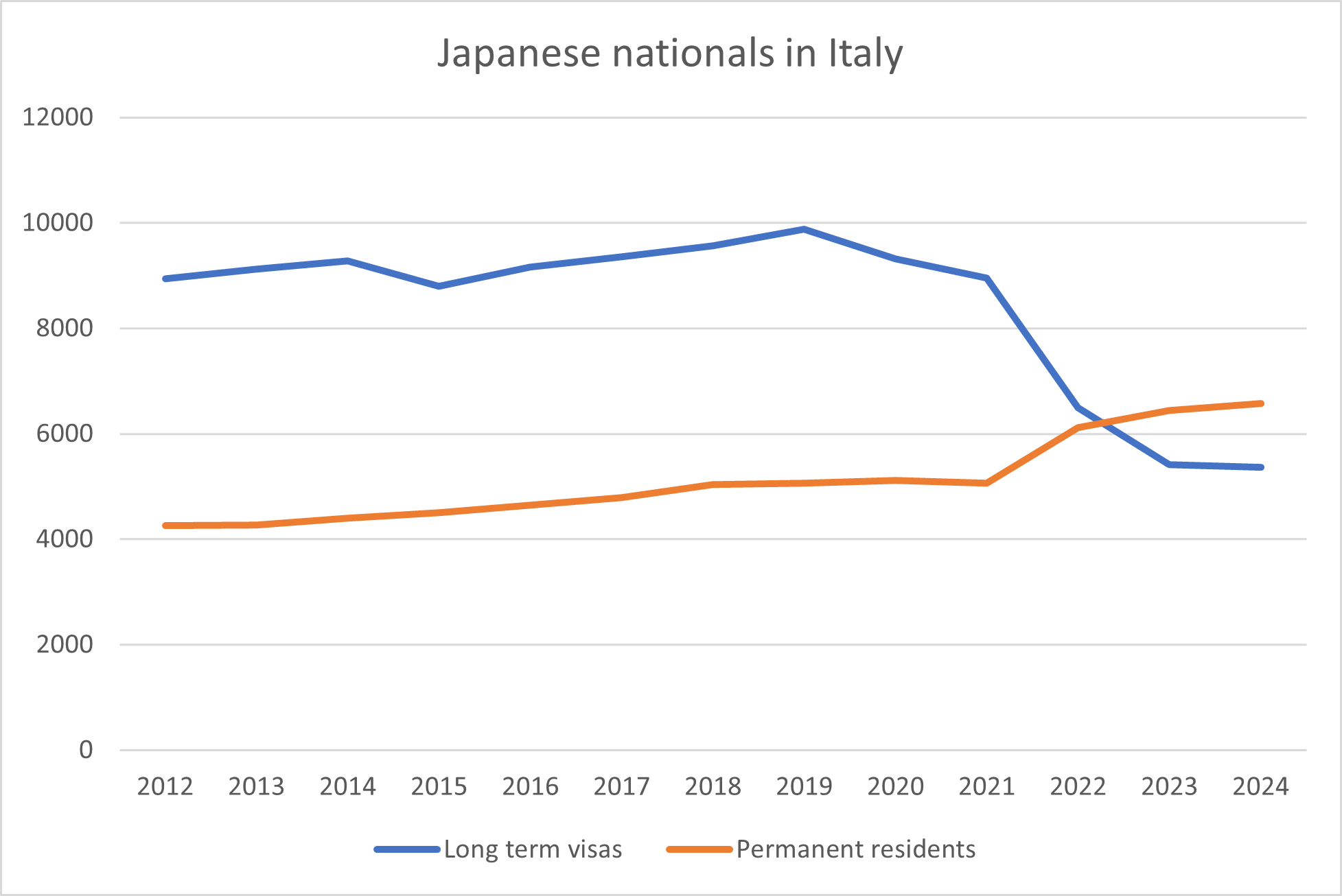
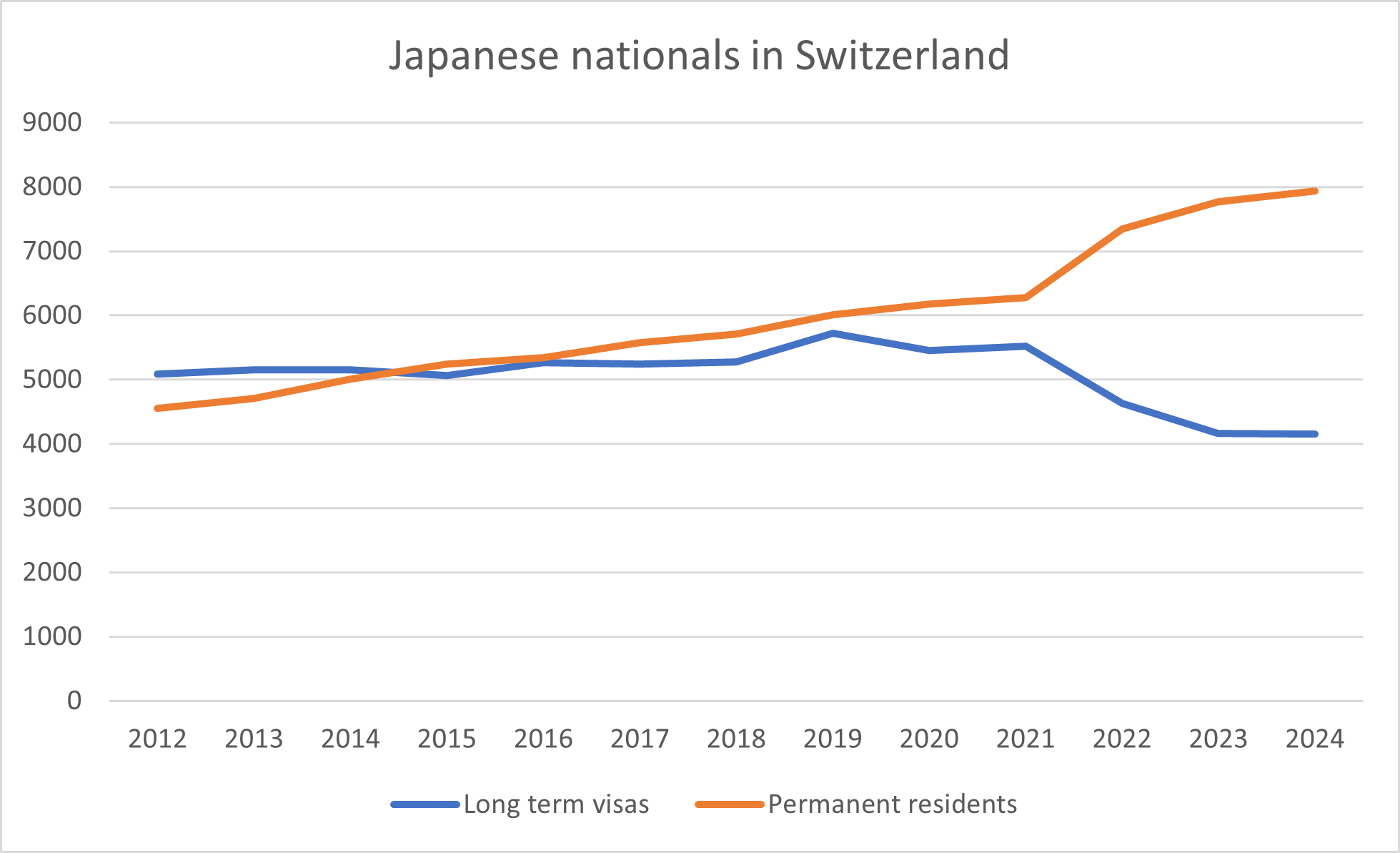
Separating out the numbers for permanent residents and those on long term visas (who are likely to be corporate expatriates) reveals the impact of legal changes, the pandemic and also long term shifts in Japanese corporate expatriation and Japanese who commit to “burying their bones” as it is said in Japanese, in a foreign country – probably due to having married and raised families in that country.
The rise of the permanent resident
If current trends continue, the number of Japanese who are permanent residents in the UK is set to overtake the number who are in the UK temporarily on working visas by around 2026 – a function of both the decline in Japanese corporate expatriates and a steady increase in the number of Japanese choosing to live permanently in the UK.
The other major host countries (more than 10,000 Japanese nationals) where more than half the Japanese nationals are permanent residents are Argentina (96.7%), Brazil (91.7%), Canada (67.9%) Australia (61.5%), New Zealand (60%), the USA (55.7%), Italy (55.1%) and Switzerland (65.7%).
A similar crossover of Japanese permanent residents exceeding long term visa holders may occur in Germany and France within the next 5 to 10 years if the trend is projected from 2012 – but the most recent data show that there has been a slight upturn in Japanese long term visa holders in both countries and a levelling off in the number of permanent residents.
Except in the Netherlands, the Brexit benefitter
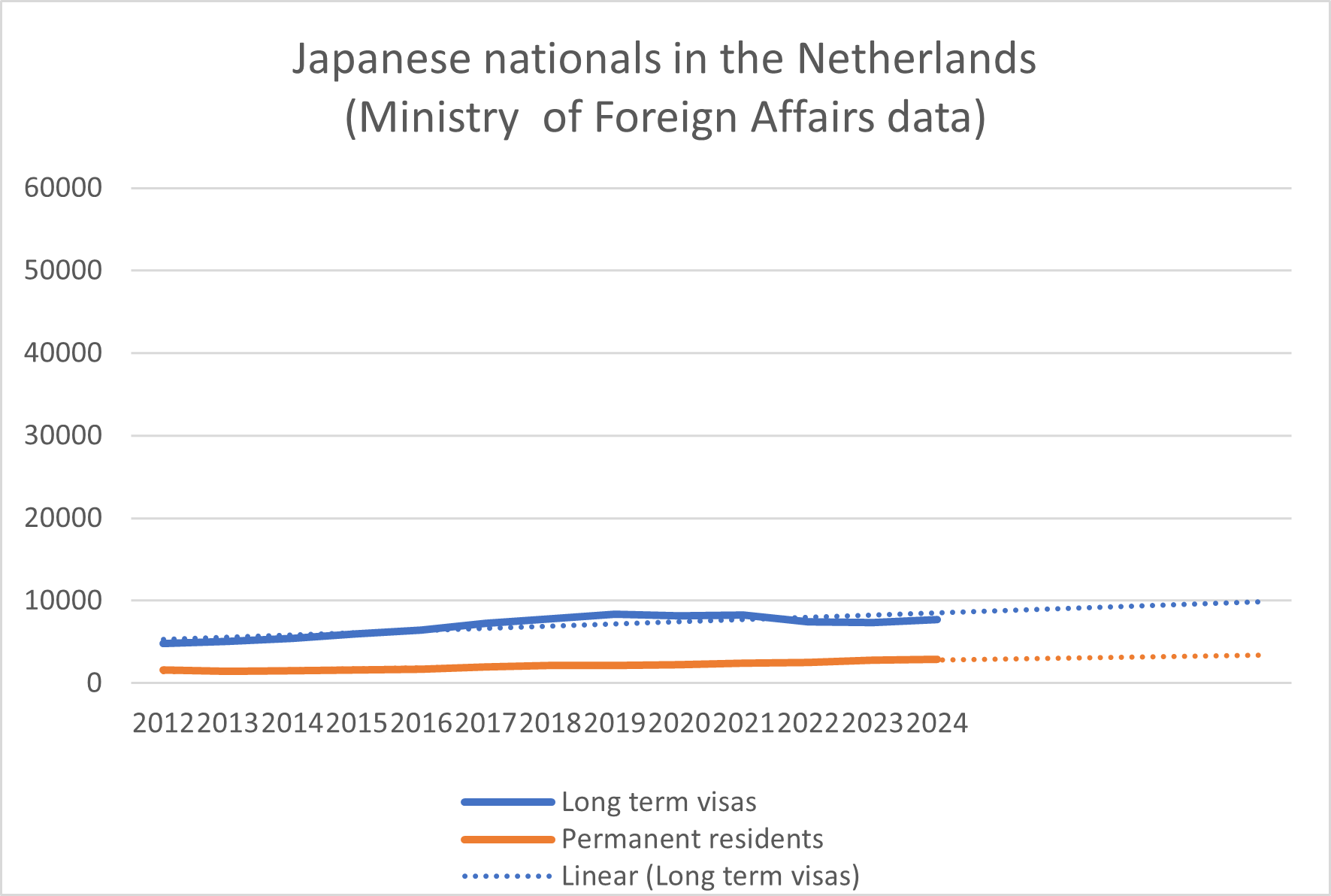
The outlier in Europe in many ways is the Netherlands. Although there only are just over 10,000 Japanese nationals living there, this represents a 53% increase on 2014. Judging by the steady rise of long term visa holding Japanese – particularly around the Brexit years, there is no sign of the gap closing between permanent and long term Japanese nationals in the Netherlands. As noted in our recent report on Japanese financial services in Europe, Japanese banks have followed their Japanese clients and reacted to Brexit by opening or reinforcing their regional headquarters in the Netherlands with assets and capital, and Japanese expatriates would seem to have followed.
Our 2025 report on Japanese Financial Services in the UK and EMEA, with a directory of 300 Japanese financial services companies in the region – can be purchased and downloaded online here
Japanese financial services firms in the UK have remained fairly resilient since Brexit, in terms of turnover and headcount – with significant growth shown by the non-life insurers and leasing and financing companies, but less growth for some in the banking and securities sectors. On the other hand, the UK has had significant outflows of Japanese capital, whereas Ireland, Luxembourg and the Netherlands have had significant inflows.
Headcount
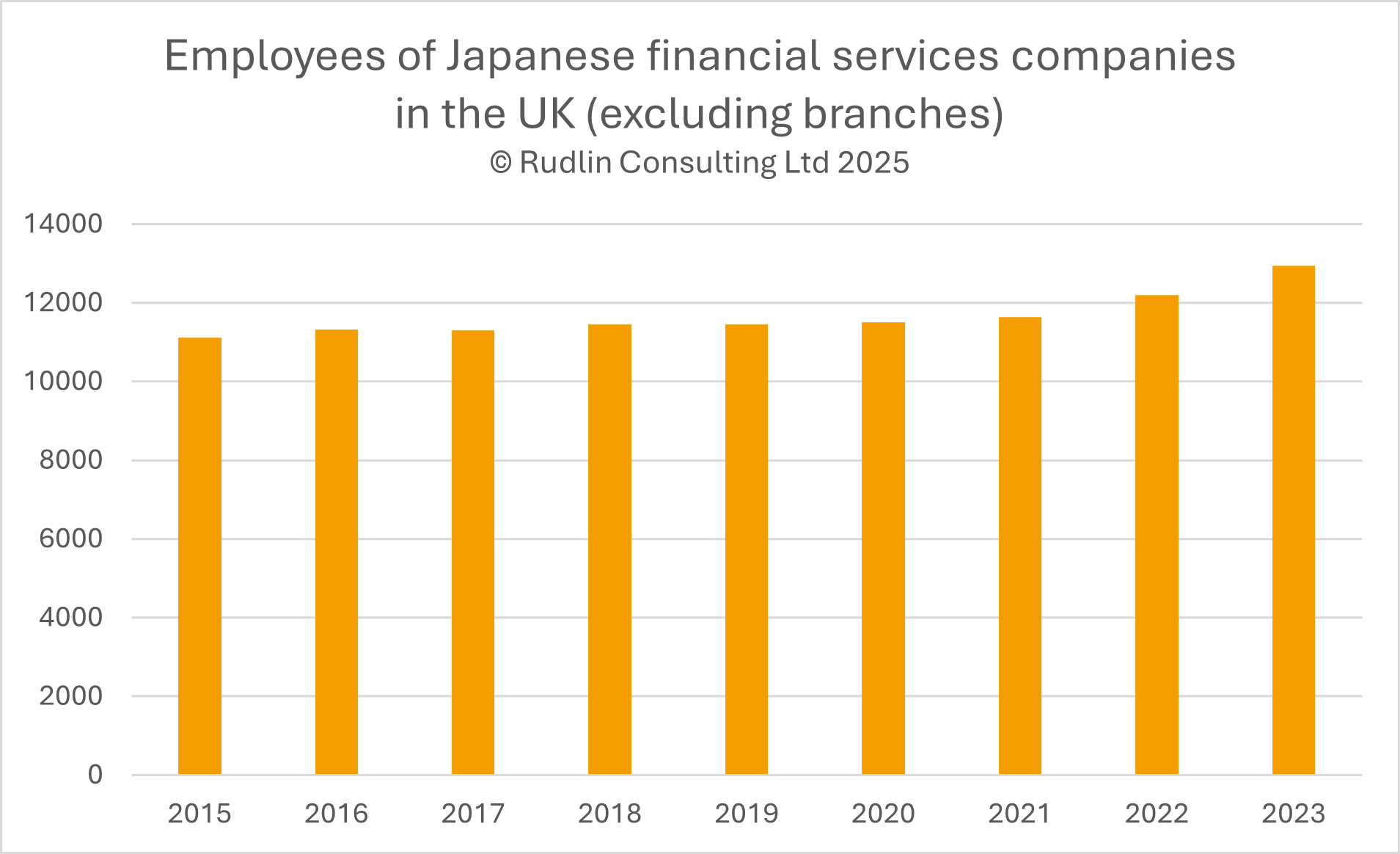
Judging by annual reports filed for the UK for the year 2023-2024, after several years of negative or little growth, Japanese financial services companies are starting to expand their hiring in the UK.
Adding in a guesstimate for the banks that are branches, there are over 15,000 employees in the Japan-owned UK financial services sector, and this total has grown by at least 10% over 2021/2 to 2023/4. This total represents around two-thirds of the total working for Japanese financial services firms in the region
This may indicate improving business for the Japanese financial services sector across the whole EMEA region, as many of the Japanese financial services firms in the UK act as EMEA regional headquarters. According to the JETRO Survey on Business Conditions for Japanese-Affiliated Companies Overseas (Global Edition) 2024, 92.4% of Japanese banks overseas were predicting a profit – higher than any other sector. The European edition of the survey showed that 60% of non-bank financial services companies were predicting an increased market share in Europe for 2024.
This overall growth conceals some varying fortunes, however. SMBC Bank International PLC has doubled in size since 2015, to 1,739 employees. Recent growth is partly due to the transfer of employees from SMBC Nikko Capital Markets with the merger of its securities business into SMBC. This merger process is expected to be completed by year ending March 2025. SMBC Nikko will continue as a derivatives business, conducted by employees within SMBC Bank International.
It is possible that the other two megabanks, MUFG and Mizuho have grown similarly, but as they are branches, it is not possible to verify this. Their securities arms – Mizuho International and MUFG Securities – grew by a third and by 18% respectively since 2015.
Other companies which have grown include Mitsubishi HC Capital, Tokio Marine, Aioi Nissay Dowa Insurance and Toyota Financial Services.
Headcount has dropped significantly 2021/2 to 2023/4 at Daiwa Capital Markets as part of their three year cost reduction programme. The 2024 report shows a £14m profit compared to an £18m loss in the previous year.
Nomura is showing a small recovery in employee numbers, but headcount at 1,876 is still nearly 25% down on 2015/6.
SBI Shinsei, formerly SoftBank owned Shinsei Bank, is making a comeback in London. It acquired British crypto currency company B2C2 in 2020 and its Japanese Chief Executive was approved by the UK’s FCA in 2024. The intention is to build up institutional business in equity, fixed income and digital and fintech investment.
UK financial services exports to Japan
UK financial services exports to Japan
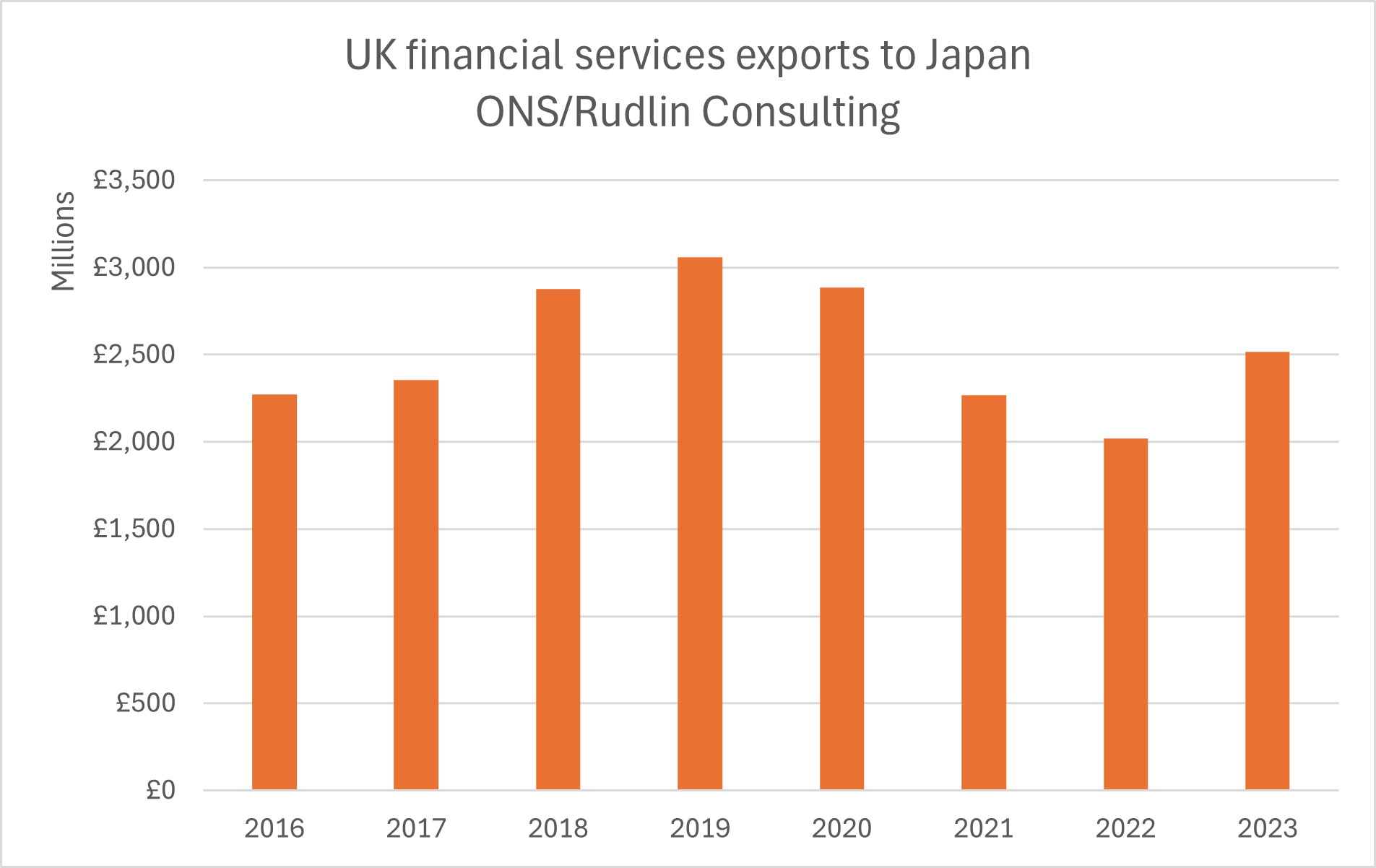
Headcount growth may be due to increased demand from Japan for UK financial servies. UK trade statistics show that financial services exports from the UK to Japan of £2.4bn represented 30% of UK services exports to Japan in the year ending Q3 2024, an increase of 2.1% (non-seasonally adjusted) on the previous year. Financial services exports to Japan grew for the first time in 4 years in 2023.
A substantial proportion of these financial services exports may be Japanese corporate purchases of the services of UK based Japanese financial services firms, or the headquarters of those firms forwarding management fees on to their operations in the UK.
Turnover
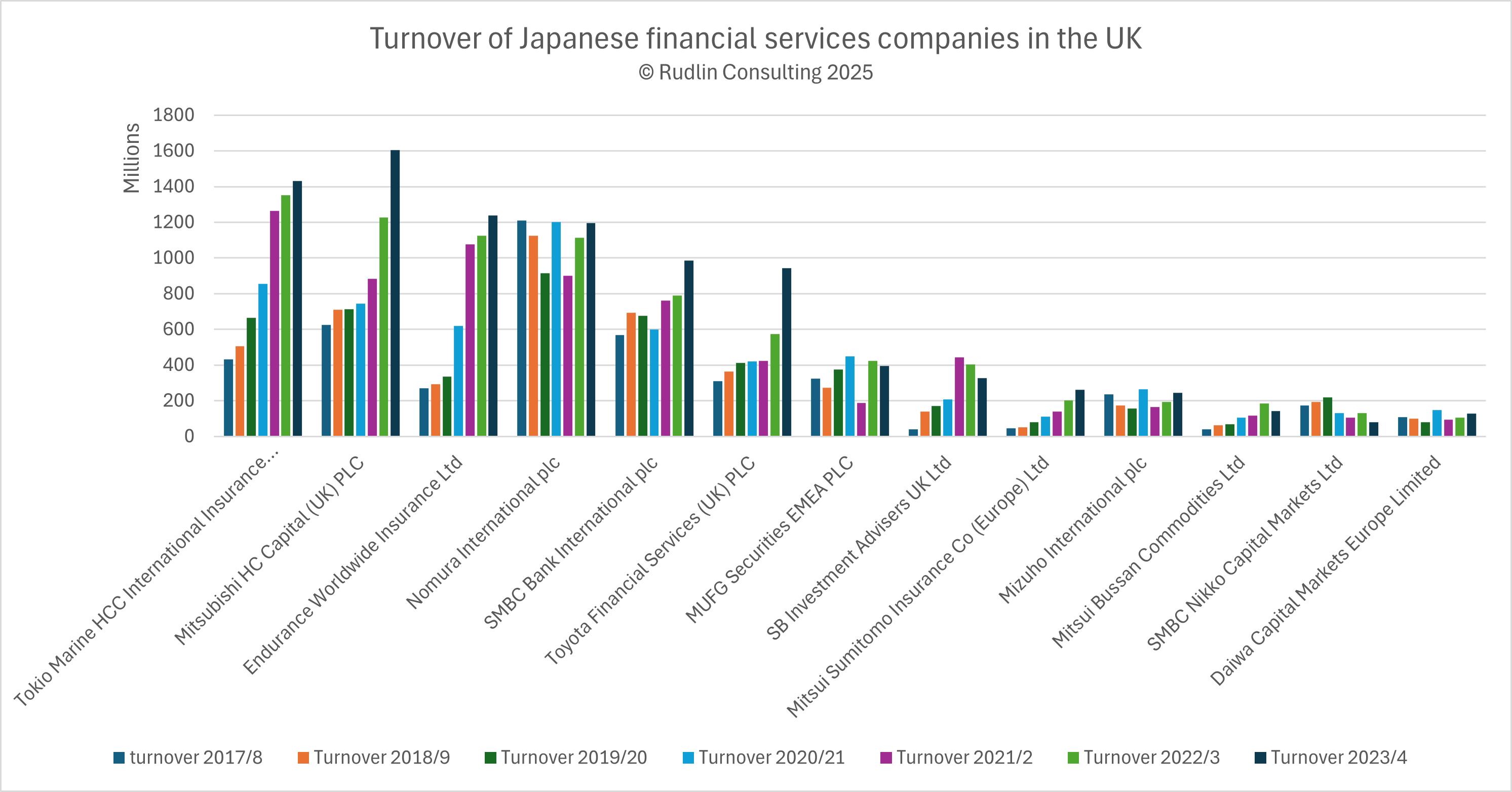
The top 14 Japanese financial services firms in terms of turnover (turnover covering everything from gross written premiums to management fees) show that securities based businesses have had a bumpy few years, but non-life insurers and leasing and financing companies have boomed, in part because of acquisitions. Tokio Marine HCC and Endurance Worldwide’s turnovers reflect their Europe-wide business holdings.
Mergers and acquisitions, entrants and exits
As far as we are aware, there were no mergers and acquisitions in the Japanese financial services sector in the UK in 2023-4. There was one closure, of retail forex broker GMO-Z.COM, which had an operation in London since 2012, and at peak employed 17 people. One newcomer to the UK was Fuyo Lease Europe, which already had established Fuyo Aviation Capital in London. It has formed a joint venture with Sumitomo Forestry to renovate office buildings in the UK.
The new wave of global acquisitions by Japanese life insurers has not brought capital directly to the UK, however Nippon Life’s acquisition of Resolution Life will mean a much larger presence in the UK, as Resolution Life services many closed book British life insurance brands.
Capital flows
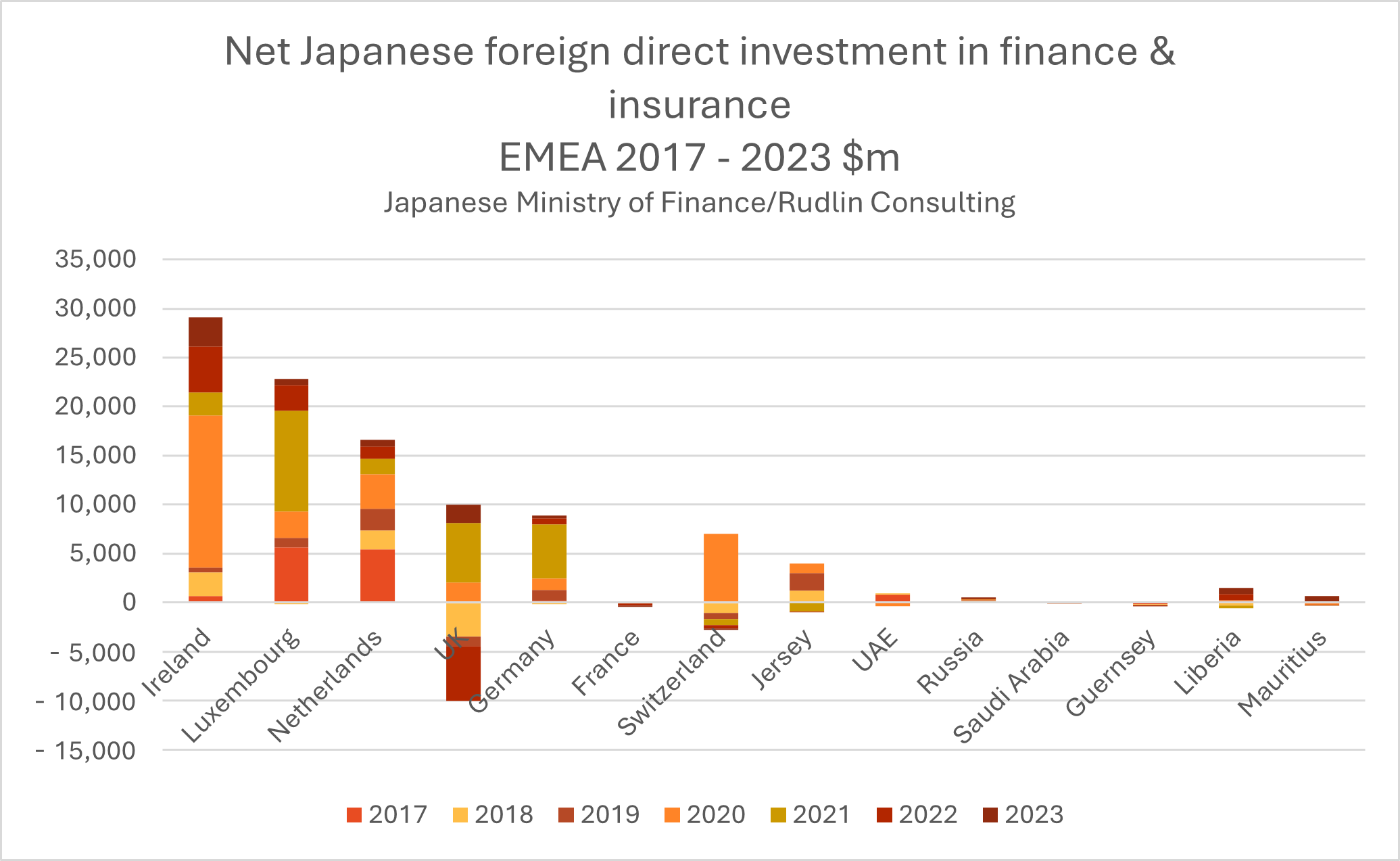
Direct investment flows from Japan, into the finance and insurance sectors, based on Japanese Ministry of Finance data,[1] show that the UK has had the largest outflow ($10bn) of Japanese investment of any country in the Europe, Middle East and Africa region from 2017 to 2023. There was a net inflow in 2023, but the balance across 2017 to 2023 is still slightly negative. (converted from JPY to USD by rate for each year)
Capital has flowed into Ireland, Luxembourg and the Netherlands since 2017 – this may be partly for favourable taxation reasons, as a reaction to the Brexit referendum but also as funds for specific financial services – for example, in Ireland’s case, for aircraft leasing. Germany and Switzerland have also seen positive flows, but France has seen a small net outflow.
Luxembourg hosts the EU headquarters for insurance companies such as Sompo and Endurance as well as various fund management companies.
Japanese banks have made some investments in British companies in 2023-24, for example Mizuho Bank invested $20 million in U.K. climate change investment and advisory firm operator Pollination Global Holdings. It is aiming to use the Pollination’s know-how to boost domestic and overseas advisory services in environmental areas and information disclosure and also to set up carbon credit projects.
Assets
Japanese banks are still small compared to other banks in Europe, in terms of total assets. The top ten biggest banks in Europe all have assets of over €1trn, whereas the biggest Japanese megabank in Europe is SMBC International, in the UK, with €51bn in assets (down from €53bn the previous year). SMBC EU AG in Germany is the second largest with €23.1bn (a 30% increase on the previous year). MUFG Bank EU has €12bn in assets and Mizuho Bank EU has €5.2bn (a 14.8% increase on the previous year).
Nomura International in the UK has total assets of €216.5bn – around the same as the assets of other Japanese financial firms in Europe combined. Nomura Financial Products GmbH has assets of €18bn, up from €14bn the previous year. They state in their most recent report that they expect assets to remain within the €15 to €20bn range over the next 24 months.
As can be seen from the chart below, total assets held in the UK have declined over the year, and mainly increased in the EU.
2023/4
2022/3
Nomura International (UK)
€216.5bn (-9%)
€238.1bn
MUFG Securities EMEA (UK)
€74.7bn (-12%)
€85.1bn
SMBC International (UK)
€48.6bn (-5%)
€51.1bn
Mizuho International (UK)
€29.5 bn (-9%)
€32.5bn
SMBC EU AG (Germany)
€23.1bn (+30%)
€17.7bn
Nomura Financial Products GmbH (Germany)
€18.1bn (+23%)
€14.7bn
MUFG Bank (Europe) (Netherlands)
€12.1bn (-5%)
€12.8bn
Mizuho Bank Europe (Netherlands)
€5.2bn (+13%)
€4.6bn
MUFG Securities Europe
€4.2bn (+5%)
€4.0bn
Norinchukin Bank Europe (Netherlands)
€3.1bn (+24%)
€2.5bn
(GBP£1 to €1.19 US$1 to €0.97)
Daiwa Capital Markets Europe restructured its balance sheet and business model in 2023 is not included here
Localisation
There has been regulatory pressure on Japanese financial services companies in the UK to improve their corporate governance and risk management since the Lehman Shock of 2008. This has resulted in a reduction of executives being sent from Japan and more locally experienced executives being appointed as executive directors. The branches have not been under as much pressure to localise, and their senior executives are therefore largely Japanese headquarter expatriates. Most of the larger Japanese financial services firms in the UK have more than 30 Japanese expatriate employees. Many of these are at the trainee level, however.[2]
UK entities
Total board members
% non-Japanese
SMBC Bank International
10
70%
Mizuho International
9
60%
MUFG Securities EMEA
9
70%
Daiwa Capital Markets Europe
6
67%
Nomura International
8
75%
SMBC Bank International has ten board members, of whom three are Japanese directors from Japan HQ including the CEO (who has been on the board since 2018 and was appointed CEO in 2023). Alan Keir, formerly of HSBC, was chair of the board for eight years, stepping down in September 2024. He has been replaced by Sophie O’Connor. Of the 1,739 employees in London, 161 are Japanese expatriates.
The Managing Executive Officer, Head of EMEA, Deputy Head of EMEA and Head of Japanese Banking Europe at Mizuho Bank London branch are Japanese nationals from Japan headquarters. Mizuho International PLC has nine board members, of whom four are Japanese directors from Japan HQ, including the Deputy President Yoji Imafuku, appointed in 2024. The CEO Suneel Bakshi has been in post since 2019.
MUFG Bank’s Regional CEO for EMEA and the Managing Director are both Japanese nationals from Japan headquarters. MUFG Securities EMEA PLC has nine board members, three of whom are Japanese directors from Japan HQ. The CEO is Chris Kyle and the Regional Chief Executive Officer is Hidefumi Yamamura, appointed in 2024. 46 of the 291 employees at Mitsubishi UFJ Trust and Banking are Japanese expatriates.
Maria Bentley took over as chair of the board of Daiwa Capital Markets in 2024 and slimmed the board membership to six, with four people leaving in 2023/4, including two Japanese directors from Japan headquarters. There are now two Japanese board members (both from Japan HQ – the President and a female executive director) and four non-Japanese directors, including Megan McDonald, who became CEO in 2022.
Jonathan Lewis, who had been CEO of Nomura International and Nomura Europe Holdings for ten years, has stepped down, and has become Chair for Nomura Financial Products Europe, Instinet Europe and Nomura Reinsurance (Guernsey). He has been replaced by John Tierney, who has been with Nomura for 26 years. There are now eight board members, two of whom are Japanese directors from Japan HQ, including the Vice-Chairman.
European structure
The European Central Bank and local regulators have demanded that critical decision-making and risk management take place within the EU, post Brexit. Japanese firms have responded by placing executives and substantive operations within the EU. As noted in the previous section, this has not led to any significant shrinking of presence in London and the number of employees in Japanese financial firms in the UK still far outnumber those in the European Union.
It would also seem from the disclosures and annual reports that the European Union banking firms now have to make that the past few years have been quite costly in terms of bolstering presence in the EU, and some restructuring and branch closures have taken place across the EMEA region.
All three banks are bringing their European securities operations under the wing of their European banks, to create universal banks.
The London operations of Japanese financial firms have repositioned themselves as the (non-EU) Europe, Middle East and Africa headquarters, making use of London’s financial infrastructure, expertise, and established market networks.
Total board members
% non-Japanese
MUFG Bank (Europe) NV
4
75%
MUFG Securities Europe NV
6
83%
Mizuho Bank Europe
3
33%
Mizuho Securities Europe
3
100%
SMBC Bank EU executive board
6
67%
SMBC Bank EU supervisory board
4
50%
Norinchukin Bank management board
4
25%
Norinchukin Bank supervisory board
4
50%
Nomura Financial Products Europe
6
67%
MUFG opened MUFG Bank (Europe) NV in the Netherlands in 2016, before the Brexit referendum. The expansion since then of the functions of the regional headquarters led to increased costs, followed by a three-year plan to increase revenue, reduce costs and maintain strict internal controls and governance, resulting in the closure of branches in Barcelona, Warsaw and Prague.
The Bank’s remaining branches are in Austria, Belgium, France, Germany, Italy and Spain (Madrid). It employs 800 people in the Amsterdam HQ and 200 in Germany. There are four members of the management board, three of whom are European including the CEO. The Japanese expatriate director is deputy President. The Chair is also European.
MUFG operates other financial services such as leasing and fund services in Ireland and Luxembourg. MUFG Securities Europe NV, a subsidiary of MUFG Securities EMEA was established in 2018, also in Amsterdam, and has 58 employees. It has a two tier board of six people, one of whom is a Japanese expatriate, who is the CEO, appointed in 2022.
From July 2025, MUFG Securities’ global subsidiaries will be managed by MUFG Bank instead of MUFG Securities Holdings.
Mizuho BankEurope was established in the Netherlands in 1974. It has branches in Brussels, Vienna and Madrid, employing 121 people in total. There are three members on the management board, two of whom are Japanese expatriates – the CEO and the Chief Business Officer. The other operations in Europe are branches of Mizuho Bank Japan – Frankfurt, Duesseldorf, Milan and Paris.
Mizuho Securities Europe was established in 2020 in Frankfurt, with branches in Madrid and Paris, and employs 43 people. All three members of the board are German. Work is underway to merge the EU securities business into Mizuho Bank Europe to create a universal bank, focused on Amsterdam, Frankfurt, Paris and Madrid. This will, subject to regulatory approval, mean the closure of Mizuho’s Brussels, Düsseldorf, Milan and Vienna operations.
In the UK, Mizuho Corporate Services EMEA was formed in 2023 to provide corporate function services to the region. It started operations on April 1 2024 and 900 employees were transferred to it from Mizuho International PLC and Mizuho Bank London branch.
SMBC Bank EU opened in Frankfurt in 2019 and now has 328 employees. It has branches in Amsterdam, Prague, Madrid, Dublin, Milan, Paris and Düsseldorf employing a further 104 people. SMBC Nikko Bank Luxembourg has now been brought under SMBC Bank EU’s umbrella, as part of the move to a universal bank. There are 6 members of the executive board of SMBC Bank EU, two of whom are Japanese expatriates, including the chair. The CEO is Stanislas Roger. There are four members of the supervisory board, two of whom are Japanese expatriates.
The Norinchukin Bank opened a subsidiary in the Netherlands in 2018 and now employs around 68 people. The supervisory board has four members, two of whom are Japanese expatriates, one of whom is the Chair of the board. There are also four members of the management board, three of whom are Japanese expatriates, including the Chair.
Nomura set up Nomura Financial Products Europe GmbH in 2017, which has branches in Italy, Spain, France, Sweden, Netherlands, Switzerland and Finland. It has six members on the management board, 2 of whom are Japanese expatriates – one of whom is the CEO, appointed in 2024. Other Nomura subsidiaries include Nomura Funds Ireland PLC.
Daiwa Capital Markets has operations in Frankfurt (Daiwa Capital Markets Deutschland GmbH established in 2017, CEO Fujino Yusuke, appointed 2023) and a representative office in Paris.
Mitsui Sumitomo Insurance has announced in June 2024 that it will merge its MS Amlin organisation (primarily based in the UK) with MSIG Insurance Europe, headquartered in Cologne, Germany. The group management services company, MSIG Corporate Services (Europe), is based in the UK. MS Amlin Insurance SE is currently headquartered in Belgium with branches in Amstelveen, Paris and London.
Klaus M. Przybyla will be the CEO of the new company. MSIG Insurance Europe currently has four management board members, one of whom is Japanese.
MSI rebranded MS Amlin AG in Switzerland as MS Reinsurance.
Tokio Marine Europe SA is based in Luxembourg, and is a subsidiary of HCC International Insurance Company Plc in the UK. It has over 350 staff in offices across Europe.
CIS, Middle East and Africa
The search for growth has taken Japanese companies and financial services firms to higher risk markets in the CIS and EMEA, but as yet, their presence is small and there have been some closures of branches.
Thanks to Saudi Arabia’s new Regional Headquarters programme, providing all kinds of carrots and sticks for foreign multinationals to set up their Middle East regional headquarters there, we may see more Japanese activity there.
Mizuho is the only Japanese bank so far to respond to the programme, setting up a separate Middle East and Africa regional headquarters in Riyadh, in November 2024. According to Mizuho it expects further need for financing, including investment in infrastructure in the region, to move towards a net zero society and reduce oil dependence.
It has also partnered with Saudi Arabia’s Public Investment Fund to create a Tokyo-listed exchange-traded fund featuring Saudi shares.
SMFG has also recently signed a Memorandum of Understanding with the National Infrastructure Fund of the Kingdom of Saudi Arabia to support infrastructure development projects in Saudi Arabia.
All of the Japanese financial services firms continue to have operations in Russia.
Back office and corporate services
Mizuho set up Mizuho Global Services India in 2020 and intends to triple its tech and administrative staff in India to around 1,000 workers by the end of fiscal 2027, turning the country into its main hub for these operations. Nomura has had a regional services office in India for the past twenty years.
The UK continues to have strength in providing corporate services such as learning & development, marketing, logistics, law and finance and accounting, reflected in the recent establishment of Mizuho Corporate Services EMEA in the UK.
Human Resources
Nearly half of new hires in Japan at the Japanese megabanks in 2024/5 will be midcareer workers, as lenders seek specialized talent, rather than hiring new graduates who are then trained as generalists as before. Japanese banks in Europe are also hiring from the growing pool of local Japanese people, who have permanent residency in the UK.
London will continue to have a role in training up a new generation of specialists. SMFG is recruiting graduates in Japan for a fast track to work overseas in New York or London from as early as their second year. Mizuho and MUFG have similar schemes.
As part of their drive to counter the labour shortages in Japan and recruit specialists, Japan’s banks have continued to build up and celebrate their alumni networks.
2024’s headaches
MUFG Bank Japan employees stealing customer assets from safe deposit boxes
Nomura was fined for manipulating Japanese government bond futures market
A former Nomura employee was charged robbery, attempted murder and arson of a customer
Sompo Insurance CEO stepped down to take responsibility for the company’s involvement in used car dealer Bigmotor Co.’s insurance fraud scandal
Japan’s FSA penalized MUFG units for unauthorized sharing of client data
Cyberattacks (DDoS) hit both MUFG and Mizuho in Japan
Conclusions
Past history and recent trends in Japanese financial services companies in the UK reflect the continuity of London’s attraction as a global financial centre in terms of a large and specialist labour pool and infrastructure.
Despite Brexit, the number of people working for Japanese financial services companies in the UK has remained steady, with some recent growth.
Turnover in the UK continues to grow – in part driven by global acquisitions rather than acquisitions of British companies, as happened in the past.
The great majority of employees in Japanese financial services companies across Europe, Middle East and Africa are in the UK. The UK is often host to management and corporate function services for the whole region, although often administrative and IT functions are further outsourced to India.
In order to comply with EU regulatory pressures, Japanese financial services have all set up subsidiaries within the European Union, and placed both locally experienced and Japanese expatriate executives on the boards of these subsidiaries. Often these subsidiaries still report into a UK holding company, and the more senior regional executives are still based in the UK.
The picture is not so positive for the UK for the securities businesses however, or capital flows. There is a discernible shift of capital to Amsterdam for banking and securities and also to Luxembourg for fund management and Ireland for aircraft leasing.
Japanese financial services firms are also looking to invest or support their clients’ investment in infrastructure, green energy and zero carbon projects, in the UK, EU and Middle East
Turnover in securities and investment banking firms has not shown consistent growth and there has been some restructuring, consolidating and closing of smaller operations in the region.
When Japanese financial services companies have globalised through acquiring a major multinational (such as Tokyo Marine acquiring HCC, Sompo acquiring Endurance, Nomura acquiring Lehman Brothers), then they continue to have global clients and behave accordingly in terms of governance and where they deploy resources.
Japanese financial services companies, mainly banking and non-life insurance, that are still servicing a large number of Japanese corporate clients may also be looking to the European Union more, if those Japanese corporate clients have their main financial and legal bases there – as companies such as Panasonic and Sony now do. We expect further capital to flow to the EU accordingly. Another indicator of this shift is the 50% increase in the number of Japanese nationals in the Netherlands over the past ten years, although at around 10,000, this is still one-sixth of the number of Japanese people the UK hosts.
[1] Note, however, that data is often not disclosed in full in Japanese Ministry of Finance FDI reports, for confidentiality reasons.
[2] According to the Japanese Chamber of Commerce and Industry in the UK 2024 directory
This is an excerpt from our 2025 report on Japanese Financial Services in the UK and EMEA, with a directory of 300 Japanese financial services companies in the region – which can be purchased and downloaded online here
Japanese banks first established operations in London in the 19th and early 20th centuries, to support Japan’s overseas trade and gain knowledge of modern financial and commercial practices. Japan was rapidly industrializing after the Meiji Restoration of 1868 and many of the banks worked closely with the Japanese government on their modernization programme. The banks and their sister companies, the trading companies, are a core part of what is known as the zaikai – the Japanese finance and business community which has power and influence in Japanese political circles to this day.
The Yokohama Specie Bank, founded by Japanese statesman Ōkuma Shigenobu and a group of Yokohama merchants in 1879, opened in London in 1881. After World War II, it reformed as the Bank of Tokyo and later merged with Mitsubishi Bank in 1996.
Mitsubishi Bank had also started in the 19th century, as the currency exchange arm of the Mitsubishi trading company, and then took over the 119th National Bank. Mitsui Bank and Sumitomo Bank were also offshoots of their respective trading companies. The three banks all had operations in London before World War II, which closed down during wartime, and reopened in the 1950s.
Fuji Bank, on the other hand, was far more domestic oriented, with no overseas branches, although it, too, grew from a trading company – Yasuda. It was the biggest bank in Japan until the Dai-ichi Bank merged with the Nippon Kangyo bank in 1971 to form the Dai-ichi Kangyo Bank (DKB).
After the bubble burst
In the 20th century, up until the Japanese economic bubble burst in 1990, the main bank system dominated, whereby major Japanese companies stayed loyal to one of the megabanks. The megabanks were the primary lender among a hierarchy of several banks to one firm and typically held shares in the firm. Main banks would send in advisors in times of financial distress and provide corporate governance to their client firms. The main banks were Dai-Ichi Kangyo Bank, Sumitomo Bank, Fuji Bank, Mitsubishi Bank, and Sanwa Bank – all of whom also had a large retail banking arm.
They were in turn part of a keiretsu – groups of companies with similar origins, holding shares in each other – the four major groups being Mitsubishi, Mitsui, Sumitomo and Fuyo (formerly Yasuda).
The Sanwa Bank was at the heart of the post war Sanwa group, which functioned as a financial, Osaka based keiretsu for companies that were not part of the four major groups. Osaka was traditionally the business, merchant capital of Japan and the historic base for the Sumitomo keiretsu. Another keiretsu, based around DKB bank included the Osaka based trading company Itochu and what is now called Sojitz. Mitsui and Mitsubishi were Tokyo based keiretsu.
After the bubble burst, and intensifying after the Asian financial crisis of 1997, a wave of restructuring and mergers hit the Japanese financial services sector. Mitsui Bank merged with Taiyo Kobe Bank in 1990 and became Sakura Bank. Then, despite coming from different keiretsu and different regions of Japan, Sumitomo Bank merged with Sakura Bank, in 2001 and became the Sumitomo Mitsui Banking Corporation. The name in Japanese is reversed, as Mitsui Sumitomo Banking Corporation. The whole group is known as SMFG.
DKB merged with Fuji Bank and the Industrial Bank of Japan (IBJ) in 2000-2002 to form the Mizuho group. In the UK, DKB UK became Mizuho Corporate Bank and IBJ UK became Mizuho International – the securities and investment banking arm.
The Bank of Tokyo Mitsubishi merged with Union Finance Japan (which in turn was the product of a merger of Sanwa Bank, Tokai Bank and Toyo Trust and Banking) in 2002 to become the MUFG group.
Given the above history, the following challenges are still being faced by the Japanese megabank groups, MUFG, SMFG and Mizuho:
Strategic clashes between a dominant domestic retail banking business and smaller overseas corporate banking, investment banking and securities businesses
Overseas customer bases are still largely composed of Japanese corporate clients
Loyalty of cohorts of executives to their original bank rather than the whole group. This should dissipate by 2040 or so, when these cohorts will have retired.
Lack of collaboration between businesses with different origins within the group such as securities, trust banking and asset management, making it difficult to put customer needs first, with one offering, as a universal bank.
Integration of legacy IT systems from different constituent banks
Branch status
Mizuho and MUFG in the UK have branch status – both being branches of the Japanese parent company. This has significant impact on their degree of autonomy, capital and decision making capability.
Norinchukin Bank, a financial institution established by Japanese agriculture, fishery and forestry cooperatives, is also a branch in the UK.
Government entities such as The Development Bank of Japan, Japan Bank for International Cooperation (a Japanese public financial institution and export credit agency) and the Bank of Japan all have branches in London. Bank of Japan also has branches in Frankfurt and Paris.
Securities and investment
Nomura is Japan’s largest investment bank and traces its roots to a money changing business in Osaka in the late 1800s, becoming Nomura Securities in 1925. Nomura opened its first office in London in 1964. It acquired Lehman Brother’s European and Middle Eastern operations in 2008.
Daiwa Securities started life in Osaka too, as Fujimoto Bill Broker in 1902. It became Daiwa Securities in 1943 and opened its first office in London in 1964. It had a joint venture with SMBC which was dissolved in 2009, and the company was renamed Daiwa Capital Markets. It acquired Close Brothers in the same year, forming Daiwa Corporate Advisory.
MUFG has a securities arm – MUFG Securities EMEA PLC in London, with a branch in Dubai. There is also MUFG Securities Europe in Amsterdam, with branch in Paris.
Mizuho International in London has a Mizuho Securities Europe GmbH subsidiary in Germany.
Trust Banks
Trust banking is far more common in Japan than in the West. The trust banks act as trustees for contracts between clients and provide banking and financing services alongside investment-related services such as asset management, pension plan design and management, real estate brokerage, and appraisal services for both corporate and individual banking clients.
The Sumitomo Mitsui Trust Bank is not within the SMFG group. It hasbeen winding down its limited company in London, Sumitomo Mitsui Trust (UK) Ltd and folding personnel into its London branch. Mitsubishi UFJ Trust and Banking is within the MUFG group.
Asset Management
Most of the Japanese asset management firms set up in London in the 1980s bubble era but are now having a second lease of life, thanks to the Japanese governmentpolicy of encouraging households to shift their cash savings into investments and promoting Japan as a “Leading Asset Management Center.”
Leasing and Financing
Another asset that Japan’s high net wealth individuals have shown an appetite for is aircraft, which are then leased. A large number of Japanese aircraft leasing companies have set up in Ireland, due to its highly favourable tax regime for lease payments.
In the UK, Japanese leasing and financing businesses have been more focused on consumer markets. Mitsubishi UFJ Lease & Finance has become Mitsubishi HC Capital, following its merger with Hitachi Capital in 2021. It trades in the UK under the Novuna brand. In 2022 Mitsubishi HC Capital UK acquired the European subsidiaries of MHC Mobility, providing leasing, decarbonisation and mobility solutions across Europe.
SMBC and Mizuho also have leasing arms in Europe, as do the car companies Toyota and Honda, along with financing services.
Fuyo Lease, which has its roots in the Fuyo group companies, has two subsidiaries in the UK and Orix has also has two subsidiaries in the UK including Gravis Capital Management – as well as an aircraft leasing business in Ireland.
Fintech, cryptocurrency
Nomura has invested in a digital asset subsidiary, Laser Digital, in the UK in 2022. It specializes in trading, asset management, solutions and early-stage investing, employing 28 people.
The Japanese crypto assets exchange bitFlyer set up in Luxembourg in 2017 and was granted a Payment Institution licence in 2018.
It was announced in January 2025 that SBI Holdings has agreed to take a stake of more than 70% in German fintech company Solaris as part of a new fundraising round. SBI acquired British crypto currency company B2C2 in 2020.
Non-life Insurance Companies
Japanese non-life insurance companies also have their origins in Japan’s trading companies. Like the banks, the bursting of the Japanese economic bubble in 1990, and then the Asian financial crisis of 1997, triggered a series of restructuring.
Although word Mitsubishi does not appear anywhere on Tokio Marine’s website, it is a core Mitsubishi group company, which began direct underwriting operations in London in 1880 and established local agents there in 1890. It acquired the UK insurance company Kiln in 2008 and the Bermuda headquartered HCC Holdings in 2015.
The Mitsui Sumitomo Insurance and Aio Nissay Dowa group (MS&AD), has, like SMFG, its origins in the Sumitomo and Mitsui keiretsus, but is independent from SMFG.
MS&AD was formed in 2010 as a merger of three insurance companies – Mitsui Sumitomo Insurance, Aioi and Nissay Dowa. Aioi was the product ofa 2001 merger between Dai-Tokyo Fire & Marine Insurance and The Chiyoda Fire & Marine Insurance. Nissay Dowa was formed, also in 2001, from Dowa Fire & Marine Insurance and Nissay General Insurance. MS&AD acquired British insurer Amlin in 2015/6. Aioi has had a long standing relationship with Toyota for car insurance, reinforced by the historic relationship between the Mitsui & Co trading company and Toyota.
Sompo was formed from the merger of Yasuda Fire & Marine and Nissan Fire & Marine insurance companies in 2002. Sompo then went on to acquire Nipponkoa in 2014. It acquired British insurer Canopius in 2014 and divested it in 2017. It then acquired Bermuda based insurers Endurance Specialty in 2016/7.
Life Insurance
The Mitsubishi group life insurance company is Meiji Yasuda, the product of a merger between Meiji Life and Yasuda Mutual Life in 2004. The latter was previously in the Fuyo keiretsu – which included the Marubeni trading company.
Dai-ichi Life was formerly a sister company of Dai-Ichi Kangyo Bank, now part of Mizuho.
Nippon Life is the largest Japanese life insurance company by revenue and was affiliated with the Sanwa group.
All have had a relatively small presence in London but have recently been active in acquiring overseas companies – Meiji Life acquiring American Heritage Life in 2024/5, Nippon Life acquiring Bermuda based, UK origin Resolution Life in 2024/5 and Dai-ichi Life acquiring New Zealand’s Partners Life in 2022.
This is an excerpt from our 2025 report on Japanese Financial Services in the UK and EMEA, with a directory of 300 Japanese financial services companies in the region – which can be purchased and downloaded online here
Britain still seemed very inward looking when we returned to it in 1977 after five years in Japan. Friends and family showed very little interest in asking us about our experiences.
At school, I was the outsider, the odd one. Thanks to my funny name I was teased with chants of “PernilleitsDanish”. I was totally ignorant of British popular culture and it was only through pure luck that I passed the leader of the girl’s gang’s test of what football team I supported (thank you Liverpool) and which Bay City Roller I fancied (thank you Les McKeown for being obviously the most handsome). If I talked about my time in Japan people would either ask me to say something in Japanese, or say “yes, you look a bit Japanese.”
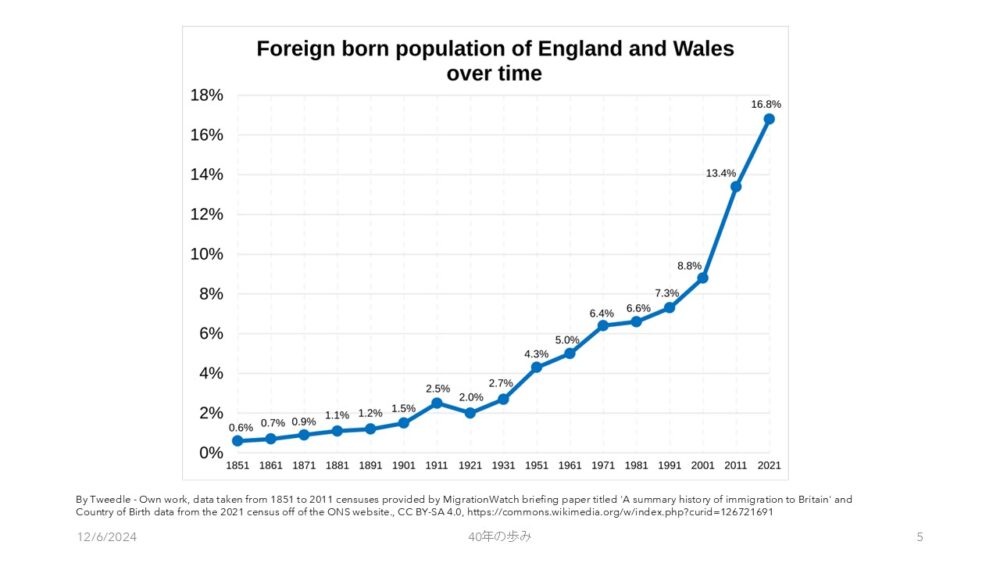
Looking back on it, I estimate my school was 99% White British and British born. There were immigrants in Britain, of course, but in particular areas of the UK like Bradford or Brixton. This is confirmed by the chart here showing the census results from 1851 to 2021* – in the 1970s only around 5 or 6% of the population were born overseas, compared to around 17% now. In current day Japan, around 3% of the population have foreign nationality – similar to the UK in the 1950s.
The Wimbledon effect, whereby foreign ownership of businesses and foreign talent were welcomed into the UK, started under Thatcher’s conservative government, with a programme of privatisation and deregulation. With this also came public sector funding cuts, including in higher education. This spurred my parents into moving back to Japan again, just as I was finishing my school.
*The eagle eyed will note this chart is based on research by MigrationWatch, which campaigns to reduce immigration. I have spent many years researching the census returns myself, and suspect there will be problems with the data as often place of birth entries are mangled or illegible or not given – particularly if digitised records that are on Ancestry.com are used. I suspect the mistakes cancel each other out, however, and the general overall trend is correct. Note however that MigrationWatch does not include Ireland born people as “foreign born”. Also that people who are only visiting the UK temporarily are recorded in the census.
I lived in Japan three times in my life. The first time was in 1972, when I was six years old, following my stepfather’s appointment as a visiting lecturer at Tohoku University in Sendai. It was not at all common for British people to travel to Japan at that time – unlike now where everyone seems to want to visit Japan. Our friends and family asked why on earth we would want to do this. My school friends thought China and Japan were the same country. I imagined all Japanese wore dressing gowns and had chopsticks in their hair.
My parents decided to move to Japan due to the frustration they felt about Britain at the time. Inflation was high, the oil crisis was beginning to develop and there was a miners’ strike leading to a state of emergency. The Troubles in Northern Ireland meant terrorist incidents were commonplace. Britain had become known as the “sick man of Europe.”
As there weren’t many foreigners living in Sendai, there was no international school. So I went to Shirayuri, a Catholic girls private school. I was the first non-Japanese person to attend the school. You can see me in the photo with my mother, in my sailor uniform. I also had to wear a hat and carry a Randoseru backpack.
As I said in the interview at the end of my Jiji lecture, because foreigners were so unusual in Sendai, people would stop in the street to look at us and shout “wah, gaijin” (wow, a foreigner) and the school children would crowd round me at playtime to look into my blue eyes or touch my fair hair. But after six months they got bored and I was just “uchi no gaijin” (“our foreigner”).
I also learnt Japanese very quickly – and the accent and natural grammatical fluency have remained with me to this day. I later came to understand that it is quite easy to pick up other languages at that age, as your native language is not yet hardwired. I even came top in composition once. My parents were very excited for me but I was more sanguine – saying it was deserved because it was the best composition.
I think we struggled a bit at first in our pre-war freezing cold ijinkan house, but by the time we moved further south to Kobe, my mother also had a job and I remember living a comfortable life in a nice modern house in a town between my international school in Kobe and my stepfather’s university in Osaka. I would commute to school every day by myself on two different trains and be met after Saturday morning school by my parents. They would take me for a Sachertorte in one of the local coffee shops, before wandering round Kobe’s excellent department stores and bookshops, or going to the sports club to play squash or swim. On Sundays we would attend the Seamen’s Mission church and then have lunch at the Italian restaurant opposite the Catholic church.
It was quite a shock when we returned to Britain in 1977.
Pernille Rudlin gave a talk in Japanese to the Jiji Top Seminar on November 22nd 2024. She took look at 40 years of Japanese business in the UK, how it has evolved and what the future might hold.
Through the lens of her own career working in and with Japanese companies, she traced the fortunes of the British and Japanese companies who supported the 1985 “Japanese Miracle” conference at Oxford University which she helped with as a student. She covered the impact of the “Big Bang” in 1986, the bursting of the Japanese economic bubble, the Asian financial crisis, the dotcom bubble and crash, the global financial crisis and Brexit. The shifts in balance between manufacturing, services and European coordination were also analysed, with some thoughts on what the new Labour government might mean for Japanese companies in the UK.
This is a summary in English of the talk – each slide will be a separate post.
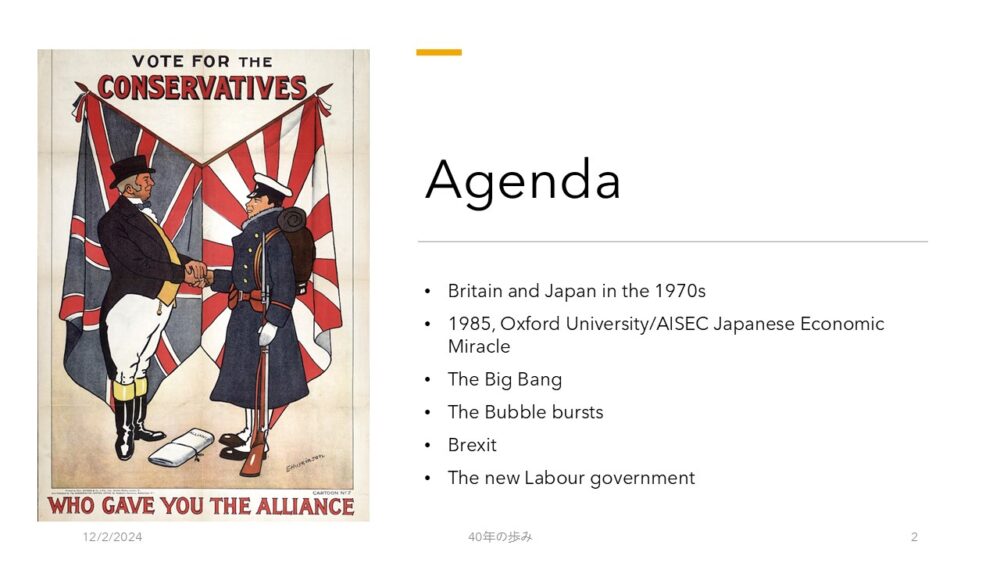
Slide 1: In researching this topic, I came across the poster you can see here. It’s from the 1906 General Election, and as you can see it was issued by the Conservative Party. The alliance that they refer to was the 1902 Anglo-Japanese alliance. Both countries were worried by the the threat from Russia, and then in 1904-5 Russo-Japanese War, Japan defeated Russia, the first time in modern history that an Eastern nation had defeated a Western one.
The British government praised the Japanese for their victory and the British public were also admiring of Japan’s “pluck” but the alliance was not a vote winner for the Conservatives, who lost badly to the Liberals. The 1906 election also saw the rise of the newly renamed Labour Party, headed by Keir Hardie. Our prime minister, Keir Starmer’s parents named their son after Keir Hardie – evidence that Starmer very much came from a Labour supporting household.
When I first saw this poster, it set me thinking whether we were about to see an Anglo-Japanese Alliance 2.0.
Japanese digital transformation consulting and software company Monstarlab is winding up its UK subsidiary. Monstarlab listed on the Tokyo Stock Exchange in 2023, but announced in August 2024 that due to significant solvency issues with growing losses and negative net assets, it would start on headcount reduction and other cost cutting.
Monstarlab acquired Danish mobile app company Nodes in 2017, and through it their operations in the UK and elsewhere in Europe. Their UK operations in London and Newcastle have around 30 staff, far short of the 100 promised when the Newcastle office was opened in 2021.
Tokyo Metro and Sumitomo Corporation have 17.5% share each of consortium that won the 7 year contract to run the Elizabeth Line, meaning Hong Kong owned incumbent MTR lost. Sumitomo Corporation is looking to develop commercial and retail opportunities around stations – as happens in Japan and is beginning to happen in London Underground stations. Tokyo Metro’s incentive for getting involved is that it did not attract institutional investors when it listed on the Tokyo Stock Exchange last month, because of lack of growth opportunities in Japan, where population is declining.
But what impact will Tokyo Metro have on the actual operations of the Elizabeth Line? I share the Toyo Keizai correspondent’s scepticism as to whether it will “breathe a breath of fresh air into the British railway industry in the form of ‘Japanese railway culture’” There no indication as yet that Tokyo Metro will be starting a subsidiary in the UK, nor that any Tokyo Metro staff will be transferred to London.
Japanese trading company Mitsui & Co has announced that it will establish an electromagnetic steel sheet processing company, Polskamit Steel in Skarwimiez in southern Poland. Polskamit will process, stock, and inspect electromagnetic steel sheets used in motor cores for electric vehicles such as hybrid electric vehicles (HEVs) and battery electric vehicles (BEVs), as well as transformer cores used in power plants and substations. It is scheduled to start operations in April 2026.
Mitsui first established, in 1993, an electrical steel sheet processing company in the Netherlands and then in the Czech Republic. Mitsui also set up Mitsui High-Tec Poland in 2018, employing around 88 people, providing lamination press processing of in-vehicle motor cores for electric vehicles.
According to US research firm BloombergNEF, Poland is a major producer of lithium-ion batteries, ranking second in the world after China and first in Europe in terms of national battery production capacity in 2022.
Japanese shipping company NYK is investing in Urchinomics, a British-Irish venture which will feed up starving sea urchins so they can be sold for food – and also support biodiversity.
Kelp forests on the seabed are being eaten up by an overabundance of sea urchins. Kelp forests are “blue” carbon as they absorb and store CO2 from the atmosphere through photosynthesis and they also support marine biodiversity by providing a habitat for small fish and other aquatic life.
The lack of kelp food means that the sea urchins are not edible. Urchinomics will collect them, feed them on other natural food and then use the profits from sales of urchin (known as uni, a delicacy in Japan) to reinvest in collection of urchins but also restoration of the kelp forests.
A new job for the 21st century – urchin rancher.
Unidon photo By Totti – Own work, CC BY-SA 4.0, https://commons.wikimedia.org/w/index.php?curid=68677193



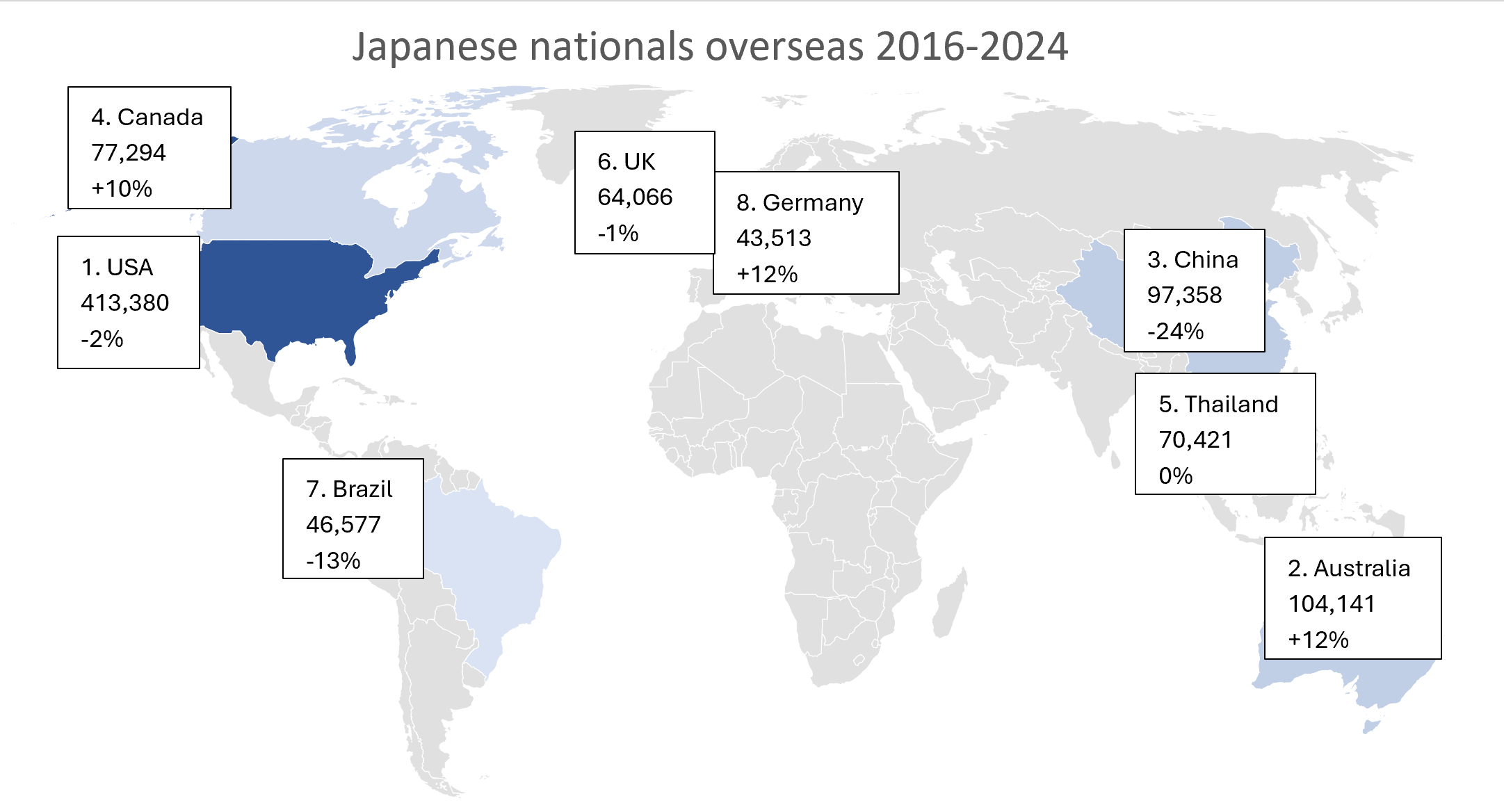 The USA is still overwhelmingly the largest host, with over 413,000 Japanese nationals living there on permanent or long term visas, but there has been a gentle decline in numbers since 2018. Similarly, the UK, which has the sixth largest number of Japanese nationals (just over 64,000) peaked in 2019 and is now around 1% down on 2016. Germany, #8, has 12% more Japanese residents than it had in 2016 – a similar growth rate to Australia, and looks to be catching up with Brazil, which has had a 13% decline in Japanese nationals.
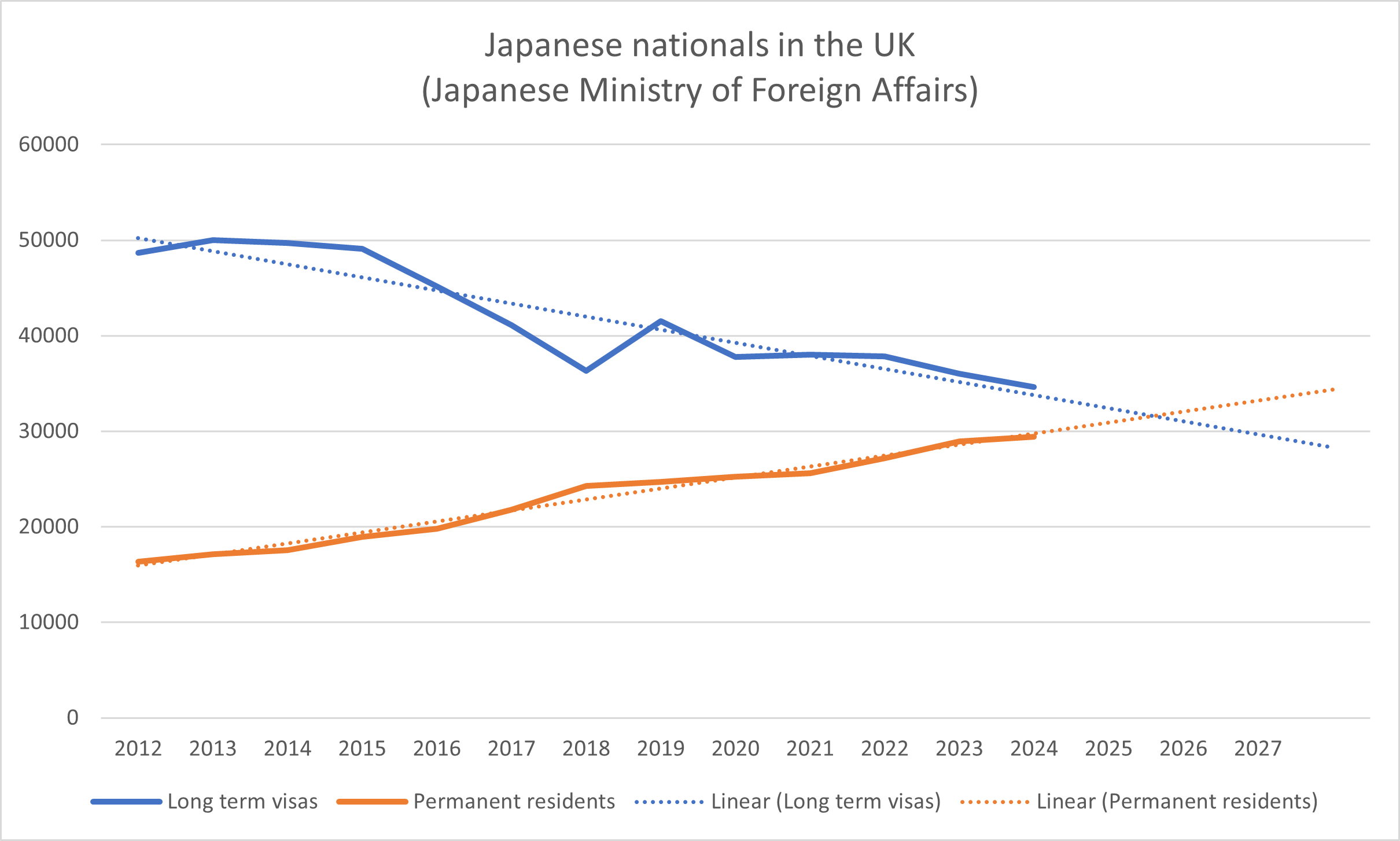 If current trends continue, the number of Japanese who are permanent residents in the UK is set to overtake the number who are in the UK temporarily on working visas by around 2026 – a function of both the decline in Japanese corporate expatriates and a steady increase in the number of Japanese choosing to live permanently in the UK.