Category: Trade

  • Japanese companies in Ireland

    Japanese companies in Ireland

    I have been visiting Ireland about once a year recently for business, but also for family reasons. The business side is to provide training for companies there that have been acquired by a Japanese company, or in one case, had acquired a company in Japan via its US parent.

    My parents also now live in Ireland. After 25 years’ working in Japan, they initially retired to France but never felt completely at home there.  My stepfather’s father was Irish, so he has family in Ireland. It was also easy for my stepfather to get an Irish passport, as an insurance against Brexit so that he can continue to receive free healthcare and a state pension.  My mother has become Danish for the same reason – and was able to do so because her father was Danish.

    They now live close to my cousins, near the city of Cork, which has become a hotspot for technology companies, particularly American ones.  Trend Micro and Alps have factories there, with the latter employing around 850 people making electronic components.

    Cork also has a pharmaceuticals and biotech cluster, as does the capital of Ireland, Dublin, which is where Astellas and Takeda* have plants.  Astellas employs over 400 people manufacturing raw materials and immunosuppressants and Takeda employs around 300 people making cancer therapies and active ingredients for various drugs. Ireland is the biggest net exporter of pharmaceuticals to the EU.

    Multinationals are attracted to Ireland because of the young, well-educated, English speaking workforce, and also the very low corporate tax rate of 12.5%.  

    Aircraft leasing in particular has benefitted from Ireland’s low tax policies. Nine out of the ten top aircraft lessors are based in Ireland, and over half the world’s airplanes are owned and managed there.  Japanese companies such as Orix Aviation and SMBC Aviation Capital have substantial operations in Dublin.

    Locating operations in Ireland purely for tax reasons may turn out to be unsustainable in the long term however, as the EU, the OECD and Japan are all taking steps towards international tax cooperation and clamping down on tax avoidance.

    The other risk to consider is of course Brexit.  The UK forms a “land bridge” to the EU for Ireland. Around 85% of Ireland’s freight trade goes to British ports, and about 40% (around 190,000 freight containers a year) of that is re-exported to elsewhere in the EU.

    Pharmaceuticals and electronic components are often shipped by air and various EU shipping companies have started up new routes connecting Ireland to the EU recently. So the main concern is any friction caused to trade that is only between the UK and Ireland.

    This is partly why the land border between Northern Ireland and the Republic of Ireland has become the key issue for resolving Brexit.  But the most important concern has nothing to do with business – there are many more families like mine, living in both countries, who do not want to lose the peaceful coexistence that the open border has brought with it.

    This article by Pernille Rudlin was originally published in Japanese in the Teikoku Databank News on November 13 2019

    *Takeda acquired Shire for $62bn in 2019, who relocated their HQ from the UK to Ireland in 2008 for tax reason. Takeda is now liquidating Shire Holdings in Ireland and transferring the assets to Takeda Ireland, to make repatriation of dividends to Japan easier – presumably avoiding Japan’s tax haven laws.

    For more content like this, subscribe to the free Rudlin Consulting Newsletter. 最新の在欧日系企業の状況については無料の月刊Rudlin Consulting ニューズレターにご登録ください。

    Share Button
  • Video: the Brexit agreement one month on

    Video: the Brexit agreement one month on

    Pernille Rudlin, Managing Director of Rudlin Consulting and David Henig, Director, UK Trade Policy Project at European Centre for International Political Economy participated in a Japan Society webinar on February 4th 2021, talking and answering questions about the Brexit agreement one month on, the impact on Japanese companies in the UK so far and what the future might hold. A video of the whole session is available below:

    For more content like this, subscribe to the free Rudlin Consulting Newsletter. 最新の在欧日系企業の状況については無料の月刊Rudlin Consulting ニューズレターにご登録ください。

    Share Button
  • Germany, Netherlands and Eastern Europe favoured in Japanese companies’ plans for in Europe

    Germany, Netherlands and Eastern Europe favoured in Japanese companies’ plans for in Europe

    The annual JETRO (Japan External Trade Organisation) 2020 survey of Japanese companies in Europe has just been published and shows the impact of the EU-Japan and UK-Japan EPAs  – largely in increasing Europe-based Japanese companies’ procurement from Japan.

    Japanese companies’ view of the next couple of years show that growth is expected in Eastern Europe and Germany, with Germany increasingly providing a regional coordination function. It looks like the number of employees and Japanese expatriates may be reduced over the next couple of years and there will be more  investment in digital transformation and interest in green technology and digital technology state supported projects.

    Of the 949 companies who responded, 286 were in Germany, 162 in the UK, 111 in the Netherlands.

    Brexit

    The biggest concern for Japanese companies in Europe regarding Brexit is the impact on the UK economy.  Other concerns  are potential changes in UK regulations and laws and how this will differ from the EU. For manufacturing, the use of the CE mark and for services, the movement of people between the UK and the EU were of particularly concern.

    60% of Japanese companies in Europe felt no impact of Brexit during the transition period. 40% of Japanese companies in the UK expect a negative impact from Brexit in 2021 whereas only 19.6% of Japanese companies in the EU expected a negative impact.  More than a third of Japanese companies in the UK and the EU were not sure what the impact would be.  Unsurprisingly, 70% of Japanese manufacturers in the UK were worried about their exports to the EU and of those nearly 90% were most concerned about customs processes. 80% of Japanese companies in the UK and the EU were worried about delays in logistics. Around 50% had made preparations for no deal, including increasing stocks, changing transportation routes, restructuring their organisations, changing procurement and setting up new locations.

    EU-Japan EPA and UK-Japan EPA and procurement

    The impact of the EU-Japan EPA and future impact of the UK-Japan EPA has also become apparent. The proportion of materials/components (particularly plastic components/automotive parts) sourced from Japan by Japanese companies in the EU has risen 5.2% to 36.6% from before the EU-Japan EPA and more than 70% of Japanese companies in the UK are considering or are using the UK Japan EPA to procure from Japan.  Importing from Japan under the EPA was particularly focused in the Czech Republic, Netherlands, Belgium, Italy and Germany.  Exporters to Japan that have been most keen to make use of the EPAs are in the chemicals/petrochemicals sector.  Around 30% of Japanese companies in the UK see some merit in the UK-Japan EPA.

    Nonetheless, there is a clear trend towards procuring more within the EU, particularly in Central and Eastern Europe. However procurement from the UK by EU based Japanese companies looks set to continue, with only 10% planning to decrease their purchasing from the UK. Conversely, 25% of Japanese manufacturers in the UK are expecting to decrease their procurement from the EU.  I wonder whether this will change now the rules of origin in the UK-EU FTA have become clear.

    Sales and profitability

    Only 48.5% of Japanese companies in Europe expect to be profitable in 2020/1, the lowest proportion since 2012. Falling sales is the main cause, along with cross border restrictions and a drop in consumer demand because of the coronavirus. Unsurprisingly, Japanese hotels and travel companies are particularly hard hit.

    The average proportion of sales of Japanese companies in Europe to EU countries is 73%.  25.4% of UK based Japanese companies say the proportion of EU sales of their total turnover has shrunk, but this is 8.1% lower than last year. Respondents were significantly more optimistic in Central and Eastern Europe than in Western Europe.  In particular 45.2% of manufacturers in Central and Eastern Europe expected to expand in the next 1-2 years. Poland was most cited as a promising sales destination, along with Germany, Hungary and the Czech Republic.

    Forecasts and plans for 2021-2

    30% expect business activity to normalize in the second half of 2021, 26.6% in the first half of 2021.  The most cited plans for 2021 are reduction of personnel and expatriates from Japan, as well as reviewing the product range, digital transformation (particularly in Italy, UK and Belgium) and reviewing of suppliers. Japanese companies are also showing interest in the green investment support and digital investment support being offered in European countries, particularly in Italy, UK and Belgium for digital and Spain, Ireland and Czech Rep for green investment.

    Overall, more Japanese companies in Europe than ever are expecting business to continue “as is” over the next 1-2 years, with 14.5% of UK based Japanese manufacturers expecting business to shrink, 5.3% more than last year.  Japanese companies in Netherlands, Switzerland, Portugal and Germany are more likely to expect to expand over the next couple of years than in other countries, and there was a significant increase in the number of Japanese companies in Germany who said they were performing regional coordination functions in Europe compared to the previous year. More than 10% of Japanese companies in Hungary, Sweden, Italy, France and the UK were expecting their business to shrink.


    For more content like this, subscribe to the free Rudlin Consulting Newsletter. 最新の在欧日系企業の状況については無料の月刊Rudlin Consulting ニューズレターにご登録ください。

    Share Button
  • Anglo-Japanese partnerships, new and old

    Anglo-Japanese partnerships, new and old

    I occasionally buy objects in local antiques shops which are a hybrid of Japanese and British design and manufacturing. Most of these date from the late 19th or early 20th century when Japonaiserie was at its peak in Europe.

    Last year I bought a milk jug decorated with a picture of Mount Fuji, junk boats and thatched houses on it. It’s a very simple traditional British shape and most of the decoration apart from the gold highlights are transfer printed rather than hand decorated.

    What caught my eye most of all was that the jug had an unusual metal hinged lid. Inside the lid is stamped “Clarke’s Patented”. It seems the lid had a design patented in the UK by a Mr Clarke, to allow the jug to pour or be filled, while keeping the lid on.

    It shows that even in the 19th century, trade between Japan and the UK wasn’t just a bilateral shipping of objects entirely made and designed in one country. Maybe the mould for the jug was exported to Japan. Was the transfer print made and designed in Japan or the UK? Was the gold highlighting applied in Japan or the UK? Was the metal lid added after the jugs arrived in the UK? It’s possible the entire jug was designed and manufactured in the UK – but was heavily influenced by Japanese export ceramics.

    This long history of interaction is why the Free Trade Agreement being negotiated between Japan and the UK is likely to be fairly basic and without much additional positive impact. A deal also needs to be reached quickly to ensure there are no new tariffs after January 1st 2021 when the Brexit transition period ends. The sector likely to produce the most gains in terms of reducing tariffs is food and agriculture, which usually causes the most difficulties and prolongs trade negotiations – so it seems likely this part will not roll over from the EU Japan EPA for the time being.

    The UK proposal reflects this, emphasising British small and medium enterprises exporting to Japan, access to Japanese government procurement and the free flow of data.

    Government procurement can also be very controversial. Many people in the UK are nervous about a trade agreement with the USA resulting in American healthcare companies being able to push for the privatisation of the UK’s national health service. There is also plenty of concern about data flows and Chinese investment in UK ICT infrastructure.

    The chief of the UN has said the world is facing the biggest crisis since World War II. For Japan and the UK the post-war period was one of austerity but also innovation. Companies such as Sony and Honda were founded in Japan and the UK established the welfare state – the nationalisation of the health service, transport and energy.

    So let us hope this crisis will bring about mutually beneficial new Japan-UK partnerships in social infrastructure and services, as well as in technology start-ups.

    This article was originally published in Japanese in the Teikoku News, on 8th July 2020.

    For more content like this, subscribe to the free Rudlin Consulting Newsletter. 最新の在欧日系企業の状況については無料の月刊Rudlin Consulting ニューズレターにご登録ください。

    Share Button
  • What is the deal with Nissan?

    What is the deal with Nissan?

    The wave of Japanese investment into UK after NSK’s first step in 1974, feared by many in the UK, did not happen immediately. Under the Labour government of 1974-79, there was double digit inflation, unemployment of over 1 million, the IMF bail out in 1976 and the Winter of Discontent, which may have been something of a disincentive to invest in the British economy. Although NSK did prove correct about a weak sterling, which at least ensured their British made exports were cheap.

    Japanese concerns over Britain’s economic, political and social stability did not end with the advent of a Conservative government in 1979, however.  It took nearly 3 years of feasibility studies, Mrs Thatcher visiting Tokyo and a visit by Nissan to NSK in Peterlee for reassurance, from the first announcement in January 1981 to when agreement was reached that Nissan could go ahead with building its UK factory in Washington, Sunderland in 1983. There were also predictions by unions and other car manufacturers of “devastation” if Nissan in the UK was just an assembly operation using cheap Japanese components.

    “Better for the British people to buy Japanese cars made by British workers than to buy German cars assembled by Turks”

    The argument made by Norman Tebbitt, then Secretary of State for Employment in April 1981 that “surely it is better for the British people to buy Japanese cars made by British workers than to buy German cars assembled by Turks” had finally won through domestically, but Nissan had also had its own misgivings which caused the delay – both from its experience in Europe and pressures in Japan from its union.

    Nissan had already dipped several toes into manufacturing in Europe. It took a stake in Moto Iberica, Spain‘s largest commercial vehicle manufacturer in 1980. The tractor division was spun off to form a new company, with Kubota taking a 55% stake and assuming managerial control. Nissan took a 67.67% stake in the rest of Motor Iberica, renaming it Nissan Motor Iberica in 1987. Manufacturing of vans and commercial vehicles continued at the plant through to the present – but not always profitably – and finally Nissan announced that it will be shut down in December 2021.

    Nissan had also in 1980 started a joint venture with Alfa-Romeo, building a plant in Italy which started production in 1982, marketed as the Alfa Romeo Arna in Italy and Germany, and the Nissan Cherry Europe in the UK. However, this venture was not a success and production was suspended in 1986.

    Nissan concluded an agreement with Volkswagen in 1987 to produce and market the Volkswagen Santana in Japan, hoping to counter criticism that the Japanese market was difficult to penetrate. Santana production was terminated in 1989, to be replaced by the Passat. Sales of imported Passats in Japan were so poor, however, Nissan cancelled the assembly agreement.

    The 1984 Nissan deal

    The Nissan union in Japan had been concerned that the size of the investment in the UK plant meant that funds would be diverted from investment in Japan, and there was no guarantee that the project would be successful. If it failed, it might even affect the security of employment within Japanese factories. Consequently, the scale of the investment was reduced from the initial announcement of a £200-£300 million investment to a two phase project, starting with a pilot plan of a £50 million investment to assemble 24,000 Bluebird cars from knockdown kits imported from Japan. This was justified as being needed to gain first-hand knowledge of operating and marketing in the UK and obtain information on local sourcing of components.

    The second phase was to be a build up from 60% local sourcing to 80% by 1991, expanding to a 100,000 units per year capacity, 30-40% of which was to be exported to Continental Europe. The total cost was put at £350 million with the British governement expected to provide selective financial assistance up to 10% of the total investment.

    Keeping to the deal in a Single Market

    Production of the Bluebird began on schedule in 1986, and the second phase began in 1987. Initially the plant made low value added models with high value-added quality cars exported from Japan, but from 1990 the Primera hatchback was manufactured in Sunderland as the sole global production source, exported back to Japan and into Taiwan. The cost of the Nissan project had risen to about £900 million by the beginning of the 1990s and output rose to 124,000 units per year in 1991.

    Whereas around 80% of the components of UK made cars were sourced in the UK when the 1984 Nissan deal was struck, by the 1990s and early 2000s the proportion had dropped to around 30-40%. Even UK components in turn contained components from elsewhere, as this comment from a supplier in the comments section of the Financial Times explains:

    “We manufacture part of one component for the Nissan Qashqai. We purchase raw materials from Taiwan, we manufacture in the UK in a Japanese owned factory. Our customer is in Germany, where our product is bonded together with products from other countries. Our customer’s customer is in France, where the bonded component is integrated into a car component. The component is shipped to Sunderland and becomes a part of a “British” car.

    How Mrs May and her merry band are going to sort this mess out is beyond me, and I suspect beyond them.

    The development time lines for the most basic of automotive components is two to three years, which means that we are already “post Brexit” for new business development. How do I persuade customers to invest in new product development with us when nobody has a clue on what basis I might sell eventually sell my product to them, and given rules of origin, in some cases on what basis they might sell their product to their customer. We have good relationships with our customers, but at the end of the day they are running their business for their benefit and may well decide its just not worth the uncertainty and risk.”

    Even if Nissan did not keep to the local sourcing part of the 1984 deal (presumably superseded by the European Single Market, so that local meant EU wide), they did expand production way beyond the 100,000 promised, peaking at 519,000 units produced in 2016/7. The 470 strong 1986 workforce grew to around  7,000 people by 2019, around 10% of whom were designers and engineers working in a design facility in Cranfield.
    Nissan also exceeded its promise of exporting 30-40% of production to Continental Europe. By 2016 nearly 1/3 of UK car production was made by Nissan, 80% exported, 55% to the EU.

    Nissan has tried to increase the proportion of locally made parts to 40% and even to 80%, to avoid tariffs and delays in the supply chain after Brexit, supported by a British government policy to reach 50%. It has encouraged suppliers to set up in a new industrial park in the North East  in order to do so, but our data does not show any move by Japanese suppliers to increase their UK presence.

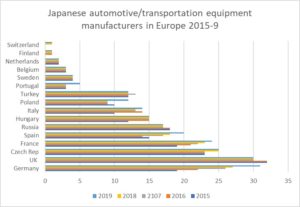
    In fact the shift seems to be more towards setting up additional factories in Continental Europe. Of the 29 new automotive manufacturing operations started in Europe in 2015-2018, according to the Teikoku Databank and our researches, 8 were in Germany, 4 in France, 4 in Slovakia, 3 in Spain, 3 in Italy, 3 in Hungary and 2 in the Czech Republic but none in the UK. For the first time there are now more Japanese automotive manufacturers in Germany than in the UK.

    The 2016 Nissan deal – to Infiniti and beyond

    Even if the long term solution to a hard Brexit is to increase the number of automotive suppliers in the UK, some short term shoring up had to be done to ensure that manufacturers didn’t conclude that the safest bet was to shift all supply chains and manufacturing to continental Europe.

    Greg Clark, the former Business Secretary, revealed in 2019 that the content of  his letter to former Nissan CEO Carlos Ghosn in October 2016 included “a package of support in areas such as skills, R&D and innovation” which “could amount to additional support of up to £80m”. This was modified to £61m by 2018 due to reduced production costs. It was conditional upon Nissan continuing with plans to manufacture the new X-Trail and a new model Qashqai in the UK. Clark revealed the terms of the letter after Nissan announced that it had decided to manufacture the X-Trail in Japan in 2019, thus invalidating the deal.

    There were rumours that the government would therefore pull the aid package, but Business Minister Richard Harrington said in 2019 that the deal would still stand, and be tied to electric vehicle development, which in Nissan’s case would be the LEAF, which only represents around 10% of its production in Sunderland.

    Nissan announced in 2019 that it would no longer produce the Infiniti in Sunderland for Western Europe. It was supposed to start production of both the new Qashqai and X-Trail in Sunderland in 2019, then it said it would start the Qashqai production in October 2020, and then announced it will delay the start to mid 2021, due to the uncertainty caused by COVID-19, and – although it did not say this – by what kind of EU-UK deal there might be.  Nissan has already spent £400m readying Sunderland for the new Qashqai, supported by £11m from the UK government.

    Nissan Next and the alliance

    In May 2020 President Uchida Makoto announced Nissan Next, a a four year medium term plan, aiming to downsize and close plants such as Spain and Indonesia.  Nissan will focus on “our highly competitive midsize segment, electrification and driver assistance technology” and increase the ratio of common electric parts across the alliance of Mitsubishi, Renault and Nissan. Nissan is seeing the Ariya as its new big hope for electric vehicles after the Leaf. The Leaf was manufactured in Sunderland, whereas the Ariya is being manufactured in Japan.

    The three companies also announced the plan for the alliance in May 2020, where each will take the lead in their main sales regions, the models and technologies under development.  Nissan is to take the lead as the “reference” for China, North America and Japan. Renault will be the reference for Europe, Russia, South America and North Africa and Mitsubishi in ASEAN and Oceania. Renault has already said it would be willing to manufacture Nissan cars in its European factories if needs be, and presumably if there is a no deal Brexit and/or lack of diagonal cumulation whereby Japanese parts are not accepted as “British” by the EU, then Renault can help out Nissan in terms of sourcing EU parts.

    Clark’s 2016 letter promised to Ghosn it would “be a critical priority of our negotiation to support UK car manufacturers and ensure that their ability to export to and from the EU is not adversely affected by the UK’s future relationship with the EU”. Clark and Ghosn are both gone, so it’s unsurprising, 4 years’ on, Nissan feels the need for more reassurance that the UK government will keep to their side of the deal, whatever that turns out to be this time. If not, Renault is waiting in the wings.

    For more content like this, subscribe to the free Rudlin Consulting Newsletter. 最新の在欧日系企業の状況については無料の月刊Rudlin Consulting ニューズレターにご登録ください。

    Share Button
  • UK’s priority in Japan trade agreement is not increasing exports, it’s protecting Japan’s investments in UK

    UK’s priority in Japan trade agreement is not increasing exports, it’s protecting Japan’s investments in UK

    [playht_player width=”100%” height=”175″ voice=”Lily”]My view on Brexit was that it was accelerating trends that were already there for Japanese business in Europe, and gave them cover to do things they were already wanting to do.

    The COVID-19 pandemic seems set to provide similar cover and if the UK is not careful, this will mean a further withdrawal of Japanese investment from the UK.

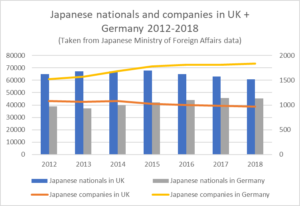
    Japanese companies are still in search of growth outside the ageing, declining population of the Japanese market, and this includes in Europe. According to Japanese Ministry of Foreign Affairs data, the number of Japanese companies in Europe grew 16% from 2012-2018 and the number of Japanese nationals in Europe also grew over the same period by 12%.

    At the same time Japanese companies are very risk averse.  Brexit was seen as a risk from around 2013 onwards, and this is reflected in the number of Japanese companies and nationals in UK falling by 11% and 7% respectively over 2012-2018 – the only country in Europe to show such significant decreases. Germany already hosts more Japanese companies than the UK and is catching up in terms of hosting Japanese nationals too.

    Although Japan is still more of a manufacturing, exporting nation than the UK is, both the UK and Europe are just as – if not more – important to Japan as a destination for investment than as a market for exports of finished goods. As the DIT itself estimates, around 59% of Japanese exports to the UK are intermediate goods, used in supply chains.  So in other words, a large number of Japan’s investments in the UK and the Europe boost Japanese exports to the UK and Europe.

    The trends in current Japanese trade and investment in Europe and the UK need to be examined for their impact in the four areas where Japan has influence over the UK economy

    1. Existing UK jobs reliant on Japanese companies

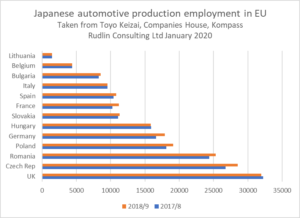
    The Japanese automotive sector is a key source of existing jobs for the UK as it accounts for around a quarter of the 163,000 people I estimate are employed in the UK by Japanese companies. There was a 3% decline from 2017/8 to 2018/9 in employment in the Japanese automotive sector in the UK, however, whereas employment in Japanese automotive companies grew elsewhere in Europe, particularly in Eastern Europe.

    So while zero tariffs on automotive parts from Japan to the UK will help –  this might just be trying to hold back the tide. The possibility of tariffs on exports of cars made in the UK to the EU is obviously a concern for Japanese companies too. Maybe sterling will fall far enough or there will be sufficient government subsidies to mitigate this extra cost but ultimately Japanese companies will choose to manufacture where there they can access not just the lowest costs but also a market sufficiently large to ensure full production capacity.

    Obviously there is a strong need to focus on electric vehicle development, and the UK has strength in automotive design, but Japanese car manufacturers will be wanting to develop EVs in line with EU regulations and to be able to influence EU regulations – which is easier done from inside the EU than outside.

      2. Where the new Japanese jobs are in the UK

    Hitachi is the most significant recent contributor to organic job growth in Japanese companies in the UK  – largely due to Hitachi Rail. Hitachi has also invested in Horizon Nuclear Power, which is currently “on ice”. Hitachi’s focus is on social infrastructure, and various commitments by UK governments on investing in transportation and energy are key to this. Many other Japanese companies are also interested in social infrastructure business in Europe.

    A UK Japan trade agreement can support further job growth by facilitating the export of parts for these industries from Japan. Hitachi has also invested in rail manufacturing in Italy so if there are any tariffs making exports from the UK to the EU uncompetitive, they have an alternative manufacturing location within the EU.

    Other Japanese companies that are expanding in the UK include NTT, the ICT/telecommunications giant, who have put their non-Japan global HQ in London and SoftBank, who acquired ARM and committed to expand the workforce. Presumably this is why DIT is emphasizing free data flows between Japan and the UK, which would be welcomed by Japanese ICT companies and Japanese regional headquarter functions based in the UK.

    I’m seeing some positive impacts of the EU-Japan EPA on investment elsewhere in Europe. There have been quite a few acquisitions by Japanese companies of food businesses in France for example.  Japanese trade statistics show that food and alcohol exports to Japan from Europe have risen after the EPA came into force. If a similar agreement on food, textiles and leather goods to the EU Japan EPA is reached between Japan and the UK as the DIT is asking, there may be similar acquisitions by Japanese companies in the UK – as well as the growth in exports for UK SMEs that the DIT seems to be focusing on. There already have been a few food related acquisitions by Japanese companies in the UK. This might see some increase in new jobs in the UK as a result. But this is marginal compared to the jobs that could be created by Japanese investment in the UK infrastructure sector.

      3. UK exports of services to Japan are M&A driven

    It seems likely that Japanese companies will continue to use their piled-up cash to acquire – perhaps in Asia initially as it is opening up first after COVID-19. In the past, Japan established companies in the UK as gateway to EU but recent Japanese acquisitions in the UK have been increasingly pure domestic (recruitment, car parking, outsourcing, advertising) or pure global (SoftBank, financial services).

    These acquisitions do not necessarily create more jobs, but financial, legal and other services around the acquisitions is, I would guess, a large component of UK services exports to Japan. Allowing UK professionals to operate in Japan is not a key driver – it is more that UK based professionals are supporting Japanese companies in Europe and globally. I even know of one UK based, American owned advertising agency that deals directly with the Japan HQ of a Japanese sports brand on their global campaigns, even though the advertising agency have a Japanese office.

    Japanese companies may well buy up more British companies in the near future, as they will be cheap. However, there does seem to be a decline in big ticket acquisitions in the UK – the most recent major European acquisition by a Japanese company that I am aware of is Mitsubishi Corporation acquiring the Dutch Energy company ENECO – my understanding is that Netherlands based services companies mainly supported this.

      4. Export of services because of UK as European/EMEA hub

    Another element in the UK’s export of services to Japan is that the UK subsidiaries of Japanese companies often perform a regional headquarters function for Japanese firms – and receive management fees for this. Brexit (but also changes in Japanese laws on treatment of offshore profits) has caused some Japanese companies to move their regional HQ from UK (Panasonic, Sony) in a legal and financial sense. But there is still a critical mass of people in the UK working for such companies, because the UK provides marketing, IT, design, engineering, legal, financial, accounting services that are of a high, globally accepted standard.

    This is why, as the JETRO survey of 2019 of Japanese companies in Europe pointed out, the biggest regulatory concern of Japanese companies is that the UK or the EU might change regulations regarding the freedom of movement between the UK and EU for their employees. Continuing that regional coordination role requires regional employees to move around the region – or can this all now be done by web conferencing?

    The UK is still seen by Japan as an attractive place to send students but also employees for education and development. Japanese students only want short term, under 1 year courses, however and many are looking at cheaper, nearer options. Both students and Japanese professionals would want ease of acquiring visas, including work visas and a safe, stable environment to live in.

    UK offensive interests

    Looking at the recent DIT paper on the UK-Japan FTA, clearly there are some non-tariff barriers to the UK accessing the Japanese market – as there have been for decades. But my overwhelming impression is that most British companies have not been very proactive in approaching the Japanese market – it’s a big commitment, opening an office in Japan is needed, not just exporting from afar. It’s relatively easy to set up a company in Japan but not so easy to hire the right people. There is a labour shortage, particularly of capable salespeople who are English speakers.  This is not something that can be solved in a trade agreement.

    A final point regarding the DIT paper’s claim that the UK is a “technology superpower” – not in Japanese eyes I’m afraid – possibly in fintech and there have been some Japanese investments in that sector in the UK. But they’re fairly small scale. Japanese technology companies such as Panasonic are basing their innovation arms in Silicon Valley.  The US, China and the EU are more important to Japan than the UK – in many ways.

    For more content like this, subscribe to the free Rudlin Consulting Newsletter. 最新の在欧日系企業の状況については無料の月刊Rudlin Consulting ニューズレターにご登録ください。

    Share Button
  • Japanese companies in Europe say Brexit is their biggest worry for 2020

    Japanese companies in Europe say Brexit is their biggest worry for 2020

    The annual Japan External Trade Relations Organisation (JETRO) survey of Japanese companies in Europe reveals that over 70% of Japanese companies expect their European operations to be profitable for the fifth year running, but  concerns over an economic downturn in the region are higher than in previous years. Brexit came top of the list of management worries – selected by 56.5% of Japanese companies in Europe.

    31% say Brexit has had a negative impact on their business so far, and 37.7% are expecting a negative impact in the future. 3.7% felt Brexit has had a positive impact on their business both now and will do in the future. A negative impact was felt by 54% of Japanese companies in the UK both now and in the future, with 2.1% of Japanese companies saying Brexit has had a positive impact and only 0.5% expecting it to have a positive impact in the future.

    Brexit

    More than half of the 842 companies who responded cited Brexit as their biggest management concern, outstripping the perennial headache of recruiting and retaining employees.  Unsurprisingly the group that was most worried was the manufacturing sector in the UK – but the services sector in Ireland and the UK also ranked Brexit highly as a concern.  Nearly 70% of Japanese companies in Poland and Portugal picked Brexit as a key issue – significantly higher than the average for Japanese companies across Europe.

    54% of Germany based Japanese manufacturers chose Brexit as their primary concern, but interestingly, the non-manufacturing sector in Germany was even more concerned by Brexit (59%).  For all groups, the short term disruption from a no deal Brexit was the main reason for concern and the second biggest issue was the future relationship of the UK and the EU.

    Japanese companies in the UK were worried about the impact Brexit would have on the UK economy, a cheapening £ making imports more expensive, changes to the UK regulatory and legal environment and exports to non-UK EU.  Japanese companies in non-UK EU countries were most worried about exports to the UK, but also the impact of Brexit on the UK economy and on the EU economy.

    Around 90% of Japanese companies were concerned about disruption to logistics and customs processes between EU and UK, considerably higher than concerns about tariffs being imposed (65%).

    Japanese companies in the UK focused on freedom of movement of their employees

    The worries about UK regulatory and legal changes were mostly focused on changes to the freedom of movement of people between the UK and EU.  Over 50% of Japanese companies in the UK said this was their main concern, particularly those in the services sector.

    In terms of countermeasures – 22% said they had either implemented or were implementing their contingency plans – particularly regarding regulatory and legal changes. Compliance with the REACH regulations for the chemicals industry and setting up a new operation were most cited as steps taken. Around 12% of UK based Japanese companies have or are in the middle of reorganising their supply chain and logistics and 4.4% have or are in the middle of reviewing their manufacturing organisation and 2.4% have or are reviewing their R&D structure. The most frequently cited measure taken by Japanese companies in non-UK EU was to secure financial passporting into non-UK EU.

    Relocation from UK to EU (but some purchasing functions coming to UK)

    In terms of moving out of the UK, the survey found that 3 companies had moved their EU regional HQ completely out of the UK, to Germany, and 10 had partially moved out – 5 to Germany, 3 to the Netherlands and 2 to Luxembourg.  In 2015 19 companies said they wanted to expand their regional coordination function in the UK, compared to only 2 in 2019.  More companies were expanding their regional HQs in Germany, Netherlands, France and Spain.

    3 companies had moved their sales coordination out of the UK, to Germany, Czech Republic and Poland, 4 had partially shifted it, to Germany, Italy and the Netherlands. 2 companies had moved all their manufacturing out of the UK – 1 to Poland and one to Japan. 1 had partially moved their manufacturing to Hungary.  Only 1 company had moved their R&D out of the UK, to Switzerland.  4 companies had moved their procurement function from the UK to Czech Republic, Italy, Spain and one company had moved their procurement function to the UK, from Asia.

    4  companies are investigating moving their regional HQ from the UK to Germany and Italy, 2 partially moving their HQ to France and Czech Republic. 3 companies are considering moving their sales coordination to Germany and Italy or partially to Germany, France or Belgium.

    1 company is considering moving all manufacturing to Japan, and 9 companies are considering partial relocation to Hungary, Germany, Czech Republic, Romania, Japan or elsewhere in Europe. 2 companies are considering wholly or partially moving their R&D to Germany or elsewhere in Europe.

    14 companies in the UK are expecting to expand their high value added manufacturing in the UK, down from 25 in 2015 whereas 32 Japanese companies in Germany are expanding their high value added manufacturing.  The Netherlands has become the third main host for Japanese high end manufacturing – 12 are expecting to expand their manufacturing there compared to only 2 in 2015.

    12 companies are considering moving their procurement to Poland, Italy, Germany, Spain, the Netherlands, Asia or elsewhere in the EU. 3 companies are considering moving procurement to the UK from the EU, Poland, Portugal.  3 other companies are looking to move their procurement entirely out of Europe to countries such as South Korea or China.

    The EPA is encouraging Japanese imports to EU

    65.5% of Japanese companies who were importing from Japan to the EU and 53.1% of Japanese companies exporting to Japan from the EU said they were taking advantage of the EPA. Particularly notable were 80% of Japanese companies based in Italy (both importers and exporters) and 70% of Japanese companies in Spain.  62% of UK based Japanese companies were using the EPA to import from Japan (a lower proportion than Italy, Czech Republic, Spain, Poland, Belgium, Netherlands and Germany).

    100% of Japanese companies in the logistics/warehousing, plastic components, rubber products sectors say they are using the EPA and over 70% of Japanese companies in the metal products, textiles, automotive parts, wholesalers, food and seafood processing sectors are using the EPA to import from Japan.

    Sectors most making use of the EPA to export from the EU to Japan were the logistics/warehousing, automotive parts and wholesale sectors.

    Overall, Japanese companies in the EU are importing 32.6% of their parts and raw materials (by value) from Japan, 1.2% up on the previous year – Japanese companies in Germany were importing the highest share of their procurement from Japan by value – 46.6%.  Over 23% of Japanese companies in the EU expect to expand their procurement from Japan, particularly the services sector with 47.8% of wholesale and retail companies saying they will increase their purchases from Japan.

    Economic outlook for Europe

    Japanese manufacturers are however more pessimistic about prospects for 2020 than they were in 2019,  with 36.7% expecting their profitability to worsen, compared to 26.6% expecting their profitability to improve.  The causes differ from Western Europe to Eastern Europe – manufacturers in Western Europe expect falling  demand to be the key factor whereas in Eastern Europe the primary concern is rising labour costs.

    Around a third of Japanese companies are optimistic about the economic prospects in 2020 for the countries they are operating in, which is considerably down on the 57% who were optimistic for 2019 – this pessimism was particularly strong for Western European based manufacturing.

    Hiring and retaining workers continues to be a headache for Japanese companies.  This is especially an issue in Central and Eastern Europe and particularly at management level in Western Europe and at factory worker level in Central and Eastern Europe.

    Around 50-55% of Japanese companies in Europe have or expect to maintain current employee levels – over a third have or expect to increase their workforce. 16% cut their workforce in the past year but only 11.3% expect to do so in 2020.

    Strengthening selling to EU as a region

    JETRO also sees evidence that Japanese companies are strengthening their approach to selling to the EU as a region, rather than individual countries.  For the first time in their surveys, “The EU” outstripped Germany and Poland as the market that Japanese companies saw as the most promising for sales.  Maybe this is another – psychological rather than regulatory –  impact of the EPA.

    Japanese companies say that strengthening their company’s brand, developing and strengthening the technical skills of their employees (particularly in Eastern Europe) and investing further in research and development are key to increasing sales in Europe.

    So, as I have often said, Japanese companies are having to find ways to retain their integrity in a Europe and a world which is also dis-integrating, and Brexit is accelerating that process.


    For more content like this, subscribe to the free Rudlin Consulting Newsletter. 最新の在欧日系企業の状況については無料の月刊Rudlin Consulting ニューズレターにご登録ください。

    Share Button
  • Brexit update for Japanese companies

    Brexit update for Japanese companies

    I’ve been avoiding writing about Brexit this past few months, partly because I felt I had nothing more to say. Similarly, Japanese companies have stopped issuing warnings.  Many have already made and even implemented their plans for a worst-case scenario of a hard or no deal Brexit.  I hear they have also been advised by the Japanese government to leave the talking to diplomats and politicians.

    Companies in the UK have also gone silent.  Some because they have been told by the Johnson regime that if they speak out, they will jeopardise government contracts.  In financial services – Japanese firms included – alternative, approved EU entities have been set up.  There is even the chance of making some money on the chaos that will probably arise in the currency, bond and stock markets.

    It is still impossible to make any confident predictions about what will happen. Maybe it is true that Boris Johnson will, at the very last minute, blame the EU for not offering a fresh deal, then ask the EU for an extension to Article 50 in order to have a general election.  He would be hoping to fight this on a populist campaign and win a more substantial majority. Then he can ask the EU for a new deal, confident as Mrs May was not, that he has a majority in parliament to approve it – or a no deal if the EU will not offer any concessions.

    The problem is that the deal offered to Mrs May was as good as could be expected given her red lines of an end to the freedom of movement of people, no jurisdiction over the UK by the European Court of Justice and no customs union with the EU.  It is hard to imagine a Johnson government erasing any of those red lines.

    Johnson’s main aim appears to be to remove the Northern Ireland border “backstop” that in effect keeps Northern Ireland inside the EU if no solution to keeping the border open with the Republic of Ireland is found. Perhaps there could be a fudge whereby the backstop is removed from the Withdrawal Agreement and put into the Political Declaration – meaning it is to be negotiated later – which would probably also require a longer transition period than the current two years.

    So Japanese companies in the UK may find that after a tumultuous few months, the UK remains in a transition period for several years – technically not in the EU, but all conditions remaining the same, while negotiations drag on, ending in a hard Brexit.

    In which case what Japanese companies have already done remains the best solution – manufacturers adjust supply chains to circumvent the UK, financial services companies keep most of their staff in the UK but have substantial presence in the EU too. And those Japanese IT, infrastructure and outsourcing companies who have recently been investing in the UK should stay quiet, in the hope of getting government contracts to assist with whatever new systems Brexit brings.

    This article by Pernille Rudlin originally appeared in Japanese in the Teikoku Databank News, 11 September 2019

    For more content like this, subscribe to the free Rudlin Consulting Newsletter. 最新の在欧日系企業の状況については無料の月刊Rudlin Consulting ニューズレターにご登録ください。

    Share Button
  • A no deal Brexit will put the boot in for Japanese companies in the UK

    A no deal Brexit will put the boot in for Japanese companies in the UK

    My first job at Mitsubishi Corporation was exporting British made shoes from companies like Trickers and Crockett & Jones to Japan. They are high end shoes anyway, and Japanese tariffs of 30% on shoe imports certainly pushed them even further upmarket.  So when I was in Japan last month I was happy to see that one of our customers still had its Trading Post flagship shop in Aoyama, despite the so-called two lost decades in terms of economic growth. They must be one of the few businesses enjoying the fact that Brexit delays have improved their profit margins. Thanks to the new EU-Japan Economic Partnership Agreement, tariffs on European shoe exports to Japan were reduced to 21% from February of this year. They will eventually be eliminated over the next 10 years.

    Trickers and Crockett & Jones are presumably shipping out shoes to Japan as fast as they can make them while the UK’s membership of the EU lasts. Although Japan has entered discussions with the UK on a trade deal, they have made it clear that they are not going to concede as much as they did to the EU, and leather goods is one of the categories they are going to use as a bargaining weapon.

    No roll over is bad for British shoes, cheese and booze

    So a no deal Brexit or a Brexit before a UK-Japan free trade agreement is struck is bad news for the UK shoe industry, (and British cheese makers and whisky distillers will also miss out on the EPA’s tariff reductions). But not rolling over the EU-Japan EPA in to a UK-Japan trade agreement as soon as the UK leaves the EU will only have a small direct impact on both economies. According to a JETRO survey of over 3,000 Japanese companies, from March of this year, only 8.6% import from the UK, compared to 24.1% importing from Western Europe (excluding the UK) 66.2% from China and 24.2% from the USA.

    Conversely, 22% of Japanese companies export to the UK, compared to 35% exporting to non-UK Western Europe, 49.6% to the USA and 59% to China.  It’s obvious from these figures why the US-China trade war is more concerning to Japan than Brexit.

    You could argue that a UK-Japan free trade agreement would improve those percentages, but that’s an awful lot of shoes, cheese and booze to make any impact. Furthermore, a lot of the imports and exports between the UK and Japan may be EU related, rather than purely bilateral.  Think car parts from Japan to build cars for European consumers, or UK generated professional services for a Japanese EU headquarters and its European subsidiaries.

    But no deal with the EU is even more of a headache for Japanese companies in the UK

    Japanese companies that have a presence in the UK (just under 10% of the companies surveyed) have made it very clear that a No (UK-EU) Deal Brexit would be a disaster for them – far more than the UK no longer being part of the EU-Japan EPA. As frequently pointed out, they invested in the UK as a gateway to the rest of Europe.

    45% of the turnover of Japanese companies in the UK is sales to Europe according to figures from the annual reports of the 200 or so who give regional breakdowns of sales.  The range is anywhere from close to 0% for companies selling everything from lighting to metal pressing to seeds just to the UK, through to 100% – largely automotive parts manufacturers who export almost all of their production to Europe, or at least sell it via their European headquarters in continental Europe.

    Many of those who are focused on domestic UK sales are importing from Japan, China and Asia, or are at the end of a complex supply chain stretching across Europe. Some are not involved in trade of goods at all – for example NTT Data and Building Design Partnership.  The latter is one of the many of the services sector companies that have recently become Japan-owned via acquisition. NTT is aiming to grow its UK government business after Brexit, but if the UK economy tanks thanks to a no deal, it may have to wait a while. A JETRO survey last year highlighted that a UK economic slump because of Brexit was at the top of the list of concerns for Japanese companies in the UK and the rest of the EU, even more than changes in regulation or currency fluctuations.

    The UK looks to lose its crown as the top European destination for Japanese acquisitions

    Japanese acquisitions of British companies continued after the referendum, but the 2019 JETRO survey shows that it is likely the UK will lose its crown as the top destination in the EU for Japanese foreign direct investment. Non-UK Western Europe is in the top five destinations for expanding business for manufacturing textiles, clothing, foods, petrochemicals/plastics, electrical machinery, electronic components, fine engineering and also specialist services.  The UK does not feature at all in the top five of any of these sectors.

    The UK’s service sector functions as a gateway to Europe is still the biggest influence on Japanese investment – the UK is a top 20 destination for expanding services such as regional coordination(#9), logistics (#13), R&D (#14), sales (#15) and localisation (#17), as well as high value added manufacturing (#17). However, non-UK Western Europe ranks higher and is in the top 10 destinations for all of these categories.


    For more content like this, subscribe to the free Rudlin Consulting Newsletter. 最新の在欧日系企業の状況については無料の月刊Rudlin Consulting ニューズレターにご登録ください。

    Share Button
  • Brexit yanks the lid off some stinky realities for Japanese business in the UK

    Brexit yanks the lid off some stinky realities for Japanese business in the UK

    My least favourite Japanese expression is “kusai mono ni futa” – when it stinks, put a lid on it. It is at the root of many Japanese corporate governance scandals. Mistakes are made or problems surface and instead of exposing them and causing loss of face all round, they are swept under the carpet, in the hope that they will somehow magically disappear. But of course stinky things with lids on just get stinkier.

    On the face of it, there was nothing stinky about Japanese companies in the UK.  The very fact that the UK was such an easy place to do business – on a European and global scale – lulled Japanese companies into complacency.  Japanese expatriates like living in the UK, particularly around London, where the vast majority of Japanese business people are based.  A couple of years’ traineeship in London is also a great incentive to lure scarce young English speaking Japanese into your graduate recruitment scheme.

    Brexit exposed complacency about profitability in the UK

    Over 125 Japanese companies in the UK are the European headquarters, employing over 25,000 people (of the 160,000 UK employees in total who work for 1000 Japanese companies), with a combined turnover of over £40bn.  Much of that turnover derived from management fees from Japan headquarters, dividends from European subsidiaries or royalties from intellectual property, so the profitability or otherwise of the UK business itself was not so exposed.

    Profitability in manufacturing is far more obvious.  Nissan, Honda and Toyota’s factories in the UK had high levels of productivity – they had to be to win the right to make each new model. But Honda never managed to sell enough of its cars in Europe for Swindon to reach full capacity.  The car industry is going through a shift away from petrol and diesel to electric. Japanese manufacturers like to be near their key markets to develop new models, and for electric vehicles, China is a far bigger and more promising market than Europe. The supply chains for electric vehicles are more developed and close knit in their Japan base.

    Brexit yanked the lid off some stinky realities.  As the JETRO annual survey on business conditions for Japanese companies in Europe details, 60% of UK based Japanese companies predicted the future impact of Brexit on their business would be negative, and 25% said it had had a negative impact already. Most cited the threat to the supply chain of customs duties and customs procedures or divergence in regulations being introduced as their top concerns.

    Over 90% of Japanese companies could withdraw their European headquarters from the UK because of Brexit

    61% said that they had already decided to relocate/withdraw or had already relocated or withdrawn certain functions from their regional headquarters in the UK and another 32% are considering it – mostly as a partial relocation to another EU member state. As is well known, Panasonic and Sony have already done this. It was not just the threat of Brexit disrupting invoicing and customs clearance, but also in response as much to the new Japanese tax haven law. The UK’s lowering of the corporation tax rate of 17% to show Global Britain was still open for business meant revenue from dividends and royalties received in the UK would be considered as tax avoidance by the Japanese tax authorities.

    More than two thirds of Japanese companies could withdraw their European sales functions from the UK

    29% of Japanese companies in the UK have decided to relocate/withdraw or have already relocated/withdrawn their sales functions and a further 38% are considering doing so. Sharp Electronics has moved their inventory to Sharp in France along with responsibility for logistics and warehousing. Various automotive sector companies have moved customer accounts and product lines to Germany.

    Moving sales or regional headquarter functions out of the UK does not have an immediate impact on jobs in the UK. In fact labour shortage is cited as the top concern for Japanese companies across Europe.  So they are likely to try to hang on to the employees they have, and the regional management will just operate in a much more virtual way – Sharp says its UK base will still have an executive/board level responsibility for Europe, as that is where its European executives are currently based.  For now.

    Nearly two-thirds of Japanese manufacturers are withdrawing or considering withdrawing manufacturing from the UK

    33% of Japanese manufacturers have decided to relocate or withdraw or have relocated or withdrawn their manufacturing from the UK  and 30% are considering doing so. This may seem surprisingly low given the fuss made over the car companies and their supply chains being impacted by Brexit.  But actually most Japanese manufacturers have alternative plants in Europe they can use if necessary. Those who do not are usually manufacturing highly specialised products that are less supply chain time critical, or for UK sales only or that they are presumably confident they can sell across Europe no matter what barriers there are.

    No deal preparations

    The JETRO survey did not specify the type of Brexit when asking Japanese companies in Europe in general about relocation or withdrawal plans, but did ask if any countermeasures had been taken for a no deal Brexit. Just over 10% of all Japanese companies – in the UK and Europe – had already made plans or were currently making plans. A further 15% of Japanese companies in the UK were intending to plan for no deal but only 4% of non UK EU companies were intending to plan (this was as of October 2018).  The most popular countermeasure was stockpiling (21%), followed by reorganising functions within the company group (10%).

    Financial services already prepared for all possibilities

    All the Japanese financial services companies that would be affected by Brexit have already put their plans into action – most now have licenses for the UK and obtained financial passporting or licenses in the EU as necessary.  Again, having to take a hard, cold look at their European operations has taken the lid off some long standing whiffy problems, particularly for Nomura, which looks like it will be shutting down its global wholesale side in London entirely.

    No rollover and then there were none

    Stockpiling as the main countermeasure for a no deal Brexit assumes that eventually a deal will be reached, before the stocks run out.  But such deals take time.  The EU-Japan European Partnership Agreement (EPA) started in 2013, finalised at the end of 2017, signed off in July 2018, and was in force from February 2019.  Known as cars for cheese – it was actually meant to promote food and car exports both ways. Japan has already been promoting European wines and cheeses in its supermarkets and announced the first shipment of fully farmed tuna to Europe under the EPA agreement.

    Similarly, reduction on tariffs on cars and car parts was meant to protect Japanese branded manufacturing in Europe (because they could easily import Japan manufactured parts) and help European car  manufacturers export more cars to Japan.

    Hard stinky cheese

    If a no deal Brexit happens, although Japan started talks with the UK about rolling over the EPA, it has stated this would not be a cut and paste job.  Japan is clear that it expects more concessions from the UK than in the EU deal – including cheese and cars. So British cheese makers may find their exports to Japan have a longer time to ripen than they were planning, in the event of a no deal.


    For more content like this, subscribe to the free Rudlin Consulting Newsletter. 最新の在欧日系企業の状況については無料の月刊Rudlin Consulting ニューズレターにご登録ください。

    Share Button