Author: Pernille Rudlin

  • Sumitomo Heavy Industries opens new European HQ in the Netherlands

    Sumitomo Heavy Industries opens new European HQ in the Netherlands

    Sumitomo Heavy Industries employs over 4,300 people across Europe in a variety of sectors including cryogenics, energy, gears, motors and injection moulding machines. It acquired Invertek in the UK in 2019, Lafert in Italy in 2018 and FW Energie in the Netherlands in 2017.

    Up until now the subsidiaries had  been directly managed by Japan headquarters but from January 2024 they will be managed by a new European headquarters, Sumitomo Heavy Industries Europe, based in the Netherlands. The regional headquarters is intended to provide sales, accounting, and procurement-related support, as well as strengthen governance.

  • Outsourcing Inc to undergo Bain backed MBO

    Outsourcing Inc to undergo Bain backed MBO

    According to the Nikkei, Japanese human resources service company Outsourcing aims to take its shares private through a management buyout with Bain Capital, which will likely exceed 200 billion yen ($1.3 billion). It seems that rapid expansion through M&A has made the group difficult to manage. Outsourcing is currently listed on the Tokyo Prime market, and it may be that the increasing demands of maintaining this status have become too onerous.* Several other listed Japanese companies have undergone MBOs recently, such as Benesse, Taisho Pharmaceuticals and Sidax.

    The Japanese version of the Nikkei report says that Outsourcing had 230 consolidated subsidiaries as of September 2022. As the number of companies within the group increased, the cost of maintaining the company’s listing increased, including the time-consuming task of preparing consolidated financial statements. In 2021, inappropriate accounting was discovered at 17 group companies.  Outsourcing intends to use Bain to proceed with post merger integration, including the consolidation and abolition of group companies and strengthening corporate governance.

    Of the 110,000 employees, 58.8% are overseas. We estimate around 1,200 of those employees are in the UK, and 5,000 or more are in the EMEA region. It is hard to estimate accurately as so many employees are despatched employees rather than core administrative and management staff and each country treats the status of outsourced employees differently. Outsourcing has not updated its fact sheets or fact books in English for several years, which is perhaps a reflection of the complexity they now face.  The website features rather a lot of photos of the founder, Doi Haruhiko with the late Queen Elizabeth II , due to Outsourcing’s sponsorship of the Royal Windsor polo match.

    The board of directors used to reflect two of Outsourcing’s biggest acquisitions in Europe, CPL Resources and Otto Holdings. Irish born Anne Heraty from CPL still seems to be on the board but Franciscus van Gool from Otto seems to have resigned.

    *UPDATE

    On 20th December 2023, the Tokyo Stock Exchange requested Outsourcing Inc to submit an Improvement Status Report with regard to the status of implementation and operation of the improvement measures, having found that multiple companies in the group made inappropriate applications for employment adjustment subsidies (the Japanese equivalent of the furlough scheme used in various countries during the pandemic) at the same time.

  • The EU’s Corporate Sustainability Reporting Directive

    The EU’s Corporate Sustainability Reporting Directive

    The EU’s Corporate Sustainability Reporting Directive came into force in January of this year, which means that individual EU member governments must now adopt the directive at a national, legal level. The CSRD strengthens the existing EU Non-Financial Reporting Directive rules, in that global companies who are not listed in the EU will also have to comply – this includes Japanese companies who may only have what they might see as a minor presence in the EU.

    From 2024, the CSRD will compel all “large” EU companies or companies that have listed securities in the bloc, to produce extensive new reports on a range of environmental, social and governance impacts of their business and of their parent companies. Japanese companies who fall into this category include Omron and Ricoh, who are both listed on the Frankfurt Stock Exchange.

    Most Japanese companies will fall into the group of global companies who are not listed in the EU, but are defined as “large”, who will need to disclose on a consolidated group level their 2028 financial year, in 2029.

    The definition of “large” means any company that has a subsidiary or branch in the EU with two of the following three characteristics – assets over €20m, revenues of over €40m or 250 or more employees. It is estimated that overall around 50,000 companies will be subject to this new reporting requirement. I estimate that at least seventy Japanese companies would be in this category.

    To ease the transition, from 2024 until 2030, the EU has a phase-in approach for international, non-EU companies, so that a parent company can voluntarily disclose at a consolidated group level, before 2029, on all its global entities. This would mean their large EU entities are exempt from reporting gradually and individually.

    In other words, if the Japanese company is already reporting at a global consolidated level by 2029 the kind of data required by the European Sustainability Reporting Standards, then there is no need for any further reporting. The ESRS are still being defined but will include not only environmental protection but also social, such as treatment of workers across the value chain, and governance, such as diversity on company boards and internal controls and risk management.

    Penalties for not disclosing under these standards include public denunciation, an order to change conduct and financial punishment.

    Having read many hundreds of Japanese annual reports over the years, although the level of disclosure, in English, has improved, there are many who will not currently make the grade. For example, many only disclose data about Japan based employees.

    You may still think your company will be exempt from these regulations, but one of the biggest changes to EU standards is that there is an element of extra-territoriality. Global supply chains are also to be included in the reporting. If your company supplies to a Japanese company with a significant presence in the EU, they may soon be asking you searching questions about your global environmental, social and governance activities.

    This article by Pernille Rudlin was first published in Japanese in the Teikoku News, 9th August 2023

  • Japan’s NTT Data acquires UK Sapphire Systems

    Japan’s NTT Data acquires UK Sapphire Systems

    NTT DATA Business Solutions AG, the German subsidiary of NTT DATA has acquired Sapphire, a UK-headquartered provider of digital operations software and services to primarily mid-market customers in the US and UK markets. This will strengthen NTT Data’s capabilities in SAP cloud and digital related services.

    Sapphire has over 400 employees in 8 countries, with 168 in the UK. It also has offices in the USA, Argentina, Mexico, Lebanon and India.

    This is the latest in a long series of NTT Data acquisitions around the world, including Everis in Spain (2014), MagenTys (UK, 2018),  itelligence (Germany, 2013) and Dell’s services business (2016). The NTT group has nearly 37,000 employees across Europe, Middle East and Africa, making it the fourth largest Japanese employer in the region.

  • Daiwa Securities group acquires Irish M&A advisory IBI Corporate Finance

    Daiwa Securities group acquires Irish M&A advisory IBI Corporate Finance

    Daiwa Securities has added another acquisition to its European network of corporate advisory firms by acquiring IBI Corporate Finance for over 10 million euros. This will add 28 employees to the 300 or so based in Europe. More than half of the European employees are based in London and Manchester, building on the acquisition of Close Brothers in 2009. Recent acquisitions have been elsewhere in Europe such as Montalban in Spain in 2019.

    IBI provides M&A advice across sectors including finance, health care and infrastructure, centering on on small- to mid-cap M&As worth less than $500 million.

  • Fuyo General Lease to set up UK renewable energy investment subsidiary

    Fuyo General Lease to set up UK renewable energy investment subsidiary

    Fuyo General Lease is setting up a subsidiary in the UK from April 2024 to invest in renewable energy, particularly offshore wind. It entered the European renewable energy business in June 2022, and in about a year and a half, the total amount of investment and loans exceeded 50 billion yen in Japanese yen.  The company will also invest approximately 30 million euros (approximately 4.7 billion yen) in a fund managed by Danish investment company Copenhagen Infrastructure Partners (CIP).

    Fuyo General Lease already has subsidiaries in the UK and Ireland focused on aircraft leasing and acquired British company Aircraft Leasing and Management in 2014. Other Japanese leasing companies such as Orix have already been expanding in Europe – Orix acquired Spanish renewables company Elawan Energy in 2020.

  • The rise of the Japanese permanent resident in Europe

    The rise of the Japanese permanent resident in Europe

    There were around a quarter of a million Japanese permanent residents living overseas in 1989, the first year of Heisei, just before Japan’s economic bubble burst. Now, as of 2022, there are over double (+126%) the number –  557,034. It has been a steady increase, with particularly strong growth in 2006-8 and 2013-2015.

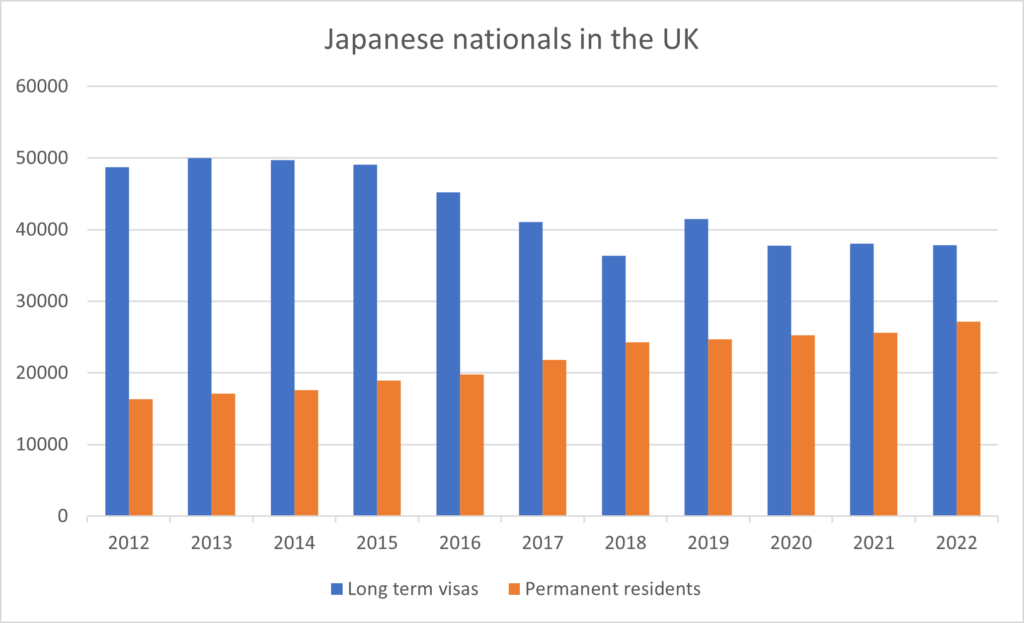
    The number of Japanese nationals on long term visas has also risen, but not to quite such an extent – from 340,000 to 751,000 (+120%) and since 2020 the number has dropped. Long term visa holders are likely to be corporate expatriates and students on longer courses, so this decrease could partly be explained by the pandemic, but there does not seem to be any sign of recovery by the end of 2022, even though the severity of the pandemic had faded by then.

    Country by country, the picture is more patchy. The USA is still the biggest host of Japanese nationals (419,000) – nearly a third of the Japanese nationals overseas, but this has declined 6% since 2018. The number of Japanese nationals in China, the second largest host, has dropped 15% over the same period. The UK, 6th largest host, has 7% more Japanese nationals than in 2018 whereas Germany (8th) has 7% fewer Japanese nationals and France (10th) 8% fewer. Australia, Thailand and Canada (3rd, 4th and 5th respectively) have also seen increases.

    By city, Los Angeles, Bangkok, New York, Shanghai, London, Singapore, Sydney, Vancouver, Honolulu and Hong Kong are the 10 largest hosts. San Francisco has dropped out of the top 10 and been replaced by Honolulu.

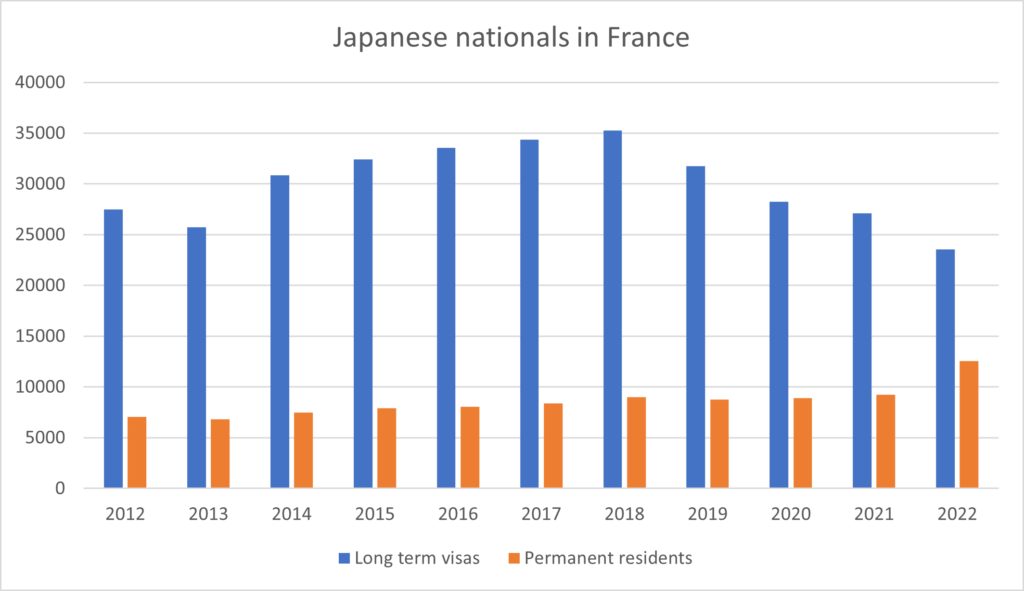
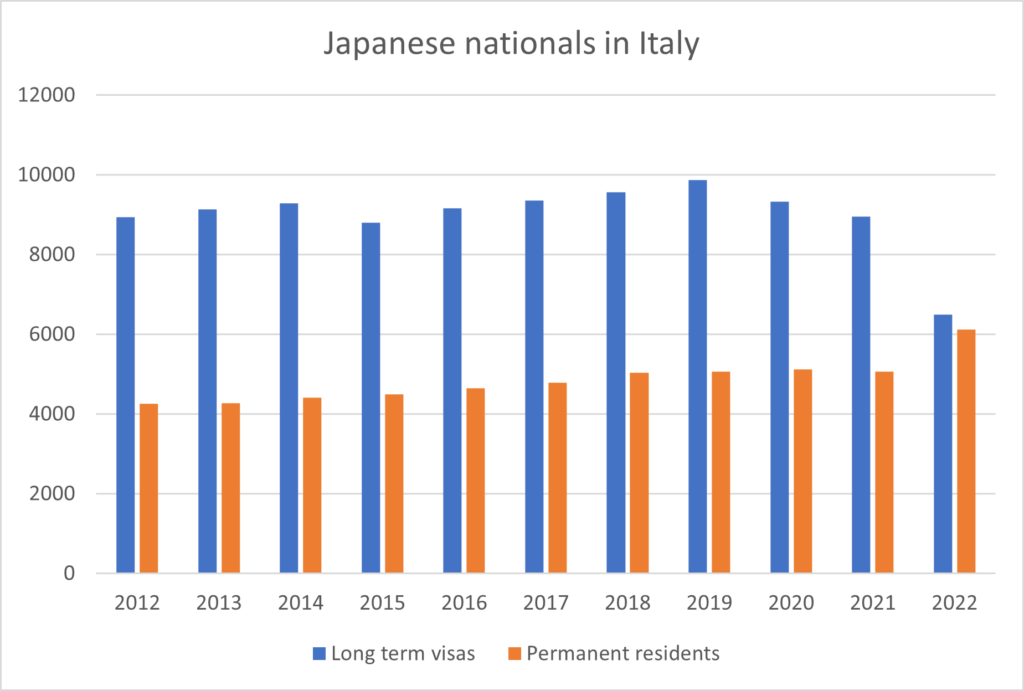
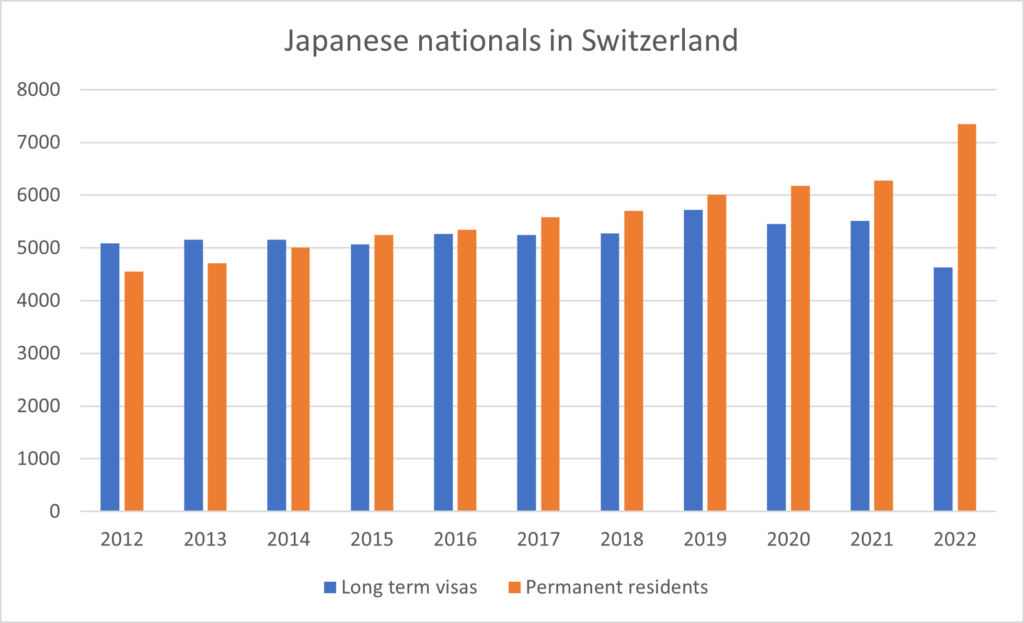
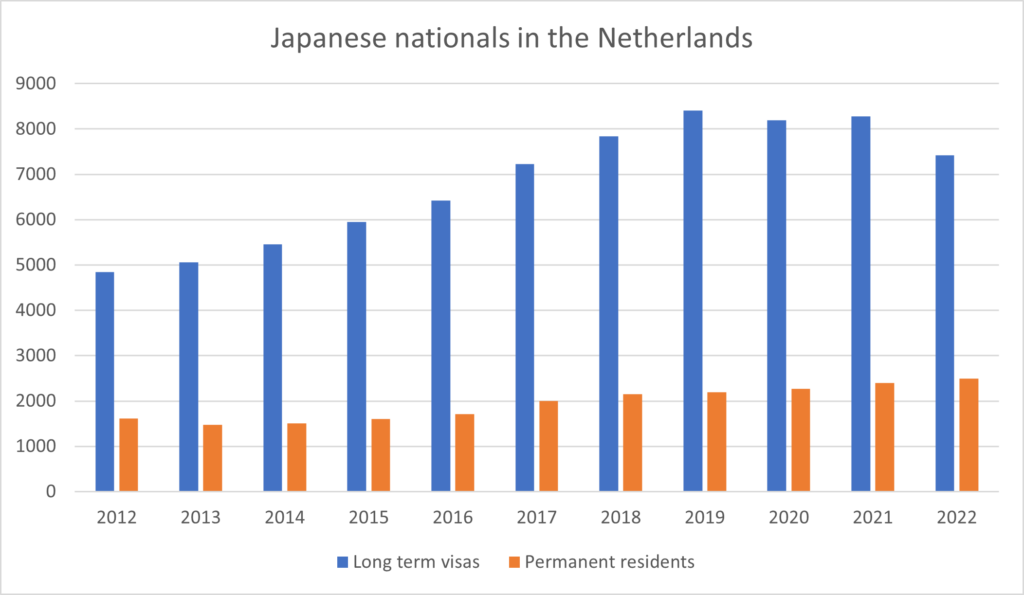
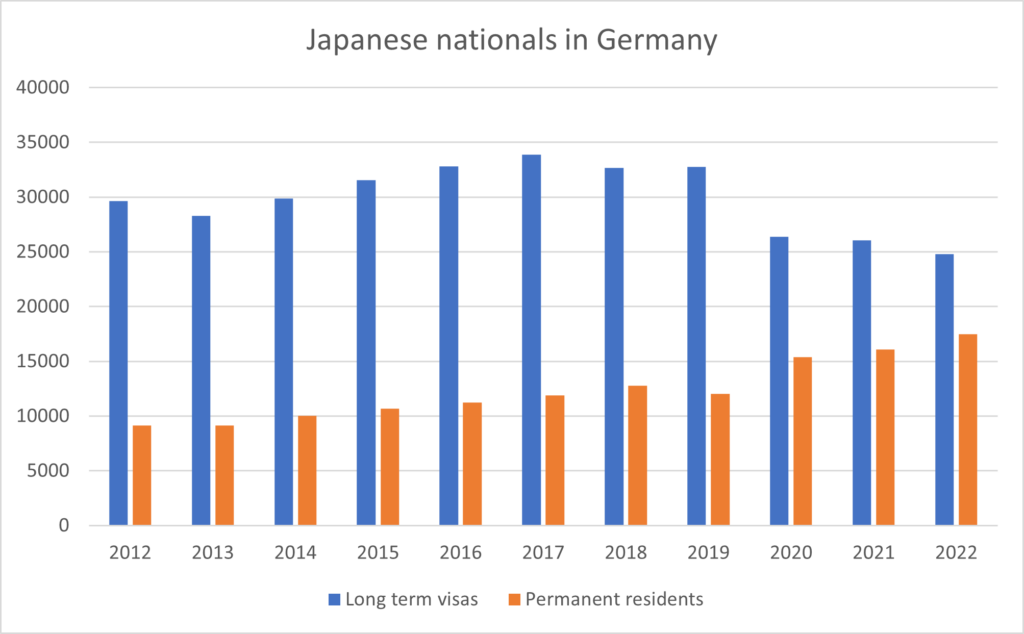
    Breaking it down by visa category shows that overall in Europe the number of Japanese nationals in the 17 biggest hosts rose 17% from 2012 to 2022 to over 216,000. But the driver behind this has been the number of nationals who are permanent residents. This rose 80% from 2012 to 2022 to over 90,000 people, with a particularly marked increase 2021-2. The number of people on long term visas in Europe has actually fallen by 13%, to 126,000.
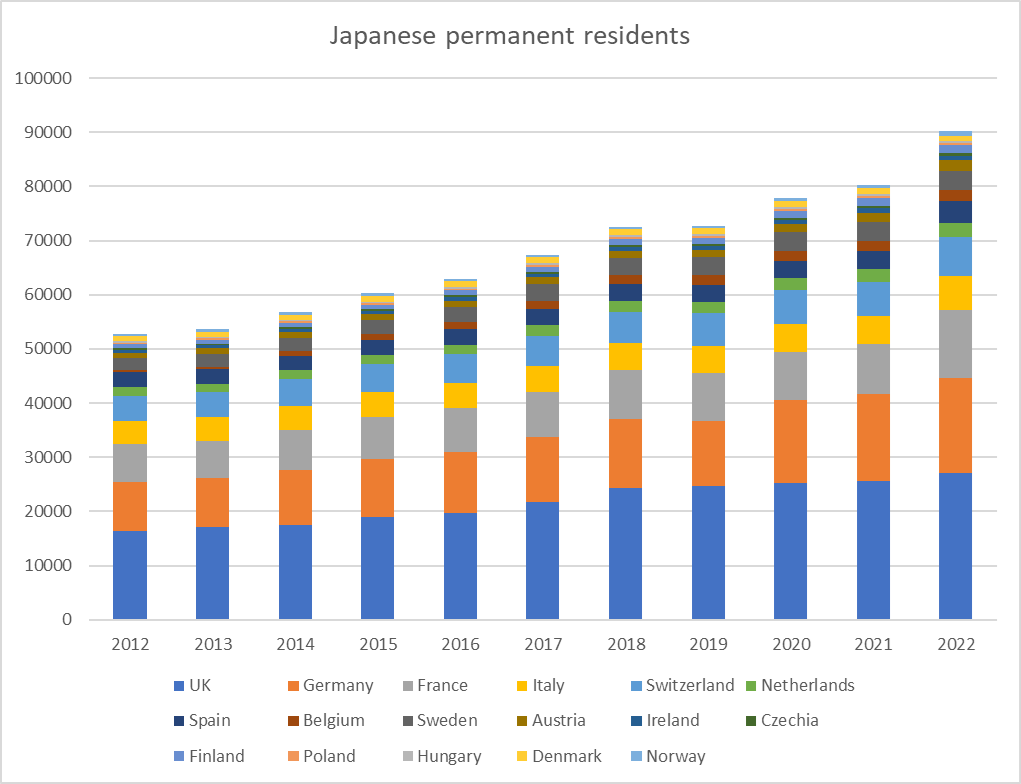
    The UK has the largest number of Japanese permanent residents – 27,179  – up 77% on 2012. Germany has nearly double the number of Japanese permanent residents it had in 2012 – to 17,496. France is the third largest host with 12,572 permanent residents, up 95% on a decade ago. Belgium has tripled the number of permanent residents and Austria doubled it.

    It is hard to know what the drivers are behind Japanese taking up permanent residency in Europe. Obviously one factor is marriage to a local person and having a family.  The stereotypical view would be of a Japanese woman marrying a European man – often after having come to Europe to study and work, having perhaps despaired of the traditional education, career and marriage prospects available to women in Japan. There does seem to be an element of that in that there are 1.6 Japanese women permanent residents for every man, up from 1.1 in 1989.

    The ratio of permanent to long term residents in the UK and Germany is around 2:3, whereas in the USA it is around 50/50.  In Australia and New Zealand is more like 3:2. In Brazil and Argentina over 90% of residents are permanent.

    Permanent residency may also be the only available option if a Japanese person wants to stay in their new home country, but does not want to lose their Japanese citizenship. As this editorial in the Asahi newspaper explains, it has long been a source of contention in Japan that dual citizenship has not been permitted. The eight plaintiffs in a recent court case who wanted to contest this said that they took up citizenship of another country in order to maintain their business in that country, or to take public office.

    Japan does seem out of step with the majority of countries in the world – 70% of countries allow multiple citizenship. It is also an open secret that many Japanese nationals abroad do actually have dual or multiple citizenships, as there is no mechanism for the Japanese authorities to become aware of this. The data above comes from the Japanese Ministry of Foreign Affairs, and is dependent on Japanese nationals registering with their local embassy. It is only when inheritance, tax and other matters have to be dealt with that multiple citizenship comes out in the open as issue. The true number of Japanese nationals (current and former) in Europe is likely to be much larger.

    The charts below attempt to show the different trends in the main countries in Europe which host Japanese nationals. There are some obvious anomalies, which may be explained by changes in citizenship laws and visa regulations in each European country. It’s also notable that Switzerland has long been a major host of Japanese permanent residents whereas, by contrast, the Netherlands would seem to be much more of a corporate expatriate destination.


  • Japanese employees see promotion to manager as a “punishment game”

    Japanese employees see promotion to manager as a “punishment game”

    Nikkei Business magazine has just run a series on how Japanese employees are becoming very reluctant to be promoted to manager, seeing it as a “punishment game”. Comedy shows on Japanese TV often involve a “punishment game” (罰ゲーム batsu gehmu) where after a bet or a game like scissors paper stone*, the winner inflicts some kind of punishment – like a slap, or eating something disgusting – on the loser.

    This reluctance to be promoted to management has been noted for at least two decades now, as the compensation for management level jobs has become less based on seniority increments and more on performance and job content. At the same time, the declining population means there are fewer people below to delegate to and many of  the younger generation do not want responsibilities delegated to them.

    Playing managers

    Japanese managers have felt they have to be “playing managers” a term taken from baseball, meaning that a person has both to manage the team, but also be a high performing player in the team. The strain of doing this is obvious – Nikkei Business cited one woman General Manager who quit because she also had to be a manager of multiple teams, coaching younger inexperienced people, as well as look after her children and parents.

    Another issue is that being promoted to manager may now mean you have to manage people older than you – something that was taboo under old seniority based systems. According to the Nikkei Business introduction, the stress of this meant one man left his successful career at a Japanese traditional company to join a foreign owned company, where age related status was not such an issue.

    Why over half would turn down promotion

    These anecdotes are backed up by a survey by Musashino University of 340 management candidates under 40, which showed that over half (52%) of respondents would turn down a promotion to manager. Other research quoted by Nikkei Business shows that whereas in 1981 a general manager could earn more than double the total take home pay of a non-management employee, it is now less than double. This may be due to higher salaries to retain younger, digitally skilled employees.

    Other research shows that the average age of appointment to team leader in Japan is around 38 years old, whereas in the USA it is 34 and in India, China and Thailand it is around 29 or 30. The average age for becoming general manager in Japan is 44, 37 in the USA, 32 in Thailand and just under 30 for China and India. There is also a higher mortality rate amongst Japanese managers compared to European managers.

    The legacy of the lost three decades

    Japan ranks 43rd in the world in IMD’s World Talent Ranking – which looks at “investment and development” “appeal” and “readiness”- a legacy of the days when managers only had “on the job training”.  Switzerland ranks 1st, again, Germany 12th, USA is 15th and the UK has dropped to its lowest ranking since 2019, of 35th – which is where Japan was in 2019. Unsurprisingly, given the inward looking nature of the past “lost three decades“, Japan scores particularly low on international experience and senior management competence.

    Nikkei Business says Japanese companies have become wine glass shaped – top heavy with people in their late 50s and 60s, with more people in their 20s and 30s at the base, putting the squeeze on the fewer people who are the “stem”, in the middle management roles in their 40s and early 50s.

    The solution is empowerment

    Nikkei Business points to some solutions arising from the research, for example that senior managers should not be top down and directive in their style, and to allow their team to have more say and influence in decision making.

    It seems to me that there should be less emphasis on quantifiable performance, when deciding how to compensate managers, and more emphasis on job content and qualitative targets, such as developing and motivating employees. This is something that is beginning to happen at some companies (Hitachi, Panasonic Industry and Ricoh are specifically mentioned in the series), who are moving to the “job gata” system, where job content is more clearly defined and employees are meant to take more control over their own career paths and development.

    At Japan Intercultural Consulting, our training on agile project management explicitly states that managers should not be “playing managers” but instead focus on supporting the team by providing resources and removing barriers to productivity – a management style known as “servant leadership”.


    *Wikipedia calls the game “rock paper scissors” – apparently that’s the more common name in the USA.  Perhaps we should all call it jankenpon, the Japanese name. It came to the West from Japan, who, in turn, got it from China.

  • The opportunities for Japanese companies in European energy

    The opportunities for Japanese companies in European energy

    It’s exactly 25 years ago that I went to Japan on a business trip and gave a presentation to the headquarters of the Japanese trading company I was then working for, on offshore wind power. I remember feeling deflated by the lack of enthusiasm for my recommendation that the company invest in this sector in Europe.

    At that time, the main obstacle was the high cost of connecting the offshore wind turbines to the power grid, but I felt sure that in the long run the costs would come down and this kind of high value infrastructure project in renewable energy was an investment Japanese trading companies should be making.

    25 years later, I felt vindicated to read that the recent announcement of $22bn Japanese investment in the UK turns out to be primarily composed of investments by Japanese trading companies in offshore wind projects. Actually this investment is not entirely “new” – Japanese trading companies have been investing in UK offshore wind projects and transmission infrastructure from around 10 years’ ago.

    Nonetheless, Japanese companies are perceived to be late comers to European wind power, at least in terms of supplying wind turbines. European companies such as Denmark’s Orsted or Vestas or Germany’s Siemens are seen as the leaders. It’s not surprising, then, to see that many Japanese companies have teamed up with foreign companies and a significant proportion of the 542 members of the Japan Wind Power Association are companies headquartered outside of Japan.

    As JWPA itself points out, while Japan’s share of wind turbine sales globally may be small, Japan excels in companies who supply the components for wind energy turbines, such as precision machinery and electric equipment. If these companies do not already have a presence in Europe, then I expect they will soon, as Japanese investment tends to bring a Japanese supply chain with it.

    Unlike the 1970s and 1980s, however, it seems to me that this time it is not a case of “domestic first, then overseas.” Renewable energy is a huge global challenge, which needs to be tackled speedily and in a collaborative way, so that we can learn from each other.

    The remaining obstacles are still very local, however. Most offshore wind projects in the UK are in the North Sea, on the eastern side of the country, where I live. There has been a vocal campaign by residents against the cables from the offshore wind projects running through picturesque countryside, or substations being sited near residential areas, which recently resulted in many local politicians losing elections.

    Another challenge that runs right across Europe is the shortage of connections to the national grid, sometimes resulting in a 5 or 10 year wait. With increased electrification such as the EU switch to electric vehicles, and Germany’s controversial proposed ban on gas boilers, the grids themselves, rather than the equipment or connections, have become the bottleneck. Hitachi’s acquisition of ABB’s power grids business brings Japanese investment to this part of the energy chain too.

    This article by Pernille Rudlin was first published in Japanese in the Teikoku News, 12th July 2023

  • Nisshinbo divests TMD Friction

    Nisshinbo divests TMD Friction

    Nisshinbo has sold its 2011 acquisition,  automotive brake component manufacturer TMD Friction to AEQUITA, a private equity firm based in Munich, Germany. TMD Friction is headquartered in Luxembourg, with European production in Germany, Spain, UK, Romania and France. It had already restructured its UK operations, shutting down production in Kilmarnock in 2019 and  more recently investing in new machinery for its Hartlepool plant. It employs around 2,237 people in the European region, with 670 in the UK, 577 in Romania, 437 in Germany, 300 in Luxembourg and 150 in France, and a further 2,000 in the USA, Mexico, Brazil, China and Japan. The transaction is expected to be completed in Q4 of 2023, subject to approval by the relevant authorities.