Author: Pernille Rudlin

  • Dentsu acquires Germany’s RCKT

    Dentsu acquires Germany’s RCKT

    Dentsu Group has acquired RCKT “a leading German digital-first brand, communications and creative agency”. RCKT will join the Dentsu Creative part of the Dentsu Group. The RCKT brand will be retained during a period of integration, becoming known as “RCKT, a Dentsu Creative Company” with immediate effect.  Given the recent reorganisation of Dentsu, where companies have been consolidated under the Dentsu brand, we predict the RCKT name will not last long.

    Dentsu now has around 3,200 employees in its DACH organisation. Dentsu Creative employs 9,000 people across 46 markets.

    We estimate that Dentsu employs around 13,000 – 14,000 people in the EMEA region – however it does not disclose any numbers in its annual reports on this.

  • Nippon Express acquires Switzerland based Tramo Group

    Nippon Express acquires Switzerland based Tramo Group

    Japanese logistics group Nippon Express has made another acquisition in Europe, the Swiss based luxury furniture specialist, Tramo Group, via Nippon Express Italia. It had already acquired the Austrian company Cargo-Partner earlier this year and in 2018 it acquired Italian luxury fashion logistics services company Traconf, as well as Franco Vago. In 2012 it acquired Swedish company APC Logistics.

    Nippon Express is aiming to generate half its revenue from overseas business by 2037, up from the current 30%. It currently has around 3,500 employees in Europe (out of 72,000 globally, of whom 42,500 are in Japan) and the acquisition of Tramo may add up to 500 to that total. Tramo has operations in Italy, the UK, Netherlands, France and Spain as well as in the USA.

  • What Japanese companies need to know about ecommerce in Europe

    What Japanese companies need to know about ecommerce in Europe

    I was browsing in a second-hand bookshop in my neighbourhood recently – with some difficulty as most of the floor was covered in boxes of newly purchased books. This led to a conversation with the owner about he managed his stock. I said I supposed that he put online the stock that he did not have room to display. He replied he did not have a website –  he had tried to use e-commerce during the pandemic but it proved to be unprofitable.

    He found he could not compete with Amazon and Amazon’s second book arm, Abe Books, in terms of search engine rankings. He could sell his books via Abe Books, but there is fierce price competition and if the book is not rare, the margins are very small.

    As I write this, I am watching a British online art auction. Almost all British art and antique auctions are now online, since the pandemic forced them to switch – and these auctions are now consolidated on a website called saleroom.com, which also has auctions from continental Europe and the USA. Buyers have returned to the auction room in person too – and I would certainly prefer to see art and antiques in person before bidding. For signed art by known artists with known provenance, it is of course less of a risk.

    On the other hand, a son of a friend of mine has become very rich selling online, even though his products are cheap, no-brand, highly commoditised products – for example lint removers – and are manufactured in China. The secret to his success is his total obsession with data  – even when he is on holiday he is checking sales volumes and competitor prices and ratings and tweaking his pricing and his social media advertising.

    Many B2C companies in the UK have become entirely online, with no physical retail presence. This is partly because the overheads, particularly energy costs, have shot up recently, as well as labour shortages. But the most successful b2c online businesses started with a physical shop, to establish their brand.

    It’s no surprise then that one of the most cited barriers for Japanese companies in a recent JETRO survey, particularly small-medium sized businesses, to growing their e-commerce sales in Europe, is their lack of brand recognition. For Japanese companies who are already selling overseas via e-commerce, the second largest concern after lack of information about overseas markets is the difficulty in increasing brand awareness overseas – even for the larger companies.

    Over 20% of the Japanese companies in the JETRO survey wanted to expand their e-commerce sales to Europe. If physical presence in Europe is not possible, then the digital first solution would be to hire a European specialist marketing agency. If you have the budget and a strong brand, they can run advertising and social media campaigns for you. For smaller budgets, or a commoditized or B2B product, then a smaller local agency can recommend specialist consolidated EC websites, analyse your sales and marketing data and make recommendations on pricing and product positioning.

    This article by Pernille Rudlin first appeared in Japanese in the Teikoku Databank News in May 2023

  • Hitachi divests UK’s Temple Lifts

    Hitachi divests UK’s Temple Lifts

    Hitachi has sold Temple Lifts to private investor Rcapital, five years after acquiring it in 2017. Temple Lifts has 125 employees and is headquartered in Bromley, Greater London with two regional offices overseeing approximately 5,000 lifts and escalators under maintenance contracts, supporting customers across multiple sectors.  This is the latest in a long series of divestments by Hitachi as it focuses its business portfolio on energy, digital and social infrastructure.

  • GMO Internet to close GMO-Z.COM London forex brokerage

    GMO Internet to close GMO-Z.COM London forex brokerage

    Japan’s GMO Internet group was to sell off its GMO-Z.COM London based forex brokerage to Australia’s Invast Global as of October 2022. However, the Financial Conduct Authority did not approve the transfer of shares in March 2023 so Invast has cancelled the transaction. GMO Internet has disclosed in the latest annual report of GMO-Z.COM that it now intends to close the operation within the year. GMO-Z.COM was established in London in 2012 and employed 10 people, 17 at its peak in 2019. It was trying to shift from individual client services to institutional client services.

  • SMFG continues its restructuring in EMEA

    SMFG continues its restructuring in EMEA

    Sumitomo Mitsui Financial Group is to merge its banking and securities businesses in the UK. SMBC Nikko Capital Markets plc will be transferred to SMBC Bank International over the next year. SMBC Bank International was renamed from Sumitomo Mitsui Banking Corporation Europe in 2020 and has a branch in Paris. All other EU operations became branches of SMBC Bank EU AG, established in Germany. SMBC Bank International plc employs 1,561 people and SMBC Nikko Capital Markets plc employs 175, already half of the peak number of 378 employed in 2019/20.

    SMFG claim this merger is to strengthen its offering to customers, and the numbers of people employed will remain the same. However, as the Nikkei points out, its medium-term management plan to FY2025 aims to reduce annual expenses by 25 billion yen and the workload of 500 people by improving the efficiency of overseas operations, such as reviewing the network of bases and integrating redundant functions.

  • Optimism for Japanese business in Africa

    Optimism for Japanese business in Africa

    I recently faced a new challenge for me, to deliver training, online, to a group of Africans who were gathered in the Johannesburg office of their Japanese employer. It was the first time for the company to use their new videoconferencing technology in this way, but everything worked well. We were using Microsoft Teams to present the slides and the livestream video of me talking, with a ceiling microphone so they could talk to me. I also asked the participants to use their smartphones to access a series of polls, via a link to a website or a QR code. All were able to do so.

    I was delighted that technology has finally allowed a more inclusive and interactive approach to training. A few years ago, I doubt any operation in Africa would have had the budget to pay for me to travel to Africa to deliver the training in person. We did attempt 15 years ago to find locally based facilitators to deliver our training, but it improved impossible to find anyone who fitted our criteria, even in South Africa.

    There were not that many Africans who had experience of Japan then – and those that did were in high demand, and not interested in taking up freelance consulting. This may have changed now – more than half the participants in the training had lived in Japan, studying or working there. As a result, they gave very informed and perceptive responses to the case studies we discussed. A large number already knew all about the nemawashi decision making process, for example.

    I realise that recruiting such well qualified people is probably only something that large Japanese companies such as sogo shosha (Japanese trading companies) can do. But even for smaller Japanese companies, this could be a sign that Africa is worth considering as a market, now that there are potential Japanese partners employing such high quality business development employees who are local to the region.

    A recent JETRO survey of Japanese companies in Africa concluded that despite the impact of the invasion of Ukraine on African economies –  rising costs of logistics, raw materials and exchange rate fluctuations – there are still growth opportunities. 70% of the respondents said they expect the importance of Africa will increase over the next five years. Côte d’Ivoire, Egypt and Kenya were seen as particular bright spots, and the consumer market, resources and energy, particularly solar power were seen as promising sectors. South Africa continues to dominate Japanese companies’ attention and Nigeria also for its large population, as well as Ghana and Tanzania.

    The survey conclusions are very similar to the recommendations for investment I saw when I was working in regional corporate planning for a Japanese trading company nearly 30 years ago. But having met, if only virtually, the young African business people from those countries, and been impressed by their understanding of Japan, as well as experienced for myself that information and communication technologies are working effectively, I feel a renewed optimism for the future of Japanese business in Africa.

    This article by Pernille Rudlin first appeared in Japanese in the Teikoku Databank News in April 2023

  • Japanese financial services companies in the UK

    Japanese financial services companies in the UK

    These two pieces of research from Dr Sarah Hall (a professor of economic geography at the University of Nottingham and Fellow of UK in a Changing Europe) and Martin Heneghan confirm what we have seen in our own researches on Japanese financial services companies in the UK. There has not been as drastic a decline in numbers employed by Japanese companies in the sector as expected since Brexit, instead, it has been more of a slight increase, followed by flatlining.

    We estimate the numbers employed in the UK by Japanese financial services companies was around 13,400 in 2015/6, rising by around 1,000 to 2019/20, dropping slightly in 2020/21 and then returning to 2019/20 levels the year after. It is hard to be precise about the absolute numbers and trend, as two of the three Japanese megabanks, who employ around 1,000 people each, are branches of their Japan headquarters, so do not issue annual reports in which employee numbers are reported. These two megabanks, Mizuho and MUFG, may come under pressure from the Bank of England to have subsidiaries in the UK too, according to recent rumours.

    We estimate there are around 160,000 people employed by Japanese companies in all sectors, so the financial services sector represents less than 10% of this. As of June 2022, 1.06 million people were employed in the UK in the financial services sector in the UK, so Japanese owned companies only represent 1.3% of the total employed in the sector.
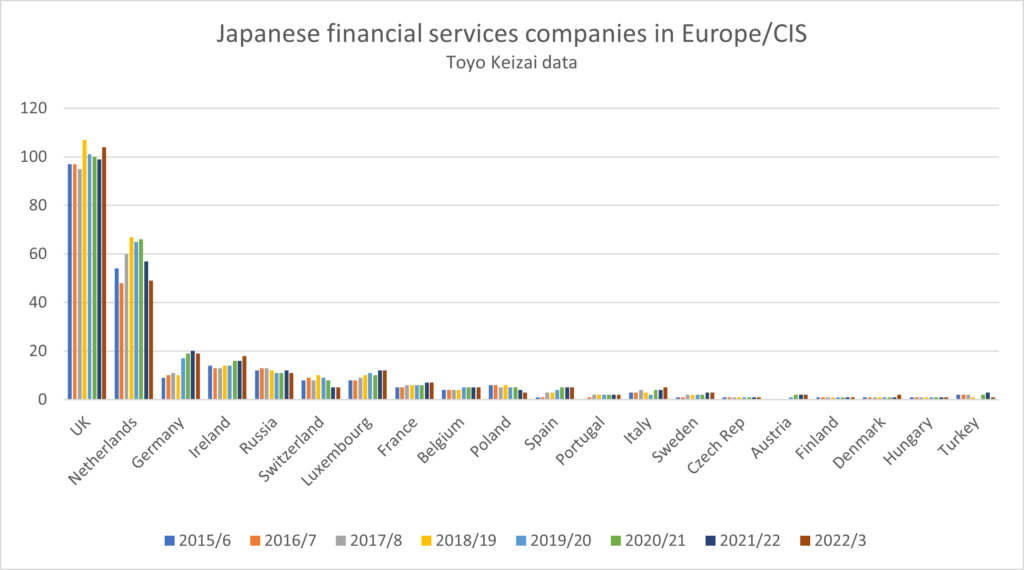
    The other issue raised by the two pieces of research are whether other EU cities have benefited from any additional growth, which the UK has missed out on. As can be seen from the chart, Toyo Keizai data shows that there was an overall upward trend in the number of Japanese financial services companies in the European region, of around 12% from 2015/6 to 2022/23.  The UK still dominates as a host, and the numbers of companies hosted rose 7% – so below trend. Germany doubled the number of Japanese financial services companies it hosted over the period. The numbers rose sharply in the Netherlands and then dropped. Just as Dr Hall’s research suggests, Ireland, Luxembourg and France seem to have benefited, albeit from a much smaller base.

    Toyo Keizai breaks down the sector into banks, trust banking, securities, investment trusts and advisory, commodities, lending and credit, leasing and investment businesses, as well as life and non life insurance and “other” finance. “Other” finance is the sector which showed the most growth for the UK – perhaps fintech and less traditional financial services are included in this. For Ireland the leasing sector, particularly aircraft leasing, is a growth area.  Germany now hosts four Japanese securities companies, from none in 2015/6. The growth and then decline for the Netherlands seems to have been mostly in investment businesses. Luxembourg has gained one or two companies across all sectors.

    Given that the rather nebulous “investment businesses” and “other finance” are the two biggest sectors, showing the most growth along with leasing, we agree with Dr Hall’s conclusion that “given the complex interplay of these two factors, we suggest that far from being done, Brexit is being played out within a sector that is itself in a period of profound flux and hence it is likely to be some time before the full impacts of Brexit of UK financial services, and their consequences for wider economic growth, are fully understood.”

    Our list of the 94 Japanese financial services companies in the UK, giving their full name, city or town of location, number employed, description of financial services offered and ultimate parent company is available for £10+VAT. Please email us for an invoice.

  • Mitsui acquires 70% stake in European food ingredients manufacturer Nutrinova

    Mitsui acquires 70% stake in European food ingredients manufacturer Nutrinova

    Japanese trading company Mitsui & Co has acquired a 70% stake in a joint venture with Celanese, Nutrinova, for around US$472.5m. Nutrinova was owned by US chemical company Celanese Corporation. Nutrinova employs over 200 people, in the Netherlands, Germany and France and manufactures and sells the high-intensity sweetener acesulfame potassium, which is used in food, beverages, and other products, as well as the preservatives sorbic acid and potassium sorbates.

    Mitsui says this in line with one of its key strategic initiatives in its Medium-term Management Plan 2026 – that in addition to healthcare and prevention, “we will contribute to improvement in quality of life through provision of healthy foods and nutrition”. Not quite sure that artificial sweeteners will be see by everyone as being a healthy food, given the continuing controversy over aspartame.  It also represents a new line of business for Mitsui in Europe, as up until now most of its investments in related sectors were in agrochemicals rather than food ingredients.

  • Bandai Namco to open its first overseas entertainment store in London

    Bandai Namco to open its first overseas entertainment store in London

    A Bandai Namco Cross Store will open in Camden Market in London in July 2023. It will feature 6 shops including outlets for capsule toys, a popular One Piece trading card game and a merchandise lottery — as well as areas for events and game machines. Capsule toy machines are known as Gacha Gacha in Japan, from the noise they make when turning the crank to get the capsule toy. Bandai Namco dominates this sector in Japan, with its machine Gacha Pon. Pon being the noise of the capsule toy popping out.

    Photo Charles Nguyen – Own work, CC BY-SA 4.0, https://commons.wikimedia.org/w/index.php?curid=3916417