
Author: Pernille Rudlin

  • 10 Years on from Brexit – Japanese Nationals in the UK

    10 Years on from Brexit – Japanese Nationals in the UK

    What do the trends in Japanese residents overseas tell us about Japan’s relations with the UK and the rest of the world?

    Headline findings

    • The headline number for Japanese nationals in the UK is deceptively stable concealing a rise in permanent residents, overtaking those on long term visas as the majority
    • The UK has shifted from being a posting destination for corporate Japan and a place to study for Japanese students towards being a settlement destination for individual Japanese
    • Brexit accelerated trends in the UK that were already there, globally, since the Global Financial Crisis of 2008-9
    • The number of students who were Japanese nationals on degree courses in the UK of over a year declined due to financial issues, and the number of students who were Japanese nationals on shorter courses declined due to student visa regulations tightening
    • The decline in Japanese corporate expatriation is explained by cost (exchange rate and visa costs), access to the EU market and growth prospects

    Overview

    The headline number for Japanese nationals in the UK is deceptively stable: 63,011 Japanese nationals lived in the UK in 2011 and 62,270 in 2025. Underneath, the population has been transformed.

    Long-term residents – the category that contains students enrolled in degree courses and corporate rotational staff and their families – peaked at 50,016 in 2013 and has fallen almost every year since the Brexit referendum, to 32,315 in 2025, a decline of 35% from the peak.

    Permanent residents have moved in exactly the opposite direction, nearly doubling from 15,325 in 2011 to 29,955 in 2025. The UK has shifted from being a posting destination for corporate Japan and a place to study for Japanese students towards being a settlement destination for individual Japanese.

    Between 2015 and 2018 – after the Brexit referendum was called, through the vote and the Article 50 uncertainty, but before COVID – UK long-term Japanese residents fell 25.9%, from 49,066 to 36,351. Over the same three years the equivalent population rose 3.5% in Germany, 8.7% in France, 31.8% in the Netherlands, 6.0% in Australia and was flat in the USA. The UK was the only major host country losing Japanese long-term residents in that window.

    The UK continues to be the sixth largest host globally of Japanese nationals but the Japanese population in other large host countries such as Australia, Canada and Germany has grown by double figures over the same period. Overall, the number of Japanese living overseas has declined by only 1.4% from 2015-2025.

    Is Brexit the cause of Japanese nationals working or studying elsewhere? As we shall see, Brexit accelerated trends that were already there. The UK government was trying to restrain the number of foreign students coming to the UK even before the referendum, as a means to reduce total immigration numbers. These new restrictions undoubtedly impacted Japanese students, along with a weak yen in 2014-5.

    The repeat of a weakening yen since 2021 and the rising expense and stricter criteria for working visas, added to the reduced attraction of investing in a post-Brexit UK as a gateway to the EU. This has undoubtedly caused the further decline in corporate long term visa holders.

    Something impacted the UK more than the rest of the world 2015-2019

    The total number of Japanese nationals in the UK shows a slow, bumpy decline of around 9% over the past 10 years. There was growth from 2012 to a peak of 68,000 in 2015, falling to just over 62,000 in 2025. There was some recovery around 2019 and again after the pandemic, but not back to previous levels.
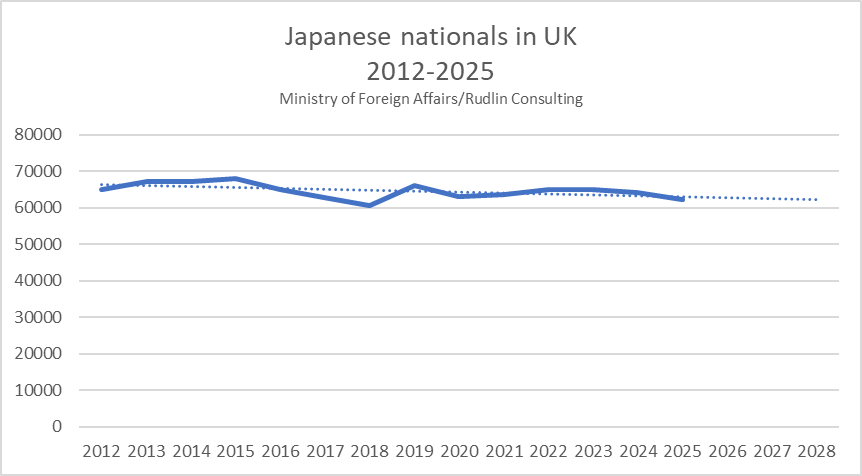
    Figure 1. Japanese nationals in the UK, 2012–2025 (total, with trend line). Source: Ministry of Foreign Affairs / Rudlin Consulting.

    Looking at the global picture, there are some similar patterns to the UK, suggesting that there are global or at least Japanese domestic trends at play – such as its shrinking, ageing population and the weakening yen. The total of Japanese nationals living overseas grew every year to a peak in 2019 of 1.4 million, and then declined to 2024, only slightly recovering in 2025, to 1.3 million. This represented an 8% decline from 2019 to 2025, but only a 1.4% decline 2015-2025, compared to -9% in the UK over the same 2015-25 period.

    The UK continues to be the 6th biggest host of Japanese nationals worldwide, but the total number of 60,000 or so is dwarfed by the USA, which has over 416,000 Japanese nationals, a decline from a peak in 2018 of 447,000 – a trend which is very similar to the trends in overall global totals.

    The other major contributor to the global decline since 2019 in Japanese nationals overseas is the significant drop in Japanese nationals living in China. This has been in steady decline since 2012.

    The decline in Japanese resident in China may be a combination of two factors – a maturity after the initial China boom, when Japanese manufacturing invested heavily in setting up operations in China, and also a sign of the deteriorating relationship between China and Japan, starting from when Japanese businesses were targets of demonstrations in 2012, and Japanese people, including women and children, being attacked in Chinese cities as recently as this year.
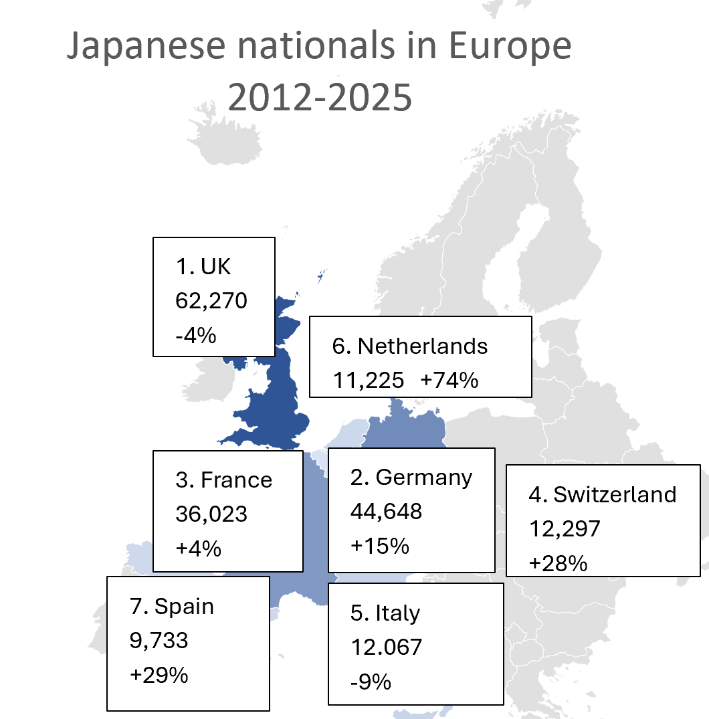
    Figure 2. Japanese nationals in Europe, 2012–2025: leading host countries and their change over the period.

    There has been consistent growth in resident Japanese nationals throughout the 2012-2025 period in Australia (+34%), Canada (+35%) and Germany (+15%).

    Understanding why the UK has fared differently to fellow Anglophone countries such as the USA, Australia and Canada, and also other European countries such as Germany and France requires closer examination of the two major categories of residency.
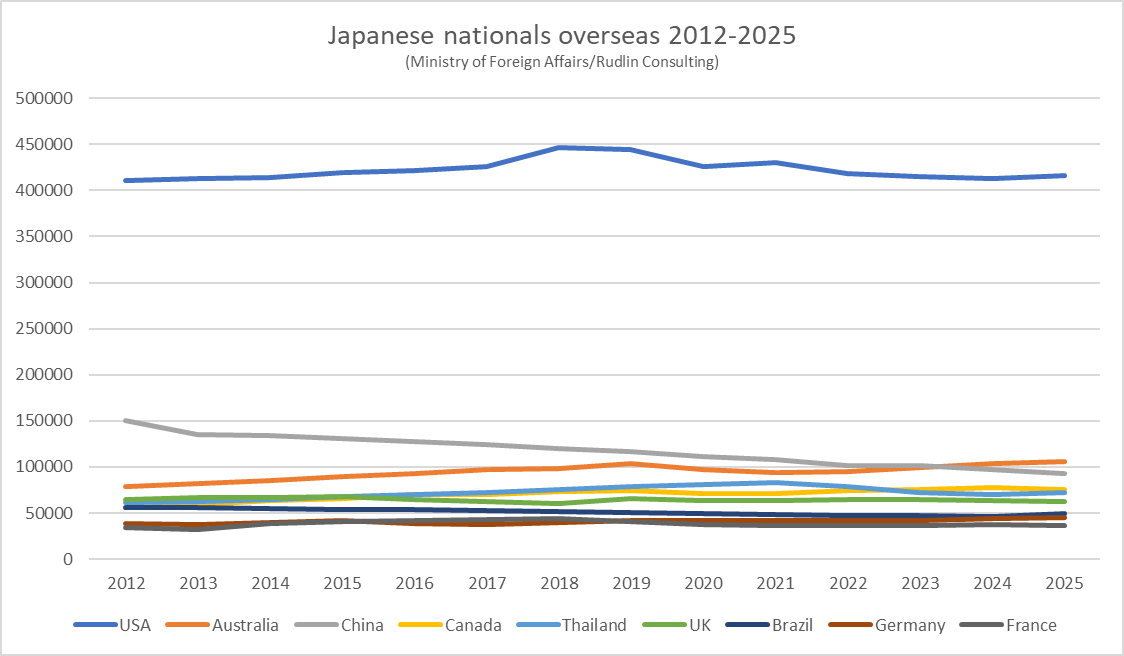
    Figure 3. Japanese nationals overseas, 2012–2025: the largest host countries.

    Long term visa holders versus permanent residents

    The two main categories used by Japan’s Ministry of Foreign Affairs for tracking Japanese nationals overseas are permanent resident and long term visa holder. Long-term visa holders mainly consist of corporate expatriates and students, academics and researchers and include anyone with a visa of 3 months or more in duration.

    This latter category does not map directly onto UK visas, however. Academics coming to the UK to research, teach or attend conferences can get a standard visa of up to 12 months. Students coming for courses of under 6 months can enter the UK on a standard visitor visa, as can academics and researchers.

    If we break down the total into these two categories, a strong trend emerges for Japanese nationals in the UK, which is that on current projections, the number of permanent residents will outstrip the number of long term visa holders in the near future.
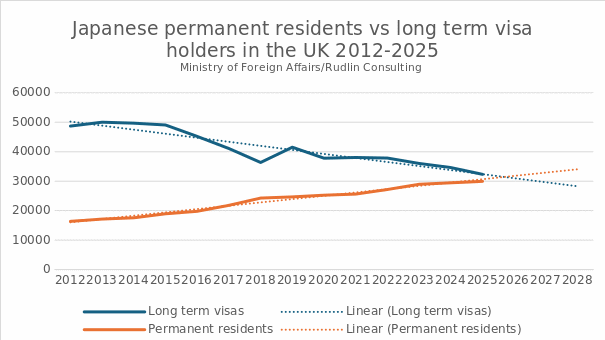
    Figure 4. Japanese permanent residents vs long-term visa holders in the UK, 2012–2025, with linear projections.

    Looking back to 2002, it also becomes clear that the bumpiness in trends over the past twenty years are mostly due to changes in the numbers of long term visa holders, versus steady growth in permanent residents.
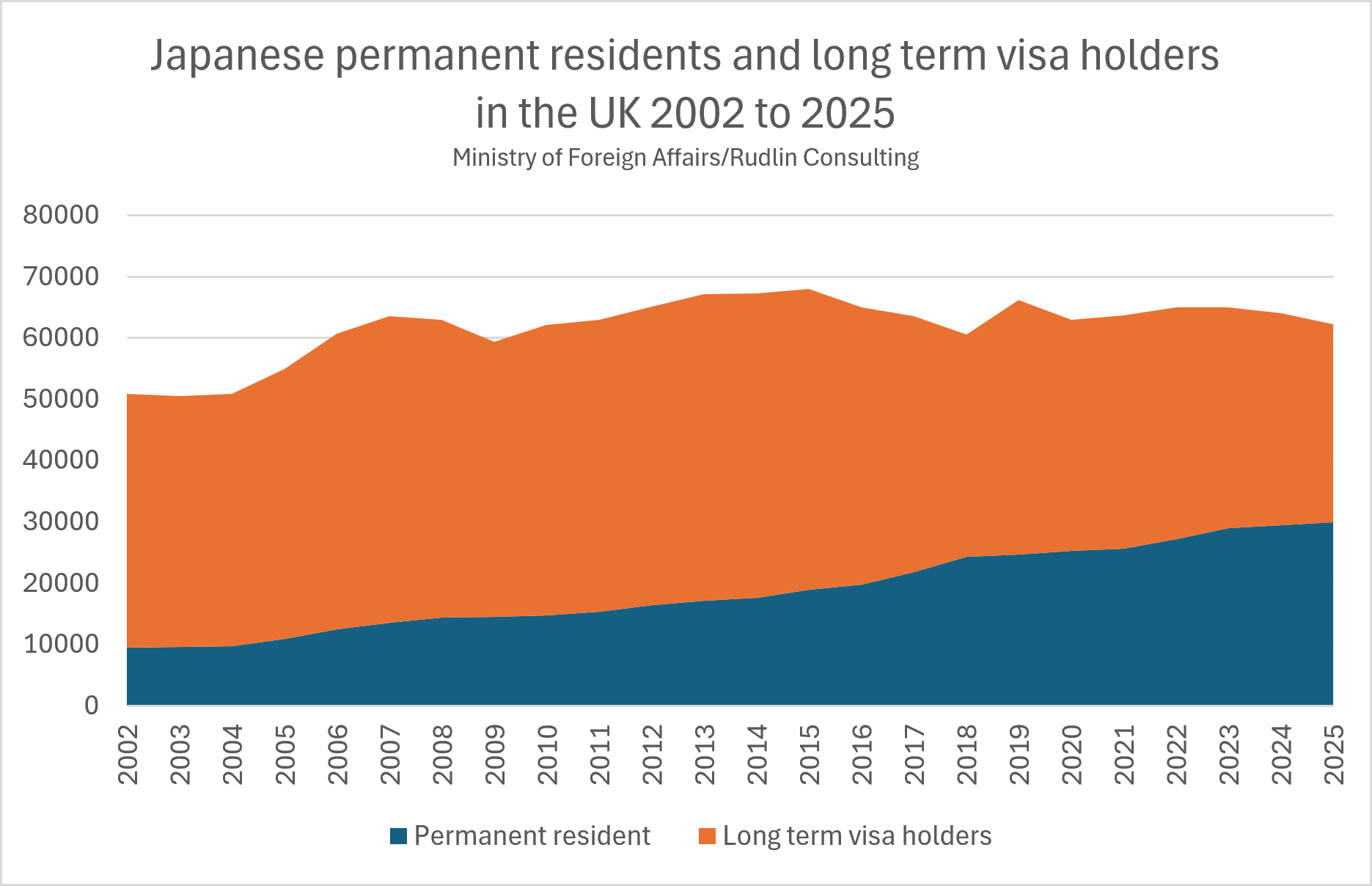
    Figure 5. Japanese permanent residents and long-term visa holders in the UK, 2002–2025.

    Again this reflects global trends for Japanese nationals – in 1991, 38% (251,000) of Japanese nationals overseas (663,000) were permanent residents. By 2025, 45% (588,000 – a record high) of Japanese nationals overseas were permanent residents.

    Within Europe, the larger countries that now have more permanent resident than long term visa holding Japanese nationals are Sweden (since at least 1997), Switzerland (since 1999 ) and Italy (since 2023).

    Globally, amongst the larger countries, Argentina, Australia, Brazil, Canada, New Zealand and the USA all have a majority of permanent residents amongst the Japanese nationals they host. This is partly down to historical factors – countries such as Brazil, Argentina and the USA were recipients of large numbers of migrants from Japan in the late nineteenth and early 20th centuries.

    Many of the descendants of these migrants have retained their Japanese nationality and passports by birthright and only have permanent resident status in the country of their birth. Japan is one of the few countries in the world that does not allow dual nationality.

    Conversely, the number of long term visa holders globally has declined from a peak in 2019 of 891,000 to 710,000 in 2025. This decline is apparent across all the major hosts of Japanese nationals, but the onset of the decline and the degree of recovery from the pandemic varies from country to country.

    Long term visa holders are affected by exchange rate related expense, safety concerns and visa regulations.

    For the USA there has been a 27% fall in the number of long term visa holders since 2012 and no signs of recovery since the pandemic.

    For China, the fall is even more precipitous – 42% since 2012 , and the trend continued after the pandemic.

    The number of long term visa holders in Thailand grew 27% overall since 2012, presumably as an alternative base to China, but has not grown since the 11% drop during the pandemic. Australia is the most positive story – growing 18% overall, and recovering since the pandemic with a 10% growth in long term visa holders over 2023-2025.

    The decline in the number of long term visa holders in the UK is nearly as stark as China’s – an overall decline of 34% since 2012 including a 15% drop after the pandemic.

    Why did the number of Japanese long term visa holders in the UK start to decline from 2015?

    The number of long term visa holders in the UK held fairly steady from 2012 to 2015, at around 50,000. It then fell to 45,000 in 2016 and continued to fall to 2019, when there was a brief recovery, only to fall during the pandemic, with a continuing decline since.

    For other European countries, however, the number of long term visa holders stayed stable or even grew 2015-2019 in Europe overall. Again, there was a drop during the pandemic, but some signs of recovery 2023-2025.
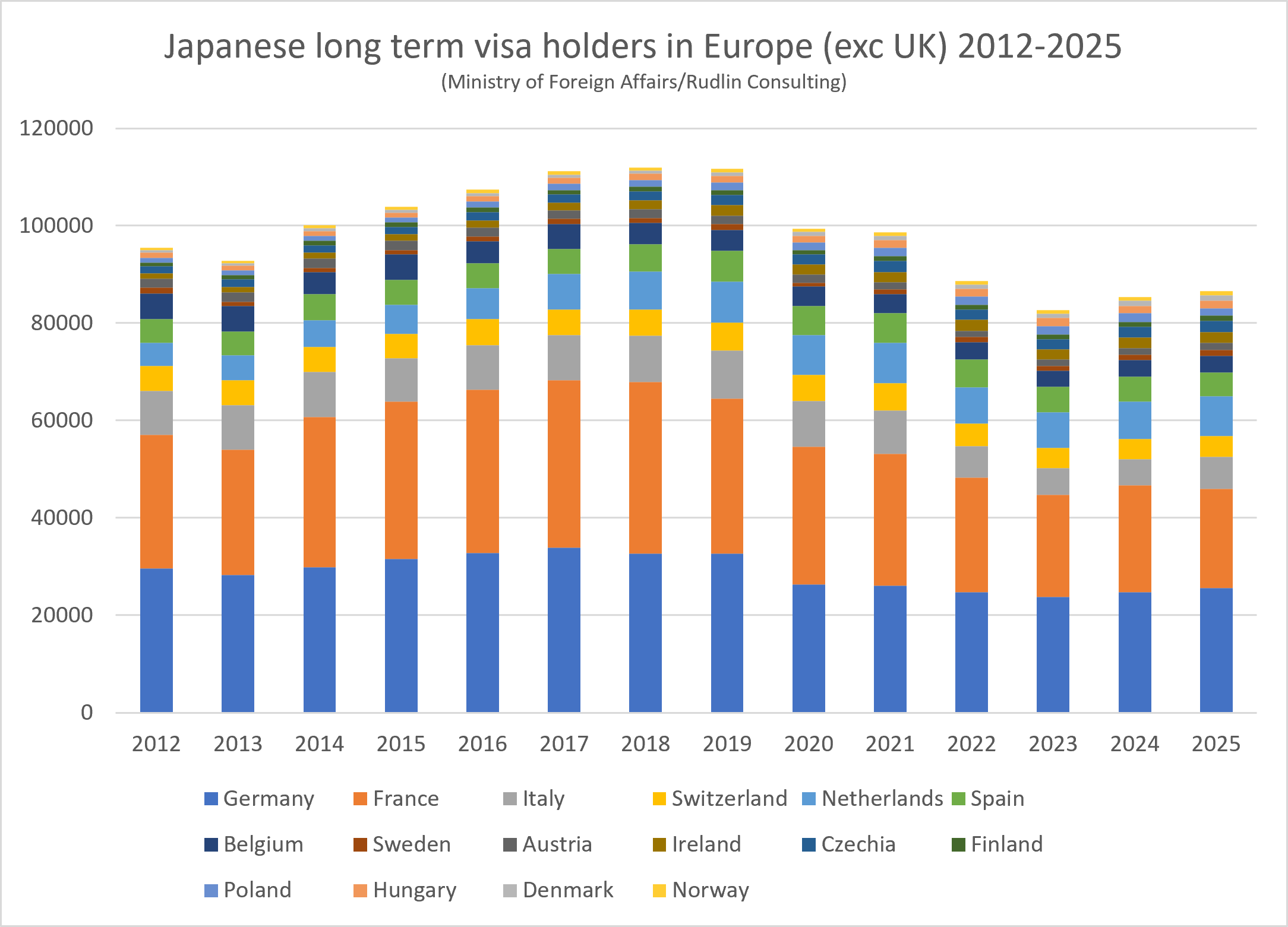
    Figure 6. Japanese long-term visa holders in Europe (excluding the UK), 2012–2025.

    Corporate expatriates vs student and academic visas

    To analyse this difference between European countries further, we need to look at the two largest categories for long term visa holders – corporate expatriates and student and academic visas.

    Unfortunately the Japanese Ministry of Foreign Affairs data only shows these categories by country for 2005 to 2017. We have added in a trend line for the UK charts below, and as can be seen, there was a significant drop in the number of academic visas from 2015 (preceded by a sudden rise the year before) and after a decline around the time of the Lehman Shock, corporate expatriate visas remained fairly steady to 2017.

    The UK had been the second largest host of Japanese nationals with academic, research or student visas in 2011, after the USA. It lost the number two spot to Australia over the 2015 to 2017 period, when visa holders in that category in the UK fell by a third – from 16,636 to 11,189 (not including dependants). The UK was the only country out of the major hosts of academic visas to experience such a major decline in Japanese student numbers. Canada was not far behind the UK in 2017 and may well have overtaken it in the years after. France and Germany held steady.
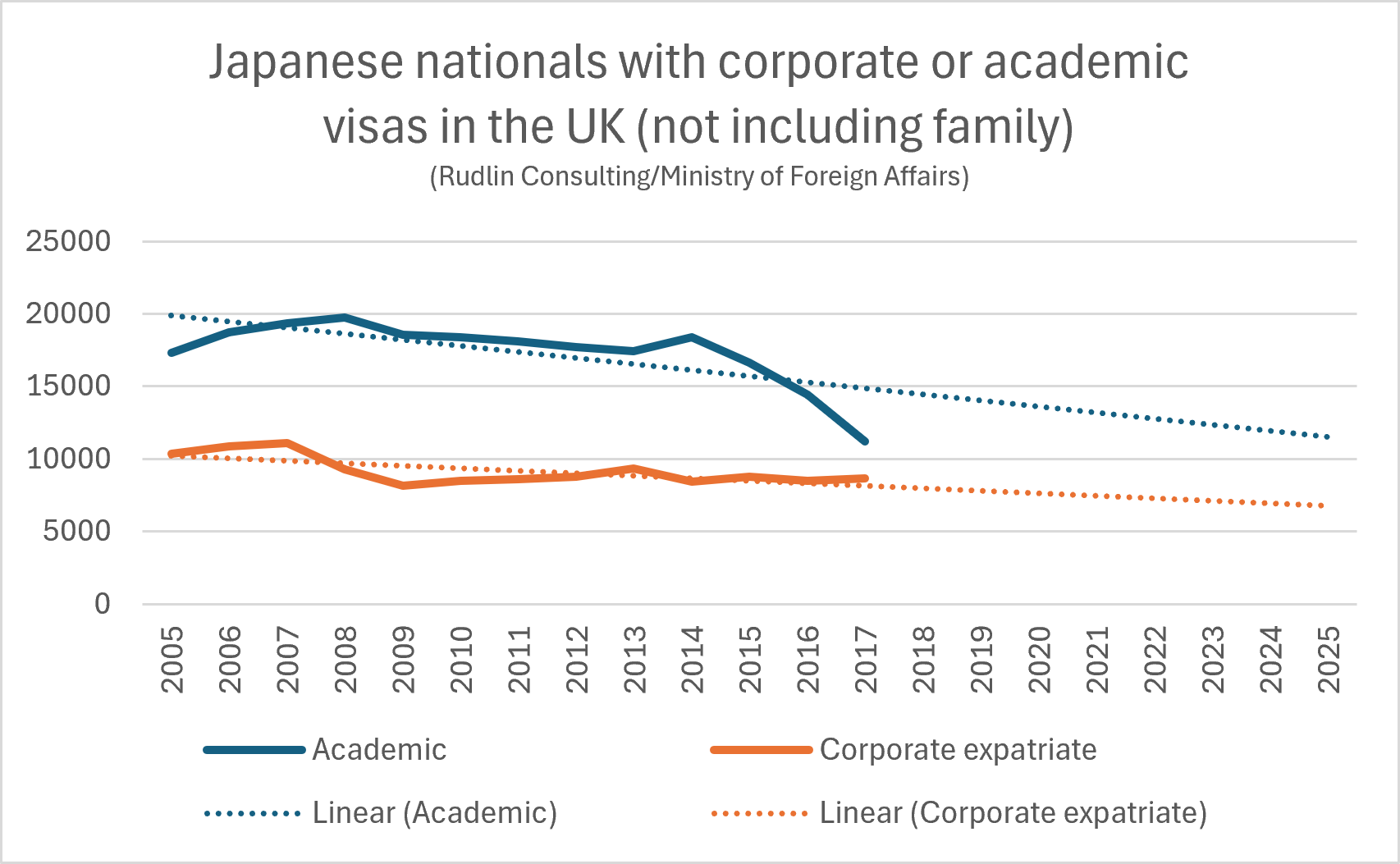
    Figure 7. Japanese nationals in the UK on corporate or academic visas (excluding family), 2005–2017, with trend lines.

    If we add in the dependents and family they bring with them, then the picture looks like this:
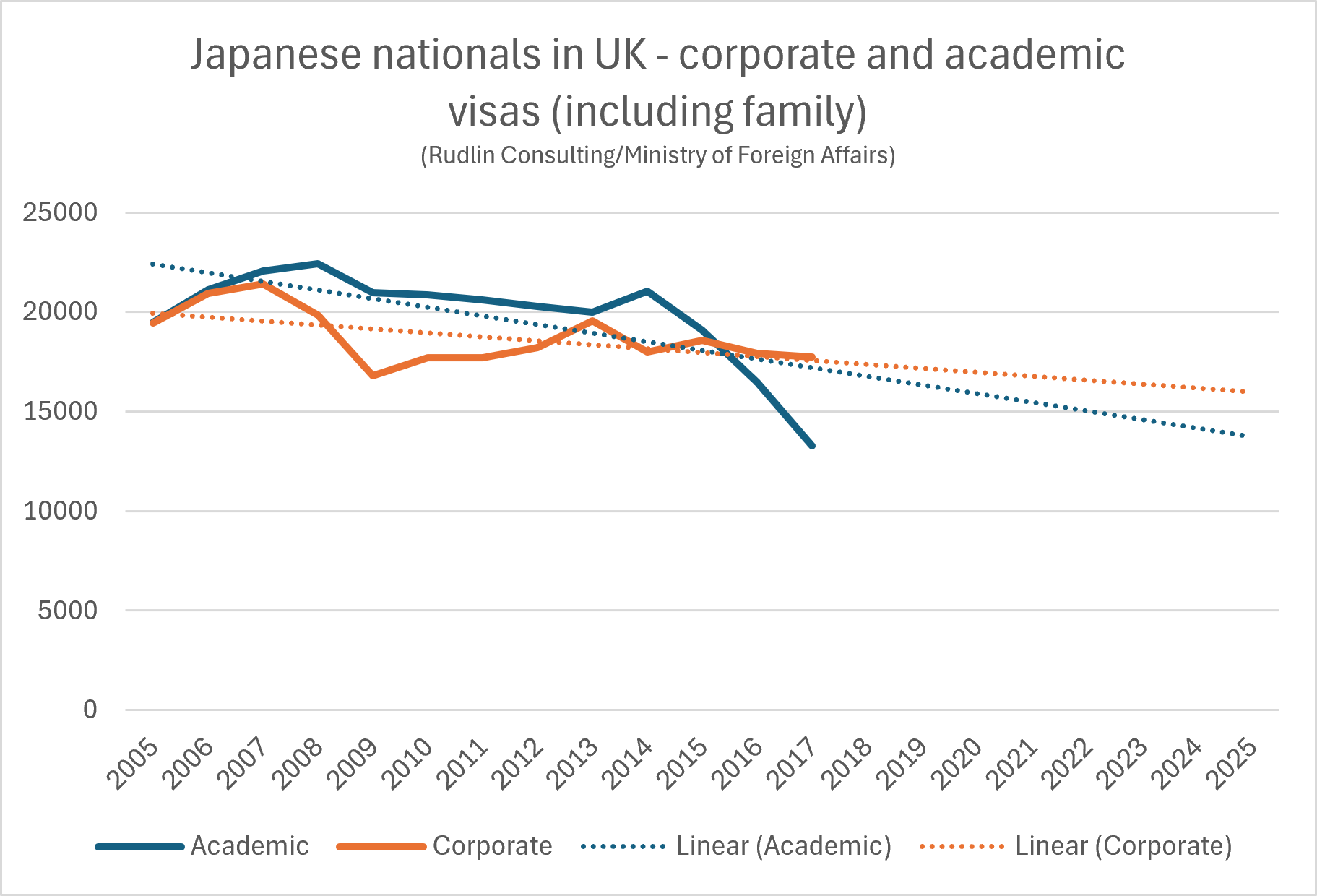
    Figure 8. The same categories including accompanying family.

    The gender balance and dependants

    One point to note is that around 66% of those Japanese nationals on academic or student visas were female in 2005 and 64% in 2017. 21% of those on corporate expatriate visas were female in 2005 and 26% in 2017.

    There was only one dependant for every eight student or academic visa holders in 2005, and around one dependant for every five student/academic visa holders in 2017. This was significantly lower than for other nationals such as students from Nigeria (more than one dependant per student) or India – around 1 dependant for every three students. Whereas there was around one dependant per Japanese corporate expatriate visa holder throughout the same period.

    It is also worth noting that around 70% of the dependants of corporate expatriates were female, reflecting the traditional pattern of the wife being the trailing spouse – or if the woman was herself on a corporate expatriate visa, being a younger, single woman.

    For the academic and student visas, around 60% of the dependants were female, again perhaps reflecting that women students and academics tend to be single, whereas the male academics and students are often accompanied by their female partners and children. This may well have fed into the rise in Japanese permanent residents – single women coming to the UK to study, meeting a romantic partner and deciding to settle in the UK.

    So what happened around 2015 to impact Japanese student, researcher and academic visa holders in the UK?

    The changes to student visas introduced in 2015 would have had a strong negative impact on Japanese students who were looking to join English language school courses, foundation years or A-level or pathway programmes, as a Secure English Language Test was introduced – which had to be taken at a UK Visas and Immigration-approved test centre. There were only two such centres in Japan – in Tokyo and Osaka. Biometric identification was also required. Ordinary IELTS tests taken outside a UKVI-approved centre were no longer accepted for visa purposes; only the ‘IELTS for UKVI’ test counted.

    The British Council’s research and JASSO analysis subsequently pointed to these changes as a contributing factor to the roughly 13% fall in Japanese exchange students to the UK between 2015/16 and 2016/17, a drop that the US and Australia — which did not impose equivalent restrictions — did not experience.

    There was a transitional window, which might explain the upward blip in visas obtained in 2014 – to avoid the new regulations in 2015.

    For degree level students there were no changes to the previous regime but the financial requirements were tightened. Students were required to demonstrate they held sufficient maintenance funds — tuition fees plus £1,020/month for London or £820/month elsewhere (for up to 9 months), held continuously for 28 days before the visa application. The abolition of the “established presence” provision meant students who had been in the UK for some time could no longer use a more relaxed evidential standard; everyone had to show the full funds upfront.

    This would have impacted the Japanese nationals who had come over with their parents on a corporate expatriate visa, gone through the British education system and now wanted to study at a British university. A child of a Japanese and British parents can have dual nationality until they are 20, but would have to choose which one to keep at that point. Given the expense of international student fees, this may have motivated some of them to register with UK universities as a domestic British student.

    To add to the financial requirements, the Japanese yen had been weakening and approached ¥195 to the £ in 2015. It then strengthened against the £ in 2016-2020, but has since weakened again. It is notable that the yen did not weaken as much against the Canadian or Australian dollar.
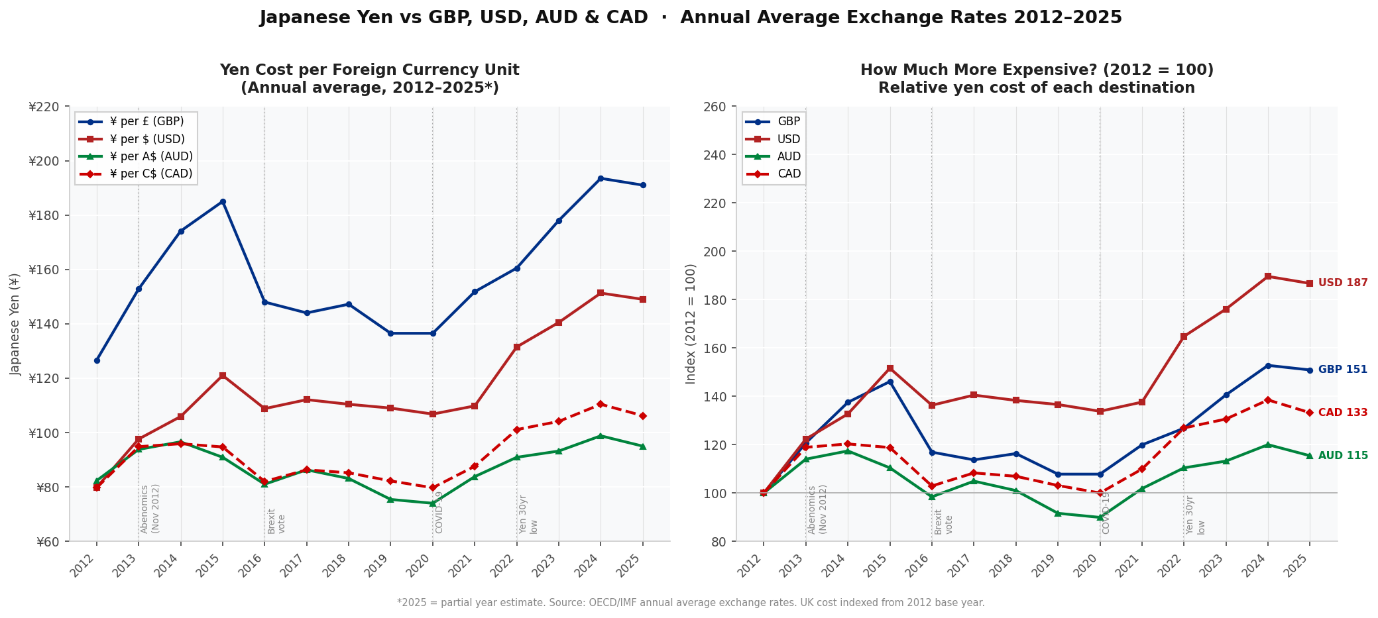
    Figure 9. The yen against the pound, dollar, Australian and Canadian dollars, 2012–2025 (annual averages; right-hand panel indexed to 2012 = 100).

    It seems highly likely then that the number of students who were Japanese nationals on degree courses of over a year declined due to financial issues, and the number of students who were Japanese nationals on shorter courses declined due to student visa regulations tightening – or that those students may have switched to a standard visitor visa instead. Many students went to cheaper countries and courses.

    What explains the decline in corporate expatriates?

    While corporate expatriate numbers held steady from 2015 to 2017 at around 8,500 (principals only, not including dependants) or so, over the 2005 to 2017 period there was a 16% decline – compared to the 35% decline for academic and student visas – which mainly related to the 2015-2017 period. The peak for Japanese corporate expatriates in the UK was in 2007, at 11,000, dropping to 9,200 in 2008 and to 8,151 in 2009, then holding steady to 2017. It seems likely then that the first event to have a negative impact on Japanese corporate expatriation to the UK was the Global Financial Crisis of 2007-9.

    As noted above, the publicly available Ministry of Foreign Affairs data stopped splitting long term visa holders into corporate and student/academic categories from 2017. It is hard therefore to estimate to what extent the steady decline in long term visa holders in the UK since 2019 was due to fewer Japanese corporate expatriates.

    A further data source on Japanese corporate expatriates is the annual directory issued by Toyo Keizai. Their data gathering is reliant on companies completing their annual survey, so only shows part of the picture, but the response rate seems to be fairly consistent over the years, so may at least indicate the overall trends.

    There was a decline of around a third across the main European hosts of Japanese nationals from 2015/6 to 2025/6. Germany (28% decline) overtook the UK (29% decline) as the top host in 2019/20 but is converging with the UK again. The decline in expatriate numbers was less steep in the Netherlands and Czechia and significantly higher than average in France, Spain, Hungary, Italy, Belgium.
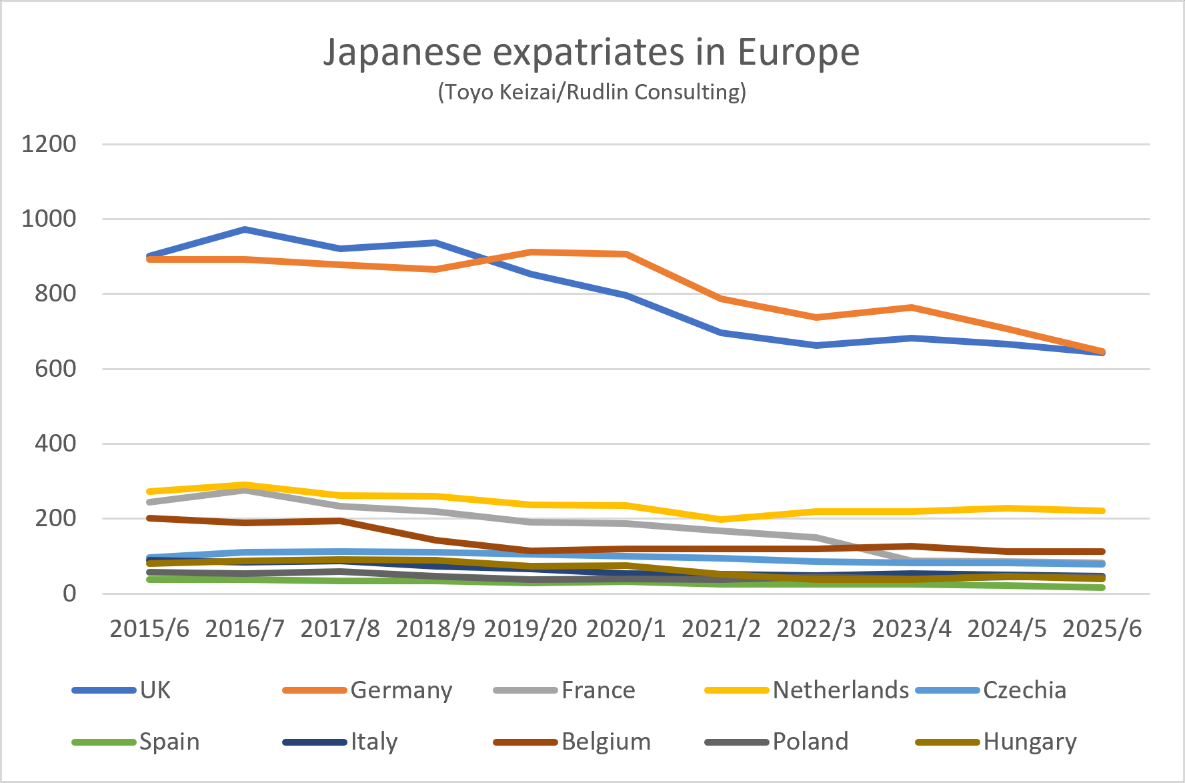
    Figure 10. Japanese expatriates in Europe, 2015/16–2025/26 (Toyo Keizai / Rudlin Consulting).

    This seems to indicate that the impact of Brexit on the UK in terms of Japanese expatriates was in the context of an overall decline in Japanese expatriates to Europe, and the UK fared quite well. Our hunch is that the UK continued to be an important host for Japanese financial services sector companies and trading companies – who tend to have a large proportion of Japanese expatriates. The Netherlands fared better after Brexit due to the transfer of logistics and European functional hubs to the Netherlands, and Czechia probably attracted expatriates in the automotive sector.

    In conclusion, there were three key factors impacting Japanese corporate expatriate presence:

    Access to the EU market – the Netherlands, which combines EU membership with an English-speaking business environment, doubled its Japanese long-term population over the decade 2015-2025.

    The cost of moving staff – the immigration costs for working visas to the UK rose sharply just as the yen weakened: the Immigration Health Surcharge rose 66% in February 2024 to £1,035 per person per year, the Immigration Skills Charge rose 32% in December 2025 to £1,320 per year for large sponsors, and the combined upfront cost of a five-year UK Skilled Worker visa (around £12,500) has been estimated at roughly ten times the average of comparable countries.

    For a typical Japanese expatriate with a spouse and two children on a five-year posting, upfront immigration costs alone now exceed £30,000 – a real consideration when Tokyo HQ compares London with Amsterdam or Düsseldorf.

    The final factor is economic growth. Japanese multinationals are in search of growth overseas, to compensate for their ageing, declining population at home. The UK is currently in a chicken and egg situation. Japanese foreign direct investment can help the UK to grow, but it needs to be assured that the UK is indeed a growth market.

    Implications for policy makers

    In the interests of attracting further investment from Japan, some kind of special arrangement could be made for reducing the costs of intra-company transfer visas. Any positive impact of this, however, would be dampened by the UK being outside the EU for market access, the overall decline in Japanese corporate expatriation and the UK’s attractiveness in terms of economic growth relative to other European countries and other regions. The major Japanese companies are already in the UK and unlikely to leave – but also unlikely to expand greatly regardless of incentives. The most likely newcomers will be the small to medium size Japanese companies, possibly more recently established and in new, emerging sectors.

    The number of Japanese international students in the UK has always been relatively small compared to those of other nationalities, so it is unlikely that any move to encourage more Japanese students will be particularly controversial in terms of impacting immigration totals significantly. The Japanese government has announced that it is keen to encourage more Japanese students to study abroad, so would be open to such a proposal – and indeed agreements on Japanese scientific researchers transferring to the UK have already been signed. The weak yen is a major factor, however, which is out of the UK government’s control. There is pressure on the Japanese government to provide more funding for Japanese students to go abroad, to mitigate this.

    Implications for suppliers to Japanese companies

    The localization of Japanese companies’ senior management implies that the local decision makers and budget holders are increasingly locally hired Europeans or locally hired Japanese nationals with permanent residency. It may still be the case, however, that the final decision rests in Japan. In which case, having a presence in Japan, or making regular trips to there, will also be necessary part of the sales relationship.

    For a sector by sector analysis of Japanese companies and their employees and the impact of M&A in the UK and Europe over the past 10 years, please see our next report.

    © Rudlin Consulting Ltd 2026 · Source data: Japanese Ministry of Foreign Affairs (Annual Report of Statistics on Japanese Nationals Overseas) and Toyo Keizai, consolidated by Rudlin Consulting.


  • Japan – Europe business update Summer 2026

    Japan – Europe business update Summer 2026

    Mitsubishi HC to invest in acquisitions of European wind and solar power plants

    The Japanese leasing company Mitsubishi HC (shareholders include Mitsubishi Corp. and Mitsubishi UFJ Financial Group) will take a 50% stake by August 2026 in a British company set up by Canadian company Brookfield. The first phase will involve spending around 400 million euros ($461 million) to acquire 20 wind and solar power plants in the U.K., France, Finland and three other European countries. This is in response to artificial intelligence driving up demand for electricity.

    JR East have acquired vending machine business of Petrie Gough Ltd

    Japanese railway company JR East have newly acquired the vending machine business of Petrie Gough Limited (UK), which operates approximately 800 units operating at major UK airports, including Heathrow, Gatwick, and Luton, bringing its total portfolio to around 1,800 machines.

    Kanadevia will build a biogas plant on the Italian island of Sicily

    Japanese industrial and engineering corporation Kanadevia, formerly Hitachi Zosen, will build a biogas plant on the Italian island of Sicily. Hitachi Zosen acquired Inova in 2010 and as a result its European headquarters are in Switzerland. In 2025, Kanadevia acquired two plants in the U.K. that convert food waste and agricultural residues into biomethane supplied as city gas.

    Obayashi Group to acquire 100% of shares of UK’s Multiplex

    Japan’s Obayashi Group, one of the country’s five largest construction companies, has announced it will acquire 100% of the shares of UK-headquartered contractor Multiplex from previous owner Brookfield, an investment firm.

    Reported to cost $540m, the deal will see Obayashi Group diversify into the Australian market, which it has identified as growing due to population increases, urban development and a stable economy. Obayashi says it will leverage Multiplex’s track record in office and mixed-use developments in the UK and also expand into Canada.

    Portuguese drone startup Tekever plans to build a manufacturing base for defense drones in Japan.

    Japanese trading house Marubeni will be Tekever’s sales agent in Japan to help develop a customer base. https://asia.nikkei.com/business/aerospace-defense-industries/european-startup-to-make-defense-drones-in-japan-export-across-asia

    Japanese rare-earth recycling project to set up plant in France

    A rare-earth recycling plant is to be set up in France with the aim of lessening dependence on China – with support from state-run Japan Organization for Metals and Energy Security and Japanese gas company Iwatani.

    Ukraine Japan reconstruction fund

    Ukraine is hoping to set up reconstruction fund with Hitachi, Toshiba, Mitsubishi Heavy involving aid and long-term loans from the Japan International Cooperation Agency and the Japan Bank for International Cooperation.

    Japan – France consultation framework on AI

    The Japanese government has signed up to a consultation framework for developing AI with France that is not dependent on USA or China to go with the ones already signed with the UK, Brazil, India, Malaysia.

  • Japan and Europe business update May 2026

    Japan and Europe business update May 2026

    Washin acquires UK company Foilco

    Japanese foil manufacturer Washin has acquired UK foil hot stamping company Foilco. Foilco employs 43 people in the UK.

    https://www.printweek.com/content/news/foilco-acquired-by-japanese-manufacturer

    UK’s Compass Group acquires Morinaga Shokken

    Morinaga Shokken is a medical and senior food services company primarily in the Kyushu region. UK-based Compass Group is already one of the largest British companies in Japan, through its acquisition of Japanese food service company NKS in 2012.

    https://www.freshfields.com/en/our-thinking/news/news-search/2026/04/freshfields-advises-compass-group-japan-on-its-acquisition-of-morinaga-shokken

    Subsidiary of Marubeni acquires Spain’s Factor Energia

    SmartestEnergy, the British energy subsidiary of Japanese conglomerate Marubeni Corporation, has closed the acquisition of a majority stake in Spain’s Factor Energia for 204 million euros. Factor Energia procures electric power and gas for sale to households and businesses in Spain, Portugal, Mexico, Brazil and other markets. It has around 400 employees.

    https://www.smartestenergy.com/en_GB/insights/news-and-blogs/smartestenergy-expands-global-acquisition-of-factor-energia-s.a

    Bearings company NSK to merge with NTN

    NSK already planned to reduce European workforce by 1000 – 600 in FY 2024, 400 in FY 2025. NSK has around 3,000 employees in Europe in FY23 – a large proportion in Poland and also the UK. NTN has around 5,000 employees in Europe (down from 5470 FY2020) – a large proportion of whom are in France due to NTN’s acquisition of SNR Roulements in 2010.

    NSK and NTN Announce Historic Memorandum for Business Integration

    Swedish private equity firm plans to acquire owner of Tabelog restaurant site

    Swedish private equity firm EQT has announced plans to acquire Kakaku.com, the company behind the popular Tabelog restaurant review and booking platform, in a deal expected to be valued around ¥590 billion ($3.74 billion). Kakaku also operates job search platform Kyujin Box. The parent company was founded in 1997.

    https://eqtgroup.com/news/eqt-to-launch-tender-offer-to-privatize-kakakucom-2026-05-12

    EQT has already made offers for Fujitec, CareNet and Mamezo in Japan.

    Panasonic Holdings acquires UK company Hive Media Control

    The Panasonic Projector & Display subsidiary of Panasonic Holdings, bought all issued shares of Hive Media Control on May 11 for an estimated 1 billion to 2 billion yen ($6.3 million to $12.6 million). The move comes after a planned 2025 sale of the subsidiary collapsed.

    Hive manufactures and sells media servers, devices that transmit image and video data to projectors and other equipment. Its technology projects images that surround the viewer and allow immersive video content. The company, founded in 2017, has annual sales around £2.5m. It employs 6 people in the UK.

    https://news.panasonic.com/global/press/en260519-3

  • Japan – EMEA business update April 2026

    Japan – EMEA business update April 2026

    NYK on the acquisition trail

    Stolt-Nielsen has confirmed it will sell 50% of its stake in its LNG bunkering and small-scale specialist Avenir LNG to Japanese shipowner NYK. NYK has also expanded its dry bulk business by taking full control of Norway’s Saga Welco, an open-hatch bulker specialist. NYK Holding Europe (NHE) will acquire Westfal-Larsen’s 50% stake in Tongsberg-based Saga Welco.

    Japan-owned National Car Parks collapses

    The UK company National Car Parks has gone into administration. It was acquired by Japanese company Park24 as a majority owner and the Development Bank of Japan in 2017 from Australia’s Macquarie Group. Employee levels peaked in 2018/9 at 1,181 but turnover halved during the pandemic and never recovered to pre-pandemic levels. Park24 is a major parking operator in Japan, most known for its Time brand. Presumably it was hoping National Car Parks was an opportunity for global growth, possibly with a view to expanding EV charging and car clubs to NCP properties. However servicing debt became unsustainable with lower turnover, fixed costs and reduced profit.

    Nippon Sheet Glass in talks to be acquired by US fund Apollo

    NSG acquired the UK’s Pilkington in 2006, spending 3 billion pounds ($3.98 billion at current rates). As Pilkington was larger, and more global than NSG, it was seen as a reverse takeover. Despite restructuring after the 2008 financial crisis, NSG continued to make losses over the past twenty years, due to a sales slump in the European market and competition from China. The interest on the debt incurred from the Pilkington purchase had become a heavy burden on the company. Pilkington had 2,353 employees in the UK in 2016 and now has 1,600, out of around 12,000 employees in the Europe, Middle East and Africa region – a similar level to around 10 years ago.

    Fujitsu to double European defence employees to 2,000

    The search for alternatives to US IT suppliers and the need to increase defence spending across Europe has prompted Fujitsu to plan on sending 1,000 staff (the Nikkei Asia article implies from Japan rather than recruiting locally) to Belgium, Germany and other NATO countries over the next few years.

    SMFG to acquire Jefferies?

    Japanese financial group SMFG considering acquiring US investment bank Jefferies – which has over 1200 employees in its European HQ in London and offices in Abu Dhabi, Amsterdam, Dubai, Frankfurt, Lisbon, Madrid, Milan, Paris, Rome, Stockholm, Tel Aviv, Warsaw, Zurich

    Japanese style convenience stores may be coming to Europe

    “Consumer sentiment in Europe approaches that of Japanese, with a strong focus on food quality,” said 7-Eleven CEO Dacus + “there is a strong demand to purchase high-quality food at affordable prices” https://asia.nikkei.com/editor-s-picks/interview/7-eleven-parent-eyes-13bn-investment-in-overseas-expansion

    Japanese food sector continues to go global

    Japan’s Zensho Holdings has expanded its European footprint with the acquisition via its UK subsidiary Wonderfield Group of Polish food group Sushi & Food Factor – a leading Polish producer of packaged sushi and convenience food products supplying to 15 countries in Europe. In 2025, Wonderfield opened a new state-of-the-art production facility in West London, to supply sushi and convenience products to retail partners across the UK.

    Nikon divests Mark Roberts Motion Control after 10 years

    Nikon has agreed to sell camera robotics specialist MRMC to UK investment firm Blandford Capital in what looks to be a Management Buy Out. Nikon acquired MRMC in 2016 and it has been struggling to make a profit over the past ten years. It employs just over 100 people in the UK.

    Bridgestone divests Exhaust, Tyres and Batteries

    Bridgestone has sold its 2018 acquisition of UK company Exhaust, Tyres and Batteries to Oak Tyres. The company has 4 warehouses across the UK and employs around 500 people.

  • Data and trust in Japan and Europe

    Data and trust in Japan and Europe

    I recently logged back into an online events platform which I had not used for a couple of years, in order to set up ticket sales for a seminar.  A message popped up saying that in order to continue using the site for sales, I needed to register with the US Inland Revenue Service. I started to fill in the form, but began to feel uneasy about handing over so much confidential data to a US government agency, given the activities of DOGE.

    I found an alternative events platform, which was developed by a UK based company. The payment system it used had joint headquarters in the US and Ireland, and was a system I was already registered with. Because of the Ireland headquarters, there was no need to hand over my data to any US agency.

    I then started to look at alternatives to other US based digital services and discovered a website specifically set up to recommend European alternatives to US based companies. Many of the sites recommended still use Google search engines, but operate via a VPN and have strong data privacy controls.

    I was reminded of research on data privacy I commissioned around 15 years ago when I was working for a Japanese IT company. The research analysed surveys on the levels of trust different countries around the world had with regard to having personal data stored in or shared with other countries. Europeans – particularly in Germany and other countries who had experienced dictatorships – turned out to be highly sensitive to having their data stored in countries whose regimes they did not trust.

    A couple of years later, the General Data Protection Regulation was introduced in the EU and the regulations based on it still hold in the UK, even after the UK left the EU. In the past year, both the UK and the EU have started to fine digital services companies for improper use of personal data.

    The good news for Japanese companies is that then and now, Japan is highly trusted in Europe. However, the language barrier and also cultural differences means that it is unlikely Japanese digital services will be an attractive alternative for European users. Similarly, European digital services may be hard to use for Japanese customers.

    More than ever, the merging of products, data and services means that European and Japanese companies will need to partner with each other to develop trusted, global solutions.

    This article by Pernille Rudlin originally appeared in Japanese in the Teikoku Databank News on 11th June 2025

  • Japan – Europe, Middle East & Africa business update

    Japan – Europe, Middle East & Africa business update

    The Japanese clutch and automotive transmission manufacturer Exedy is buying Protean Electric, the UK-based developer of in-wheel motors (IWMs) for electric vehicles, for around €30m. Exedy says the acquisition will help it to transform its portfolio to provide new opportunities in the automotive sector as it undergoes “a major transformation”.

    What Japanese companies are doing about the situation in the Middle EastInpex, Chiyoda, Toray, MUFG, Sony are pulling out some or all of their expatriate staff and families from UAE and Saudia Arabia. Mitsubishi Heavy Industries, Sojitz, Kanadevia, and Yusen Logistics are all banning travel through or to Middle East. Muji has closed its UAE store.

    Asahi Kasei has unveiled plans to acquire German biopharmaceutical firm AiCuris in a deal worth 780 million euros ($920 million). The deal is intended to expand Asahi Kasei’s portfolio of treatments for immune-related infections . Asahi Kasei’s operations span across chemical engineering, housing and healthcare. It plans to integrate research, clinical development and commercialization of its pharmaceutical business across Japan, the U.S. and Europe. AiCuris develops antiviral therapies for people with weakened immune systems. Its flagship product, Prevymis is used to prevent viral infections in organ transplant recipients.

    Long-standing accounting fraud at Nidec could result in a $1.6bn fine.  The company’s founder and former CEO, Shigenobu Nagamori stepped down as chairman emeritus in February 2026. He is seen as ultimately responsible for the problems, as he “applied considerable pressure on executive officers in the Nidec headquarters who were responsible for the business units and subsidiaries as well as the CFOs to achieve the performance targets.” Nidec made several acquisitions overseas, and now has 13,691 Nidec employees in Europe, Middle East + Africa – out of 104,000 worldwide.

    German automaker BMW will adopt smart-car technology supplied by Japanese company NTT Docomo Business for new models to be sold globally in 2026, instead of its usual German supplier.

    Toyota group company Denso has bid to acquire Japanese semiconductor manufacturer Rohm. Rohm’s European headquarters are in Germany, and it employs around 186 people in Germany, France, Spain, UK and Hungary, out of 23,000 worldwide. Despite the German-sounding name, Rohm is a Japanese company, founded as Toyo Electronics in 1958, then renamed R.Ohm, then renamed Rohm.

    Denmark’s Vestas, the world’s largest manufacturer of wind turbines used in offshore wind power generation, will set up a factory in Japan – possibly in Kitakyushu or Hokkaido – by fiscal 2029 to tap growing demand there and elsewhere in Asia. Japanese companies such as Mitsubishi Heavy and Hitachi used to make wind turbines in Japan, but pulled out, as did Mitsubishi Corp from investing in offshore wind projects in Japan.

  • Japan in the UK – The Brexit Agreement 5 and 10 years on

    Japan in the UK – The Brexit Agreement 5 and 10 years on

    It is five years ago today that David Henig,  director of the UK Trade Policy Project at the think-tank European Centre for International Political Economy (ECIPE) and Pernille Rudlin, Managing Director of Rudlin Consulting, were the speakers for the Japan Society’s webinar – The Brexit Agreement One Month On

    Viewing it again, and looking at the data five years on, have our predictions stood the test of time?

    David Henig‘s 5 key points:

    1. No surprise that it was disruptive – this was the biggest change in international trade for many years, and would inevitably have a disruptive impact, particularly in terms of food and VAT. The disruption would lessen over time, but the barriers to trade and unpredictability of further impacts will not go away.
    2. Long-term economic adjustment will occur  – because of the barriers to trade – this will impact smaller companies particularly, and there will be a loss of manufacturing capability. There will be an absolute decline in goods trade. The impact on services is less clear – they are likely to be less affected, and there may even be an increase in the supply of remote services. There may also be a substitution of UK based production for imports.
    3. The UK government does not understand trade, in particularly the importance of non tariff barriers, and focuses too much on tariff reductions.
    4. Nissan was a national champion of getting a deal rather than a “no deal” – particularly getting a better deal on rules of origin for electric vehicles than might have been expected.
    5. The UK will seek to improve relations with the EU, after some interval – years rather than weeks or months. The UK could join the CPTPP and have deals with Australia and New Zealand. The US deal is likely to be delayed because Biden is not interested. These deals will not, however, have much impact on the British economy, which is likely to continue to be negatively impacted by Brexit.

    Pernille Rudlin’s “Big Theory of Brexit” for Japanese companies in the UK

    Pernille Rudlin described her Big Theory of Brexit as being that it had accelerated trends that were already there for Japanese companies. Japanese companies are highly risk averse, and had been preparing for a hard Brexit for six years already, and this had given them an incentive to undertake consolidation and restructuring which they might have been contemplating already.

    Three trends in Japanese companies in the UK 2016-2021

    Looking over the past five years (2016-2021), some trends were already apparent:

    1. The number of Japanese companies based in the UK has declined
    2. The number of UK based employees of Japanese companies has fallen since 2018
    3. Investment flows from Japan into the UK have decreased, with some disinvestment

    However this is from a high base, and very few Japanese companies are quitting the UK entirely – and it is unlikely they ever will.

    The 2026 update on the above 3 trends:

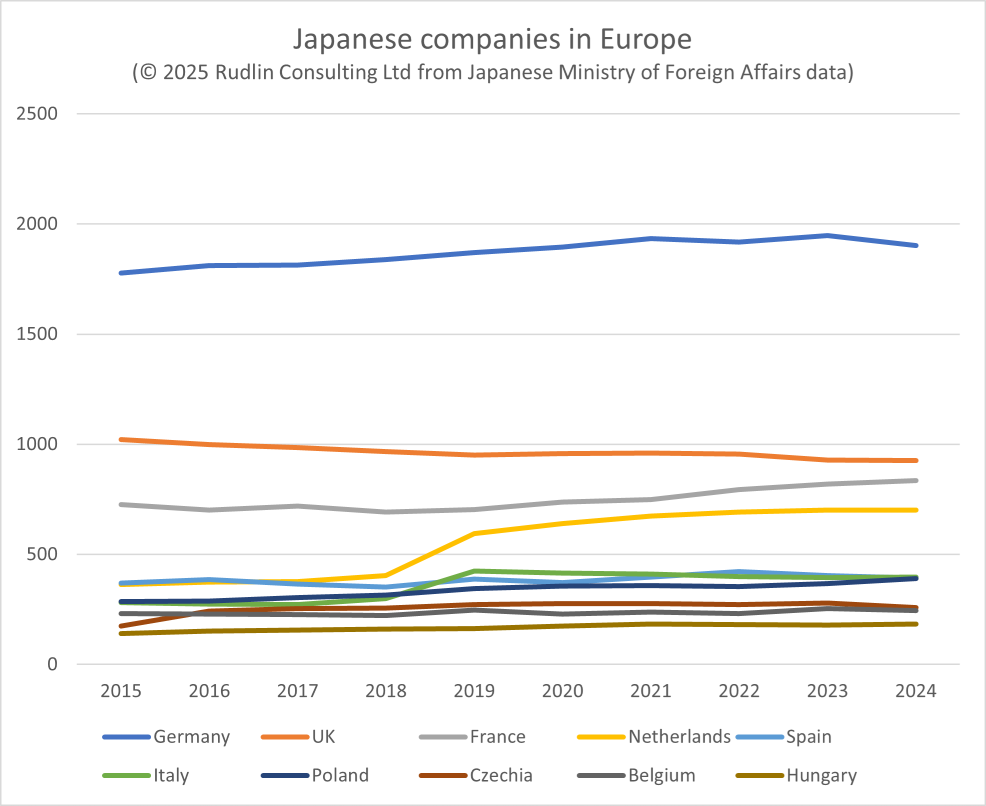
    1. The number of Japanese companies based in the UK has continued to decline since 2015, whereas there has been an increase in the number of Japanese companies hosted by other major European countries.

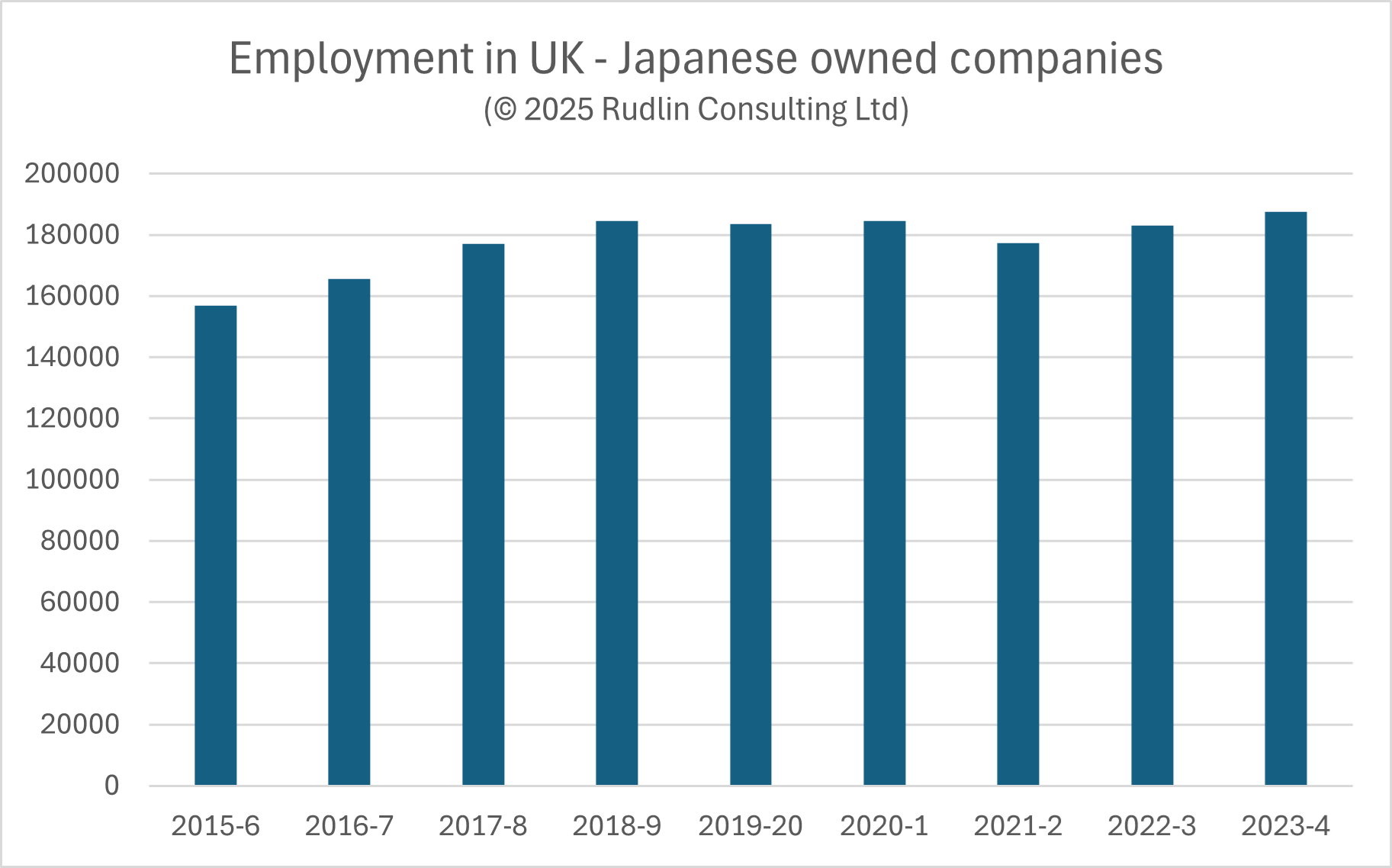
    2. The number of UK employees of Japanese companies has stagnated since 2018-9

    …with a small uptick in the past two years – resulting in a 20% net growth since 2015/6. This was lower than the overall growth in employees of Japanese companies in the Europe, Middle East and Africa region since 2015/6 which we estimate as being around 30%.

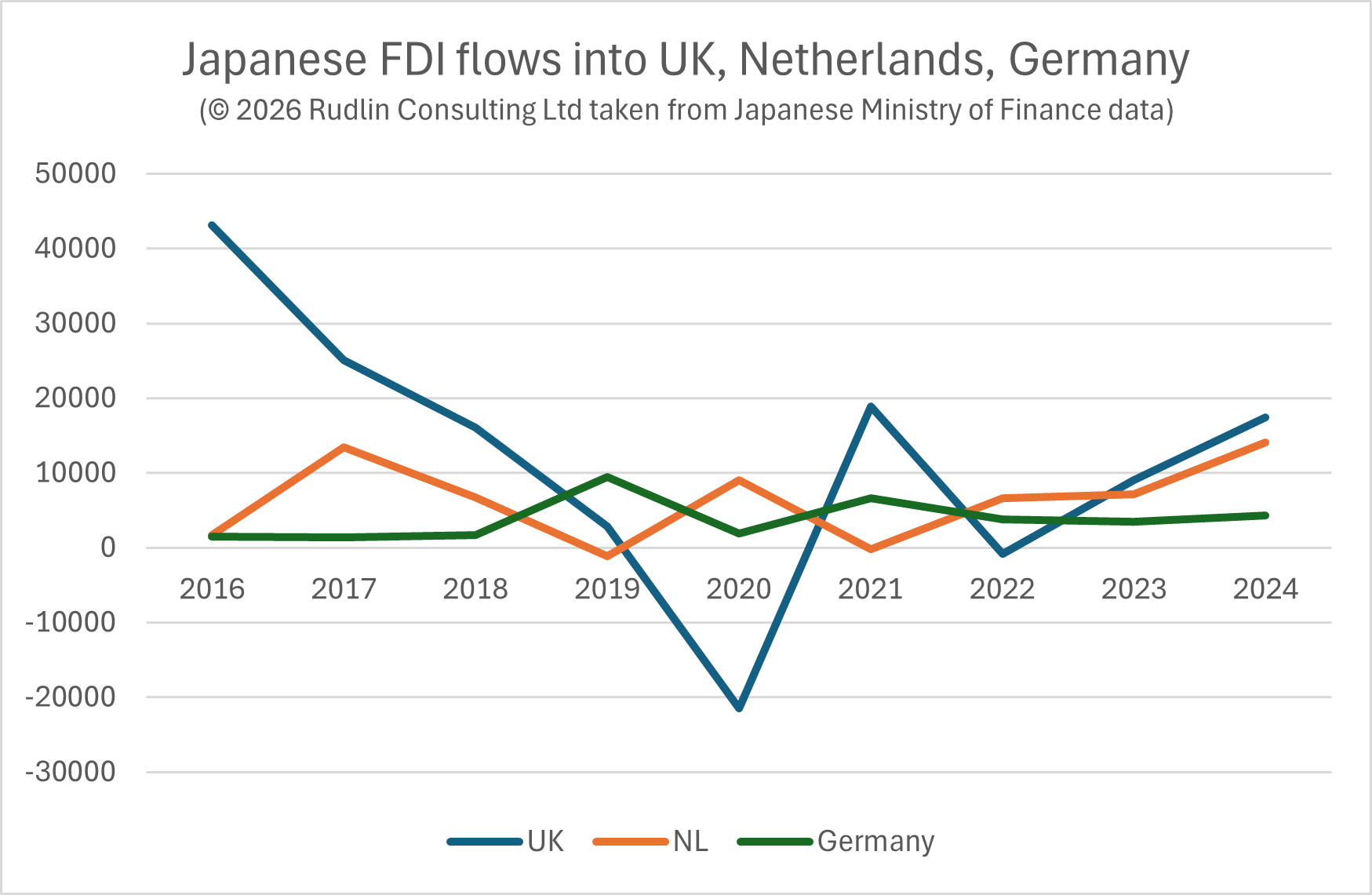
    3. Investment flows from Japan into the UK have decreased, with some disinvestment, but seem to be picking up again

    and the net flow over 2016-2024 was higher for the UK than for the Netherlands or Germany.

    Pernille then looked at sector by sector trends in the Japan Society webinar, for 2016-2021. Comparing this with what happened in the next five years to each sector will be covered in a later post.


  • Biggest European companies in Japan

    Biggest European companies in Japan

    Having looked at the largest foreign-owned companies in Japan in a previous post, we thought we’d take a look at the largest companies in Japan owned by European companies in more detail.

    By employee number, they are:

    1. Mitsubishi Fuso Truck – Germany (89.2% owned by Daimler), #3 overall, 10,633 employees
    2. Bosch – Germany, #10 overall, 5,254 employees
    3. Chugai Pharmaceuticals – Switzerland (59.8% owned by Roche), #12 overall, 5,026 employees
    4. AstraZeneca – UK, #17 overall, 3,700 employees
    5. IKEA Japan – Netherlands (yes, not Sweden, it’s owned by Ingka Group, which is a franchisee of Inter IKEA Systems B.V.), #19 overall, 3,602 employees
    6. NOK – Germany (25% owned by Freudenberg Group – maybe not strictly speaking foreign owned therefore), #21 overall, 3,337 employees
    7. DHL Supply Chain – Germany, #24 overall, 3,000 employees
    8. Compass Group Japan – UK, #26 overall, 2,684 employees
    9. Novartis Pharma – Switzerland, #30 overall, 2,600 employees
    10. GlaxoSmithKline – UK, #32 overall, 2,500 employees
    11. Louis Vuitton Japan – France, #32 overall, 2,500 employees
    12. Nestle Japan – Switzerland, #34 overall, 2,400 employees
    13. L’Oreal – France, #35 overall, 2,350 employees
    14. Veolia Jenets – France, #41 overall, 2,000 employees
    15. Phillips Japan – Netherlands, #43 overall, 1,942 employees
    16. DHL Japan – Germany, #45 overall, 1,900 employees
    17. Pioneer – Sweden, #46 overall, 1,859 employees
    18. SAP Japan – Germany, #49 overall, 1,727 employees
    19. Boehringer Ingelheim – Germany, #50 overall, 1,700 employees
    20. Valeo Japan – France, #52 overall, 1,660 employees
    21. Bayer – Germany, #56 overall, 1,591 employees
    22. Ichikoh industries – France (61% owned by Valeo), #60 overall, 1,485 employees
    23. Cap Gemini – France, #62 overall, 1,400 employees
    24. Sanofi – France – #65 overall, 1,334 employees
    25. Autoliv – Sweden – #66 overall, 1,332 employees
    26. Lush – UK – #67 overall, 1,300 employees
    27. Johnson Controls – Ireland, #70 overall, 1,282 employees
    28. Novo Nordisk – Denmark, #72 overall, 1,274 employees
    29. Sika – Switzerland, #80 overall, 1,136 employees
    30. ICON Clinical Research – Ireland, #85 overall, 1,000 employees
    31. NN Life Insurance – Netherlands, #87 overall, 975 employees
    32. Zurich Insurance – Switzerland, #89 overall, 946 employees

    = 33 BASF Japan – Germany, #92 overall, 920 employees

    =33 GKN Driveline Japan – UK, #92 overall, 920 employees

    35. Mahle Engine Components Japan – Germany, #96 overall, 880 employees

    36. Lacoste Japan – France, #98 overall, 851 employees

    37. Dassault Systems – France, #100 overall, 850 employees

    There are many missing names from this, so it is just indicative, based on whatever company responded to Toyo Keizai’s enquiries. but overall it seems that European companies represent around 37% of the largest foreign companies in Japan. American companies are around 46% of the largest foreign companies in Japan, with the remaining 17% being owned by companies from Taiwan, Israel, India, China, Hong Kong, Canada and Australia – plus Japan Display, owned by a company, Ichigo Trust, registered in the Cayman Islands, which is technically UK territory.

    10 of the 37 are German, 9 French, 6 British (or 7 if you count Japan Display), 5 Swiss, 3 Dutch, 3 Swedish, 2 Irish, 1 Danish. The missing major European economies are Italy and Spain. Judging by size of economy, the UK looks a bit underweight.

    8 are pharmaceutical manufacturers or clinical research related and the other main categories are automotive manufacturing/engineering and consumer brands.

    At least 6 (7 if you count Japan Display) are the result of acquisitions or at least a major investment in Japanese companies – Compass Group acquiring NKS for example.


  • Two swallows make a summer?

    Two swallows make a summer?

    We were somewhat sceptical when the Financial Times greeted Mitsubishi Corporation’s $1bn acquisition of Norwegian company Grieg Seafood’s salmon farms as being part of a record breaking acquisition spree by Japanese companies. It seemed that here in Europe at least, Japanese acquisitions had not really picked up momentum at all, compared to the pre Brexit and pre pandemic years.

    Then today it was announced that Yusen Logistics is spending $1.45bn on acquiring Dutch healthcare logistics company Movianto – subject to EU approval.  NYK, the parent company of Yusen Logistics, had already acquired a majority stake in Swedish company Northern Offshore this year and UK company Global Freight Solutions and Dutch company Parts Express last year. Movianto has around 5,400 employees in Europe, primarily in the Netherlands, France and UK.

    Although Mitsubishi Corporation has a long history of involvement in salmon and seafood, stretching back to the mid 20th century, as the Financial Times article points out, the acquisition of salmon farms represents a more general trend of Japanese food related companies strengthening Japan’s involvement in the food supply chain, from farming through to restaurant chains. The most recent entrants into our Top 30 largest Japanese companies are Fulham Shore (The Real Greek and Franco Manca restaurant chains, now owned by Toridoll) and Yo! Sushi, now owned by Zensho.

    Yusen Logistics is already in our Top 30 largest Japanese companies in the UK, with 1,863 employees. If Movianto UK remains an independent company rather than merged into Yusen Logistics, it too will be in the Top 30, with 1,354 employees. If they are merged, Yusen Logistics will be the 4th largest Japanese company in the UK, after Nissan, Fujitsu and Kwik-Fit (owned by Itochu).

    Both NYK and Mitsubishi Corporation are in the same Mitsubishi group of companies, who have been key players in Japan’s global supply chains for the past 150 years.

    Rudlin Consulting is the Europe, Middle East and Africa Representative of Japan Intercultural Consulting, which provides post-merger integration cultural training and consulting.


  • Biggest foreign companies in Japan

    Biggest foreign companies in Japan

    It all depends on what you mean by big, of course. And, it turns out, what you mean by foreign.

    Our favourite way of measuring size and growth at Rudlin Consulting has been by numbers of employees, because ranking by capital or turnover risks comparing apples to oranges. Taking a look at the rankings compiled by Toyo Keizai, the top 10 foreign companies in Japan in terms of numbers of employees are:

    1. Accenture (25,000 employees)
    2. Gibraltar Life Insurance (12,003 – US parent company Prudential)
    3. Mitsubishi Fuso Truck and Bus (10,633 – German parent company Daimler Truck)
    4. Metlife (8,569 US parent company)
    5. Prudential Life Insurance (6,169 US parent company)
    6. AIG (6,064 US parent company)
    7. Proterial (5,759 was Hitachi Metals, now owned by Bain)
    8. Sharp (5,603, now owned by Taiwan’s Foxconn/Hon Hai)
    9. Starbucks (5,505 US parent company)
    10. Bosch (5,254 German parent company)

    It’s interesting to note that the majority of these companies are services sector, particularly insurance companies. Three out of the four manufacturing companies were originally Japanese but have been acquired by foreign companies. Some of the life insurance companies have also built up presence in Japan through acquisition, but are also divesting. Bosch also acquired a few Japan owned businesses but also divested its stake in Denso.

    Toyo Keizai has not designated a nationality or parent company for Accenture, presumably because of being a federation of local partnerships. Similarly, EY and Deloitte should be in the top 10 as both employ over 10,000 but because of the partnership structure are not included in Toyo Keizai Rankings.

    The rankings by capital (not market capitalization) are dominated by financial services sector companies:

    1. Nippon Paint (now majority owned by Singapore based Wuthelam Holdings)
    2. Metlife
    3. IBM Japan
    4. BNP Paribas Securities
    5. Citigroup Securities
    6. Axa Life
    7. Goldman Sachs Securities
    8. Bank of America Securities
    9. Gibraltar Life
    10. JP Morgan Securities

    The rankings by turnover are:

    1. Sharp
    2. Nippon Paint
    3. Microsoft Japan
    4. Chugai (owned by Roche)
    5. Proterial
    6. IBM Japan
    7. Mitsubishi Fuso Truck
    8. NOK (owned by German company Freudenberg)
    9. Accenture
    10. Mercedes Benz

    60% of these companies were originally Japanese.

    Looking at all three rankings, it’s not surprising to see that these companies are long established in Japan.  Looking at the newcomers, and the sectors of the future, there is a clear trend of IT, systems and software companies entering the Japanese market,  primarily from the USA, but also France, Germany, Luxembourg, South Korea, Taiwan, Vietnam, and the UK. We’ve certainly seen a marked increase in enquiries for our services at Japan Intercultural Consulting from non-Japanese companies in this sector over the past couple of years. Japanese companies are embarking on digital transformation and further globalization, and the organisational change that this entails throws up plenty of cross cultural challenges both for the suppliers of digital technology and their clients.

    Japan Intercultural Consulting holds regular online seminars covering topics such as cross cultural communications, business trips to Japan and what Japanese customers want.