Category: Japanese business in Europe

  • Daikin continues to expand in Europe with new heat pump plant in Poland

    Daikin continues to expand in Europe with new heat pump plant in Poland

    Daikin has started construction of its new heat pump factory in Poland, its fourth plant in Europe. It will create 1,000 jobs by 2025 and 3,000 by 2030.

    Daikin’s European headquarters, in Belgium, announced last year that sales of heat pumps had increased 170% on the previous year, thanks to a push to reduce dependency on Russian gas.  It will also increase production in Belgium and Czech Republic.

    Daikin has over 11,000 employees in the EMEA region, making it the 24th largest Japanese corporate group in EMEA, up from 27 a year ago.


  • Mitsubishi Chemical to end methacrylate production in UK

    Mitsubishi Chemical to end methacrylate production in UK

    Mitsubishi Chemical UK has announced in its latest annual report that following a global review of Mitsubishi Chemical’s methacrylate business in October 2022, and a consultation with employees at its Cassell site in Billingham, UK, it will close the methacrylate production at the Cassell site. Over 200 jobs are likely to be affected.

    This is due to the “significant increase in natural gas prices” but also the downturn in the European economy due to high inflation and instability from the war in Ukraine having a detrimental effect on the demand for methacrylate monomers.  Mitsubishi Chemical has 10 other methacrylate monomer plants around the world and has also delayed an investment decision into a new methyl methacrylate plant in Louisiana, USA.

    Workers at Mitsubishi’s separate electrolyte business at the same site, which is used for electric vehicle battery parts, are not affected.

    Mitsubishi Chemical Group’s European HQ is in Germany. The group has 69,784 employees in total – with around 40,000 in Japan and 30,000 outside, of whom around 4,000 are in Europe, according to our estimates.

  • Japanese automotive supplier Nitto Denko to stop production in UK

    Japanese automotive supplier Nitto Denko to stop production in UK

    Japanese automotive supplier Nitto Denko is to stop production in UK and will turn its UK operation into a satellite office. According to their annual report this is due to the global decline in automotive markets, the pandemic, the semi conductor shortage and Brexit.

    Nitto Denko UK employed 138 people at a 2017/8 peak. This is now down to 50 in 2021/2.

    Nitto Denko’s EMEA headquarters in Belgium, with a turnover of 360 million euro in fiscal year 2019-2020 employing around 1,725 across Europe.

    Nitto Denko has manufacturing and converting operations in Belgium, Czechia, Hungary and Turkey and sales offices elsewhere, manufacturing and selling films, foam, fabric, sealing materials, reinforcing and damping materials and various kinds of industrial adhesive tapes which are used in worldwide markets such as automotive, electronics, furniture, paper production, aerospace and metal processing.

  • Toridoll expands restaurant business further in Europe

    Toridoll expands restaurant business further in Europe

    Tokyo listed food company Toridoll Holdings (owner of Marugame Udon + Wok to Walk) has acquired The Real Greek + Franco Manca owner Fulham Shore for £93 million.  It acquired 40% of UK based Shoryu Ramen in 2016 and Netherlands based Wok to Walk in 2015.

    Marugame Udon Europe’s headquarters is in the UK, employing around 100 people, with 11 restaurants. It has plans to open 150 restaurant outlets across Europe by 2027, creating 10,000 jobs.

    Marugame Udon had 7 restaurants in Russia, operating as franchises, but these seem to have disappeared from its network.

    Wok to Walk has restaurants in 12 European countries.

  • Nihon Nohyaku first acquisition in Europe

    Nihon Nohyaku first acquisition in Europe

    Nihon Nohyaku has acquired all shares of Interagro (UK) (13 employees), an agricultural materials manufacturer, through its UK subsidiary, Nichino Europe. The aim is to expand the business portfolio beyond synthetic agrochemicals, to become a leading company in life sciences.

    Nichino Europe is Nihon Nohyaku’s only subsidiary in Europe, employing 20 people in Cambridge. It has other overseas subsidiaries in Korea, Vietnam, Colombia, Brazil, India, Taiwan, China and the USA.

  • Koyo Bearings Europe changes name to JTEKT Automotive England

    Koyo Bearings Europe changes name to JTEKT Automotive England

    Koyo Bearings Europe in the UK has changed its name to JTEKT Automotive England. It decided in 2021/2 to stop serving European market and transfer some production to continental Europe. UK employees at Koyo Bearings Europe have fallen to 205 from 279 in 2016. Koyo UK has become JTEKT Sales UK and has 20 employees.

    JTEKT ‘s European headquarters is in the Netherlands, coordinating 28 subsidiaries across the region, employing 6,699 people in 2022 – of whom 365 are in the UK, across 4 subsidiaries.

    Koyo was the bearings brand name of JTEKT since Toyoda Machine Works and Koyo Seiko merged in 2006 to form JTEKT. Now all businesses and brands are being rebranded to JTEKT globally.

  • Top 30 Japanese companies in the UK – what’s changed over five years

    Top 30 Japanese companies in the UK – what’s changed over five years

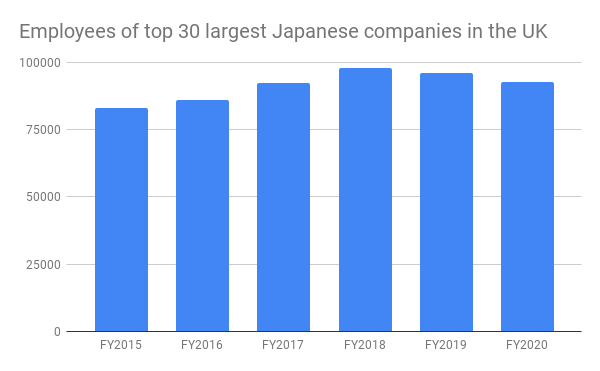
    The total number of UK employees of the top 30 Japanese company groups fell 2.6% from 2019/20 to 2020/2021 – a strengthening of the downward trend in employee numbers since 2018/9. The peak of employment by the 30 largest Japanese company groupings in the UK was 97,827 in 2018/9 and this has now fallen by 5,000 to 92,851 employees. The top 30 represent around two thirds of the 137,000 people employed by 1,200+ Japanese companies in the UK.

    It’s taken longer than usual to compile the top 30 Japanese companies in the UK for FY 2020, because some of the biggest employers have been very late in filing their accounts at Companies House. Like their Japanese parents, most Japanese companies in the UK run their financial year from April to March.  We are defining the financial year as the year in which the majority of trading took place. So if FY2020 ended in the first half of 2021, companies then have nine months to file with Companies House, which would mean filing at the beginning of 2022. Some companies (we are looking at you NEC) did not file until the beginning of 2023, however.  In most cases this seem to have been due to a mixture of the impact of the pandemic, coinciding with major acquisitions and restructuring.

    2020/21 was the first year after the UK left the EU, on January 31 2020, so it may seem too early to assess the impact of Brexit. But as has been noted in this blog many times before, Japanese companies are risk averse, long term planners, so actually many of the plans were already in place and in progress, largely based on worst case scenarios. There is also a longer term trend of a shift from manufacturing (particularly automotive manufacturing) to services, in terms of who is in or out, or up or down the top 30.

    Who’s shrinking

    The company groups with above average decreases in employee numbers were MUFG (-21.91%), Konica Minolta (-20.13%)  and Denso (-18.8%). MUFG Bank is a branch of MUFG Bank Europe NV, however, so there is no official figure for the number of employees in London. The decrease is largely based on the reports that MUFG offered 500 managers of its 1500 staff redundancy in 2019 and that this would have fed through by FY2020.  It’s perfectly possible, however, that MUFG were simultaneously hiring more staff in other areas. There are another 670 or so employees at MUFG Securities, which is incorporated in the UK and shares an office with MUFG Bank. There are a further 250 so in a separate London office housing Mitsubishi UFJ Trust, Trust and Banking and Asset Management. MUFG usually says it has “around 2000” employees in London.
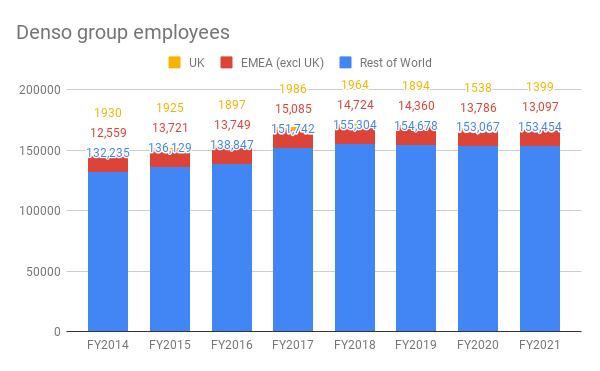
    Konica Minolta acquired various UK companies before Brexit, but since Brexit has shrunk down and consolidated its operations in the UK and is focusing more on their European HQ in Germany and also the Czech Republic.  The longer term trend of shifting away from manufacturing in the UK, to manufacturing elsewhere in Europe is seen at Denso, the Toyota group automotive parts manufacturer – UK employee numbers peaked in FY2018, and have been falling since, and are now 27.5% below the FY2014 level, whereas employment in the rest of the region is up 4.3% and global employee numbers, excluding UK, have risen 16% since FY2014.

    Who’s growing

    Company groups with the strongest growth over FY2019/20 to FY2020/21 were SoftBank, Mitsubishi Electric and Panasonic. SoftBank was fulfilling its promise to the Takeover Panel to double its UK workforce to 3,500 people in the UK after acquiring ARM in 2016, but it has recently become clear that it has since lost 40% of those it hired and there are now around 2,800 people at ARM in the UK. This will not be reflected until the 2021/22 reports.

    Mitsubishi Electric is also, like MUFG, a branch of a European HQ in the Netherlands, so the employee total is an estimate, but it employs nearly 1,500 people at its air conditioning company and factory in Scotland, which is a UK incorporated company.  Air conditioning has been a high growth area for several Japanese manufacturers in Europe.

    Panasonic‘s growth is due to the acquisition of American software company Blue Yonder, which has around 300 employees in the UK. The bulk of Panasonic’s employees are in Panasonic UK and Panasonic Business Support Europe, which are both branches of Panasonic Marketing Europe in Germany – in Panasonic UK’s case since 2011. The European HQ was moved from the UK to the Netherlands in 2018 and it has not been disclosed what the trends in employment in these UK operations has been since then. The website says it employs over 400 people in its Bracknell offices, which is considerably lower than the 1,389 employees it had in 2018/9. If these figures can be regarded as comparable, then Panasonic has actually shrunk in the UK over the past few years, despite the Blue Yonder acquisition.

    The top 3

    Less significant changes in employee totals have resulted in a reshuffle of the top 3. The Hitachi group was the largest employer in the UK in FY2020, taking over from Nissan, which dropped to #3. Itochu moved up from #3 to #2. In Hitachi’s case, the growth was at Hitachi Energy (the recently acquired ABB power grids business), Hitachi Solutions and what was Hitachi Capital. The latter may have to be dropped from the total in future years as Hitachi now only owns 27% of it, and it has been renamed Mitsubishi HC Capital.  Similarly 51% of Hitachi Construction Machinery is being sold to Itochu and Japan Industrial Partners, so it will leave the Hitachi group.

    Itochu has considerable presence in the UK thanks to its acquisition of Kwik-Fit, with over 5,000 employees in FY2020 and Stapleton’s Tyres, with over 1,000 employees. There were rumours that Itochu was considering the sale of Stapleton’s and Kwik-Fit in 2020, but nothing seems to have developed since.

    Key changes compared to FY2015
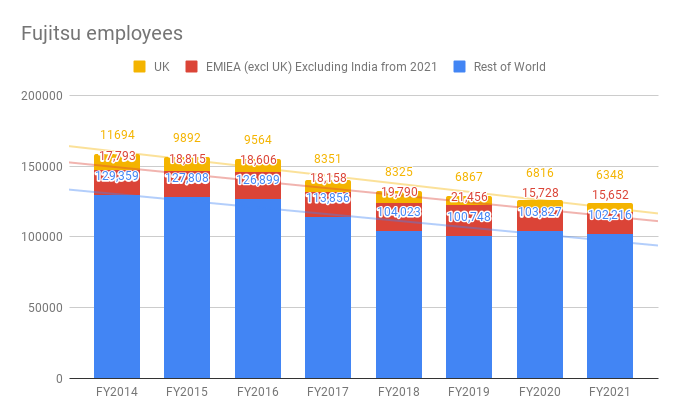
    Five years’ ago, Fujitsu was the largest Japanese corporate group in the UK, with 9,892 people. It has lost 3,000 employees since, and was the fourth largest Japanese group in the UK in FY2020. As of FY2021, Fujitsu has 6,348 employees in the UK, 45% down on FY2016, compared to a 21% decrease globally, excluding the UK.  Growth at Fujitsu has been in India (and Fujitsu’s CTO is Indian) and in its global delivery centres in countries such as Poland and the Philippines.

    Honda was at #3 in FY2015 and had already fallen to #5 by FY2020 – before Swindon closed in July 2021. The closure of the Swindon plant will mean that Honda drop out of the top 30.

    Companies that have dropped out of the top 30 since FY2015 include Calsonic Kansei, which is now Marelli, since merging with Italy’s Magneti Marelli, with KKR as the main shareholder. KKR is American, but it is KKR Japan that has the stake. Marelli has over 1,700 employees in the UK, so maybe we should keep it in the top 30. The Marelli website indicates the global headquarters is in Japan – but the management team has plenty of non-Japanese on it. It’s another example of how it has become increasingly complex to define what a Japanese company is.

    Another automotive company to drop out of the top 30 is Yazaki. It had 1,345 employees in the UK in FY2015, and now has 890. Olympus has just dropped out of the top 30, not due to shrinkage so much (it had 1,362 employees in FY2015 and now has 1,389) as other companies growing more. JTI (Japan Tobacco International) has also dropped out of the top 30, since the closure of its Gallaher factory in Northern Ireland in 2017.

    Newcomers to the top 30 over the past five years are:

    • NTT following their acquisition and consolidation of many IT services companies including Dimension Data, itelligence, Everis and Keane
    • Outsourcing, who have acquired various recruitment and outsourcing companies in the UK 
    • NEC, who acquired Northgate Public Services
    • Mizuho – who expanded organically – but total employees are an estimate, as Mizuho Bank is a branch of Japan

    Predictions for 2021/2

    Around two-thirds of the 1200+ Japanese companies in the UK have filed their annual reports for 2021/2.  The data from these reports suggests a further 10,000 drop (-7.6%) in employment numbers, from 137,000 to 126,000.  4,000 of this will be due to the closure of Honda’s Swindon plant, and a further 750 or so due to the closure of related automotive companies.  For the top 30, there looks to be an overall decline in employee numbers, apart from Toyota.

    There have been no major acquisitions in the past couple of years so we do not expect there to be any new entrants to the Top 30. The shift to services will continue, as will the increasing lack of transparency as to how many people are actually employed in the UK by Japanese companies, thanks to many of the UK operations becoming branches, with the shift of the regional headquarter functions to the EU.

    Click the link below for a pdf of the Top 30 Japanese employers in the UK:

    DOWNLOAD OF TOP 30 JAPANESE EMPLOYERS IN UK

  • Has the time come for Japan’s Nadeshiko Brand to include overseas female employees?

    Has the time come for Japan’s Nadeshiko Brand to include overseas female employees?

    The Japanese Ministry of Economy, Trade and Industry announced in October last year that they are revamping their their Nadeshiko* Brand – the annual selection of Japanese companies that are outstanding in their encouragement of the success of women in the workplace. As well as quantitative questions, this time they are asking more qualitative questions, on areas such as “whether the systems and measures to promote [women’s success in the workplace] are linked to management strategies.” The aim is to evaluate “whether each company has visualized a consistent story whether they are conveying information effectively throughout Japan and overseas”. The background to this change seems to be the increasing pressure on Japanese and other multinationals to be more transparent – for example making more disclosures of information such as the gender pay gap reporting requirement in the UK.

    I am wondering whether this evaluation will cover more than the communication of initiatives overseas. Will they also be including their overseas employees in their quantitative questions, and also in the systems and measures?  It has been a longstanding bugbear of mine that many Japanese companies publish plenty of information about the diversity of their Japanese workforce, but very little detail about their overseas employees. In the case of Japanese trading companies, they do not publish any figures on the numbers of people that are working at their overseas subsidiaries. It would seem they literally do not count.

    When I last took a look at the boards of the largest Japanese companies in the UK, in 2016, it was clear there were fewer women on the boards of Japanese companies in the UK than there were even in Japan.  I also found differences in the degree of national diversity – some boards in the UK were all Japanese (and almost all men), and some hardly had any Japanese on the board.

    Seven years on, there has undoubtedly been progress, of sorts. The pressures that I pointed to in 2016, such as the stricter demands from UK and other financial regulatory authorities on Japanese financial services companies to have more diverse boards or for Japanese companies who are public sector suppliers (Hitachi, Fujitsu) to be more diverse have worked.

    Fujitsu UK proudly points out on its website that it was one of the first companies to report on its gender pay gap, in 2017, since when, there has been a 44% reduction in the median gap to 10% and a 43% reduction in the mean to 9.6%. They have also published their first ever ethnicity pay gap, even though this is not a government mandated requirement.  They also have a female Managing Director for the UK, a first I believe. She and the former UK MD and the head of Global Legal (both male) are the three board members – there are no Japanese board directors. In 2016 there were 6 people on the board, all male, one of whom was Japanese. The board in Japan has also undergone an overhaul, as have many Japanese boards, with the governance laws mandating them to appoint external directors. Fujitsu Japan has only two representative directors, both Japanese males, and 6 external directors, two of whom are female and one is an American male (albeit a fluent Japanese speaker and permanent resident in Japan).  Fujitsu was a Nadeshiko brand in 2016, but not since.

    Daiwa Capital Markets Europe also recently appointed its first ever female CEO – who is dual nationality British/South African. There are nine members of the DCME board in the UK, five of whom are non executive directors and the majority of whom are not Japanese. Of the non-executive directors, 3 are female non-Japanese, 2 are male Japanese. The other three members of the board besides the CEO are one Japanese male in the UK, 1 Japanese male in Japan and one South African/British male in the UK, who is the Chair. The holding company for Daiwa Capital Markets Europe, Daiwa Securities, has been a Nadeshiko brand every year since 2013. Its gender pay gap in the UK is nonetheless quite high for 2021, above the financial institutions average of 32% for the mean, at 38.8% mean, 37.9% median. Perhaps this will change with the new CEO in place.

    The services sector has rather different challenges to the automotive manufacturing sector both in Japan and in the UK. In Japan, only Toyota group member Aisin is a Nadeshiko brand in the transportation equipment category. Nissan points out that 92% of its 7,342 employees, across manufacturing, design, parts and sales and marketing in the UK are male. Looking at their gender pay gap numbers, it’s clear that there is a higher proportion of women in bonus attracting, presumably white collar jobs and middle management, and a higher percentage of men than women are in lower paid blue collar jobs. Nonetheless, a gender pay gap of 6.4% median and 8.7% mean was identified. The UK boards of both the manufacturing and the sales and marketing side are 100% non-Japanese in composition, but no female representation. Nissan was named as a Nadeshiko brand in 2017 but not since.

    Presumably, as in previous years, the announcement of the FY2022 Nadeshiko brands will be made in March 2023. It will be interesting to see what has changed.

    * Nadeshiko is a Japanese flower that is also native to northern Europe  – “pink”, of course. 

  • Agritech – Japan and UK

    Agritech – Japan and UK

    I attended a celebration recently at the Japanese Embassy in London, to mark the ending of the British ban on the import of food and drink originating from Fukushima. Plenty of Fukushima sake and peach juice was served but it seemed to me that the large crowd of people who were attended were more keen to get their hands on the Fukushima food that was served. 

    Although Japanese food has become so popular in the UK, I doubt, given the distances and size of population, that the UK is going to become a significant market for Fukushima. The Japanese ambassador admitted as much in his speech, saying that the lifting of the ban by the UK had more of a symbolic significance, which he hoped would be noted by the EU and China.

    Similarly, it seems unlikely that British food is going to sell in any greater quantity to Japan than it did before the UK Japan Economic Partnership Agreement went into effect in 2021.

    Nonetheless, as two island nations, who are not as self-sufficient in food as we would like to be, we have challenges in common, which means we could find solutions together too. It is becoming urgent, as our currencies have weakened, causing imported food, fertilisers and energy to fuel food price inflation.

    There are differences, however. The UK is more self-sufficient than Japan, with about 54% of food needs met by domestic production, compared to 38% in Japan. Our main imports are of fresh fruit and vegetables, from the EU – much of it from the Netherlands – grown hydroponically and vertically in huge greenhouses.

    The UK could develop its own hydroponic vertical farming further, but the high energy costs of this are a barrier. Energy costs are also a barrier for Japan if it wants to grow its main food imports – wheat, soybeans and oilseeds – in this way. Japan has developed hydroponic vertical technology, for growing food such as lettuce – particularly in Fukushima to avoid having to use contaminated soil – and is now working on low energy solutions.

    Another area for collaboration is robotics. I noticed at the Japan embassy event that asparagus – considered to be a speciality of where I live in Norfolk – is also a speciality of Fukushima. Harvesting asparagus has become a problem in post Brexit UK – we can no longer easily hire cheap seasonal workers from the EU to do it. There are labour shortages in Japan too, and also in the Netherlands. As a result, all three nations are developing asparagus harvesting robots. The same technology can then be adjusted to cope with more complex produce.   

    A final challenge is to address the issue that hydroponically grown, robot harvested fruit and vegetables are not as tasty as traditionally grown and hand-picked fruit and vegetables. Agrichemicals and breeding of new strains may provide solutions to this. This may explain why, at the embassy event, I kept bumping into representatives of Japanese trading companies who have invested in these sectors in Europe.

    This article by Pernille Rudlin first appeared in Japanese in the Teikoku Databank News in October 2022

  • Who’s getting the biggest pay rises in Japanese companies in Europe?

    Who’s getting the biggest pay rises in Japanese companies in Europe?

    If you’re in Hungary, Poland or Romania and you’re working in construction or engineering or in IT for a Japanese company, you’re in luck.

    According to a survey by JETRO of Japanese companies in Europe, of the 857 organisations who responded, employees in Romania, Hungary and Poland are seeing pay rises of well over 7.5% to 8.5%, whereas employees  in Western European countries such as Italy, Finland and Sweden are getting less than 3%. Those countries with the largest numbers of Japanese companies – Germany, UK, France – are seeing pay rises ranging between 3.5 to 4.5%.

    The top three sectors with the highest pay rises were:

    • 2022/23: Construction/Plant/Engineering (6.25%), Communication/IT/Software/Information system/Digital services (5.95%), Rubber products (5.87%)
    • 2023/24: Other manufacturing industries (7.50%), Non-banking financial institutions (7.17%), Non-ferrous metals (6.00%)

    These seem to be indicators of where demand is the strongest and therefore competition for employees. We’ve heard quite a few cases of Japanese companies expanding in Romania recently, not only in manufacturing but also IT services and logistics. Hungary has been a hotspot for a while now, particularly in automotive manufacturing.