Sharp Corporation Chairman and President Tai Jeng-wu was the second in command at Taiwan’s Hon Hai when it acquired Sharp in 2016. His cost cutting organisational reforms have turned the company’s results around in a “V” shaped recovery. He is now hurrying ahead with restructuring the business portfolio. In an interview with Nikkei Business he says Sharp is “Japan’s treasure” and is at pains to point out how influenced he has been by Japanese teachers in the past. Japan and Taiwan continue to have good relations (reinforced by a common threat of China, hinted at in this interview with the dig at unfair competition from state owned companies), and many Taiwanese speak excellent Japanese.
He says that unlike Carlos Ghosn, he did not arrive at Sharp with a posse of executives. He feels that the reforms are still only half way but he wants to work alongside Sharp employees – rather than a top down imposed change.
Asked what was the problem at Sharp, he said “it is not for me to say, but I suppose the crisis occurred when there were problems with management in the 2010s – when people who have only had experience in one particular technical area or business become president. You need to have a general overview to be a top executive, so when there was a crisis they were unable to respond. How I fixed the $2.5bn loss was to cut costs by around $1.7bn and then cut back investments and with some transient profits, we were back in the black.”
Don’t be a big fish
“You have to develop people step by step. When I started at Sharp, I said when announcing my strategy that “Sharp should not be a big fish, but should aim to be a fast swimming fish”. So I kept asking every day for things to speed up. I set some rules for developing successors. I lowered the limit requiring presidential approval to Y3m ($27,000). That was to ensure I would be aware of all the company’s problems. I then increased the limit to Y20m ($184,000) in 2018 when I put the CEO structure in place and this year I increased the limit to Y100m.”
“I will stay on as chairman of Sharp until March 2022. My wife and family want me back in Taiwan though. All the time from 2016 I have been looking for a successor. I even asked a Japanese consultant to help, but I cannot find one. I want the successor to be Japanese – it doesn’t matter if it’s an internal or external appointment. Maybe it could be someone from Hon Hai even. They should be able to manage in the current harsh environment, covering a wide range of businesses and find synergy with Hon Hai. It is the second criterion that makes finding the right person difficult.”
Japanese managers became bureaucrats
“It used to be that Japanese management of factories and businesses were strong, and my teachers were all Japanese. But then Japan went into a recession and the founder managers all disappeared, and managers became bureaucrats. That is why management strength declined. Japan is now only strong in parts and materials. ”
Sharp’s employee levels are back to the same as before the management crisis. “There were two early retirement drives during the crisis, and a lot of good people left. Those who remained when I joined the company in 2016 were one of three types – highly capable and loyal, those who couldn’t find another place to go and those where were waiting to be pushed. I actually never cut employees. In fact we need to increase our employees – we had some influxes from when we took over Toshiba’s PC business and other M&A.”
“I am not a god, I just improved everything step by step”
“I renegotiated the contracts for solar battery procurement and saved around $100m. I have also brought the Sharp brand back in house for the US TV production business. A brand is like a person’s name. Selling it is wrong. During the crisis Sharp sold off its precious buildings for $188m and then spent $30m on out of date computing. I am not a god, I just improved everything step by step. I was taught to do Horenso (keeping bosses in the loop) and check everything thoroughly, not just sign off easily by Japanese teachers.”
I am now promoting management based on data, and a shift to B2B (business to business). B2C (consumer) business is currently 65% of our turnover, I want to make it 50/50. The structure of trade in B2C is unfair – companies like ours in a free trade country have to compete with state owned companies who don’t have to invest or write off so much. That is why Japan’s IT/electronic companies’ share is falling – it’s a structural problem. In B2B it is a fairer fight. W have built a good ecosysytem over many years, so we have a good chance.
A Rising Sun Alliance of Japanese electronics companies
“I think there should be a Rising Sun Alliance of Japanese companies. There are a lot of Japanese electronics manufacturers but I don’t see that they will merge -t here is too much pride. I do have to be careful as Hon Hai is not a Japanese company. I am reflecting every day on how to manage employees. If I am criticised, it is not just my, but Taiwan’s pride at stake.”
“Sharp will last over 100 years. It is a treasure of Japan. I would like the brand to last another 100 years. I come to the office every day before 7:00am and give a bow to the statues of the founders in the front entrance. Sharp is a treasure to me too.”
Nikkei Business comments that there is no doubting his sincerity and dedication – apparently he lives in a single man’s dormitory and walks round the factory at 5am in the morning thinking about Sharp. He is at pains to seem almost more Japanese than the Japanese in this. But, the Nikkei wonders, will this be enough to succeed in the new territory for him and Sharp of B2B platform business.
The headline number for Japanese nationals in the UK is deceptively stableconcealing a rise in permanent residents, overtaking those on long term visas as the majority
The UK has shifted from being a posting destination for corporate Japan and a place to study for Japanese students towards being a settlement destination for individual Japanese
Brexit accelerated trends in the UK that were already there, globally, since the Global Financial Crisis of 2008-9
The number of students who were Japanese nationals on degree courses in the UK of over a year declined due to financial issues, and the number of students who were Japanese nationals on shorter courses declined due to student visa regulations tightening
The decline in Japanese corporate expatriation is explained by cost (exchange rate and visa costs), access to the EU market and growth prospects
Overview
The headline number for Japanese nationals in the UK is deceptively stable: 63,011 Japanese nationals lived in the UK in 2011 and 62,270 in 2025. Underneath, the population has been transformed.
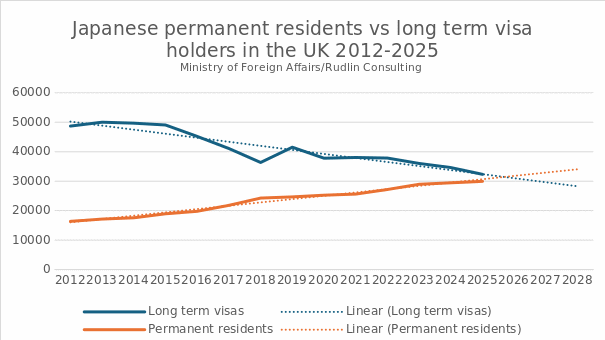
Long-term residents – the category that contains students enrolled in degree courses and corporate rotational staff and their families – peaked at 50,016 in 2013 and has fallen almost every year since the Brexit referendum, to 32,315 in 2025, a decline of 35% from the peak.
Permanent residents have moved in exactly the opposite direction, nearly doubling from 15,325 in 2011 to 29,955 in 2025. The UK has shifted from being a posting destination for corporate Japan and a place to study for Japanese students towards being a settlement destination for individual Japanese.
Between 2015 and 2018 – after the Brexit referendum was called, through the vote and the Article 50 uncertainty, but before COVID – UK long-term Japanese residents fell 25.9%, from 49,066 to 36,351. Over the same three years the equivalent population rose 3.5% in Germany, 8.7% in France, 31.8% in the Netherlands, 6.0% in Australia and was flat in the USA. The UK was the only major host country losing Japanese long-term residents in that window.
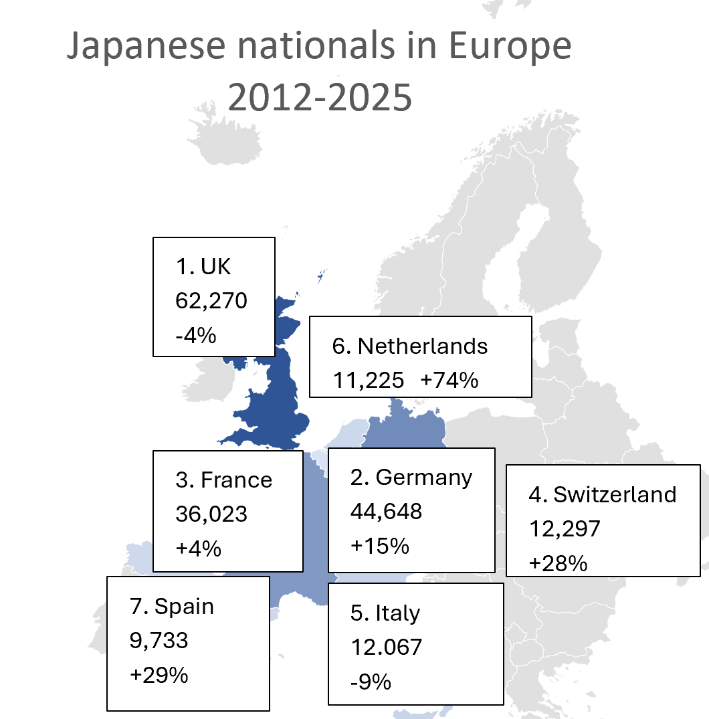
The UK continues to be the sixth largest host globally of Japanese nationals but the Japanese population in other large host countries such as Australia, Canada and Germany has grown by double figures over 2012-2025. Overall, the number of Japanese living overseas grew 4% during 2012-2025 but has been in decline since 2019.
Is Brexit the cause of Japanese nationals working or studying elsewhere? As we shall see, Brexit accelerated trends that were already there. The UK government was trying to restrain the number of foreign students coming to the UK even before the referendum, as a means to reduce total immigration numbers. These new restrictions undoubtedly impacted Japanese students, along with a weak yen in 2014-5.
The repeat of a weakening yen since 2021 and the rising expense and stricter criteria for working visas, added to the reduced attraction of investing in a post-Brexit UK as a gateway to the EU. This has undoubtedly caused the further decline in corporate long term visa holders.
Something impacted the UK more than the rest of the world 2015-2019
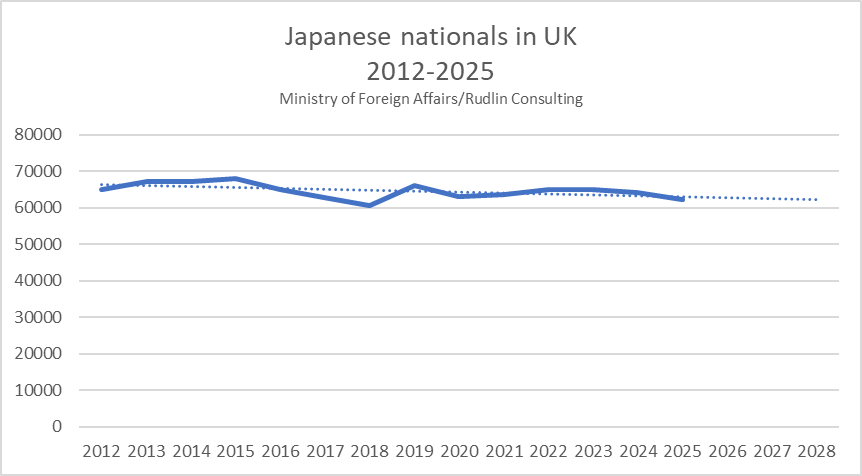
The total number of Japanese nationals in the UK shows a slow, bumpy decline of around 9% over the past 10 years. There was growth from 2012 to a peak of 68,000 in 2015, falling to just over 62,000 in 2025. There was some recovery around 2019 and again after the pandemic, but not back to previous levels.
Figure 1. Japanese nationals in the UK, 2012–2025 (total, with trend line). Source: Ministry of Foreign Affairs / Rudlin Consulting.
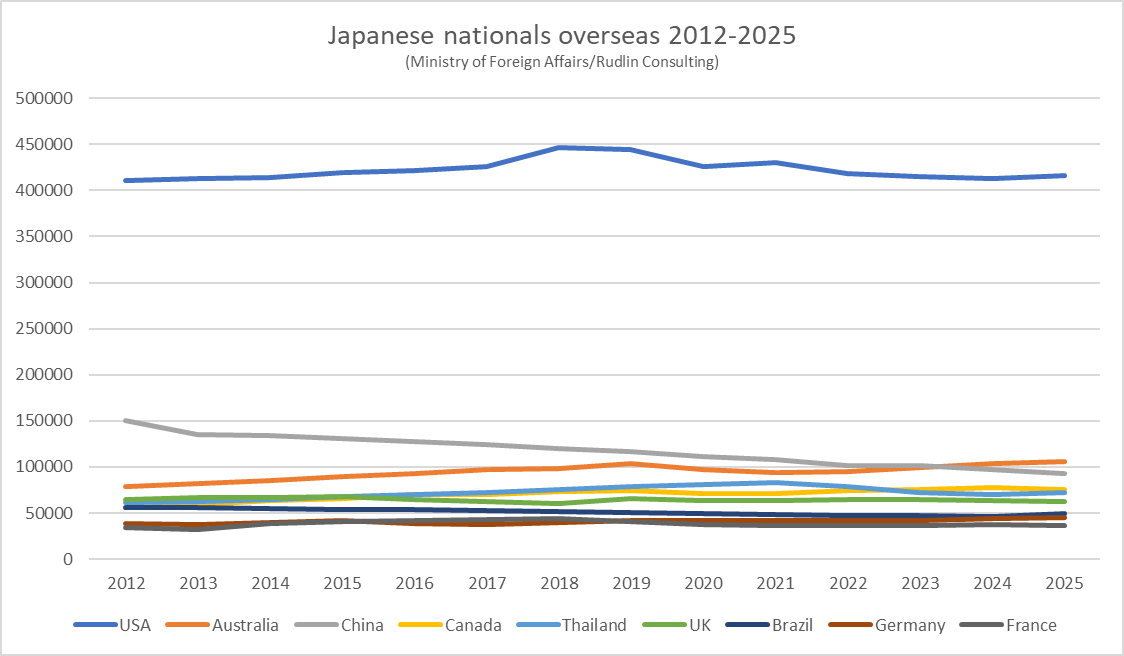
Looking at the global picture, there are some similar patterns to the UK, suggesting that there are global or at least Japanese domestic trends at play – such as its shrinking, ageing population and the weakening yen. The total of Japanese nationals living overseas grew every year to a peak in 2019 of 1.4 million, and then declined to 2024, only slightly recovering in 2025, to 1.3 million. This represented an 8% decline from 2019 to 2025, but only a 1.4% decline 2015-2025, compared to -9% in the UK over the same 2015-25 period.
The UK continues to be the 6th biggest host of Japanese nationals worldwide, but the total number of 60,000 or so is dwarfed by the USA, which has over 416,000 Japanese nationals, a decline from a peak in 2018 of 447,000 – a trend which is very similar to the trends in overall global totals.
The other major contributor to the global decline since 2019 in Japanese nationals overseas is the significant drop in Japanese nationals living in China. This has been in steady decline since 2012.
The decline in Japanese resident in China may be a combination of two factors – a maturity after the initial China boom, when Japanese manufacturing invested heavily in setting up operations in China, and also a sign of the deteriorating relationship between China and Japan, starting from when Japanese businesses were targets of demonstrations in 2012, and Japanese people, including women and children, being attacked in Chinese cities as recently as this year.
Figure 2. Japanese nationals in Europe, 2012–2025: leading host countries and their change over the period.
There has been consistent growth in resident Japanese nationals throughout the 2012-2025 period in Australia (+34%), Canada (+35%) and Germany (+15%).
Understanding why the UK has fared differently to fellow Anglophone countries such as the USA, Australia and Canada, and also other European countries such as Germany and France requires closer examination of the two major categories of residency.
Figure 3. Japanese nationals overseas, 2012–2025: the largest host countries.
Long term visa holders versus permanent residents
The two main categories used by Japan’s Ministry of Foreign Affairs for tracking Japanese nationals overseas are permanent resident and long term visa holder. Long-term visa holders mainly consist of corporate expatriates and students, academics and researchers and include anyone with a visa of 3 months or more in duration.
This latter category does not map directly onto UK visas, however. Academics coming to the UK to research, teach or attend conferences can get a standard visa of up to 12 months. Students coming for courses of under 6 months can enter the UK on a standard visitor visa, as can academics and researchers.
If we break down the total into these two categories, a strong trend emerges for Japanese nationals in the UK, which is that on current projections, the number of permanent residents will outstrip the number of long term visa holders in the near future.
Figure 4. Japanese permanent residents vs long-term visa holders in the UK, 2012–2025, with linear projections.
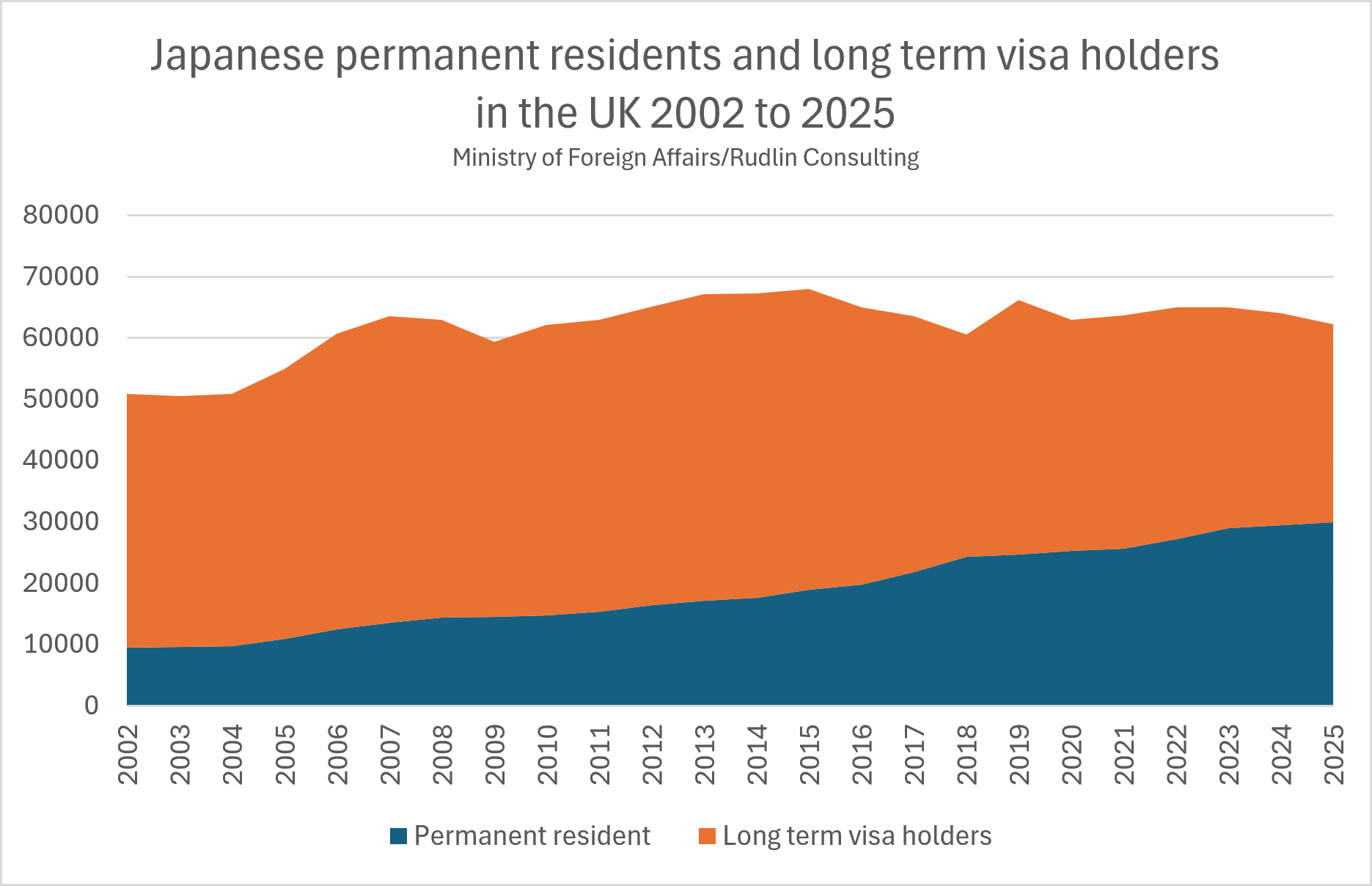
Looking back to 2002, it also becomes clear that the bumpiness in trends over the past twenty years are mostly due to changes in the numbers of long term visa holders, versus steady growth in permanent residents.
Figure 5. Japanese permanent residents and long-term visa holders in the UK, 2002–2025.
Again this reflects global trends for Japanese nationals – in 1991, 38% (251,000) of Japanese nationals overseas (663,000) were permanent residents. By 2025, 45% (588,000 – a record high) of Japanese nationals overseas were permanent residents.
Within Europe, the larger countries that now have more permanent resident than long term visa holding Japanese nationals are Sweden (since at least 1997), Switzerland (since 1999 ) and Italy (since 2023).
Globally, amongst the larger countries, Argentina, Australia, Brazil, Canada, New Zealand and the USA all have a majority of permanent residents amongst the Japanese nationals they host. This is partly down to historical factors – countries such as Brazil, Argentina and the USA were recipients of large numbers of migrants from Japan in the late nineteenth and early 20th centuries.
Many of the descendants of these migrants have retained their Japanese nationality and passports by birthright and only have permanent resident status in the country of their birth. Japan is one of the few countries in the world that does not allow dual nationality.
Conversely, the number of long term visa holders globally has declined from a peak in 2019 of 891,000 to 710,000 in 2025. This decline is apparent across all the major hosts of Japanese nationals, but the onset of the decline and the degree of recovery from the pandemic varies from country to country.
Long term visa holders are affected by exchange rate related expense, safety concerns and visa regulations.
For the USA there has been a 27% fall in the number of long term visa holders since 2012 and no signs of recovery since the pandemic.
For China, the fall is even more precipitous – 42% since 2012 , and the trend continued after the pandemic.
The number of long term visa holders in Thailand grew 27% overall since 2012, presumably as an alternative base to China, but has not grown since the 11% drop during the pandemic. Australia is the most positive story – growing 18% overall, and recovering since the pandemic with a 10% growth in long term visa holders over 2023-2025.
The decline in the number of long term visa holders in the UK is nearly as stark as China’s – an overall decline of 34% since 2012 including a 15% drop after the pandemic.
Why did the number of Japanese long term visa holders in the UK start to decline from 2015?
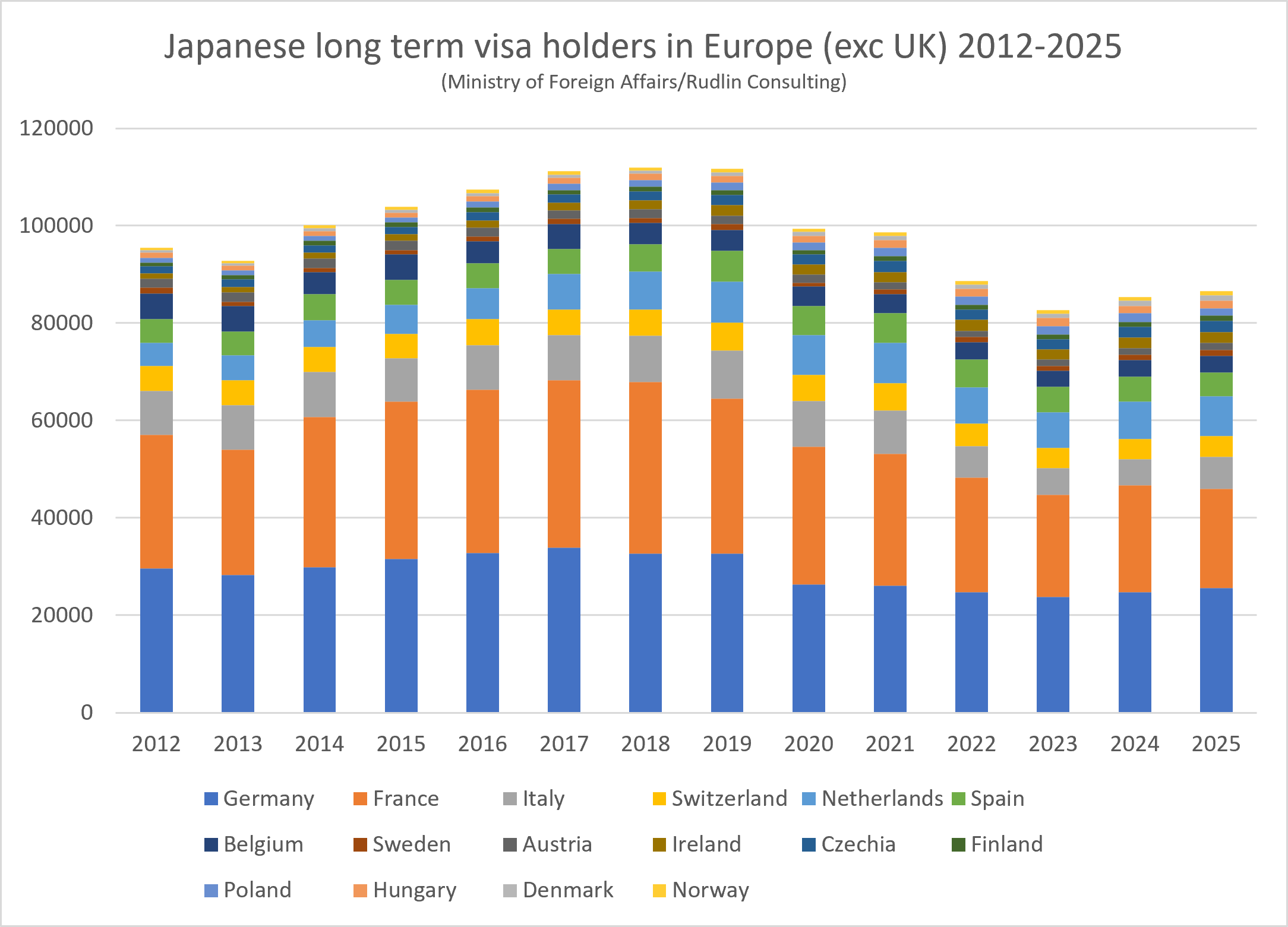
The number of long term visa holders in the UK held fairly steady from 2012 to 2015, at around 50,000. It then fell to 45,000 in 2016 and continued to fall to 2019, when there was a brief recovery, only to fall during the pandemic, with a continuing decline since.
For other European countries, however, the number of long term visa holders stayed stable or even grew 2015-2019 in Europe overall. Again, there was a drop during the pandemic, but some signs of recovery 2023-2025.
Figure 6. Japanese long-term visa holders in Europe (excluding the UK), 2012–2025.
Corporate expatriates vs student and academic visas
To analyse this difference between European countries further, we need to look at the two largest categories for long term visa holders – corporate expatriates and student and academic visas.
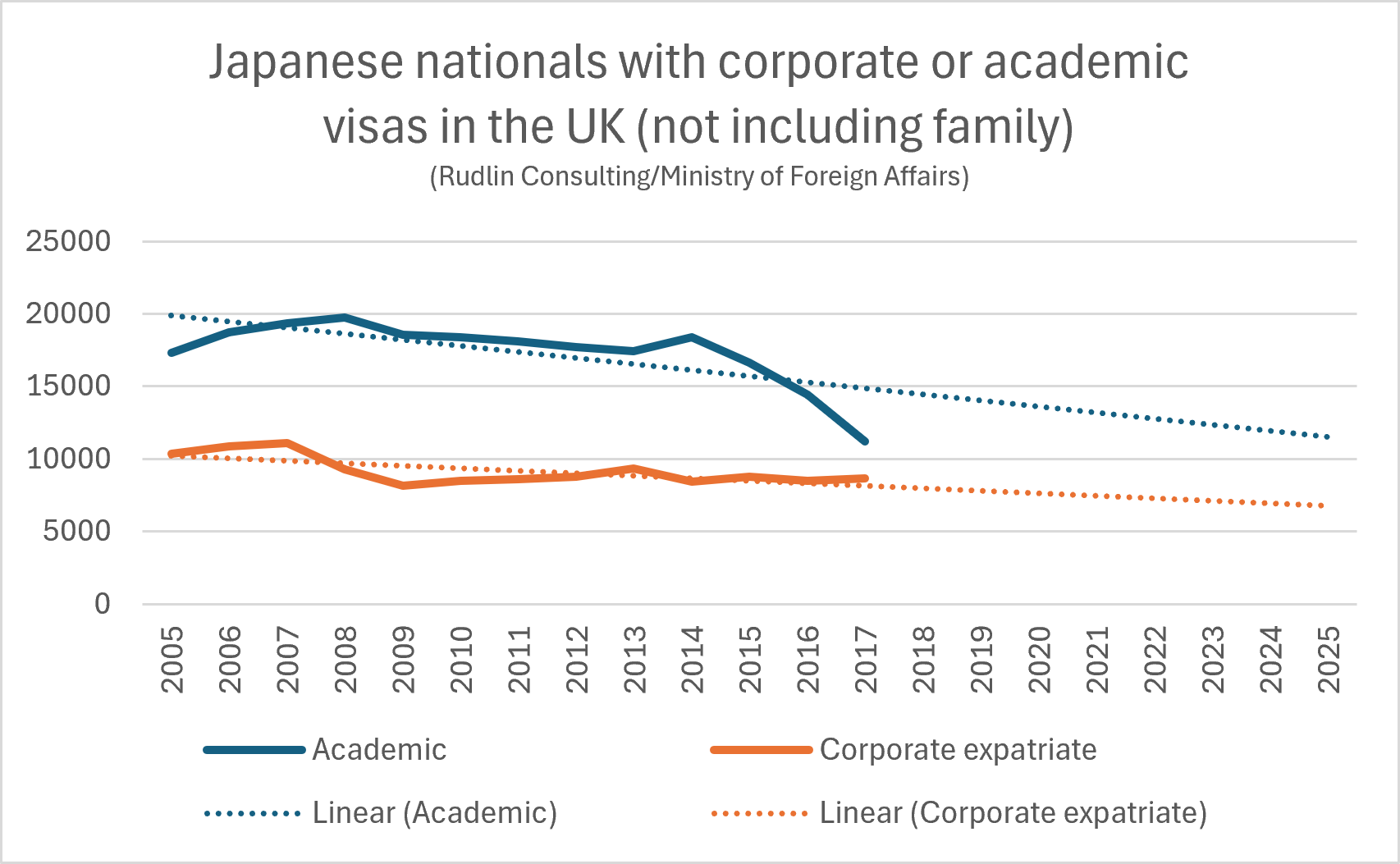
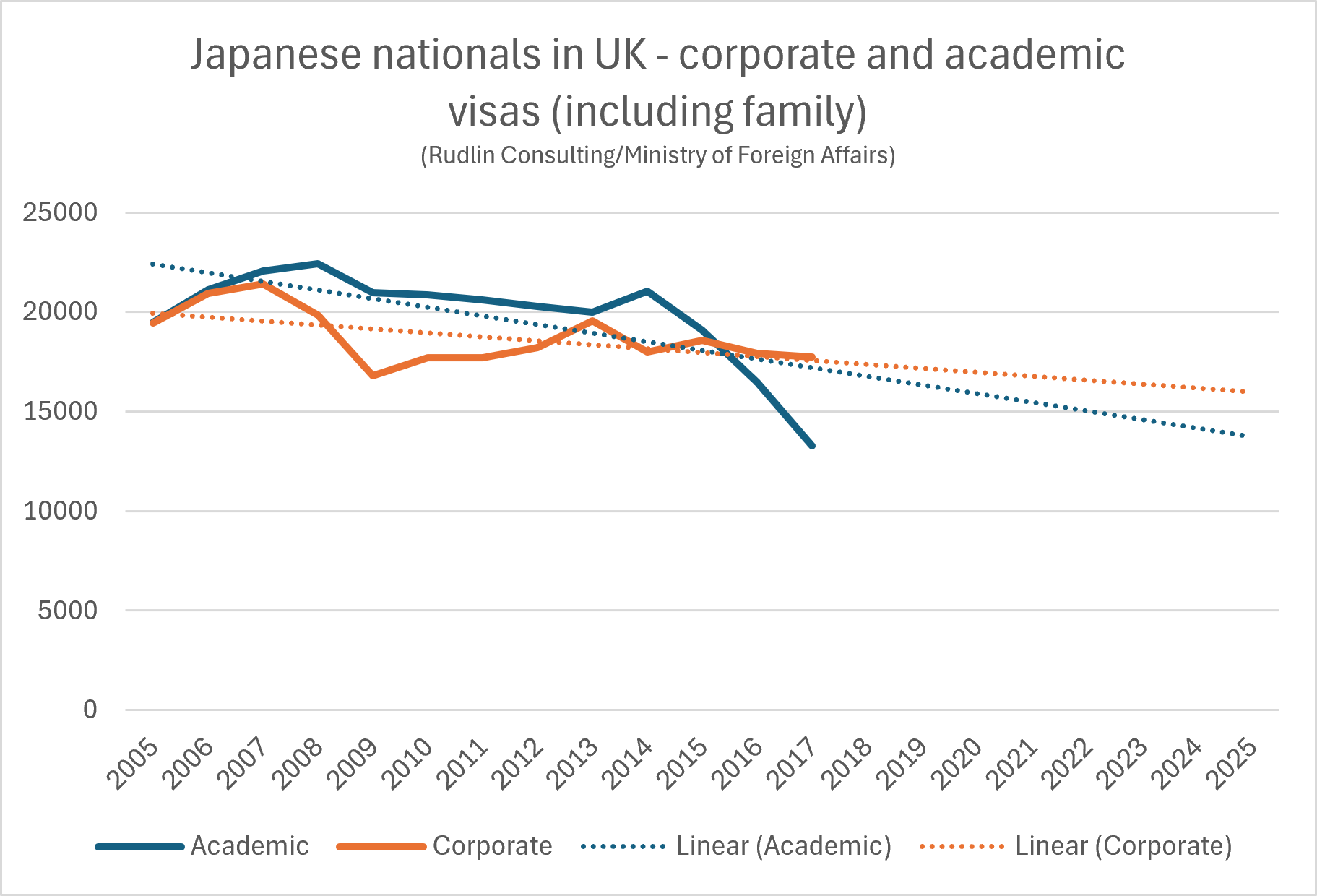
Unfortunately the Japanese Ministry of Foreign Affairs data only shows these categories by country for 2005 to 2017. We have added in a trend line for the UK charts below, and as can be seen, there was a significant drop in the number of academic visas from 2015 (preceded by a sudden rise the year before) and after a decline around the time of the Lehman Shock, corporate expatriate visas remained fairly steady to 2017.
The UK had been the second largest host of Japanese nationals with academic, research or student visas in 2011, after the USA. It lost the number two spot to Australia over the 2015 to 2017 period, when visa holders in that category in the UK fell by a third – from 16,636 to 11,189 (not including dependants). The UK was the only country out of the major hosts of academic visas to experience such a major decline in Japanese student numbers. Canada was not far behind the UK in 2017 and may well have overtaken it in the years after. France and Germany held steady.
Figure 7. Japanese nationals in the UK on corporate or academic visas (excluding family), 2005–2017, with trend lines.
If we add in the dependents and family they bring with them, then the picture looks like this:
Figure 8. The same categories including accompanying family.
The gender balance and dependants
One point to note is that around 66% of those Japanese nationals on academic or student visas were female in 2005 and 64% in 2017. 21% of those on corporate expatriate visas were female in 2005 and 26% in 2017.
There was only one dependant for every eight student or academic visa holders in 2005, and around one dependant for every five student/academic visa holders in 2017. This was significantly lower than for other nationals such as students from Nigeria (more than one dependant per student) or India – around 1 dependant for every three students. Whereas there was around one dependant per Japanese corporate expatriate visa holder throughout the same period.
It is also worth noting that around 70% of the dependants of corporate expatriates were female, reflecting the traditional pattern of the wife being the trailing spouse – or if the woman was herself on a corporate expatriate visa, being a younger, single woman.
For the academic and student visas, around 60% of the dependants were female, again perhaps reflecting that women students and academics tend to be single, whereas the male academics and students are often accompanied by their female partners and children. This may well have fed into the rise in Japanese permanent residents – a typical pattern being a single women coming to the UK to study, meeting a romantic partner and deciding to settle in the UK.
So what happened around 2015 to impact Japanese student, researcher and academic visa holders in the UK?
The changes to student visas introduced in 2015 would have had a strong negative impact on Japanese students who were looking to join English language school courses, foundation years or A-level or pathway programmes, as a Secure English Language Test was introduced – which had to be taken at a UK Visas and Immigration-approved test centre. There were only two such centres in Japan – in Tokyo and Osaka. Biometric identification was also required. Ordinary IELTS tests taken outside a UKVI-approved centre were no longer accepted for visa purposes; only the ‘IELTS for UKVI’ test counted.
The British Council’s research and JASSO analysis subsequently pointed to these changes as a contributing factor to the roughly 13% fall in Japanese exchange students to the UK between 2015/16 and 2016/17, a drop that the US and Australia — which did not impose equivalent restrictions — did not experience.
There was a transitional window, which might explain the upward blip in visas obtained in 2014 – to avoid the new regulations in 2015.
For degree level students there were no changes to the previous regime but the financial requirements were tightened. Students were required to demonstrate they held sufficient maintenance funds — tuition fees plus £1,020/month for London or £820/month elsewhere (for up to 9 months), held continuously for 28 days before the visa application. The abolition of the “established presence” provision meant students who had been in the UK for some time could no longer use a more relaxed evidential standard; everyone had to show the full funds upfront.
This would have impacted the Japanese nationals who had come over with their parents on a corporate expatriate visa, gone through the British education system and now wanted to study at a British university. A child of a Japanese and British parents can have dual nationality until they are 20, but would have to choose which one to keep at that point. Given the expense of international student fees, this may have motivated some of them to register with UK universities as a domestic British student.
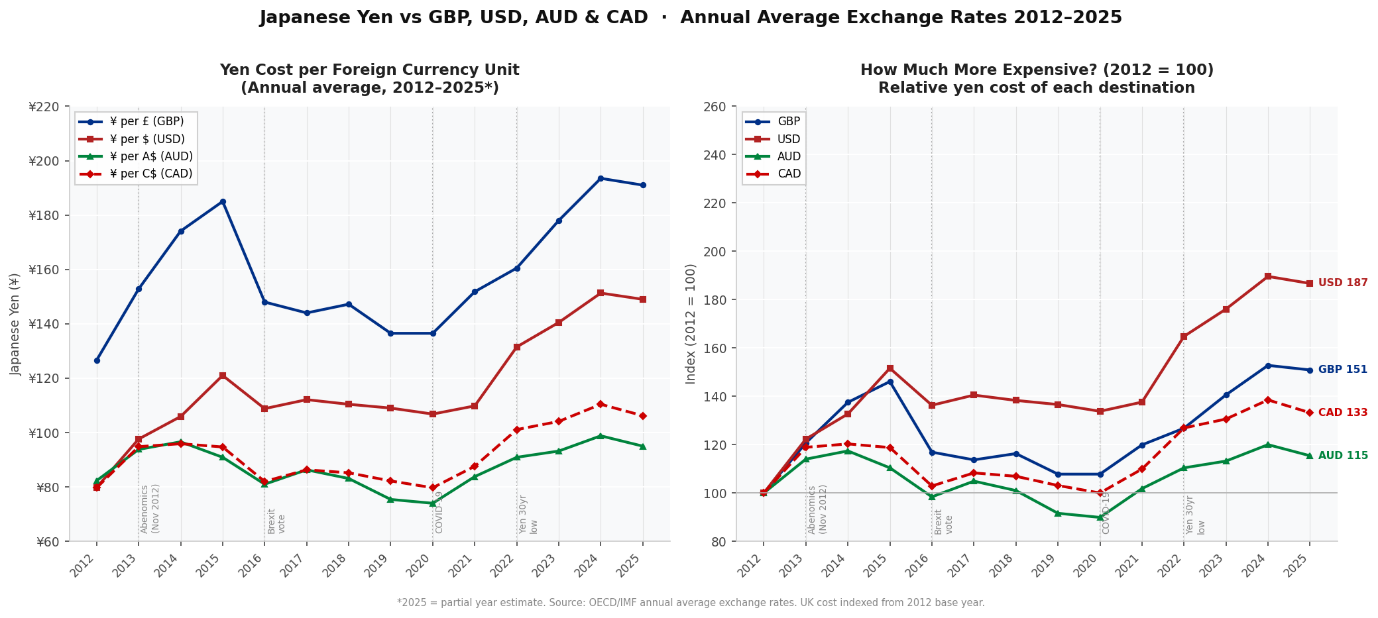
To add to the financial requirements, the Japanese yen had been weakening and approached ¥195 to the £ in 2015. It then strengthened against the £ in 2016-2020, but has since weakened again. It is notable that the yen did not weaken as much against the Canadian or Australian dollar.
Figure 9. The yen against the pound, dollar, Australian and Canadian dollars, 2012–2025 (annual averages; right-hand panel indexed to 2012 = 100).
It seems highly likely then that the number of students who were Japanese nationals on degree courses of over a year declined due to financial issues, and the number of students who were Japanese nationals on shorter courses declined due to student visa regulations tightening – or that those students may have switched to a standard visitor visa instead. Many students went to cheaper countries and courses.
What explains the decline in corporate expatriates?
While corporate expatriate numbers held steady from 2015 to 2017 at around 8,500 (principals only, not including dependants) or so, over the 2005 to 2017 period there was a 16% decline – compared to the 35% decline for academic and student visas – which mainly related to the 2015-2017 period. The peak for Japanese corporate expatriates in the UK was in 2007, at 11,000, dropping to 9,200 in 2008 and to 8,151 in 2009, then holding steady to 2017. It seems likely then that the first event to have a negative impact on Japanese corporate expatriation to the UK was the Global Financial Crisis of 2007-9.
As noted above, the publicly available Ministry of Foreign Affairs data stopped splitting long term visa holders into corporate and student/academic categories from 2017. It is hard therefore to estimate to what extent the steady decline in long term visa holders in the UK since 2019 was due to fewer Japanese corporate expatriates.
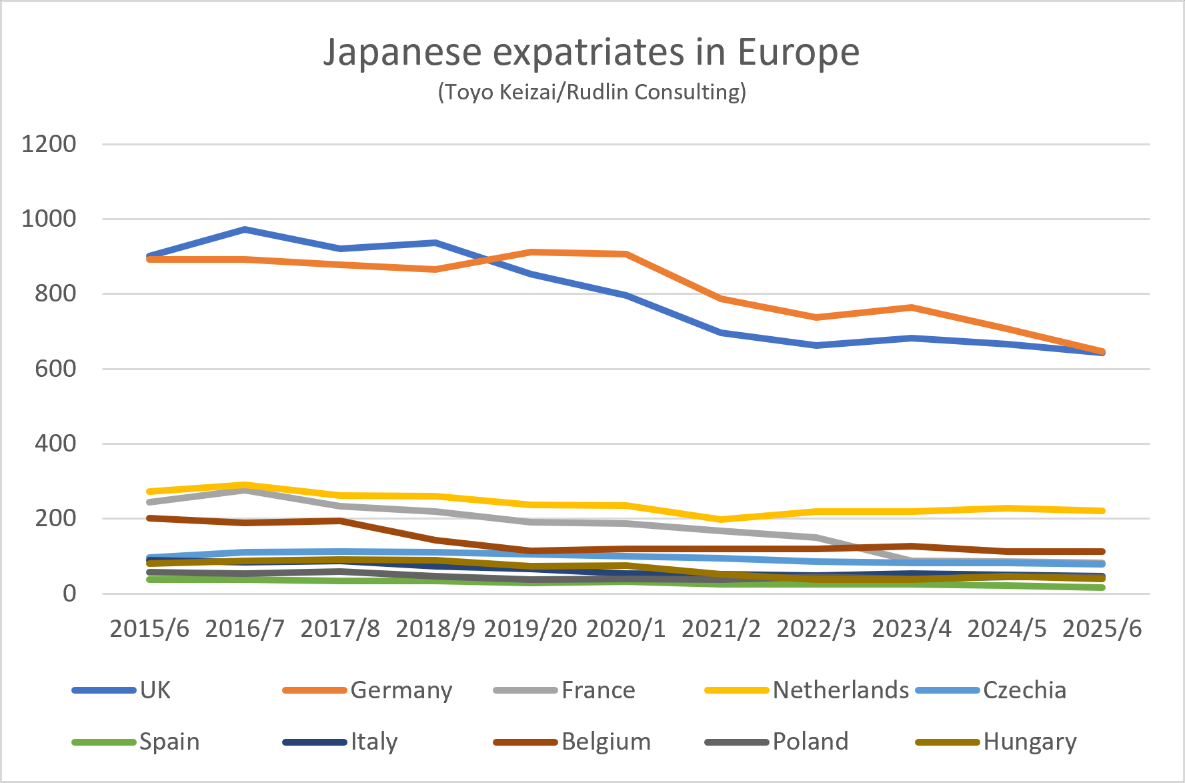
A further data source on Japanese corporate expatriates is the annual directory issued by Toyo Keizai. Their data gathering is reliant on companies completing their annual survey, so only shows part of the picture, but the response rate seems to be fairly consistent over the years, so may at least indicate the overall trends.
There was a decline of around a third across the main European hosts of Japanese nationals from 2015/6 to 2025/6. Germany (28% decline) overtook the UK (29% decline) as the top host in 2019/20 but is converging with the UK again. The decline in expatriate numbers was less steep in the Netherlands and Czechia and significantly higher than average in France, Spain, Hungary, Italy, Belgium.
Figure 10. Japanese expatriates in Europe, 2015/16–2025/26 (Toyo Keizai / Rudlin Consulting).
This seems to indicate that the impact of Brexit on the UK in terms of Japanese expatriates was in the context of an overall decline in Japanese expatriates to Europe, and the UK fared quite well. Our hunch is that the UK continued to be an important host for Japanese financial services sector companies and trading companies – who tend to have a large proportion of Japanese expatriates. The Netherlands fared better after Brexit due to the transfer of logistics and European functional hubs to the Netherlands, and Czechia probably attracted expatriates in the automotive sector.
In conclusion, there were three key factors impacting Japanese corporate expatriate presence:
Access to the EU market – the Netherlands, which combines EU membership with an English-speaking business environment, doubled its Japanese long-term population over the decade 2015-2025.
The cost of moving staff – the immigration costs for working visas to the UK rose sharply just as the yen weakened: the Immigration Health Surcharge rose 66% in February 2024 to £1,035 per person per year, the Immigration Skills Charge rose 32% in December 2025 to £1,320 per year for large sponsors, and the combined upfront cost of a five-year UK Skilled Worker visa (around £12,500) has been estimated at roughly ten times the average of comparable countries.
For a typical Japanese expatriate with a spouse and two children on a five-year posting, upfront immigration costs alone now exceed £30,000 – a real consideration when Tokyo HQ compares London with Amsterdam or Düsseldorf.
The final factor is economic growth. Japanese multinationals are in search of growth overseas, to compensate for their ageing, declining population at home. The UK is currently in a chicken and egg situation. Japanese foreign direct investment can help the UK to grow, but it needs to be assured that the UK is indeed a growth market.
Implications for policy makers
In the interests of attracting further investment from Japan, some kind of special arrangement could be made for reducing the costs of intra-company transfer visas. Any positive impact of this, however, would be dampened by the UK being outside the EU for market access, the overall decline in Japanese corporate expatriation and the UK’s attractiveness in terms of economic growth relative to other European countries and other regions. The major Japanese companies are already in the UK and unlikely to leave – but also unlikely to expand greatly regardless of incentives. The most likely newcomers will be the small to medium size Japanese companies, possibly more recently established and in new, emerging sectors.
The number of Japanese international students in the UK has always been relatively small compared to those of other nationalities, so it is unlikely that any move to encourage more Japanese students will be particularly controversial in terms of impacting immigration totals significantly. The Japanese government has announced that it is keen to encourage more Japanese students to study abroad, so would be open to such a proposal – and indeed agreements on Japanese scientific researchers transferring to the UK have already been signed. The weak yen is a major factor, however, which is out of the UK government’s control. There is pressure on the Japanese government to provide more funding for Japanese students to go abroad, to mitigate this.
Implications for suppliers to Japanese companies
The localization of Japanese companies’ senior management implies that the local decision makers and budget holders are increasingly locally hired Europeans or locally hired Japanese nationals with permanent residency. It may still be the case, however, that the final decision rests in Japan. In which case, having a presence in Japan, or making regular trips to there, will also be necessary part of the sales relationship.
For a sector by sector analysis of Japanese companies and their employees and the impact of M&A in the UK and Europe over the past 10 years, please see our next report.
It all depends on what you mean by big, of course. And, it turns out, what you mean by foreign.
Our favourite way of measuring size and growth at Rudlin Consulting has been by numbers of employees, because ranking by capital or turnover risks comparing apples to oranges. Taking a look at the rankings compiled by Toyo Keizai, the top 10 foreign companies in Japan in terms of numbers of employees are:
Accenture (25,000 employees)
Gibraltar Life Insurance (12,003 – US parent company Prudential)
Mitsubishi Fuso Truck and Bus (10,633 – German parent company Daimler Truck)
Metlife (8,569 US parent company)
Prudential Life Insurance (6,169 US parent company)
AIG (6,064 US parent company)
Proterial (5,759 was Hitachi Metals, now owned by Bain)
Sharp (5,603, now owned by Taiwan’s Foxconn/Hon Hai)
Starbucks (5,505 US parent company)
Bosch (5,254 German parent company)
It’s interesting to note that the majority of these companies are services sector, particularly insurance companies. Three out of the four manufacturing companies were originally Japanese but have been acquired by foreign companies. Some of the life insurance companies have also built up presence in Japan through acquisition, but are also divesting. Bosch also acquired a few Japan owned businesses but also divested its stake in Denso.
Toyo Keizai has not designated a nationality or parent company for Accenture, presumably because of being a federation of local partnerships. Similarly, EY and Deloitte should be in the top 10 as both employ over 10,000 but because of the partnership structure are not included in Toyo Keizai Rankings.
The rankings by capital (not market capitalization) are dominated by financial services sector companies:
Nippon Paint (now majority owned by Singapore based Wuthelam Holdings)
Metlife
IBM Japan
BNP Paribas Securities
Citigroup Securities
Axa Life
Goldman Sachs Securities
Bank of America Securities
Gibraltar Life
JP Morgan Securities
The rankings by turnover are:
Sharp
Nippon Paint
Microsoft Japan
Chugai (owned by Roche)
Proterial
IBM Japan
Mitsubishi Fuso Truck
NOK (owned by German company Freudenberg)
Accenture
Mercedes Benz
60% of these companies were originally Japanese.
Looking at all three rankings, it’s not surprising to see that these companies are long established in Japan. Looking at the newcomers, and the sectors of the future, there is a clear trend of IT, systems and software companies entering the Japanese market, primarily from the USA, but also France, Germany, Luxembourg, South Korea, Taiwan, Vietnam, and the UK. We’ve certainly seen a marked increase in enquiries for our services at Japan Intercultural Consulting from non-Japanese companies in this sector over the past couple of years. Japanese companies are embarking on digital transformation and further globalization, and the organisational change that this entails throws up plenty of cross cultural challenges both for the suppliers of digital technology and their clients.
Japan Intercultural Consulting holds regular online seminars covering topics such as cross cultural communications, business trips to Japan and what Japanese customers want.
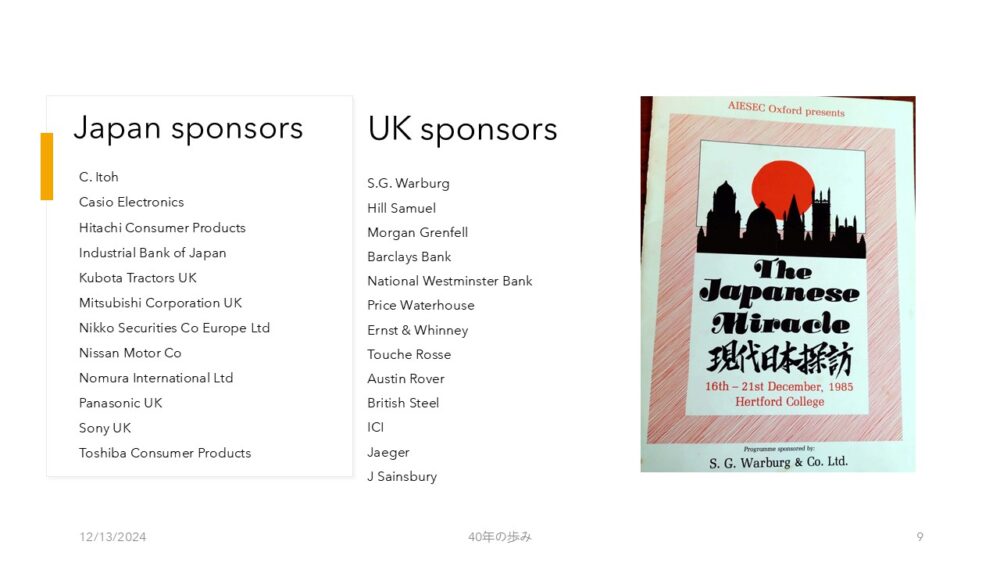
The Japanese Miracle was the title of a conference held by AISEC at Oxford University in December 1985. Japan’s economic success was beginning to be noticed, but often as a threat, with books starting to appear such as Japan as Number 1 and American unionists smashing up Toyota cars.
I joined the organizing committee of the conference, but am unnamed in the programme you can see here, as I was only a fresher, so was mainly used like a runner on a film set. The programme is a great snapshot of the influential people in UK-Japan business and political relations who were guest speakers, and features a long list of Japanese and British corporate sponsors.
On the Japanese side, the list is dominated by consumer electronics manufacturers – Hitachi Consumer Products, Casio, Panasonic, Sony and Toshiba Consumer products. My generation had grown up as teenagers with the Sony Walkman, a Panasonic or Sharp double cassette deck, Hitachi TVs and Casio calculators. The Zaikai (Japanese financial community) are represented by trading companies such as C. Itoh (now Itochu) and Mitsubishi Corporation and Nomura and the Industrial Bank of Japan. All of these companies still exist to this day – although the consumer electronics companies have shifted more to B2B.
Financial services companies featured heavily on the UK sponsor list, but very few have the same name or ownership structure as in 1985 apart from Barclays. Price Waterhouse is now PwC, Ernst & Whinney is EY, Touche Rosse is Deloitte. Austin Rover has become part of JLR, owned by an Indian company. British Steel is owned by a Chinese company. ICI was mostly acquired by the Dutch company AkzoNobel. Jaeger went bankrupt and is now just a brand owned by Marks and Spencer. The only company that remains pretty much as it was in 1985 is J Sainsbury. To quote Napoleon again, Britain is indeed a nation of shopkeepers.
These twopieces of research from Dr Sarah Hall (a professor of economic geography at the University of Nottingham and Fellow of UK in a Changing Europe) and Martin Heneghan confirm what we have seen in our own researches on Japanese financial services companies in the UK. There has not been as drastic a decline in numbers employed by Japanese companies in the sector as expected since Brexit, instead, it has been more of a slight increase, followed by flatlining.
We estimate the numbers employed in the UK by Japanese financial services companies was around 13,400 in 2015/6, rising by around 1,000 to 2019/20, dropping slightly in 2020/21 and then returning to 2019/20 levels the year after. It is hard to be precise about the absolute numbers and trend, as two of the three Japanese megabanks, who employ around 1,000 people each, are branches of their Japan headquarters, so do not issue annual reports in which employee numbers are reported. These two megabanks, Mizuho and MUFG, may come under pressure from the Bank of England to have subsidiaries in the UK too, according to recent rumours.
We estimate there are around 160,000 people employed by Japanese companies in all sectors, so the financial services sector represents less than 10% of this. As of June 2022, 1.06 million people were employed in the UK in the financial services sector in the UK, so Japanese owned companies only represent 1.3% of the total employed in the sector.
The other issue raised by the two pieces of research are whether other EU cities have benefited from any additional growth, which the UK has missed out on. As can be seen from the chart, Toyo Keizai data shows that there was an overall upward trend in the number of Japanese financial services companies in the European region, of around 12% from 2015/6 to 2022/23. The UK still dominates as a host, and the numbers of companies hosted rose 7% – so below trend. Germany doubled the number of Japanese financial services companies it hosted over the period. The numbers rose sharply in the Netherlands and then dropped. Just as Dr Hall’s research suggests, Ireland, Luxembourg and France seem to have benefited, albeit from a much smaller base.
Toyo Keizai breaks down the sector into banks, trust banking, securities, investment trusts and advisory, commodities, lending and credit, leasing and investment businesses, as well as life and non life insurance and “other” finance. “Other” finance is the sector which showed the most growth for the UK – perhaps fintech and less traditional financial services are included in this. For Ireland the leasing sector, particularly aircraft leasing, is a growth area. Germany now hosts four Japanese securities companies, from none in 2015/6. The growth and then decline for the Netherlands seems to have been mostly in investment businesses. Luxembourg has gained one or two companies across all sectors.
Given that the rather nebulous “investment businesses” and “other finance” are the two biggest sectors, showing the most growth along with leasing, we agree with Dr Hall’s conclusion that “given the complex interplay of these two factors, we suggest that far from being done, Brexit is being played out within a sector that is itself in a period of profound flux and hence it is likely to be some time before the full impacts of Brexit of UK financial services, and their consequences for wider economic growth, are fully understood.”
Our list of the 94 Japanese financial services companies in the UK, giving their full name, city or town of location, number employed, description of financial services offered and ultimate parent company is available for £10+VAT. Please email us for an invoice.
The annual survey by JETRO of Japanese multinationals shows that many are struggling to return to pre-COVID levels of profitability. 65% of the 7,000 companies surveyed expect to be profitable by the end of FY 2022 (March 31 2023) but the automotive parts sector is forecasting widening losses.
Expectations for profitability are slightly higher in Europe than the global average and within the region, on a country by country basis, business prospects are overall more positive for Japanese companies in the Netherlands and Germany than for those in France or the UK. On the other hand, due to logistics, procurement and energy costs, 35% of Japanese manufacturers in Eastern Europe are expecting their business prospects to worsen, only just balanced out by the 36% who expect their business prospects to improve. Increasing labour costs and hiring and retention even outweigh the impact of the Ukraine war for Japanese companies in Europe as the key challenge. This is also seen as a challenge in Western Europe, but with more focus on white collar, managerial workers, particularly in Germany and the Netherlands.
More than 70% of Japanese companies in the Netherlands, UK, Germany and UAE are expecting to achieve profitability in FY2022. However only 37.9% of companies in the region expect profits to improve, 11.8% lower than 2020/21. More than half of the Japanese companies based in Finland, Ireland, Italy, Sweden, Czech Republic and Portugal are expecting profits to improve – compared to 46.7% of Japanese companies in the Netherlands, 44.4% in the UK, 38.1% in France, 36.4% in Germany, 35.3% in UAE and 31.1% in South Africa. Manufacturers in the UK, having not recovered as quickly as in the rest of Europe from the pandemic, are now more optimistic about profitability for 2022/23 than other manufacturers in the region.
45% of Japanese companies are expecting to expand their business in their region over the next 1-2 years, but do not expect to return to full pre-COVID levels because of rising costs. One bright spot is increasing investment in the human resources and hospitality sectors, thanks to the lifting of coronavirus restrictions.
Within EMEA, more than 50% are expecting to expand their business in Denmark, Portugal, Switzerland, Italy, Spain, Ireland and Romania. When asked about expanding “functions”, Germany, UK and the Netherlands were the top 3 for expanding sales functions, Germany, Netherlands and Czech Republic for expanding manufacturing and Germany, France, Spain, UK and Belgium were top for R&D. Overall, particularly for the UK, the mood seems to be “keeping things as they are”
Trade
Over 50% of Japanese companies in the UK say that Brexit has had a negative impact on their business, mainly due to (in rank order) increased customs clearance processes, delays and costs of logistics, imposition of tariffs, responding to new UK regulations (eg the CE vs UKCA mark), customers leaving the UK and difficulties in hiring. 40% of Japanese manufacturers in the UK say they are experiencing problems in exporting to the EU.
37.9% of UK based companies say they are using the EU-UK Trade and Cooperation Agreement for their exports to the EU, 12.9% up on the previous year. The main reason given for not using it was that their exports were already tariff free, or did not fall within the agreement. The main challenges in using the TCA were setting up their own internal systems, getting the cooperation of EU based suppliers or customers and interacting with customs. Securing human resources was cited by 50% of the Japanese companies in the UK as a negative impact of Brexit (61.5% for manufacturers), compared to only 9.8% of Japanese companies in the EU saying they were concerned about this as a result of Brexit.
49% of Japanese companies in the EU are using the EU Japan Economic Partnership Agreement for importing from Japan to the EU and 34% are using the agreement to export from the EU to Japan. More than half of Japanese companies in Austria, Italy, Czech Republic, France and Spain are using the EPA to import to the EU. The sectors with the highest use of the EPA are chemicals, wholesale, foods, plastic products and transportation equipment.
Localization of supply chains and staff
60% of Japanese manufacturers globally are expecting to review their supply chains in the future months. Localization of procurement, production and sales is accelerating due to rising raw material and transportation costs and the emergence of supply chain disruption risks. Within Europe, 48.2% of all companies have reviewed their supply chains and 55.5% expect to review them in the coming year.
In Europe, however, there is more interest in localising procurement within the EU than within the country of location. 21.4% of Japanese companies in Western Europe, 32.1% of Japanese companies in Central and Eastern Europe and only 9.5% of Japanese companies in the UK are expecting to increase domestic procurement, whereas 34.3% of Japanese companies in Western Europe and 45.8% of companies in Eastern Europe are expecting to increase their procurement within the EU. No UK companies are expecting to increase their procurement from the EU and no Eastern European Japanese companies are expecting to increase their procurement from the UK either.
Around 20% of European companies are expecting to increase procurement from Japan, but significantly more (around 35%) are expecting to increase procurement from ASEAN countries.
Japanese companies are also planning to reduce the number of expatriate staff sent from Japan, and increase the number of locally hired staff, particularly in Asia. The pandemic has accelerated the ability to manage the business remotely, from Japan. Within EMEA, 28.9% are expecting to increase their Japanese expats to the Netherlands, compared to a 22.1% increase to UAE, 19.3% increase to Germany, 18.1% to the UK and 13.3% to France and 6.6% to South Africa. 13.3% are expecting to reduce the number of Japanese expats in the Netherlands, 12.4% in Germany, 6.4% to the UK, 16.7% to France.
In terms of hiring more local employees, Japanese companies in Germany came top with 44.3% wishing to do so, then South Africa with 39.5%, Netherlands with 38.9%, France with 37.7%, UK with 36.1%, UAE with 35.9%. 10% of Japanese companies in Germany and the Netherlands were planning to reduce local staff numbers, compared to 11.3% in the UK, 9.8% in France, 9.3% in South Africa, and 4.9% in the UAE.
Whereas automation and reduction of the workforce had been a top priority for manufacturers before 2020, while this is still at number 2, the top priority for the next few years is investment in new equipment and new projects. The third highest priority is revising manufacturing location. The reasons underpinning these priorities are the need to optimise production costs, the high cost of labour and the high cost of raw materials.
CSR and supply chains
A third of Japanese multinationals are doing due diligence on human rights in their supply chains, particularly in Europe, where regulations are being introduced. 46.2% of Japanese companies in the UK are already doing due diligence – compared to 42.9% in France, 30.3% in Germany and 23.2% in the Netherlands. Sectors which are particularly concerned with human rights are mining and minerals, plastic products, non ferrous metals, textiles, construction and foods.
42.4% of Japanese multinationals have started taking steps to reduce their carbon emissions, 9% up on the previous year. 20% of Japanese companies are proceeding with “green procurement” for their suppliers. Portugal, Switzerland, Ireland, Austria, Spain and France score particularly highly in terms of taking steps to reduce carbon emission with over 70% of companies in those countries already having done so, compared to 63.6% in South Africa, 58.3% in the UK, 55.2% in the Netherlands, 51.5% in UAE and 50% in Germany.
Actions taken include reducing energy usage, using more electric power, using more renewable or new energy sources, with solar being the most popular. Other actions have included developing new environmentally friendly products, green procurement and revising procurement and logistics. The interest in green investments is at a record high, greater than digital investments or eco friendly transportation or tourism.
Sales
The most promising sales destination for Japanese companies in Europe continues to be Poland, for the fourth year running. Turkey has overtaken Germany for the first time in 7 years and the UK is back in the top 10. Other Eastern European countries in the top 10 are Hungary, Czech Republic and Romania – mainly for their economic growth prospects. The other Western European countries in the top 10 are France, Italy and Spain.
Japanese companies in the UK are showing an increasing focus on the UK domestic market for their sales, with an average of 49.4% of sales to the UK market, 2.4% up on 2021/2, compared to a European average of domestic sales of 37.7%. UK companies are selling on average 16.5% of sales to EU countries, compared to 37.6% of sales to other EU countries (excluding their own country) for Japanese companies located in the EU. Unsurprisingly, Japanese companies in the UK have become more UK oriented since Brexit, as many of the EU sales and coordination functions have shifted from the UK to the EU – and is now potentially stabilising after the sharp decline over 2019/20 to 2021/2
Although the proportion of sales to non-EU Europe (presumably Norway, Switzerland, maybe Turkey) is higher for the UK (16.3%) than for Europe overall (4.4%), there is not much evidence that the UK is being used as a base for sales outside Europe – the proportion of sales to North America (1.7%) or China (1.3%) is actually slightly lower than for the whole of Europe. Sales to Japan have been falling steadily since 2019 (possibly related to Honda Civic sales to Japan). The proportion of sales to “other” countries is higher – 8.5% compared to 6.5%, perhaps showing that some Japanese companies in the UK are indeed Europe, Middle East and Africa headquarters, with sales focused more on the latter regions. ASEAN only accounted for 1% of the 7% of sales to other countries in 2019/20.
Hybrid working and pay rises
European employees of Japanese companies are not returning to the workplace at anything like the rate they are in South West Asia, North West Asia or ASEAN. During 2021, 14.6% of Japanese companies in Europe said that 90% or more of their employees were working at their office or factory and only 29.6% were expecting this to happen in 2022/3 in Europe. In Asia, around 30% of companies said their over 90% of employees were working at the office or factory in 2021 and this is expected to be near to 70% in 2023. This may reflect that there are proportionately more manufacturing companies in Asia than in Europe.
In terms of reviewing management and personnel policies and structure, by far the most popular choice for review was human resource development and training – chosen by 61.6% of Japanese multinationals. Second was reviewing working from home policies, at 35.3%, closely followed by reviewing staff remuneration at 32.3%. The next three topics were all chosen by around 27% of Japanese companies – digitization of workflows, reviewing the expat staff structure and localising management.
Pay rises are highest in emerging markets such as Brazil, India, Mexico, Vietnam and South Africa and in Europe – Hungary, Poland, Romania and Czech Republic – at around 6 to 9% over the past two quarters, whereas despite the high inflation rates, pay is only expected to rise by 2.7% to 4.6% in the Netherlands, Germany, UK, France and UAE.
Comparing the top ranked Japanese companies for Corporate Social Responsibility (CSR) in Toyo Keizai’s 2022 rankings* with the 2007 rankings shows how the Japanese corporate landscape has changed. The three telecoms companies – NTT, NTT DoCoMo and KDDI – have taken over the top 3 positions. In 2007 the top 3 positions went to the heavy engineering and electronics companies Toshiba, Hitachi and Canon. Sharp, Panasonic. Fujifilm and Sony also made appearances over the years, as did automotive companies such as Denso, Toyota and Nissan.
The woes of Toshiba, Hitachi, Sharp and Nissan over the past 15 years are well documented but although Toshiba and Hitachi are in the 2022 top 50, Nissan and Sharp are at 437 and 179 respectively. Canon, Panasonic, Fujifilm and Sony are still in the top 50 along with other electronics and IT companies such as Fujitsu, NEC, Omron, Mitsubishi Electric and Seiko Epson. Denso and Toyota are all still in the top 50 along with other automotive companies such as Aisin, Bridgestone, Isuzu and Honda. Despite being tobacco or drinks companies, JTI is ranked at 7, down from #4, Suntory is at #8, one down from #7 in 2021, Asahi at 28, up from #33 and Kirin at #31, down from #10.
A Japanese trading company (shosha) has entered the top 10 for the first time. Mitsui has shot up from #64 in 2021 to #4 – all the more remarkable as it used to be seen as one of the more hardcore traditionalists of the 5 big shosha. The second highest ranked shosha is Itochu, up to #22 from #37. Sumitomo Corporation is at #40, down from #26 and Mitsubishi Corporation is at #45 up from #58. Marubeni is somewhat lagging the other shosha at #112, up from #143. Toyo Keizai singled out Mitsui’s distributed power supply project, using solar power and storage batteries for non-electrified areas of India and use of carbon offsets through a company owned forest as contributing to its high ranking.
Some of the companies whose rankings have fallen considerably include Nidec (down from 67 to 174, scoring low on environment) and Recruit, down from #62 to 172, also scoring low on environment and Ricoh, down from #47 to #217, with a lower score in HR.
*500 companies ranked by scores out of 600 for finance (300), HR (100), governance (100) and environment (100).
Around a half of the 1,100 or so Japanese companies in the UK have filed their annual reports for the financial year 2021/2. Most paint a positive picture of recovery from the pandemic and resilience to any impact from Brexit. However, the employee totals show a more worrying trend emerging.
Overall, the total number employed by those Japanese companies in the UKwho have reported their resultshas fallen by 8% over the past year. This is an acceleration of a decline which started three years ago – employee numbers had fallen 3% the previous year, and 2% the year before that. This was preceded by a couple of years of growth from 2016/7 to 2018/9. Projected, this suggests that the number of people employed by Japanese companies in the UK will fall to 158,000 by the end of the financial year 2021/2, below the 161,000 that were employed by Japanese companies in 2016/7 and a 14,000 drop on the numbers employed in 2020/1.
A number of factors might be behind this rise to 2018/9, followed by a fall, and more recently a sharp fall. It could be that Japanese companies continued to invest in growing their UK businesses, until the likely Brexit deal became clearer towards the end of 2019, and then the impact of Brexit played out after 31 January 2020 through to when the transition arrangements ended on December 31 2020.
It could also be that Japanese companies laid off people during the pandemic (although the decline in employment started before early 2020 in some sectors) and then were hit further by the Great Resignation in the past year.
It is certainly partly due to the impact of Honda closing its Swindon factory in July 2021. That meant the loss of nearly 3,000 jobs and it looks likely a further 5,000 jobs will have been lost in the automotive sector over the past year – many of which were dependent on Honda. The decline in employment in the automotive sector began in 2018/9, a year or two before other sectors began to lose jobs.
So what about the 6,000 jobs that look to be disappearing in other sectors? Finance seems to have stayed steady, even growing slightly, employing around 14,000 people, but non-financial services, after years of high growth, are beginning to show a decline, maybe by 1,000 or so to around 55,000.
Wholesale (not including automotive), having grown strongly to 2019 has dropped around 5,000 or so jobs in the past couple of years, employing around 38,000 people. This could be reflection of the change in structure of Japanese wholesalers in Europe, who have moved their EU logistics and warehousing to the continent. There are also another 1,000 or so jobs likely to be lost in non-automotive manufacturing sectors.
We have not been able to publish a final Top 30 UK for 2020/2021 of the largest Japanese corporate groups, as there are still outstanding annual reports due to be filed at Companies House for NTT and NEC. Taking both of those groups out, it seems the biggest employers are cutting back, deliberately or through passivity, on their employee numbers in the UK. The decline represents around 5,000 jobs, 5% of the 97,000 who were employed by the big corporate groups in 2019/20, and it seems likely the total will fall further in 2021/2022. This is not just because of the Honda Swindon closure feeding through, but also from factoring in the 700 or so fewer staff at SoftBank-owned ARM, down from the 3,700 peak a year or so ago, when it fulfilled its 2016 promise to double its workforce in the UK.
The key question, particularly for Brexit watchers, is whether this decline in employment by Japanese companies in the UK is also occurring in the rest of the region. The Top 30 Japanese companies in Europe, Middle East and Africa employed around 577,000 people as of the annual reports for the year ending 2022. The data for Yazaki is yet to come in, but for the remaining 29 companies (which includes Honda), there was a 2% increase in employees in the region. Without the loss of 4,500 jobs at Honda UK companies, this would have been a 3% increase. So while EMEA has seen gradual growth in numbers employed by Japanese companies in the past couple of years, the UK has seen an accelerated decline.
Toyo Keizai has not, as far as we are aware, issued another ranking of the biggest foreign companies in Japan since the one we blogged about in 2018. So for an update, we are relying on the analysis of a Japanese blogger working for a publisher in Tokyo, going by the name of Naganasu (long aubergine, ahem), who has done the number crunching from the Toyo Keizai directory for 2020.
Naganasu has not included minority foreign owned companies such as Nissan, who were top of the rankings last time. This means Accenture (headquartered in Ireland) has shot to the top, with a 70% increase in employee numbers from 7,600 in 2018 to 13,000 in 2020. Gibraltar Life Insurance, a Japan only brand, formerly known as Kyoei, acquired by US company Prudential Holdings in 2001 is still at #2 with 12,731 employees. Naganasu has also not included Sharp, 65% owned by Taiwanese Hon Hai, which was at #3 before.
The largest European-owned Japanese company is Bosch, at #6 with 5,333 employees. VSN (a staffing company acquired by Swiss company Adecco in 2012) has risen to #10 from #31 with 4, 271 employees, a third larger than in 2018. IKEA has also grown in Japan, from 2,700 employees to 3,200, up from #36 to #16.
As in 2018, there is a lack of British owned companies in the top 50. The only one included by Naganasu is AstraZeneca at #19 with 3,000 employees. What happened to GSK, which was at #28 with 3,300 employees in 2018 is not clear. Perhaps they have shrunk to below 2,000 employees, so were not in the top 50. Alternatively, as we’ve often noticed with Toyo Keizai, if you don’t respond to their questionnaires, you don’t get included.
Other European companies in the 2020 top 50 are Adecco, L’Oreal, Bayer, Nestle, Philips, Valeo (French automotive supplier), Triumph (Swiss underwear company) and Autoliv (Swedish automotive company).
I was recently asked what Japanese company’s mission statement I most admired and I said Horiba’s “Omoshiro okashiku” which is translated into English as “Joy and Fun” (but the fun also means quirky, or as Horiba says “interesting” which is what I think many Japanese companies are to Western eyes, and that’s a good thing). I know from reports from our consultants in Germany that this ethos is transmitted to the overseas subsidiaries too. This interview with the President of Horiba in Nikkei Business by Higashi Masaki, the Editor, is so interesting, I have not made a precis, rather with big help from Google Translate, have left it pretty much as is.
——————
Since Horiba Atsushi took office as president, sales have increased more than five times, and overseas employees are now the majority, transforming it into a global company. He has also developed a unique corporate culture, including calling employees “Horibarians” regarding them as part of the family. We asked about Japan’s challenges as seen by companies competing globally in technology development.
(Interviewer: Masaki Higashi, Editor-in-Chief of Nikkei Business)
PROFILE
Atsushi Horiba was born in 1948 in Kyoto Prefecture. After graduating from Konan University Faculty of Science in 1971, he joined Olson Horiba, Inc. of the United States. He then joined HORIBA, Ltd. in 1972. He is also graduated from the Department of Electronic Engineering, Faculty of Engineering, University of California, USA in 1977. After that, he directed the overseas expansion of the group, and after working as a director in 1982 and managing director in 1988, became president in 1992. He has also served as chairman since 2005. He has been in his current position for18 years. He is also the face of the local business community, such as serving as the vice chairman of the Kansai Economic Federation. He is the eldest son of Masao Horiba, the founder of HORIBA, Ltd.
The automobile industry is greatly affected by the new coronavirus.
It was a difficult time for car makers even without the coronavirus. This is because there is a dramatic switch towards “CASE” (Connected, Autonomous, Sharing, Electric). It is necessary to move from the “hard” industry, which competes through productivity gains to steadily manufacture high-quality cars, to the “light” industry, which has become IT (information technology) intensive. What was a simultaneous equation with one variable has now become treble the pain.
HORIBA has the largest share of car exhaust gas inspection equipment in the world. The main business is conventional car-related products.
Electric vehicles will be the mainstream in urban areas. However, the combustion type will not disappear in areas with harsh climates. Regulations will also become stricter. However, it is not a growing market, so I would like to expand the CASE field.
How to secure human resources is very important. In 2015, we acquired a British company called Mira (which supports the development of automobiles). We wanted the excellent R & D unit of about 600 people, but it also had test equipment related to CASE. Mira’s test track has research bases for automobile manufacturers such as Toyota (automobile) and major parts manufacturers, so tests and research can be done together.
The company motto is “Joy and Fun”, but is that feeling the same even with the coronavirus?
Now more than ever is the time to have “joy and fun”. All managers are at a loss now. Even so, we don’t feel so sad because we are working in various fields under this company motto. “Fun” does not mean “funny” but “interesting”. With that idea, we shifted our direction. It’s not absolute, but I feel that this helps us be responsive.
It is necessary to strike a good balance between being extremely advanced in a specific field and expanding the range in order to foster new businesses?
To be honest, I don’t think this is managed properly. But that’s what’s interesting, and it’s made up of the enthusiasm of each unit. Trust is at the base. For example, if you are studying optics, you can think of many people who would be good to consult with within the company.
It is unreasonable to expect people who are developing the products that are profitable now think about what the future needs will be. There is no Superman in the world. In many cases, human resources are crushed in search of Superman.
What kind of human resources are you looking for?
I often say that I don’t want a guy who has a good memory, that is, a guy who just graduated from a good university with good grades. Some of the students who are considered to be excellent in the world outside join us, but from our point of view, they are also “stupid” children (laughs). I often join in on the quiz shows for highly educated people on TV, but they are just competing for memory and have no sense.
What does ‘sense’ mean?
Whether you are interested. That is, whether you can do “joy and fun” However, if only “sharp angled” human resources are hired, the company will collapse. That is the balance.
In order to maximize the breadth of the business, it is necessary to have an organizational structure for that purpose.
Now, the biggest issue is the wall between each department. In a pyramid-type organization, individual departments do their best, but there is no interface to connect the results. But if the organization is flat, it’s not necessary. It’s in a mixed state. Instead, the person above needs to be a Superman who can figure out where and what is going on (laughs).
Is the solid financial structure with an equity ratio of over 50% also a factor that guarantees the realization of “interesting and funny”?
Companies with weak internal reserves will have a hard time during coronavirus. When it was said that it was bad to retain earnings, I thought that retained earnings should definitely be increased. This is to ensure that opportunities for M & A (merger / acquisition) are not missed. If you have to ask the bank for money, it may be too late and the target is acquired by someone else.
What do you see as the challenges facing the Japanese economy now?
We manufacture all the key products such as detectors, filters and electronic boards in-house. The problem with Japan is that we have go outside to get the basic science for these key products. You cannot apply knowledge if you do not have the basic science. Nevertheless, Japanese industry and academia are only doing applied science.
We have R & D units in France, Germany and the United States because the academia of these countries never let go of the basic science. Not only is China accumulating product know-how, but it is also conducting basic research. China is the best-selling market for the latest optical analyzer developed in France. It’s neither Japan nor the United States. We need to be aware of the fact that China is doing this very thoroughly.
It is a worry that China’s technological capabilities are rising rapidly.
Japan has not lost yet. I just don’t know after 4-5 years where we’ll be. They are thinking very clearly about the combination of academia and industry. The winners and losers in a battle of comprehensive strength are becoming clear. How do you get around this? I don’t like the word “niche,” but we’ve survived because we’ve put more people and money into a specialty than a giant company.
The Japanese, and Japanese technology and schools are excellent. However, various regulations and past shackles are in the way. For example, why does the faculty council have personnel rights even at universities? At Tsinghua University in China, the top management is steadily being replaced with excellent human resources. But in Japan, once you get tenure, you stay in academia until retirement. This is such an unfair situation.
Are there any other obstacles to your competitiveness?
If I weren’t Japanese, I would have headquartered in California, USA, and the company would have been three times as large as it is now. Taxes are high and fixed costs are high in Japan. Our main medical base is located in France because of problems with Japanese regulations. We just pay lip service to “deregulation” and in the meantime Japan declines.
Industry-academia-government must think about industrial policy and decide what to make a strength.
Even if the government and others hold meetings to gather the top executives of large companies, they cannot take the plunge because they have a company. When I first became President I was called by the Ministry of International Trade and Industry (currently the Ministry of Economy, Trade and Industry), and when I talked about what I thought, I wasn’t called on again. The people around me just gave textbook answers.
However, the current Ministry of Economy, Trade and Industry is different from that time. What is worrisome is that bureaucrats who are trying to reform in line with our opinion tend to be off the career track.
Do they not want to change?
Perhaps they prioritize their own lives rather than the country. The sense of life or death of officials and politicians of the Meiji era is not there. I’m afraid that there is no sense of crisis about the fact that Japan is buying in more and more technology now.
China’s “brain” is talented people educated in the United States. There is no brain in Japan. People who are active (at the forefront) don’t end up leading government councils. Even if the technology and the times change, Japan still has excellent human resources, but they cannot “overtake” the incumbents. It’s the same with the top executives of large companies.
Because the term of office is fixed, the number of “salarymen” in top management has increased.
There is absolutely no business that will produce results in 6 years [the usual stint as President of a Japanese company] after investing from zero. It just means continual losses.
It takes at least two years for our products to be researched, tested, designed and finalized. It will be five years if the basic research is redone. It will take another 2-3 years to make a profit from it. Many things can be done with technology and machines, but this is useless if you do not develop people as well.
When the top executive who started a growth business retires after six years, and that business is making losses, he is said to be the “worst executive”, and when the next top executive harvests from what his predecessor has sown, he is celebrated as “great”. That shouldn’t be the case.
Don’t avoid developing leaders
What does it take to enable top management to think about things in the long run?
Japan is overwhelmingly strong in terms of both technology and human resources. The only weakness is the top. The United States and China are working hard on how to raise the elite. If we don’t train leaders, society won’t progress. On the other hand, in Japan, “elite” is a forbidden concept. In Japan, both politicians and business owners are a disorderly mob.
Japan is in a very dangerous state now. It has become a bogus democracy. True democracy has competition, and everyone is different. In the United States, they first educate elementary school pupils about how different each person is. But in Japan, it’s like “stop it, you’re annoying the old guy.” The responsibility of the media is also heavy.
It’s rare for a person at the top of a listed company to have a beard.
I nearly died of hepatitis when I was about 35 years old. Until then, I was just being the diligent president’s son. But at that time, I thought this is a turning point and I thought I would live a life where I do what I think is best, no matter what others say. My beard is a proof of that. From then on it became a lot easier.
You don’t know what works and how it works.
It feels like God only knows the future (laughs). However, there is a belief that we will make the best decision at that time by listening directly to the stories of people on the front line. I’ve done my best so I can’t help if it doesn’t work. However, people end up worrying about seeking more than the best.
You end up just wanting the correct answer.
The difficulty of management is that there is no correct answer. Everyone has the illusion that there is a correct answer, but there isn’t. The answer will come.
Side note from the interviewer Higashi Masaki
I don’t know if it’s because Japan has become richer or there is more inequality now, but as Mr. Horiba points out, “how individuals live” rather than the desirable way of organizations such as countries and companies should be has become increasingly the priority. It is important to note that the pursuit of personal well-being can sometimes be inconsistent with the interests of the organization.
For example, there is a tendency for top management to change and quickly write off assets of unprofitable businesses to generate a deficit. Then their predecessor has not made a loss, and the successor is certain to recover in a V shape during his term. The rewards for the two executives may be good, but is the timing as an organization optimal? As the mobility of talent increases, the relationship between individuals and organizations can become more difficult.






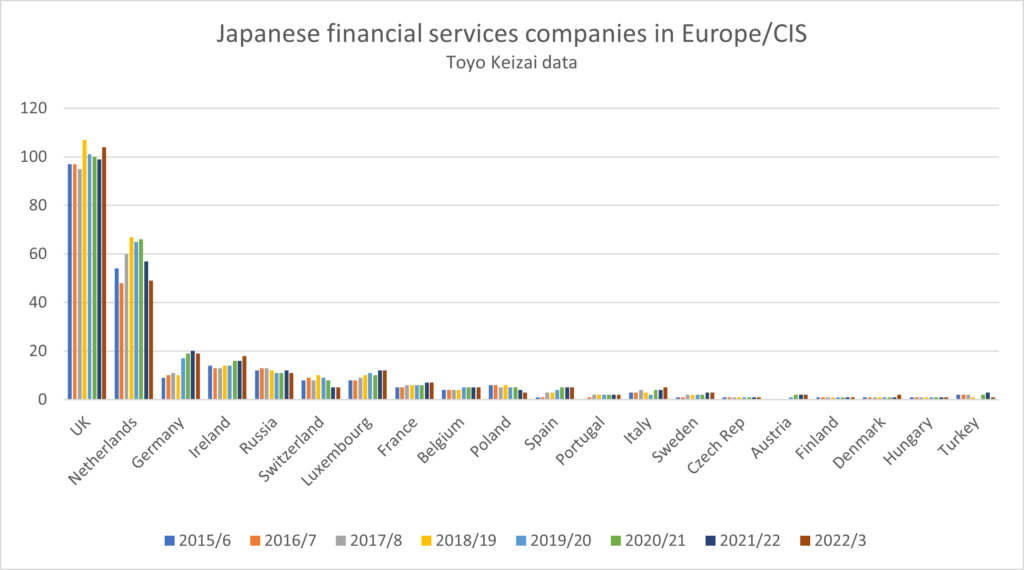 The other issue raised by the two pieces of research are whether other EU cities have benefited from any additional growth, which the UK has missed out on. As can be seen from the chart, Toyo Keizai data shows that there was an overall upward trend in the number of Japanese financial services companies in the European region, of around 12% from 2015/6 to 2022/23. The UK still dominates as a host, and the numbers of companies hosted rose 7% – so below trend. Germany doubled the number of Japanese financial services companies it hosted over the period. The numbers rose sharply in the Netherlands and then dropped. Just as Dr Hall’s research suggests, Ireland, Luxembourg and France seem to have benefited, albeit from a much smaller base.
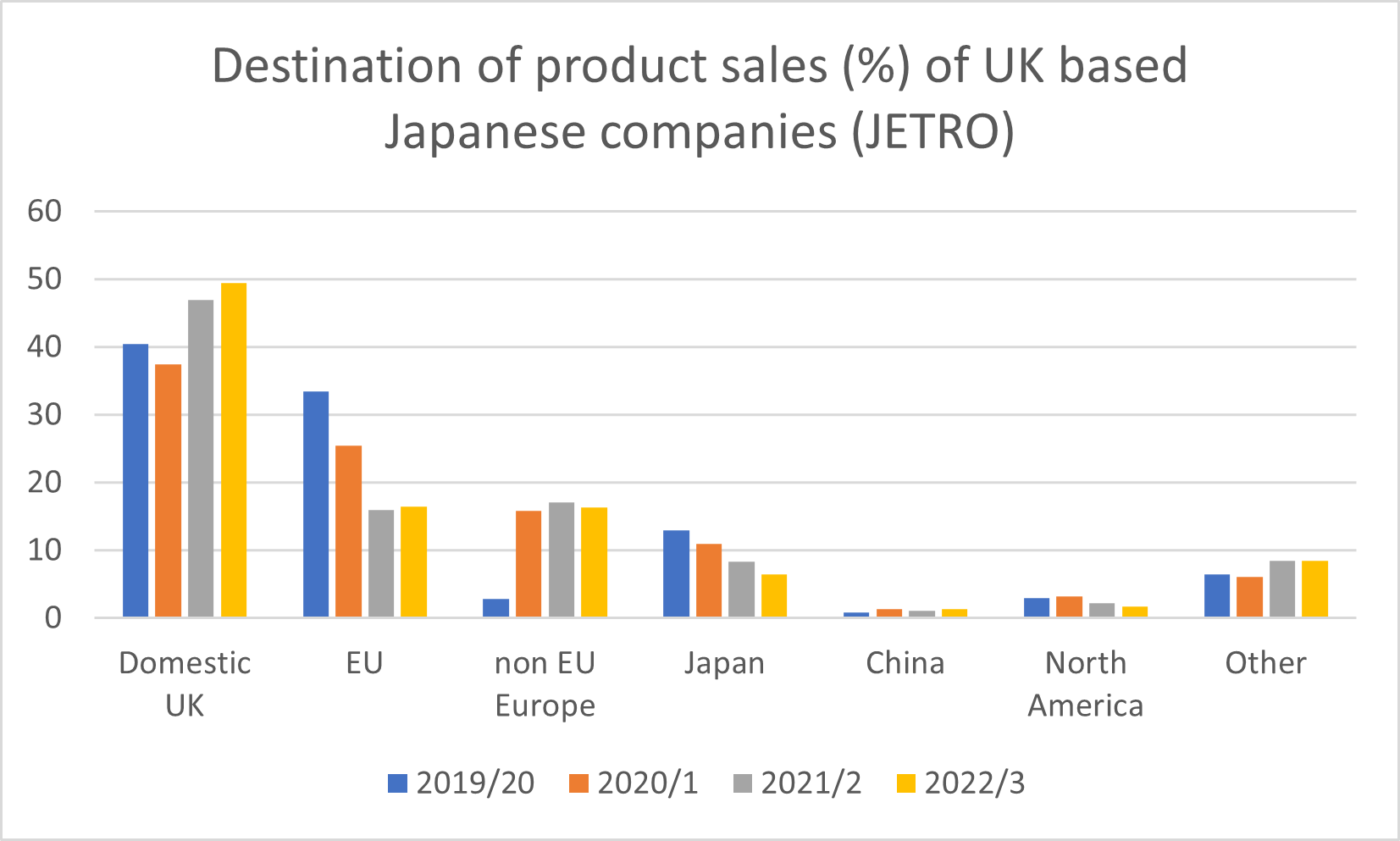 Japanese companies in the UK are showing an increasing focus on the UK domestic market for their sales, with an average of 49.4% of sales to the UK market, 2.4% up on 2021/2, compared to a European average of domestic sales of 37.7%. UK companies are selling on average 16.5% of sales to EU countries, compared to 37.6% of sales to other EU countries (excluding their own country) for Japanese companies located in the EU. Unsurprisingly, Japanese companies in the UK have become more UK oriented since Brexit, as many of the EU sales and coordination functions have shifted from the UK to the EU – and is now potentially stabilising after the sharp decline over 2019/20 to 2021/2

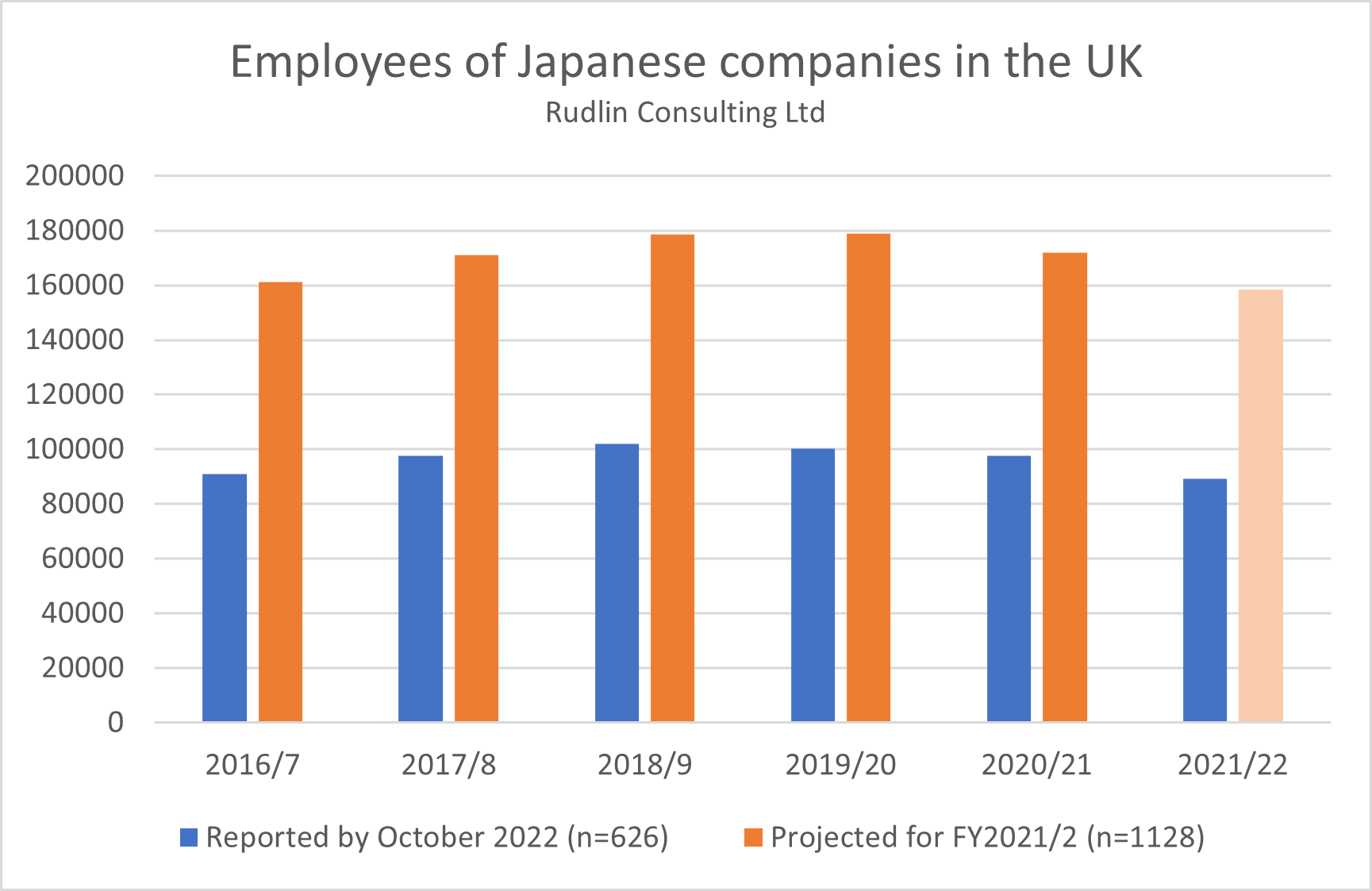 Overall, the total number employed by those Japanese companies in the UK who have reported their results has fallen by 8% over the past year. This is an acceleration of a decline which started three years ago – employee numbers had fallen 3% the previous year, and 2% the year before that. This was preceded by a couple of years of growth from 2016/7 to 2018/9. Projected, this suggests that the number of people employed by Japanese companies in the UK will fall to 158,000 by the end of the financial year 2021/2, below the 161,000 that were employed by Japanese companies in 2016/7 and a 14,000 drop on the numbers employed in 2020/1.
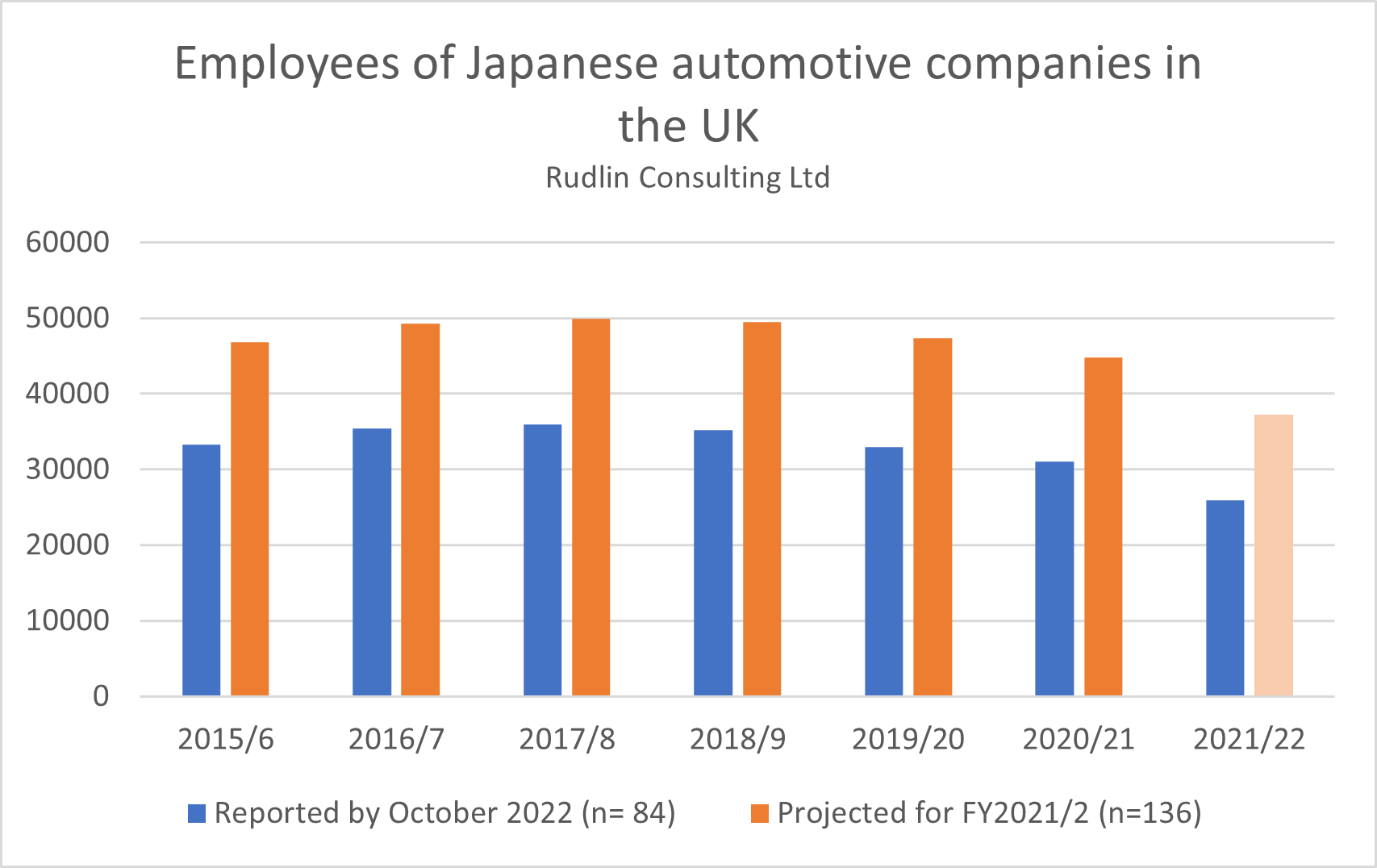 It is certainly partly due to the impact of Honda closing its Swindon factory in July 2021. That meant the loss of nearly 3,000 jobs and it looks likely a further 5,000 jobs will have been lost in the automotive sector over the past year – many of which were dependent on Honda. The decline in employment in the automotive sector began in 2018/9, a year or two before other sectors began to lose jobs.