Search results for: “sharp”

  • The good and bad of no longer being “Japan owned”

    The good and bad of no longer being “Japan owned”

    I’ve been wondering for a while whether Japanese employees of companies such as Sharp or Takata have been feeling any change in corporate culture since being acquired by Taiwanese or Chinese companies and whether those companies could still be considered to be “Japanese”.

    Nikkei Business has inteviewed employees from Sharp, Toshiba memory division and also from the laptop division of NEC (now owned by Lenovo) and come up with  13 aspects that have caused difficulties for Japanese employees who have been “bought” (as the Nikkei puts it) and 7 positive effects.

    Difficulties:

    1. Having to work much harder than before – due to increasing focus on short term profitability – even longer hours than is the norm in Japan.

    2. Loss of right to evaluate staff – a sense that Taiwan HQ is now in charge of career development

    3. Increase in employees who have a “Taiwan First” mindset

    “If you don’t like doing things the Hon Hai way, then start your own business, or go and work for Nidec or Panasonic. If you can’t do that, then suck it up, seems to be their attitude” says one employee.

    4. Rigid management by numbers

    5. English skills are now compulsory

    6. Nemawashi (stakeholder management/consensus) no longer works

    7. Large cuts in salary

    8. Reduction in autonomy

    9. Sudden changes in supplier relationships

    10. Reduction in  management positions

    11. Being posted to unwelcome locations

    12. Collapse of succession planning

    13. Low capability managers being seconded to your company

    Some of the above could happen to any acquired company in any country, but I guess 1, 4, 5, and 6 are particularly acutely felt for Japanese companies acquired by foreign companies.

    Some employees saw an upside however:

    1. Structural problems are removed

    2. Disappearance of bullying bosses

    3. Job becomes more fulfilling

    4. “Rags to riches” when previously your career history or educational record counted against you

    5. Increased salary

    6. Improved credit rating

    7. More opportunities for promotion

    Again many of these are the result of issues arising from having worked for a failing company, and now being owned by a more successful one – but I can see that for many Japanese who were stuck – with their careers blocked by bullying bosses, or considered lower status because of not being a lifetime employee since graduation or not coming from a top university –  it is refreshing to be evaluated and promoted purely on ability.

  • Brexit yanks the lid off some stinky realities for Japanese business in the UK

    Brexit yanks the lid off some stinky realities for Japanese business in the UK

    My least favourite Japanese expression is “kusai mono ni futa” – when it stinks, put a lid on it. It is at the root of many Japanese corporate governance scandals. Mistakes are made or problems surface and instead of exposing them and causing loss of face all round, they are swept under the carpet, in the hope that they will somehow magically disappear. But of course stinky things with lids on just get stinkier.

    On the face of it, there was nothing stinky about Japanese companies in the UK.  The very fact that the UK was such an easy place to do business – on a European and global scale – lulled Japanese companies into complacency.  Japanese expatriates like living in the UK, particularly around London, where the vast majority of Japanese business people are based.  A couple of years’ traineeship in London is also a great incentive to lure scarce young English speaking Japanese into your graduate recruitment scheme.

    Brexit exposed complacency about profitability in the UK

    Over 125 Japanese companies in the UK are the European headquarters, employing over 25,000 people (of the 160,000 UK employees in total who work for 1000 Japanese companies), with a combined turnover of over £40bn.  Much of that turnover derived from management fees from Japan headquarters, dividends from European subsidiaries or royalties from intellectual property, so the profitability or otherwise of the UK business itself was not so exposed.

    Profitability in manufacturing is far more obvious.  Nissan, Honda and Toyota’s factories in the UK had high levels of productivity – they had to be to win the right to make each new model. But Honda never managed to sell enough of its cars in Europe for Swindon to reach full capacity.  The car industry is going through a shift away from petrol and diesel to electric. Japanese manufacturers like to be near their key markets to develop new models, and for electric vehicles, China is a far bigger and more promising market than Europe. The supply chains for electric vehicles are more developed and close knit in their Japan base.

    Brexit yanked the lid off some stinky realities.  As the JETRO annual survey on business conditions for Japanese companies in Europe details, 60% of UK based Japanese companies predicted the future impact of Brexit on their business would be negative, and 25% said it had had a negative impact already. Most cited the threat to the supply chain of customs duties and customs procedures or divergence in regulations being introduced as their top concerns.

    Over 90% of Japanese companies could withdraw their European headquarters from the UK because of Brexit

    61% said that they had already decided to relocate/withdraw or had already relocated or withdrawn certain functions from their regional headquarters in the UK and another 32% are considering it – mostly as a partial relocation to another EU member state. As is well known, Panasonic and Sony have already done this. It was not just the threat of Brexit disrupting invoicing and customs clearance, but also in response as much to the new Japanese tax haven law. The UK’s lowering of the corporation tax rate of 17% to show Global Britain was still open for business meant revenue from dividends and royalties received in the UK would be considered as tax avoidance by the Japanese tax authorities.

    More than two thirds of Japanese companies could withdraw their European sales functions from the UK

    29% of Japanese companies in the UK have decided to relocate/withdraw or have already relocated/withdrawn their sales functions and a further 38% are considering doing so. Sharp Electronics has moved their inventory to Sharp in France along with responsibility for logistics and warehousing. Various automotive sector companies have moved customer accounts and product lines to Germany.

    Moving sales or regional headquarter functions out of the UK does not have an immediate impact on jobs in the UK. In fact labour shortage is cited as the top concern for Japanese companies across Europe.  So they are likely to try to hang on to the employees they have, and the regional management will just operate in a much more virtual way – Sharp says its UK base will still have an executive/board level responsibility for Europe, as that is where its European executives are currently based.  For now.

    Nearly two-thirds of Japanese manufacturers are withdrawing or considering withdrawing manufacturing from the UK

    33% of Japanese manufacturers have decided to relocate or withdraw or have relocated or withdrawn their manufacturing from the UK  and 30% are considering doing so. This may seem surprisingly low given the fuss made over the car companies and their supply chains being impacted by Brexit.  But actually most Japanese manufacturers have alternative plants in Europe they can use if necessary. Those who do not are usually manufacturing highly specialised products that are less supply chain time critical, or for UK sales only or that they are presumably confident they can sell across Europe no matter what barriers there are.

    No deal preparations

    The JETRO survey did not specify the type of Brexit when asking Japanese companies in Europe in general about relocation or withdrawal plans, but did ask if any countermeasures had been taken for a no deal Brexit. Just over 10% of all Japanese companies – in the UK and Europe – had already made plans or were currently making plans. A further 15% of Japanese companies in the UK were intending to plan for no deal but only 4% of non UK EU companies were intending to plan (this was as of October 2018).  The most popular countermeasure was stockpiling (21%), followed by reorganising functions within the company group (10%).

    Financial services already prepared for all possibilities

    All the Japanese financial services companies that would be affected by Brexit have already put their plans into action – most now have licenses for the UK and obtained financial passporting or licenses in the EU as necessary.  Again, having to take a hard, cold look at their European operations has taken the lid off some long standing whiffy problems, particularly for Nomura, which looks like it will be shutting down its global wholesale side in London entirely.

    No rollover and then there were none

    Stockpiling as the main countermeasure for a no deal Brexit assumes that eventually a deal will be reached, before the stocks run out.  But such deals take time.  The EU-Japan European Partnership Agreement (EPA) started in 2013, finalised at the end of 2017, signed off in July 2018, and was in force from February 2019.  Known as cars for cheese – it was actually meant to promote food and car exports both ways. Japan has already been promoting European wines and cheeses in its supermarkets and announced the first shipment of fully farmed tuna to Europe under the EPA agreement.

    Similarly, reduction on tariffs on cars and car parts was meant to protect Japanese branded manufacturing in Europe (because they could easily import Japan manufactured parts) and help European car  manufacturers export more cars to Japan.

    Hard stinky cheese

    If a no deal Brexit happens, although Japan started talks with the UK about rolling over the EPA, it has stated this would not be a cut and paste job.  Japan is clear that it expects more concessions from the UK than in the EU deal – including cheese and cars. So British cheese makers may find their exports to Japan have a longer time to ripen than they were planning, in the event of a no deal.


  • Lessons from the decline of Japanese electronics manufacturing in the UK for the automotive industry

    Lessons from the decline of Japanese electronics manufacturing in the UK for the automotive industry

    Although around 10,000 manufacturing jobs in Japanese electronics companies in  the UK were lost in the 1990s-2000s, about the same number have been added, either created by Hitachi Rail or in the automotive or air conditioning sectors. Japanese electronics companies such as Sony, Fujitsu, Panasonic, NEC, Mitsubishi Electric and Hitachi still all employ thousands of people in the UK.

    It is a story of how industrial policy cannot ultimately stop product obsolescence, shifts of manufacturing to cheaper locations or the transformation from mass manufacturing of products to supply chain ecosystems providing solutions and services. Recent investment from Japan in the UK is in services and infrastructure, for the domestic UK market, and at least for now, the EU. But this has meant fewer jobs in the areas that voted Brexit.

    Bunging £10s of millions at Nissan to compensate for tariffs was not going to stop these shifts. Over 10% of the 7,000 Nissan employ in the UK are working in design centres, not on the factory floor. Being a gateway to the EU now, even in manufacturing, needs regulatory alignment and free movement of people so suppliers can visit and base themselves at client sites and provide services and ship prototypes around the region.

    The shift to electric vehicles means the car companies have to cooperate more than ever with ICT and electronics companies. Many of these ICT and electronics companies have joint European HQs spread across the UK, Netherlands or Germany, with senior management and teams scattered across the region, working virtually or at customer and partner sites. They have also integrated back office and technical support into cheaper locations such as Portugal or Poland.

    Some examples of the history of Japanese electronics companies in the UK over the past 30 years:

    Fujitsu

    Fujitsu is the biggest Japanese employer in the UK with over 8,000 employees, 2,000 down on a few years ago, as it grows delivery and support centres in Portugal, South Africa and India and downsizes in the UK. It acquired 80% of UK’s ICL in 1990 (increasing to 100% 1998). ICL had 2,000 UK employees, 26,000 worldwide, with mainframe and PC factories in Letchworth, Manchester and the Midlands.  ICL was born out of 1960s industrial policy – the British government had a 10% stake in it for a while. To this day, Fujitsu provides a lot of  government IT infrastructure and services. Its last computer factory in Europe, in Augsburg in Germany, will shut down in 2019, retaining manufacturing in Japan only.

    Hitachi

    Hitachi used to employ around 1,000 people in its factory in Aberdare, Wales, making cathode ray TVs, video recorders and microwave ovens. It was shut in 2001, blaming low price competition from Asia. Hitachi has since shifted away from consumer products to infrastructure. In the UK it acquired the now stalled Horizon Nuclear Power projects in Wylfa and Oldbury and set up Hitachi Rail in the UK as the global headquarters with a new factory in Newton Aycliffe, employing nearly 2,000 people.

    Hitachi employs another 4,000 people in the UK services sector – for example credit and loans company Hitachi Capital, IT consultants Hitachi Vantara and Hitachi Consulting and Vantec, providing logistics for Nissan.

    Sony

    Sony came to the UK in 1973, and had 2 plants in Pencoed making cathode ray TVs, employing 1,800 by the 1990s. As these started to shut down, Pencoed transformed itself into an innovation centre, developing and producing broadcast and professional equipment, employing 500-600 people.

    Sony has been restructuring across Europe recently, consolidating back office functions into cheaper regions. It was still manufacturing DVDs in Enfield in the UK but this was shifted to Austria in 2017/8, reducing capital in UK by over £250m. It still employs nearly 2,000 in its music, home entertainment and interactive businesses in the UK.

    Ricoh

    Ricoh still has a factory in Telford (and two other plants in UK), employing the same number of people in 2018 as in 1991 – around 700 – but the product range has shifted from faxes to printers and consumables.

    Mitsubishi Electric

    Mitsubishi Electric acquired Apricot Computers in 1990, with a plant in Glenrothes and R&D in Birmingham, employing 442 in 1991. Glenrothes was shut in 1999, blaming cheap competition in Asia. It still has manufacturing in the UK, employing nearly 1,000 people (many of whom are non-UK EU citizens) in Livingston, at its airconditioning plant.

    Panasonic

    Panasonic, formerly known as Matsushita, had many plants in UK from 1970s to 1990s, employing 1,621 in Cardiff (TVs, microwaves), 469 in Gwent (electric typewriters, carphones), 160 in Port Talbot (components for TVs, video recorders, microwaves) and 63 in Reading (fax machines).  Most Matsushita/Panasonic plants in UK shut down in early 2000s, with production shifting to Eastern Europe. 1 plant remains in Wales, employing 400 people, manufacturing microwave ovens but also conducting R&D into fuel cell technology.  Panasonic has acquired Belgian IT company Zetes and Spanish automotive supplier Ficosa recently.

    NEC

    NEC is also shifting into IT services via European acquisitions. It used to have a semiconductor plant in Livingston (Silicon Glen, remember that?) which employed 1200 by 2001, when it shut down. NEC UK employees now number over 1000 again thanks to the acquisition of Northgate Public Services, in 2018.

    Others

    Oki Electric were relatively late in shutting down their Cumbernauld printer plant in 2018 – and now all production is in Asia.  JVCKenwood shut down their East Kilbride TV/CD player factory in 2008 and shifted production to Poland. Pioneer closed its CD player/TV factory in Wakefield in 2009. Toshiba had a factory in Plymouth, which used to make TVs, video recorders, but is now owned by a US company and makes air conditioners. Sharp (now owned by a Taiwanese company) still has a factory in Wrexham as does Brother.

     

  • Who’s looking grumpy in Japan’s summer bonus season?

    Who’s looking grumpy in Japan’s summer bonus season?

    If you’ve noticed your Japanese colleagues looking grumpier than usual and making pointed remarks about the amount of money overseas offices soak up, you may need to be aware that it’s not just the heat and the typhoons getting to them, but the fact that despite Prime Minister Abe’s push, some companies are still cutting salaries –  and employee numbers are shrinking.  The summer bonus season, which will have been added to their monthly pay cheque in June or July, may have reminded them that their salaries have not increased much in real terms over all for some years, but they are supposed to be grateful they have a secure job, with bonuses, benefits and a pension.
    It’s surprising to see who tops the list in Toyo Keizai’s ranking of companies who have had the biggest reductions in pay and number of employees over the past five years – trading company Mitsui Bussan is at #1. Toyo Keizai reckons this is because their business was badly hit by falling resource prices over the past few years.  Although average annual income at Mitsui is high – around Y12.3m (US$111,000), it has dropped by Y1.48m compared to five years’ ago.  The number of employees has also fallen by 201 to 5,971.  Sumitomo Corporation, another major trading company is at #9 – average income falling Y1.255m but personnel numbers only falling by 23.  Mitsubishi Corporation is at #78 – total average income has fallen by around Y260,000, and numbers of staff have dropped by 579 to 5,217.

    As you might expect, given its recent problems and selling off of businesses, Toshiba is in the top rankings, at #15, having reduced the number of employees by 4,401, to 32,353, with average income falling by Y880,000. Similarly Sharp has also reduced total average income by around Y600,000 and cut staff at almost double the rate of Toshiba, by 8,175, to 13,363.  Sony has reduced staff even more, by 10,391 to 6,185, and total average income has fallen by Y410,000.

    Eisai, the pharmaceuticals company, is at #23, having cut its staff by 938, to 3,246 and average income falling Y710,000.  There has been no obvious negative issues for Eisai over the past five years, so maybe this is the work of the CFO, Ryohei Yanagi, trying to keep ROE above 8%, as we previously blogged.

  • What is a Japanese company?

    What is a Japanese company?

    I had anticipated the “do you have any questions for us?” at a recent final interview for a non-executive directorship for an investment trust focused on Japan.  I was advised by another experienced non-executive director to think of a thought provoking question, to show the board I was capable of bringing a different perspective, something they had not thought of before.


    On reflection, I probably erred too far on the “thought provoking”.  It was a genuine question, however, and I was genuinely interested in their answer.  As the fund’s strategy was to invest only in Japanese companies, how do you define a Japanese company?

    Listed in Japan or majority of business in Japan?

    The fund defined it as being listed on a Japanese stock exchange.  This may seem a clear enough definition, but does this mean Sharp, now owned by a Taiwanese company, Hon Hai, is a still a Japanese company?  How about Hitachi Power Tools and Calsonic Kansei, now both owned by American buyout firm KKR?

    Other Japan focused funds also invest in companies that are listed outside Japan, so long as a significant majority of their business is in Japan.  But if percentage of sales in Japan is the criterion, then there are plenty of Japanese companies who are listed in Japan, for whom a majority of their business is outside Japan – Takeuchi for example exports 95% of its diggers to overseas markets and 68% of Sony’s business is outside Japan.

    Avoiding ‘country risk’

    Why does it matter?  It matters to the boards of such funds, because if they define “Japanese” as Japan listed or majority of business in Japan, then clearly they need to consider the “country risk” of Japan and ensure the strategy is adjusted, or mitigation is put in place accordingly. 

    They need an expert in Japanese economics or politics to read the entrails on whether Prime Minister Abe will be re-elected as leader of the LDP in September, and if so whether he will be in a strong enough position to carry on with his “Three Arrows” of reform.  They need to be able to judge whether the recent dip in Japan’s GDP growth is temporary, or likely to be revised upwards in June, as often happens. They might need some inside track on trade friction around the world and how this might affect the Yen.

    But if the strategy is to invest in specific Japanese companies with long term growth potential, then this is not the same as investing in the Japanese economy or a Japanese index tracker.  The aim should be to look for companies that will succeed no matter what happens to the Yen or Abe.

    Managed by Japanese executives?

    Specifying that those companies should be Japanese indicates to me that there is thought to be something unique to Japanese companies that makes them worthy of special attention.  So should it be that the management of the company is Japanese?  In which case, how should Takeda be classified – likely to become even more dominated by non-Japanese executives after the acquisition of Shire?

    What about other companies who, like Takeda, have substantial overseas business acquired through acquisition, but manage it mostly through an international HQ based outside Japan, such as Japan Tobacco (Swiss HQ) or Dentsu (Dentsu Aegis Network in the UK)?

    Or how about SoftBank, founded and run by Masayoshi Son, ethnically Korean and educated in the USA?  The original telecoms business is clearly Japanese, but what about ARM in the UK and Sprint in the US – not to mention Softbank’s massive Vision Fund which notably is not investing much into Japanese companies at all?

    Where Japanese companies have the edge…

    I propose some further, admittedly fuzzier definitions of “Japanese”. Firstly, the business should reflect an aspect where Japan has an “edge” – a comparative advantage.  For example, any business that is focused on the elderly, as Japan has the most rapidly ageing population in the world, with over 25% over the age of 65.  Or a business which has evolved from Japan’s traditional manufacturing and craftsmanship strengths, what is known as monozukuri in Japanese – highly sophisticated machine tools, robotics and components.

    But I think there is something more than that to being “Japanese”.  It’s about the corporate culture and governance – a different model to the Anglo-Saxon shareholder value maximization model.  Investing in a Japanese company should be for long term capital growth rather than a quick dividend, as well as some satisfaction that the investment is going into a company which does not engage in creative destruction type capitalism. 

    …is also where the risks lie

    And this is where the risks also lie.  Japan’s stakeholder capitalist model means job security, but also hidden underemployment and low productivity.  Jealous guarding of corporate reputation can mean cover ups when something goes wrong.  Strong loyalty to other members of the corporate family can mean deference to seniors without questioning or challenging orders given.  Extreme risk aversion can mean opportunities missed.

    Understanding and mitigating these risks is not something that can be resolved by an informal chat with a contact in a ministry, nor by looking at exchange rate forecasts and putting some hedges in place.

    This was the conversation I wanted to have, and where I thought I could add value, but that’s the trouble with the “any questions for us” coming at the end of the interview.  As the board chair said – fascinating question, but you’d need a whole afternoon or a seminar to thrash it out.  And no, I did not get the job.

  • Japanese boards in Europe should reflect their customers, employees and community

    Japanese boards in Europe should reflect their customers, employees and community

    I have just completed the first phase of research into how diverse the European subsidiary boards of the biggest Japanese companies in Europe are, both in terms of the nationality mix of Japanese and European directors, and also the number of women on the board.

    More boards in Japan had women on them than in Europe, which is surprising if you were expecting boards to reflect the employee mix – particularly the pipeline of managers coming through the ranks of an organisation – as there are without doubt more women employees and proportionally more women managers in Japanese companies in Europe than there are in Japan.

    The proportion of directors with European nationalities on the board of Japanese subsidiaries varied wildly from none in the case of Toshiba, Sharp and Fast Retailing (the Uniqlo subsidiary in the UK), through to 100% in the case of Asahi Glass, Bridgestone, Canon and Nidec. So national diversity does not seem to be influenced by which industry the company is in. This also means that what to me is the most compelling case for a diverse board, that it should reflect the customers it is serving, is not the key factor I thought it would be.

    20 years’ ago, becoming less reliant on Japanese customers abroad as well as in Japan, was the driving force for many Japanese companies embarking on “kokusaika” (“internationalization”). Canon was a pioneer then in appointing Europeans to senior positions in overseas subsidiaries and does as a consequence appear to have fared better than other companies in the consumer electronics sector, both in Japan and in Europe.

    The current favoured path to globalization for Japanese companies is through M&A rather than growing international businesses and executives internally, and the major acquisitions of the past decades account for the diverse boards of Asahi Glass (who acquired Glaverbel) and other companies that still have a high proportion of European directors such as Fujitsu (International Computers Ltd), Nomura (Lehman Brothers) and NSG (Pilkington).

    There is some sectoral influence. For example, the financial services industry is under intense scrutiny by European regulators who have the power to approve board appointments. They expect directors to have deep understanding and experience of local markets – something which not many Japanese executives can claim.

    Both Fujitsu and Hitachi have substantial public sector oriented businesses in the UK (government services, nuclear power and rail) which means that they not only need to meet the diversity requirements of government purchasing but also gain acceptance of the communities in which they operate. For example, the board of a Japan-owned UK utility recently advertised for a director, with a requirement that applicants be a customer of that utility.

    For smaller Japanese companies, or those which are just starting in Europe, it is tempting to stick with a small board with just a couple of non-resident Japanese directors, but as boards come under pressure to have greater transparency and better governance in Europe, appointing local directors from the start should lead to better relations with regulators, customers and employees.

    (This article first appeared in Japanese in the Teikoku Databank News in December 2015 and also appears in Pernille Rudlin’s new book  “Shinrai: Japanese Corporate Integrity in a Disintegrating Europe”  – available as a paperback and Kindle ebook on  Amazon.)

  • Fewer women on the boards of Japanese companies in Europe than in Japan

    Fewer women on the boards of Japanese companies in Europe than in Japan

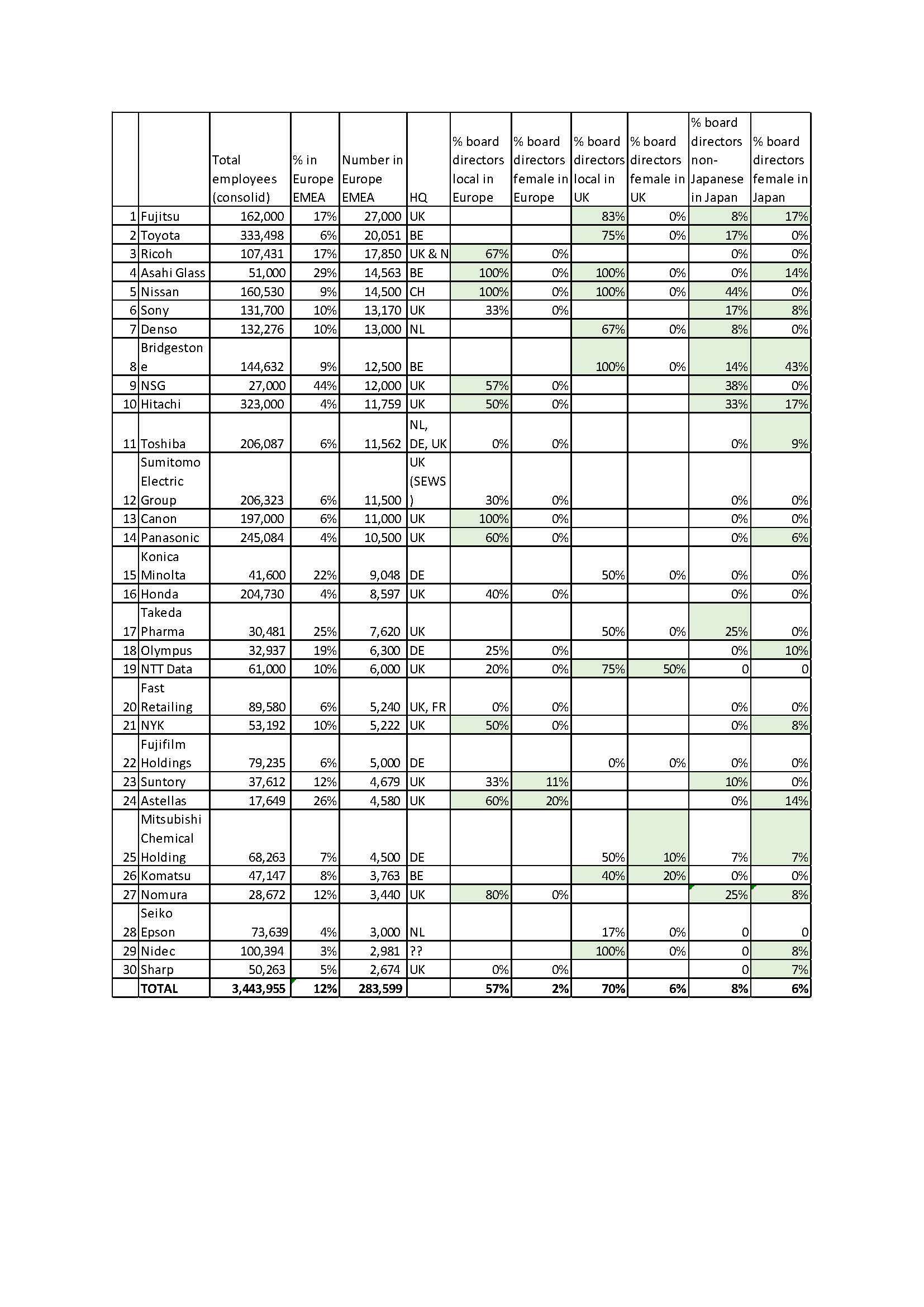
    We’ve revised our Top 30 Japanese companies in Europe again.  Where possible we have updated the number of employees, which means the Suntory Group is now in the Top 30 along with Konica Minolta (and Kao and Daiichi Sankyo are out).  This time we wanted to take a look at the gender and nationality diversity on boards, both in Japan and Europe, and have discovered that there are actually fewer women on the boards of Japanese companies in Europe than in Japan.

    Only two out of 19 (10%) of European headquarter boards of Japanese companies have women on them – Astellas and Suntory (the latter including Makiko Ono, an executive in Suntory Japan) and only 3 of the 14 (21%) UK based Japanese companies we looked at (in cases where the European HQ was not in the UK or there were separate European and UK companies in the UK) had women members – Lucite (subsidiary of Mitsubishi Chemical Holding/Mitsubishi Rayon), Komatsu and NTT Data.  Komatsu UK’s female director is Keiko Fujiwara, who is the CEO of Komatsu Europe, in Belgium.  This contrasts with 13 (43%) out of the Top 30 companies’ boards in Japan  having women directors.  In case you were wondering, only 6% of FTSE250 companies have no women on them.

    • 4% of the Top 30 Japanese companies in Europe’s board members in Europe and/or the UK are female
    • 6% of the Top 30 Japanese companies in Europe’s board members in Japan are female
    • 8% of the Top 30 Japanese companies in Europe’s board members in Japan are non-Japanese
    • 16% of the board members of the Top 100 listed Japanese companies in Japan are female
    • 19.6% of FTSE250 board members are female

    Around 62% of the members of European and UK boards of of the Top 30 Japanese companies are European, on average.  Companies whose boards in the UK and Europe only had Japanese directors were Toshiba, Fast Retailing (Uniqlo), Fujifilm and Sharp. Sharp and Toshiba’s troubles are well known.  Fast Retailing recently reported struggles in the US market and falling profits in Europe for Uniqlo, Comptoir des Cotonniers and Princess Tam Tam. Fujifilm has made a remarkable transformation from a B2C camera film to a B2B imaging company but the last set of quarterly results, issued last month were deemed “mixed”.

    (Note: only main boards, not executive or supervisory boards were analysed, and company secretaries were excluded)

    The full chart is here (highlighted means “above average) and can be downloaded here :Top 30 Japanese companies in Europe board diversity Nov 3 2015

    Top 30 Japanese companies in Europe board diversity Nov 3 2015


  • The san-thing revisited

    Namae – or name?

    As I mentioned in a previous article, the question of how to address Japanese colleagues or customers is almost always raised in our seminars.  I explain that it is indeed a complex issue, but surname-san is the default option.  It’s polite enough, particularly if you are not Japanese anyway.  However, a Japanese junior often addresses a Japanese senior by their job title – kacho (section chief, the first real manager position in a Japanese company) or bucho (general manager) for example and would address a customer with surname-sama or with their job title.

    The new egalitarianism

    But this is changing in Japan too.  When Kozo Takahashi took over as President of Sharp, he insisted, as part of a major culture change – that from now on, all seniors would be addressed as surname-san, rather than by job title plus dono. As I mentioned when I blogged on this, bucho-dono is rather like calling someone Mr General Manager.

    Diamond Online reckons this egalitarian trend started as far back as the late 1980s.  New companies that were booming then like Recruit had a culture where all were called surname-san.  Still, the older more traditional companies to this day keep to the job title system.  I frequently ask my Japanese contacts at our clients what their company culture is like, and some say it even depends which department you are in – whether they stick to the tradition or have moved to surname-san.  Diamond Online describes how in one financial services company there are 6 layers of titles from branch manager down, and one young staff member was even scolded for calling a colleague deputy chosayaku when he was a full chosayaku.  There is no one translation of chosayaku by the way – I have found ‘assistant to section manager’, ‘assistant manager’ and ‘assistant to director’ in various sources.  Google Translate translates it literally as ‘investigation officer’, which yet again proves that Google Translate should not be relied upon.  Either way, you can see why you would be quite keen to be called “assistant manager” rather than “deputy assistant manager”.

    The disappearing kacho

    The term kacho might disappear completely in some companies, Diamond Online asserts in another article. In companies like Sony, which have moved completely away from any kind of seniority based promotion to one based on job roles and competencies, the change has resulted in demotion to “individual contributor” for around half of the 40% of their staff that were previously in management grades. Panasonic is also reviewing its bucho/kacho system and has, in the interests of developing its staff better, decided that managers should have around 7 staff members reporting to them.  This is in reaction to having flattened the hierarchy to speed up decision making, only to find that staff development suffered.

    My old employer Mitsubishi led the way in the 1980s, by changing the ka (section) and kacho (section chief) system to ‘team’ and ‘team leader’.  This was due to the fact that there were too many people in the kacho grade and not enough sections to manage.  The resulting dual system – whereby you have a kacho grade but your job role may or may not include managing a team is one that many Japanese companies have since adopted.

    Job mobility

    Diamond Online reckons whether you stick with the kacho system or get rid of it depends on whether your corporate culture is one where it doesn’t matter if decisions take a long time, so long as no mistakes are made.  The kacho system may also have beneficial knowledge sharing and staff development effects.  Role and competency based systems are promoted in Japan by foreign consultancies, says Diamond Online, and often adopted by Japanese companies as a way of cutting salaries.  It also makes job mobility easier, if you have a better way of measuring your market value.

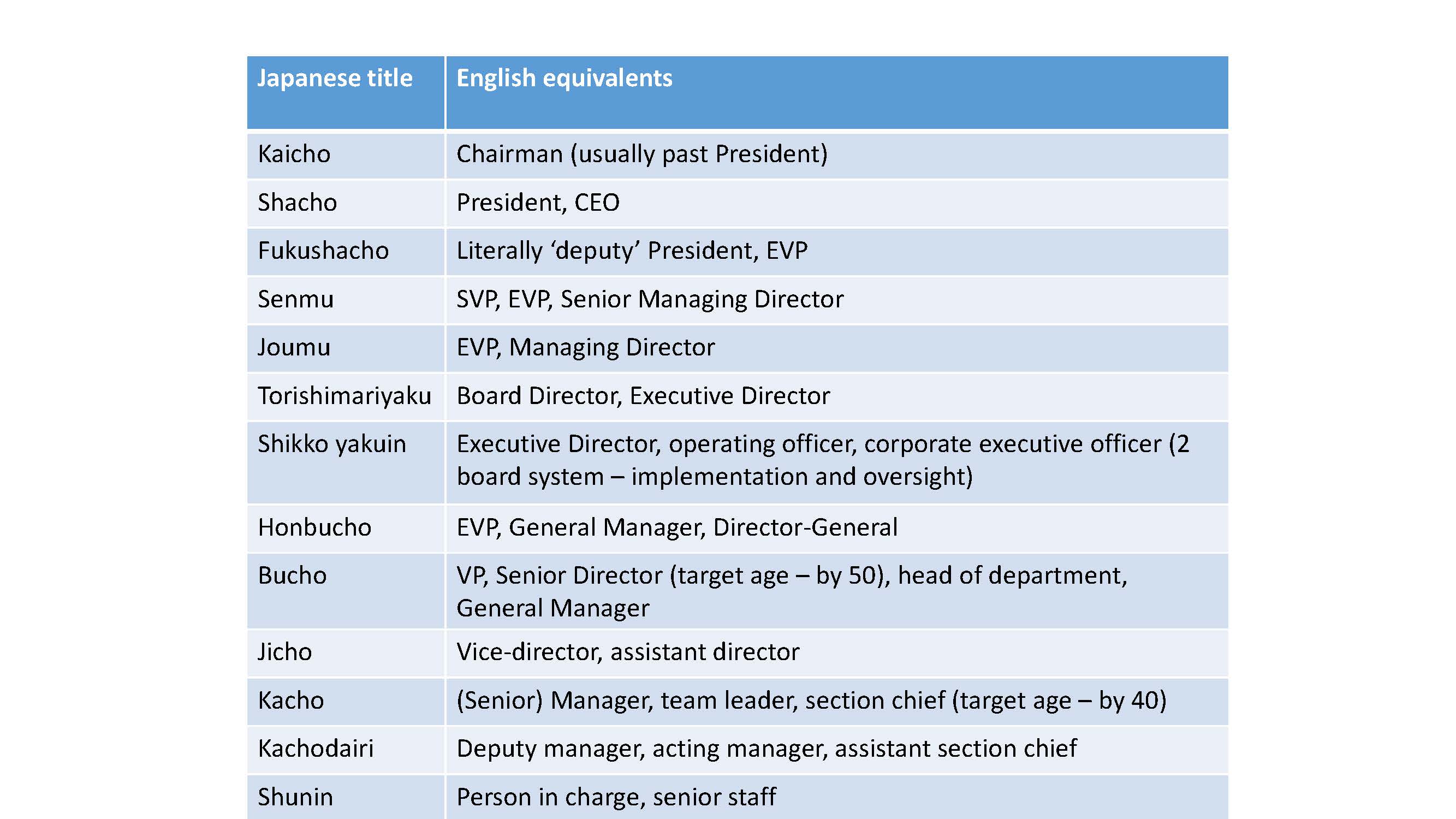
    It would also make international mobility easier (as Hitachi are hoping), if there is a more globally accepted set of job grades and titles.  One of my least favourite requests for advice is helping people translate their job titles into Japanese or from Japanese into English.  It is a political minefield and can result in yet more meaningless ‘Mr deputy senior assistant director’ type titles, with nobody the wiser as a result.  With many caveats therefore, I offer the chart below:

    Japanese job title translations


  • Octopus balls to Tokyo – why it matters where your company is from in Japan

    Octopus balls to Tokyo – why it matters where your company is from in Japan

    Most countries have rival cities – usually the official capital city versus other cities which consider themselves to be the real business, historical or cultural heart of the country – think London versus Manchester or Birmingham, Berlin versus Dusseldorf or Frankfurt, Rome versus Milan, Madrid versus Barcelona.  Japan is no exception and the rivalries go way back into history.

    Kyoto used to be the capital of Japan, before Tokyo (or Edo as it was then) began to usurp it in the 17th century.  If you ask Japanese people today about Kyoto, they joke that Kyotoites still think Kyoto is the real capital of Japan, and the Emperor is just temporarily visiting Tokyo (he moved there in 1868, when Tokyo became the official capital) – and will return one day.

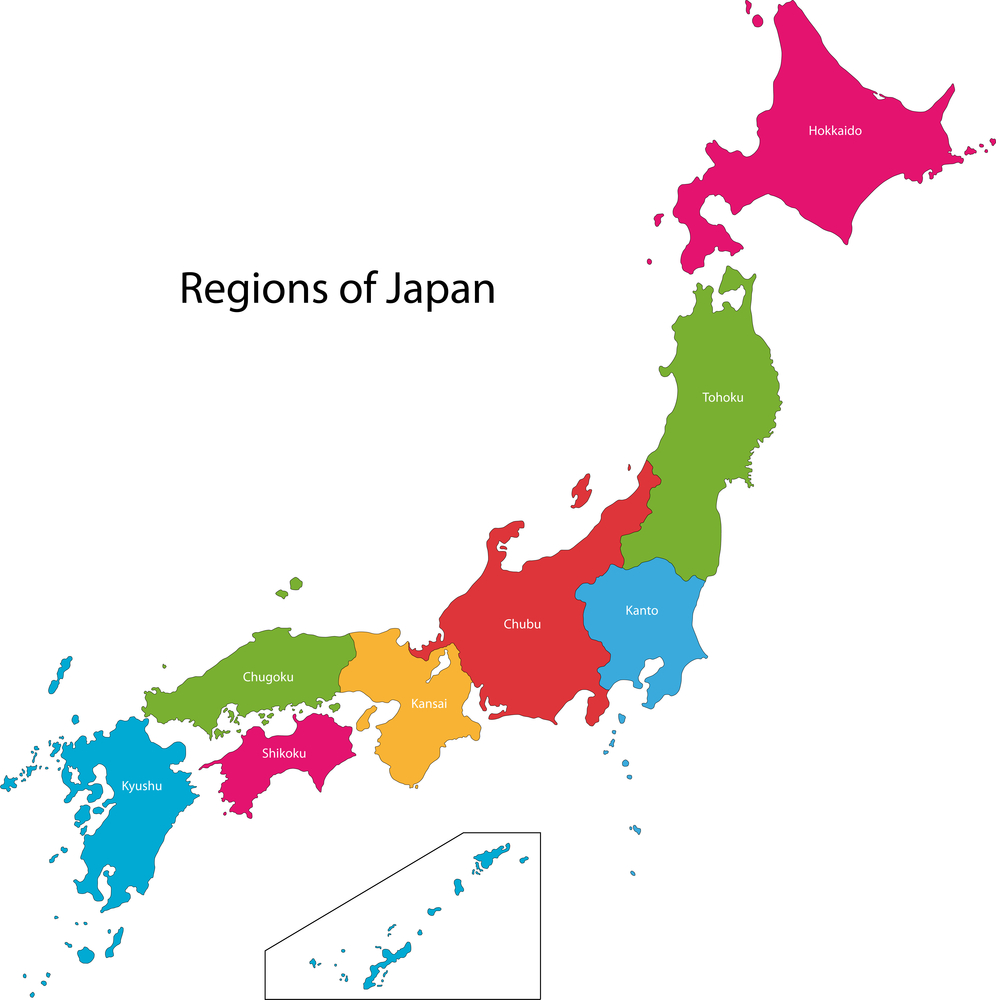
    Tokyo literally means the Eastern Capital and is part of the Kanto region, where the ruling feudal Tokugawa shogunate was based from the 17th century.  Kanto means East of the Barrier (usually considered to be the Hakone checkpoint) and Kansai – the region where Osaka, Kobe and Kyoto are based – means the West of the Barrier (originally the Osaka Tollgate).

    Before Kyoto’s reign as capital for a 1000 years, Nara (also in the Kansai region) was the capital and seat of the Emperor but is now a quiet backwater, more visited by tourists than business people.  Kobe is the other main city in the Kansai region – a port with a strongly cosmopolitan feel and very close to Osaka geographically.  Whilst Kyoto remains aloof and quietly superior (and has some very successful high tech companies of its own such as Kyocera and Nidec), the real battle now in business culture is between Osaka and Tokyo.

    Osakans see Tokyo as standardizing, dull and full of bureaucrats and view Osaka (which historically had very few samurai but plenty of merchants) as the real money maker, with vastly superior food.  Many of Japan’s celebrities, comedians and musicians come from the Kansai region too.

    So what does this mean for corporate cultures?  Osaka companies often have merchant roots – the joke goes, when you meet an Osakan, you don’t ask “how are you” (ogenki desuka) but “how’s business” (moukarimakka).  To which the correct response is “bochi bochi denna” – a wonderfully vague way of giving nothing away, like saying “plodding along nicely thank you”.  Osaka companies are brash, tough negotiators and mean with the money.  “They’d skin the fleece off a gnat” said one British engineer to me, describing his colleagues in the Osaka HQ of a consumer electronics company.

    Tokyo companies are gentlemanly but at the same time highly political.  You need to have a good understanding of their organisation, the factions and the individual relationships to understand how to get things done.  Mitsui and Mitsubishi, both Tokyo based corporate groups, are distinguished by the saying “Mitsui  is people – Mitsubishi is the organisation”.  It’s hard sometimes to understand how exactly this is different, but it seems to boil down to the idea that if an individual is powerful enough at a Mitsui group company, they can get things done, whereas at a Mitsubishi group company, the whole organisation has to support an action.

    The other main corporate groups, Sumitomo and Itochu, are Kansai based companies.  Both have strong “mercantile” roots – Sumitomo in metals trading, hard-nut, conservative and domestically focused and Itochu – strong in fashion and consumer goods, and seen as the more maverick, progressive and international in outlook.  The regional cultural differences don’t seem to have been that strong between Sumitomo and Mitsui as various mergers have taken place between their respective member companies, particularly in financial services.   However regional cultural differences have definitely had an impact on Astellas Pharma, the product of a merger between Yamanouchi (Tokyo) and Fujisawa (Osaka).  Apparently many Fujisawa employees were horrified that Yamanouchi was going to be the dominant partner in the merger.  Fujisawa had a strong tradition of innovation and had regarded Yamanouchi as “Mane-nouchi” (Mane = imitation) – a bunch of play-safe Tokyo bureaucrats.

    Those who know Japan well will have spotted that there is an important region missing from this analysis – Chubu.  Literally and metaphorically this is the midlands of Japan.  Just like the Midlands in the UK it is the historic heart of the car industry.  Nagoya is the main city, and teased just as Birmingham in the UK is for being ugly and soullessly modern.  The area has the last laugh though, as it is the most wealthy in Japan – thanks to the enduring success of Toyota (so mighty their home town was renamed Toyota City) and its corporate group of suppliers such as Denso.

    So, where are the top 30 Japanese companies in Europe from?

    Kanto/Tokyo based companies:

    • Asahi Glass
    • Astellas (but Fujisawa originally Osaka)
    • Canon
    • Daiichi Sankyoshutterstock_36509791
    • Fujifilm
    • Fujitsu
    • Hitachi
    • Honda
    • Kao Corporation
    • Mitsubishi group
    • Mitsui group
    • Nissan
    • Nomura (but was Osaka originally)
    • NTT group
    • NYK group
    • Olympus
    • Ricoh
    • Sony
    • Toshiba

    Kansai based companies:
    • Horiba (Kyoto)
    • Nidec (Kyoto)
    • Nippon Sheet Glass (Sumitomo Group)
    • Omron (Kyoto)
    • Panasonic (Osaka)
    • Sharp (Osaka)
    • Sumitomo group (Osaka)
    • Takeda Pharma (Osaka)

    Chubu based companies:
    • Denso
    • Seiko Epson
    • Toyota

    Chugoku (Hiroshima etc) based companies:

    • Fast Retailing/Uniqlo


    [download_after_email id=”6107″]

  • The Bubble Gang – what became of my cohort in Japan

    The Bubble Gang – what became of my cohort in Japan

    In the UK I would be regarded as part of Generation X but in Japan I am in the Bubble Gang, of people aged 45-49 who joined a major Japanese company straight out of university between 1988 and 1992 – at the very end of Japan’s economic “Bubble Era”. I graduated in 1988 but did not join Mitsubishi Corporation until 1990, spending two years at a US PR company first. And actually, because I transferred to Mitsubishi’s Tokyo headquarters in 1992, my company ID number started with 92, and I was therefore regarded as being a member of the 1992 graduate intake, despite my protests.

    After a period selling building materials in Japan, I transferred to the HR department, where we tried to set up an international HR system which was intended to make the year of joining less relevant and therefore Japanese traditional seniority based promotion less rigid. This was meant to ensure non-Japanese, mid-career hires had more chance of being promoted appropriately, but twenty years on, elements of the old system still persist in Mitsubishi and elsewhere. I was given the title of manager at the time, but didn’t really manage anything in the Western sense of the word – having no team or budget under my control.

    If I had stuck with the company into my late 30s I may well have become a ‘proper’ manager, attaining the kacho (team leader or section chief) grade under the Japanese system, and who knows, ten or so years later maybe even made it to bucho (General Manager – head of a department) as some of my friends from that time have recently done.

    Contemplating that future at the age of 33, when so many of my MBA class were already running businesses, put a chill in my soul and I decided to leave Mitsubishi after 9 enjoyable years.

    It’s not often you get a chance to see how your career might have panned out if a different choice had been made, but thanks to a special feature in the Nikkei Business magazine on the Bubble Gang, I now have more insight, and it has reassured me that I probably took the right path.

    The article sets out the following phases:

    1. Entrance ceremony day 1988-1992

    So many new graduates joined – up to a 1000 in some cases – that the company has to hire the Budokan for the entrance ceremony

    1. 2-3 years on – Japan’s “Loadsamoney”

    A separate envelope full of cash is handed out at bonus time, making a 24 hour working day bearable. Hanakin (Flower Friday – the equivalent of POETS day in the UK) drinking to the small hours, including Y50,000 bottles of champagne and waving Y10,000 notes to flag down taxis

    1. 5 years on – the Bubble bursts

    It’s a slow burst, from the initial bubble burst in 1990, when asset prices started to plummet, through to 1997, with the Asian financial crisis, and the collapse of Hokkaido Bank, the Long Term Credit Bank of Japan and Yamaichi Securities. Friends start to lose their jobs. The wife wants to go back to her family.

    1. 10 years on – no team, but performance based pay introduced

    Companies like Fujitsu and Mitsui introduce performance based and potential based pay systems. You start to worry about what level of bonus others in your cohort are getting. Due to a hiring freeze, you don’t have any juniors working for you, so end up having to do admin work yourself.

    1. 15 years on – the company recovers, but your pay doesn’t

    Thanks to a cheaper yen, exports boom and the company results improve, but your pay level does not. Some of the other high fliers in your cohort make it to kacho, but you don’t. Your daughter, whom you struggled to get into a private high school, seems to have lost her mojo too.

    1. 20 years on – the Lehman Shock

    Every industry suddenly goes into recession. Elpida Memory enters bankruptcy and Panasonic and Sony are in tatters. You start to envy the old guys with their golden goodbyes and full pensions.

    1. 25 years on – what do I do now?

    Sharp seems to be on its last legs, Toshiba is hit by an accounting scandal. Is my company OK? Drinking with old friends, there are more grey hairs and wheezing than before. Even your highflier friend has applied for early retirement. Younger colleagues are looking at you, still only a kacho, coldly. Should I stay or start my own business or change companies?

    The feature then looks at the fate of one man at Sharp. He is called to a seminar by a department called “People Making”, which appears to him to be a firing squad. They show him a chart of the pay offs available to people of his age under the voluntary retirement scheme. He then has a meeting with his General Manager, who tells him to stay. His colleague of the same age is not so lucky, and is told that as there isn’t a job for him, he should contact the employment agencies who are both under contract to Sharp to assist with re-employment, elsewhere.

    It seems to be a repeat of the mid 1990s, when HR departments used similar tactics to get rid of the bulge of post war baby boomers, who joined companies in the late 1970s. Apparently the Bubble Gang are the biggest cohort in most companies, comprising 1/6 of the total employees, but only 1/3 have made it to kacho or bucho level.

    In response to this, over 60% of companies surveyed by the Nikkei have reviewed their seniority based pay system or introduced voluntary early retirement schemes. Conversely, 59% of the Bubble Gang, the highest percentage of all the cohorts, feel their company has betrayed them – either because they were not promoted as expected or their pay level is not as they hoped. However the vast majority want to continue working for their company, at least for the time being. No surprise really, because you have to wonder how easy it is going to be for someone who has worked for the same company for 25 years to find a job elsewhere.