Search results for: “toshiba”

  • Toshiba launches quantum technology hub in Cambridge, UK

    Toshiba launches quantum technology hub in Cambridge, UK

    Toshiba launched its Quantum Technology Centre in Cambridge on 22nd September 2023. The centre has about 40 employees, with plans to expand the head count to 70. Toshiba will invest 20 million pounds ($25 million) in the facility over five years starting in fiscal 2023.

    Toshiba already had a research laboratory in Cambridge, conducting research on artificial intelligence and quantum technology. Some engineers will transfer from there to the new quantum-specialized offshoot.

  • Governance – interview with Yoshimitsu Kobayashi, external director at Toshiba and Tokyo Electric Power

    Governance – interview with Yoshimitsu Kobayashi, external director at Toshiba and Tokyo Electric Power

    Yoshimitsu Kobayashi, chairman of Mitsubishi Chemical Holdings, seems to be attracted to intractable problems.  Not only has he become an external director of Tokyo Electric Power Company, post Fukushima but is now also a director of Toshiba, as it goes through a massive restructuring of its business, following its falsified accounting scandal (see our previous post – Toshiba – where did it all go wrong?).  On top of all that he is also the chairman of the Japan Association of Corporate Executives.

    Asked by the Nikkei Business magazine why he has taken on both TEPCO and Toshiba, he explains that he regards both as extremely important to the Japanese economy.  “Nuclear power is a Japanese national policy, and Toshiba is a national policy company.  If it is damaged, then it is damage to the whole Japanese economy” (as we explained in another post Shazai and the art of being a corporate shame magnet).  “That doesn’t mean we have to preserve it at whatever cost.  We need to be open about all the bad parts of Toshiba, and take responsibility for explaining what happened.  Then we can rebuild.  Governance needs to have concrete substance, not just on the surface.”

    Nikkei Business calls 2015 “Year Zero of Corporate Governance” for Japan.  Kobayashi says it will take 10 years to change corporate culture at the roots.  Toshiba and TEPCO resemble each other, he thinks, in that TEPCO is learning to be a privately owned company, that looks after public infrastructure, which is similar to Toshiba.

    “Aspects of Japan that had been good such as life time employment and seniority based promotion have now become a minus, and Japan has lost its competitiveness.  Companies should not rely on politicians.  It is not just about deregulating but changing the spirit behind the regulations.”

    Kobayashi points out that while Japanese companies have been investing large amounts in overseas M&A, domestic M&A is still a fraction of that.  There are 3 nuclear power companies, 8 car companies and yet 20,000 chemical companies.  As a consequence, research and development is behind the West and China.

    “What’s key is for Japan to keep hold of its traditional technical strength, but work out how to team this up with services.”  “Mitsubishi Chemical Holdings is doing this – working on new materials, for the environment and healthcare… and also for light weight cars”.

    Kobayashi also believes that top executives in Japanese companies should walk away once they have finished their stint as chairman.  However he think that it takes 10 years at the top to really understand a company.  The Toshiba system, whereby Presidents only stayed in post for 4 years, but then carried on for many years after as advisors was not healthy.  “Maybe it’s because their remuneration is not as high as in the West that they stick around.  Dow Chemical’s CEO is earning 50 times what I earn.  Although Mitsubishi group companies don’t have so much cross shareholding in common now, we keep an eye on each other’s governance, so oldies are not allowed to hang around”

    “Toshiba has a surprising number of businesses.  In companies like that where there are many capable people, there are a lot of big fish swimming in small ponds.  They think they are the company, and forget the public interest.”

  • Japan – Europe business update Summer 2026

    Japan – Europe business update Summer 2026

    Mitsubishi HC to invest in acquisitions of European wind and solar power plants

    The Japanese leasing company Mitsubishi HC (shareholders include Mitsubishi Corp. and Mitsubishi UFJ Financial Group) will take a 50% stake by August 2026 in a British company set up by Canadian company Brookfield. The first phase will involve spending around 400 million euros ($461 million) to acquire 20 wind and solar power plants in the U.K., France, Finland and three other European countries. This is in response to artificial intelligence driving up demand for electricity.

    JR East have acquired vending machine business of Petrie Gough Ltd

    Japanese railway company JR East have newly acquired the vending machine business of Petrie Gough Limited (UK), which operates approximately 800 units operating at major UK airports, including Heathrow, Gatwick, and Luton, bringing its total portfolio to around 1,800 machines.

    Kanadevia will build a biogas plant on the Italian island of Sicily

    Japanese industrial and engineering corporation Kanadevia, formerly Hitachi Zosen, will build a biogas plant on the Italian island of Sicily. Hitachi Zosen acquired Inova in 2010 and as a result its European headquarters are in Switzerland. In 2025, Kanadevia acquired two plants in the U.K. that convert food waste and agricultural residues into biomethane supplied as city gas.

    Obayashi Group to acquire 100% of shares of UK’s Multiplex

    Japan’s Obayashi Group, one of the country’s five largest construction companies, has announced it will acquire 100% of the shares of UK-headquartered contractor Multiplex from previous owner Brookfield, an investment firm.

    Reported to cost $540m, the deal will see Obayashi Group diversify into the Australian market, which it has identified as growing due to population increases, urban development and a stable economy. Obayashi says it will leverage Multiplex’s track record in office and mixed-use developments in the UK and also expand into Canada.

    Portuguese drone startup Tekever plans to build a manufacturing base for defense drones in Japan.

    Japanese trading house Marubeni will be Tekever’s sales agent in Japan to help develop a customer base. https://asia.nikkei.com/business/aerospace-defense-industries/european-startup-to-make-defense-drones-in-japan-export-across-asia

    Japanese rare-earth recycling project to set up plant in France

    A rare-earth recycling plant is to be set up in France with the aim of lessening dependence on China – with support from state-run Japan Organization for Metals and Energy Security and Japanese gas company Iwatani.

    Ukraine Japan reconstruction fund

    Ukraine is hoping to set up reconstruction fund with Hitachi, Toshiba, Mitsubishi Heavy involving aid and long-term loans from the Japan International Cooperation Agency and the Japan Bank for International Cooperation.

    Japan – France consultation framework on AI

    The Japanese government has signed up to a consultation framework for developing AI with France that is not dependent on USA or China to go with the ones already signed with the UK, Brazil, India, Malaysia.

  • Reflections on the past forty years of Japanese business in the UK – what’s next? – 6

    Reflections on the past forty years of Japanese business in the UK – what’s next? – 6

    (continued from part 5)

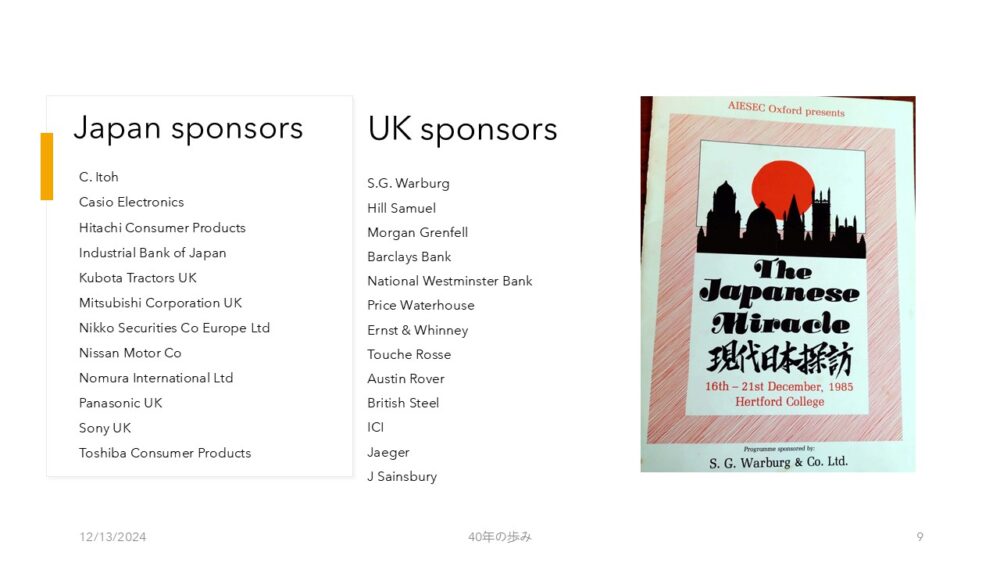
    The Japanese Miracle was the title of a conference held by AISEC at Oxford University in December 1985. Japan’s economic success was beginning to be noticed, but often as a threat, with books starting to appear such as Japan as Number 1  and American unionists smashing up Toyota cars.

    I joined the organizing committee of the conference, but am unnamed in the programme you can see here, as I was only a fresher, so was mainly used like a runner on a film set. The programme is a great snapshot of the influential people in UK-Japan business and political relations who were guest speakers, and features a long list of Japanese and British corporate sponsors.

    On the Japanese side, the list is dominated by consumer electronics manufacturers – Hitachi Consumer Products, Casio, Panasonic, Sony and Toshiba Consumer products. My generation had grown up as teenagers with the Sony Walkman, a Panasonic or Sharp double cassette deck, Hitachi TVs and Casio calculators. The Zaikai (Japanese financial community) are represented by trading companies such as C. Itoh (now Itochu) and Mitsubishi Corporation and Nomura and the Industrial Bank of Japan.  All of these companies still exist to this day – although the consumer electronics companies have shifted more to B2B.

    Financial services companies featured heavily on the UK sponsor list, but very few have the same name or ownership structure as in 1985 apart from Barclays. Price Waterhouse is now PwC, Ernst & Whinney is EY, Touche Rosse is Deloitte. Austin Rover has become part of JLR, owned by an Indian company. British Steel is owned by a Chinese company. ICI was mostly acquired by the Dutch company AkzoNobel. Jaeger went bankrupt and is now just a brand owned by Marks and Spencer. The only company that remains pretty much as it was in 1985 is J Sainsbury. To quote Napoleon again, Britain is indeed a nation of shopkeepers.


  • Telecoms takeover of Japan’s top CSR rankings

    Telecoms takeover of Japan’s top CSR rankings

    Comparing the top ranked Japanese companies for Corporate Social Responsibility (CSR)  in Toyo Keizai’s 2022 rankings* with the 2007 rankings shows how the Japanese corporate landscape has changed. The three telecoms companies – NTT, NTT DoCoMo and KDDI – have taken over the top 3 positions. In 2007 the top 3 positions went to the heavy engineering and electronics companies Toshiba, Hitachi and Canon. Sharp, Panasonic. Fujifilm and Sony also made appearances over the years, as did automotive companies such as Denso, Toyota and Nissan.

    The woes of Toshiba, Hitachi, Sharp and Nissan over the past 15 years are well documented but although Toshiba and Hitachi are in the 2022 top 50, Nissan and Sharp are at 437 and 179 respectively. Canon, Panasonic, Fujifilm and Sony are still in the top 50 along with other electronics and IT companies such as Fujitsu, NEC, Omron, Mitsubishi Electric and Seiko EpsonDenso and Toyota are all still in the top 50 along with other automotive companies such as Aisin, Bridgestone, Isuzu and Honda.  Despite being tobacco or drinks companies, JTI is ranked at 7, down from #4, Suntory is at #8, one down from #7 in 2021, Asahi at 28, up from #33 and Kirin at #31, down from #10.

    A Japanese trading company (shosha) has entered the top 10 for the first time.  Mitsui has shot up from #64 in 2021 to #4 – all the more remarkable as it used to be seen as one of the more hardcore traditionalists of the 5 big shosha. The second highest ranked shosha is Itochu, up to #22 from #37. Sumitomo Corporation is at #40, down from #26 and Mitsubishi Corporation is at #45 up from #58. Marubeni is somewhat lagging the other shosha at #112, up from #143. Toyo Keizai singled out Mitsui’s distributed power supply project, using solar power and storage batteries for non-electrified areas of India and use of carbon offsets through a company owned forest as contributing to its high ranking.

    Some of the companies whose rankings have fallen considerably include Nidec (down from 67 to 174, scoring low on environment) and Recruit, down from #62 to 172, also scoring low on environment and Ricoh, down from #47 to #217, with a lower score in HR.

    *500 companies ranked by scores out of 600 for finance (300), HR (100), governance (100) and environment (100).

  • Top earning executives in Japan 2022

    Top earning executives in Japan 2022

    As in previous years, the top earning executives in Japan over the past year include many non-Japanese people. At number 1 is Shin Jingho, Korean founder of Line (Japanese messaging app), far outstripping all the other big earners, pulling in US$315m to March 2022. He moved to Japan in 2008 to turn around parent company Naver’s websearch business, and somewhat alarmingly, claims to have learnt Japanese by watching gangster movies.

    At number 2 is Kurotsuchi Hajime, the 100 year old chairman of Daiichi Koutsu Sangyo, a taxi and real estate firm in Kyushu. He has just announced he is retiring and intending to start a foundation for small to medium sized businesses. Perhaps that is where some of his US$138 million earnings will be going.

    Yoshida Kenichiro, CEO of Sony, is the third highest earner, on US$137m. Christophe Weber, French CEO of Takeda Pharma is at #4 with US$135m. Kawai Toshiki, CEO of Tokyo Electron is in 5th place with US$121m.

    Nikkei points out that the number of executives earning over Y100m a year (US$728,000) has increased to 652, 105 up on the previous year, the highest number in 3 years. It sees this as proof that Japanese executive compensation is shifting towards Western standards. With the top 5 including two Japanese executives who are not also founders (Yoshida and Kawai), this does seem to show a move away from the usual rule in long standing blue chip companies that the president should only earn around 10 to 20 times the average salary (around US$40,000).

    Hitachi has the highest number of executives (18) earning over Y100m a year, then MUFG with 13, Toshiba also with 13 (presumably danger money for being associated with it), Mitsui & Co (9), Daiwa Securities (9), Tokyo Electron (8),  Mitsui Real Estate (8) and Bandai Namco (8). Companies with 7 Y100m earners are Daikin, Sompo, Fujifilm, Nissan and Nomura.

    Non-Japanese executives resident in Japan in the Y100m club include Simon Segars at SoftBank (British former CEO of ARM), Andrew Plump at Takeda, James Kuffner Chief Digital Officer at Toyota, James Shea at Sompo International, He Xian Han at Ferrotec, Costa Saroukos CFO Takeda Pharma, Stefan Kaufmann, CAO Olympus, Rony Kahan, Recruit (founder of Indeed),  Eric Johnson, CEO of semi conductor company JSR, John Marotta former CEO of PHC (was Panasonic Healthcare) holdings and Alistair Dormer, former board director of Hitachi.

  • People rather than shareholding unite Japan’s conglomerates

    People rather than shareholding unite Japan’s conglomerates

    I sometimes wonder if I am being a bit “old school” in going into detail on the history and influence of Japan’s keiretsu (conglomerates of companies such as Mitsubishi, Mitsui, Sumitomo) in my training sessions. It’s a legacy of working at Mitsubishi Corporation for nearly 10 years, and also my hobby of researching 19th century Japan-UK relations, in which Mitsubishi, Mitsui and Sumitomo played an important part.

    A recent article in Diamond magazine is reassuring to me in that it shows that the deep relationships within the keiretsu endure – pointing out that the interrelationships between the different companies in each keiretsu are still going strong, but through the mechanism of people rather than cross shareholdings.

    The Mitsubishi power pyramid

    For example, Mitsubishi Motors’ new external directors include Takehiko Kakiuchi – former President, now Chairman of Mitsubishi Corporation. He is taking over from Ken Kobayashi, who had also been President and then Chairman of Mitsubishi Corporation before Kakiuchi. Other candidates are Kanetsugu Mike (that’s MEE-kay, not Mike, as his biographies tetchily point out), formerly President, now Chairman of Mitsubishi UFJ Financial Group who will be joining his predecessor as Chairman of MUFG, Kiyoshi Sono on the Mitsubishi Motors board.

    Diamond magazine puts the “Gosanke” – three honorable families – of MUFG, Mitsubishi Corporation and Mitsubishi Heavy Industries at the top of the “power pyramid”, then the next tier contains Mitsubishi Trust & Banking, Mitsubishi Material, Mitsubishi Real Estate, Mitsubishi Electric, AGC, NYK, Tokio Marine & Fire, Meiji Yasuda Life, Kirin Holdings.

    The tier below that contains Mitsubishi Logistics, ENEOS Holdings, Mitsubishi Chemical Holdings, Mitsubishi Steel, Mitsubishi Paper, Mitsubishi Kakoki, Mitsubishi Gas Chemicals, Nikon, Mitsubishi Motors, Mitsubishi Fuso Truck & Bus,  MA Aluminium, PS Mitsubishi, Mitsubishi Research and Mitsubishi UFJ Securities.

    The above are all in the Kinyokai – Friday Club – a lunch of the heads of all the member companies – fuel for many conspiracy theorists. These three tiers plus a further fourth tier, containing companies such as Lawson and Mitsubishi HC Capital, form the Mitsubishi Public Affairs Committee, which acts the guardian of the Mitsubishi brand.

    Shunichi Miyanaga of Mitsubishi Heavy Industries is an external director of Mitsubishi Corporation, Ken Kobayashi (chairman of Mitsubishi Corporation ) and Nobuyuki Hirano (former chairman of MUFG) are both external directors of Mitsubishi Heavy Industries and Akio Negishi, chairman of Meiji Yasuda and Toshifumi Kitazawa formerly President of Tokio Marine & Fire are both on the board of MUFG.  I could go on, and Diamond does.

    Mitsui’s loose ties

    Diamond magazine show Mitsui’s group interrelations as concentric circles rather than a pyramid. A the heart are Mitsui Real Estate, Mitsui & Co and SMFG.  SMFG is a product of the merger of Sumitomo Bank and Mitsui’s Sakura bank, which is one reason why the ties are looser. Their Monday club includes Mitsui Chemical, Mitsui E&S, Toray, Mitsui Kinzoku and Sumitomo Mitsui Trust. The next ring are also members of the public affairs committee with the first two – Denka, Oji, Mitsui Sumitomo Insurance, Mitsui OSK, Sanki, JSW, Mitsui Sumitomo Construction.

    Then the outer ring are “companies who keep their distance”, most notably Toyota, who Mitsui love to remind were bailed out by Mitsui in the 1960s, Toshiba, Fujifilm and IHI. It also includes the department store group Mitsukoshi Isetan (who have former Mitsui & Co, Toshiba and SMFG executives on their board). Toyota has a female external director from SMFG on its board and Toyota has its chairman on the board of Mitsui.

    Sumitomo’s three peaks

    Diamond characterises the Sumitomo group as having three peaks – financial, mining & manufacturing and the postwar group.  At the top of each peak is SMBC, Sumitomo Metal & Mining/Sumitomo Chemical and Sumitomo Corporation.  Sumitomo Metals used to be the third family, but has recently merged with Nippon Steel, and so is no longer seen as part of the group.  Within the mining and manufacturing group are NEC  (who have external directors from SMFG and Sumitomo Corporation) and NSG (who has an external director from SMBC).

    Reflecting on these lists, I realise that the bulk of my work over the years has come from Mitsubishi group companies, although there have been some notable clients from the Sumitomo group. I don’t think I’ve had a single client from the Mitsui group. That is, apart from Mitsui Sumitomo & Aioi Nissay Dowa, the insurance group who acquire Amlin a while back. Even then it was more via Aioi Nissay Dowa. Aioi Nissay is not mentioned in the three peaks, or the Mitsui rings which makes me wonder whether, despite its partnership with Mitsui Sumitomo, it is not regarded as “outside” both Mitsui and Sumitomo. I wonder also if the Mitsubishi group is more active globally than Mitsui, and with the exception of Sumitomo Electric Industries, the Sumitomo group too, but this could be confirmation bias on my part.

    As Diamond says, each group has its individuality, but maintains cohesion through people – the “external” directors who are really not “outside” at all. Can these arrangements survive the corporate governance headwinds?

  • Top 30 Japanese employers in France 2021

    Top 30 Japanese employers in France 2021

    It’s been 4 years since we last looked at the top 30 Japanese employers in France. Much of what was true four years’ ago is true today. The top 30 partly reflects France’s traditional strengths, at least in Japanese minds, of food and drink, fashion, beauty and imaging technology – with Ajinomoto and Suntory still in the top 30 along with Shiseido, Fast Retailing (Uniqlo, Princesse Tam Tam and Comptoir des Cotonniers), Canon, Ricoh, Toshiba and Konica Minolta.

    The automotive sector is still a big employer, as you might expect with Toyota having a plant in Onnaing making the Yaris, and Nissan having some of its models made by Renault, supplied by NTN, JTEKT and Nidec.

    Some of the new entries are in the pharmaceuticals sector, including Taisho Pharma, who acquired UPSA from Bristol Myers Squibb in 2018 and Otsuka who have grown and made several acquisitions since they bought Nutrition et Santé in 2009.

    SoftBank is still in the Top 30 as they have a substantial number of employees via ARM, which they still have not managed to get approval to sell. They have also said they are cutting half of the staff in France who were working on robotics, including the not very popular Pepper, brought in with their acquisition of Aldebaran in 2012 and may be planning to sell it to a German company.

    According to our estimates, France is still the third largest base for Japanese company employees in the European region, with 76,000 employees. This is still less than half the employees of Japanese companies in the UK (176,000) or Germany (167,000) however. Around 60% of these employees are working for the top 30 largest Japanese employers (see below).

    The largest employer is Toyota Tsusho, (the trading sister company to Toyota Motor) who shot to the top of the rankings after their acquisition of French company (with a major presence in Africa), CFAO in 2016.  Nidec have also become a substantial presence in France thanks to their acquisition of Leroy-Somer, also in 2016.

    The most recent acquisition in France by a Japanese company is Nippon Paint‘s acquisition of Cromology, Europe’s fourth largest architectural paints manufacturer.  The acquisition was done via a new UK based company, DGL International, which is in turn owned by the DuluxGroup, an Australian paints company acquired by Nippon Paint in 2019. Nippon Paint sees this acquisition as a way of accessing markets across Europe, particularly France, Spain, Italy and Portugal, and then into Central European countries.

    Up until now France has hosted far fewer regional headquarter companies than the UK or Germany. Perhaps these recent acquisitions show the start of a trend towards France becoming a base for Japanese companies to expand into the wider EMEA region.

    Update:

    We have received some more recent data regarding Hitachi’s employee numbers in France, following their acquisition of ABB Power Grids and JR Automation and other growth, so have updated the Top 30 for France accordingly. We welcome such updates so please do get in touch if you think we are missing something.

    You can download the (updated) Top 30 Japanese employers in France below:

    PDF DOWNLOAD OF TOP 30 JAPANESE EMPLOYERS IN FRANCE 2021

  • Top 10 Japanese corporate charity donors in the UK

    Top 10 Japanese corporate charity donors in the UK

    Japan-owned companies in the UK contributed over £17 million to charity in 2019.  £10 million of this, however, was the donation made by First Sentier Investments (formerly First State Investments), owned by Japan’s MUFG Group since 2019.

    £8.5m of the £10m went to the Maitri Trust which was established by the Stewart Investors team members (part of First Sentier Investments) in 2006, and helps educational initatives in India, South Africa and Mexico. The other £1.5m was given to the Charities Aid Foundation. 2019’s donation was a substantial increase on the £5.5m First Sentier donated in 2018.

    The biggest Japanese corporate donors (>£100,000) increased their charitable budgets over the past two years, but overall the total dropped 3% on a like for like basis (not including First Sentier as they were not Japan owned  in 2018/9).

    Benchmarking Japanese corporate charitable donations

    It’s difficult to benchmark Japanese companies’ charitable activities in the UK against FTSE 100 companies as many of the Japanese companies in the UK operate on a regional or global basis and the charitable donations are on that basis too. Only around 10% of the 1000 or so Japanese companies in the UK put a monetary figure on their charitable donations in their annual reports, or specifically state that they do not donate to charity.

    The Charities’ Aid Foundation issued a report in 2018 on FTSE 100 charitable donations, which estimated that the FTSE 100 donated around £1.9bn in 2016. The report uses donations as a percentage of pre tax profit as a benchmark. Unfortunately some of the biggest Japanese companies in the UK such as Toyota, Nomura and Dentsu have been making losses in recent years so this is not a benchmark which can be readily applied to them. However, CAF’s cut off point of “at least 1% of pre-tax profits” as being an indication of commitment to charitable giving means that it is possible to say that JTI, Dentsu (using 2018 figures), Mitsubishi Corporation, Fujitsu Services and Ricoh are all in the “above 1%” category.

    The Top 10 Japanese corporate givers

    The next biggest donor after First Sentier was  Japan Tobacco International through their Gallaher subsidiary in the UK. They donated £3.24m in 2019, a similar level to 2018.  Gallaher “works with leading charities to improve the lives of socially isolated older people as well as those who are homeless, disabled or excluded from society in other ways”. They have a UK Community Investment Programme which has been accredited with Business in the Community’s CommunityMark. Employees have an allowance of up to 6 days’ a year to get involved in community fund raising and volunteering.

    The third largest Japanese corporate donor was advertising and marketing group Dentsu Aegis Network, (soon to be rebranded as Dentsu International) whose global headquarters are in London. They donated £1m to charity (£0.9m in 2018) – but this is likely to be a worldwide, excluding Japan total.  Dentsu announced in 2017 that “Society” was now one of its official stakeholders and announced a new social purpose of a digital economy for all. They are aiming to reach a billion people with sustainable development goal led campaigns and support 100 female founded businesses. They are launching a digital skills initiative to support 100,000 people to improve their skills.

    Close behind are Toyota Motor Manufacturing UK, who donated £0.9m in 2019, slightly down on the previous year of £0.95m. It “seeks to support good causes in the areas local to its manufacturing operations” [Burnaston in Derbyshire and Deeside]. It has a charitable trust that makes donations in the areas of road safety, social inclusion and deprivation and health. As well as fund raising it makes in kind donations of cars, parts and volunteering hours (included in the £9.08m). Its nominated charity of the year was the Derbyshire, Leicestershire & Rutland and Wales Air Ambulance Service.

    Mitsubishi Corporation donated £267,000 in 2019/20 (up from £140,000 in 2018/19) – to the British Museum , the Earthwatch Fellowship Programme, the University of Cambridge Faculty of East Asian Studies, the UK-Japan Music Society and the Mitsubishi Corporation Fund for Europe and Africa, which engages with partner organisations in environmental conservation.

    Hitachi Capital donated £250,000 (up from £200,000 in the previous year) in 2019/20. Their national charity partner is FareShare which redistributes food going to waste to charities and community groups – contributing to the sustainable development goal of “no poverty”. Hitachi Capital staff also volunteer at FareShare. The group also works with Young Enterprise and The Wildlife Trust.

    Nomura established The Nomura Charitable Trust in 2009, “supporting disadvantaged young people in the local communities in which it operates through both grant making and employee engagement in the form of volunteering and other engagement initiatives.”  It gave £235,659 to 11 charities which aligned with the objectives of the trust and were recommended by Nomura employees in the year ending March 2019.

    Eisai, the Japanese pharmaceutical company with a factory in Hatfield donated £212,000 in 2018/9, up from £116,00 in 2017/8.  Around half of this was to patient organisations such as Alzheimer’s Research UK and Breast Cancer Now, according to their “Transparency” page on their website.

    In 2018/9 Fujitsu raised over £200,000 for its partner charity Macmillan Cancer Support as well as 5,500 volunteer hours spent by employees volunteering and skill sharing.

    The Olympus KeyMed group via KeyMed (Medical and Industrial Equipment Ltd) gave £122,621 within the UK, of which £45,905 was to healthcare charities, £40,202 was to “other”, £33,856 was to cancer charities and £2,658 to children’s charities. This represented a 10% decrease on the previous year

    Ricoh UK made £110,426 in charitable donations in 2019, a significant increase on the previous year’s £66,285. The sum represents both financial and in kind, providing products and people to support charitable activities.

    The others

    Many of the larger Japanese companies in the UK not mentioned above do contribute to charities but do not put a price tag on this in their annual reports. Nissan Motor Manufacturing, for example, launched a Days for Change Europe wide programme where employees can take days “off” to volunteer. Kwik Fit, owned by Japanese trading company Itochu announced in 2019 that its charity partner was Children with Cancer UK, and a target of £1m to be raised through its sponsorship of the British Touring Car Championship.

    Hitachi Rail says it made no charitable donations in 2019, seemingly leaving this up to its employees, who raised £156,846 for the Railway Children charity “to date.”

    Canon UK describes its “social value policy” as comprising “employability skills training, education support, community and charitable activities” but goes into no further detail.

    Conclusions

    Japanese executives who had lived in the UK have occasionally remarked to me how many charity shops there are in the UK and how often they are approached by their employees to help with fundraising initiatives. According to Charities’ Aid Foundation, the UK is number 6 in the world in terms of individual charitable giving (money and time), after Indonesia, Australia, New Zealand, USA and Ireland. Japan is at 128 but in 6th position in terms of the number of people who volunteer time for charitable causes.

    Certainly I remember when living in Japan and working for Mitsubishi Corporation that there were plenty of opportunities to get involved in volunteering via the company. Conversely, to my relief, noone ever asked me to sponsor them to take a charity ramen bath. I have vivid memories of being in a group of employees who took severely disabled people to Tokyo Disneyland. National disasters such as the Fukushima earthquake and tsunami also saw thousands of employees of various companies giving up weeks on end to go to the region to help.

    Those Japanese companies who do give substantial amounts of money to charity in the UK tend either to have acquired established British companies and therefore their legacy of charitable activity (JTI, Dentsu, Fujitsu, Olympus KeyMed) or are manufacturers employing large numbers of staff and looking for ways to engage with the local community such as Toyota, Eisai and Ricoh. In many cases, the decision makers will also be local executives looking to raise the brand profile in a globally appealing way, so a specifically “Japanese” flavoured proposition may not be of great interest unless part of their corporate purpose is to represent Japanese interests abroad.

    There are plenty of funds in Japan set up by companies such as Toshiba, Honda, Panasonic (Matsushita) but these tend to be educational in orientation and more in the business of awarding prizes, scholarships and research grants.  Japanese companies will sometimes endow foundations overseas (Nissan Institute of Japanese Studies at Oxford, Daiwa Anglo-Japanese Foundation) which are also educational and dispense scholarships and grants.

    Anyone wishing to approach Japanese companies may need to bear these differences and distinctions in mind. For local giving, it will be necessary to win over the local employees, and for large, prestigious donations, much of the funding available may be controlled from Japan.

  • Japan’s lost three decades – what are the causes?

    Japan’s lost three decades – what are the causes?

    The 1990s were called the Lost Decade in Japan, and then as the economy seemed to stagnate in the 2000s, it became the Lost Two Decades.  Now the Nikkei Business in a recent special series seems to be saying it has been a lost three decades.  Turnover and profitability were growing through to around 1990 when the economic bubble burst.  Then profits fell – although since 2010 they have been growing  again.  The total revenues of Japanese companies (excluding financial services) has been static, with only a small bump upwards around 2005-2008.

    Nikkei Business says the lack of growth in turnover is the key problem. Even sales overseas, which were meant to be the growth driver, have not shown much of an upward trend.  According to Nikkei Business the root causes of this lack of growth are:

    1. low investment (1991 capital investment as a percentage of cashflow was 133%, compared to 82.2% in 2018)
    2. low wages (106.5 in 1990 indexed against 100 in 2015, down to 99.6 in 2019)
    3. low efficiency (return on assets was 4.3% in 1990, down to 3.8% in 2018)

    It cites Panasonic as an example of #1. Every time profits rose, Panasonic increased its investment, but every time profits shrank, it cut investment back, since 2001.  As for #2, Nikkei Business lists all the major restructurings since 1999 with major Japanese companies, which makes for sobering reading for a country famed for lifetime employment:

    • 1999 – Nissan plan to cut 21,000 from its workforce, closing 5 factories
    • 2008 – Sony announced it would reduced its electronics workforce by 16,000
    • 2009 – Panasonic announced it would cut 15,000 people and 27 factories. Pioneer axed 10,000 jobs.
    • 2010 – All Nippon Airways proposed reducing its workforce by 16,000 as part of its revival plan
    • 2011 – Ricoh announced a mid term plan aiming at reducing its workforce by 10,000
    • 2012 – NEC announced a workforce reduction programme of 10,000 job cuts
    • 2013 – Fujitsu announced it that by axing its semi-conductor business, it would remove 5,000 jobs.
    • 2015 – Toshiba announce it would erduce its workforce by 15,0000
    • 2017 – Mizuho Financial Group announced an administrative work reduction programme targetting 19,000 roles.
    • 2019 – Nissan restructuring to impact 12,500 personnel

    The low efficiency seems to be in the service sector, where there has been a lack of economies of scale.  The number of Japanese companies with turnover of over  Y100bn/$1bn doubled from around 40 to 80 from 1980 to 1991, but has not risen much since – apart from a blip in 2008 – after the birth of Japan Post, and is still heavily manufacturing oriented.

    I will cover the analysis and suggestions from the rest of series for how Japan can “wake up” in my next blog posts.