
Search results for: “toshiba”

  • If the nail sticks out too much, you can’t hammer it down

    If the nail sticks out too much, you can’t hammer it down

    One of my least favourite and most used expressions about Japan is “the nail which sticks out gets hammered down”.  It does however have its use in explaining Japanese risk aversion when it comes to individuals going against the group. Of course many successful business people did well precisely because they were not conformists – and Japan is no exception to this.  Tadashi Saegusa, now senior chairman of Misumi and Yoshimitsu Kobayashi, chairman of Mitsubishi Chemicals are both nails which stuck out, despite their senior status in the Japanese business world.

    In a conversation moderated by Nikkei Business magazine, Kobayashi talks about how he did not join Mitsubishi Chemical until the age of 28, having spent some time in post graduate study, including in Israel.  He therefore missed the usual graduate entry scheme. “I was an outsider from the start” he says. Saegusa initially joined a predecessor company of what is now Mitsui Chemical but then left to join the Boston Consulting Group – the first person to be recruited by them in Japan.

    Japan has become complacent

    Both worry that Japan has become complacent during the 30 years of the Heisei era.  Japan’s GDP has stayed flat, whereas the USA’s GDP has doubled during that time, says Kobayashi. 7 of the world’s top 10 companies were Japanese in 1989 (mostly Japanese banks) whereas not one of them is in the top 10 now. Kobayashi worries that Japanese people are not aware of how this seems from the outside – citing a survey that shows that 83% of young Japanese people are satisfied with the current situation.

    Saegusa agrees that there is no sense of crisis in Japanese companies and of understanding what is lacking. For 27 years people have been told not to spend money or invest, which is the same as saying “don’t challenge the status quo”.  “Everyone is in the same situation in Japan, so we’re rotting from the inside, if we don’t challenge ourselves.”

    It can’t just be about the art of manufacturing, it’s how you design the business too

    Even in basic research, China is top, and Japan is somewhere between 4th or 10th depending on the survey, says Kobayashi. “Yes Japan still leads in some sectors globally, but starting with semi conductors, there are many areas where it has lost share. How long can Japan keep its share of the carbon fibre business when Taiwan and South Korea are chasing it? It’s just a question of time.  It can’t just be about monozukuri (craftsmanship, manufacturing ability). It’s how you design the business itself.”

    Saegusa believes that such a large gap has opened up with the US in some sectors that it’s too late to catch up. “But Japan has just let this situation drag on. You can do something when a company still has life left in it, but when there is no money or resources left, then it’s too late. You have to look at the worst case scenario and focus the business, showing a path to survival, before it happens.  That is what a leader needs to do.”

    Only 10-20% of people in a group will take action

    “Only 10-20% of people will actually take action in any large group of people” says Kobayashi. So many Japanese companies are still sitting on their cash, despite Abenomics. “Companies and their managers have lost the will to fight and just want to avoid doing anything extreme. They’ve lost speed and dynamism.”

    “If you look at the US in the 1990s, it was revived by venture capitalists, university researchers and professional managers who would trigger changes. If you took a risk as an individual and succeeded, you would earn big money.  But Japanese companies put priority on balance and are group oriented – it’s difficult to develop professionals. If you try to become a professional, you get slapped down. Everyone turned into salarymen, who would not take risks. That’s why we we’ve ended up not being able to develop managers.”

    The age of the individual and platformers

    Kobayashi believes this model worked in times of high growth and mass production. But now in the age of the individual, it is the platformers like Google, Amazon, Facebook and Apple who are using new cultures and innovations as triggers. “Japanese businesses do not realise what a handicap their culture is.”

    Japanese companies have become too big, says Saegusa. “There is not that ‘create, build and sell’ mentality you get in the US. Bloated companies don’t give rise to leaders, rather to people who are good at pulling everything together.”

    See your predecessors as war criminals

    When he was working at Mitsubishi Chemicals, Kobayashi would say “see your predecessors as war criminals” (senpai wa senpan 先輩は戦犯). “If your predecessor did something wrong, you have to say so and do something about it, otherwise it won’t change. And when you become a senior manager, you have to be prepared to be treated like a war criminal.”

    “A nail which sticks out too much cannot be hammered down” says Saegusa, noting that Kobayashi is rooted in a strong sense of values. “But such people are rare, even though they are needed right now.”  When Saegusa left his Mitsui group company, he was seen as an outsider but now more and more people say that his life choices were the right ones. “If organisations treasure outsiders, they will find the old order breaks apart – but they may fear this kind of revolution.”

    When Kobayashi was running Mitsubishi Chemical, he appointed a CTO, CIO and CMO from outside the organisation. “I felt that we could not develop such people inside the company. Now I am an external director of Toshiba, and we appointed a CEO from outside the organisation. Japan will have to change its corporate governance radically in the next five years to deal with the fast pace of change globally.  If you make use of an external perspective early on, then you can deal more effectively with changes such as more vocal shareholders.”

    Mitsui and Mitsubishi must lead the change away from big company disease

    Saegusa worries that it might take 20 or 30 years more, to reach an absolute bottom, before Japanese people understand what their fundamental strengths are.  Large groups like Mitsui and Mitsubishi must take responsibility for leading the change away from “big company disease”.  “We have the information resources to know that we are losing on a global level.”

    “It’s not over for Japan. I also think Japanese people can be great, but we need to reflect on what has happened and realise we have become complacent. We have been totally defeated these past 30 years, but if we can work together to find out spirit to fight back, we can be a strong country once again”, says Kobayashi.

    This dialogue seems in strange contrast to the kind of articles we read in the Western press in recent years saying that while Japan is not Number One any more, there are so many good things about the country in terms of civility and a general good standard of living. And this is reflected in how Japan has become such a popular tourist destination.  I suppose we recognise there are worse models than becoming a gently stagnating, ageing society where people are polite and kind to each other.
  • Brexit and Japanese jobs in the UK – growing by acquisition or “new” jobs?

    Brexit and Japanese jobs in the UK – growing by acquisition or “new” jobs?

    Those looking for “despite Brexit” good news may be reassured that employment in the UK by the biggest Japanese companies has grown by 22% since 2014/5, right in line with the growth in Japanese jobs across Europe, Middle East and Africa (EMEA).  About a quarter of the 750,000 people we estimate work for Japanese companies in the region are working in the UK, and so far there is no obvious divergence between the UK and the rest of EMEA in terms of overall job growth.

    Big ticket acquisitions are the main driver of Japanese growth in the UK

    But as we pointed out in previous posts looking at the trends across Europe, a distinction needs to be made between “new jobs” created in EMEA by Japanese greenfield investment, and investments which are acquisitions of existing jobs.  Eastern Europe is the beneficiary of the former, particularly for the automotive sector, whereas the UK has been the target of the latter with big ticket acquisitions like SoftBank acquiring ARM, Mitsui Sumitomo acquiring Amlin, Sumitomo Rubber acquiring Micheldever, and NEC acquiring Northgate Public Services as well as Outsourcing acquiring various staffing and outsourcing companies.

    Where are the “new jobs”?

    These acquisitions account for the new entrants to the Top 30 ranking we have compiled below. They push out Fujifilm, Sumitomo Corporation, Japan Tobacco (who shut their factory in Northern Ireland last year) and Toshiba. The original Top 30 in 2014/5 have grown a more modest 10% if the acquisitive newcomers are not included.  One of the highest climbers from the original 2014/5 ranking is the main Japanese creator of new jobs in the UK- Hitachi – in particular via their rail manufacturing and assembly plant at Newton Aycliffe.

    There has not been a decline in automotive sector jobs in the UK – yet – however.  In fact quite the reverse – there has been some growth in jobs in all three of the big Japanese car companies. But the trend is clear, as pointed out in previous posts, that even without Brexit, the drift of investment and jobs in the automotive sector is eastwards and to Africa.  It’s easy to see how British people in those areas where Japanese automotive supply chains are active could blame the EU for job losses. Even though there actually weren’t that many EU grants enabling Japanese companies to transfer production from the UK to Eastern Europe – despite the rumours – merely by being members of the Single Market, and having lower labour costs, Eastern European countries are an obvious destination for new manufacturing investment.

    Will Japan’s investment in the UK services sector be Brexit proof?

    The investment in the UK by Japanese companies over the past three years has largely been through acquisitions in the services sector. This is not surprising, as services are 80% of the UK’s GDP and the UK’s comparative advantage in the region. It is also relatively Brexit proof in the sense that services sector investment will not be directly affected by any supply chain disruptions. Clearly if the UK economy takes a hit from Brexit, however, this will dampen demand for services. There has also been a shift of regional headquarters away from the UK by Panasonic and Sony and others, and of financial services companies, but as yet this has not hit UK jobs.

    Eastern Europe has also been attractive to Japanese companies for business process outsourcing. Although Fujitsu is still – just – the top employer in the UK, employee numbers have dropped 29% – and there are now 13,000 people working for its service centres in PolandNTT and its subsidiary NTT Data has also shot up the Top 30 both for the UK and the EMEA region – again through acquisitions – and has decided to base its new global ex-Japan headquarters in the UK.

    Infrastructure, energy, transport should be the future for Japanese jobs in the UK

    The UK’s strength as a global services provider will not disappear overnight, however hard the Brexit. But it’s hard to imagine how the kinds of secure, high quality automotive manufacturing jobs that those who voted for Brexit might have wanted to see return to the UK will come back, however soft the Brexit.  The potential sunlit upland is in infrastructure – energy and transport.  These sectors were needing investment regardless of whether the UK is in or out of the EU and are not so reliant on just in time supply chains across the region. Transport, environment and energy are areas where cooperation and financing on an EU-wide  basis makes business and environmental sense though. But unfortunately Brexit has provided a distraction that has resulted in Hitachi freezing its Horizon nuclear power projects in Wales and Gloucestershire from lack of government financial support, and the recently called review of HS2 must also be giving Hitachi’s rail business and other Japanese executives cause for concern. Risk averse Japanese companies are not going to want to make multi million investments in infrastructure projects in a country which is politically unstable and unreliable.
    [download_after_email id=”5729″]
     

  • Is Sharp still a Japanese treasure?

    Is Sharp still a Japanese treasure?

    Sharp Corporation Chairman and President Tai Jeng-wu was the second in command at Taiwan’s Hon Hai when it acquired Sharp in 2016.  His cost cutting organisational reforms have turned the company’s results around in a “V” shaped recovery.  He is now hurrying ahead with restructuring the business portfolio.  In an interview with Nikkei Business he says Sharp is “Japan’s treasure” and is at pains to point out how influenced he has been by Japanese teachers in the past.  Japan and Taiwan continue to have good relations (reinforced by a common threat of China, hinted at in this interview with the dig at unfair competition from state owned companies), and many Taiwanese speak excellent Japanese.

    He says that unlike Carlos Ghosn, he did not arrive at Sharp with a posse of executives.  He feels that the reforms are still only half way but he wants to work alongside Sharp employees – rather than a top down imposed change.

    Asked what was the problem at Sharp, he said “it is not for me to say, but I suppose the crisis occurred when there were problems with management in the 2010s – when people who have only had experience in one particular technical area or business become president.  You need to have a general overview to be a top executive, so when there was a crisis they were unable to respond. How I fixed the $2.5bn loss was to cut costs by around $1.7bn and then cut back investments and with some transient profits, we were back in the black.”

    Don’t be a big fish

    “You have to develop people step by step.  When I started at Sharp, I said when announcing my strategy that “Sharp should not be a big fish, but should aim to be a fast swimming fish”. So I kept asking every day for things to speed up.  I set some rules for developing successors.  I lowered the limit requiring presidential approval to Y3m ($27,000).  That was to ensure I would be aware of all the company’s problems. I then increased the limit to Y20m ($184,000) in 2018 when I put the CEO structure in place and this year I increased the limit to Y100m.”

    “I will stay on as chairman of Sharp until March 2022.  My wife and family want me back in Taiwan though. All the time from 2016 I have been looking for a successor.  I even asked a Japanese consultant to help, but I cannot find one.   I want the successor to be Japanese – it doesn’t matter if it’s an internal or external appointment. Maybe it could be someone from Hon Hai even.  They should be able to manage in the current harsh environment, covering a wide range of businesses and find synergy with Hon Hai.  It is the second criterion that makes finding the right person difficult.”

    Japanese managers became bureaucrats

    “It used to be that Japanese management of factories and businesses were strong, and my teachers were all Japanese. But then Japan went into a recession and the founder managers all disappeared, and managers became bureaucrats. That is why management strength declined.  Japan is now only strong in parts and materials. ”

    Sharp’s employee levels are back to the same as before the management crisis.  “There were two early retirement drives during the crisis, and a lot of good people left.  Those who remained when I joined the company in 2016 were one of three types – highly capable and loyal, those who couldn’t find another place to go and those where were waiting to be pushed. I actually never cut employees. In fact we need to increase our employees – we had some influxes from when we took over Toshiba’s PC business and other M&A.”

    “I am not a god, I just improved everything step by step”

    “I renegotiated the contracts for solar battery procurement and saved around $100m. I have also brought the Sharp brand back in house for the US TV production business.  A brand is like a person’s name. Selling it is wrong. During the crisis Sharp sold off its precious buildings for $188m and then spent $30m on out of date computing.   I am not a god, I just improved everything step by step. I was taught to do Horenso (keeping bosses in the loop) and check everything thoroughly, not just sign off easily by Japanese teachers.”

    I am now promoting management based on data, and a shift to B2B (business to business). B2C (consumer) business is currently 65% of our turnover, I want to make it 50/50. The structure of trade in B2C is unfair – companies like ours in a free trade country have to compete with state owned companies who don’t have to invest or write off so much. That is why Japan’s IT/electronic companies’ share is falling – it’s a structural problem.   In B2B it is a fairer fight. W have built a good ecosysytem over many years, so we have a good chance.

    A Rising Sun Alliance of Japanese electronics companies

    “I think there should be a Rising Sun Alliance of Japanese companies. There are a lot of Japanese electronics manufacturers but I don’t see that they will merge -t here is too much pride. I do have to be careful as Hon Hai is not a Japanese company. I am reflecting every day on how to manage employees. If I am criticised, it is not just my, but Taiwan’s pride at stake.”

    “Sharp will last over 100 years.  It is a treasure of Japan. I would like the brand to last another 100 years. I come to the office every day before 7:00am and give a bow to the statues of the founders in the front entrance. Sharp is a treasure to me too.”

    Nikkei Business comments that there is no doubting his sincerity and dedication – apparently he lives in a single man’s dormitory and walks round the factory at 5am in the morning thinking about Sharp.  He is at pains to seem almost more Japanese than the Japanese in this. But, the Nikkei wonders, will this be enough to succeed in the new territory for him and Sharp of B2B platform business.


  • The good and bad of no longer being “Japan owned”

    The good and bad of no longer being “Japan owned”

    I’ve been wondering for a while whether Japanese employees of companies such as Sharp or Takata have been feeling any change in corporate culture since being acquired by Taiwanese or Chinese companies and whether those companies could still be considered to be “Japanese”.

    Nikkei Business has inteviewed employees from Sharp, Toshiba memory division and also from the laptop division of NEC (now owned by Lenovo) and come up with  13 aspects that have caused difficulties for Japanese employees who have been “bought” (as the Nikkei puts it) and 7 positive effects.

    Difficulties:

    1. Having to work much harder than before – due to increasing focus on short term profitability – even longer hours than is the norm in Japan.

    2. Loss of right to evaluate staff – a sense that Taiwan HQ is now in charge of career development

    3. Increase in employees who have a “Taiwan First” mindset

    “If you don’t like doing things the Hon Hai way, then start your own business, or go and work for Nidec or Panasonic. If you can’t do that, then suck it up, seems to be their attitude” says one employee.

    4. Rigid management by numbers

    5. English skills are now compulsory

    6. Nemawashi (stakeholder management/consensus) no longer works

    7. Large cuts in salary

    8. Reduction in autonomy

    9. Sudden changes in supplier relationships

    10. Reduction in  management positions

    11. Being posted to unwelcome locations

    12. Collapse of succession planning

    13. Low capability managers being seconded to your company

    Some of the above could happen to any acquired company in any country, but I guess 1, 4, 5, and 6 are particularly acutely felt for Japanese companies acquired by foreign companies.

    Some employees saw an upside however:

    1. Structural problems are removed

    2. Disappearance of bullying bosses

    3. Job becomes more fulfilling

    4. “Rags to riches” when previously your career history or educational record counted against you

    5. Increased salary

    6. Improved credit rating

    7. More opportunities for promotion

    Again many of these are the result of issues arising from having worked for a failing company, and now being owned by a more successful one – but I can see that for many Japanese who were stuck – with their careers blocked by bullying bosses, or considered lower status because of not being a lifetime employee since graduation or not coming from a top university –  it is refreshing to be evaluated and promoted purely on ability.

  • Lessons from the decline of Japanese electronics manufacturing in the UK for the automotive industry

    Lessons from the decline of Japanese electronics manufacturing in the UK for the automotive industry

    Although around 10,000 manufacturing jobs in Japanese electronics companies in  the UK were lost in the 1990s-2000s, about the same number have been added, either created by Hitachi Rail or in the automotive or air conditioning sectors. Japanese electronics companies such as Sony, Fujitsu, Panasonic, NEC, Mitsubishi Electric and Hitachi still all employ thousands of people in the UK.
    It is a story of how industrial policy cannot ultimately stop product obsolescence, shifts of manufacturing to cheaper locations or the transformation from mass manufacturing of products to supply chain ecosystems providing solutions and services. Recent investment from Japan in the UK is in services and infrastructure, for the domestic UK market, and at least for now, the EU. But this has meant fewer jobs in the areas that voted Brexit.

    Bunging £10s of millions at Nissan to compensate for tariffs was not going to stop these shifts. Over 10% of the 7,000 Nissan employ in the UK are working in design centres, not on the factory floor. Being a gateway to the EU now, even in manufacturing, needs regulatory alignment and free movement of people so suppliers can visit and base themselves at client sites and provide services and ship prototypes around the region.

    The shift to electric vehicles means the car companies have to cooperate more than ever with ICT and electronics companies. Many of these ICT and electronics companies have joint European HQs spread across the UK, Netherlands or Germany, with senior management and teams scattered across the region, working virtually or at customer and partner sites. They have also integrated back office and technical support into cheaper locations such as Portugal or Poland.

    Some examples of the history of Japanese electronics companies in the UK over the past 30 years:

    Fujitsu

    Fujitsu is the biggest Japanese employer in the UK with over 8,000 employees, 2,000 down on a few years ago, as it grows delivery and support centres in Portugal, South Africa and India and downsizes in the UK. It acquired 80% of UK’s ICL in 1990 (increasing to 100% 1998). ICL had 2,000 UK employees, 26,000 worldwide, with mainframe and PC factories in Letchworth, Manchester and the Midlands.  ICL was born out of 1960s industrial policy – the British government had a 10% stake in it for a while. To this day, Fujitsu provides a lot of  government IT infrastructure and services. Its last computer factory in Europe, in Augsburg in Germany, will shut down in 2019, retaining manufacturing in Japan only.

    Hitachi

    Hitachi used to employ around 1,000 people in its factory in Aberdare, Wales, making cathode ray TVs, video recorders and microwave ovens. It was shut in 2001, blaming low price competition from Asia. Hitachi has since shifted away from consumer products to infrastructure. In the UK it acquired the now stalled Horizon Nuclear Power projects in Wylfa and Oldbury and set up Hitachi Rail in the UK as the global headquarters with a new factory in Newton Aycliffe, employing nearly 2,000 people.

    Hitachi employs another 4,000 people in the UK services sector – for example credit and loans company Hitachi Capital, IT consultants Hitachi Vantara and Hitachi Consulting and Vantec, providing logistics for Nissan.

    Sony

    Sony came to the UK in 1973, and had 2 plants in Pencoed making cathode ray TVs, employing 1,800 by the 1990s. As these started to shut down, Pencoed transformed itself into an innovation centre, developing and producing broadcast and professional equipment, employing 500-600 people.

    Sony has been restructuring across Europe recently, consolidating back office functions into cheaper regions. It was still manufacturing DVDs in Enfield in the UK but this was shifted to Austria in 2017/8, reducing capital in UK by over £250m. It still employs nearly 2,000 in its music, home entertainment and interactive businesses in the UK.

    Ricoh

    Ricoh still has a factory in Telford (and two other plants in UK), employing the same number of people in 2018 as in 1991 – around 700 – but the product range has shifted from faxes to printers and consumables.

    Mitsubishi Electric

    Mitsubishi Electric acquired Apricot Computers in 1990, with a plant in Glenrothes and R&D in Birmingham, employing 442 in 1991. Glenrothes was shut in 1999, blaming cheap competition in Asia. It still has manufacturing in the UK, employing nearly 1,000 people (many of whom are non-UK EU citizens) in Livingston, at its airconditioning plant.

    Panasonic

    Panasonic, formerly known as Matsushita, had many plants in UK from 1970s to 1990s, employing 1,621 in Cardiff (TVs, microwaves), 469 in Gwent (electric typewriters, carphones), 160 in Port Talbot (components for TVs, video recorders, microwaves) and 63 in Reading (fax machines).  Most Matsushita/Panasonic plants in UK shut down in early 2000s, with production shifting to Eastern Europe. 1 plant remains in Wales, employing 400 people, manufacturing microwave ovens but also conducting R&D into fuel cell technology.  Panasonic has acquired Belgian IT company Zetes and Spanish automotive supplier Ficosa recently.

    NEC

    NEC is also shifting into IT services via European acquisitions. It used to have a semiconductor plant in Livingston (Silicon Glen, remember that?) which employed 1200 by 2001, when it shut down. NEC UK employees now number over 1000 again thanks to the acquisition of Northgate Public Services, in 2018.

    Others

    Oki Electric were relatively late in shutting down their Cumbernauld printer plant in 2018 – and now all production is in Asia.  JVCKenwood shut down their East Kilbride TV/CD player factory in 2008 and shifted production to Poland. Pioneer closed its CD player/TV factory in Wakefield in 2009. Toshiba had a factory in Plymouth, which used to make TVs, video recorders, but is now owned by a US company and makes air conditioners. Sharp (now owned by a Taiwanese company) still has a factory in Wrexham as does Brother.


  • Who’s looking grumpy in Japan’s summer bonus season?

    Who’s looking grumpy in Japan’s summer bonus season?

    If you’ve noticed your Japanese colleagues looking grumpier than usual and making pointed remarks about the amount of money overseas offices soak up, you may need to be aware that it’s not just the heat and the typhoons getting to them, but the fact that despite Prime Minister Abe’s push, some companies are still cutting salaries –  and employee numbers are shrinking.  The summer bonus season, which will have been added to their monthly pay cheque in June or July, may have reminded them that their salaries have not increased much in real terms over all for some years, but they are supposed to be grateful they have a secure job, with bonuses, benefits and a pension.



    It’s surprising to see who tops the list in Toyo Keizai’s ranking of companies who have had the biggest reductions in pay and number of employees over the past five years – trading company Mitsui Bussan is at #1. Toyo Keizai reckons this is because their business was badly hit by falling resource prices over the past few years.  Although average annual income at Mitsui is high – around Y12.3m (US$111,000), it has dropped by Y1.48m compared to five years’ ago.  The number of employees has also fallen by 201 to 5,971.  Sumitomo Corporation, another major trading company is at #9 – average income falling Y1.255m but personnel numbers only falling by 23.  Mitsubishi Corporation is at #78 – total average income has fallen by around Y260,000, and numbers of staff have dropped by 579 to 5,217.

    As you might expect, given its recent problems and selling off of businesses, Toshiba is in the top rankings, at #15, having reduced the number of employees by 4,401, to 32,353, with average income falling by Y880,000. Similarly Sharp has also reduced total average income by around Y600,000 and cut staff at almost double the rate of Toshiba, by 8,175, to 13,363.  Sony has reduced staff even more, by 10,391 to 6,185, and total average income has fallen by Y410,000.

    Eisai, the pharmaceuticals company, is at #23, having cut its staff by 938, to 3,246 and average income falling Y710,000.  There has been no obvious negative issues for Eisai over the past five years, so maybe this is the work of the CFO, Ryohei Yanagi, trying to keep ROE above 8%, as we previously blogged.

  • “Innovative jam” or Singapore? Foreign Direct Investment post Brexit

    “Innovative jam” or Singapore? Foreign Direct Investment post Brexit

    A Brexit supporter recently told me that he wanted Brexit to mean the removal of as many tariff and non-tariff barriers as possible, so we would have cheap imports and the UK would become once again “the most prosperous nation on earth, as it had been in the 19th century”.  Free trade in the 19th century prodded the British economy of the industrial revolution to the services based economy we are now.  But it has taken a century to work through, and we still worry about the impact of globalization on an industrial and agricultural workforce who cannot easily or willingly switch to service sector jobs.

    In the 19th century, the flood of cheap imports was paid for by the profits from the UK’s investment in foreign railways and other industries overseas and our management of trade routes – particularly in relation to the British Empire.  Up until 2011 the UK continued to pay for its trade deficit by making more money from its overseas investments than foreign investors were making from investments in the UK.  Since 2011 the UK is no longer making enough money from its overseas investments to make up the deficit. The current account deficit is financed by the continued growth of foreign investment into the UK on the capital account.

    So Brexit supporters have proposed three non-mutually exclusive ways to reinvent 19th century free trade prosperity for the UK, absent an Empire we can exploit.  One is to compensate for any loss from no longer being members of the Single Market by making the UK as low cost and deregulated a place to do business as possible to attract more foreign investment (the Singapore option).  Another option is for British businesses to expand into further flung overseas territories that they have for some reason been neglecting up until now.  Or there is the “innovative jam” option, where we identify manufacturing or services that the UK has comparative advantage in and can export more of.

    Japanese investment has been a key component of foreign investment into the UK, with greenfield manufacturing investments in the 1970s and 1980s like Nissan, Toyota and Honda but in the past 20 years has been more to do with acquisition or building up service sector presence such as banking and insurance.  Some of the acquisitions built up a supply chain within the Single Market (particularly the automotive parts suppliers such as Denso/Marston/Excelsior, Calsonic Kansei/Llanelli Radiators) and others have been pure service sector market share acquisitions (such as Itochu buying KwikFit) or to buy up creative and technological expertise (Dentsu/Aegis, Softbank/ARM).  So apart from the automotive sector, lack of access to the Single Market might not be such a blow to these acquisitions.  Nonetheless, I know from my own experience that is not low cost or lack of regulations that are the most attractive for Japanese companies who invested in the UK – they were looking for stability and a skilled workforce, for long term sustainability, not short term profit.  Brexit and the loss of regulatory predictability makes the UK less stable, and it also seems we might cut off access to the non-UK EU wide skilled workforce, who make up around 30-40% of the employees of some of my clients.

    Alex Brummer, City Editor of the Daily Mail and author of “Britain For Sale – British Companies in Foreign Hands – The Hidden Threat to Our Economy”  wrote in the Daily Mail regarding the multibillion dollar writedown arising from the Toshiba profit inflation scandal that “Toshiba shows the foolishness of relying on foreign owners, who put their domestic agenda first, ploughing money into Britain” and “corporate Japan operates to very different accounting and governance standards to Britain” (citing Olympus) and that this should worry the UK because Toshiba has investments in the UK nuclear power industry.

    He then goes on to point at Dentsu‘s overtime related suicide scandal (although he doesn’t mention Dentsu’s earlier overcharging scandal) and how Dentsu has bought up Aegis, a UK advertising agency.  He asserts that the CEO, who has now resigned, may have taken his eye off the ball due to his global expansion ambitions.  He also laments the acquisition by Softbank of Cambridge based chip designer ARM.

    “When command and control of our infrastructure, technology and creative industries is passed to decision makers far away, we all suffer.” he concludes.  No evidence of this suffering is given. Presumably the worry is that Toshiba will have to pull out of the 50 per cent stake in NuGen it acquired from Spain’s Iberdrola, which is looking at building a 3.6 gigawatt nuclear power plant near Sellafield in Cumbria.  No mention is made of Hitachi, who acquired the stakes in Horizon Nuclear Power after German utilities E.ON and RWE pulled out a few years’ ago – and have transferred their global rail HQ to the UK.  I’m also not clear how Dentsu’s domestic woes are supposed to impact Dentsu Aegis Network.  Nor what the issue might be with Softbank acquiring ARM, as Softbank’s CEO Masayoshi Son has promised to dramatically increase employment in the UK rather than asset strip.  The trend I have seen with these acquisitions over the past decade or so is that Japanese companies have given up trying to manage everything from Japan and as with Dentsu Aegis Network, or Hitachi Rail, or Japan Tobacco, the international headquarters has moved to Europe.

    I would argue that it is globalization and foreign acquisitions which have forced Japanese companies to become more transparent in many cases (Olympus acquiring Keymed, and thereby whistleblowing CEO Michael Woodford coming on board, or Toshiba making a mess of acquiring Westinghouse and CB&I Stone & Webster), and as a result, Japanese corporate governance is improving, albeit slowly.  The majority of corporate governance scandals both in Japan and the UK are in the domestic services sector – certain British retailers for example, or banks – indeed Alex Brummer’s other book is “Bad Banks – Greed, Incompetence and the Next Global Crisis”.  It was RBS’s acquisition of ABN Amro, and HSBC’s compliance issues in the USA, Switzerland and Mexico that exposed their lack of proper governance and management capability, and Rolls Royce had to pay fines to US and Brazilian regulators for their corrupt activities there.

    Given that the Daily Mail and Alex Brummer are pro Brexit, is the implication that Brexit should not lead as other Brexiteers suggest to the UK becoming the new Singapore, but an opportunity to put an end to any further foreign direct investment in key industries, and maybe even try to kick out the current foreign investors in our infrastructure, technology and creative industries?  At least that way our corruption and incompetence will be purely domestic and less prone to being exposed globally, because I would imagine other investor countries will retaliate by blocking British investment and erecting non-tariff barriers too, which might make doing any deals with China or Japan tricky. And if we don’t concede on immigration, a trade partnership seems unlikely with India, so that leaves other former colonies in the Commonwealth and the Anglosphere, for whom I doubt 19th century relationships with the UK feature much in their visions for the 21st century, with the possible exception of Trump.

    Or there’s the “innovative” jam option.  We will have to find alternative export sectors to build up, because the export sector we really had an advantage in after decades of free trade and EU membership – providing the professional services to support multinational industries (law, design, IT, engineering, research & development, finance, insurance, consulting, advertising, accounting, education) will fade away.  If this kind of Brexit nativism really takes hold, multinationals will take their business elsewhere, swiftly followed by most of the EU professionals themselves. Still, at least we get back control.

  • At a stroke, the Brexit vote has increased Japan’s perception of the risk of investing in UK and EU

    At a stroke, the Brexit vote has increased Japan’s perception of the risk of investing in UK and EU

    Japan’s (heartfelt) message to the UK and the EU regarding Brexit surprised many by its directness and the way it was shared publicly.  Not so surprising was the underlying theme, of wanting to maintain arrangements as they are.  As is often said,  business (and particularly Japanese business) hates uncertainty.  Companies and governments desperately want to be kept in the loop of any developments so they can make plans accordingly.  As Japan’s message pleads:  “we request the both [EU and UK] to heed the voices of Japanese businesses to the fullest extent… some Japanese firms may not be able to respond sufficiently to the drastic changes in the business environment that could be caused by BREXIT and they also have difficulty in articulating their requirements publicly”.

    As well as this hint that Japan worries it is not listened to, and is not good at putting its case, I also get a whiff of a feeling of betrayal and loss of trust.  “In light of the fact that a number of Japanese businesses, invited by the Government [my italics] in some cases, have invested actively to the UK, which was seen to be a gateway to Europe, and have established value-chains across Europe we strongly request that the UK will consider this fact seriously and respond in a responsible manner to minimise any harmful effects on these businesses.”  Well it made me wince, and I hope it made our government wince too.

    Having spent some time working in the regional coordination department of a major Japanese investor in the UK, I know full well how much political and economic risk factors are constantly reviewed and investments made or retracted accordingly by Japanese multinationals.  Softbank is the exception rather than the rule when it comes to appetite for risk amongst Japanese companies.

    I know Brexit supporters will immediately counter that Japanese companies are highly unlikely “to cut their noses off to spite their faces” by closing down operations and moving away from the UK when the UK represents an important market for their products.  Furthermore, they will no doubt argue that the much cheaper pound will counterbalance any 10% tariffs if we revert to WTO rules.

    Foreign Direct Investment (FDI) matters more than trade in terms of Brexit impact, in my view.  Increased trade volumes are an outcome of FDI in these days of integrated supply chains, not the origin of economic prosperity as they might have been in some mercantilist world of the past.  The voice of every economics teacher I have ever had (from O level to MBA) keeps echoing in my mind: “an export is simply a means to buy an import”.

    Foreign Direct Investment (FDI) is an ongoing process, not a one off.  What matters is not just whether any more Japanese companies will invest in the UK (they will, if there’s something alluring in its own right above and beyond being part of the Single Market) but where they will put further investments.

    To me, what really matters is the jobs that result from investment in existing operations and the trade that investment generates, not trade on its own.

    So with that in mind, here’s my analysis of what a hard Brexit (ie tariff barriers, loss of financial passporting, end to freedom of movement) might mean for our Top 30 Japanese companies in the UK.  We have ranked them according to the number of employees, including employees at any acquisitions and subsidiaries and together they represent nearly 90,000 of the 140,000 or so jobs that Japanese companies directly generate in the UK.

    My conclusion in short is that Japanese companies will probably be able to adjust to a hard Brexit better than they might fear, and the direct impact on British jobs might not be so severe, except in the automotive industry, and even then, it will be a longer term impact.

    But, 20 out of the Top 30 Japanese companies in the UK are regional headquarters.  If a hard Brexit means that the centre of the action – in terms of regulatory influence, access to a diverse and talented workforce and selling into a large and growing market – shifts to the continent, then those regional headquarters will shift too, and with them will go the purchasing power for all of those services which the UK has become so good at providing – not just financial but legal, consulting, IT, R&D and creative.

    If our trade negotiators really can pull off some good deals with the Middle East and Africa, the best defensive countermeasure UK regional headquarters can take is to position themselves as EMEA headquarters.  Many of them already cover not just Europe, but the Middle East, Africa and in the case of IT companies such as Fujitsu, India too. But I worry that this will not be enough, given the relative size of these markets.

    • Technology companies (9 of the Top 30)  such as Fujitsu, Hitachi, Sony, Ricoh, Canon, Fujifilm, Konica Minolta, Olympus and Toshiba have been increasingly moving from B2C to B2B and from products to services in the UK and no longer mass manufacture consumer products in the UK.  Sony’s last manufacturing operation in the UK, in Wales, produces professional audio visual equipment.  The bulk of Sony’s employees are in Sony Music or Sony Computer Entertainment, or in the European sales and marketing operation.  Ricoh’s Telford factory produces 3D printers. Fujifilm’s facility in the UK is nothing to do with cameras – it is a contract drug manufacturer for the biotech industry. Hitachi has shifted away from TVs and other consumer electronics and has its global rail headquarters in the UK, with a rail vehicle assembly manufacturing facility recently opened in Newton Aycliffe, as well as being the owner of Horizon Nuclear Power.

    Canon’s European HQ already moved from the Netherlands to the UK a few years ago, and no doubt the Netherlands would like it to move back.  There is a constant tug of war between Germany and the UK for Fujitsu’s regional power centre.  Olympus has Keymed in the UK, but its regional HQ is in Germany. Toshiba splits its regional HQ by business between Germany, Netherlands and the UK but is currently restructuring.  Konica Minolta’s regional HQ is Germany anyway, as is Fujifilm’s. Hitachi (UK HQ) has just acquired an Italian rail company, so could use that as a European Union base.

    Prediction: even a hard Brexit might not have that much impact on Japanese technology companies (who are mostly headquartered in Germany anyway), as in the UK their businesses have already moved into high end, high margin, relatively price inelastic segments, drawing on specific local expertise.  Their regional HQs may feel pulled back towards the continent however, particularly in B2B businesses.

    • Automotive companies (7 of out the Top 30) such as Nissan, Honda, Nippon Sheet Glass, Toyota, Yazaki, Denso and Calsonic Kansei all have factories in other parts of the EU or inside the EU customs union (ie Turkey).  Nissan (headquartered in Switzerland) has a factory in Spain, Honda (HQ in the UK) has a factory in Turkey. NSG (acquired UK based Pilkington) makes automotive glass in Finland, Spain, Italy, Poland and Germany.  Toyota (HQ in Belgium) produces vehicles in France, Turkey, Czech Republic and Portugal. Yazaki (HQ in Germany) doesn’t have any factories in the UK anyway (but plenty of sales engineers). Denso (HQ in the Netherlands) has 2 factories in the UK but also in Spain, the Czech Republic, Hungary, Turkey Italy, Poland and Portugal. Calsonic Kansei (UK HQ) also has 2 factories in the UK but also in Spain and Romania.  Nissan, Honda and Toyota all export around 75-80% of what they manufacture in the UK, mostly to the European Union.

    Prediction: investment for production of new models will go to factories in the EU.  As much as a consequence of this than any tariffs, production volumes and jobs in vehicle factories will slowly decline in the UK to a level which mainly supplies the UK domestic market, but this may not be a viable production volume so plants may have to close.  Parts manufacturers will cut production and sales engineers in the UK accordingly.  Automotive design, a traditional strength for the UK, may even have to relocate to the continent, to be near to the regional HQs and the main markets.

    • Financial services companies (7 of the Top 30) such as Nomura, Mitsubishi UFJ Financial Group, Mitsui Sumitomo & Aioi Nissay Dowa, Sumitomo Mitsui Financial Group, Mizuho Financial Group, Tokio Marine Holdings and Sompo Holdings are all headquartered in the UK, but all already have other offices in EU countries.  Some already have, and others no doubt will, strengthen their operations in EU, transfer some functions and apply for passporting for other offices.  Amsterdam seems to be a favourite (both MUFG and Mizuho have licensed offices there), both for its regulatory environment and also because of the ease of using English, plus long standing friendly relations between Japan and the Netherlands.  The insurance companies MS&AD, Tokio Marine Holdings and Sompo Holdings have all recently acquired Lloyd’s Underwriters and London is the historic heart of underwriting, so it is hard to imagine their operations in London fading away that much. Swiss Re and Zurich are both headquartered in Switzerland, outside the EU – so life outside the EU is possible in insurance and could be viewed as an escape from burdensome EU capital requirements.

    Prediction: UK HQs position themselves as EMEA HQ.  EU functions move to an EU-based capital.  Some reduction in high paying top level jobs in UK.  Back office jobs might stay in UK if sterling stays cheap but there could well be a drift eastwards to Poland or even India.

    • Companies who own major UK brands (5 out of the Top 30) such as the trading company Itochu (who own Kwik Fit), Japan Tobacco (Silk Cut, Mayfair etc), Suntory (Lucozade, Ribena), trading company Mitsubishi Corp (Princes Foods), Mitsubishi Chemical Holdings (Lucite).  Japanese trading companies (Mitsubishi Corp, Mitsui, Sumitomo Corp, Itochu, Marubeni) have always had their regional HQs in London for 100 years+ in some cases and they usually cover Africa and the Middle East from there too. Although they are very traditional, I know, as an ex employee, that the debate never stops about how to structure and where to invest in their global operations, and the political and economic risk that Brexit has introduced may well tip the balance not just away from the UK but away from Europe and back to Asia again.  Furthermore, for certain of their business lines such as chemicals there has always been a strong pull to Germany.  Mitsubishi Chemical Holdings is headquartered in Germany, and although Lucite is in the UK, it is a global business in terms of operations and customers.

    Japanese companies tend to be honourable, even sentimental about keeping the operations of brands in the country in which they were born.  Having said that, Japan Tobacco (headquartered in Switzerland) has shut down the last of its former Gallaher UK factories in Northern Ireland recently.  Suntory’s CEO is a Harvard Business School graduate with a correspondingly unsentimental view of business and as Suntory also owns Jim Beam and Orangina, it may not feel that wedded to the UK as a regional base.  Kwik-Fit may seem quintessentially British, but is in fact a market leader in France and the Netherlands too.

    Prediction: Japanese companies are getting less sentimental and more globally hardheaded.  They will do what they have to do in search of stable growth.

    • B2B services suppliers – The remaining 2 companies in the Top 30, Dentsu (advertising) and NYK (logistics) have different histories as well as businesses.  Dentsu has been on an acquisition rampage recently, and has formed out of its acquisition of Aegis, the Dentsu Aegis network, headquartered in the UK.  The UK is traditionally strong in terms of advertising and marketing expertise, but again, the industry will have to follow wherever its customers go, so if more Japanese clients shift their headquarters to the European continent, I would expect Dentsu Aegis headcount to follow.  Although advertising, PR and marketing agencies like to claim they can work globally, my experience is that they are not quite so globally integrated as they seem – wherever the client budget is will be where most of the work is being done.

    NYK has both shipping and ground logistics arms – both very integrated into the automotive supply chain.  Again, they will have to follow their customers. 

    • Pharmaceutical companies – none of the Japanese pharmaceutical companies employ enough people in the UK to be in the Top 30. The biggest is Astellas, which has its EMEA HQ in the UK, but also a strong R&D and manufacturing operation in the Netherlands.  The well documented concern for pharmaceutical companies is that the European Medicines Agency will move out of the UK with Brexit, probably to Spain, as Spain has plaintively pointed out that it does not host any EU agencies.  Eisai also has a major R&D campus in the UK.  Takeda has already announced it is closing its Cambridge R&D facility.  I would expect a  major negative impact if the EMA moves out of the UK.

    Regional headquarters tend to do business with other regional headquarters. If a hard Brexit means Japanese and other multinationals shift their headquarters out of the UK, the negative impact for the UK will be deep and far reaching.

    Save

    Save

    Save

    Save

  • Japanese boards in Europe should reflect their customers, employees and community

    Japanese boards in Europe should reflect their customers, employees and community

    I have just completed the first phase of research into how diverse the European subsidiary boards of the biggest Japanese companies in Europe are, both in terms of the nationality mix of Japanese and European directors, and also the number of women on the board.

    More boards in Japan had women on them than in Europe, which is surprising if you were expecting boards to reflect the employee mix – particularly the pipeline of managers coming through the ranks of an organisation – as there are without doubt more women employees and proportionally more women managers in Japanese companies in Europe than there are in Japan.

    The proportion of directors with European nationalities on the board of Japanese subsidiaries varied wildly from none in the case of Toshiba, Sharp and Fast Retailing (the Uniqlo subsidiary in the UK), through to 100% in the case of Asahi Glass, Bridgestone, Canon and Nidec. So national diversity does not seem to be influenced by which industry the company is in. This also means that what to me is the most compelling case for a diverse board, that it should reflect the customers it is serving, is not the key factor I thought it would be.

    20 years’ ago, becoming less reliant on Japanese customers abroad as well as in Japan, was the driving force for many Japanese companies embarking on “kokusaika” (“internationalization”). Canon was a pioneer then in appointing Europeans to senior positions in overseas subsidiaries and does as a consequence appear to have fared better than other companies in the consumer electronics sector, both in Japan and in Europe.

    The current favoured path to globalization for Japanese companies is through M&A rather than growing international businesses and executives internally, and the major acquisitions of the past decades account for the diverse boards of Asahi Glass (who acquired Glaverbel) and other companies that still have a high proportion of European directors such as Fujitsu (International Computers Ltd), Nomura (Lehman Brothers) and NSG (Pilkington).

    There is some sectoral influence. For example, the financial services industry is under intense scrutiny by European regulators who have the power to approve board appointments. They expect directors to have deep understanding and experience of local markets – something which not many Japanese executives can claim.

    Both Fujitsu and Hitachi have substantial public sector oriented businesses in the UK (government services, nuclear power and rail) which means that they not only need to meet the diversity requirements of government purchasing but also gain acceptance of the communities in which they operate. For example, the board of a Japan-owned UK utility recently advertised for a director, with a requirement that applicants be a customer of that utility.

    For smaller Japanese companies, or those which are just starting in Europe, it is tempting to stick with a small board with just a couple of non-resident Japanese directors, but as boards come under pressure to have greater transparency and better governance in Europe, appointing local directors from the start should lead to better relations with regulators, customers and employees.

    (This article first appeared in Japanese in the Teikoku Databank News in December 2015 and also appears in Pernille Rudlin’s new book  “Shinrai: Japanese Corporate Integrity in a Disintegrating Europe”  – available as a paperback and Kindle ebook on  Amazon.)

  • Fewer women on the boards of Japanese companies in Europe than in Japan

    Fewer women on the boards of Japanese companies in Europe than in Japan

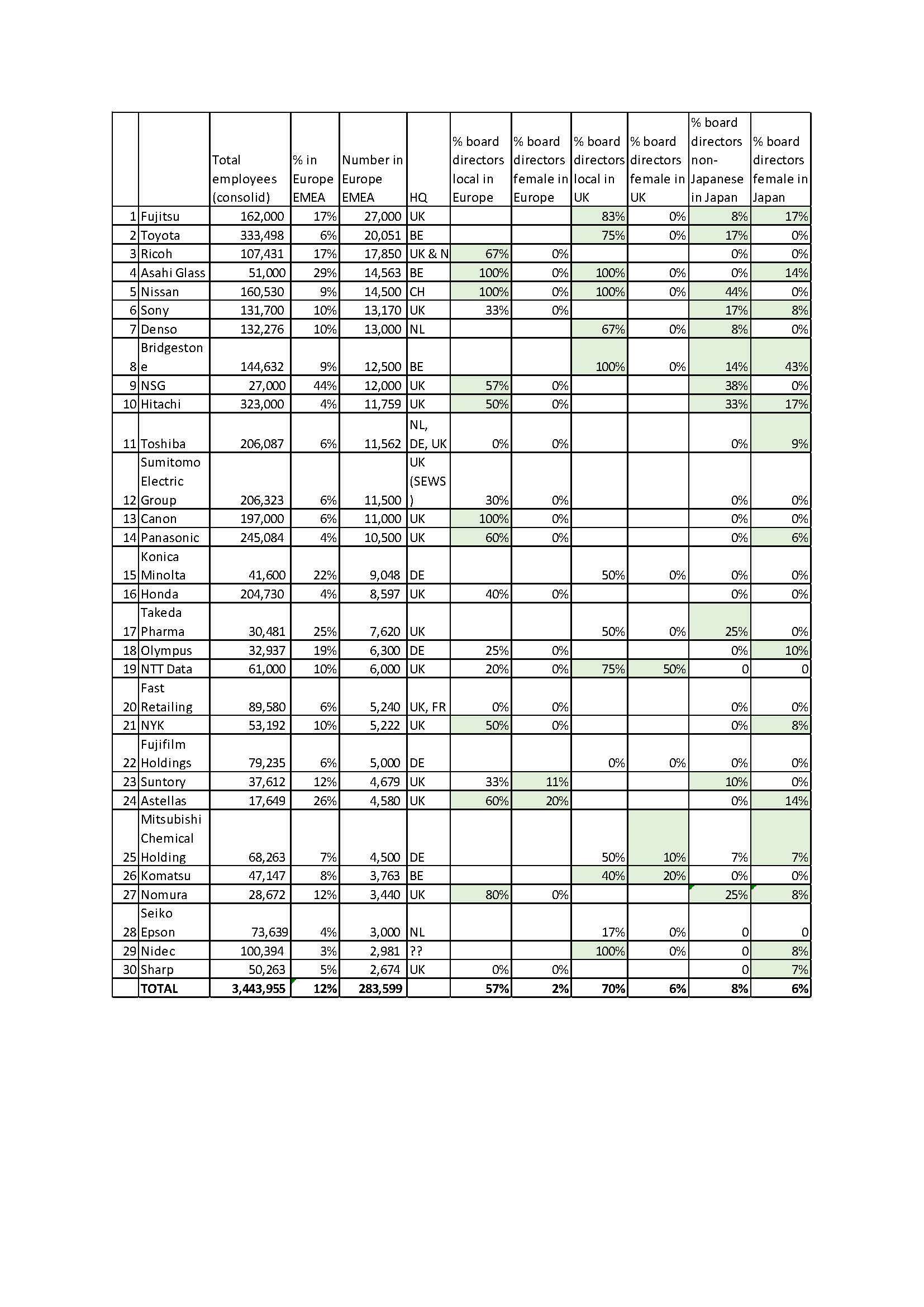
    We’ve revised our Top 30 Japanese companies in Europe again.  Where possible we have updated the number of employees, which means the Suntory Group is now in the Top 30 along with Konica Minolta (and Kao and Daiichi Sankyo are out).  This time we wanted to take a look at the gender and nationality diversity on boards, both in Japan and Europe, and have discovered that there are actually fewer women on the boards of Japanese companies in Europe than in Japan.

    Only two out of 19 (10%) of European headquarter boards of Japanese companies have women on them – Astellas and Suntory (the latter including Makiko Ono, an executive in Suntory Japan) and only 3 of the 14 (21%) UK based Japanese companies we looked at (in cases where the European HQ was not in the UK or there were separate European and UK companies in the UK) had women members – Lucite (subsidiary of Mitsubishi Chemical Holding/Mitsubishi Rayon), Komatsu and NTT Data.  Komatsu UK’s female director is Keiko Fujiwara, who is the CEO of Komatsu Europe, in Belgium.  This contrasts with 13 (43%) out of the Top 30 companies’ boards in Japan  having women directors.  In case you were wondering, only 6% of FTSE250 companies have no women on them.

    • 4% of the Top 30 Japanese companies in Europe’s board members in Europe and/or the UK are female
    • 6% of the Top 30 Japanese companies in Europe’s board members in Japan are female
    • 8% of the Top 30 Japanese companies in Europe’s board members in Japan are non-Japanese
    • 16% of the board members of the Top 100 listed Japanese companies in Japan are female
    • 19.6% of FTSE250 board members are female

    Around 62% of the members of European and UK boards of of the Top 30 Japanese companies are European, on average.  Companies whose boards in the UK and Europe only had Japanese directors were Toshiba, Fast Retailing (Uniqlo), Fujifilm and Sharp. Sharp and Toshiba’s troubles are well known.  Fast Retailing recently reported struggles in the US market and falling profits in Europe for Uniqlo, Comptoir des Cotonniers and Princess Tam Tam. Fujifilm has made a remarkable transformation from a B2C camera film to a B2B imaging company but the last set of quarterly results, issued last month were deemed “mixed”.

    (Note: only main boards, not executive or supervisory boards were analysed, and company secretaries were excluded)

    The full chart is here (highlighted means “above average) and can be downloaded here :Top 30 Japanese companies in Europe board diversity Nov 3 2015

    Top 30 Japanese companies in Europe board diversity Nov 3 2015