
Category: Japanese business in Europe

  • Eastern Europe, 30 years’ on

    Eastern Europe, 30 years’ on

    Recent events marking the 30 years since the Berlin Wall fell have brought back memories for me of 1989, when I was working in London, having graduated from university a year previously. Perhaps it was watching young Eastern Europeans being so brave that made me decide that I wanted a more global, challenging job, so I quit my job in a PR company and joined Mitsubishi Corporation.

    Luckily my new Japanese boss was also up for such a challenge. Together we travelled around Germany and Czechoslovakia in search of business opportunities. Unfortunately, this turned out to be premature.  We soon realised it was going to take many years before disposable incomes improved sufficiently to buy the Honda motorbikes we were looking to sell. The demand was more for shipping second-hand Honda bikes in from Western Europe, and selling parts for repair.

    Similarly, our attempts to link up an East German glassware factory with a UK glassware company were unsuccessful. The German factory made old fashioned, heavily cut, coloured crystal glassware based on production ability rather than customer needs. The UK firm was not prepared to make the investment to improve the quality and refresh the designs. I took the German management around the crystal room of Harrods, and watched as they despairingly noted the high prices for items that they felt lacked the craftsmanship of what they had produced.

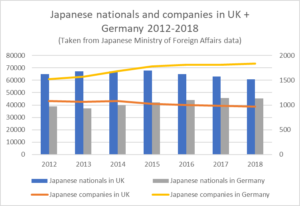
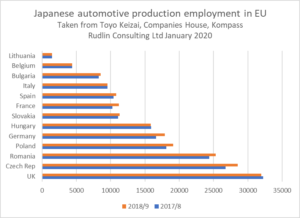
    Thirty years’ on, there is still a noticeable gap in employment and incomes between east and west – but this is mainly to do with a generation gap.  There has been multinational investment in Eastern European manufacturing, including by Japanese companies, to take advantage of the lower wages. But there are problems with a low skilled, ageing workforce, unable to speak English and a severe shortage of younger, skilled, English speaking recruits.

    Many Eastern Europeans who graduated since their countries joined the EU in the 2000s have come to study and work in Western Europe.  Recently I met two impressive HR managers at Japanese clients – both were Lithuanian, speaking excellent English and clearly effective at their jobs.

    Eastern European countries are trying to lure their young people back with various cash and tax incentives. Japanese recruitment companies are also venturing into Eastern Europe to help Japanese companies recruit Japanese speakers from Western Europe.

    Unfortunately, the 20 or so Eastern European students who attended a Japanese studies summer school seminar I taught at my local university were not very enthusiastic about working for a Japanese company. They worried about work life balance and that the corporate culture would be very strict.

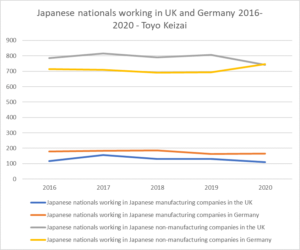
    Japanese companies may need to learn from Fujitsu, who are the biggest non-manufacturing Japanese employer in Poland. They emphasise flexible working and benefits such as private medical care, training, free fresh fruit, CSR activities, sports and corporate discounts. This is because countries such as Poland, Romania and Czech Republic are becoming hot spots for business process outsourcing, logistics and IT services, so the competition for employees is fierce.

    This article was originally published in Japanese in the Teikoku Databank News on 11th November 2019

    For more content like this, subscribe to the free Rudlin Consulting Newsletter. 最新の在欧日系企業の状況については無料の月刊Rudlin Consulting ニューズレターにご登録ください。

    Share Button
  • Which Japanese companies to work for in Europe

    Which Japanese companies to work for in Europe

    We’ve been publishing our top 30 Japanese companies in Europe intermittently for 5 years now.  We regularly receive enquiries for recommendations on which Japanese companies to approach as potential employers.  We’re not a recruitment consultancy so we don’t have any inside track on what jobs are available (please talk to our friends at Centre People Appointments for more practical assistance), but I would say that size in Europe and growth are important factors to consider.

    Relative size in Europe is a key factor

    If the European operations of a Japanese company represent a substantial part of their business, then it’s more likely that Europeans will have some influence within the organisation. There will also be more promotion opportunities and career paths than working for a smaller organisation in Europe. For that reason, it’s worth trying to join the organisation in the European/EMEA headquarters.

    Companies with a relatively high proportion of their employees in EMEA (25%+) include NSG (Pilkington), Asahi (brewery company recently acquired Grolsch, Peroni, Pilsner Urquell etc brands), NTT Data, Toyota Tsusho (acquired French company CFAO with a big presence in Africa), Asahi Glass, JT International, Konica Minolta.

    Has the company been growing?

    Not only are growing companies more likely to have job openings, but they are more fun to work for. Japanese companies are still growing their operations in Europe overall.  However some have been undergoing substantial restructuring, which has resulted in significant headcount reductions in some countries, and significant growth in others. For example Fujitsu is reducing headcount in the UK and Germany, but growing rapidly in Poland and Portugal.

    Companies that have grown the most rapidly in Europe (more than doubling) over the past five years are Nidec, NTT Data and Panasonic.

    Working for an acquired company

    The rapidly growing companies have mostly expanded through acquisition – for example Dentsu, Nidec, Panasonic (Ficosa, Zetes) and NEC (Northgate Public Services), Toyota Industries (Vanderlande), Hitachi (Ansaldo).  Working in those acquired companies might also be an attractive option, as there will be more autonomy, and less domination by Japanese management layers than Japanese subsidiaries which have grown organically.

    Companies who score highly in terms of growth and significant European presence are NTT Data (third largest company in Europe) and Dentsu (8th).

    In terms of sectoral growth – as well as IT companies that are moving into services and solutions like NTT Data, Konica Minolta and PanasonicDaikin (# 27) and Mitsubishi Electric (#30) have both grown substantially recently, probably due to expansion of their eco friendly air conditioning businesses.

    For new graduates, many of the top 30 have graduate trainee schemes, which would be worth considering if you are looking for a chance to be seconded to Japan.

    Top 3 largest Japanese employers in Europe, Middle East and Africa:

    1. Sumitomo Electric Wiring

    Large numbers of employees in manufacturing, as making automotive wire harnesses is still a fairly manual job. Manufacturing jobs will tend to be in North Africa and Eastern Europe. There are plenty of jobs in design engineering and sales as well, and will be future proof as apparently electric vehicles also require complex wire harnesses to operate.

    EMEA headquarters: UK (SEWS-E), Italy (CABIND), Germany (Bordnetze)

    No graduate trainee scheme, but this page gives a flavour of the jobs available in the region for SEWS-E https://www.sews-e.com/current-vacancies/

    2.  Yazaki

    Very similar to Sumitomo Electric Wiring in terms of business and jobs but privately owned, so more of a family style corporate culture. Has a YEA!cademy (Yazaki Europe training academy) https://www.yazaki-europe.com/career.html

    EMEA headquarters: Germany

    3. NTT Data

    Owned by Japan’s NTT (formerly Ministry of Post and Telecommunications, now partly privatised).  NTT Data has acquired various companies in Europe and elsewhere such as itelligence, Cirquent, Value Team, Intelligroup, and Keane. NTT is in the middle of restructuring and have put a new global headquarters, NTT Limited, in London. NTT Data will be kept as a separate organisation, however.

    Lots of training and chances to go to Japan, however recruitment seems more by country/company than centralised and as you can see here https://www.nttdata.com/global/en/careers

    EMEA headquarters: UK

    If you would like a consultation on working for a Japanese company, then you can book an hour with Pernille Rudlin here.

    We also recommend doing the e-learning modules from the leading global intercultural training firm focused on Japanese business –  Japan Intercultural Consulting – on working in a Japanese company – each module comes with a certificate – proof that you know what you’re letting yourself in for!

    For more content like this, subscribe to the free Rudlin Consulting Newsletter. 最新の在欧日系企業の状況については無料の月刊Rudlin Consulting ニューズレターにご登録ください。

    Share Button
  • It’s not over yet for Honda in the UK

    It’s not over yet for Honda in the UK

    “Don’t be ordinary, Honda” urges a 20 page special feature in Nikkei Business magazine. It points out that Honda occupies a similar space to Sony in Japanese people’s hearts. They both had maverick founders, produced quirky, innovative products for decades, lost their edge and then had to undergo deep restructuring to survive.

    The loss of face for Swindon

    Part 1 of the special feature starts in Swindon, lamenting that it has come to a point where Honda, “the face of Swindon”, is having to shut down. “Falling European sales and the chaos of Brexit are not the only reasons”. Honda says it is because of the need to respond to the rise of electric vehicles, a recognition that it had not set up the necessary structure in Europe to deal with the EU’s strict environmental regulations and supply electric and hybrid vehicles.

    Going it alone made it difficult to innovate

    This lack of preparedness may have been because Honda was going it alone, in contrast to Toyota working with Mazda, Suzuki, Subaru and Daihatsu and Nissan’s alliance with Mitsubishi and Renault.  Even adding in Honda suppliers like TS Tech, Keihin, Showa, Musashi and Nisshin, its total supply chain sales amount to a tenth of Toyota’s. Toyota’s supply chain includes other large multinationals like Denso, Aisin, Toyota Industries, JTEKT and Toyota Boshoku. R&D expenditure is similarly tiny compared to Toyota’s spend.

    Honda is not in Boston Consulting Group’s Top 50 most innovative companies of the world – whereas Toyota is at #37.  It’s not even in the top 50 of Japan’s own ranking of most innovative domestic companies. Toyota is at #2, Honda at #105.

    Only 70% of Honda’s sales are 4 wheel vehicles however – 13% are motorbikes, 2.2% power products like lawnmower engines and 14.9% is financial services. Honda has been innovating in these areas as well as becoming active in Mobility as a Service, investing in electric vehicle charging, including in the UK and Sweden.

    Honda still has roots in the UK

    In fact it’s not over for Honda in the UK by any means. Nikkei Business’s special feature takes a nostalgic look at whether Honda can grab back the “speed” and “challenge” spirit that Honda showed in the Isle of Man TT races, illustrated by a headline from the Daily Mirror in 1961 “The Japs are Laps in Front”. It described the 3 times Honda has left Formula One, only to come back again. Honda R&D and Honda Motor Europe are still based in the UK, and Honda has mainly supplied engines to UK based Formula One teams over the years – most recently to Red Bull in Milton Keynes.

    The special feature finishes with an interview with Honda’s President Hachigo Takahiro – who was himself posted to the UK during his career.  He shows no interest in merging with Toyota or Nissan in order to achieve scale.  “We are not thinking about making a bid for Nissan…We are innovative when we face challenges, like we did with Formula One.  As for Toyota, we won’t get very friendly, we will have a fight occasionally.  Otherwise the Japanese car industry would be very dull. We have different personalities.  We should be good rivals, and help Japan rise up. We have no intention of taking Toyota’s money.”

    Even if Honda is shutting down its manufacturing in the UK, the hope seems to be that the UK can play a part in recharging its innovative spirit.

    For more content like this, subscribe to the free Rudlin Consulting Newsletter. 最新の在欧日系企業の状況については無料の月刊Rudlin Consulting ニューズレターにご登録ください。

    Share Button
  • Japanese companies in Europe say Brexit is their biggest worry for 2020

    Japanese companies in Europe say Brexit is their biggest worry for 2020

    The annual Japan External Trade Relations Organisation (JETRO) survey of Japanese companies in Europe reveals that over 70% of Japanese companies expect their European operations to be profitable for the fifth year running, but  concerns over an economic downturn in the region are higher than in previous years. Brexit came top of the list of management worries – selected by 56.5% of Japanese companies in Europe.

    31% say Brexit has had a negative impact on their business so far, and 37.7% are expecting a negative impact in the future. 3.7% felt Brexit has had a positive impact on their business both now and will do in the future. A negative impact was felt by 54% of Japanese companies in the UK both now and in the future, with 2.1% of Japanese companies saying Brexit has had a positive impact and only 0.5% expecting it to have a positive impact in the future.

    Brexit

    More than half of the 842 companies who responded cited Brexit as their biggest management concern, outstripping the perennial headache of recruiting and retaining employees.  Unsurprisingly the group that was most worried was the manufacturing sector in the UK – but the services sector in Ireland and the UK also ranked Brexit highly as a concern.  Nearly 70% of Japanese companies in Poland and Portugal picked Brexit as a key issue – significantly higher than the average for Japanese companies across Europe.

    54% of Germany based Japanese manufacturers chose Brexit as their primary concern, but interestingly, the non-manufacturing sector in Germany was even more concerned by Brexit (59%).  For all groups, the short term disruption from a no deal Brexit was the main reason for concern and the second biggest issue was the future relationship of the UK and the EU.

    Japanese companies in the UK were worried about the impact Brexit would have on the UK economy, a cheapening £ making imports more expensive, changes to the UK regulatory and legal environment and exports to non-UK EU.  Japanese companies in non-UK EU countries were most worried about exports to the UK, but also the impact of Brexit on the UK economy and on the EU economy.

    Around 90% of Japanese companies were concerned about disruption to logistics and customs processes between EU and UK, considerably higher than concerns about tariffs being imposed (65%).

    Japanese companies in the UK focused on freedom of movement of their employees

    The worries about UK regulatory and legal changes were mostly focused on changes to the freedom of movement of people between the UK and EU.  Over 50% of Japanese companies in the UK said this was their main concern, particularly those in the services sector.

    In terms of countermeasures – 22% said they had either implemented or were implementing their contingency plans – particularly regarding regulatory and legal changes. Compliance with the REACH regulations for the chemicals industry and setting up a new operation were most cited as steps taken. Around 12% of UK based Japanese companies have or are in the middle of reorganising their supply chain and logistics and 4.4% have or are in the middle of reviewing their manufacturing organisation and 2.4% have or are reviewing their R&D structure. The most frequently cited measure taken by Japanese companies in non-UK EU was to secure financial passporting into non-UK EU.

    Relocation from UK to EU (but some purchasing functions coming to UK)

    In terms of moving out of the UK, the survey found that 3 companies had moved their EU regional HQ completely out of the UK, to Germany, and 10 had partially moved out – 5 to Germany, 3 to the Netherlands and 2 to Luxembourg.  In 2015 19 companies said they wanted to expand their regional coordination function in the UK, compared to only 2 in 2019.  More companies were expanding their regional HQs in Germany, Netherlands, France and Spain.

    3 companies had moved their sales coordination out of the UK, to Germany, Czech Republic and Poland, 4 had partially shifted it, to Germany, Italy and the Netherlands. 2 companies had moved all their manufacturing out of the UK – 1 to Poland and one to Japan. 1 had partially moved their manufacturing to Hungary.  Only 1 company had moved their R&D out of the UK, to Switzerland.  4 companies had moved their procurement function from the UK to Czech Republic, Italy, Spain and one company had moved their procurement function to the UK, from Asia.

    4  companies are investigating moving their regional HQ from the UK to Germany and Italy, 2 partially moving their HQ to France and Czech Republic. 3 companies are considering moving their sales coordination to Germany and Italy or partially to Germany, France or Belgium.

    1 company is considering moving all manufacturing to Japan, and 9 companies are considering partial relocation to Hungary, Germany, Czech Republic, Romania, Japan or elsewhere in Europe. 2 companies are considering wholly or partially moving their R&D to Germany or elsewhere in Europe.

    14 companies in the UK are expecting to expand their high value added manufacturing in the UK, down from 25 in 2015 whereas 32 Japanese companies in Germany are expanding their high value added manufacturing.  The Netherlands has become the third main host for Japanese high end manufacturing – 12 are expecting to expand their manufacturing there compared to only 2 in 2015.

    12 companies are considering moving their procurement to Poland, Italy, Germany, Spain, the Netherlands, Asia or elsewhere in the EU. 3 companies are considering moving procurement to the UK from the EU, Poland, Portugal.  3 other companies are looking to move their procurement entirely out of Europe to countries such as South Korea or China.

    The EPA is encouraging Japanese imports to EU

    65.5% of Japanese companies who were importing from Japan to the EU and 53.1% of Japanese companies exporting to Japan from the EU said they were taking advantage of the EPA. Particularly notable were 80% of Japanese companies based in Italy (both importers and exporters) and 70% of Japanese companies in Spain.  62% of UK based Japanese companies were using the EPA to import from Japan (a lower proportion than Italy, Czech Republic, Spain, Poland, Belgium, Netherlands and Germany).

    100% of Japanese companies in the logistics/warehousing, plastic components, rubber products sectors say they are using the EPA and over 70% of Japanese companies in the metal products, textiles, automotive parts, wholesalers, food and seafood processing sectors are using the EPA to import from Japan.

    Sectors most making use of the EPA to export from the EU to Japan were the logistics/warehousing, automotive parts and wholesale sectors.

    Overall, Japanese companies in the EU are importing 32.6% of their parts and raw materials (by value) from Japan, 1.2% up on the previous year – Japanese companies in Germany were importing the highest share of their procurement from Japan by value – 46.6%.  Over 23% of Japanese companies in the EU expect to expand their procurement from Japan, particularly the services sector with 47.8% of wholesale and retail companies saying they will increase their purchases from Japan.

    Economic outlook for Europe

    Japanese manufacturers are however more pessimistic about prospects for 2020 than they were in 2019,  with 36.7% expecting their profitability to worsen, compared to 26.6% expecting their profitability to improve.  The causes differ from Western Europe to Eastern Europe – manufacturers in Western Europe expect falling  demand to be the key factor whereas in Eastern Europe the primary concern is rising labour costs.

    Around a third of Japanese companies are optimistic about the economic prospects in 2020 for the countries they are operating in, which is considerably down on the 57% who were optimistic for 2019 – this pessimism was particularly strong for Western European based manufacturing.

    Hiring and retaining workers continues to be a headache for Japanese companies.  This is especially an issue in Central and Eastern Europe and particularly at management level in Western Europe and at factory worker level in Central and Eastern Europe.

    Around 50-55% of Japanese companies in Europe have or expect to maintain current employee levels – over a third have or expect to increase their workforce. 16% cut their workforce in the past year but only 11.3% expect to do so in 2020.

    Strengthening selling to EU as a region

    JETRO also sees evidence that Japanese companies are strengthening their approach to selling to the EU as a region, rather than individual countries.  For the first time in their surveys, “The EU” outstripped Germany and Poland as the market that Japanese companies saw as the most promising for sales.  Maybe this is another – psychological rather than regulatory –  impact of the EPA.

    Japanese companies say that strengthening their company’s brand, developing and strengthening the technical skills of their employees (particularly in Eastern Europe) and investing further in research and development are key to increasing sales in Europe.

    So, as I have often said, Japanese companies are having to find ways to retain their integrity in a Europe and a world which is also dis-integrating, and Brexit is accelerating that process.


    For more content like this, subscribe to the free Rudlin Consulting Newsletter. 最新の在欧日系企業の状況については無料の月刊Rudlin Consulting ニューズレターにご登録ください。

    Share Button
  • Brexit update for Japanese companies

    Brexit update for Japanese companies

    I’ve been avoiding writing about Brexit this past few months, partly because I felt I had nothing more to say. Similarly, Japanese companies have stopped issuing warnings.  Many have already made and even implemented their plans for a worst-case scenario of a hard or no deal Brexit.  I hear they have also been advised by the Japanese government to leave the talking to diplomats and politicians.

    Companies in the UK have also gone silent.  Some because they have been told by the Johnson regime that if they speak out, they will jeopardise government contracts.  In financial services – Japanese firms included – alternative, approved EU entities have been set up.  There is even the chance of making some money on the chaos that will probably arise in the currency, bond and stock markets.

    It is still impossible to make any confident predictions about what will happen. Maybe it is true that Boris Johnson will, at the very last minute, blame the EU for not offering a fresh deal, then ask the EU for an extension to Article 50 in order to have a general election.  He would be hoping to fight this on a populist campaign and win a more substantial majority. Then he can ask the EU for a new deal, confident as Mrs May was not, that he has a majority in parliament to approve it – or a no deal if the EU will not offer any concessions.

    The problem is that the deal offered to Mrs May was as good as could be expected given her red lines of an end to the freedom of movement of people, no jurisdiction over the UK by the European Court of Justice and no customs union with the EU.  It is hard to imagine a Johnson government erasing any of those red lines.

    Johnson’s main aim appears to be to remove the Northern Ireland border “backstop” that in effect keeps Northern Ireland inside the EU if no solution to keeping the border open with the Republic of Ireland is found. Perhaps there could be a fudge whereby the backstop is removed from the Withdrawal Agreement and put into the Political Declaration – meaning it is to be negotiated later – which would probably also require a longer transition period than the current two years.

    So Japanese companies in the UK may find that after a tumultuous few months, the UK remains in a transition period for several years – technically not in the EU, but all conditions remaining the same, while negotiations drag on, ending in a hard Brexit.

    In which case what Japanese companies have already done remains the best solution – manufacturers adjust supply chains to circumvent the UK, financial services companies keep most of their staff in the UK but have substantial presence in the EU too. And those Japanese IT, infrastructure and outsourcing companies who have recently been investing in the UK should stay quiet, in the hope of getting government contracts to assist with whatever new systems Brexit brings.

    This article by Pernille Rudlin originally appeared in Japanese in the Teikoku Databank News, 11 September 2019

    For more content like this, subscribe to the free Rudlin Consulting Newsletter. 最新の在欧日系企業の状況については無料の月刊Rudlin Consulting ニューズレターにご登録ください。

    Share Button
  • Japanese corporate integrity in a disintegrating Europe

    Japanese corporate integrity in a disintegrating Europe

    I’ve made a screencast (12 minutes with captions – ably edited by my son) of my keynote speech at a Dutch Embassy event for Japanese companies on a clipper ship on the Thames last month. It looks at the challenges facing Japanese companies trying to build their employer brands in a disintegrating Europe. I explain how difficult is is for Japanese companies to build ‘virtual trust’ across Europe when they are used to implicit communication, sticking to Japanese processes and working as homogenous, Japanese speaking teams huddled into one office.

    I introduce the five competencies Japanese companies and their employees need to build trust across cultures – ability to communicate, understanding mutual interests, respecting European and Japanese processes and regulations, being reliable and accountable and having a shared vision and values.   You can also find them in my book  “Shinrai: Japanese Corporate Integrity in a Disintegrating Europe” available as a paperback and Kindle ebook on  Amazon.


    For more content like this, subscribe to the free Rudlin Consulting Newsletter. 最新の在欧日系企業の状況については無料の月刊Rudlin Consulting ニューズレターにご登録ください。

    Share Button
  • I love Japan but I don’t want to work in a Japanese company

    I love Japan but I don’t want to work in a Japanese company

    I’ve done a screencast (around 11 minutes long) of my talk at the Centre People Appointments HR seminar earlier this year, on why people love Japan, but don’t want to work for a Japanese company, and what Japanese companies can do about it.

    If you  want to know more about working in a Japanese company, you can find our Japan Intercultural Consulting e-learning modules on Teachable, starting from £39 https://japan-intercultural-emea.teachable.com/

    For more content like this, subscribe to the free Rudlin Consulting Newsletter. 最新の在欧日系企業の状況については無料の月刊Rudlin Consulting ニューズレターにご登録ください。

    Share Button
  • No sacred cows for NEC’s President Niino

    No sacred cows for NEC’s President Niino

    I was reminiscing a couple of days’ ago with a Japanese business person about how in the 1990s there was a Silicon Glen in Scotland hosting many Japanese electronics and semiconductor factories, including NEC’s semiconductor plant in Livingston. After the IT bubble burst in 2000, most of these plants disappeared, including NEC’s. Silicon Glen has remade itself, focusing more on software and semiconductor design and development.  NEC has also reinvigorated its presence in the UK with the acquisition of Northgate Public Services in 2018.

    NEC is not out of the woods yet, however. In a tough interview in the Nikkei Business, President Niino seems willing to slaughter several sacred cows and even commits to taking responsibility (presumably by resigning) if his revival plan to FY 2020 does not succeed.

    He said he was open to merging with rival Fujitsu, even if it meant the NEC name disappeared. I certainly recognised from his descriptions some similar characteristics in the way they operate.

    NEC, like Fujitsu, was part of the so-called Den Den Family, where stable, dependable business came from government contracts from what is now NTT. “Customers would make very stringent requests of us and we would always try to respond with the best possible technical solutions, and deliver 100%. This is an important quality, but you cannot survive globally just on this”.

    Niino thinks there were many reasons for the halving of NEC’s turnover since 2000.  They had relied on introducing new technology in areas such as semiconductors, PCs and mobile phones, but once these became volume businesses with many newcomers, spending far more on R&D, NEC was no longer able to compete.

    Niino is focusing on profit targets rather than turnover and sees NEC’s future strength as being in “safer cities” – using AI and software development rather than hardware. Clearly China will be a major competitor in this, but I guess NEC and other Japanese suppliers will be preferred by many who might view China as a threat.

    Niino has brought in an HR director from Microsoft Japan to shake up the HR system.  He has appointed 31 “change agents” and made evaluations more visible, and the distinction between specialists and managers more clear.  Corporate officers on the board have all been asked to step down temporarily and then are being rehired on 1 year contracts. “I won’t be firing them if they don’t meet targets within one year, but if they miss two years’ running, it might be that they are better off working outside NEC”.  As Niino is himself a Corporate Officer, no wonder he has to commit to taking personal responsibility for any failure too.

    For more content like this, subscribe to the free Rudlin Consulting Newsletter. 最新の在欧日系企業の状況については無料の月刊Rudlin Consulting ニューズレターにご登録ください。

    Share Button
  • Brexit and Japanese jobs in the UK – growing by acquisition or “new” jobs?

    Brexit and Japanese jobs in the UK – growing by acquisition or “new” jobs?

    Those looking for “despite Brexit” good news may be reassured that employment in the UK by the biggest Japanese companies has grown by 22% since 2014/5, right in line with the growth in Japanese jobs across Europe, Middle East and Africa (EMEA).  About a quarter of the 750,000 people we estimate work for Japanese companies in the region are working in the UK, and so far there is no obvious divergence between the UK and the rest of EMEA in terms of overall job growth.

    Big ticket acquisitions are the main driver of Japanese growth in the UK

    But as we pointed out in previous posts looking at the trends across Europe, a distinction needs to be made between “new jobs” created in EMEA by Japanese greenfield investment, and investments which are acquisitions of existing jobs.  Eastern Europe is the beneficiary of the former, particularly for the automotive sector, whereas the UK has been the target of the latter with big ticket acquisitions like SoftBank acquiring ARM, Mitsui Sumitomo acquiring Amlin, Sumitomo Rubber acquiring Micheldever, and NEC acquiring Northgate Public Services as well as Outsourcing acquiring various staffing and outsourcing companies.

    Where are the “new jobs”?

    These acquisitions account for the new entrants to the Top 30 ranking we have compiled below. They push out Fujifilm, Sumitomo Corporation, Japan Tobacco (who shut their factory in Northern Ireland last year) and Toshiba. The original Top 30 in 2014/5 have grown a more modest 10% if the acquisitive newcomers are not included.  One of the highest climbers from the original 2014/5 ranking is the main Japanese creator of new jobs in the UK- Hitachi – in particular via their rail manufacturing and assembly plant at Newton Aycliffe.

    There has not been a decline in automotive sector jobs in the UK – yet – however.  In fact quite the reverse – there has been some growth in jobs in all three of the big Japanese car companies. But the trend is clear, as pointed out in previous posts, that even without Brexit, the drift of investment and jobs in the automotive sector is eastwards and to Africa.  It’s easy to see how British people in those areas where Japanese automotive supply chains are active could blame the EU for job losses. Even though there actually weren’t that many EU grants enabling Japanese companies to transfer production from the UK to Eastern Europe – despite the rumours – merely by being members of the Single Market, and having lower labour costs, Eastern European countries are an obvious destination for new manufacturing investment.

    Will Japan’s investment in the UK services sector be Brexit proof?

    The investment in the UK by Japanese companies over the past three years has largely been through acquisitions in the services sector. This is not surprising, as services are 80% of the UK’s GDP and the UK’s comparative advantage in the region. It is also relatively Brexit proof in the sense that services sector investment will not be directly affected by any supply chain disruptions. Clearly if the UK economy takes a hit from Brexit, however, this will dampen demand for services. There has also been a shift of regional headquarters away from the UK by Panasonic and Sony and others, and of financial services companies, but as yet this has not hit UK jobs.

    Eastern Europe has also been attractive to Japanese companies for business process outsourcing. Although Fujitsu is still – just – the top employer in the UK, employee numbers have dropped 29% – and there are now 13,000 people working for its service centres in PolandNTT and its subsidiary NTT Data has also shot up the Top 30 both for the UK and the EMEA region – again through acquisitions – and has decided to base its new global ex-Japan headquarters in the UK.

    Infrastructure, energy, transport should be the future for Japanese jobs in the UK

    The UK’s strength as a global services provider will not disappear overnight, however hard the Brexit. But it’s hard to imagine how the kinds of secure, high quality automotive manufacturing jobs that those who voted for Brexit might have wanted to see return to the UK will come back, however soft the Brexit.  The potential sunlit upland is in infrastructure – energy and transport.  These sectors were needing investment regardless of whether the UK is in or out of the EU and are not so reliant on just in time supply chains across the region. Transport, environment and energy are areas where cooperation and financing on an EU-wide  basis makes business and environmental sense though. But unfortunately Brexit has provided a distraction that has resulted in Hitachi freezing its Horizon nuclear power projects in Wales and Gloucestershire from lack of government financial support, and the recently called review of HS2 must also be giving Hitachi’s rail business and other Japanese executives cause for concern. Risk averse Japanese companies are not going to want to make multi million investments in infrastructure projects in a country which is politically unstable and unreliable.
    [download_after_email id=”5729″]
     

    For more content like this, subscribe to the free Rudlin Consulting Newsletter. 最新の在欧日系企業の状況については無料の月刊Rudlin Consulting ニューズレターにご登録ください。

    Share Button
  • The successes and failures of Japan’s era of big overseas acquisitions

    The successes and failures of Japan’s era of big overseas acquisitions

    The era of Japan’s big overseas acquisitions began with domestic mega M&As in the 1990s according to Nikkei Business magazine.  Following the bursting of Japan’s economic bubble in 1990, a wave of M&As happened in the financial sector, giving birth to Mizuho from Fuji Bank, Daiichi Kangyo and the Industrial Bank of Japan and Sumitomo Bank and Sakura Bank producing SMBC. In the steel sector with NKK merging with Kawasaki Steel and becoming JFE and in the pharmaceuticals sector with Yamanouchi and Fujisawa merged to become Astellas.

    The key concept for these M&As in the 1990s was “restructuring” – to rationalise the back office and integrate R&D. Then in the second half of the 2000s came a wave of overseas acquisitions, to counter the business impact of the shrinking, ageing population of Japan by growing overseas but also to benefit from further restructuring and rationalisation.

    Mega overseas acquisitions of the 2000s

    In 2007 Japan Tobacco acquired the UK’s Gallaher from RJR, becoming the third biggest tobacco company in the world. In 2006 SoftBank acquired Vodafone Japan and then the US company Sprint Nextel, then British ARM Holdings in 2016. Takeda acquired US Millennium Pharmaceuticals in 2008, then Swiss Nycomed in 2011, with the biggest M&A ever by a Japanese company, acquiring Ireland’s Shire in 2019.

    “Growing overseas means the development of our human resources has become an urgent necessity” said the President of Takeda in 2006, Yasuchika Hasegawa. Hasegawa  was seen as “an alien from outerspace” for his dry, rational management style, arising from many years working in the USA.  Although Takeda had been the biggest pharmaceutical company in Japan for some years, it only ranked around 17 in the world before its acquisition spree and urgently needed to find new drug development sources. It felt it was lagging competitors.

    The need for global management skills

    Hasegawa decided to globalise the company internally by recruiting a foreign successor to himself in 2014 – Christophe Weber from GlaxoSmithKline.  Three out of the seven current Takeda directors are not Japanese.

    Japan Tobacco‘s managers sent overseas after the Gallaher acquisition found themselves caught between overseas executives determined to defend their patch with rational, logical arguments about productivity, logistics and profitability. After years of painful discussion, it was agreed to close the factory in Northern Ireland.  Even now, says Masamichi Terabatake, the current President of Japan Tobacco, a Japan based executive needs to be prepared to travel around the world regularly to discuss strategy with local executives. “You need to keep global staff motivated. Investment and marketing cannot be left vague, they have to be quantitative so they can be transparently discussed. That’s probably why executives in the West are a bit younger!” he says.

    NSG acquired UK’s Pilkington in 2006, becoming heavily indebted to do so. From being very domestic, it became a company whose sales were 80% overseas. Unfortunately this proved to be terrible timing as the automotive and architectural glass market crashed after the Lehman Shock.

    Many of the acquirers also struggled because they did not have managers with experience of managing overseas businesses.  As Nikkei Business magazine says, mega M&A means mega complexity for which plenty of preparation and a high level of management know-how, with the ability to spread this know-how horizontally and vertically is needed for success.  It’s still not clear how far Japanese companies have progressed in this.

    Rudlin Consulting has assisted many European companies acquired by a Japanese parent. Please contact Pernille Rudlin for further details.

    For more content like this, subscribe to the free Rudlin Consulting Newsletter. 最新の在欧日系企業の状況については無料の月刊Rudlin Consulting ニューズレターにご登録ください。

    Share Button