Category: Japanese business in Europe

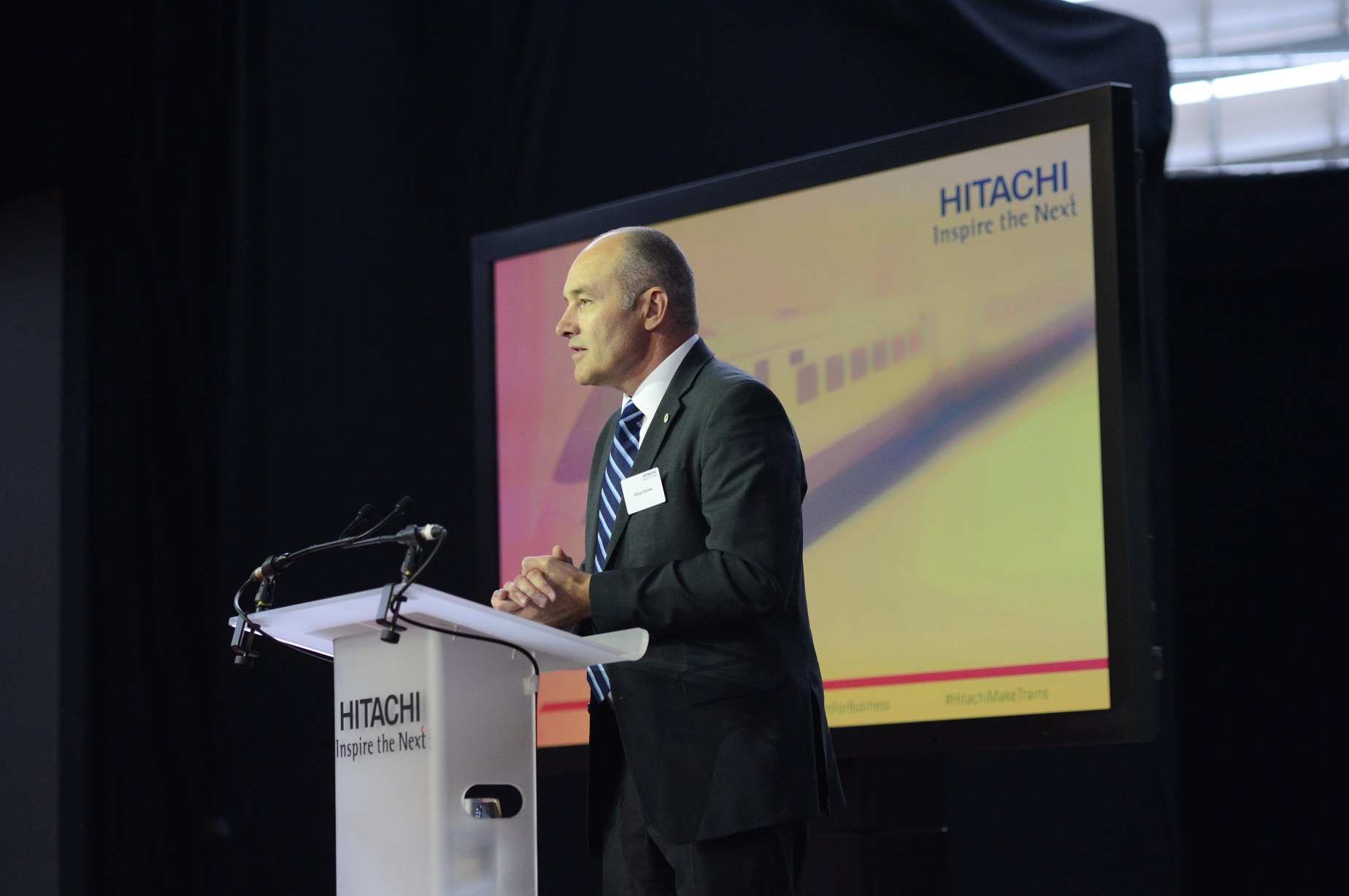
  • Hitachi Rail’s CEO Alistair Dormer on Brexit, speeding up and the need to speak simple English

    Hitachi Rail’s CEO Alistair Dormer on Brexit, speeding up and the need to speak simple English

    Hitachi’s rail business is only 5% of the whole group’s turnover, but is growing rapidly and moving from being “double domestic” to a truly global business.  Overseas sales are now 83% of turnover, having been 28% of the business in 2012.

    Nikkei Business interviewed Alistair Dormer  (subscription only, in Japanese), the CEO of Hitachi Rail who is also a Senior Vice President and Executive Officer of the Hitachi Group about his four years as CEO – at a time when the railway business is undergoing major change, with Siemens and Alstom joining forces in Europe for their rail business.

    Dormer talks about the importance of being able to scale multilaterally through M&A, with the acquisition of Ansaldo Breda and other companies, which resulted in acquiring customers across 27 countries – 26% of business is now in the UK, 17% in Japan, 10% in Asia Pacific. Hitachi Rail is also moving, like every technology business, into “solutions” adding a services side, including communication technology, software development, signalling systems and operations.

    Speed up every aspect

    Dormer says the most important thing for Hitachi Rail as a Japanese company was to speed up every aspect.  “It is a strength of Hitachi as with other Japanese companies that business advances on a consensus basis, carefully harmonizing in-house planning and business negotiations with partners.  This leads to stable quality standards and organizational cohesion, but it is also a weakness in that it takes too much time when you face global competition.  The leader needs to be able to make quick decisions and communicate rapidly.”

    Of course this is even more difficult when communication and decisions have to be made across long distances such as between the UK and Japan.  So Dormer decided the best way was to move people around, to raise the frequency and density of communication.  So there has been substantial exchange of people between the factory in Japan and manufacturing bases in UK and Italy.

    If there is a substantial geographical and time distance, then people prefer not to have meetings about trivial things, but these details can later become obstacles.  So having more regular interaction is necessary. Hitachi Rail thererefore also has regular video confererence and Dormer himself visits sites, holding meetings with 50-80 people to exchange opinions.

    Only use simple English

    With English as the common language, Dormer (as a native Brit) instituted a rule that only simple English should be used.  “When native English speakers are talking, they speed up.  It should be easy to say, “I don’t understand, I can’t follow what you’re saying”, but it’s difficult to do this in a teleconference or an important meeting.  So then the meeting ends inconclusively and you find out later that people did not understand.  So not only should you use simple English, but also I put in a process to confirm understanding after the meeting. The productivity of our meetings has greatly improved as a result”

    Hitachi Rail has also introduced common standards across all countries for HR reviews, cost, engineering performance etc. “Each country, the UK and Italy and Japan, have different cultures and ways of doing things, so we did not force conformity, but respected each others’ cultures while working to Hitachi’s values as the common standard.”

    Brexit – nobody knows what the future will hold

    With regard to Brexit, Dormer says he is repeatedly asked about it, but at the moment there has been no change.  “Hitachi has good relations with the UK government.  All we can do is continue to ask that companies like us who have their regional base in the UK can continue to access the EU market as seamlessly as possible.  There is no choice but to believe this. A transition period is being discussed, so it’s possible the environment will not change for the foreseeable future.  However it is still a shock to me on a personal level that the UK made such a decision – even when we knew there was nothing to gain from leaving the EU.  There are many people in our offices who were born in the European Union outside the UK, and they are worried.  My priority is to reassure them, but the only thing I can say is that nobody knows what the future will hold.”

    For more content like this, subscribe to the free Rudlin Consulting Newsletter. 最新の在欧日系企業の状況については無料の月刊Rudlin Consulting ニューズレターにご登録ください。

    Share Button
  • First decrease in Japanese nationals living in UK since Lehman Shock

    The number of Japanese nationals resident in the UK fell by 4.5% in 2016, from 67,997 in 2015 to 64,968 – the first time since 2008-9, when the Lehman Shock hit and numbers dropped from 63,526 to 59,431.

    It’s difficult to avoid concluding that the Brexit referendum vote had an immediate psychological impact along with the beginning of a renewed crackdown on non-EU migration. I expect the downward trend to be intensified in 2017-8 as it has become much more expensive and difficult to bring in Japanese expatriate staff from 2017.  The non-EU immigration cap has been hit for the third month running in February 2018. It is estimated that the cost of bringing in a Japanese expat has increased from £2151 to £7174 in 2017 (and might double again in later years) after the introduction of the immigrant skills charge of £1000 per year in April 2017. The charge to use the NHS is proposed to rise from £200 to £600 over the next couple of years.

    Given that some Japanese companies have hundreds of Japanese expatriates in the UK, this is a significant cost, even though it does not seem to have deterred more non-EU migrants from coming to the UK in 2018 compared to 2017.

    Delving further into the Japan’s Ministry of Internal Affairs and Communication’s Statistics Bureau’s statistics, it is clear that other European countries are still seeing significant rises in Japanese nationals as residents – Sweden has seen an increase of 8% from 2015 to 2016, the Netherlands a 7% rise and the two largest Japanese populations after the UK, Germany and France have also seen 3-4% rises, to 44,027 and 41,641 respectively.  Belgium and Russia are the only two other countries to record a decrease in Japanese nationals, of 9% to 5,707 and 4% to 2,650 respectively.

    For more content like this, subscribe to the free Rudlin Consulting Newsletter. 最新の在欧日系企業の状況については無料の月刊Rudlin Consulting ニューズレターにご登録ください。

    Share Button
  • Nidec’s Nagamori on the root causes of Japanese corporate scandals.

    Nidec’s Nagamori on the root causes of Japanese corporate scandals.

    The founder and President of Nidec Corp, Shigenobu Nagamori has been high profile in the Japanese media (again).  As well as a long interview in Diamond magazine about why all 57 of his acquisitions (many in Europe) have been a success, he gives some punchy analysis in his final column for the Nikkei Business magazine on what the root causes of the succession of scandals coming out of corporate Japan.

    “It is the top management’s fault if bad news does not reach them.  If there is something wrong with the production process or sloppiness in quality control, this is a matter of life or death for a manufacturer.  That such important information is not being communicated is because the management is not going to the genba (where the action is) and seeing what is going on for themselves.

    4 root causes of scandals at the genba

    1. Nare (becoming used to something) Thinking that a certain level of irregularity won’t be a problem, getting accustomed to it.
    2. Amae (being indulged) – believing that you won’t get found out anyway
    3. Tiredness – when the cost price seems to have reached rock bottom or kaizen has been continuing for a while
    4. Takotsubo (octopus pot – for more uses of this analogy, see our post on octopus appointments) – silos where a problem in one unit is hidden and not communicated to other units

    This happens because managers are not ensuring a sense of urgency in the genba.  This doesn’t mean they have to keep pressurising employees.  They should be making frequent efforts to strengthen and pull up the genba.  That’s why they should enter the genba themselves and see for themselves what is going on in R&D and manufacturing, sales.  This will naturally lead to a sense of urgency.

    Of course managers set targets, but if they don’t know the genba, then these are just words, and feel very distant to the genba.

    The need for “hands on”, “micromanagement” and “making responsible without giving away responsibility”

    Hands on means the genba solves problems with the management alongside.  Not just throwing problems at them.

    Micromanagement is that managers make decisions about all the issues in the genba.  When I acquire a company that is in trouble, in order to reconstruct it, I check purchasing for even 1 yen. Some people say this will undermine the ability to think for themselves but it’s quite the opposite.  It is to make the employees think, come up with suggestions and work alongside managers to review it.  Not just get told, in a one way fashion.

    “Making responsible without giving away responsibility” means that I delegate authority, but I don’t just leave people up to it.  Otherwise the genba logic just becomes stronger and they fail to see what is appropriate overall.  So delegate, but regularly check, very thoroughly.

    The importance of developing generalists

    It’s also important to develop executives.  Although there is a tendency in Japan at the moment to reject generalists, it’s no good if someone only knows one business area and has no idea about other parts of the business.  While people are young, they should experience management in different divisions in order to become proper executives.

    That’s why I am always visiting our subsidiaries around the world.  We have 300 companies and over 100,000 employees so I can’t do this by myself.  So I get other people like our CSO (Chief Sales Officer) to travel around too.  I am visiting somewhere pretty much every week.  If managers had this attitude, the morale of the genba will also improve.  You cannot take it easy.

    For more content like this, subscribe to the free Rudlin Consulting Newsletter. 最新の在欧日系企業の状況については無料の月刊Rudlin Consulting ニューズレターにご登録ください。

    Share Button
  • The positives and negatives for investors of local pride and identity

    The positives and negatives for investors of local pride and identity

    I was working in Catalonia just before the referendum there in 2017 and shortly after that I was in the North Rhine -Westphalia area in Germany, where people were still digesting the results of the German elections. These trips, as well as the impact of Brexit in the UK, have made me aware of how important local – not just national – identities are for businesses to thrive.

    The majority of Japanese companies based in Spain are in the Catalonia region, and this choice of location is not surprising as Catalonia has been one of the most prosperous and industrialized areas of the country, offering easy land access to France and several international ports.  It turns out that one of the factors behind the Catalan independence movement is a resentment amongst the people of the region that their taxes are being transferred to prop up poorer parts of Spain.

    The freedom of capital, labour, goods and services in the European single market creates competition between not just countries but also regions within those countries to attract investment from business.  The European Union tries to prevent this turning into a “race to the bottom” in terms of cost of labour, tax rates and cost of capital by having tough regulations on labour standards, cracking down on tax avoidance and limiting how far member governments can subsidise business investment.

    Before 2008 the system seemed to work well – labour flowed to the more prosperous parts of the EU where there were job shortages and capital flowed from those regions (and from Japan) to regions where the cost of labour was lower. 

    In a free market, this should have eventually led to an equalization of living standards across the European Union. However, the Lehman Shock, combined with the influx of new member countries from Eastern Europe meant that capital flows returned to the safer havens of Western and Northern Europe and workers in southern and eastern Europe left their home towns to find work elsewhere in greater numbers than before.

    The tension this caused is particularly apparent in Germany.   The anti-immigrant Alternativ fur Deutschland had very little support in the recent elections in the prosperous North Rhine-Westphalia region – which has one the highest concentration of Japanese companies in Europe.  But it had strong support in former communist eastern Germany, where the continuing gap in living standards with the west causes resentment, fuelled by worries that immigrants from other eastern European countries are further eroding wages. 

    For Japanese companies considering investment in Europe, local sensitivities add another layer of complexity in choosing a company to acquire or a locational base.  However, if Japanese companies show strong local commitment, the local employees will respond with equal loyalty and commitment too.   This is very clear in the pride and loyalty of employees at Japanese automotive plants which have been operating for over 25 years in some of most deprived parts of the UK, who have expressed their determination to succeed despite Brexit.

    This article was originally published in Japanese in the Teikoku Databank News on 8th November 2017 and also appears in Pernille Rudlin’s new book  “Shinrai: Japanese Corporate Integrity in a Disintegrating Europe”  – available as a paperback and Kindle ebook on  Amazon.

    For more content like this, subscribe to the free Rudlin Consulting Newsletter. 最新の在欧日系企業の状況については無料の月刊Rudlin Consulting ニューズレターにご登録ください。

    Share Button
  • Profitability of Japanese companies in the UK lags rest of EU, pessimistic about 2018

    Profitability of Japanese companies in the UK lags rest of EU, pessimistic about 2018

    The lag between the UK’s growth rate and the rest of the world noted by Christine Lagarde today has also been felt by Japanese companies in the UK.  According to the recently published JETRO survey on business conditions of Japanese companies in Europe, whereas the percentage of Japanese companies in the EU reporting profitability has increased year on year, reaching 75% overall this year, this breaks down into 71.6% for UK companies and 76.6% for other EU countries.  This might only be a 5% gap, but business sentiment is also taking a hit – with the UK coming second from bottom amongst EU countries in terms of expectations of profit growth for 2017-8, beaten only by the Czech Republic.

    As for Brexit contengency plans, of the 952 responses received, 245 were from UK based companies. Around 25% of these said they were currently reviewing or considering a review of their location in the UK.  Of these, 60% are reviewing the relocation of their sales functions, and 50% looking to review the location of their regional headquarters functions and 20% are looking to relocate manufacturing.  Over 80% said they were preparing or considering preparing to partly relocate to another EU country, and 20% were looking to completely relocate.  The top 2 countries cited as potential relocation destinations were Germany (23 responses) and the Netherlands (6 responses).

    Nearly half of UK based Japanese companies were expecting a negative impact on their business from Brexit, citing customs tariffs, securing human resources and changes to regulations and legislation as their main areas of concern.

    On a more positive note, the new Economic Partnership Agreement between Japan and the EU is seen as being a major advantage for their business by over half the respondents, particularly for companies based in Central and Eastern Europe.  Even UK based Japanese companies did not see as much merit in a UK-Japan EPA however. The most selected reason for welcoming the EU-Japan EPA was “tariff reduction or abolition for imports from Japan” – which is mostly in the automotive sector, so I guess this means more imports to Central and Eastern Europe of Japanese cars and automotive components can be expected.

    The biggest operational challenge was seen as securing human resources – for more than half of the companies based in Germany, the UK, the Netherlands and Central and Eastern Europe, again echoing recent news about labour shortages in the UK – both in terms of skills and incoming EU migration. Labour shortages outstripped last year’s biggest operational challenge of “European political and social conditions” – but the latter challenge did not fade away and in fact concerns strengthened slightly, thanks to worries in Spain regarding Catalonian independence, and in the UK regarding Brexit negotiations.

    Over half of respondents expected to expand their  business, over 70% in the case of Japanese companies in Italy and Poland.  So, happy days if you’re an automotive sector worker in Poland.

    For more content like this, subscribe to the free Rudlin Consulting Newsletter. 最新の在欧日系企業の状況については無料の月刊Rudlin Consulting ニューズレターにご登録ください。

    Share Button
  • Japanese companies should put their hard Brexit contingency plans into action now

    Japanese companies should put their hard Brexit contingency plans into action now

    “Don’t give up on expressing your concerns to the British government, but also start putting your contingency plans into action now” was the response from Haruki Hayashi, CEO of Europe & Africa for Mitsubishi Corporation to a question at the end of a lunch seminar in London I attended earlier this month, along with 150 mostly Japanese business people.  The question had been “if we won’t know until October 2018 the likely shape of the agreement between the UK and the EU, won’t it be too late to put our contingency plans into action by then, in time for March 2019?”.

    To another question regarding the possibility of a second referendum, Hayashi responded – “however desirable, might it not have the same result? And aren’t the British too proud to have a second referendum?”

    Hayashi’s speech was a geo-political, economic and risk analysis of the impact of Brexit.  He started by hinting that the meeting between Ambassador to the UK Tsuruoka (who was present at the lunch) and the Japanese Chamber of Commerce and Industry in the UK (JCCI UK) that morning had been encouraging – that the ambassador said Theresa May’s visit to Japan had been fruitful in the sense of being a reaffirmation of a common vision on security, economic issues and global partnership and also that there was clear agreement that the EU Japan agreement would be the basis for a quick agreement between UK and Japan.

    But then he shared a classic Mitsubishi Corporation political (including security, business environment) risk versus economic impact matrix, plotting the key countries in the EU along with Japan.  Unsurprisingly, he predicted the UK economic impact to decline and political risk to increase from its current position clustered with France, Germany, Japan, Italy, Spain and Poland.

    “London is the UK”- and up until now, the UK was the EU for Japanese expats

    Nonetheless, from Japan’s perspective, the UK is currently so dominant in terms of Japanese presence in the EU, it will take a while for this to unwind.  I hadn’t realised quite how dominant in terms of where Japanese themselves are located – there are around 207,000 Japanese living in the EU, and around a third of those are in the UK, with 90% of those in England and over half in London.  “London is the UK for Japanese” said Hayashi.  There are around 1000 Japanese companies in the UK, around a third of them are members of the JCCI UK.  This represents 15% of the 6465 Japanese companies in the EU, which is not far from the 16% of EU GDP that the UK economy represents or the 13% of the population of the EU that the UK represents.

    But as I have blogged elsewhere, it is the size and function of these Japanese companies, and also I now realise the density of the Japanese expatriates in them, which is where the UK has been dominant – many of the Japanese companies in the UK are the regional headquarters, and most of their Japanese expatriates are located there.

    The UK also took the lion’s share of Japanese investment into the UK.  Hayashi pointed out here was a big increase in Japanese acquisitions in the UK from 2010, particularly in 2016, with Mitsui Sumitomo Insurance acquiring Amlin and Softbank acquiring ARM (although I see the latter as an investment rather than an acquisition in the sense of integrating or accessing a market).

    Japan’s soft power – more British visit Japan than Japanese visit the UK

    Japan’s soft power in the UK is very apparent too – Hayashi listed up all the British brands that aren’t Japanese, but are Japanese influenced, like Yo! Sushi, Wagamama, Wasabi, Itsu and Superdry.  And I can testify to his point that the Mitsubishi Corporation sponsored Hokusai exhibition at the British Museum was completely sold out. More British people now visit Japan than Japanese visit the UK – the cross over being in 2011 – 292,000 visited Japan last year, 75% of whom were tourists, whereas Japanese visitors have been at a fairly stable 220,000 to 240,000 a year to the UK.  And British tourists spend more than Chinese tourists – because they stay longer and spend more on accommodation.

    Japan’s voice is being heard more than a few years’ ago

    Hayashi pointed out how the share of global GDP has shifted over the decades from the traditional West to China and India, and that EU integration seems to be losing pace. Japan can take leadership, to continue to support globalization and rebuild it to include China and Russia.  Hayashi says he was initially rather embarrassed at the coverage his comments about Brexit got in the Guardian newspaper, but now he thinks it was fair, and that as British people do read the newspapers, it’s important for Japanese companies to have their voices heard in the media – for which they need to have a focused message.  “Write to UK ministers about your concerns.  Don’t give up.  Start now”.


    For more content like this, subscribe to the free Rudlin Consulting Newsletter. 最新の在欧日系企業の状況については無料の月刊Rudlin Consulting ニューズレターにご登録ください。

    Share Button
  • Pernille Rudlin interviewed by BBC on UK trade delegation to Japan and Brexit

    Pernille Rudlin interviewed by BBC on UK trade delegation to Japan and Brexit

    Pernille Rudlin is interviewed by BBC World Service Business Matters on Theresa May’s trade delegation visit to Japan and the likelihood of being able to get any kind of commitment to a trade deal. You can hear it or download it here There’s a clip in the introductory news headlines and the actual piece starts 6 mins 38 seconds in on the podcast, 3 minutes 50 seconds in if you are listening to the streaming version.


    For more content like this, subscribe to the free Rudlin Consulting Newsletter. 最新の在欧日系企業の状況については無料の月刊Rudlin Consulting ニューズレターにご登録ください。

    Share Button
  • Japanese overseas subsidiaries in Europe: M&A boom equals more employees, less capital investment?

    Japanese overseas subsidiaries in Europe: M&A boom equals more employees, less capital investment?

    Recent statistics on Japanese companies’ activities in Europe show an overall positive picture – growth in employee numbers but declines in capital investment.  Could this be a reflection of the ongoing Japanese overseas acquisition boom?

    Sales of Japanese overseas subsidiaries in the 1st quarter of 2017 were up 7.9% overall on the previous year and at similar levels in Europe, but growth in North America was 4.3% up on the previous year.  Asia represents nearly 50% of Japanese subsidiaries abroad, and sales grew 8.8% on the previous year, according to figures from Japan’s Ministry of Economy Trade, and Industry.

    However capital investment declined again, by 13.6% (12 consecutive quarters of decreases) particularly in Europe (40.9% decline – the first decrease in 5 quarters) and ASEAN countries.  Capital investment in North America was only down 0.8% but even this was the first decrease for three quarters.

    Nonetheless, the number of employees increased 1.9% globally, and by 4.9% in Europe, the 15th consecutive quarterly increase.  Growth was less in Asia (1.3%) and North America 2.9%).

    This may reflect a long term shift of Japanese companies in Europe towards more service oriented, and therefore people intensive businesses, away from capital intensive manufacturing.

    However, figures from the Japan Automobile Manufacturers’ Association show that automakers in Europe are still expanding production (by 7%), although below the peak levels of 2007 and 2008.  17% more cars were imported from Japan than the previous  year, but Japanese car manufacturers also purchased record numbers of EU made components.

    Exports of Japanese cars manufactured in Europe fell 17%, representing around 20% of Japanese production in Europe.  These exports went (in order of size) to North America (24%), Latin America (10%), Middle East (10%), Africa (8%), Oceania (8%) and Asia (6%) – presumably including Japan, and the Honda Civic that Boris Johnson drove when he recently visited Japan, citing it as an example of “fantastic” British exports to Japan.

    Japanese car manufacturers now operate 14 plants in seven EU countries – 4 in the UK, 3 in Spain, 2 in Portugal, 2 in Poland, 1 in Hungary, 1 in France and 1 in the Czech Republic.  The major capital investments in 2016 were made by Nissan in the UK and Spain and Toyota in Poland.

    For more content like this, subscribe to the free Rudlin Consulting Newsletter. 最新の在欧日系企業の状況については無料の月刊Rudlin Consulting ニューズレターにご登録ください。

    Share Button
  • Size matters when choosing a Japanese company

    Size matters when choosing a Japanese company

    Whether you’re looking to work for or supply to a Japanese company, size matters.  The most obvious reason being, as bank robber Willie Sutton apparently never said, “that’s where the money is”.  That’s why we started our Top 30 Japanese Employers rankings  – we’ve found them useful in understanding our customer base and the likely concerns of participants in our seminars.

    We use the number of employees as a proxy for size rather than turnover or profit, and although there is a degree of correlation between employee numbers globally and in Europe and overall profit, there are some exceptions.

    Toyo Keizai have recently listed up the companies* who made the biggest cumulative profit in the past 10 years and it’s absolutely no surprise that Toyota, one of the biggest companies in Japan and #9 amongst Japanese companies in Europe, made a whopping Y11 trillion ($99bn) cumulative profit from 2007 to 2017, far outstripping NTT and NTT Docomo at #2 and #3 who made less than half that amount.  NTT and NTT Docomo are not in our Top 30 Japanese companies in Europe, although another group company, NTT Data, is.

    However NTT and NTT Docomo never made a loss, whereas Toyota did go into the red – with a loss of $.8.6bn in 2008/9.  Honda, who has had a tough time in Europe (and is #23 in our rankings), has also never made a loss, and accumulated a $36bn profit over the decade.  Nissan, who made a loss but was famously turned round by Carlos Ghosn, is 10th largest in Europe in our rankings and has the 6th largest cumulative profit.

    I was surprised to see my old employer Mitsubishi Corporation at #5, as they too had some rough patches particularly with losses in the commodity side, but clearly overall the Japanese trading companies have been very profitable, despite their death being heralded every decade – Mitsui is at #9, Itochu at #11, Sumitomo Corp at #14 and Marubeni at #21.

    Unsurprisingly, almost none of the Japanese electronics companies feature in the top 30, apart from Canon at #10 and Mitsubishi Electric at #25.  Other industries in the top 50 most profitable are automotive (Denso, Bridgestone) and pharmaceutical (Takeda, Astellas) related, and also heavily domestic businesses such as telecommunications (KDDI, SoftBank as well as NTT mentioned above), rail and retail (7&I, Fast Retailing).

    Two of the largest Japanese companies in Europe – Fujitsu and Hitachi – are at #69 and #70 – Hitachi’s cumulative profit was heavily dented by the historic loss of $8bn in 2008/9.  The largest company in the Europe and Africa region – Sumitomo Electric Industries (due to its labour intensive automotive manufacturing operations) is at #38, with a $6bn cumulative profit.

    *Excludes banks, insurance and other financial services companies

    For more content like this, subscribe to the free Rudlin Consulting Newsletter. 最新の在欧日系企業の状況については無料の月刊Rudlin Consulting ニューズレターにご登録ください。

    Share Button
  • “Everyone has responsibility, but nobody can take responsibility” – the roots of nemawashi

    “Everyone has responsibility, but nobody can take responsibility” – the roots of nemawashi

    [playht_player width=”100%” height=”175″ voice=”Lily”]One of the most practised concepts in Japanese business is nemawashi, often described as “Japanese style consensus building”. Sometimes explanations go further, getting into the word’s literal meaning- to dig around the roots of a tree in preparation for transplantation. When I talk about nemawashi in my training sessions, I try to create a more vivid image by pointing out that if you want to transplant a mature tree, just yanking the tree out of the ground by the trunk will kill it. The metaphor holds if the goal is to transplant a new idea in a Japanese company. If you were approach whoever you think has the decision making authority (‘the trunk’) and obtain only their approval, it is likely the decision would die in implementation, because you did not get the understanding or agreement of all the other people likely to be affected or interested (the roots).

    Europeans do consensus too…

    Europeans from consensus oriented national cultures like those of the Netherlands and Sweden, respond to this lesson by saying “well of course, we would always do this kind of consensus building anyway, it’s common sense.” In the Netherlands, consensus-based decision making is known as the polder model. Polders are low lying tracts of reclaimed land protected from the sea by dykes. In the past, all Dutch, regardless of whether they were peasants or noblemen, whether they lived on or near the polders, had to reach a consensus on how to protect them, and everyone had to be involved in carrying out the plan, otherwise all would suffer. Nowadays the word describes the kind of political consensus reached between government, the unions and business to adjust wages or social benefits or environmental protection.

    …but it’s differently interpreted

    Both Dutch and Japanese would therefore say they have a long history of consensus based decision making, but a study published in the Journal of Management Studies* concludes that “the concept of consensus is interpreted quite differently by Japanese and Dutch managers.” In Japanese companies, nemawashi is carried out through a series of informal, often one-on-one discussions, so that there is already a consensus when the meeting to discuss the “transplantation” is held. The meeting, then, is more about formally recognising the decision. In Dutch companies, the consensus is reached during a meeting, often through quite heated debate. Also, the Japanese managers demand a more complete consensus, whereby all agree, including other departments, whereas Dutch “appreciate the process of trying to reach consensus, but when a difference of opinion persists, the decision is taken by someone”.

    This someone would therefore be expected to take responsibility for the decision, if things were to go wrong. In Japan, the view is that a comprehensive consensus is necessary to avoid putting the decision maker and the company at risk, and to preserve harmony and the employee loyalty. Given the time and care taken to get such a comprehensive consensus in Japan, once a decision is made, there is no turning back. To the Dutch, this is symptomatic of Japanese companies, where “everyone has responsibility, but nobody can take responsibility”.

    *Comprehensiveness versus Pragmatism: Consensus at the Japanese-Dutch Interface, Niels G. Noorderhaven, Jos Benders and Arjan B. Keizer, Journal of Management Studies, 2007

    This article by Pernille Rudlin originally appeared in the Nikkei Weekly.  This and other articles are available as an e-book “Omoiyari: 6 Steps to Getting it Right with Japanese Customers”

    For more content like this, subscribe to the free Rudlin Consulting Newsletter. 最新の在欧日系企業の状況については無料の月刊Rudlin Consulting ニューズレターにご登録ください。

    Share Button