Search results for: “fujitsu”

  • Japan’s lost three decades – what are the causes?

    Japan’s lost three decades – what are the causes?

    The 1990s were called the Lost Decade in Japan, and then as the economy seemed to stagnate in the 2000s, it became the Lost Two Decades.  Now the Nikkei Business in a recent special series seems to be saying it has been a lost three decades.  Turnover and profitability were growing through to around 1990 when the economic bubble burst.  Then profits fell – although since 2010 they have been growing  again.  The total revenues of Japanese companies (excluding financial services) has been static, with only a small bump upwards around 2005-2008.

    Nikkei Business says the lack of growth in turnover is the key problem. Even sales overseas, which were meant to be the growth driver, have not shown much of an upward trend.  According to Nikkei Business the root causes of this lack of growth are:

    1. low investment (1991 capital investment as a percentage of cashflow was 133%, compared to 82.2% in 2018)
    2. low wages (106.5 in 1990 indexed against 100 in 2015, down to 99.6 in 2019)
    3. low efficiency (return on assets was 4.3% in 1990, down to 3.8% in 2018)

    It cites Panasonic as an example of #1. Every time profits rose, Panasonic increased its investment, but every time profits shrank, it cut investment back, since 2001.  As for #2, Nikkei Business lists all the major restructurings since 1999 with major Japanese companies, which makes for sobering reading for a country famed for lifetime employment:

    • 1999 – Nissan plan to cut 21,000 from its workforce, closing 5 factories
    • 2008 – Sony announced it would reduced its electronics workforce by 16,000
    • 2009 – Panasonic announced it would cut 15,000 people and 27 factories. Pioneer axed 10,000 jobs.
    • 2010 – All Nippon Airways proposed reducing its workforce by 16,000 as part of its revival plan
    • 2011 – Ricoh announced a mid term plan aiming at reducing its workforce by 10,000
    • 2012 – NEC announced a workforce reduction programme of 10,000 job cuts
    • 2013 – Fujitsu announced it that by axing its semi-conductor business, it would remove 5,000 jobs.
    • 2015 – Toshiba announce it would erduce its workforce by 15,0000
    • 2017 – Mizuho Financial Group announced an administrative work reduction programme targetting 19,000 roles.
    • 2019 – Nissan restructuring to impact 12,500 personnel

    The low efficiency seems to be in the service sector, where there has been a lack of economies of scale.  The number of Japanese companies with turnover of over  Y100bn/$1bn doubled from around 40 to 80 from 1980 to 1991, but has not risen much since – apart from a blip in 2008 – after the birth of Japan Post, and is still heavily manufacturing oriented.

    I will cover the analysis and suggestions from the rest of series for how Japan can “wake up” in my next blog posts.

  • No sacred cows for NEC’s President Niino

    No sacred cows for NEC’s President Niino

    I was reminiscing a couple of days’ ago with a Japanese business person about how in the 1990s there was a Silicon Glen in Scotland hosting many Japanese electronics and semiconductor factories, including NEC’s semiconductor plant in Livingston. After the IT bubble burst in 2000, most of these plants disappeared, including NEC’s. Silicon Glen has remade itself, focusing more on software and semiconductor design and development.  NEC has also reinvigorated its presence in the UK with the acquisition of Northgate Public Services in 2018.

    NEC is not out of the woods yet, however. In a tough interview in the Nikkei Business, President Niino seems willing to slaughter several sacred cows and even commits to taking responsibility (presumably by resigning) if his revival plan to FY 2020 does not succeed.

    He said he was open to merging with rival Fujitsu, even if it meant the NEC name disappeared. I certainly recognised from his descriptions some similar characteristics in the way they operate.

    NEC, like Fujitsu, was part of the so-called Den Den Family, where stable, dependable business came from government contracts from what is now NTT. “Customers would make very stringent requests of us and we would always try to respond with the best possible technical solutions, and deliver 100%. This is an important quality, but you cannot survive globally just on this”.

    Niino thinks there were many reasons for the halving of NEC’s turnover since 2000.  They had relied on introducing new technology in areas such as semiconductors, PCs and mobile phones, but once these became volume businesses with many newcomers, spending far more on R&D, NEC was no longer able to compete.

    Niino is focusing on profit targets rather than turnover and sees NEC’s future strength as being in “safer cities” – using AI and software development rather than hardware. Clearly China will be a major competitor in this, but I guess NEC and other Japanese suppliers will be preferred by many who might view China as a threat.

    Niino has brought in an HR director from Microsoft Japan to shake up the HR system.  He has appointed 31 “change agents” and made evaluations more visible, and the distinction between specialists and managers more clear.  Corporate officers on the board have all been asked to step down temporarily and then are being rehired on 1 year contracts. “I won’t be firing them if they don’t meet targets within one year, but if they miss two years’ running, it might be that they are better off working outside NEC”.  As Niino is himself a Corporate Officer, no wonder he has to commit to taking personal responsibility for any failure too.

  • Brexit and Japanese jobs in the UK – growing by acquisition or “new” jobs?

    Brexit and Japanese jobs in the UK – growing by acquisition or “new” jobs?

    Those looking for “despite Brexit” good news may be reassured that employment in the UK by the biggest Japanese companies has grown by 22% since 2014/5, right in line with the growth in Japanese jobs across Europe, Middle East and Africa (EMEA).  About a quarter of the 750,000 people we estimate work for Japanese companies in the region are working in the UK, and so far there is no obvious divergence between the UK and the rest of EMEA in terms of overall job growth.

    Big ticket acquisitions are the main driver of Japanese growth in the UK

    But as we pointed out in previous posts looking at the trends across Europe, a distinction needs to be made between “new jobs” created in EMEA by Japanese greenfield investment, and investments which are acquisitions of existing jobs.  Eastern Europe is the beneficiary of the former, particularly for the automotive sector, whereas the UK has been the target of the latter with big ticket acquisitions like SoftBank acquiring ARM, Mitsui Sumitomo acquiring Amlin, Sumitomo Rubber acquiring Micheldever, and NEC acquiring Northgate Public Services as well as Outsourcing acquiring various staffing and outsourcing companies.

    Where are the “new jobs”?

    These acquisitions account for the new entrants to the Top 30 ranking we have compiled below. They push out Fujifilm, Sumitomo Corporation, Japan Tobacco (who shut their factory in Northern Ireland last year) and Toshiba. The original Top 30 in 2014/5 have grown a more modest 10% if the acquisitive newcomers are not included.  One of the highest climbers from the original 2014/5 ranking is the main Japanese creator of new jobs in the UK- Hitachi – in particular via their rail manufacturing and assembly plant at Newton Aycliffe.

    There has not been a decline in automotive sector jobs in the UK – yet – however.  In fact quite the reverse – there has been some growth in jobs in all three of the big Japanese car companies. But the trend is clear, as pointed out in previous posts, that even without Brexit, the drift of investment and jobs in the automotive sector is eastwards and to Africa.  It’s easy to see how British people in those areas where Japanese automotive supply chains are active could blame the EU for job losses. Even though there actually weren’t that many EU grants enabling Japanese companies to transfer production from the UK to Eastern Europe – despite the rumours – merely by being members of the Single Market, and having lower labour costs, Eastern European countries are an obvious destination for new manufacturing investment.

    Will Japan’s investment in the UK services sector be Brexit proof?

    The investment in the UK by Japanese companies over the past three years has largely been through acquisitions in the services sector. This is not surprising, as services are 80% of the UK’s GDP and the UK’s comparative advantage in the region. It is also relatively Brexit proof in the sense that services sector investment will not be directly affected by any supply chain disruptions. Clearly if the UK economy takes a hit from Brexit, however, this will dampen demand for services. There has also been a shift of regional headquarters away from the UK by Panasonic and Sony and others, and of financial services companies, but as yet this has not hit UK jobs.

    Eastern Europe has also been attractive to Japanese companies for business process outsourcing. Although Fujitsu is still – just – the top employer in the UK, employee numbers have dropped 29% – and there are now 13,000 people working for its service centres in PolandNTT and its subsidiary NTT Data has also shot up the Top 30 both for the UK and the EMEA region – again through acquisitions – and has decided to base its new global ex-Japan headquarters in the UK.

    Infrastructure, energy, transport should be the future for Japanese jobs in the UK

    The UK’s strength as a global services provider will not disappear overnight, however hard the Brexit. But it’s hard to imagine how the kinds of secure, high quality automotive manufacturing jobs that those who voted for Brexit might have wanted to see return to the UK will come back, however soft the Brexit.  The potential sunlit upland is in infrastructure – energy and transport.  These sectors were needing investment regardless of whether the UK is in or out of the EU and are not so reliant on just in time supply chains across the region. Transport, environment and energy are areas where cooperation and financing on an EU-wide  basis makes business and environmental sense though. But unfortunately Brexit has provided a distraction that has resulted in Hitachi freezing its Horizon nuclear power projects in Wales and Gloucestershire from lack of government financial support, and the recently called review of HS2 must also be giving Hitachi’s rail business and other Japanese executives cause for concern. Risk averse Japanese companies are not going to want to make multi million investments in infrastructure projects in a country which is politically unstable and unreliable.
    [download_after_email id=”5729″]
     

  • Acquire or be acquired – predictions on the future of Japanese mergers and acquisitions

    Acquire or be acquired – predictions on the future of Japanese mergers and acquisitions

    Japanese companies used to be seen as very reluctant to acquire and merge with other companies, but the record breaking £46bn acquisition, finalised in January 2019, of Irish pharmaceuticals company Shire by Japan’s Takeda may not even be the peak of what has been at least 10 years’ of an overseas spending spree by Japanese companies.  Faced with a declining, ageing domestic market, Nikkei Business magazine expects Japanese companies to continue their spending spree in 2019, even if there is not a big ticket purchase like Takeda/Shire.

    Autonomous vehicles, Internet of Things and other new technologies are likely to be the focus of future M&A.  For example Japan’s tyre maker Bridgestone has acquired the telematics business of Dutch company TomTom. “Tyre companies are also entering the era of CASE (Connected, Autonomous, Sharing Electric)” says Bridgestone’s CEO Masaaki Tsuya. Sensors can be placed in tyres to understand driving conditions, for example.

    In the IT sector, NEC has acquired the UK company Northgate Public Services in January 2019 and in December of the previous year acquired Denmark’s KMD Holding and is looking to acquire a stake in India’s Mindtree.

    Food and drink companies are also active – Mizkan, Ajinomoto and Asahi Beer have all made acquisitions recently in Europe.

    In the financial sector, Nikkei Business speculates that a Japanese company like SMFG or Orix might be interested in acquiring GE’s aircraft leasing business GECAS, headquartered in Ireland – although GE has since denied GECAS is for sale.  MUFG might be interested in the US Bank of the West.

    Most of the acquisitions of Japanese companies have been by Chinese companies, but Nikkei Business also wonders whether some of the big Western automotive suppliers such as Bosch, Continental, ZF, or Magna might not be interested in acquiring Japanese automotive suppliers.

    Declutter and dispose

    M&A is also an opportunity for Japan’s keiretsus (conglomerates and company groupings) to do a bit of tidying up. The trendsetter in this has been Hitachi, who have been pursuing a rigorous policy of “selection and focus” in rearranging their business portfolio. Over the past 10 years or so they have sold off Hitachi Global Storage Technologies to Western Digital, Hitachi Logistics to SG Holdings, sold a 27% share in Hitachi Capital to MUFG, sold Hitachi Power Tools and Hitachi Kokusai Electric to KKR and Clarion to Faurecia.

    Japanese investors and banks are keeping a watch on Hitachi High Technologies, Hitachi Chemical, Hitachi Automotive Systems, Hitachi Construction Machinery and Hitachi Metals as the next possible candidates.  Hitachi Chemical and Hitachi Metals were supposed to be two of the “Three Branches” of Hitachi along with Hitachi Cable, so the idea that they could be sold off would be heresy to some Hitachi old timers.  As the Nikkei Business magazine says, Hitachi is trying to compete as a global company, so any business that has no synergy with its “social innovation” vision is likely to be dropped.

    Panasonic already sold off its security camera business and foreign funds are eyeing up Panasonic Avionics – an inflight entertainment company – as a likely next candidate. “It has nothing to do with Panasonic’s main business”, one investor commented.

    Takeda seems to be preparing to dispose of its consumer healthcare business to help fund its acquisition of Shire, as it has spun off its vitamin drinks and other products into a separate company.

    Fujitsu has also been disposing of its hardware businesses – mobile phones, car electronics and PCs and Sony‘s mobile phone business is still struggling, and rumours that it could be sold continue.

    Spark surprise

    Nikkei Business concludes with some surprise predictions from the experts it spoke to:

    • Astellas and Daiichi Sankyo merging
    • Pioneer and JVCKenwood merging
    • SoftBank acquiring NEC
    • Fast Retailing acquiring Gap
    • Google acquiring Recruit
    • Amazon acquiring 7&i (7-11 convenience store chain)

    Unsettling though it may be for the employees concerned, if clarity in the focus and business of Japan’s iconic companies results from these M&As, ultimately it should make for a more confident Japan Inc.


  • Lessons from the decline of Japanese electronics manufacturing in the UK for the automotive industry

    Lessons from the decline of Japanese electronics manufacturing in the UK for the automotive industry

    Although around 10,000 manufacturing jobs in Japanese electronics companies in  the UK were lost in the 1990s-2000s, about the same number have been added, either created by Hitachi Rail or in the automotive or air conditioning sectors. Japanese electronics companies such as Sony, Fujitsu, Panasonic, NEC, Mitsubishi Electric and Hitachi still all employ thousands of people in the UK.


    It is a story of how industrial policy cannot ultimately stop product obsolescence, shifts of manufacturing to cheaper locations or the transformation from mass manufacturing of products to supply chain ecosystems providing solutions and services. Recent investment from Japan in the UK is in services and infrastructure, for the domestic UK market, and at least for now, the EU. But this has meant fewer jobs in the areas that voted Brexit.

    Bunging £10s of millions at Nissan to compensate for tariffs was not going to stop these shifts. Over 10% of the 7,000 Nissan employ in the UK are working in design centres, not on the factory floor. Being a gateway to the EU now, even in manufacturing, needs regulatory alignment and free movement of people so suppliers can visit and base themselves at client sites and provide services and ship prototypes around the region.

    The shift to electric vehicles means the car companies have to cooperate more than ever with ICT and electronics companies. Many of these ICT and electronics companies have joint European HQs spread across the UK, Netherlands or Germany, with senior management and teams scattered across the region, working virtually or at customer and partner sites. They have also integrated back office and technical support into cheaper locations such as Portugal or Poland.

    Some examples of the history of Japanese electronics companies in the UK over the past 30 years:

    Fujitsu

    Fujitsu is the biggest Japanese employer in the UK with over 8,000 employees, 2,000 down on a few years ago, as it grows delivery and support centres in Portugal, South Africa and India and downsizes in the UK. It acquired 80% of UK’s ICL in 1990 (increasing to 100% 1998). ICL had 2,000 UK employees, 26,000 worldwide, with mainframe and PC factories in Letchworth, Manchester and the Midlands.  ICL was born out of 1960s industrial policy – the British government had a 10% stake in it for a while. To this day, Fujitsu provides a lot of  government IT infrastructure and services. Its last computer factory in Europe, in Augsburg in Germany, will shut down in 2019, retaining manufacturing in Japan only.

    Hitachi

    Hitachi used to employ around 1,000 people in its factory in Aberdare, Wales, making cathode ray TVs, video recorders and microwave ovens. It was shut in 2001, blaming low price competition from Asia. Hitachi has since shifted away from consumer products to infrastructure. In the UK it acquired the now stalled Horizon Nuclear Power projects in Wylfa and Oldbury and set up Hitachi Rail in the UK as the global headquarters with a new factory in Newton Aycliffe, employing nearly 2,000 people.

    Hitachi employs another 4,000 people in the UK services sector – for example credit and loans company Hitachi Capital, IT consultants Hitachi Vantara and Hitachi Consulting and Vantec, providing logistics for Nissan.

    Sony

    Sony came to the UK in 1973, and had 2 plants in Pencoed making cathode ray TVs, employing 1,800 by the 1990s. As these started to shut down, Pencoed transformed itself into an innovation centre, developing and producing broadcast and professional equipment, employing 500-600 people.

    Sony has been restructuring across Europe recently, consolidating back office functions into cheaper regions. It was still manufacturing DVDs in Enfield in the UK but this was shifted to Austria in 2017/8, reducing capital in UK by over £250m. It still employs nearly 2,000 in its music, home entertainment and interactive businesses in the UK.

    Ricoh

    Ricoh still has a factory in Telford (and two other plants in UK), employing the same number of people in 2018 as in 1991 – around 700 – but the product range has shifted from faxes to printers and consumables.

    Mitsubishi Electric

    Mitsubishi Electric acquired Apricot Computers in 1990, with a plant in Glenrothes and R&D in Birmingham, employing 442 in 1991. Glenrothes was shut in 1999, blaming cheap competition in Asia. It still has manufacturing in the UK, employing nearly 1,000 people (many of whom are non-UK EU citizens) in Livingston, at its airconditioning plant.

    Panasonic

    Panasonic, formerly known as Matsushita, had many plants in UK from 1970s to 1990s, employing 1,621 in Cardiff (TVs, microwaves), 469 in Gwent (electric typewriters, carphones), 160 in Port Talbot (components for TVs, video recorders, microwaves) and 63 in Reading (fax machines).  Most Matsushita/Panasonic plants in UK shut down in early 2000s, with production shifting to Eastern Europe. 1 plant remains in Wales, employing 400 people, manufacturing microwave ovens but also conducting R&D into fuel cell technology.  Panasonic has acquired Belgian IT company Zetes and Spanish automotive supplier Ficosa recently.

    NEC

    NEC is also shifting into IT services via European acquisitions. It used to have a semiconductor plant in Livingston (Silicon Glen, remember that?) which employed 1200 by 2001, when it shut down. NEC UK employees now number over 1000 again thanks to the acquisition of Northgate Public Services, in 2018.

    Others

    Oki Electric were relatively late in shutting down their Cumbernauld printer plant in 2018 – and now all production is in Asia.  JVCKenwood shut down their East Kilbride TV/CD player factory in 2008 and shifted production to Poland. Pioneer closed its CD player/TV factory in Wakefield in 2009. Toshiba had a factory in Plymouth, which used to make TVs, video recorders, but is now owned by a US company and makes air conditioners. Sharp (now owned by a Taiwanese company) still has a factory in Wrexham as does Brother.


  • About Us

    About Us

    Who we are

    Rudlin Consulting Ltd was founded in 2002 by Pernille Rudlin, as a coming together of her fascination with Japan, corporate cultures, and communication.  It became incorporated in 2009 in the UK.

    Rudlin Consulting Ltd was the first non-Japanese company to become a member of the Japanese Chamber of Commerce in the UK.

    Registered address

    15 Palace St
    Norwich
    NR3 1RT
    United Kingdom

    Company Number 06988092

    Pernille Rudlin—Managing Director

    Pernille Rudlin was brought up partly in Japan and partly in the UK. She is fluent in Japanese and lived in Japan for 9 years in total, as a child, student and adult.

    She spent nearly a decade at Mitsubishi Corporation (the Japanese investment and trading conglomerate) working in their London operations, Europe & Africa HQ and Tokyo headquarters in sales and marketing and corporate planning and also including a stint in their International Human Resource Development Office.

    More recently she had a global senior role as Director of External Relations, International Business, at Fujitsu, the leading Japanese information and communication technology company and one of the biggest Japanese employers in Europe, focusing on ensuring the company’s corporate messages in Japan reach the world outside.

    Pernille Rudlin holds a B.A. (Hons) from Oxford University in Modern History and Economics and an M.B.A. from INSEAD. She is a columnist for the Teikoku News and the author of several books and articles on cross cultural communications and business.

    Since starting Japan Intercultural Consulting’s operations in Europe in 2004, Pernille has conducted seminars for Japanese and European companies in Belgium, Germany, Italy, Japan, the Netherlands, Poland, South Africa, Spain, Switzerland, UAE, the UK and the USA, on Japanese cultural topics, post merger integration and on working with different European cultures.

    Past media interviews on UK-Japan business relations include: BBC News at 6 and 10 (TV), BBC Radio 4 World Tonight,  BBC World ServiceFinancial TimesMainichi ShimbunThe New York Times, Nippon TV, National Public Radio, Sky News and Wired.

    Pernille is a non-executive director of Japan House London and was a trustee of the Japan Society from 2019 to 2025. She is also a director of Japan in Norwich.

  • Service sector dominates Japanese investments in the UK

    Service sector dominates Japanese investments in the UK

    Although most people think of car manufacturers such as Nissan, Honda and Toyota when they think of Japanese investment in the UK, our Top 30 Japanese employers in the UK very much reflects the way the UK economy itself has shifted from manufacturing to services.

    The three car groups are still in the Top 30 – in the Top 10 in fact – employing over 18,000 people – although many hundreds of them are not actually working on the factory floor, and are design engineers or in sales and marketing.

    There are over 200 companies in the Top 30 employers (each consolidated group is counted as one employer) and 15-20% are manufacturers. They employ over 33,000 (36%) of the 92,000 or so people employed by the Top 30. This reflects why countries want to retain manufacturing – manufacturers are relatively larger employers, providing decent jobs in often deprived areas, creating a ripple effect of suppliers and further jobs.

    Comparing these numbers with Roger Strange’s 1991 figures given in his “Japanese Manufacturing Investment in Europe” shows that while Nissan has grown from 2,500 employees to over 8,000, Honda from 400 to over 7,000 and Toyota from 1,900 to over 3,000, some have shrunk. Sony used to employ 1,800 in Pencoed, making TVs – it is now a technical centre manufacturing high end audio visual products and employing around 500-600 people

    Other companies have changed their product mix – Hitachi used to employ around 1,000 people in Aberdare, making TVs, video recorders and microwave ovens and another 500 at Maxell in Telford making audio tapes and floppy disks. Now most of its manufacturing employees are working at Hitachi Rail and there are around 85 employees at Maxell, making plastic moulded products for the food, pharmaceutical and automotive industries and another 100 or so in Horwich making engine control systems.

    Some have stayed the same – Ricoh had 650 employees in Telford in 1991 making fax machines and photocopiers, and still has 650 employees there 27 years’ on, making printing devices.

    Brother is in the Top 30 not because it grew its manufacturing operations in Wrexham (in fact there are only 164 people there compared to 634 in 1991) but through the other big Japan-UK investment story – acquisition. It now owns Domino Printing Sciences, who develop and manufacture printing systems in Cambridge.

    Also growing through acquisition is NEC. A couple of years’ ago it seemed like it was fading out of the UK and focusing on developing markets. It was no longer manufacturing – for obvious reasons – video recorders, car telephones, TVs and faxes in Telford. But in 2018 it acquired Northgate Public Services and through its acquisition of JAE in Japan, their UK operation and now it has over 2000 employees in the UK. Other big acquisitions have been SoftBank acquiring ARM, Dentsu acquiring multiple marketing agencies, Sumitomo Rubber acquiring tyre dealer Micheldever and Outsourcing acquiring various recruitment and debt collection agencies. The reason Fujitsu is still at the top of the ranking – just – dates back to its acquisition of ICL in 1990. All, notably, service sector companies.

    A final thought on the current hot Brexit topic of location of regional HQ. It’s becoming increasingly difficult to identify one country location as the sole European headquarters – I’ve left the HQ column in the chart below, largely on the basis of where the historic HQ was and where most of the key regional people are based – but many companies are moving to a more virtual, dispersed structure, with Brexit and Japanese tax haven laws providing added incentive to do so.

    [download_after_email id=”5729″]

  • What role did Carlos Ghosn’s status as a foreigner have in terms of his downfall?

    What role did Carlos Ghosn’s status as a foreigner have in terms of his downfall?

    And what does this mean for any other foreigner leading or looking to reach the top of a Japanese company? Obviously the Nissan story is evolving hour by hour, so what follows is based on my current understanding as of 20th November 2018.

    The specific accusations are that Carlos Ghosn received share price-related compensation and the Dutch holding company of which he was a director along with Greg Kelly, as part of the Nissan-Renault alliance, used its funds to acquire and refurbish houses which were his residences. These were not declared, not as an income tax issue, but as a fiduciary/governance issue, in terms of declarations to the Japanese securities and exchange commission.

    Is the way this possible misuse of funds was exposed specifically because Ghosn was not Japanese? Actually a lot of Japanese Presidents and Chairmen are allowed to use company funds for personal reasons, and because of the blurring of personal/private and employer in Japanese companies, it is quite common for companies to provide housing and other benefits far beyond the norm in the West, particularly to senior executives, who are not, on paper, paid that well. This is particularly true of companies where the President is also the founder or has a high degree of autonomy.

    Terrie Lloyd, a long term resident and entrepreneur in Japan wrote an interesting piece on this recently – https://www.terrielloyd.com/terries-take/tt-970-imploding-one-man-shacho-listed-companies-e-biz-news-from-japan/

    You also can’t help wondering what had been going on over the years in terms of internal checks and corporate governance at Nissan if they did not know and challenge what kind of “benefits” and compensation Ghosn was getting – as illustrated by this blog post from a Japanese corporate insider https://bdti.or.jp/en/blog/en/nissanltr/?77

    So the next question is, as it often is with Japanese corporate scandals, why is this particular accusation being exposed and why now? The official story is that it was made by a whistleblower, which necessitated an internal investigation, and then this led to a plea bargain which would reduce the penalties to Nissan.* There is only one other instance of this happening – with Mitsubishi Hitachi Power Systems and a Thai bribery case – and it was a Japanese manager who was involved.

    But I suspect, as do other analysts, that Nissan chose to pursue this and publicly expose it because they didn’t like the direction Ghosn was taking the company in and couldn’t work out another way to get rid of him. There was undoubtedly a long running worry about the degree of control/interference by Renault and the French government and Ghosn’s intention to make the alliance irreversible by the time he finally stepped down in 2022. I also just read a story in the Nikkei Business magazine that Ghosn was very keen for the alliance to partner with Google, Microsoft and Daimler and Chinese companies to create a CASE (Connected, Autonomous, Shared, Electric) strategy. That degree of “foreignness” and with the US, and China, and Daimler with whom Mitsubishi Motors already had a failed alliance might have elicited an allergic reaction from Japanese executives at Nissan and Mitsubishi Motors.

    But also, which accounts for the strong words from current President Saikawa, indulgence of senior executives is tolerated so long as they still seem to be working for the good of the company, and Ghosn not turning up for the public apology after the inspection scandal, and the sense that it was his corporate culture of imposing aggressive targets on employees that might have caused that scandal – and yet he blamed Saikawa, might have tipped Nissan executives further into exposing the issue publicly rather than dealing with it in the usual way.

    The usual way (see Fujitsu/President Nozoe resignation in 2009), when other executives decide that a President has to go sooner than the usual carousel of 6 years as President and another 6 years as Chairman because they think he’s gone beyond what is morally acceptable and/or they don’t like his strategy, is that they try to let the executive exit honourably, by getting him to resign due to illness or some similar blamefree excuse.

    Maybe this option was offered to Ghosn – who had after all been leading Nissan as President and Chairman for nearly 20 years, so way beyond the norm for Japan. But I can imagine that he refused it – and this could be attributed to him being “foreign” – instead of understanding Japan’s “shame” culture, he would have gone down the Judaeo-Christian and legalistic route of saying he had a contract until 2022 and as far as he was concerned he had done nothing wrong, innocent until proven guilty, so bring it on.

    There may also be a political aspect – again nothing specifically to do with Ghosn being foreign – but Nissan may have got the hint from Japanese government agencies that they would be supported in taking Ghosn down because they were not politically in favour of the direction he was taking the alliance in – see what happened to Horiemon/Livedoor.

    So in summary, I doubt Ghosn was treated differently because he was foreign per se, but because he was foreign he probably reacted differently, just as Michael Woodford did when asked to resign after uncovering scandals at Olympus, believing his own innocence and not fearing public exposure.

    But underlying this there could be a resistance in Nissan and beyond, to any further globalizing, whether it results in French or Chinese or American or German control or influence. If I was a foreign executive, particularly if I was Christophe Weber at Takeda, I would be watching further developments in this case like a hawk and making sure I built as many strong, trusting relationships with my Japanese executives as possible.

    *The story has indeed evolved – it now turns out that Nissan itself was not part of the plea bargaining deal, it was the two officials, one non-Japanese SVP who managed the Dutch subsidiary and one Japanese who was Ghosn’s chief of staff, who agreed to cooperate with the investigation under a plea bargain.

    I was also quoted in the New York Times on this subject.

  • Brexit watch – Top 30 Japanese companies in the UK

    Brexit watch – Top 30 Japanese companies in the UK

    We’ve been tracking the 30 biggest Japanese employers in the UK for over 3 years now, so it seems a good moment as Brexit draws nearer to see what changes they have made over the past three years, explicitly or implicitly, to prepare for Brexit and beyond. Overall, the top 30 Japanese companies in the UK have had a good 3 years’ in the UK, with total number employed increasing by nearly 15% to just under 90,000, out of the 140,000 employed by 1000 Japanese companies that is usually cited. I even wonder whether that 140,000 ought to be revised substantially upwards, as I believe the estimate dates from 2015.

    However the average increase conceals some hefty drops (Fujitsu, Nomura and Yazaki) and substantial increases – the latter largely due to acquisitions.

    Nearly every annual report from the companies that make up the 30 biggest Japanese employers mentions Brexit, but few state explicitly what actions they have taken to deal with the risk, unless they are financial services companies facing regulatory issues.  Most note that the outcome is uncertain, and that they are monitoring and planning.

    No tax haven please we’re Japanese

    As well as Brexit, another factor that some Japanese companies in the UK have to take into account is the tightening of the Japanese tax haven law.  Passive income such as dividends and royalties, if received in a country with a corporate tax below 20%, will be subject to charges from the Japanese tax authorities.  The UK corporation tax rate is 19%, due to go down in stages to 17% and Theresa May has recently promised “whatever your business, investing in a post-Brexit Britain will give you the lowest rate of corporation tax in the G20.”

    As I stated in my speech to the UK Tax Forum, because of their long term, stakeholder oriented, risk averse ethos, Japanese companies are not really interested in the UK as a tax haven. Panasonic, seen as a bellwether in terms of corporate governance in Japan, cited the tax law as the reason to move its headquarter function from the UK to the Netherlands, where the headline rate of corporate tax is 25% (although sweetheart deals can be done). I also think that the decision of the European headquarters in the UK of trading companies Sumitomo Corporation and Mitsubishi Corporation to sell their shares in investments such as Princes and Triland Metals in the UK to their Japan headquarters is part of this drive – to avoid being seen as using the UK as a tax haven for their dividend earnings.

    Whose standards are they anyway?

    Japanese companies would be more interested in the second part of May’s statement – “you will access service industries and a financial center in London that are the envy of the world, the best universities, strong institutions, a sound approach to public finance and a consistent and dependable approach to high standards but intelligent regulation”.

    But of course the question they will be asking is “whose high standards?”

    There are around 200 Japanese companies with manufacturing in the UK, and we estimate around 50% of their production on average goes to the EU (excluding the UK). 30% is to the UK and the remainder to the rest of the world. In Toyota’s case, over 80% of their production in the UK is exported to the EU. So it’s no surprise that, as repeatedly stated, including in the Japanese Ministry of Finance’s “Message to the UK and the EU” of a couple of years’ ago, Japanese business want harmonised regulations and standards across the UK and the EU.

    All the Japanese financial services companies affected by EU regulation have taken action – Hitachi Capital and MUFG have strengthened or set up bases in Amsterdam, MS&AD in Brussels, Sompo International in Luxembourg, SMFG, Mizuho and Nomura in Frankfurt.

    The rise of the pure UK plays

    Looking at who’s in and who’s out of the Top 30, the rise of “pure services” is noticeable, largely through acquisitions such as MS&AD acquiring Lloyds underwriters Amlin and InsureTheBox, Dentsu acquiring multiple advertising and marketing agencies in the UK, Outsourcing acquiring recruitment agencies and government debt collectors. Bubbling under are Park24, now the owner of National Car Parks. Many of these investments are very domestic UK market oriented, so Brexit proof in the sense that they are not reliant on the European single market in terms of supply chains, regulation or freedom of movement.

    Conversely manufacturing companies have dropped out – such as JTI, with the closure of its Gallaher factory in Northern Ireland last year and Fujifilm, who have three different production sites in the UK.

    Freedom of movement and solutions

    As well as emphasising the need to harmonise regulations and standards, and ensure tariff free trade, the Japanese government “Message to the UK and the EU” of two years ago also pointed out that Japanese companies in all sectors employ large numbers of non-British EU nationals in the UK.  Because many of them have UK -based regional headquarters, or have design and engineering or customer support centres in the UK, they rely on the freedom of movement of these non-British EU nationals as well as the freedom of movement of British employees themselves, to visit or be seconded to client sites to provide pre sales, installation and aftercare support.  This also applies to Japanese engineers visiting the UK from Japan who at the moment are finding themselves being turned away because they gave the wrong answer at the border, saying they have come to the UK “to work”.

    This last issue is likely to be raised quite insistently in any post Brexit trade deal between Japan and the UK, and if not solved, I would expect to see the numbers employed by the Top 30 in the UK to fall in the years to come.

    FREE PDF DOWNLOAD OF TOP 30 JAPANESE EMPLOYERS IN THE UK 2021

  • How Japanese risk aversion explains reactions to Brexit and whether UK should join the CPTPP

    How Japanese risk aversion explains reactions to Brexit and whether UK should join the CPTPP

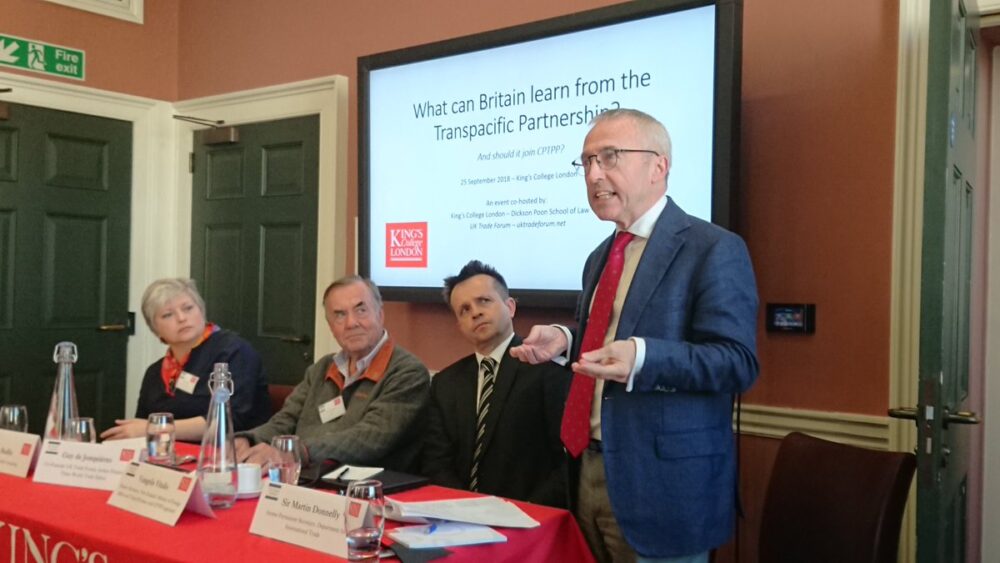
    I was a panellist for the UK Trade Forum on 25th September 2018, on Japanese business and government viewpoints in response to the UK’s request to join the Comprehensive and Progressive Agreement for the Trans-Pacific Partnership (CPTPP, TPP as was, often known in Japan as the TP11)

    The Chatham House rule was invoked, but I believe that I am allowed to report what I said, so long as I don’t attribute any comments to the other speakers.

    As I only had 10 minutes, I decided to focus on risk aversion to explain Japanese reactions to Brexit and the UK joining the CPTPP.  Even so, I had to drop the final part of my speech, so I will add this back in at the end:

    “I have spent more than 45 years now living in or visiting Japan and working with or for more than 200 Japanese companies, and one generalisation I feel I can make, even though I am well aware of the dangers of stereotyping, is that Japan as a nation – as well as Japanese companies – are highly risk averse.

    The geopolitical angle

    I was reminded of this when I attended a lecture by Koji Tsuruoka last week, the current Japanese Ambassador to the UK, who was also the chief negotiator for Japan for the TPP. He gave a very powerful, thought-provoking speech, tackling head-on controversial subjects like Japan’s behaviour in WWII, whaling, defending Big Pharma IP interests in trade negotiations and so on, in a way that didn’t seem strictly necessary given it was an audience of Japanophiles, but I think his message, on reflection, was very clear.  Japan feels very vulnerable, with neighbours such as China and North Korea and Russia, and supposed allies and defenders such as the USA now behaving unpredictably, and it needs a rules based international order because it is energy and resource poor and relies on other countries for imports of these things.  WIthout a rules based international order being adhered to, countries behave unpredictably, and this can lead to war.

    So this is why Tsuruoka and other Japanese government representatives and ministers have been very positive and welcoming of the UK wanting to join the CPTPP or roll over the EU-Japan EPA, even if the practicalities of this are not clear. They worry that the UK leaving the EU means the UK is also leaving that rules based international order, so needs to be roped back in somehow.

    Why are Japanese companies so risk averse?

    So that’s the geopolitical side to this – for the rest of my ten minutes I want to look at the Japanese business side, and three sectors in particular, what kind of trends we are seeing and how they are reacting to Brexit and what TPP might contribute in terms of mitigation or otherwise.

    So why are Japanese companies so risk averse?  I think it’s because they operate on a very different model to the Anglo Saxon, short term, shareholder value model. It could be called a stakeholder model, but primarily the motivation is not to make a quick profit, but long term survival. So they don’t want to do anything so risky as to jeopardise that, and they are very hot on ESG – Environmental, Social and Governance – issues.  It’s one of the really good things about Japanese companies, why I am still a fan.

    So when the Japan bashing started happening in the 1980s, and many Japanese remember Americans taking hammers to Japanese cars, Japanese companies decided that foreign direct investment was the way forward, and started up factories in the USA and of course also in the UK, with Nissan, and then Honda and Toyota.

    They chose the UK – and the UK is the recipient of 40% of Japan’s cumulative FDI into the EU, and has the largest Japanese population in the EU, including intra-company transferees – (but both those numbers are declining these past couple of years – I leave that to you to conclude why, but a hostile environment certainly isn’t helping) – because the UK was seen as a stable, rules based system, low risk place to invest, and of course because we were then members of the EU and a gateway into the EU.

    So what is happening now with Brexit in terms of Japanese risk aversion, is that it is tipping them into making decisions and directions they were going in anyway.  Looking at the three main sectors of Japanese investment in the UK – automotive and supply chains, IT and electronics and “pure” services – these sectors make up the bulk of the around 1000 Japanese companies in the UK, employing around 140,000 people.  Actually many of the 1000 don’t really count because they are paper companies, brass plates, or several versions of the same company, but there are 30 or so really big employers who make up more than half of those 140,000 employees.

    Automotive supply chains – a pivot to a new chain of right hand driving nations?

    So for Japanese companies, trade negotiations aren’t really about trade in products so much any more, more about protecting their foreign investments.  Even then, to be realistic, the EU only makes up around 10% of Japanese companies’ turnover.  Asia is still the really big market outside of Japan, and within that, China, and then secondly the US.  And the UK is probably only around 10% of the EU total.  But the UK is also host to a lot of regional HQs and of course the three car plants.

    The main trends you see in the automotive supply chains is that they are shifting eastwards in Europe, to the Czech Republic, Slovakia, and Japanese car manufacturers also have factories in Russia and Turkey, and the suppliers – of wire harnesses for example – have factories in Africa.  So Brexit is accelerating that shift.

    Can the CPTPP help with this?  Well I suppose there are a large number of CPTPP members who are right hand driving like the UK, but when you look at what sells in Australasia for Toyota, it’s pick up trucks like the Hilux, whereas Toyota in the UK is manufacturing the Auris/Corolla.  I suppose that shift could happen – at least then there is access to a market of over 100 million, which is supposed to be the minimum to sustain an automotive supply chain.  Honda is already trying to sell half of its Civic production from Swindon to the US, so it could happen, despite the distance.

    Information technology and electronics – integrated disintegration

    You’re also seeing a shift in the power balance in those supply chains, towards the components suppliers, and IT, because of Big Data, the Internet of Things and so on.  Which brings me to the second major sector – information & communication technology, electronics etc.  Here you’re seeing what I call an integrated disintegration. Japanese companies are becoming more B2B, solutions based, and trying to integrate back office functions, but also customer support, technical support into low cost locations with multilingual educated workforces – so in Europe this would be Portugal, or Poland.

    But at the same time, the regional management and sales are becoming more dispersed.  Anyone who has worked in a multinational as I did working at Fujitsu will know what this means – endless fights about who gets what in terms of money or actually doing the work, and whereas the UK often won those fights, I am beginning to see signs that Japanese companies are reverting back to the country model, are finding the matrix system just too tough.  If you’ve ever run a global or regional virtual team, as I did, you can understand why.  So there is a drift away from the UK and to Germany or the Netherlands, as we’ve seen with Panasonic, and it would seem also Sony now, accelerated by Brexit. And that’s bad news for UK suppliers of services to those Japanese companies.

    Pure services also need a rule based international order

    But Panasonic did not just cite Brexit as a reason for moving its headquarters to the Netherlands. It was also to do with the tightening of Japan’s tax haven rules from April of this year. Dividends and other “passive income” in Japan’s overseas subsidiaries will be the subject of attention of Japanese tax authorities, regardless of how much real business activity they are undertaking, if the corporate tax rate is below 20%.  And of course the UK’s is 19% and due to decrease further – reiterated by the Chancellor after the referendum to show that the UK is still open for business.

    But actually this is not appealing to Japanese companies.  Nor is the “chlorinated chicken” approach about deregulating or having looser environmental or other regulations of much interest to Japanese companies. They want to maintain high standards, and like robust, thorough rules – again, because of the risk aversion.

    But there are cultural issues beyond the need for a rules based international order

    Although Japanese companies really like being in the UK and I think a lot of the commercial and financial sector companies, like Japanese banks, or trading companies like Mitsubishi Corporation that I used to work for, have no intention of entirely shifting their regional headquarters out of the the UK despite Brexit, if they can help it, one thing that keeps me in business is the cultural gap between Japan’s very process and rule oriented way of managing and the more principles based, some might say “winging it” approach of British management.

    I believe Japan is still very reluctant to open up its public procurement and professional services sector, even to the UK, and I can see why. There is not really a developed set of professional specialists the way we have in the UK.  Most Japanese employees follow a generalist track.  So in trade negotiations, such as the CPTTP or the EPA, it must be very difficult to find common terminology in order to agree any rules for recognition of qualifications, or mutual understanding of governance principles for services, much more difficult than defining standards for products.  “Risk” in Japanese is the same word that is used for “crisis”. So it has a very negative meaning, and the neutral concept of risk management is not translatable into Japanese as a result.