



President Tokita of Fujitsu was interviewed by Saeki Shinya of the Nikkei Business magazine in August 2020. The beginning of the interview focused on the impact of the pandemic and China on Fujitsu’s business but the bulk of the interview was regarding Fujitsu’s recent announcement of various workstyle reforms (the English translation of hatarakikata kaikaku, a government led initiative to change Japanese workplaces).
Tokita felt Japan was unlikely to recover economically from COVID-19 until the end of FY 2021. As for China, clearly this was a delicate subject and Nikkei Business had to issue a correction to how they described what Tokita said. He said the progression of nationalism should not be welcomed. It would be disrespectful to say it’s a great chance for Fujitsu if the USA or Europe move away from Huawei, however the need for a secure communication infrastructure is important, regardless, for a more resilient society, and this is helping Fujitsu employees to “reset their mindset”.
The Q&A regarding workstyle reforms I have translated as below:
Q: Why did Fujitsu announce work style reforms such as a 50 percent reduction in office space, the abolition of commuting passes, the introduction of telework allowances and job-type employment (to assign and evaluate human resources after clarifying duties such as roles and skills to be fulfilled) all at once?
Mr. Tokita: It just happened that way – actually I narrowed down the scope somewhat.
In the first place, we didn’t announce it in July just because of coronavirus. We have been introducing telework since 2017, and we had already introduced a job type system overseas – only Japan was different. Since I became president last year, I realised Fujitsu’s biggest value is that its 130,000 employees can move in the same vector. Therefore, I wanted to unify the way we work, and we thought that we should utilise good governance as a global company.
Q: You had experience of being assigned to Europe – you had doubts yourself about the difference in personnel systems in Japan and overseas?
Mr. Tokita: My desire for globalization was strong. In fact, I hated the phrase “one Fujitsu” when I first became president. It was used because we were not “1” but there was no point in using it like a slogan if behaviours don’t change. I used it officially for the first time in June when we celebrated our 85th birthday, because our internal systems and communication have now improved, and we are convinced that it can happen.
Work style reforms have been carried out in many different ways. There are also criticisms that the results based system failed and there were people saying “how much longer are we going to use man-months as a basis for calculation?” I understood all of this. That’s why this time it happened all at once.
So far, we have been reforming little by little. Because it is a large company, it is scary if the change is too big. However, the reason why it did not work was that the personnel system itself had not changed in nature. Changing if you only change the structure and operations superficially will not work. I decided to go with the idea to change everything at once.
Q: Isn’t there an overlap between the new “job type” system and the failed results based system [known as seikashugi in Japanese – introduced in many companies in the 1990s]?
Tokita: There are many viewpoints – some say the results based system failed, and I haven’t heard many stories of it succeeding.
However, a job type system will be different from company to company and for Fujitsu. Evaluations are no longer top down. We have no choice but try to make sure it will lead to Fujitsu’s growth and sustainable business. Of course there are some lessons to be learnt from what happened in the past but I try not to worry too much about that.
Q: What does Fujitsu want employees to do with the introduction of a job-type personnel system?
Mr. Tokita: It’s about each and every employee being autonomous. If the general employees, the managers, the executive, and I are all autonomous individuals, the collective body becomes stronger. Ideally, a strong individual can both work collaboratively and create a healthy conflict. We stopped uniform education by hierarchy and year of entry to the company. Instead, we encourage people to advance their careers through free educational programs online.
Q: How do you get your employees to collaborate once they haves become autonomous?
Tokita: We are currently working with in-house culture change teams. In order to work collaboratively, physical contact is necessary, so it is important to create space in various offices where people can discuss each other’s opinions.
Q: It is said that young people are disadvantaged because they do not have enough experience of the job-type personnel system, what are your thoughts on this?
Tokita: Is that so? I didn’t think it was an advantage or a disadvantage. I know OJT (on-the-job training) was inadequate. Rather, I hope that young people will be able to take on challenges without any restraints.
Q: Some say that the reforms, which will reduce office space by 50 percent, are just about cutting costs.
Mr. Tokita: It’s not just about cutting the office space in half. It will also cost money for renewal.
The aim is not to cut costs, but to increase the choice of employees. The main objective is to help employees to feel engaged in their work. Whether there is a coronavirus pandemic or not, there are many employees who have problems with commuting time, childcare, and nursing care, and we have been building telework and satellite offices to solve this. It is true that Coronavirus became a driver to push this. But I’ve been thinking about it for a long time. Future behaviours and growth will show if this is correct or not
Q: Many people say that the corona shock will accelerate digital transformation (DX). Isn’t this is an opportunity for Fujitsu, which advocates DX for companies?
Mr. Tokita: I’ve been working longer hours at home so I saw a daytime show which said that digital transformation of medical institutions, public health centers and education is very behind in Japan.
However, DX does not take root just by promoting systemization and IT. The essence of DX is whether each and every one of us can be autonomous, acquire skills, collaborate, and create new value. This is also a challenge for Fujitsu. No matter how much IT as a tool is implemented, it will not be the whole solution.
Q: So DX hasn’t taken root in Fujitsu yet?
Mr. Tokita: I don’t think it has.
It doesn’t make sense for DX only to develop in certain industries. Fujitsu has been promoting IT by forming teams across industries. It will not function unless the whole aspect of an issue is grasped, rather than small points, and the issue is addressed as a society.
Coronavirus has increased the need to do this, but we need a system that allows us to collaborate properly. It’s easy to standardize in the IT industry, but without a deeper or higher level of common understanding of rules, no one will be able to make it work.
Q: Japan as a whole needs to deepen its understanding of DX. What should we do?
Mr. Tokita: It will be difficult to discuss on a national basis. We have no choice but to move forward with small communities and companies. In that sense, Fujitsu has a responsibility. We are a global large company and have a mission to solve Japan’s problems because we are based in Japan.
Inside the company, I often say, “Think about what it means to work for a large company.” Large companies have large company sized responsibilities. A large company can make big ripples in society – that’s a kind of responsibility.
Mr. Tokita: We will make use of our own knowledge and experience. This will make Fujitsu stronger. Companies that have accumulated their own experience and can turn it into a business are definitely stronger. If you don’t do it yourself, you’ll end up in running a race in borrowed shoes, and you can’t be a strong company.
If you want to hear more from Mr Tokita, he’s one of the keynote speakers at the Fujitsu ActivateNow digital event in October – more information here
If you want to understand further about the history and changes to Japanese corporate HR systems, I made a 5 minute video on this for my Japanese Business Mysteries Explained series – here.






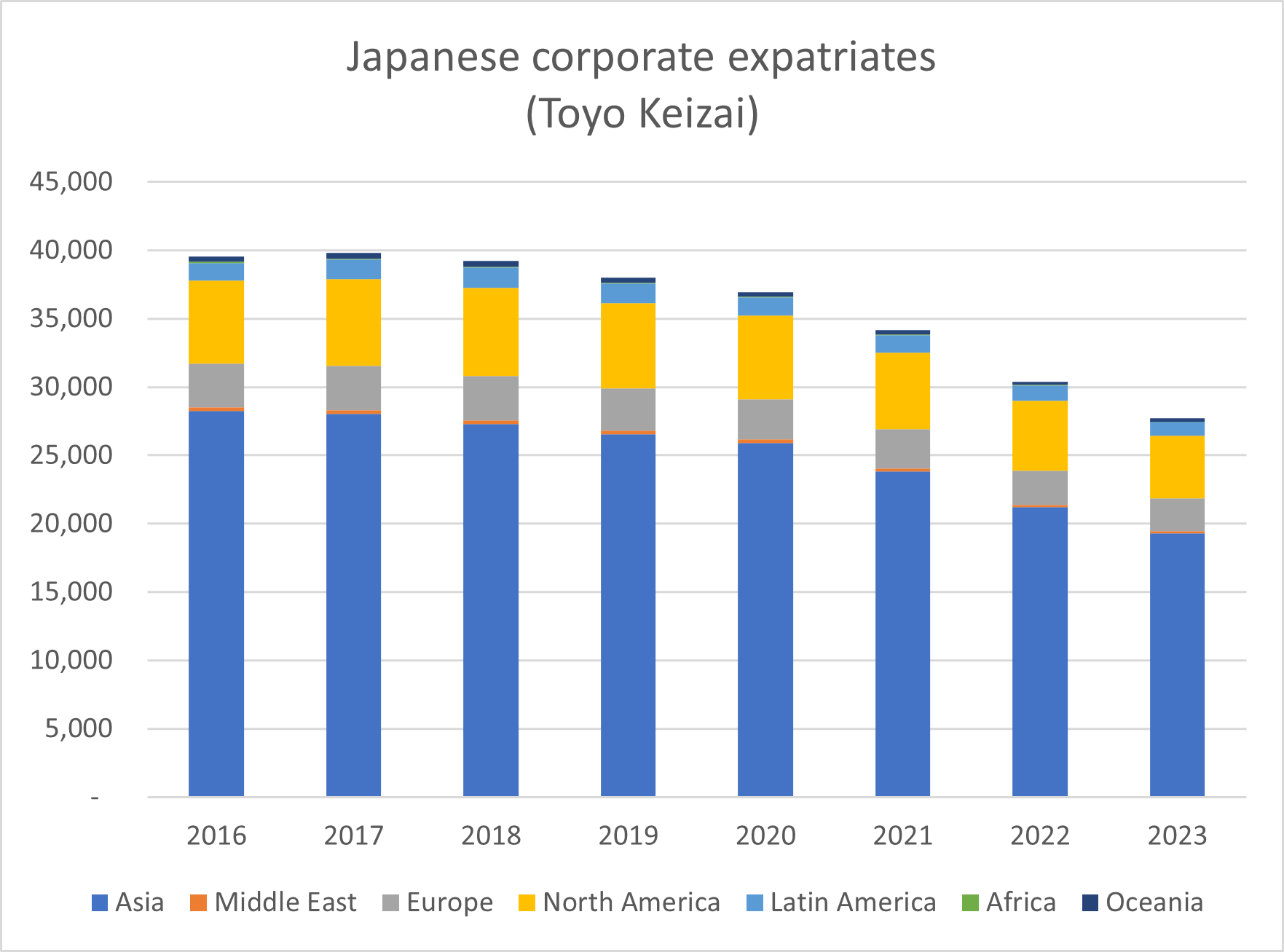 Many other Japanese companies may be adopting similar systems, or just relying more on local managers to run things –
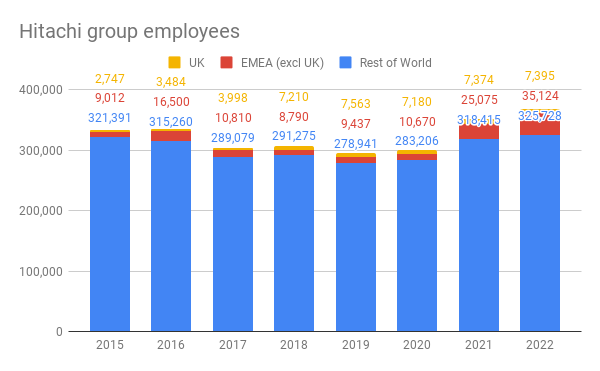
 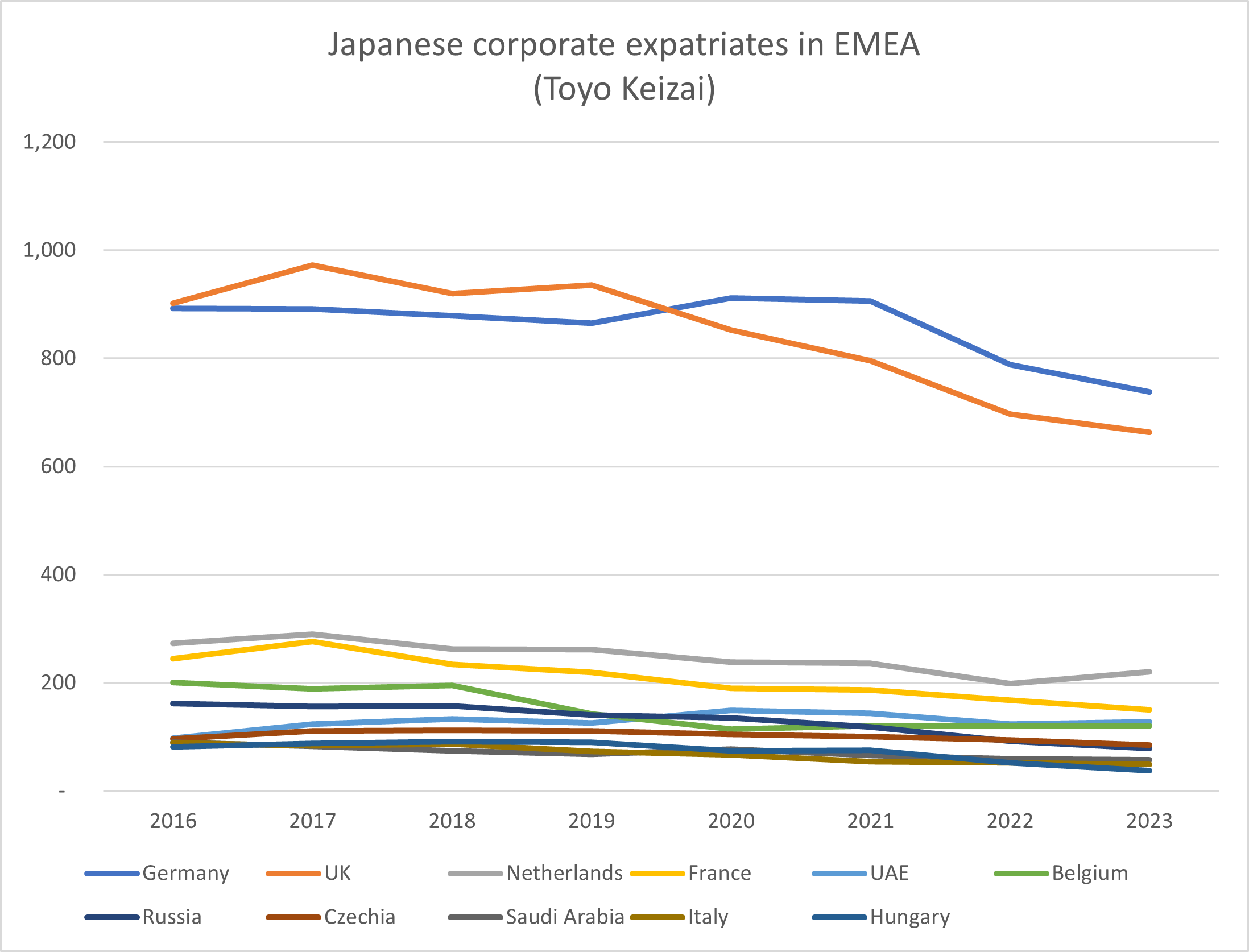 Looking at the Toyo Keizai data for individual countries in Europe and the Middle East shows that the only country to show any positive growth in Japanese corporate expatriate numbers since 2016 is the United Arab Emirates. The fall in Japanese expats in the Netherlands (-19%) was not as steep as elsewhere in EMEA (-27% average, -26% for UK, -40% for Belgium ) and seems to be recovering a bit since the pandemic. The number of expats in Germany also fell by only 17% since 2016, having grown and surpassed the UK in 2019/20, but falling steeply since the pandemic began, with no signs of recovery yet.
 .
.

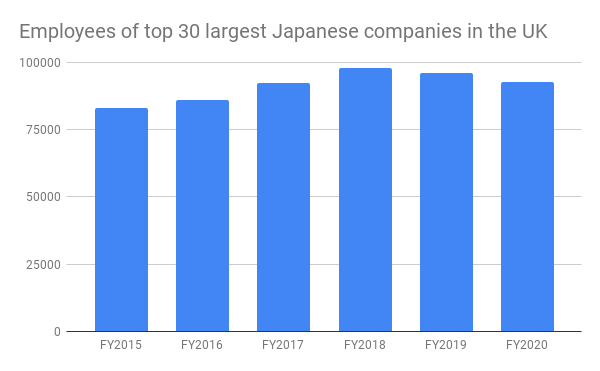 The total number of UK employees of the top 30 Japanese company groups fell 2.6% from 2019/20 to 2020/2021 – a strengthening of the downward trend in employee numbers since 2018/9. The peak of employment by the 30 largest Japanese company groupings in the UK was 97,827 in 2018/9 and this has now fallen by 5,000 to 92,851 employees. The top 30 represent around two thirds of the 137,000 people employed by 1,200+ Japanese companies in the UK.
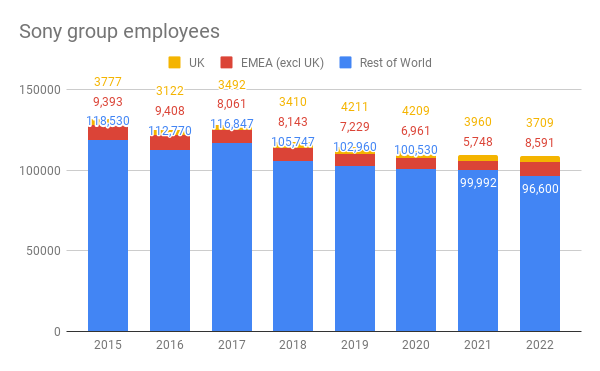
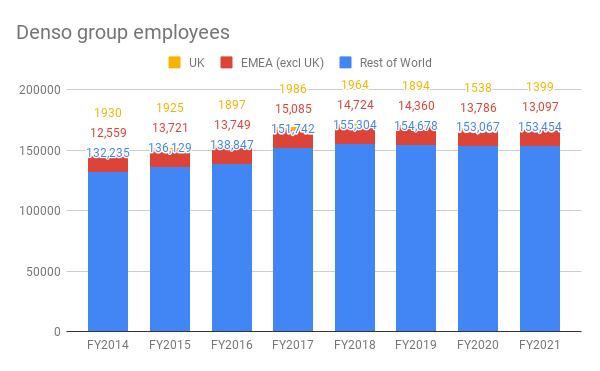 Konica Minolta acquired various UK companies before Brexit, but since Brexit has shrunk down and consolidated its operations in the UK and is focusing more on their European HQ in Germany and also the Czech Republic. The longer term trend of shifting away from manufacturing in the UK, to manufacturing elsewhere in Europe is seen at Denso, the Toyota group automotive parts manufacturer – UK employee numbers peaked in FY2018, and have been falling since, and are now 27.5% below the FY2014 level, whereas employment in the rest of the region is up 4.3% and global employee numbers, excluding UK, have risen 16% since FY2014.
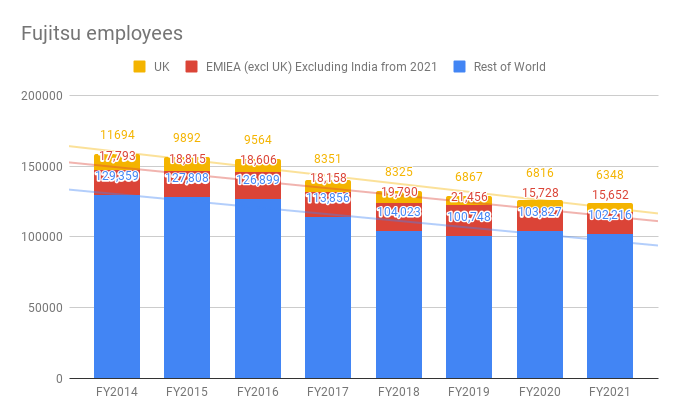 Five years’ ago, Fujitsu was the largest Japanese corporate group in the UK, with 9,892 people. It has lost 3,000 employees since, and was the fourth largest Japanese group in the UK in FY2020. As of FY2021, Fujitsu has 6,348 employees in the UK, 45% down on FY2016, compared to a 21% decrease globally, excluding the UK. Growth at Fujitsu has been in India (and Fujitsu’s CTO is Indian) and in its global delivery centres in countries such as Poland and the Philippines.