Search results for: “fujitsu”

  • Top 30 Japanese employers in Europe, Middle East, Africa 2021

    Top 30 Japanese employers in Europe, Middle East, Africa 2021

    The major Japanese employers in Europe, Middle East and Africa employ over 540,000 people, a 1.4%* rise comparing financial year 2018/9 to 2019/20, even though their global employee numbers have shrunk by around 1% over the same period. As in previous years, acquisitions of companies in the region are the main growth drivers.

    The top 5 largest employers remain the same – Sumitomo Electric Industries, Yazaki, NTT Data, Fujitsu and Canon.  The rest of the top 10 are the same, apart from Hitachi rising from 14 to 9, bumping Toyota Tsusho to number 11.

    Exiting the Top 30 are Mitsubishi Corporation, Mitsubishi Electric and Olympus – not so much due to any decline as the growth of the new entrants LIXIL (following its acquisition of Grohe), NEC (acquiring KMD in Denmark and Northgate in UK) and Asahi (having acquired various European beer brands such as Peroni, Fullers and Grolsch).

    Which company to work for

    We have previously recommended that people wanting to work for a Japanese company should consider not just whether it is growing in the region but also what proportion of its employees are in the region. The greater the proportion, the more influence the region is likely to have in headquarters’ decisions.

    The average for proportion of employees in the EMEA region of the top 30 is around 14%. Those with more than a quarter of their global employees in EMEA are NSG (due to its acquisition of Pilkington), Asahi Group (due to the acquisition of the beer brands mentioned above), Asahi Glass (the continuing influence of the 1981 Glaverbel acquisition), Sumitomo Electric Industries (the continuing influence of acquiring Volkswagen Bordnetze in 2006), Toyota Tsusho (acquired French company – mainly operating in Africa – CFAO in 2012).

    The companies who score highly both in terms of growth and proportion of employees in the region are Sumitomo Electric Industries, Toyota Tsusho and NTT Data. The latter grew through acquisitions of Dimension Data, Keane and Itelligence but appears to have shrunk its EMEA employees over the 2018/9 to 2019/20 period. This is actually due to Latin America being excluded from the regional total in 2019/20, having been previously included.  Dentsu also has nearly a quarter of its employees in EMEA and has grown nearly 50% since 2014/5 due to the acquisition of Aegis Network and subsequent smaller acquisitions, but the numbers are starting to decline as it starts to consolidate and restructure, aiming to cut its overseas roles by 12.5%.

    Dentsu does not publish consolidated regional employee numbers, and neither do trading companies such as Mitsubishi Corporation, Toyota Tsusho and Itochu.  Some have been inconsistent in publishing details – JT International for example – so we have had to use our best guesses and our own database. Overall the level of transparency in Japanese companies’ reporting on overseas employees has improved tremendously over the six years we have been tracking them, thanks to Japanese companies’ enthusiastic adoption of UN Sustainable Development Goals.  Perhaps a lack of transparency on employee details should be a factor to consider in terms of desirability as an employer.

    If you’re thinking of working for a Japanese company, a good way to signal that you know what you’re letting yourself in for would be to obtain the certificates from doing the e-learning modules on working in a Japanese company from the leading global Japan focused intercultural training company, Japan Intercultural Consulting.

    *If NTT Data is excluded, as the 2018/9 employee numbers for the EMEA region in their annual report included Latin America, but Latin America was not included in the 2019/20 regional employee numbers.  Including NTT Data in 2019/20 figures produces a small decline in the regional employee total for the Top 30  of -0.24%.

    FREE PDF DOWNLOAD OF TOP 30 JAPANESE EMPLOYERS IN EMEA

  • The advantages of investing in smaller countries

    The advantages of investing in smaller countries

    I was asked to speak at a Portugal-Japan Investment event at the end of 2019. Initially I was worried about what I could say as I was not sure there would be much that would interest Japanese companies in Portugal. The population is only around 10 million and multinationals mostly either have a small sales office there, or cover it from Spain.

    For British people Portugal is mainly seen as a nice place to go on holiday – for golf or the beaches or to enjoy the rich history, culture and port wine.  There are also some similarities in temperament between Portugal, the UK and even Japan – a gentility, understatement and a slight melancholy which contrasts with bigger European nations like Spain or France or Germany.

    Portugal is the UK’s longest standing ally – for more than 650 years –  and the Portuguese Prime Minister and officials who spoke at the event emphasised that they saw Portugal as an additional base for Japanese companies, rather than an alternative to the UK.

    Portugal has strengths in traditional sectors such as food, apparel and automotive manufacturing. For example, Toyota has a joint venture with Caetano, who also have a joint venture with Mitsui, manufacturing electric buses.  There are also some emerging strengths, such as energy and IT services, particularly business process outsourcing.

    The two Japanese companies that spoke on the panel with me were Fujitsu, who employ nearly 2000 people in Portugal now, providing business process outsourcing and IT services and Marubeni, who have invested in various energy projects.

    All the presentations emphasised the obvious advantages of Portugal. Firstly, that the economic and political risks are low. Portugal has recovered well from the Lehman Shock recession, does not have much populism, and the coalition government has been in power for over 5 years.

    Secondly, Portugal has a well-educated (particularly in science, technology and maths), multilingual workforce. And thirdly, as well as being in the EU, it also provides a bridge to Portuguese speaking markets, most notably Brazil.

    But there was an additional reason, given by the Marubeni representative which caught my interest. He said that starting a new business in a smaller economy meant it was more “manageable”.  A foreign direct investment expert at the event confirmed what I had found out through my own researches on Japanese companies in Europe – smaller European countries are becoming popular foreign direct investment destinations.

    Japanese companies in Portugal have quadrupled (from a small base) over the past 6 years, but other European countries of 6-11 million population size have also seen an increase in Japanese acquisitions or greenfield manufacturing investment, such as Finland, Sweden, Hungary and Czech Republic.

    The number of Japanese expatriates in Portugal has not risen quite so rapidly.  Growth in the Japanese communities in the Netherlands, Poland and Ireland has been greater. From a business, as well as a weather, food, golfing and cultural perspective, I wonder whether this might be about to change.

    This article by Pernille Rudlin was originally published in Japanese in the Teikoku Databank News on 15 January 2020

  • Are there 10% or 1% fewer Japanese companies in the UK than five years’ ago? And why?

    Are there 10% or 1% fewer Japanese companies in the UK than five years’ ago? And why?

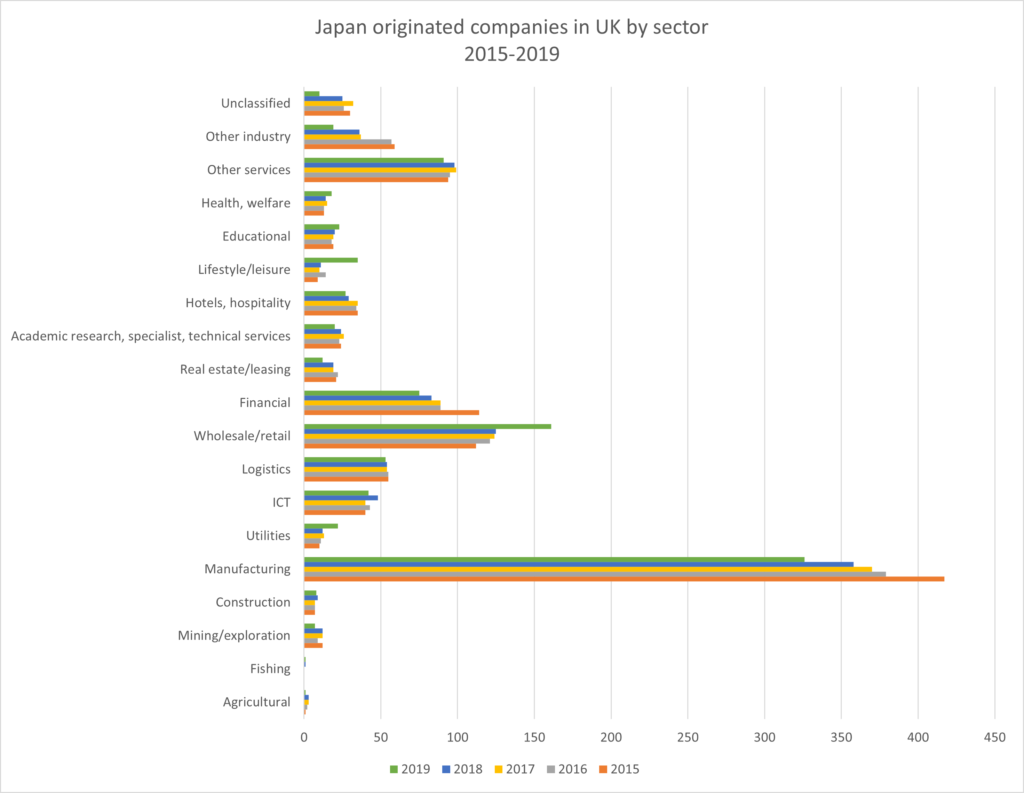
    We covered in a previous post how Japan originated companies continued to increase their presence in Europe – apart from in the UK and Switzerland – over the past 5 years.  We used the Japanese Ministry of Foreign Affairs annual data, which showed an 11% decline from 1,064 Japan originated companies in the UK to 951 in 2019.

    The other source of data on Japanese investment overseas is the Toyo Keizai annual directory. This shows a 1% decline in Japanese companies in the UK from 2018-9, from 972 to 966. It’s the first drop since at least 2015, numbers having risen 11% 2015-2018, according to the Toyo Keizai totals for the UK. We analysed this further in this post, noting that it’s hard to work out where Toyo Keizai derives the net drop of 6 Japanese companies in the UK from. Their list of the 7 companies which have closed down in the UK 2019 shows that this was mainly due to reorganization of holding companies or merging of companies rather than full withdrawal from the UK. Of the 8 new Japanese companies in the UK in 2019, 5 were indirect investments into energy companies by Nippon Koei, a civil engineering company and 2 were indirect investments by WDI, a Hong Kong originated Dim Sum chain which is registered in Japan.

    Subsidiaries turning into branches

    The Ministry of Foreign Affairs only breaks down its figures by organisational type and sector, but this does provide further clues. The biggest absolute decrease in numbers is amongst those categorized as a subsidiary incorporated in the UK. There were 480 such companies in the UK in 2014 – this fell 16% to 404 in 2019. Conversely branches of local subsidiaries rose 31% from 179 to 226. This seems to indicate that a fair number of UK incorporated subsidiaries unincorporated and became branches over this period, particularly over 2018-9.  This tallies with what we have observed empirically – most famously with Sony Europe and Panasonic Europe becoming branches of EU subsidiaries but also a dozen or so others such as Takeda, Shionogi, Sanden, Fujitsu General, Murata and Alps becoming EU branches.

    It looks like Brexit also provided an excuse to do a bit of tidying up, – consolidating multiple subsidiaries into one, for example. The Ministry of Foreign Affairs data also include companies established by a Japanese national with over 10% share in equity in its figures. This number has shrunk by 68 since 2014 to 96. We suspect this may be in part to do with those Japanese nationals becoming permanent residents in the UK or British citizens (other MoFA figures show this group has grown considerably) and therefore no longer included.

    Manufacturing turning into wholesaling

    Breaking the number down by sector also provides some insights. Japanese companies in the UK who are manufacturers are the biggest group, despite the UK’s heavily services oriented economy.  Their numbers have dropped 22% from 2014 to 2019, from 417 to 326. Conversely, the number in the wholesale and retail sector has increased 44% from 112 to 161. The changes in the two sectors may be related, as Oki, Sony DADC, Tamura, Keihin, Nicera, Zeon Chemicals and Maruwa stopped production in the UK during this period but remained as wholesalers in the UK. Financial services companies, traditionally a UK strength,  fell by a third from from 114 to 75, which is surprising considering they were active pre-Brexit in acquisitions, but perhaps again reflects some Brexit-related consolidation and divestment. Closures we are aware of include MC Asset Management, Speedloan Finance, Okasan Securities, Nomura Alternative Investment Management, Sumitomo Mitsui Asset Management.

    The sectors where there have been significant jumps in investors show where Japanese corporate interest in the UK now is. The number of Japanese utilities companies investing in the UK rose 120% from 10 to 22 and in the lifestyle and leisure sector by 289% from 9 to 35 – some new entrants we have been aware of the past couple of years in these two categories have been Hakutsuru Sake, MTG, Asahi Premium Brands, JERA Power, Nippon LP Resources, DTM Renewables and Sojitz Energy. The majority of “new” Japanese companies in the UK over the past five years were the result of acquisitions.


  • The generation gap in working from home in Japan and UK

    The generation gap in working from home in Japan and UK

    Despite the UK government’s announcement that companies can allow employees to return to their workplaces from August 1st 2020, the Royal Bank of Scotland told 50,000 of its staff to continue working from home until 2021.  A friend who travels into their City of London office once a week tells me it is still eerily quiet and only essential staff are coming in. Lifts can only take 1 person at a time and half of the toilet cubicles have been shut down.  A British architect has predicted that this will mean the end of the high-rise office building in London as many firms are making changes for the long-term. Some smaller City firms have shut their office permanently, and others are sub-letting their office space to other businesses.

    I see similar trends in Japan too, judging by announcements from banks such as Mizuho or ICT companies such as Fujitsu, wanting to accelerate their digital transformation.

    When I was a UK-based employee of Fujitsu ten years’ ago, I used to work from home quite regularly. My team was scattered across the world anyway, so most meetings were done by teleconferencing. Working from home is already well embedded in Europe. For people with children where both parents are working, it is often the only practical solution.

    Most people who work in London and have children cannot afford to live centrally, so have long, crowded commutes – just like in Japan. They have no intention of being made to ride on a packed train until a coronavirus vaccine is commonly available.

    But there is a generation gap in Europe with regard to working from home, which companies will have to address. Younger, single employees, despite being “digital natives”, are finding working from home very stressful. Partly it is to do with loneliness – for young singles, the workplace represents a vital social life. It is also to do with trust. More senior employees have already built relationships with their co-workers and are confident in their own abilities. Younger people lack that confidence and have not had enough time to prove themselves to their colleagues.

    There is also the problem of the environment for working from home. More senior workers have bigger houses. Whereas many young Londoners share houses and flats with other young people. They may have a very small bedroom and no communal rooms apart from a kitchen.

    This issue is true for city dwellers in Japan as well of course – a 1 bedroom apartment may have no space for a desk or the possibility of shutting the door on noise and distractions.

    But it seems there is one dissimilarity between Japan and Europe – which is that middle aged people in Japan find working from home stressful too. As managers, they have been used to evaluating staff on the amount of effort put in, rather than results, and communicating through horenso and ishindenshin. None of these approaches work well remotely.  Digital transformation is going to be as much about managing people as managing ICT.

    This article originally appeared in Japanese in The Teikoku Databank News on 12 August 2020

  • “Why is our Japan sales team so useless?”

    “Why is our Japan sales team so useless?”

    I am asked a variant of this question, several times a year, by Western companies with sales subsidiaries in Japan.  They may not say “useless” as such, rather complain about the passivity, and lack of interest in trying something new in their Japanese team.

    The Western managers feel obliged to visit Japan once or twice a year. They make visits to the same prospects, where they present their thoughts on what is going on in the industry and new offerings from their company. They are listened to politely but no business results from it. Or they explain the marketing strategy and new approaches to the Japan sales team and there is no engagement at all.  Instead they receive a list of what seem like trivial customer complaints.

    Of course if you talk to the Japan sales team, they have their own frustrations about the lack of understanding on the Western side about how sales and marketing works in Japan.

    So here are the 3 issues that face sales and marketing teams of Western companies in Japan and what to do about it:

    1 – They’re not as elite as their customers

    Unless it’s a very well known company like an American tech company or one of the big consultants, a Western company in Japan is unlikely to be able to attract people who have graduated from Japan’s top universities. This means their employees cannot access an old boys’ network to open doors. And even if they do manage to get in front of a potential blue chip client, they are probably already feeling pretty intimidated, added to which, in Japan, the customer is not just king, but god.

    2 – The dead hand of eigyō

    Eigyō is the term used to describe the sales function in Japan, but it tends to be more about relationship building with existing customers – which means regular visits to customers for no particular reason, passive and predictable “order taking” and a lot of hospitality.  It’s difficult to acquire new customers, as most established companies are in long term supplier relationships. A top salesperson in Japan is traditionally considered to be the person who is out of the office all day, doorstepping and cold calling, no matter how hopeless the situation, leaving their business card and brochures with icy receptionists in the hope that one day, maybe, they’ll be invited in.

    So there is nothing very strategic behind targeting and acquiring new customers other than dogged persistence. This means that many marketing concepts that are commonly used in the West are not common knowledge in Japan, such as value proposition, USP or the 5Ps.

    3 – Over-servicing

    Japanese customers would expect a Western company to be sticklers for sticking to the contract, and delivering only what is paid for. There’s also a nervousness that if things go wrong, a Western supplier will sue, or disappear. Japanese suppliers are meant to stick with their customers through thick and thin, customising when asked, continuing with products and services that are unprofitable because the customer wants them and over-servicing in the hope that the cost can be recouped, some time in the far distant future.

    So what can Western companies do about this?

    Hire the rebels and treat them as equals

    Many Japanese women are attracted to working in foreign companies because they assume they will be treated more fairly, and indeed many have reached senior positions in foreign companies such as Microsoft, Boston Consulting Group and Accenture. Unfortunately Japanese companies have woken up to this and are now trying to lure them back.  But Japanese women will be well aware of the barriers they will face to being treated as equals to lifetime employees in such companies. So making sure that your Western company is as inclusive of them as possible in terms of career development, including international postings and training (particularly in marketing), and ensuring their voice is heard at top level meetings, will be key to retaining them and reminding them of what attracted them to a foreign company in the first palce.

    And this goes for the older male employees too.  They may have been lifetime employees at a big name company and were hired by a Western company for their connections and industry knowledge. They were probably frustrated in their careers at their Japanese company and saw joining a foreign company as a risk, but a chance to start again. You may discover there were some valid reasons why they were not successful in their careers in their Japanese company, but there will still be a value in their knowledge and experience, and their rebellious mindset might offer some creative solutions.

    Be innovative

    About the only acceptable reason in Japan for taking on a new supplier, especially a foreign one, is that they offered something that existing Japanese suppliers did not – Salesforce.com is an example of this. Being radically cheaper, like Amazon Web Services, can also work, but is not an avenue open to all companies. Japanese companies are very risk averse, so will assume the cheapness comes with a price in terms of quality.

    But this still requires putting the effort in – such as the seemingly pointless regular visits to Japan give your sales team a reason to set up a meeting with potential clients, on the promise of a new perspective or innovative offering.

    Break the rules

    You can also use the ugly foreigner technique. Japan has a long history of letting the foreigner say the thing that everyone knew, but didn’t want to say out loud for fear of upsetting the rest of the group. Foreigners also get a certain number of get out of jail free passes for ignoring local protocols, so long as it was done from open hearted enthusiasm rather than malign intent.

    One British Japan market entry expert told me he spotted a prospective customer from the signs on the office building his taxi had stopped outside. He persuaded the terrified Japanese sales person he was in the taxi with to accompany him into the building, and made his pitch in good Japanese to the receptionist, who was sufficiently impressed that she contacted the person in charge, and a few meetings later they had a new customer.

    Japanese companies such as Fujitsu are also losing patience with the old eigyō, over-servicing ways. Fujitsu has renamed employees in eigyō “business producers” and are encouraging them to take a more consultancy based approached, banning them from taking systems engineers with them to client meetings.  “Business producer” may not be a common term in Western sales but Fujitsu has chosen to render it as “Bijinesu purodyu-sa-” ビジネスプロデューサー in katakana, which is the alphabet reserved for borrowed foreign words. The foreign-ness presumably makes it seem like a necessary break from the past.

  • Japan’s new “job type” system explained

    Japan’s new “job type” system explained

    Many Japanese companies such as Hitachi and Fujitsu are introducing a “job-type” (job-gata in Japanese) system. The term “job-type” will not be familiar to Europeans, so we will draw on a series in the Nikkei Business  to explain the background to this change.

    It’s common practice in Japan to hire full time, permanent staff, usually straight out of university, known as “seishain” with a ‘blank contract’ and no clear definition of the content of the work or the location of employment. Many Japanese commentators call this the “membership type” system, because the new recruit has in effect become a member of a corporate community. I like to use Trompenaars Hampden-Turner’s description of Japanese companies being a “family” company too, even if the founding family are no longer in control.

    In contrast to this, the “job type” system is commonly used in Europe and the US, where the company and the individual have a carefully worded employment contract, and the content of the job and remuneration are clearly set out in advance.

    Job type Membership type
    Duties In principle, duties outside the job description are not undertaken Boundaries of the role are not clearly defined. Job rotations are common.
    Salary Salary is based on job evaluation/duties Salary is based on ability and position in a career track, which in turn is based on years of service
    Job location Job location is defined and limited. In principle there is no relocation Job location and assignment is not defined. Relocation is the norm
    Training for immediate applicability – up to the individual to acquire long term employment is the precondition, so the company trains the individual.

    3 decades of HR reforms

    There is plenty of criticism that this is just a repackaging of the much criticised seikashugi or performance based system. Many Japanese companies introduced this after the economic bubble burst in the 1990s but it was seen as simply a cost cutting exercise.  Managers started looking for ways to reduce employees’ bonuses, which up until then had mainly been based on company or divisional performance. Nikkei Business notes that the “3 lost decades” in Japan  have seen a series of crises followed by changes to HR systems, but somehow the change is watered down and the company reverts to seniority based HR management.

    Companies that have introduced the job type system include Mitsubishi Chemical. When they first introduced it in 2017, it was still the manager who made the decision on promoting employees, and as a consequence the seniority element remained. So from October this year they are introducing an open application system, to increase fairness and transparency.  Mitsubishi Chemical’s HR Director Nakata Ruriko notes that their workforce is no longer the homogenous group of lifetime employees recruited as graduates. There are more mid career hires and dual income couples, trying to balance child and elderly care. Nakata is introducing choice and the ability to build your own career, to respond to this diversity.

    The telecoms company KDDI has skipped trying to negotiate with the labour union to introduce the job type system to current union members and is only introducing it to managers and new graduates from April 2021. There will no longer be the same salary for all new graduate recruits – compensation will depend on skills and internships undertaken before entering the company.

    Fujitsu has ended “side by side” cohort based training and a mandatory retirement age. The position of manager will be open to all, but if you do not ask to be a manager, you will not be promoted.

    Working from home and relocations

    Having a job type system also helps with working from home, as people have more autonomy and clarity on the boundaries to their work. Several Japanese companies are also ending the “tanshin funin” job relocation where the employee (usually male) would be assigned to another location and move there without their family.

    From the management side the intentions behind bringing in a job type system depend on the sector, but at least one of three main reasons are usually cited:

    1.  the need to bring in people from outside the company who have the skills to support the company with technological innovations such as AI
    2. to counter the constant increase in labour cost brought about by the seniority based system
    3. a unified, globally applicable HR system which will improve internal job mobility across multinational operations

    Over half of Japanese employees prefer the job type system

    Nikkei Business surveyed over 1100 employees and found that nearly half preferred the job type system, compared to 24% who preferred the membership type system. When asked “do you think you can survive a switch to the job type system?”, 62.4% felt they could.  More than 75% of the respondents said they would like to continue to work from home even after the pandemic was over.

    But better state support and retraining are needed

    The chairman of Rengo, Japan’s Trade Union Confederation, points out that Japanese employees are still very dependent and tied to their companies. If the aim of a job type system is to increase labour mobility, there needs to be more of a state safety net provided than there currently is. Some companies will simply be looking to reduce costs and those employees whose skills are no longer needed will find it very hard to switch to another company if they are no longer satisfied with the pay they receive for the work they do.

    Takeda Yoko, a Director at the Mitsubishi Research Institute recommends FLAP as a way to succeed in a job type system – Find the work you want to do, Learn how to do it, Act upon this learning and then Perform – be evaluated and treated correctly.

  • Top 10 Japanese corporate charity donors in the UK

    Top 10 Japanese corporate charity donors in the UK

    Japan-owned companies in the UK contributed over £17 million to charity in 2019.  £10 million of this, however, was the donation made by First Sentier Investments (formerly First State Investments), owned by Japan’s MUFG Group since 2019.

    £8.5m of the £10m went to the Maitri Trust which was established by the Stewart Investors team members (part of First Sentier Investments) in 2006, and helps educational initatives in India, South Africa and Mexico. The other £1.5m was given to the Charities Aid Foundation. 2019’s donation was a substantial increase on the £5.5m First Sentier donated in 2018.

    The biggest Japanese corporate donors (>£100,000) increased their charitable budgets over the past two years, but overall the total dropped 3% on a like for like basis (not including First Sentier as they were not Japan owned  in 2018/9).

    Benchmarking Japanese corporate charitable donations

    It’s difficult to benchmark Japanese companies’ charitable activities in the UK against FTSE 100 companies as many of the Japanese companies in the UK operate on a regional or global basis and the charitable donations are on that basis too. Only around 10% of the 1000 or so Japanese companies in the UK put a monetary figure on their charitable donations in their annual reports, or specifically state that they do not donate to charity.

    The Charities’ Aid Foundation issued a report in 2018 on FTSE 100 charitable donations, which estimated that the FTSE 100 donated around £1.9bn in 2016. The report uses donations as a percentage of pre tax profit as a benchmark. Unfortunately some of the biggest Japanese companies in the UK such as Toyota, Nomura and Dentsu have been making losses in recent years so this is not a benchmark which can be readily applied to them. However, CAF’s cut off point of “at least 1% of pre-tax profits” as being an indication of commitment to charitable giving means that it is possible to say that JTI, Dentsu (using 2018 figures), Mitsubishi Corporation, Fujitsu Services and Ricoh are all in the “above 1%” category.

    The Top 10 Japanese corporate givers

    The next biggest donor after First Sentier was  Japan Tobacco International through their Gallaher subsidiary in the UK. They donated £3.24m in 2019, a similar level to 2018.  Gallaher “works with leading charities to improve the lives of socially isolated older people as well as those who are homeless, disabled or excluded from society in other ways”. They have a UK Community Investment Programme which has been accredited with Business in the Community’s CommunityMark. Employees have an allowance of up to 6 days’ a year to get involved in community fund raising and volunteering.

    The third largest Japanese corporate donor was advertising and marketing group Dentsu Aegis Network, (soon to be rebranded as Dentsu International) whose global headquarters are in London. They donated £1m to charity (£0.9m in 2018) – but this is likely to be a worldwide, excluding Japan total.  Dentsu announced in 2017 that “Society” was now one of its official stakeholders and announced a new social purpose of a digital economy for all. They are aiming to reach a billion people with sustainable development goal led campaigns and support 100 female founded businesses. They are launching a digital skills initiative to support 100,000 people to improve their skills.

    Close behind are Toyota Motor Manufacturing UK, who donated £0.9m in 2019, slightly down on the previous year of £0.95m. It “seeks to support good causes in the areas local to its manufacturing operations” [Burnaston in Derbyshire and Deeside]. It has a charitable trust that makes donations in the areas of road safety, social inclusion and deprivation and health. As well as fund raising it makes in kind donations of cars, parts and volunteering hours (included in the £9.08m). Its nominated charity of the year was the Derbyshire, Leicestershire & Rutland and Wales Air Ambulance Service.

    Mitsubishi Corporation donated £267,000 in 2019/20 (up from £140,000 in 2018/19) – to the British Museum , the Earthwatch Fellowship Programme, the University of Cambridge Faculty of East Asian Studies, the UK-Japan Music Society and the Mitsubishi Corporation Fund for Europe and Africa, which engages with partner organisations in environmental conservation.

    Hitachi Capital donated £250,000 (up from £200,000 in the previous year) in 2019/20. Their national charity partner is FareShare which redistributes food going to waste to charities and community groups – contributing to the sustainable development goal of “no poverty”. Hitachi Capital staff also volunteer at FareShare. The group also works with Young Enterprise and The Wildlife Trust.

    Nomura established The Nomura Charitable Trust in 2009, “supporting disadvantaged young people in the local communities in which it operates through both grant making and employee engagement in the form of volunteering and other engagement initiatives.”  It gave £235,659 to 11 charities which aligned with the objectives of the trust and were recommended by Nomura employees in the year ending March 2019.

    Eisai, the Japanese pharmaceutical company with a factory in Hatfield donated £212,000 in 2018/9, up from £116,00 in 2017/8.  Around half of this was to patient organisations such as Alzheimer’s Research UK and Breast Cancer Now, according to their “Transparency” page on their website.

    In 2018/9 Fujitsu raised over £200,000 for its partner charity Macmillan Cancer Support as well as 5,500 volunteer hours spent by employees volunteering and skill sharing.

    The Olympus KeyMed group via KeyMed (Medical and Industrial Equipment Ltd) gave £122,621 within the UK, of which £45,905 was to healthcare charities, £40,202 was to “other”, £33,856 was to cancer charities and £2,658 to children’s charities. This represented a 10% decrease on the previous year

    Ricoh UK made £110,426 in charitable donations in 2019, a significant increase on the previous year’s £66,285. The sum represents both financial and in kind, providing products and people to support charitable activities.

    The others

    Many of the larger Japanese companies in the UK not mentioned above do contribute to charities but do not put a price tag on this in their annual reports. Nissan Motor Manufacturing, for example, launched a Days for Change Europe wide programme where employees can take days “off” to volunteer. Kwik Fit, owned by Japanese trading company Itochu announced in 2019 that its charity partner was Children with Cancer UK, and a target of £1m to be raised through its sponsorship of the British Touring Car Championship.

    Hitachi Rail says it made no charitable donations in 2019, seemingly leaving this up to its employees, who raised £156,846 for the Railway Children charity “to date.”

    Canon UK describes its “social value policy” as comprising “employability skills training, education support, community and charitable activities” but goes into no further detail.

    Conclusions

    Japanese executives who had lived in the UK have occasionally remarked to me how many charity shops there are in the UK and how often they are approached by their employees to help with fundraising initiatives. According to Charities’ Aid Foundation, the UK is number 6 in the world in terms of individual charitable giving (money and time), after Indonesia, Australia, New Zealand, USA and Ireland. Japan is at 128 but in 6th position in terms of the number of people who volunteer time for charitable causes.

    Certainly I remember when living in Japan and working for Mitsubishi Corporation that there were plenty of opportunities to get involved in volunteering via the company. Conversely, to my relief, noone ever asked me to sponsor them to take a charity ramen bath. I have vivid memories of being in a group of employees who took severely disabled people to Tokyo Disneyland. National disasters such as the Fukushima earthquake and tsunami also saw thousands of employees of various companies giving up weeks on end to go to the region to help.

    Those Japanese companies who do give substantial amounts of money to charity in the UK tend either to have acquired established British companies and therefore their legacy of charitable activity (JTI, Dentsu, Fujitsu, Olympus KeyMed) or are manufacturers employing large numbers of staff and looking for ways to engage with the local community such as Toyota, Eisai and Ricoh. In many cases, the decision makers will also be local executives looking to raise the brand profile in a globally appealing way, so a specifically “Japanese” flavoured proposition may not be of great interest unless part of their corporate purpose is to represent Japanese interests abroad.

    There are plenty of funds in Japan set up by companies such as Toshiba, Honda, Panasonic (Matsushita) but these tend to be educational in orientation and more in the business of awarding prizes, scholarships and research grants.  Japanese companies will sometimes endow foundations overseas (Nissan Institute of Japanese Studies at Oxford, Daiwa Anglo-Japanese Foundation) which are also educational and dispense scholarships and grants.

    Anyone wishing to approach Japanese companies may need to bear these differences and distinctions in mind. For local giving, it will be necessary to win over the local employees, and for large, prestigious donations, much of the funding available may be controlled from Japan.

  • Pork for cars and a fog lamp

    Pork for cars and a fog lamp

    As the UK-Japan Free Trade Agreement is in its final stages, it seems a good moment to revisit our Top 30 Japanese companies in the UK. Although the headlines seem to be heading towards “pork for cars”, the most important win-win for the UK and Japan should be protecting Japan’s investments in the UK. Japanese companies employ around 170,000 people in the UK by our estimates, and many thousands more indirectly.

    The EU-UK deal is still the biggest source of concern for Japanese companies

    There is a limit to what the UK-Japan deal can do to protect those investments, however. For Japanese companies in the UK, the EU-UK trade deal is the bigger source of concern. Many of them have their regional headquarters in the UK or have invested in the UK as their base for exporting to the rest of Europe.

    The shape (or non-existence) of a UK-EU trade deal will determine not only whether it is worth continuing with manufacturing in the UK for Japanese companies but also whether Japanese companies will continue to coordinate services regionally out of the UK such as finance, legal, IT, HR, engineering, R&D etc. These services account for why the UK has a trade surplus in services exports to Japan – it’s largely due to Japan HQ sending money to their UK based regional operations to fund professional support services needed both for acquisitions and day to day operations.

    If the barriers between the UK and the EU to mutual regulatory recognition and movement of people become too high to run European operations from the UK effectively, and as a consequence UK companies are no longer attractive investment targets, Japanese regional HQs and acquisitions will begin to drift to the continent. In fact, they already have started to shift piecemeal to the EU. No amount of bilateral recognition of services and data regulations between the UK and Japan is going to help stem this.

    According to our estimates, the number of people employed by Japanese companies in the UK levelled off comparing 2018/9 to 2017/8 – rising by only 0.2% to 170,187, having risen around 6% a year in the previous two years.

    Japanese automotive sector dominates Japanese jobs in UK, but is declining

    Our Top 30 Japanese employers in the UK employment total has also levelled out at around 94,000 or 55% of the 170,000 people employed by Japanese companies in the UK.

    Nissan (#1), Honda (#5) and Toyota (#8) employ around 18,400 – 11% or so of the total. If other Japanese automotive suppliers are added such as Denso (#20) and Unipres (#30), the total number employed is 37,489 (22% of the total employed by Japanese companies), down 2.8% on 2017/8.

    Making sure that there are tariff free automotive components from Japan for manufacturing in the UK will help sustain Japanese manufacturing in the UK at least in the short term, if tariffs are imposed on EU automotive imports as part of the UK-Japan FTA or there’s a no deal. But the shift in automotive production to eastern Europe has been going on for some time.

    Japanese trading companies growing steadily in the UK but no acquisitions

    The UK, or more especially London, has been the commercial and trading location of choice for Japanese companies in Europe for over 100 years. At the heart of this are Japan’s trading companies – Mitsubishi Corporation, Mitsui & Co, Sumitomo Corporation, Itochu, Marubeni and Sojitz. They are still involved in commodity trading but also financing and more recently acquisitions – although there have not been any UK acquisitions since 2017. The most notable recent European acquisition was Mitsubishi Corporation acquiring Dutch energy company Eneco in 2019 for €4.1bn.

    Japanese trading companies currently employ around 14,700 people in the UK, and this has grown just under 2% a year over the past couple of years

    Japanese financial services holding steady in the UK

    The next biggest Japanese sector in the UK is financial services, including MS&AD (#15), MUFG (#16), Nomura (#17), SMFG (#22), Mizuho (#29). It accounts for around 13,000 employees and growth has been around 1% to 2% a year.

    All Japanese financial services companies that are impacted by Brexit have set up or strengthened their subsidiaries in the EU, but the scale of these organisations is still far smaller than their UK operations. There may be an issue eventually not so much about the quantity as the quality of these EU subsidiaries for the EU – they will want to see the decision makers based in the EU as a condition for regulatory approval. But as most decisions are ultimately made by multiple people in Japan headquarters, it is not clear how Japanese companies can respond to such a demand. In the meantime, Japanese financial groups are repositioning their London operations as EMEA (Europe, Middle East and Africa) headquarters.

    Electronics, ICT and acquisitions

    Fujitsu (#3), the pioneer of big acquisitions in the UK (ICL in 1990) is no longer the biggest Japanese employer in the UK, having shrunk its workforce by 38% since 2014/5. Sony (#9) has also cut its workforce by 11% over the past four years. Canon (#12) and Ricoh (#7) have grown by less than 10%, Brother (#28) grew around 15%, Mitsubishi Electric (#27) by 17%. Konica Minolta (#24) has grown over 40% in the past 4 years through acquisitions but seems to be shifting more towards the Czech Republic recently.

    NTT (#11) and Hitachi (#2), both with ex Japan global HQ in the UK, have grown 60% and 175% respectively over the past 4 years, partly through acquisitions but also in Hitachi’s case through organic growth, with the investment in the rail manufacturing and assembly plant in Newton Aycliffe.

    Other new entrants over the past four years have been through acquisitions too – Outsourcing (#26) in recruitment, Sumitomo Rubber (#19) through its acquisition of Micheldever in 2017 and SoftBank acquiring (and soon to be disposing of) ARM.

    A holding pattern until the fog clears

    The years of double digit growth and acquisitions by Japanese companies in the UK seems to be coming to an end, or at least is on hold until the picture is clearer after the fog lifts from the UK-EU negotiations and the coronavirus pandemic. The UK-Japan FTA does not clear this fog, but at least lays out a path for the UK, which Japan very much would like it to follow, of reintegrating itself back into the rules based international order, towards joining the CPTPP and continuing to be one of Japan’s closest allies in terms of digital security and strategic interests.

    [download_after_email id=”5842″]

  • Eastern Europe, 30 years’ on

    Eastern Europe, 30 years’ on

    Recent events marking the 30 years since the Berlin Wall fell have brought back memories for me of 1989, when I was working in London, having graduated from university a year previously. Perhaps it was watching young Eastern Europeans being so brave that made me decide that I wanted a more global, challenging job, so I quit my job in a PR company and joined Mitsubishi Corporation.

    Luckily my new Japanese boss was also up for such a challenge. Together we travelled around Germany and Czechoslovakia in search of business opportunities. Unfortunately, this turned out to be premature.  We soon realised it was going to take many years before disposable incomes improved sufficiently to buy the Honda motorbikes we were looking to sell. The demand was more for shipping second-hand Honda bikes in from Western Europe, and selling parts for repair.

    Similarly, our attempts to link up an East German glassware factory with a UK glassware company were unsuccessful. The German factory made old fashioned, heavily cut, coloured crystal glassware based on production ability rather than customer needs. The UK firm was not prepared to make the investment to improve the quality and refresh the designs. I took the German management around the crystal room of Harrods, and watched as they despairingly noted the high prices for items that they felt lacked the craftsmanship of what they had produced.

    Thirty years’ on, there is still a noticeable gap in employment and incomes between east and west – but this is mainly to do with a generation gap.  There has been multinational investment in Eastern European manufacturing, including by Japanese companies, to take advantage of the lower wages. But there are problems with a low skilled, ageing workforce, unable to speak English and a severe shortage of younger, skilled, English speaking recruits.

    Many Eastern Europeans who graduated since their countries joined the EU in the 2000s have come to study and work in Western Europe.  Recently I met two impressive HR managers at Japanese clients – both were Lithuanian, speaking excellent English and clearly effective at their jobs.

    Eastern European countries are trying to lure their young people back with various cash and tax incentives. Japanese recruitment companies are also venturing into Eastern Europe to help Japanese companies recruit Japanese speakers from Western Europe.

    Unfortunately, the 20 or so Eastern European students who attended a Japanese studies summer school seminar I taught at my local university were not very enthusiastic about working for a Japanese company. They worried about work life balance and that the corporate culture would be very strict.

    Japanese companies may need to learn from Fujitsu, who are the biggest non-manufacturing Japanese employer in Poland. They emphasise flexible working and benefits such as private medical care, training, free fresh fruit, CSR activities, sports and corporate discounts. This is because countries such as Poland, Romania and Czech Republic are becoming hot spots for business process outsourcing, logistics and IT services, so the competition for employees is fierce.

    This article was originally published in Japanese in the Teikoku Databank News on 11th November 2019

  • Which Japanese companies to work for in Europe

    Which Japanese companies to work for in Europe

    We’ve been publishing our top 30 Japanese companies in Europe intermittently for 5 years now.  We regularly receive enquiries for recommendations on which Japanese companies to approach as potential employers.  We’re not a recruitment consultancy so we don’t have any inside track on what jobs are available (please talk to our friends at Centre People Appointments for more practical assistance), but I would say that size in Europe and growth are important factors to consider.

    Relative size in Europe is a key factor

    If the European operations of a Japanese company represent a substantial part of their business, then it’s more likely that Europeans will have some influence within the organisation. There will also be more promotion opportunities and career paths than working for a smaller organisation in Europe. For that reason, it’s worth trying to join the organisation in the European/EMEA headquarters.

    Companies with a relatively high proportion of their employees in EMEA (25%+) include NSG (Pilkington), Asahi (brewery company recently acquired Grolsch, Peroni, Pilsner Urquell etc brands), NTT Data, Toyota Tsusho (acquired French company CFAO with a big presence in Africa), Asahi Glass, JT International, Konica Minolta.

    Has the company been growing?

    Not only are growing companies more likely to have job openings, but they are more fun to work for. Japanese companies are still growing their operations in Europe overall.  However some have been undergoing substantial restructuring, which has resulted in significant headcount reductions in some countries, and significant growth in others. For example Fujitsu is reducing headcount in the UK and Germany, but growing rapidly in Poland and Portugal.

    Companies that have grown the most rapidly in Europe (more than doubling) over the past five years are Nidec, NTT Data and Panasonic.

    Working for an acquired company

    The rapidly growing companies have mostly expanded through acquisition – for example Dentsu, Nidec, Panasonic (Ficosa, Zetes) and NEC (Northgate Public Services), Toyota Industries (Vanderlande), Hitachi (Ansaldo).  Working in those acquired companies might also be an attractive option, as there will be more autonomy, and less domination by Japanese management layers than Japanese subsidiaries which have grown organically.

    Companies who score highly in terms of growth and significant European presence are NTT Data (third largest company in Europe) and Dentsu (8th).

    In terms of sectoral growth – as well as IT companies that are moving into services and solutions like NTT Data, Konica Minolta and PanasonicDaikin (# 27) and Mitsubishi Electric (#30) have both grown substantially recently, probably due to expansion of their eco friendly air conditioning businesses.

    For new graduates, many of the top 30 have graduate trainee schemes, which would be worth considering if you are looking for a chance to be seconded to Japan.

    Top 3 largest Japanese employers in Europe, Middle East and Africa:

    1. Sumitomo Electric Wiring

    Large numbers of employees in manufacturing, as making automotive wire harnesses is still a fairly manual job. Manufacturing jobs will tend to be in North Africa and Eastern Europe. There are plenty of jobs in design engineering and sales as well, and will be future proof as apparently electric vehicles also require complex wire harnesses to operate.

    EMEA headquarters: UK (SEWS-E), Italy (CABIND), Germany (Bordnetze)

    No graduate trainee scheme, but this page gives a flavour of the jobs available in the region for SEWS-E https://www.sews-e.com/current-vacancies/

    2.  Yazaki

    Very similar to Sumitomo Electric Wiring in terms of business and jobs but privately owned, so more of a family style corporate culture. Has a YEA!cademy (Yazaki Europe training academy) https://www.yazaki-europe.com/career.html

    EMEA headquarters: Germany

    3. NTT Data

    Owned by Japan’s NTT (formerly Ministry of Post and Telecommunications, now partly privatised).  NTT Data has acquired various companies in Europe and elsewhere such as itelligence, Cirquent, Value Team, Intelligroup, and Keane. NTT is in the middle of restructuring and have put a new global headquarters, NTT Limited, in London. NTT Data will be kept as a separate organisation, however.

    Lots of training and chances to go to Japan, however recruitment seems more by country/company than centralised and as you can see here https://www.nttdata.com/global/en/careers

    EMEA headquarters: UK

    If you would like a consultation on working for a Japanese company, then you can book an hour with Pernille Rudlin here.

    We also recommend doing the e-learning modules from the leading global intercultural training firm focused on Japanese business –  Japan Intercultural Consulting – on working in a Japanese company – each module comes with a certificate – proof that you know what you’re letting yourself in for!