Search results for: “nidec”

  • The latest in Nidec President Nagamori’s string of acquisitions – a university

    The latest in Nidec President Nagamori’s string of acquisitions – a university

    Shigenobu Nagamori, the founder of Nidec is interviewed in the Nikkei Business series on how to “wake up Japan” about his latest acquisition – not a company this time, but a university – Kyoto Gakuen. He feels that Japan has become too brand name obsessed about higher education and that 18 year olds should not have their future decided simply on the basis of their standardised score for the university entry exams.

    “You get into university in Japan on rote memorization and exam technique, so when you graduate, you have a rather fake identity, with no real strength, so don’t know how to survive in society.” Nagamori is aiming for a university where “you graduate with fluent English [science graduates do not have to study English at university in Japan] and specialist skills that you can put to immediate use”.  He has changed Kyoto Gakuen’s name to the Kyoto University of Advanced Science.

    “Japanese university students aren’t fully formed human beings. They don’t know how to speak for themselves.  They fall asleep in lectures or mess about on their smartphones. This has to change, starting with the teachers.  That’s why I became the chairman of the university. Lectures will be in English.  1/3 of the teachers will be foreign. There will be some students who cannot cope with this, so we will have the same lectures in the evening in Japanese.  We had 600 lecturers apply for 30 positions. The evening supplementary lectures wll be given by post doc students or research students. The lectures will not be 90 minutes of sitting down.  There will be a 45 minute lecture and the rest will be doing experiments. ”

    “The administrators become the elite in Japanese companies – hardly any technical specialists become CEO. This is completely different to the USA. We also need to encourage overseas study – and encourage overseas students to come to us – maybe half our students should be from overseas. If they achieve good results, we will fund their fees and living costs. If results fall off, they pay half, if they hit the bottom, they have to pay all of it. That’s what we’re thinking. This might seem extreme, but it’s normal in the USA.”

    Most of the rest of the interview is about facing the threat from China.  Nagamori finishes by comparing himself to Konosuke Matsushita, the founder of Panasonic. Matsushita developed his management philosophy, and set up the Matsushita Institute of Government and Management , “but I don’t have any interest in politics, so I want to develop people who can set up businesses in advanced science – kids from poor Asian families who can come here to study, and then go out into the world and start something new.”

  • Nidec’s Nagamori on the root causes of Japanese corporate scandals.

    Nidec’s Nagamori on the root causes of Japanese corporate scandals.

    The founder and President of Nidec Corp, Shigenobu Nagamori has been high profile in the Japanese media (again).  As well as a long interview in Diamond magazine about why all 57 of his acquisitions (many in Europe) have been a success, he gives some punchy analysis in his final column for the Nikkei Business magazine on what the root causes of the succession of scandals coming out of corporate Japan.

    “It is the top management’s fault if bad news does not reach them.  If there is something wrong with the production process or sloppiness in quality control, this is a matter of life or death for a manufacturer.  That such important information is not being communicated is because the management is not going to the genba (where the action is) and seeing what is going on for themselves.

    4 root causes of scandals at the genba

    1. Nare (becoming used to something) Thinking that a certain level of irregularity won’t be a problem, getting accustomed to it.
    2. Amae (being indulged) – believing that you won’t get found out anyway
    3. Tiredness – when the cost price seems to have reached rock bottom or kaizen has been continuing for a while
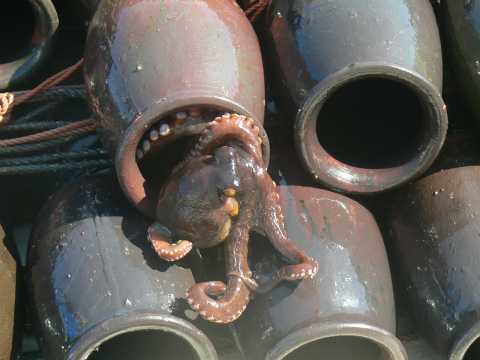
    4. Takotsubo (octopus pot – for more uses of this analogy, see our post on octopus appointments) – silos where a problem in one unit is hidden and not communicated to other units

    This happens because managers are not ensuring a sense of urgency in the genba.  This doesn’t mean they have to keep pressurising employees.  They should be making frequent efforts to strengthen and pull up the genba.  That’s why they should enter the genba themselves and see for themselves what is going on in R&D and manufacturing, sales.  This will naturally lead to a sense of urgency.

    Of course managers set targets, but if they don’t know the genba, then these are just words, and feel very distant to the genba.

    The need for “hands on”, “micromanagement” and “making responsible without giving away responsibility”

    Hands on means the genba solves problems with the management alongside.  Not just throwing problems at them.

    Micromanagement is that managers make decisions about all the issues in the genba.  When I acquire a company that is in trouble, in order to reconstruct it, I check purchasing for even 1 yen. Some people say this will undermine the ability to think for themselves but it’s quite the opposite.  It is to make the employees think, come up with suggestions and work alongside managers to review it.  Not just get told, in a one way fashion.

    “Making responsible without giving away responsibility” means that I delegate authority, but I don’t just leave people up to it.  Otherwise the genba logic just becomes stronger and they fail to see what is appropriate overall.  So delegate, but regularly check, very thoroughly.

    The importance of developing generalists

    It’s also important to develop executives.  Although there is a tendency in Japan at the moment to reject generalists, it’s no good if someone only knows one business area and has no idea about other parts of the business.  While people are young, they should experience management in different divisions in order to become proper executives.

    That’s why I am always visiting our subsidiaries around the world.  We have 300 companies and over 100,000 employees so I can’t do this by myself.  So I get other people like our CSO (Chief Sales Officer) to travel around too.  I am visiting somewhere pretty much every week.  If managers had this attitude, the morale of the genba will also improve.  You cannot take it easy.

  • “Japanese companies are too scared to touch their overseas acquisitions” – Nidec’s Nagamori

    “Japanese companies are too scared to touch their overseas acquisitions” – Nidec’s Nagamori

    Shigenobu Nagamori, the billionaire founder of the world’s biggest manufacturer of micro-motors for hard disks and optical drives, Nidec, has acquired more than 40 companies in Japan and overseas.  He comments in a Nikkei Business article that “you cannot just leave foreign acquisitions alone to get on with things by themselves.  You need thorough mutual understanding and to even replace management if necessary.”

    “Although you no longer hear about Japanese companies sending lots of managers over to their overseas subsidiaries who end up issuing all sorts of misguided directions, you now hear of companies who say ‘we think the same way as the counterpart management’ and so decide to buy the company and then just leave the management as is.”

    “This is an illusion.  Actually they are being left alone because the Japanese company doesn’t really understand what they are doing. It ends up with compromising on the necessary management reforms and profit targets.”

    “I have regrets myself. We acquired 10 or so companies in Europe and North America from about 2010.  We were warned by various companies who had M&A experience and financial institutions that we couldn’t restructure foreign companies the way we would Japanese acquisitions and that it was best to ‘leave it up to the foreigners’ otherwise they will quit”

    “I thought that was true at the time.  I also took on board the advice that Japanese managers needed to be people with Harvard degrees and a network amongst foreign executives.”

    “However one company did not make any improvement no  matter how often I set profit targets.  I thought there must be something wrong with the company management as such a company should as a matter of course achieve profit margins over 15% but I was told that it was the limit for their industry.”

    “In Japan you would try to persuade the management to adopt our “kaizen” knowhow (knowledge of how to improve) but we hit a wall with this in the West.  So in 2012 we changed the management of the acquired company.  But you can’t do it like pulling a trigger.  I make a point of visiting each company at least once a year and have dinner not just with the executives but also the managers and discuss things with them.  I also encourage them to send emails directly to me and I respond to them.  I am trying to understand all the ideas people have for improving profitability.”

    “It’s important that people in the company understand my thinking and I understand whether they are capable of understanding.  If they are then it doesn’t matter if the CEO is changed. ”

    “It’s the same in Japan.  Communication is important.  If you just cut back costs and improve profit, the company will not survive in the long term.  Where is there waste, how can we make the most profitable products – the basics are the same in Japan or elsewhere. If this is understood, then overseas companies can be reformed too.”

    “I think Japanese companies are too scared to touch their overseas subsidiaries.  They overthink the differences.  I used to be like that, but there is no need.  The basics of management are the same everywhere.”

  • Japan – Europe, Middle East & Africa business update

    Japan – Europe, Middle East & Africa business update

    The Japanese clutch and automotive transmission manufacturer Exedy is buying Protean Electric, the UK-based developer of in-wheel motors (IWMs) for electric vehicles, for around €30m. Exedy says the acquisition will help it to transform its portfolio to provide new opportunities in the automotive sector as it undergoes “a major transformation”.

    What Japanese companies are doing about the situation in the Middle EastInpex, Chiyoda, Toray, MUFG, Sony are pulling out some or all of their expatriate staff and families from UAE and Saudia Arabia. Mitsubishi Heavy Industries, Sojitz, Kanadevia, and Yusen Logistics are all banning travel through or to Middle East. Muji has closed its UAE store.

    Asahi Kasei has unveiled plans to acquire German biopharmaceutical firm AiCuris in a deal worth 780 million euros ($920 million). The deal is intended to expand Asahi Kasei’s portfolio of treatments for immune-related infections . Asahi Kasei’s operations span across chemical engineering, housing and healthcare. It plans to integrate research, clinical development and commercialization of its pharmaceutical business across Japan, the U.S. and Europe. AiCuris develops antiviral therapies for people with weakened immune systems. Its flagship product, Prevymis is used to prevent viral infections in organ transplant recipients.

    Long-standing accounting fraud at Nidec could result in a $1.6bn fine.  The company’s founder and former CEO, Shigenobu Nagamori stepped down as chairman emeritus in February 2026. He is seen as ultimately responsible for the problems, as he “applied considerable pressure on executive officers in the Nidec headquarters who were responsible for the business units and subsidiaries as well as the CFOs to achieve the performance targets.” Nidec made several acquisitions overseas, and now has 13,691 Nidec employees in Europe, Middle East + Africa – out of 104,000 worldwide.

    German automaker BMW will adopt smart-car technology supplied by Japanese company NTT Docomo Business for new models to be sold globally in 2026, instead of its usual German supplier.

    Toyota group company Denso has bid to acquire Japanese semiconductor manufacturer Rohm. Rohm’s European headquarters are in Germany, and it employs around 186 people in Germany, France, Spain, UK and Hungary, out of 23,000 worldwide. Despite the German-sounding name, Rohm is a Japanese company, founded as Toyo Electronics in 1958, then renamed R.Ohm, then renamed Rohm.

    Denmark’s Vestas, the world’s largest manufacturer of wind turbines used in offshore wind power generation, will set up a factory in Japan – possibly in Kitakyushu or Hokkaido – by fiscal 2029 to tap growing demand there and elsewhere in Asia. Japanese companies such as Mitsubishi Heavy and Hitachi used to make wind turbines in Japan, but pulled out, as did Mitsubishi Corp from investing in offshore wind projects in Japan.

  • Japanese companies in the UK 7 years on – the new third phase

    Japanese companies in the UK 7 years on – the new third phase

    Executive summary

    In the seven years since the Brexit referendum, the benefits of Japanese long term planning for resilience have become clear. Although employment by Japanese companies in the UK has fallen since 2018/9, this is largely in the automotive sector, triggered by the closure of the Honda Swindon plant. Non-automotive manufacturing employment and investment have stayed steady, but there have been no new manufacturing companies coming to the UK.

    Employment in the wholesale sector has also fallen, as Japanese companies move their European logistics, warehousing and coordination functions to the EU. There has been significant disinvestment from the UK financial sector, but again employment seems to have held steady.

    Germany has almost caught up with the UK as the largest host of Japanese companies in the EU and has overtaken the UK as the largest host of Japanese corporate expatriates.

    Now the smoke and fog of Britain’s departure from the EU, and the pandemic have cleared, a new third phase of Japanese investment is taking shape. It is more focused on geopolitical concerns around climate change, energy, defence and security. The UK is seen as an important partner in this, but needs to ensure that it strengthens its long term policy commitments to these sectors, which require large investments and the support of host communities, as well as collaboration and synchronization with the EU, Africa and the Middle East.

    Contents

    Employment by Japanese companies in the UK grew to 2018/9, then shrank since

    Germany has nearly caught up with the UK as a host of Japanese companies

    More company closures in the UK than in Germany

    A similar number of new Japanese companies opened in the UK and Germany since

    UK still the target of Japanese M&A, but on a smaller scale than before

    Switzerland overtakes the UK as largest net recipient of Japanese investment in Europe

    Manufacturing employment holding steady, apart from the automotive sector 

    Net disinvestment in UK financial services sector, although employment remains steady

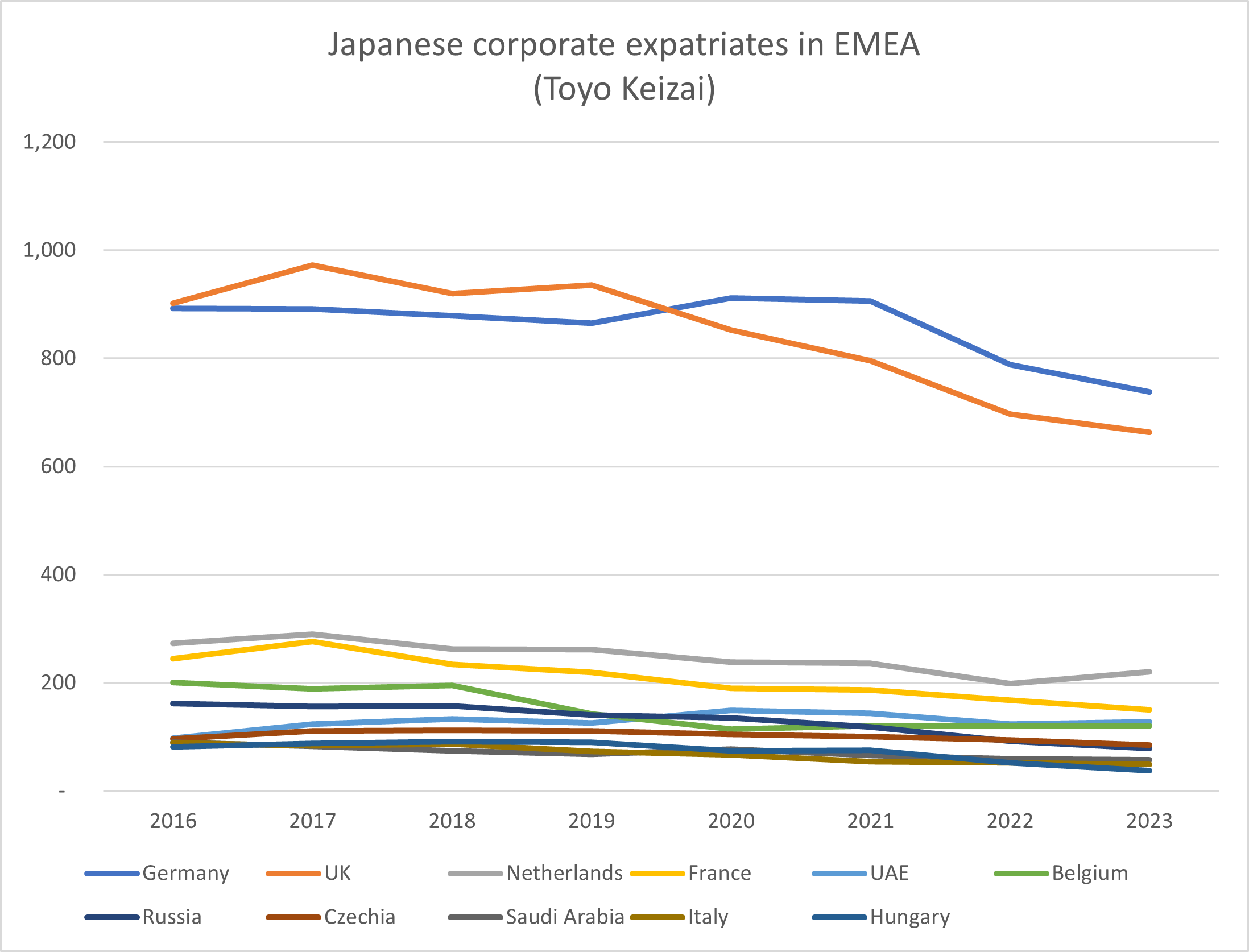
    Germany has overtaken the UK become the largest host to Japanese corporate expatriates in Europe

    What does it all mean? An acceleration of trends, new and old


    Employment by Japanese companies in the UK grew to 2018/9, then shrank since

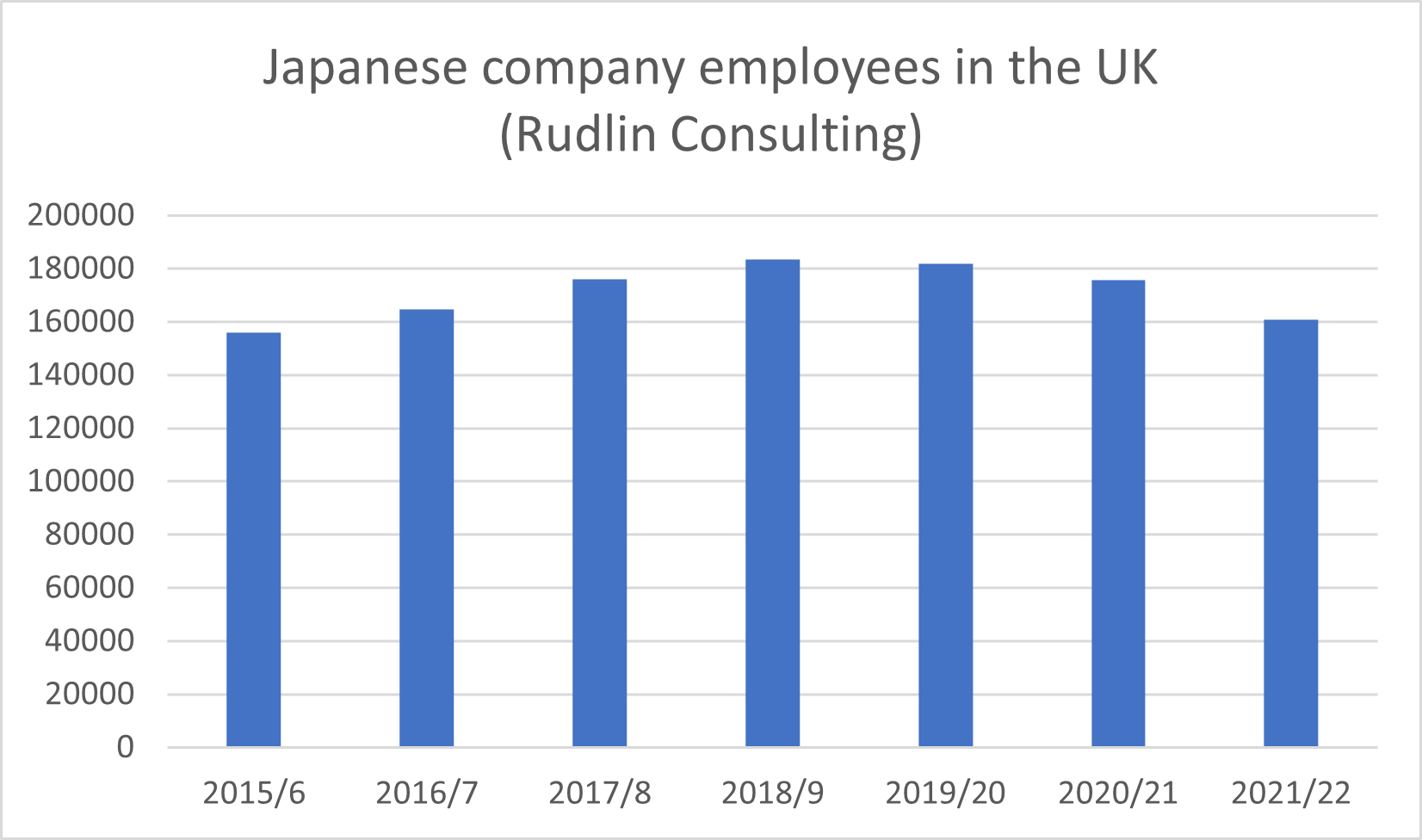
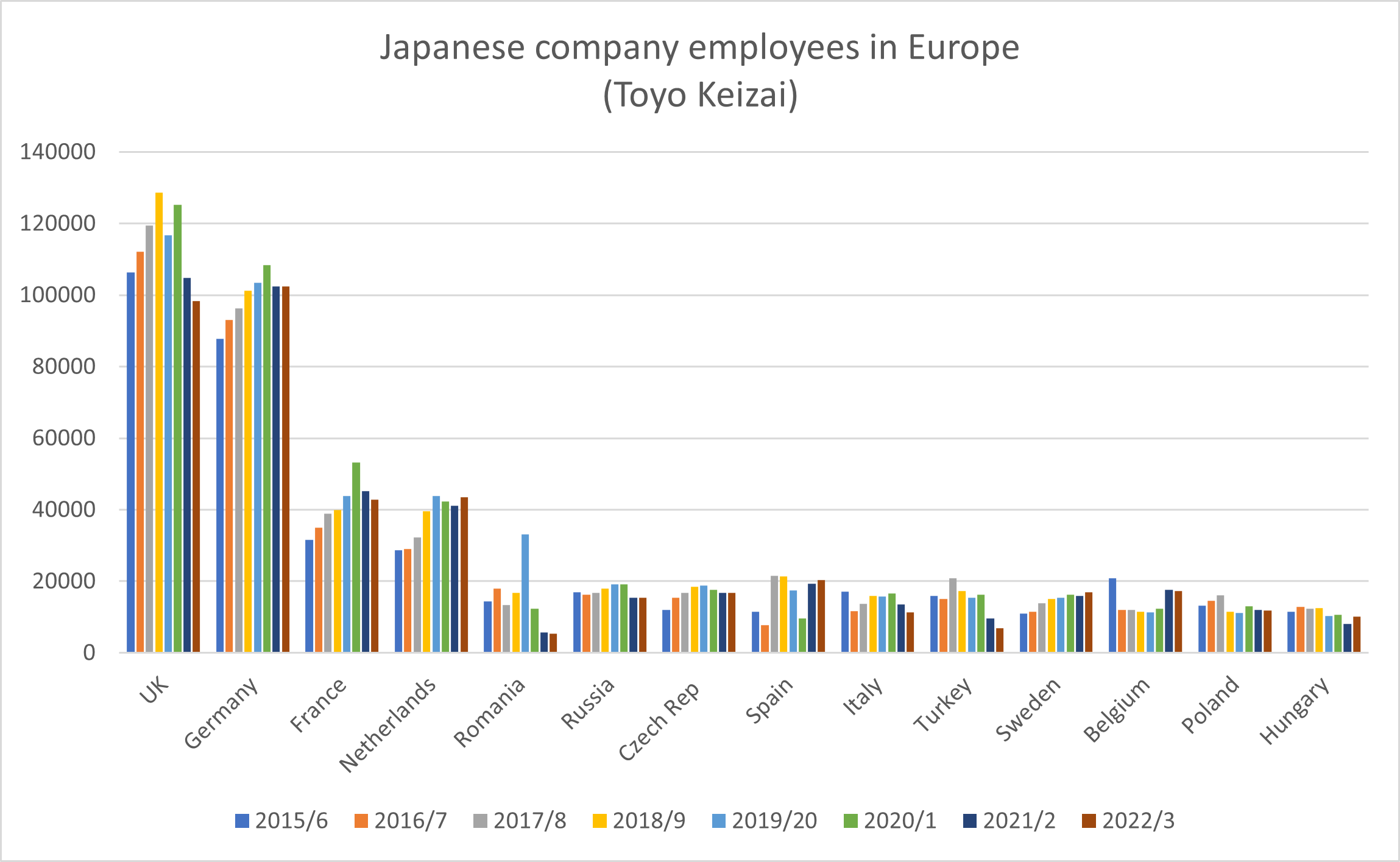
    There were 98,000 people employed by Japan owned companies in the UK, according to the Toyo Keizai[1] database published April 2023, compared to 106,000 in 2015/6.

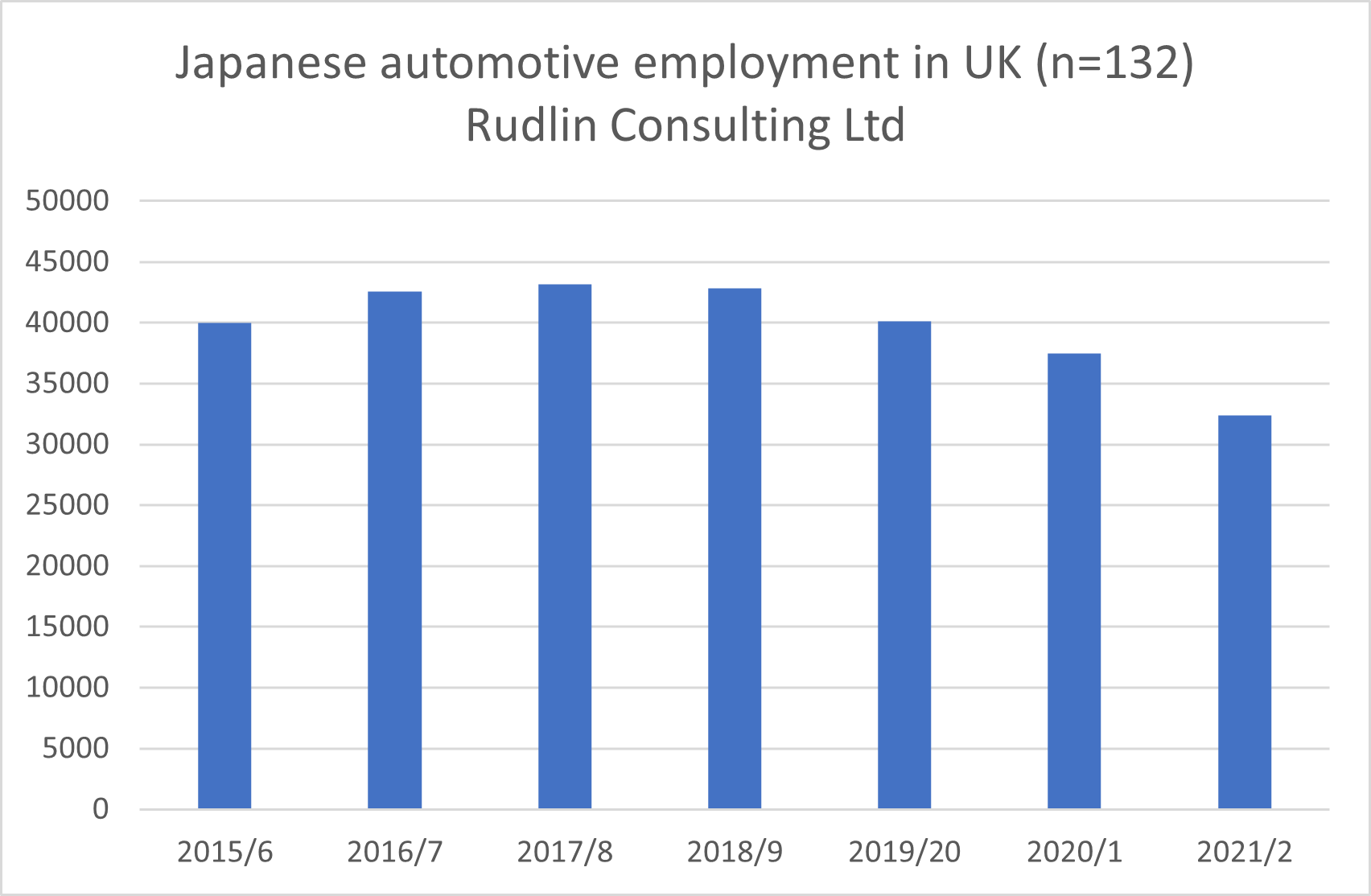
    The Rudlin Consulting database, which includes more companies who have a Japanese owner through acquisition, shows around 160,000 employees for 2021/2, up slightly from 156,000 in 2015/6.

    Both sets of data show that employee numbers reached a peak in 2018/9 and have fallen since. This is a different pattern to what has happened in France and Germany, where the employee numbers peaked in 2020/1, but have fallen since. The Netherlands shows somewhat bumpy growth.

    Looking at the employment data by sector, it seems the shrinkage in employment in the UK is almost entirely due to the decline in the automotive sector, where around 11,000 jobs have been lost in manufacturing and wholesale.
     

    Germany has nearly caught up with the UK as a host of Japanese companies

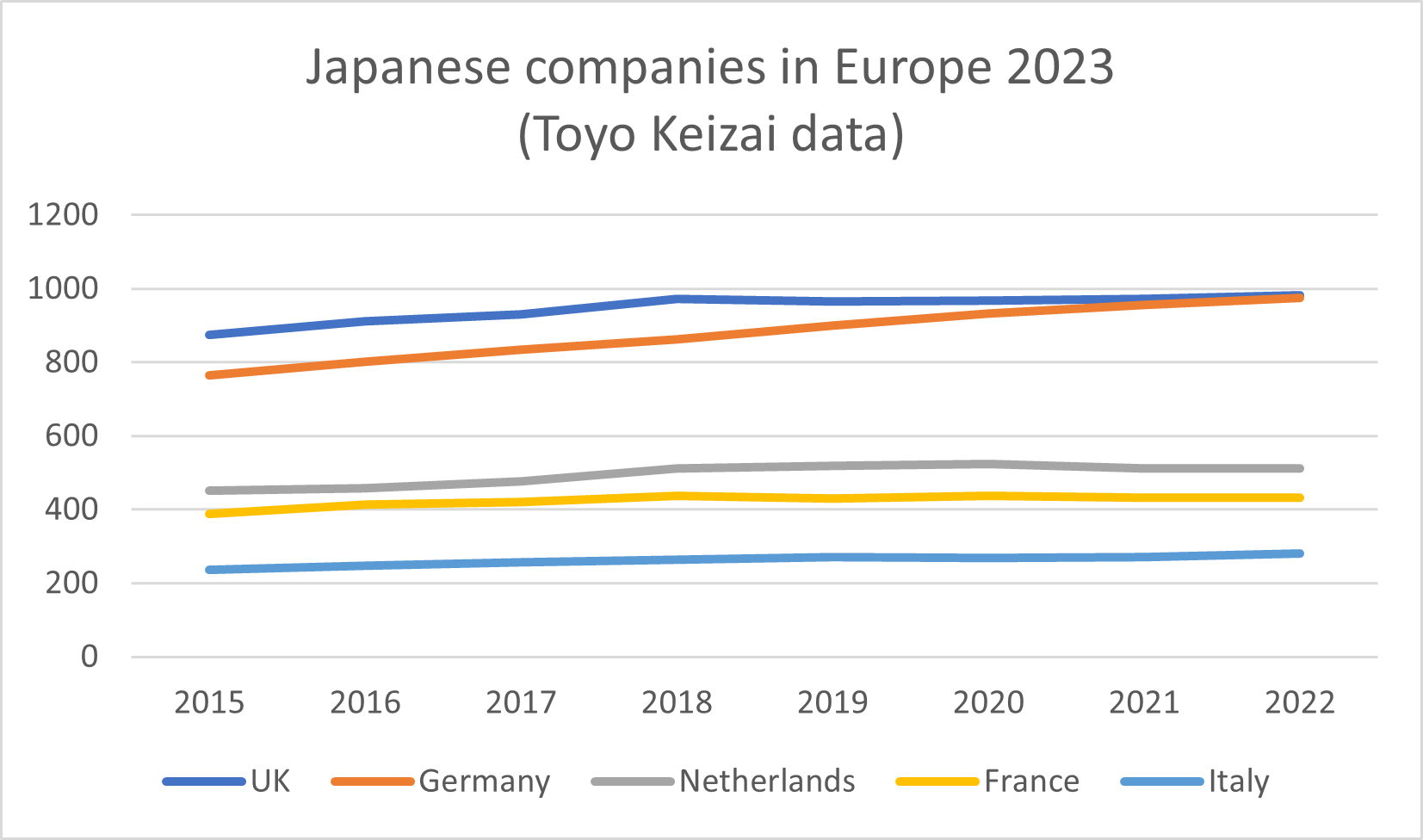
    Toyo Keizai estimates there were 875 Japanese incorporated subsidiaries in the UK in 2015/6 compared to 764 in Germany. By 2022/3 there were 982 Japanese incorporated subsidiaries in the UK, compared to 975 in Germany.

    Rudlin Consulting estimates also include branches and more subsidiaries acquired through acquisition than Toyo Keizai. As of June 2023, we estimate there are 1,113 Japan owned organisations in Germany, compared to 1,151 in the UK.
     

    More company closures in the UK than in Germany

    48 companies closed in Germany since 2018 and 145 closed in the UK since 2017. The biggest sectoral net loss was in wholesale in the UK. A likely explanation is that many companies were dissolved or turned into branches, once they lost their European wholesale coordination functions, with warehousing and logistics focused more on the EU single market.

    • 26 of the UK closures were in the automotive sector
    • 41 were services
    • 39 were wholesale
    • 27 were manufacturing companies
    • 11 were in the IT sector
    • 9 financial
    • 8 logistics
    • 6 chemicals
    • 4 retail
    • 4 food

    (some companies in multiple categories).

    Many of these closures were due to consolidation and mergers, rather than outright withdrawal from the UK.

    A similar number of new Japanese companies opened in the UK and Germany since 2017

    64 new companies were established in Germany since 2017, compared to 63 new companies in the UK (of which 4 divested or closed since):

    Of the 63 new companies in the UK:

    • 35 were in the services sector
    • 14 in wholesale sector
    • 6 in IT
    • 6 in the financial services sector
    • 3 in manufacturing
    • 3 in energy – storage, renewables, production
    • 1 in logistics (following merger of container businesses of several Japanese companies)
    • 1 in automotive (Highly Marelli, formed from merger with Calsonic Kansei)

    (some companies in multiple categories)

    UK still the target of Japanese M&A, but on a smaller scale than before

    We have tracked 179 companies coming under Japanese ownership in the UK from 2017 to 2023 to date compared to 79 in Germany. These are not exhaustive numbers, and may well reflect a UK bias.

    Furthermore, many of the acquisitions were not made directly of British or German companies, but rather of US or other European headquartered companies, which have subsidiaries in the UK or Germany. There may also be recent acquisitions which have not been identified yet.

    With those caveats in mind, it does seem to be that majority (123 of the 179 UK acquisitions) were made over the three years from 2017-2019, and since then the rate has been more around 25 companies a year or fewer. There seems to be a similar trend in Germany.

    The biggest acquisitions across Europe since 2017 have been:

    • Takeda’s acquisition of Irish pharmaceutical company (London listed) Shire for $64bn in 2019
    • Hitachi’s acquisition of Swiss company ABB’s Power Grids business for $11bn in 2020/2
    • Renesas acquisition of US founded, UK domiciled semiconductor company Dialog in 2021 for $5.9bn
    • Mitsubishi Corporation’s acquisition of Dutch energy company Eneco for $4.4bn
    • Taisho’s acquisition of French pharmaceutical manufacturer UPSA SAS for $1.6n from Bristol-Myers Squibb.
    • Hitachi Rail’s acquisition of Italy’s Ansaldo STS (1.5bn euros) from 2015 to 2019
    • Nidec’s $1.2bn 2017 acquisition of Emerson Electric’s motors, drives and power generation businesses, which included the Welsh drives make Control Techniques and the French motor manufacturer, Leroy-Somer.
    • Toyota Industries’ acquisition of Dutch logistics company Vanderlande for $1.3bn in 2017
    • NEC’s acquisition of Danish IT company KMD in 2018/9 for $1.2bn
    • Fujifilm acquisition of US company Biogen’s Hillerod manufacturing in Denmark for $930m in 2019

    In the past, British companies have often been the target of the largest M&A deals, such as SoftBank acquiring ARM, NSG acquiring Pilkington Glass and various acquisitions in the financial services sector. This preference does not seem to have continued, apart from the Renesas/Dialog deal, although there have been smaller scale acquisitions in sectors such as recruitment and staffing, drives, tyres, food and paper wholesale in the UK.

    Switzerland overtakes the UK as largest net recipient of Japanese investment in Europe

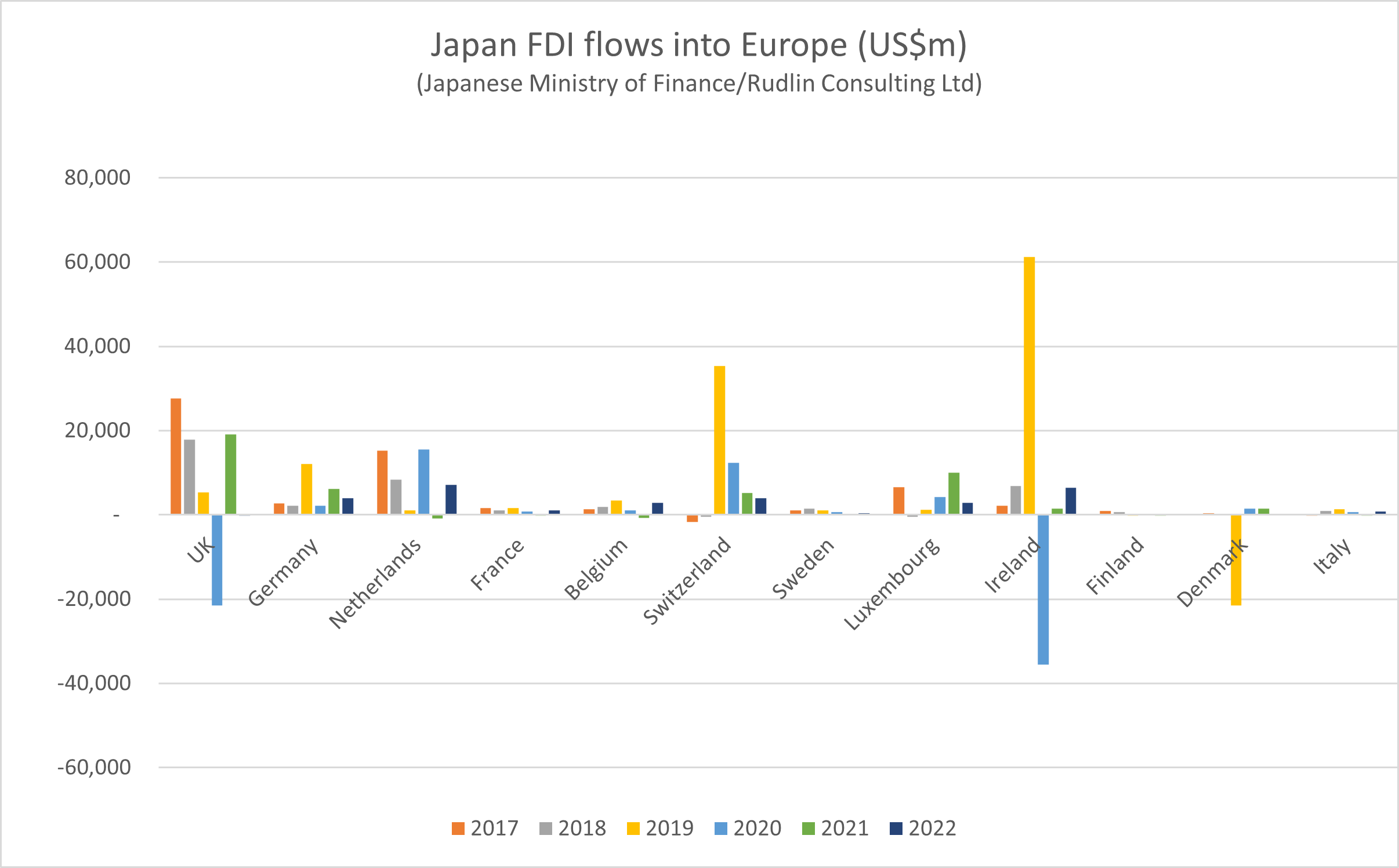
    These big deals have of course had an impact on the flow of investment from Japan into Europe, causing lumpiness in year-to-year totals.

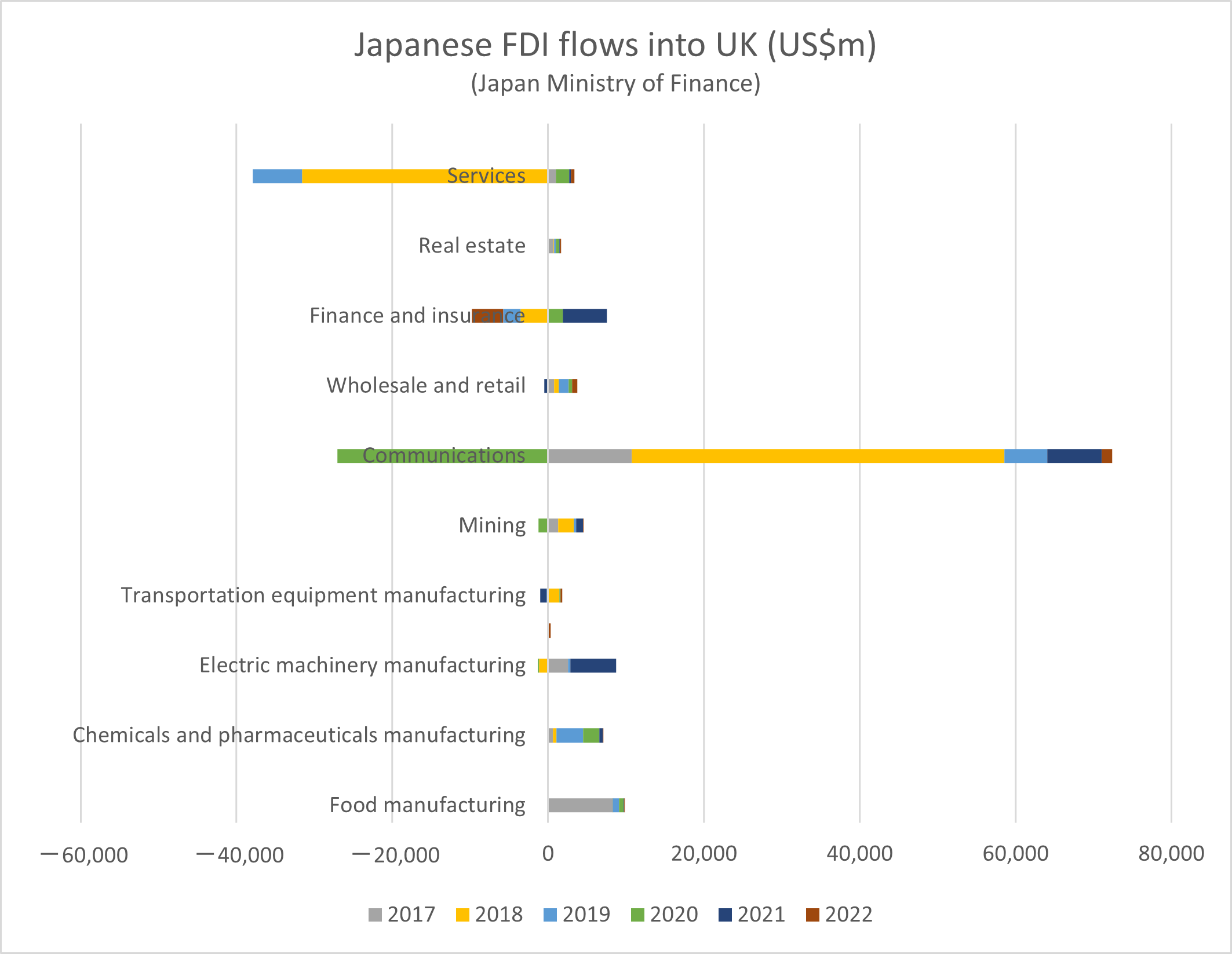
    Switzerland received more cumulative net direct investment from Japan since 2017 than the UK, which was the largest recipient of Japanese investment in Europe in the past. The large inflow into Switzerland in 2019 in the wholesale and retail sector was presumably related to Hitachi’s acquisition of the ABB power grids business. The Netherlands was the third largest recipient and Ireland the fourth largest recipient.

    The net divestment from the UK in 2020 was in the communications sector and may have been related to SoftBank, as much of their investment activities is located in London. There was also net divestment from the services sector in 2018. There were no major divestments by Japanese companies in terms of selling off subsidiaries in that year, so this might represent movement of assets from UK based subsidiaries to EU based subsidiaries as part of companies such as Sony shifting ownership their intellectual property rights.

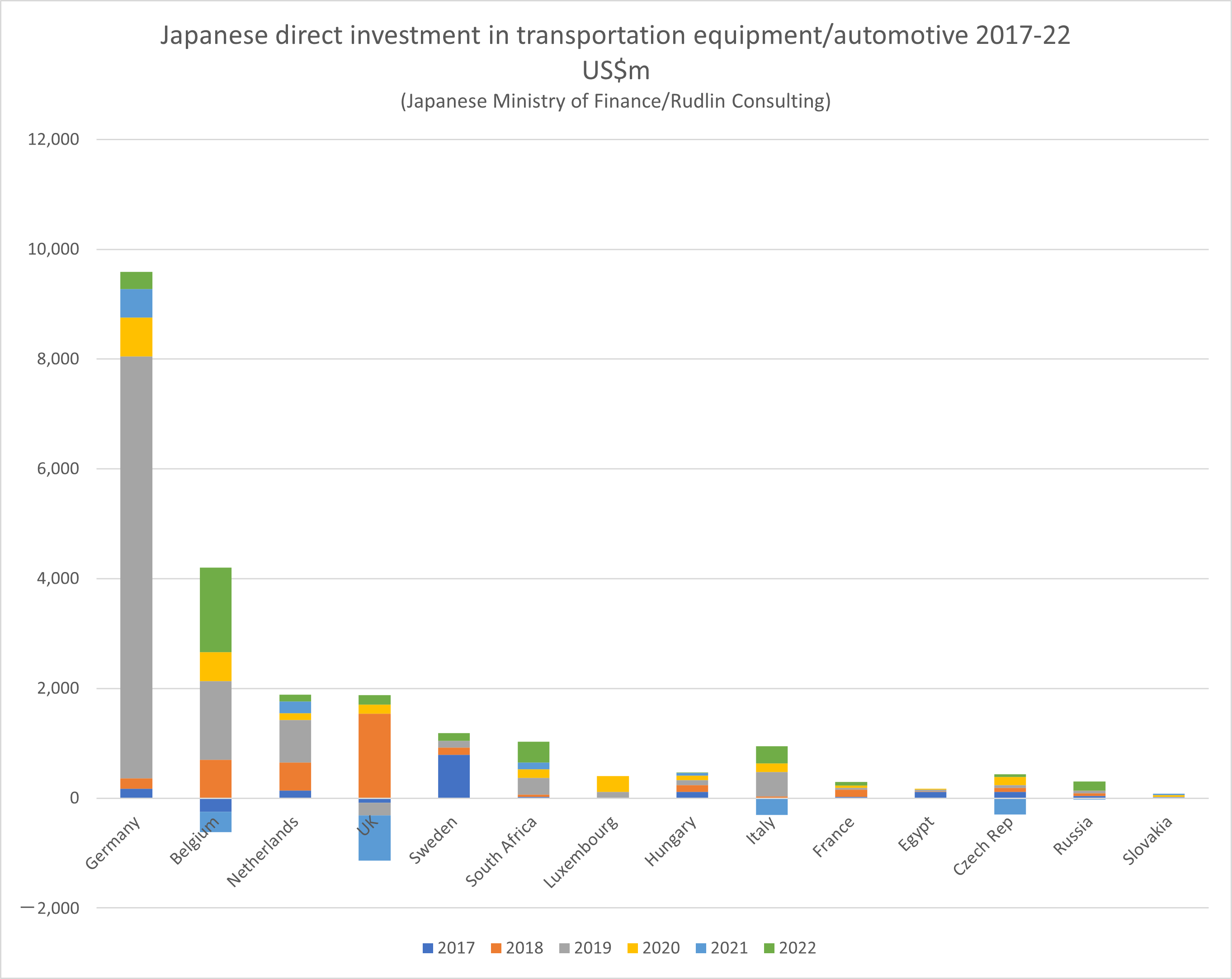
    In manufacturing, investment in UK electrical machinery, food and chemicals has been greater than the investment in transportation equipment (automotive) and substantially more than in German electrical machinery, food and chemicals manufacturing over the same period.

    Cumulative Japanese direct investment totals for Germany and the UK in since 2017 are: [2]

    Sector Germany UK
    Food manufacturing $0.8bn $9.8bn
    Chemicals & pharmaceuticals manufacturing $3.1bn $7.1bn
    Electrical machinery manufacturing $0.6bn $7.8bn
    Transportation equipment manufacturing $9.3bn $0.8bn
    Communications $0.6bn $45.3bn
    Wholesale and retail $2bn $3.2bn
    Finance and insurance $8.2bn -$2.3bn
    Services $1.2bn -$34.5bn

    As can be seen below, Ireland has had both inflows and outflows in the chemicals and pharmaceuticals manufacturing sector in 2019 and 2020, presumably related to the Takeda/Shire deal. Denmark had an outflow in 2019, which may have been related to the sale by Takeda of two factories in Denmark to Orifarm.

    The data from Japan’s Ministry of Finance needs to be treated with caution, as in many cases (France and financial services sector for example) no data is given, for confidentiality reasons.
    Manufacturing employment holding steady, apart from the automotive sector

    Disinvestment from the UK in the automotive sector in 2019 and 2021 was presumably related to the closure of Honda’s Swindon plant which was announced in February 2019 and finally shut down in July 2021. 20 or so Japanese automotive suppliers also ceased operations in the UK during this period.

    Germany has benefited the most from Japanese investment in the automotive sector – the large inflow in 2019 may be related to Sekisui’s acquisition of Proseat’s European operations – with manufacturing in Germany, Poland and Czech Republic. The UK plant was closed in 2021.

    There may have been some second hand investment in the UK automotive sector which is not reflected in the data. Belgium’s status as the second largest recipient of investment is almost certainly due to Toyota having their European headquarters there. Some of that investment may well then have made its way to Toyota’s plants in the UK.

    The larger inflow of automotive investment into the UK in 2018 may have been related to Nissan starting production of the Juke at Sunderland in 2019 and then the third generation Qashqai.

    Non-automotive manufacturing employment grew to 2019/20 and has held steady since.  Most of the Japanese manufacturers we looked at set up Brexit committees, planned and invested for various scenarios. They must have come to the conclusion that the cost/benefit analyses showed it made more sense to stay put and invest in mitigation measures than to shut down and transfer manufacturing elsewhere.
    Net disinvestment in UK financial services sector, although employment remains steady

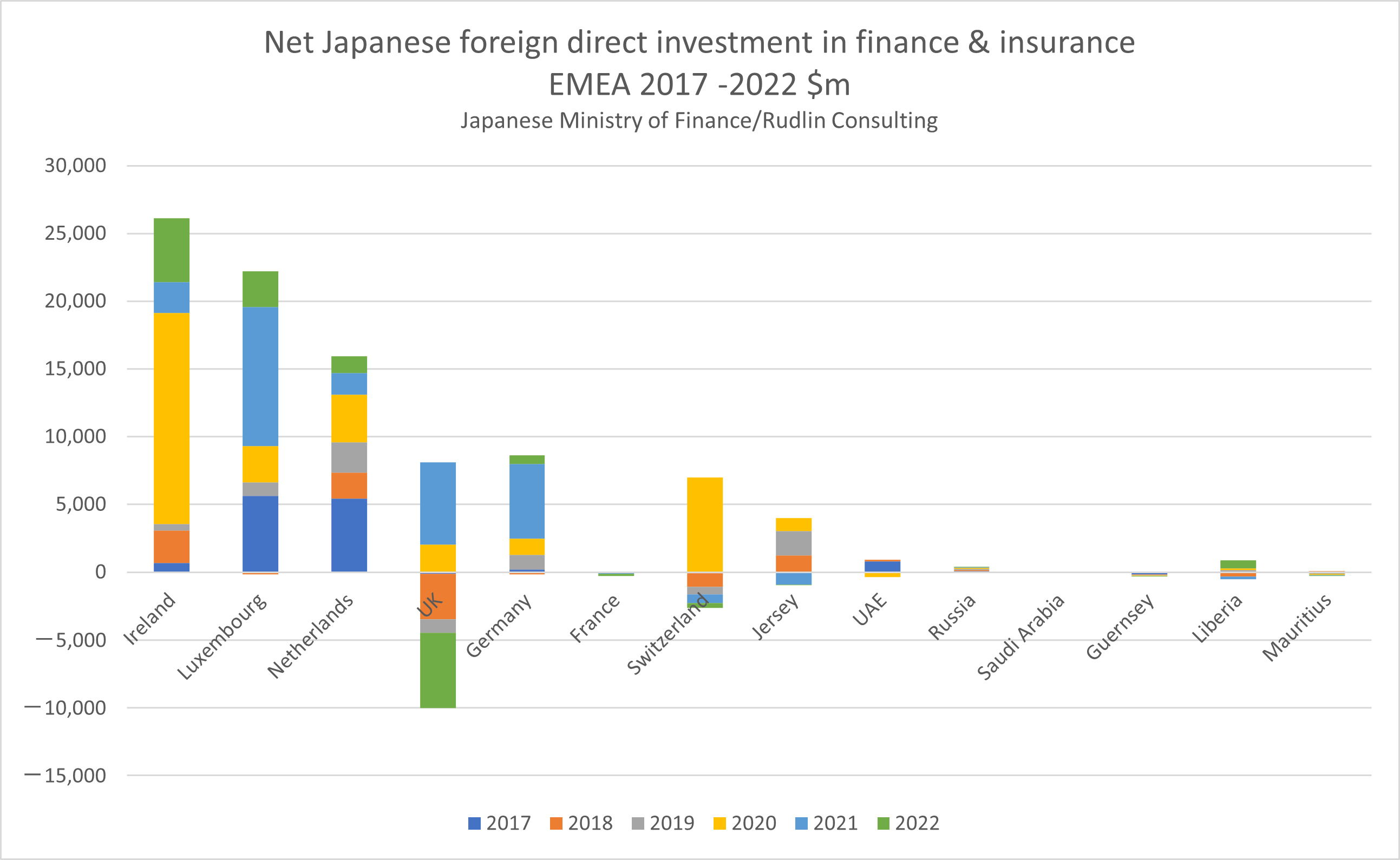
    Although the cumulative investment by Japan into in the UK financial sector was negative from 2017 to 2022, according to Rudlin Consulting data, employment in this sector has held relatively steady. It is hard to be certain of this, as two of the three main Japanese banks are branches of the European headquarters in the Netherlands or the Japanese headquarters, so employee numbers are not disclosed.

    Ireland has been a focus for Japanese aircraft leasing and related financing, which may explain why it has benefited most from Japanese financial services sector investment since 2017. For example, in 2020-2022, Japan Investment Adviser subsidiary JP Leasing Services set up a leasing company in Ireland with Airbus, acquiring several aircraft, which may  account for the large investment in 2020.
    Germany has overtaken the UK become the largest host to Japanese corporate expatriates in Europe

    The general trend in Japanese corporate expatriation across EMEA is downward, and does not seem to have picked up after the pandemic, apart from in the Netherlands and the UAE. The shift of Japanese expatriates (largely based around London) is likely to be an indicator of regional headquarter functions shifting to Germany and the Netherlands, particularly in financial services and trading companies, where the density of Japanese expatriate staff is the highest.
    What does it all mean? An acceleration of trends, new and old

    I have, over the past seven years, tried to approach the data I gather on Japanese companies in the UK with an open mind. Nonetheless, I admit to having a Big Theory of Brexit (beyond believing it to be an unnecessary waste of time, effort and resources) which is that it accelerates trends which were already there.

    So the question I wanted to answer, in looking at the data this time, was what trends were showing through, new and old.

    In my history of Mitsubishi Corporation in London, examining how its business developed from 1915,[3] it became apparent that the organization had quite quickly moved from an importer/exporter trading model to a regional coordinator. It was following a well-known model of globalization in business to move from pure export to manufacturing locally and then to some kind of transnational model, with regional centers of excellence.

    Japanese trading companies like Mitsubishi Corporation do not directly manufacture, but often invest in manufacturing, as Mitsubishi Corporation did, in acquiring Princes Foods in the UK in 1989. Primarily though, they are in London because they see it as an important global and regional hub, a good training ground for their rising stars to gather information and influence global policy making.

    Just after Brexit became a reality, I remember attending a large gathering of senior executives of Japanese companies in the UK. The then head of Mitsubishi Corporation in Europe, Middle East and Africa spoke, making it clear that while he thought Brexit was a negative for Japanese business, the company would not be leaving the UK.

    Having worked at Mitsubishi Corporation myself, including in planning and coordination, I instinctively understood this to be about the strategic value that a presence in the UK had for Mitsubishi Corporation, and other zaikai[4] Japanese companies.  Nonetheless I worried that the UK’s strategic value to Japanese companies would diminish by no longer having as much influence in the EU once it was on the outside.

    The only Japanese trading company to have left the UK since 2017 is Sojitz, which is not one of the top five of Mitsubishi Corporation, Mitsui, Sumitomo Corporation, Itochu and Marubeni. It has clearly decided to focus on chemicals trading, and to put that headquarters in Germany, which has traditionally been seen by Japanese companies as the regional leader in chemicals manufacturing.

    Other regional headquarters to have left the UK were part of the earliest phase of globalization – the wholesalers who were importing from Japan. They have moved their regional coordination, warehousing and logistics hubs to the EU – which is why there has been significant growth in employee numbers and expatriate Japanese numbers in the Netherlands. At the same time, the overall drop in the number of Japanese expatriates across the region may well be due to how localized many of the wholesale operations have become in terms of senior management.

    The second phase companies – those who opened manufacturing operations in the UK – have also shifted further out of the UK, and taken their supply chains with them. Consumer electronics manufacturing left some time ago, and the main concern had been for the automotive sector. As the analysis above shows, Germany has had by far the greater share of automotive investment in Europe since 2017, although this may be a one off, due to an acquisition. Some of the investment into Belgium may feed through to the UK via Toyota, however, and both Toyota and Nissan have not shown any signs of leaving the UK yet.

    The third phase, of having regional coordination and centres of excellence, is showing through more strongly now for the UK. Now that the regional coordination which was more to do with supply chains for manufacturers, or logistics and warehousing for importing from Japan has shifted away from the UK, the UK is left with the geopolitically minded, strategic investors, in energy, transportation and telecommunications infrastructure, defence and R&D in biotech and pharmaceuticals and semiconductors.

    These investors are not so influenced by the search for growth overseas which characterized Japanese acquisitions in the UK and elsewhere during the lost three decades of the 1990s to the 2010s. They are driven by geopolitical concerns regarding climate change and reducing dependence on hostile states in sectors such as telecommunications, energy and digital data.

    Despite the current British government’s taboo on mentioning industrial policy, it is clear that many British politicians are aware of this new phase and realise that the UK’s concerns align with Japan’s. There has been an embarrassment of former and current prime ministers and ministers at recent UK-Japan events in London. The exhibition stands at the one I attended, as a non-executive director of a Japanese soft-power initiative, Japan House London, were almost exclusively focused on renewable energy.

    The recent announcement[5] by the Japanese government that they will harmonise Japanese standards for domestically produced defence equipment with US and European standards, to reduce maintenance costs and increase business opportunities for Japanese defence companies is very much in line with this new third phase. The UK, Italy and Japan have merged their fighter jet programmes and are aiming to develop a next generation fighter jet demonstrator by 2027.

    It is not going to be entirely smooth – Japanese trading companies have shown no inclination to disinvest from Russian LNG projects, for example. This will have been the subject of discussions with the Japanese government in terms of impact on Japanese dependency on foreign energy supplies – the Sakhalin 2 project, for example, supplies around 9%  of Japan’s LNG imports.[6]

    In terms of “making Brexit work” – for phase 1 and 2 companies, this ship has sailed as far as traditional import export, manufacturing related trade is concerned. They made all the contingency plans and moved what needed to moved a long time ago. There have been no new Japanese manufacturers setting up in Britain, and it is unlikely this will happen until the UK joins the single market again.

    For phase 3, making Brexit work will be more to do with ensuring that cooperation and synchronisation with the rest of Europe and the UK’s positive influence inside and outside Europe is as strong as possible in the strategic areas of energy, defence, telecommunications and transportation infrastructure and R&D. This will not have the positive populist impact of phase 2 manufacturing projects, which bring thousands of jobs and supply chains in their wake. In fact the impact electorally could be negative, as we have seen with nuclear power, wind farms and high speed rail – there is antagonism towards the disruption to the countryside they cause and the massive investments they require. This is a problem familiar to Japanese companies in their home country too.

    Furthermore, this collaboration is not just about Europe, it needs to bring in the neighbouring continents of Africa and the Middle East. Obviously climate change has to be tackled globally, it cannot be “environmentalism in one country”. Successive Japanese governments have worried about Japan’s energy poverty for decades and this has driven much of the investment, particularly by Japanese trading companies, in overseas energy projects. Trading companies have invested in Africa and the Middle East, often through their regional headquarters in the UK, in renewable energy projects ranging from hydroelectric power generation to solar home systems.

    Japanese companies like working with other Japanese companies, so once a beachhead of investment is established, others in the supply chain and support system will follow – as the UK saw with Japanese car companies in the 1970s and the 1980s. That ecosystem is still strong in the UK and many of the components suppliers can also supply the energy and infrastructure sectors.

    This new third phase of Japanese investment in and via the UK is not going to be attracted by the UK government giving grants to build or re-equip factories, but by it showing a willingness to invest for results which will only be seen in the long term, and to put political energy into building sustainable government policies and community support.

    A pdf of this report can be downloaded here

    Our latest 2023 directories of Japanese companies in the UK are available here.

    [1] https://biz.toyokeizai.net/en/data/service/detail/id=860&academic=1

    [2] https://www.mof.go.jp/english/policy/international_policy/reference/balance_of_payments/ebpfdii.htm

    [3] The History of Mitsubishi Corporation in London: 1915 to Present Day Routledge Advances in Asia-Pacific Business, 2000 https://www.amazon.co.uk/History-Mitsubishi-Corporation-London-Asia-Pacific/dp/0415228727

    [4] Zaikai means the Japanese business and finance community, particularly those companies with power and influence and connections to the political sphere, which are seen as representing Japan in the world.

    [5] https://asia.nikkei.com/Business/Aerospace-Defense-Industries/Japan-to-standardize-arms-with-U.S.-Europe-for-joint-maintenance accessed 22 June 2023

    [6] https://www.reuters.com/business/energy/japans-mitsui-says-no-plans-exit-russias-sakhalin-2-lng-project-2023-06-21/

  • Telecoms takeover of Japan’s top CSR rankings

    Telecoms takeover of Japan’s top CSR rankings

    Comparing the top ranked Japanese companies for Corporate Social Responsibility (CSR)  in Toyo Keizai’s 2022 rankings* with the 2007 rankings shows how the Japanese corporate landscape has changed. The three telecoms companies – NTT, NTT DoCoMo and KDDI – have taken over the top 3 positions. In 2007 the top 3 positions went to the heavy engineering and electronics companies Toshiba, Hitachi and Canon. Sharp, Panasonic. Fujifilm and Sony also made appearances over the years, as did automotive companies such as Denso, Toyota and Nissan.

    The woes of Toshiba, Hitachi, Sharp and Nissan over the past 15 years are well documented but although Toshiba and Hitachi are in the 2022 top 50, Nissan and Sharp are at 437 and 179 respectively. Canon, Panasonic, Fujifilm and Sony are still in the top 50 along with other electronics and IT companies such as Fujitsu, NEC, Omron, Mitsubishi Electric and Seiko EpsonDenso and Toyota are all still in the top 50 along with other automotive companies such as Aisin, Bridgestone, Isuzu and Honda.  Despite being tobacco or drinks companies, JTI is ranked at 7, down from #4, Suntory is at #8, one down from #7 in 2021, Asahi at 28, up from #33 and Kirin at #31, down from #10.

    A Japanese trading company (shosha) has entered the top 10 for the first time.  Mitsui has shot up from #64 in 2021 to #4 – all the more remarkable as it used to be seen as one of the more hardcore traditionalists of the 5 big shosha. The second highest ranked shosha is Itochu, up to #22 from #37. Sumitomo Corporation is at #40, down from #26 and Mitsubishi Corporation is at #45 up from #58. Marubeni is somewhat lagging the other shosha at #112, up from #143. Toyo Keizai singled out Mitsui’s distributed power supply project, using solar power and storage batteries for non-electrified areas of India and use of carbon offsets through a company owned forest as contributing to its high ranking.

    Some of the companies whose rankings have fallen considerably include Nidec (down from 67 to 174, scoring low on environment) and Recruit, down from #62 to 172, also scoring low on environment and Ricoh, down from #47 to #217, with a lower score in HR.

    *500 companies ranked by scores out of 600 for finance (300), HR (100), governance (100) and environment (100).

  • France as a global brand manager

    France as a global brand manager

    Nippon Paint Holding’s November 2021 acquisition of French company Cromology initially caused me some confusion. The acquisition was done via Nippon Paint’s consolidated subsidiary, the Australia based DuluxGroup and their newly established UK based company DGL International UK Ltd. To most British people, Dulux is a British consumer brand, famous for using an Old English Sheepdog in its marketing since the 1960s. Because this breed of sheepdog has been used in the Dulux commercials and on its paint tins for so long, it is even known as the Dulux Dog.

    It turns out that the Dulux Dog was also used for advertising Dulux paints in Australia, but Dulux in the UK and Dulux in Australia are now owned by separate companies. Dulux brand paints first appeared in the UK the 1930s, developed by the British company ICI, with the brand name being a combination of “Durable” and “Luxury”.  By 1986, ICI Australia had 100% ownership of Dulux Australia but ICI plc then sold off ICI Australia in 1997.

    In 2008 the Dutch company AkzoNobel acquired ICI, whereas the DuluxGroup listed on the Australian stock market as an independent company in 2010 and acquired various Australian, British and French paint companies and brands since then.

    Cromology is Europe’s fourth largest architectural paints manufacturer with 20 paint brands that it sells across Italy, Spain, Portugal and France. Nippon Paint is apparently seeing its acquisition as a way of expanding its various brands, including Dulux, into Central and Eastern Europe too.

    Up until recently France has not been as big a base for Japanese companies to expand regionally as the UK or Germany. But this acquisition by Nippon Paint and also the acquisition of French company CFAO by Toyota Tsusho and French multinational Leroy-Somer by Nidec in 2016 makes me wonder whether this might be changing.

    CFAO is rather similar to Japan’s trading companies, with a history stretching back nearly 170 years, and has a substantial presence in 39 African countries, including what is sometimes known as Francophone Africa, as well as other former French colonies such as Vietnam. It has over 21,000 employees worldwide and as well as distributing Toyota vehicles, it also has brewing, pharmaceutical, retail and car servicing businesses

    France has a long experience of managing famous brands globally, but as I have mentioned before in this column, multinationals are often reluctant to invest in a country that is costly to do business in, with poor labour relations and a complex bureaucracy. French President Emmanuel Macron has been trying to reform labour laws, extend the retirement age and make pensions less costly, but this has been stalled by the pandemic, and the need to maintain his popularity until he seeks a second term as President in April next year. It will not be until later in 2022 that we will see if France is in the mood to redecorate its house.

    This article was originally published in Japanese in the Teikoku Databank News on 8th December 2021

  • Top 30 Japanese employers in France 2021

    Top 30 Japanese employers in France 2021

    It’s been 4 years since we last looked at the top 30 Japanese employers in France. Much of what was true four years’ ago is true today. The top 30 partly reflects France’s traditional strengths, at least in Japanese minds, of food and drink, fashion, beauty and imaging technology – with Ajinomoto and Suntory still in the top 30 along with Shiseido, Fast Retailing (Uniqlo, Princesse Tam Tam and Comptoir des Cotonniers), Canon, Ricoh, Toshiba and Konica Minolta.

    The automotive sector is still a big employer, as you might expect with Toyota having a plant in Onnaing making the Yaris, and Nissan having some of its models made by Renault, supplied by NTN, JTEKT and Nidec.

    Some of the new entries are in the pharmaceuticals sector, including Taisho Pharma, who acquired UPSA from Bristol Myers Squibb in 2018 and Otsuka who have grown and made several acquisitions since they bought Nutrition et Santé in 2009.

    SoftBank is still in the Top 30 as they have a substantial number of employees via ARM, which they still have not managed to get approval to sell. They have also said they are cutting half of the staff in France who were working on robotics, including the not very popular Pepper, brought in with their acquisition of Aldebaran in 2012 and may be planning to sell it to a German company.

    According to our estimates, France is still the third largest base for Japanese company employees in the European region, with 76,000 employees. This is still less than half the employees of Japanese companies in the UK (176,000) or Germany (167,000) however. Around 60% of these employees are working for the top 30 largest Japanese employers (see below).

    The largest employer is Toyota Tsusho, (the trading sister company to Toyota Motor) who shot to the top of the rankings after their acquisition of French company (with a major presence in Africa), CFAO in 2016.  Nidec have also become a substantial presence in France thanks to their acquisition of Leroy-Somer, also in 2016.

    The most recent acquisition in France by a Japanese company is Nippon Paint‘s acquisition of Cromology, Europe’s fourth largest architectural paints manufacturer.  The acquisition was done via a new UK based company, DGL International, which is in turn owned by the DuluxGroup, an Australian paints company acquired by Nippon Paint in 2019. Nippon Paint sees this acquisition as a way of accessing markets across Europe, particularly France, Spain, Italy and Portugal, and then into Central European countries.

    Up until now France has hosted far fewer regional headquarter companies than the UK or Germany. Perhaps these recent acquisitions show the start of a trend towards France becoming a base for Japanese companies to expand into the wider EMEA region.

    Update:

    We have received some more recent data regarding Hitachi’s employee numbers in France, following their acquisition of ABB Power Grids and JR Automation and other growth, so have updated the Top 30 for France accordingly. We welcome such updates so please do get in touch if you think we are missing something.

    You can download the (updated) Top 30 Japanese employers in France below:

    PDF DOWNLOAD OF TOP 30 JAPANESE EMPLOYERS IN FRANCE 2021

  • Top 30 Japanese employers in Italy 2021

    Top 30 Japanese employers in Italy 2021

    We’ve just compiled our first ever Top 30 for Japanese employers in Italy (see below for updated 2022 version). We’ve thought for a while that Tōyō Keizai underreported the number of employees in Italy, and that it probably ranked fourth after the UK, Germany and France in terms of numbers employed. Tōyō Keizai records 16,500 employees at 270 companies.  We estimate it’s more like 50,000 employees at 350 or so companies. We were also wondering what might be behind the Japanese Ministry of Foreign Affairs data showing a sudden rise from 300 Japanese companies in Italy in 2018 to 425 to 2019.

    The answer to both puzzles might lie in the fact that the Hitachi group, which was the largest Japanese employer in Italy, acquired various rail businesses from Ansaldo in 2019 and one of its subsidiaries, Hitachi Chemical, acquired FIAMM in 2020.  Hitachi has now dropped one rank, to the second largest Japanese employer in Italy, behind the NTT group, as Hitachi Chemical was acquired by Showa Denko in 2020. Another factor is that the NTT group has also grown substantially in Italy recently, mainly thanks to acquisitions by NTT Data.

    Other large Japanese employers in Italy are the result of earlier acquisitions: Denso has some of its major manufacturing operations in Italy, deriving from acquisitions from Magneti Marelli more than 20 years’ ago. Denso Thermal Systems S.p.A. is now the regional headquarters for the air conditioning manufacturing business.

    Mitsubishi Electric at #5 acquired Italian firm Climaveneta in 2015. Nidec, the 6th largest Japanese employer in Italy, acquired Ansaldo Sistemi Industriali S.p.A. in 2012. Sumitomo Heavy Industries acquired Lafert (electric motors and drives) in 2018.

    So it seems likely the underestimation of Italy lies more in acquisitions unaccounted for than a sudden influx of Japanese greenfield investment.

    Half of the Top 30 Japanese employers in Italy are also in the EMEA region top 30, so would be expected to have substantial presence in Italy too. The acquisitions detailed above show that Italy’s strengths, as far as Japanese companies are concerned, are in engineering – particularly rail and air conditioning. Judging by the companies that are only in the Italy Top 30,  textiles (Toray) and pharmaceuticals (CBC and Takeda) are still attractive sectors for Japanese investment – and of course food – such as the Princes tomato processing plant, owned by Mitsubishi Corporation.

    New 2022 edition

    The 2022 Top 30 has just been published – it can be downloaded from our website here.
     We can provide more detail on the 85 companies within the Top 30 – each company name in full and employee total per company (a truer indicator of size of the company than turnover in our opinion)  for £9.99 – please email us for a PayPal invoice.
  • Which Japanese companies to work for in Europe

    Which Japanese companies to work for in Europe

    We’ve been publishing our top 30 Japanese companies in Europe intermittently for 5 years now.  We regularly receive enquiries for recommendations on which Japanese companies to approach as potential employers.  We’re not a recruitment consultancy so we don’t have any inside track on what jobs are available (please talk to our friends at Centre People Appointments for more practical assistance), but I would say that size in Europe and growth are important factors to consider.

    Relative size in Europe is a key factor

    If the European operations of a Japanese company represent a substantial part of their business, then it’s more likely that Europeans will have some influence within the organisation. There will also be more promotion opportunities and career paths than working for a smaller organisation in Europe. For that reason, it’s worth trying to join the organisation in the European/EMEA headquarters.

    Companies with a relatively high proportion of their employees in EMEA (25%+) include NSG (Pilkington), Asahi (brewery company recently acquired Grolsch, Peroni, Pilsner Urquell etc brands), NTT Data, Toyota Tsusho (acquired French company CFAO with a big presence in Africa), Asahi Glass, JT International, Konica Minolta.

    Has the company been growing?

    Not only are growing companies more likely to have job openings, but they are more fun to work for. Japanese companies are still growing their operations in Europe overall.  However some have been undergoing substantial restructuring, which has resulted in significant headcount reductions in some countries, and significant growth in others. For example Fujitsu is reducing headcount in the UK and Germany, but growing rapidly in Poland and Portugal.

    Companies that have grown the most rapidly in Europe (more than doubling) over the past five years are Nidec, NTT Data and Panasonic.

    Working for an acquired company

    The rapidly growing companies have mostly expanded through acquisition – for example Dentsu, Nidec, Panasonic (Ficosa, Zetes) and NEC (Northgate Public Services), Toyota Industries (Vanderlande), Hitachi (Ansaldo).  Working in those acquired companies might also be an attractive option, as there will be more autonomy, and less domination by Japanese management layers than Japanese subsidiaries which have grown organically.

    Companies who score highly in terms of growth and significant European presence are NTT Data (third largest company in Europe) and Dentsu (8th).

    In terms of sectoral growth – as well as IT companies that are moving into services and solutions like NTT Data, Konica Minolta and PanasonicDaikin (# 27) and Mitsubishi Electric (#30) have both grown substantially recently, probably due to expansion of their eco friendly air conditioning businesses.

    For new graduates, many of the top 30 have graduate trainee schemes, which would be worth considering if you are looking for a chance to be seconded to Japan.

    Top 3 largest Japanese employers in Europe, Middle East and Africa:

    1. Sumitomo Electric Wiring

    Large numbers of employees in manufacturing, as making automotive wire harnesses is still a fairly manual job. Manufacturing jobs will tend to be in North Africa and Eastern Europe. There are plenty of jobs in design engineering and sales as well, and will be future proof as apparently electric vehicles also require complex wire harnesses to operate.

    EMEA headquarters: UK (SEWS-E), Italy (CABIND), Germany (Bordnetze)

    No graduate trainee scheme, but this page gives a flavour of the jobs available in the region for SEWS-E https://www.sews-e.com/current-vacancies/

    2.  Yazaki

    Very similar to Sumitomo Electric Wiring in terms of business and jobs but privately owned, so more of a family style corporate culture. Has a YEA!cademy (Yazaki Europe training academy) https://www.yazaki-europe.com/career.html

    EMEA headquarters: Germany

    3. NTT Data

    Owned by Japan’s NTT (formerly Ministry of Post and Telecommunications, now partly privatised).  NTT Data has acquired various companies in Europe and elsewhere such as itelligence, Cirquent, Value Team, Intelligroup, and Keane. NTT is in the middle of restructuring and have put a new global headquarters, NTT Limited, in London. NTT Data will be kept as a separate organisation, however.

    Lots of training and chances to go to Japan, however recruitment seems more by country/company than centralised and as you can see here https://www.nttdata.com/global/en/careers

    EMEA headquarters: UK

    If you would like a consultation on working for a Japanese company, then you can book an hour with Pernille Rudlin here.

    We also recommend doing the e-learning modules from the leading global intercultural training firm focused on Japanese business –  Japan Intercultural Consulting – on working in a Japanese company – each module comes with a certificate – proof that you know what you’re letting yourself in for!