
Search results for: “asahi glass”

  • Successes and failures of Japanese cross border M&A (Pilkington & Nippon Sheet Glass)

    Successes and failures of Japanese cross border M&A (Pilkington & Nippon Sheet Glass)

    Softbank’s $21bn acquisition of Sprint, the merger of Tokyo Electron and Applied Materials and most recently LIXIL’s 3bn euro acquisition of German bathroom fitting manufacturer Grohe have provoked a two part series in the Nikkei Business magazine on the successes and failures of Japanese cross border M&A, starting with the article of 2nd December, which I read just as I was travelling to Japan to help with a post merger integration project.

    Since 2000, domestic M&As have decreased, but cross border M&As have soared for Japanese companies, with a pause after the Lehman Shock in 2009-2011.  Of the 15 M&As noted by the Nikkei from March 2011 to October 2013, 14 were cross border, and the majority were deals of over  $1bn.

    The Nikkei comments that although the reason for these acquisitions is clear (the hunt for growth outside the saturated Japanese domestic market), the post merger story has not been that rosy for many of the acquiring companies in the past decade.  The Nikkei focuses on three cases – Nippon Sheet Glass’s acquisition of Pilkington in 2006, Daiichi Sankyo’s acquisition of Ranbaxy in 2008 and Ricoh’s acquisition of US company Ikon Office Solutions in 2008, to see what lessons can be learnt.

    Nippon Sheet Glass/Pilkington

    NSG were worried that they might be dumped by Toyota, their key customer, if they could not match Toyota’s overseas expansion.  Before the acquisition of Pilkington, 80% of NSG’s sales were in Japan.  Pilkington’s turnover was double that of NSG, so by acquiring it, NSG was finally able to be on equal terms with Asahi (who had previously acquired Saint Gobain).  After the acquisition, the March 2008 results showed that NSG Group sales were 80% overseas, with profits at a record high.  Stuart Chambers and other Pilkington executives took over the key management positions in the group and it seemed as if the company had become global overnight.

    However the good times did not last, as the Lehman Shock brought about the world economic crisis, followed by the euro debt crisis, impacting the two main businesses of automotive glass and construction glass.  The NSG management did not take any effective action “and then it hit us” says a Japanese executive at the time “that we knew nothing about Pilkington”.  They thought it would be a growth engine, so did not do anything beyond cut employees and shut down operations.

    Too focused on growth and globalization

    This is where Japanese M&As often come unstuck says the Nikkei – they are so focused on the growth and globalization, they do not fully develop strategies and pathways for ensuring the M&A actually bears fruit.  “We had to focus on the immediate crisis, rather than the growth of the new company” says Kazumitsu Fujii, an executive officer.

    NSG did know Pilkington quite well – having held equity in the company since 2000, and collaborated on various projects together.  Howerver they had not undertaken any simulation of the financial impacts of any worsening market conditions post merger.  As one executive at the time says “we did not even have any thought that the economic situation would get so bad so quickly”.

    Stuart Chambers resigned in September 2009, citing family pressures from being in Japan all the time – and it was felt that his heart was not really in the job.

    NSG had a 4-3-3 10 year vision.  The first four years were to be about integrating the two companies’ systems and cutting down the debts.  The next three years were to expand sales in automotive and construction glass and the second 3 years were to be about investing in new businesses.

    However the company has not managed to move on from the first phase yet.  It seems that the lack of understanding and knowledge between the two companies has meant that the negative financial situation has dragged on.  “We thought that once we had made the leap into being a global company, all kinds of paths would open up to us, but it was not the case” says a former employee.

    The new President, Keiji Yoshikawa says “we are having to fix areas we did not see at the time of the acquisition”.  Pilkington had centralised, standardized global HR management and sales systems which looked efficient at first glance, but meant that there were regional differences which were ignored.

    For example, construction glass has to take account of the different climates and lifestyles, but apparently such products were not given much priority.  So NSG have started to allocate budgets to projects such as fire resistant glass in Germany.

    After 7 years, NSG have finally started to understand Pilkington, concludes Nikkei Business.

    Standardization and taking the initiative

    My personal thoughts on this, having conducted various cross cultural communications seminars for Pilkington and Nippon Sheet Glass at the time, was that the two companies knew each other pretty well.  The gap was more to do with differing views and levels of experience in managing globally.

    Pilkington, like many Anglo Saxon multinationals, would indeed emphasise a standard unified approach to management and product development around the world, in order to ensure maximum profitability.  The Japanese view that products should be customised to suit different markets is not cost effective, in this world view.

    The other issue, as is so often the case when Japanese companies acquire Western ones, is that both parties sit back and wait for the other to take the initiative – and this was amplified by the Lehman Shock – where quick and decisive action was needed.  Pilkington may well have expected NSG to take the lead, whereas NSG was expecting Pilkington to have the global experience to provide the guidance for what to do in such extreme circumstances.


    For more content like this, subscribe to the free Rudlin Consulting Newsletter. 最新の在欧日系企業の状況については無料の月刊Rudlin Consulting ニューズレターにご登録ください。

    Share Button
  • Top 30 Japanese companies in EMEA – not much growth in 2023

    Top 30 Japanese companies in EMEA – not much growth in 2023

    We have finalised the Top 30 rankings for the largest Japanese employers in the Europe, Middle East and Africa region (download available below). As before,  the extent to which Japanese companies take the UN Sustainable Development Goals pretty seriously has had a noticeably positive effect on disclosure of data and transparency. But there are still some laggards in terms of the metric we focus on, which is the number and location of employees outside of Japan.

    Overall, the year from 2021/2 to 2022/3 has been one of very little growth for Japanese companies in Europe.

    83% of companies have the majority of their staff overseas

    More often than not, the detail on human resources in terms of diversity and inclusion in the various sustainability reports published by Japan headquarters is all about employees in Japan. And yet, 83% of the companies in our rankings have more than 50% of their employees overseas.  Those with less than 50% of employees overseas are the ICT companies – NTT, Fujitsu and NEC, along with Toyota and Asahi Glass. In some cases no clear figures were given for Japan and overseas employees, so we estimated  them based on employee numbers give for consolidated (Japan and overseas) and non-consolidated (which we took to be the Japan parent company).

    The non-disclosers

    NTT does not disclose the number and location of its staff, which is perhaps excusable as the huge consolidation and reorganisation of its group companies and overseas acquisitions is still working its way through.

    The two recruitment giants, Outsourcing and Recruit are notably lacking in transparency on employee numbers. The excuse may be that is difficult to calculate numbers on a consistent basis, given that in some countries, temporary workers on their books will count as employees. Outsourcing has had to delist from the Tokyo Stock Exchange and may be bought out by Bain, following investigation for fraud and inflating revenues and expenses. We estimate Outsourcing is now the second largest Japanese corporate employer in Europe, after Sumitomo Electric Industries, pushing Yazaki to third place.

    The other companies  who do not disclose regional data on employees are Sony, Toyota Tsusho, Japan Tobacco, Dentsu, Toyota Industries, Kyocera, Mitsubishi Electric  and Mitsubishi Corporation.  Japan Tobacco does  not even disclose how many employees are outside Japan at all. Some estimate can be made by looking at the employee numbers given for each location, on their website however.

    No growth?

    The lack of data from Outsourcing makes it very difficult to estimate the trend for the whole Top 30. We think their acquisitions in Europe over 2018 to 2021 may have grown the European workforce to 48,000. If we assume that this held level in 2022/3, then there are around 629,000 employees working for the biggest Japanese companies across the region and growth was only around 1%.

    The only companies who grew significantly in the region from FY 2021/2 to FY 2022/3 were Daikin (10%) and Dentsu (6%). Shrinkage was noticeable in the automotive sector – Nissan (-22%) . Toyota Motor (-5%) and Toyota Industries (-6%). Honda has dropped out of the Top 30 since the closure of manufacturing in the UK, but has shrunk further by 3%. NSG, which supplies automotive glass, has shrunk by 5% over the year.

    The influence of Europe through acquisitions

    The total employed in EMEA as a proportion of all employees in the Top 30 companies is 16%. Those companies with significantly above that proportion of employees in EMEA are NSG, Outsourcing, Japan Tobacco, Toyota Tsusho and the Asahi Group. The Asahi Group acquired many beer and alcohol brands in Europe around eight years ago, which was also when Toyota Tsusho acquired CFAO, a France headquartered company with substantial operations in Africa. NSG acquired Pilkington in 2006 and Japan Tobacco acquired Gallaher in 2007.

    The lack of any large scale acquisitions since 2021 is undoubtedly one of the factors behind the lack of growth of Japanese companies in the region.

    Click the link below for  a pdf (£3 + VAT) of the Top 30 Japanese employers in the EMEA region, showing ranking in 2022 and 2023, total global employees, % of employees overseas and number employed in EMEA:

    DOWNLOAD OF TOP 30 JAPANESE COMPANIES IN EUROPE, MIDDLE EAST & AFRICA

    For more content like this, subscribe to the free Rudlin Consulting Newsletter. 最新の在欧日系企業の状況については無料の月刊Rudlin Consulting ニューズレターにご登録ください。

    Share Button
  • Top 30 Japanese companies in Europe, Middle East and Africa 2022

    Top 30 Japanese companies in Europe, Middle East and Africa 2022

    Our top 30 Japanese companies in Europe, Middle East and Africa for 2022 (download available below) shows that there has been a modest growth in total employee numbers to 593,195,* up around 3% from 575,962 in 2021. We estimate over a million people are employed by Japanese companies in the EMEA region, so around 60% of them are working for these large corporate groups.

    This would be a 2% growth if Honda had not dropped out of the Top 30, thanks  to the closure of its Swindon UK factory, and been replaced with NYK Group. Japanese corporate groups where the number of employees in EMEA declined over the year were largely in the automotive sector – not only Honda – including Nissan (-8%), NSG (-6%) and Denso (-5%).

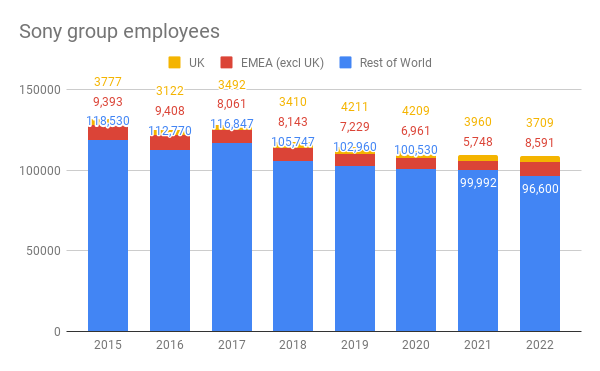
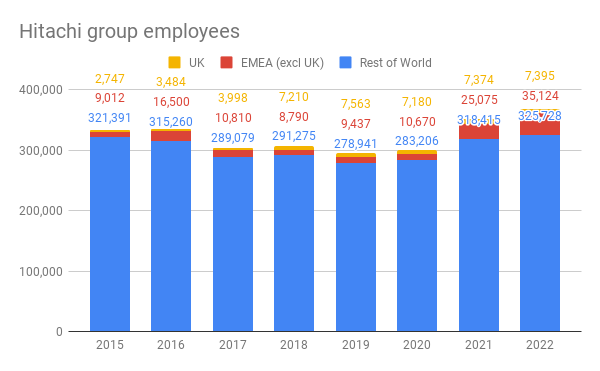
    Some of the growth in employees  was due to acquisitions, for example Hitachi‘s employees in the region expanded by nearly a third after the acquisition of the ABB Power Grids business. Sony has also grown in EMEA by 27% from 2021 to 2022 – this may be the result of multiple acquisitions, mainly of video game companies in the UK, Netherlands and Finland as well as in the  USA.

    This now means 12% of Hitachi‘s global employees and 11% of Sony’s global employees are in the EMEA region, compared to the top 30 average of 14%. The groups with a significantly higher than average proportion of employees in EMEA tend to be those with large manufacturing presence –

    • NSG (46% of global employees in the region), arising from its acquisition of Pilkington Glass
    • Sumitomo Electric Industries (26%), thanks to the labour intensive wire harness factories it has in Eastern Europe and North Africa
    • Toyota Tsusho, who have a significant presence in Africa since their acquisition of the French company CFAO
    • Asahi Glass

    Japan Tobacco, with 38% of its global employees in the EMEA region, has entered the top 10 of the largest Japanese corporate groups, up from number 16 – not necessarily from any expansion, but more due to the fact that previous employee estimates were our own, and proved to be an underestimate, judging by figures that are now given on the website for Europe and the Middle East.  It has not announced anything further about its operations in Russia, where it employs around 4,000 people, other than a suspension of investment.

    Recruit and Asahi also have more than 30% of their global employees in the EMEA – Recruit through its acquisition of USG People as well as Glassdoor and Indeed and Asahi through its acquisitions of various beer brands such as Grolsch and Peroni.

    The corporate groups that have expanded the most in the region since 2014/5 are Hitachi (262%), NTT (157%) and Panasonic (89%). Those groups which have contracted the most are Honda (-55%),  Asahi (-30%), Fujitsu  (-25%) , Nissan (-22%) and Ricoh (-15%).

    Click on this link for a pdf download of the Top 30 Japanese Companies in EMEA 2022

    *This number has been updated to reflect the inclusion of Mitsubishi Electric in the Top 30 (17 April 2023) and the inclusion of NYK Group (16th May 2023)

    For more content like this, subscribe to the free Rudlin Consulting Newsletter. 最新の在欧日系企業の状況については無料の月刊Rudlin Consulting ニューズレターにご登録ください。

    Share Button
  • Top 30 Japanese employers in Europe, Middle East, Africa 2021

    Top 30 Japanese employers in Europe, Middle East, Africa 2021

    The major Japanese employers in Europe, Middle East and Africa employ over 540,000 people, a 1.4%* rise comparing financial year 2018/9 to 2019/20, even though their global employee numbers have shrunk by around 1% over the same period. As in previous years, acquisitions of companies in the region are the main growth drivers.

    The top 5 largest employers remain the same – Sumitomo Electric Industries, Yazaki, NTT Data, Fujitsu and Canon.  The rest of the top 10 are the same, apart from Hitachi rising from 14 to 9, bumping Toyota Tsusho to number 11.

    Exiting the Top 30 are Mitsubishi Corporation, Mitsubishi Electric and Olympus – not so much due to any decline as the growth of the new entrants LIXIL (following its acquisition of Grohe), NEC (acquiring KMD in Denmark and Northgate in UK) and Asahi (having acquired various European beer brands such as Peroni, Fullers and Grolsch).

    Which company to work for

    We have previously recommended that people wanting to work for a Japanese company should consider not just whether it is growing in the region but also what proportion of its employees are in the region. The greater the proportion, the more influence the region is likely to have in headquarters’ decisions.

    The average for proportion of employees in the EMEA region of the top 30 is around 14%. Those with more than a quarter of their global employees in EMEA are NSG (due to its acquisition of Pilkington), Asahi Group (due to the acquisition of the beer brands mentioned above), Asahi Glass (the continuing influence of the 1981 Glaverbel acquisition), Sumitomo Electric Industries (the continuing influence of acquiring Volkswagen Bordnetze in 2006), Toyota Tsusho (acquired French company – mainly operating in Africa – CFAO in 2012).

    The companies who score highly both in terms of growth and proportion of employees in the region are Sumitomo Electric Industries, Toyota Tsusho and NTT Data. The latter grew through acquisitions of Dimension Data, Keane and Itelligence but appears to have shrunk its EMEA employees over the 2018/9 to 2019/20 period. This is actually due to Latin America being excluded from the regional total in 2019/20, having been previously included.  Dentsu also has nearly a quarter of its employees in EMEA and has grown nearly 50% since 2014/5 due to the acquisition of Aegis Network and subsequent smaller acquisitions, but the numbers are starting to decline as it starts to consolidate and restructure, aiming to cut its overseas roles by 12.5%.

    Dentsu does not publish consolidated regional employee numbers, and neither do trading companies such as Mitsubishi Corporation, Toyota Tsusho and Itochu.  Some have been inconsistent in publishing details – JT International for example – so we have had to use our best guesses and our own database. Overall the level of transparency in Japanese companies’ reporting on overseas employees has improved tremendously over the six years we have been tracking them, thanks to Japanese companies’ enthusiastic adoption of UN Sustainable Development Goals.  Perhaps a lack of transparency on employee details should be a factor to consider in terms of desirability as an employer.

    If you’re thinking of working for a Japanese company, a good way to signal that you know what you’re letting yourself in for would be to obtain the certificates from doing the e-learning modules on working in a Japanese company from the leading global Japan focused intercultural training company, Japan Intercultural Consulting.

    *If NTT Data is excluded, as the 2018/9 employee numbers for the EMEA region in their annual report included Latin America, but Latin America was not included in the 2019/20 regional employee numbers.  Including NTT Data in 2019/20 figures produces a small decline in the regional employee total for the Top 30  of -0.24%.

    FREE PDF DOWNLOAD OF TOP 30 JAPANESE EMPLOYERS IN EMEA

    For more content like this, subscribe to the free Rudlin Consulting Newsletter. 最新の在欧日系企業の状況については無料の月刊Rudlin Consulting ニューズレターにご登録ください。

    Share Button
  • Which Japanese companies to work for in Europe

    Which Japanese companies to work for in Europe

    We’ve been publishing our top 30 Japanese companies in Europe intermittently for 5 years now.  We regularly receive enquiries for recommendations on which Japanese companies to approach as potential employers.  We’re not a recruitment consultancy so we don’t have any inside track on what jobs are available (please talk to our friends at Centre People Appointments for more practical assistance), but I would say that size in Europe and growth are important factors to consider.

    Relative size in Europe is a key factor

    If the European operations of a Japanese company represent a substantial part of their business, then it’s more likely that Europeans will have some influence within the organisation. There will also be more promotion opportunities and career paths than working for a smaller organisation in Europe. For that reason, it’s worth trying to join the organisation in the European/EMEA headquarters.

    Companies with a relatively high proportion of their employees in EMEA (25%+) include NSG (Pilkington), Asahi (brewery company recently acquired Grolsch, Peroni, Pilsner Urquell etc brands), NTT Data, Toyota Tsusho (acquired French company CFAO with a big presence in Africa), Asahi Glass, JT International, Konica Minolta.

    Has the company been growing?

    Not only are growing companies more likely to have job openings, but they are more fun to work for. Japanese companies are still growing their operations in Europe overall.  However some have been undergoing substantial restructuring, which has resulted in significant headcount reductions in some countries, and significant growth in others. For example Fujitsu is reducing headcount in the UK and Germany, but growing rapidly in Poland and Portugal.

    Companies that have grown the most rapidly in Europe (more than doubling) over the past five years are Nidec, NTT Data and Panasonic.

    Working for an acquired company

    The rapidly growing companies have mostly expanded through acquisition – for example Dentsu, Nidec, Panasonic (Ficosa, Zetes) and NEC (Northgate Public Services), Toyota Industries (Vanderlande), Hitachi (Ansaldo).  Working in those acquired companies might also be an attractive option, as there will be more autonomy, and less domination by Japanese management layers than Japanese subsidiaries which have grown organically.

    Companies who score highly in terms of growth and significant European presence are NTT Data (third largest company in Europe) and Dentsu (8th).

    In terms of sectoral growth – as well as IT companies that are moving into services and solutions like NTT Data, Konica Minolta and PanasonicDaikin (# 27) and Mitsubishi Electric (#30) have both grown substantially recently, probably due to expansion of their eco friendly air conditioning businesses.

    For new graduates, many of the top 30 have graduate trainee schemes, which would be worth considering if you are looking for a chance to be seconded to Japan.

    Top 3 largest Japanese employers in Europe, Middle East and Africa:

    1. Sumitomo Electric Wiring

    Large numbers of employees in manufacturing, as making automotive wire harnesses is still a fairly manual job. Manufacturing jobs will tend to be in North Africa and Eastern Europe. There are plenty of jobs in design engineering and sales as well, and will be future proof as apparently electric vehicles also require complex wire harnesses to operate.

    EMEA headquarters: UK (SEWS-E), Italy (CABIND), Germany (Bordnetze)

    No graduate trainee scheme, but this page gives a flavour of the jobs available in the region for SEWS-E https://www.sews-e.com/current-vacancies/

    2.  Yazaki

    Very similar to Sumitomo Electric Wiring in terms of business and jobs but privately owned, so more of a family style corporate culture. Has a YEA!cademy (Yazaki Europe training academy) https://www.yazaki-europe.com/career.html

    EMEA headquarters: Germany

    3. NTT Data

    Owned by Japan’s NTT (formerly Ministry of Post and Telecommunications, now partly privatised).  NTT Data has acquired various companies in Europe and elsewhere such as itelligence, Cirquent, Value Team, Intelligroup, and Keane. NTT is in the middle of restructuring and have put a new global headquarters, NTT Limited, in London. NTT Data will be kept as a separate organisation, however.

    Lots of training and chances to go to Japan, however recruitment seems more by country/company than centralised and as you can see here https://www.nttdata.com/global/en/careers

    EMEA headquarters: UK

    If you would like a consultation on working for a Japanese company, then you can book an hour with Pernille Rudlin here.

    We also recommend doing the e-learning modules from the leading global intercultural training firm focused on Japanese business –  Japan Intercultural Consulting – on working in a Japanese company – each module comes with a certificate – proof that you know what you’re letting yourself in for!

    For more content like this, subscribe to the free Rudlin Consulting Newsletter. 最新の在欧日系企業の状況については無料の月刊Rudlin Consulting ニューズレターにご登録ください。

    Share Button
  • Japanese boards in Europe should reflect their customers, employees and community

    Japanese boards in Europe should reflect their customers, employees and community

    I have just completed the first phase of research into how diverse the European subsidiary boards of the biggest Japanese companies in Europe are, both in terms of the nationality mix of Japanese and European directors, and also the number of women on the board.

    More boards in Japan had women on them than in Europe, which is surprising if you were expecting boards to reflect the employee mix – particularly the pipeline of managers coming through the ranks of an organisation – as there are without doubt more women employees and proportionally more women managers in Japanese companies in Europe than there are in Japan.

    The proportion of directors with European nationalities on the board of Japanese subsidiaries varied wildly from none in the case of Toshiba, Sharp and Fast Retailing (the Uniqlo subsidiary in the UK), through to 100% in the case of Asahi Glass, Bridgestone, Canon and Nidec. So national diversity does not seem to be influenced by which industry the company is in. This also means that what to me is the most compelling case for a diverse board, that it should reflect the customers it is serving, is not the key factor I thought it would be.

    20 years’ ago, becoming less reliant on Japanese customers abroad as well as in Japan, was the driving force for many Japanese companies embarking on “kokusaika” (“internationalization”). Canon was a pioneer then in appointing Europeans to senior positions in overseas subsidiaries and does as a consequence appear to have fared better than other companies in the consumer electronics sector, both in Japan and in Europe.

    The current favoured path to globalization for Japanese companies is through M&A rather than growing international businesses and executives internally, and the major acquisitions of the past decades account for the diverse boards of Asahi Glass (who acquired Glaverbel) and other companies that still have a high proportion of European directors such as Fujitsu (International Computers Ltd), Nomura (Lehman Brothers) and NSG (Pilkington).

    There is some sectoral influence. For example, the financial services industry is under intense scrutiny by European regulators who have the power to approve board appointments. They expect directors to have deep understanding and experience of local markets – something which not many Japanese executives can claim.

    Both Fujitsu and Hitachi have substantial public sector oriented businesses in the UK (government services, nuclear power and rail) which means that they not only need to meet the diversity requirements of government purchasing but also gain acceptance of the communities in which they operate. For example, the board of a Japan-owned UK utility recently advertised for a director, with a requirement that applicants be a customer of that utility.

    For smaller Japanese companies, or those which are just starting in Europe, it is tempting to stick with a small board with just a couple of non-resident Japanese directors, but as boards come under pressure to have greater transparency and better governance in Europe, appointing local directors from the start should lead to better relations with regulators, customers and employees.

    (This article first appeared in Japanese in the Teikoku Databank News in December 2015 and also appears in Pernille Rudlin’s new book  “Shinrai: Japanese Corporate Integrity in a Disintegrating Europe”  – available as a paperback and Kindle ebook on  Amazon.)

    For more content like this, subscribe to the free Rudlin Consulting Newsletter. 最新の在欧日系企業の状況については無料の月刊Rudlin Consulting ニューズレターにご登録ください。

    Share Button
  • Using Europe as a global pivot

    Using Europe as a global pivot

    One trend we have noticed in the past few years of observing Japanese companies in Europe is a move away from having global operations either directly managed by Japan HQ or via their US subsidiary.  In fact there have been a few cases, usually following a major acquisition of a European company, where the Japan HQ pretty much delegates overseas management functions to the European executive team.

    One such example is Asahi Glass.  When it decided to set up operations in Brazil in 2013, Japan HQ made a decision to leave local management to their European managers, thereby hoping to avoid the three traps that, according to Nikkei Business, Japanese companies often fall into when entering overseas markets – 1) treating developing markets contemptuously 2) disciminatory hiring and HR practices 3) forcing the “Japanese Way” of doing things.  The president of AGC Brazil is Italian – AGC reasoning that they are “both Latin cultures”.

    The European team thoroughly investigated the local labour pool and came to the conclusion that there was a severe lack of high level skills, They decided to implement a brand new hiring and training system. Local media publicity attracted applications from 5371 people, which they whittled down to 600 through looking at educational attainment, and then after a written exam, this was further filtered down to 120 candidates.

    These 120 candidates were sent on the Brazilian government SENSAI 3 month training scheme.  Most continued working, participating in the course from 18:00 to 23:00 at night. Asahi Glass paid the training fees.  Many dropped out because of the punishing schedule, and other participants were able to find jobs elsewhere, using the fact that they persisted to the end of the course to enhance their employability.  In the end, Asahi Glass hired 33 people – 1% of the original applicants.  Even though this may seem ineffecient, they repeated the process 4 times and were able to gather a workforce of 200 people before the factory began operations.

    Around 100 of them were then sent to Europe, to factories in Italy, Hungary and France, for around 3 months.  In the two years since the factory started operations, hardly anyone has left of their own accord.  Some have become managers, and of the original European team of 13, only 7 remain.  The Italian president expects that his successor will be Brazilian.

    Nikkei Business magazine comments that Japanese companies are not as serious as they should be about hiring and developing people overseas, and that is why they are having problems hiring outside Japan.  “Expatriates from Japan do their best, but does Japan HQ really give much priority to HR strategy?”

    For more content like this, subscribe to the free Rudlin Consulting Newsletter. 最新の在欧日系企業の状況については無料の月刊Rudlin Consulting ニューズレターにご登録ください。

    Share Button
  • Octopus balls to Tokyo – why it matters where your company is from in Japan

    Octopus balls to Tokyo – why it matters where your company is from in Japan

    Most countries have rival cities – usually the official capital city versus other cities which consider themselves to be the real business, historical or cultural heart of the country – think London versus Manchester or Birmingham, Berlin versus Dusseldorf or Frankfurt, Rome versus Milan, Madrid versus Barcelona.  Japan is no exception and the rivalries go way back into history.

    Kyoto used to be the capital of Japan, before Tokyo (or Edo as it was then) began to usurp it in the 17th century.  If you ask Japanese people today about Kyoto, they joke that Kyotoites still think Kyoto is the real capital of Japan, and the Emperor is just temporarily visiting Tokyo (he moved there in 1868, when Tokyo became the official capital) – and will return one day.

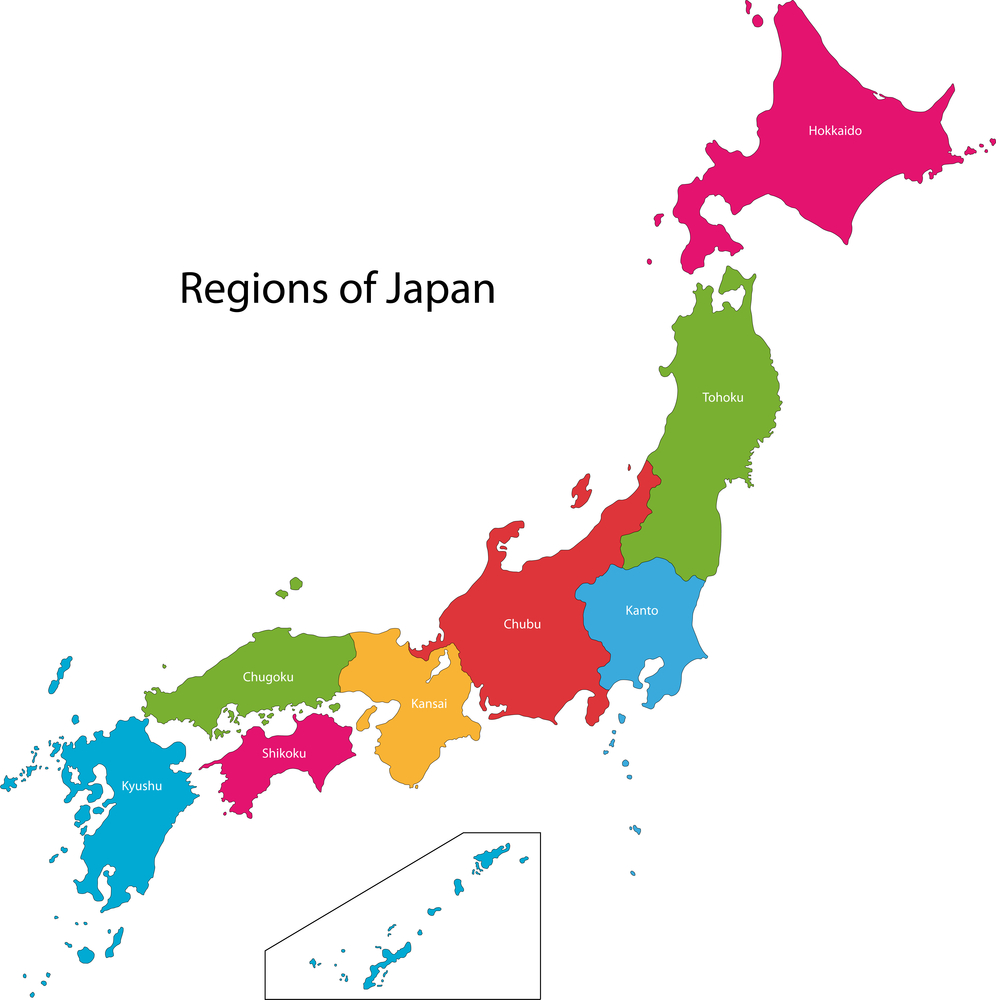
    Tokyo literally means the Eastern Capital and is part of the Kanto region, where the ruling feudal Tokugawa shogunate was based from the 17th century.  Kanto means East of the Barrier (usually considered to be the Hakone checkpoint) and Kansai – the region where Osaka, Kobe and Kyoto are based – means the West of the Barrier (originally the Osaka Tollgate).

    Before Kyoto’s reign as capital for a 1000 years, Nara (also in the Kansai region) was the capital and seat of the Emperor but is now a quiet backwater, more visited by tourists than business people.  Kobe is the other main city in the Kansai region – a port with a strongly cosmopolitan feel and very close to Osaka geographically.  Whilst Kyoto remains aloof and quietly superior (and has some very successful high tech companies of its own such as Kyocera and Nidec), the real battle now in business culture is between Osaka and Tokyo.

    Osakans see Tokyo as standardizing, dull and full of bureaucrats and view Osaka (which historically had very few samurai but plenty of merchants) as the real money maker, with vastly superior food.  Many of Japan’s celebrities, comedians and musicians come from the Kansai region too.

    So what does this mean for corporate cultures?  Osaka companies often have merchant roots – the joke goes, when you meet an Osakan, you don’t ask “how are you” (ogenki desuka) but “how’s business” (moukarimakka).  To which the correct response is “bochi bochi denna” – a wonderfully vague way of giving nothing away, like saying “plodding along nicely thank you”.  Osaka companies are brash, tough negotiators and mean with the money.  “They’d skin the fleece off a gnat” said one British engineer to me, describing his colleagues in the Osaka HQ of a consumer electronics company.

    Tokyo companies are gentlemanly but at the same time highly political.  You need to have a good understanding of their organisation, the factions and the individual relationships to understand how to get things done.  Mitsui and Mitsubishi, both Tokyo based corporate groups, are distinguished by the saying “Mitsui  is people – Mitsubishi is the organisation”.  It’s hard sometimes to understand how exactly this is different, but it seems to boil down to the idea that if an individual is powerful enough at a Mitsui group company, they can get things done, whereas at a Mitsubishi group company, the whole organisation has to support an action.

    The other main corporate groups, Sumitomo and Itochu, are Kansai based companies.  Both have strong “mercantile” roots – Sumitomo in metals trading, hard-nut, conservative and domestically focused and Itochu – strong in fashion and consumer goods, and seen as the more maverick, progressive and international in outlook.  The regional cultural differences don’t seem to have been that strong between Sumitomo and Mitsui as various mergers have taken place between their respective member companies, particularly in financial services.   However regional cultural differences have definitely had an impact on Astellas Pharma, the product of a merger between Yamanouchi (Tokyo) and Fujisawa (Osaka).  Apparently many Fujisawa employees were horrified that Yamanouchi was going to be the dominant partner in the merger.  Fujisawa had a strong tradition of innovation and had regarded Yamanouchi as “Mane-nouchi” (Mane = imitation) – a bunch of play-safe Tokyo bureaucrats.

    Those who know Japan well will have spotted that there is an important region missing from this analysis – Chubu.  Literally and metaphorically this is the midlands of Japan.  Just like the Midlands in the UK it is the historic heart of the car industry.  Nagoya is the main city, and teased just as Birmingham in the UK is for being ugly and soullessly modern.  The area has the last laugh though, as it is the most wealthy in Japan – thanks to the enduring success of Toyota (so mighty their home town was renamed Toyota City) and its corporate group of suppliers such as Denso.

    So, where are the top 30 Japanese companies in Europe from?

    Kanto/Tokyo based companies:

    • Asahi Glass
    • Astellas (but Fujisawa originally Osaka)
    • Canon
    • Daiichi Sankyoshutterstock_36509791
    • Fujifilm
    • Fujitsu
    • Hitachi
    • Honda
    • Kao Corporation
    • Mitsubishi group
    • Mitsui group
    • Nissan
    • Nomura (but was Osaka originally)
    • NTT group
    • NYK group
    • Olympus
    • Ricoh
    • Sony
    • Toshiba

    Kansai based companies:
    • Horiba (Kyoto)
    • Nidec (Kyoto)
    • Nippon Sheet Glass (Sumitomo Group)
    • Omron (Kyoto)
    • Panasonic (Osaka)
    • Sharp (Osaka)
    • Sumitomo group (Osaka)
    • Takeda Pharma (Osaka)

    Chubu based companies:
    • Denso
    • Seiko Epson
    • Toyota

    Chugoku (Hiroshima etc) based companies:

    • Fast Retailing/Uniqlo


    [download_after_email id=”6107″]

    For more content like this, subscribe to the free Rudlin Consulting Newsletter. 最新の在欧日系企業の状況については無料の月刊Rudlin Consulting ニューズレターにご登録ください。

    Share Button
  • “Japanese managers have been brainwashed by the West” and should aim to be ‘virtuous companies’ instead

    “Japanese managers have been brainwashed by the West” and should aim to be ‘virtuous companies’ instead

    An interview with George Hara, currently Chairman of Alliance Forum and former board member of various Silicon Valley start ups as a venture capitalist kicks off Nikkei Business’s attempt at finding a new standard for evaluating Japanese companies, beyond the shareholder capitalism model.

    Instead of “Good/Best company”or “Great Place to Work” and all the other awards you can get, the Nikkei proposes ‘Yoi‘, which can be translated as ‘good’ but is probably better translated as ‘virtuous’.  They even deliberately write the headline ‘Yoi kaisha‘ (‘Virtuous company’) in Japanese brush stroke calligraphy.

    Hara doesn’t think the term ‘stakeholder capitalism’ quite covers what  he and the Nikkei are getting at, even though he says the company should be  measured on the benefit to employees, customers, partners and regional society as well as shareholders.  He prefers ‘shachu‘ (which my dictionary translates as clique or troupe) or public benefit capitalism – meaning that all the concerned parties have a common objective.

    He particularly criticises the way companies in the US – the home of full blooded shareholder capitalism – such as Hewlett Packard or Dupont find that putting shareholder interests first means firing people even when there are record breaking profits, or not being able to invest in long term projects to develop technologies which will benefit society.

    Japanese corporate leaders used to be much more inclined to public benefit capitalism, and the cause is not lost yet, says Hara – citing that when he showed the great and the good of the IMF around Tokyo’s underground system recently they were full of praise for how clean, orderly and busy a city supposedly suffering from a 20 year recession was.  Japan should be setting its own standard for the rest of the world, he feels.

    Following on from this, Nikkei Business have come up with a Yoi company metric, based on profit, changes in employee numbers, corporate tax contribution and share price over the past 10 quarters for 3841 Tokyo stock exchange listed companies and the top 10 are:

    1. Softbank
    2. Fast Retailing* (Uniqlo) (Yanai, the founder and also board member of Softbank is quick to throw this back in the face of those who have termed Fast Retailing a “black company”)
    3. Keyence
    4. Fanuc (the current target of shareholder activist Daniel Loeb)
    5. Yahoo
    6. Aeon Mall
    7. Rakuten
    8. Mani (medical devices)
    9. Japan Tobacco
    10. Takeda Pharma *
    11. Central Japan Railway
    12. KDDI
    13. ABC-MART
    14. Sumitomo Real Estate
    15. USS (car auctions)
    16. Astellas Pharma*
    17. Toyota*
    18. SMC (automatic control equipment)
    19. Nakanishi (motor spindles, micro grinders)
    20. Trend Micro (security solutions, founded in the USA, HQ in Japan)
    21. Sysmex (healthcare)
    22. Hisamitsu Pharma
    23. Komatsu*
    24. Terumo
    25. Canon*
    26. Honda*
    27. Makita
    28. Nitori Holdings (furniture)
    29. Shimano
    30. J Trust

    Other of our Top 30 Japanese companies in Europe* in the top 100

    • Bridgestone #41
    • Denso #46
    • Sumitomo Electric Group #51

    In our Top 30 in Europe but not in the Top 100 Yoi companies:

    Fujitsu, Ricoh, Sony, Asahi Glass, NSG, Toshiba, Hitachi, Panasonic, NTT Data, NYK, Fujifilm, Olympus, Mitsubishi Chemical Holding, Nomura, Nidec, Sharp, Daiichi Sankyo, Kao, Seiko Epson

    For more content like this, subscribe to the free Rudlin Consulting Newsletter. 最新の在欧日系企業の状況については無料の月刊Rudlin Consulting ニューズレターにご登録ください。

    Share Button
  • Top 30 Japanese companies in Poland 2021

    Top 30 Japanese companies in Poland 2021

    Poland and other Eastern European nations are a forgotten economic success story, according to Ruchir Sharma of Morgan Stanley Investment Management in a recent Financial Times opinion piece. The Czech and Slovak Republics, Lithuania, Latvia, Estonia, and Slovenia have all made it into the advanced economies, as defined by the IMF, and have a per capita income of $17,000, with Poland not far behind at a per capita income of $15,000. Hungary is even closer, with per capita income of $16,000 and Romania is also catching up, on $13,000.  Quality of institutions and other more subjective factors are included in the IMF criteria, so it may be that if some of these countries are judged to have deteriorated under a populist government, then promotion to the premier division will be delayed.

    Sharma argues that consistent long term growth is the key to economic success, and manufacturing prowess lies behind this for Eastern Europe. Poland has grown at an average of 4% a year over the past three decades, without a single year of negative growth. Japanese companies do seem to have been attracted to this economic stability. According to our research, Japanese companies in Poland now employ around 53,000 people, making it the fourth largest base for Japanese company employees in the European region after the UK (176,000), Germany (167,000) and France (75,000).

    The largest Japanese employers in Poland are indeed manufacturers such as Sumitomo Electric Industries (Sumitomo Electric Wiring/Bordnetze producing harnesses and Sumitomo Riko producing hoses for the automotive industry) and other automotive suppliers such as NGK Insulators, NSG (automotive glass), Toyota Motor, NSK, Bridgestone and Yazaki.

    Beer and cigarette manufacturers also feature – Asahi after their acquisition of Polish beer brands Tyskie and Lech, and Japan Tobacco has a factory in Poland manufacturing Winston and Camel. A further vice, chocolate, is also manufactured by a Japan headquartered company Lotte, via their 2010 acquisition of Wedel.

    There are some large services sector employers as well – Fujitsu has around 3,000 employees working in its global delivery centres in Katowice and Łódź. However, we estimate around a third of the 200 Japanese companies in Poland have plants there, compared to 16% of the 1000+ Japanese companies in the UK or Germany.

    We may still be missing a few Japanese companies in Poland. There are relatively fewer Japanese expatriates in Poland compared to other countries which host larger numbers of Japanese companies. This may cause some underreporting to database survey companies such as Toyo Keizai, which only records around 130 Japanese companies in Poland, and less than 20,000 employees, compared to our estimates of over 200 companies and 53,000 employees.  There is still a tendency by Japanese companies to locate their Japanese expatriates in Germany, to manage Eastern European subsidiaries and branches from there. The Polish investment agency says there are 300 companies in Poland employing over 40,000, in 2019.

    Cornel Ban, of the Copenhagen Business School, responded to Sharma’s piece by arguing that a high risk of stagnation in countries such as Poland is “baked in”, if they only rely on low labour costs. There is a lack of investment in training and R&D and that “the multinational manufacturing firms that dominate these countries’ export-led growth regimes have few incentives to relocate significant technical innovation systems in the region.”  As far as we can ascertain, there are only a few Japanese companies that are conducting R&D in Poland – Canon Ophthalmic Technologies, Fujitsu‘s FQS in computational chemistry systems and Rigaku in thin films and materials.

    PDF DOWNLOAD OF TOP 30 JAPANESE EMPLOYERS IN POLAND 2021

    For more content like this, subscribe to the free Rudlin Consulting Newsletter. 最新の在欧日系企業の状況については無料の月刊Rudlin Consulting ニューズレターにご登録ください。

    Share Button