


Japanese trading companies are continuing to build their UK and global energy activities, as we outlined in our recent report. Mitsui & Co have acquired Aberdeen based STATS (UK) – an energy pipeline repair and engineering services, involved in projects around the world, including, unfortunately, Russia – but this only represents 5% of their turnover. They have 311 employees in the UK, £50m turnover, and were profitable in the year ending December 2021.
Author: Pernille Rudlin
-

Japanese companies in the UK 7 years on – the new third phase
Executive summary
In the seven years since the Brexit referendum, the benefits of Japanese long term planning for resilience have become clear. Although employment by Japanese companies in the UK has fallen since 2018/9, this is largely in the automotive sector, triggered by the closure of the Honda Swindon plant. Non-automotive manufacturing employment and investment have stayed steady, but there have been no new manufacturing companies coming to the UK.
Employment in the wholesale sector has also fallen, as Japanese companies move their European logistics, warehousing and coordination functions to the EU. There has been significant disinvestment from the UK financial sector, but again employment seems to have held steady.
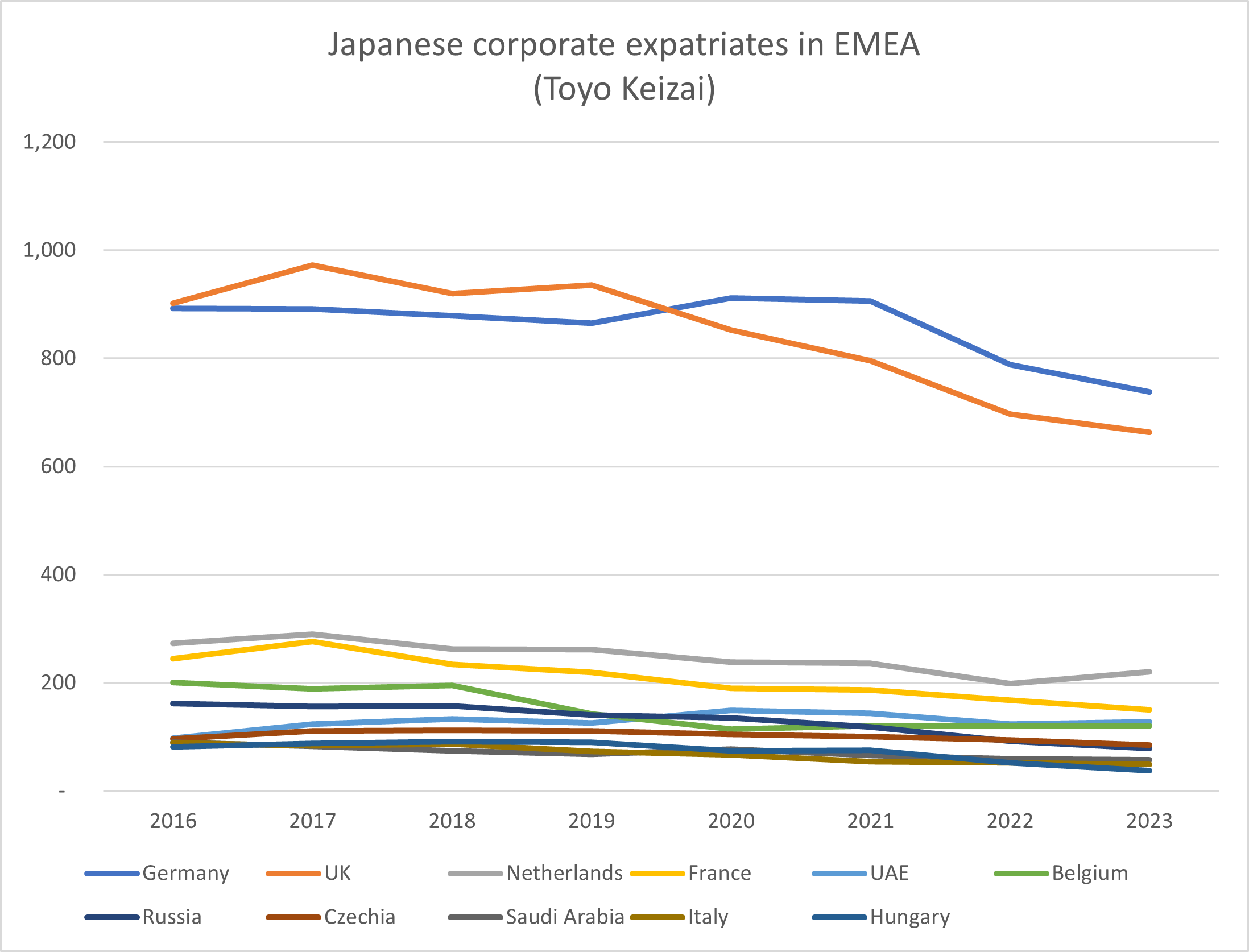
Germany has almost caught up with the UK as the largest host of Japanese companies in the EU and has overtaken the UK as the largest host of Japanese corporate expatriates.
Now the smoke and fog of Britain’s departure from the EU, and the pandemic have cleared, a new third phase of Japanese investment is taking shape. It is more focused on geopolitical concerns around climate change, energy, defence and security. The UK is seen as an important partner in this, but needs to ensure that it strengthens its long term policy commitments to these sectors, which require large investments and the support of host communities, as well as collaboration and synchronization with the EU, Africa and the Middle East.
Contents
Employment by Japanese companies in the UK grew to 2018/9, then shrank since
Germany has nearly caught up with the UK as a host of Japanese companies
More company closures in the UK than in Germany
A similar number of new Japanese companies opened in the UK and Germany since
UK still the target of Japanese M&A, but on a smaller scale than before
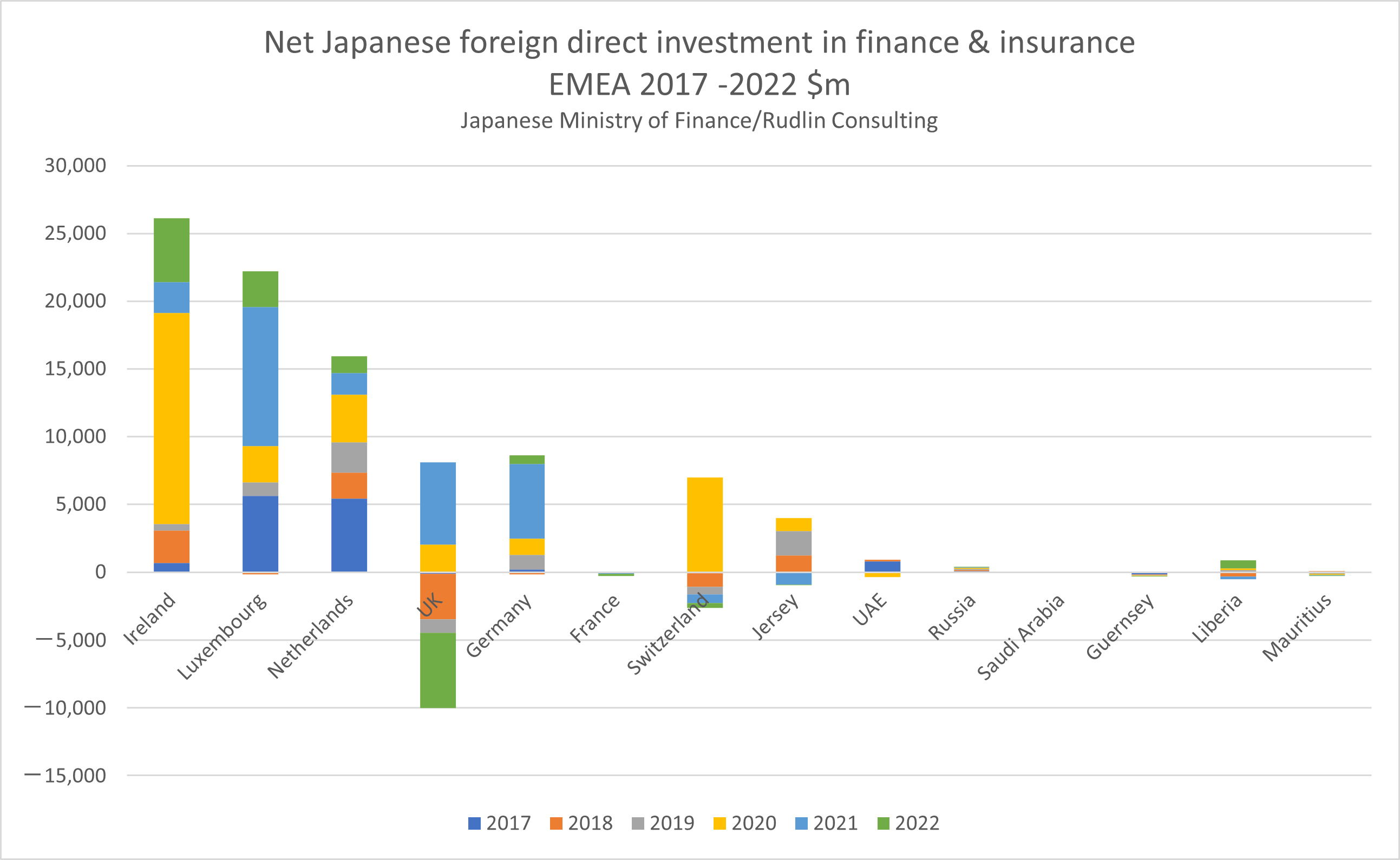
Switzerland overtakes the UK as largest net recipient of Japanese investment in Europe
Manufacturing employment holding steady, apart from the automotive sector
Net disinvestment in UK financial services sector, although employment remains steady
Germany has overtaken the UK become the largest host to Japanese corporate expatriates in Europe
What does it all mean? An acceleration of trends, new and old
Employment by Japanese companies in the UK grew to 2018/9, then shrank since
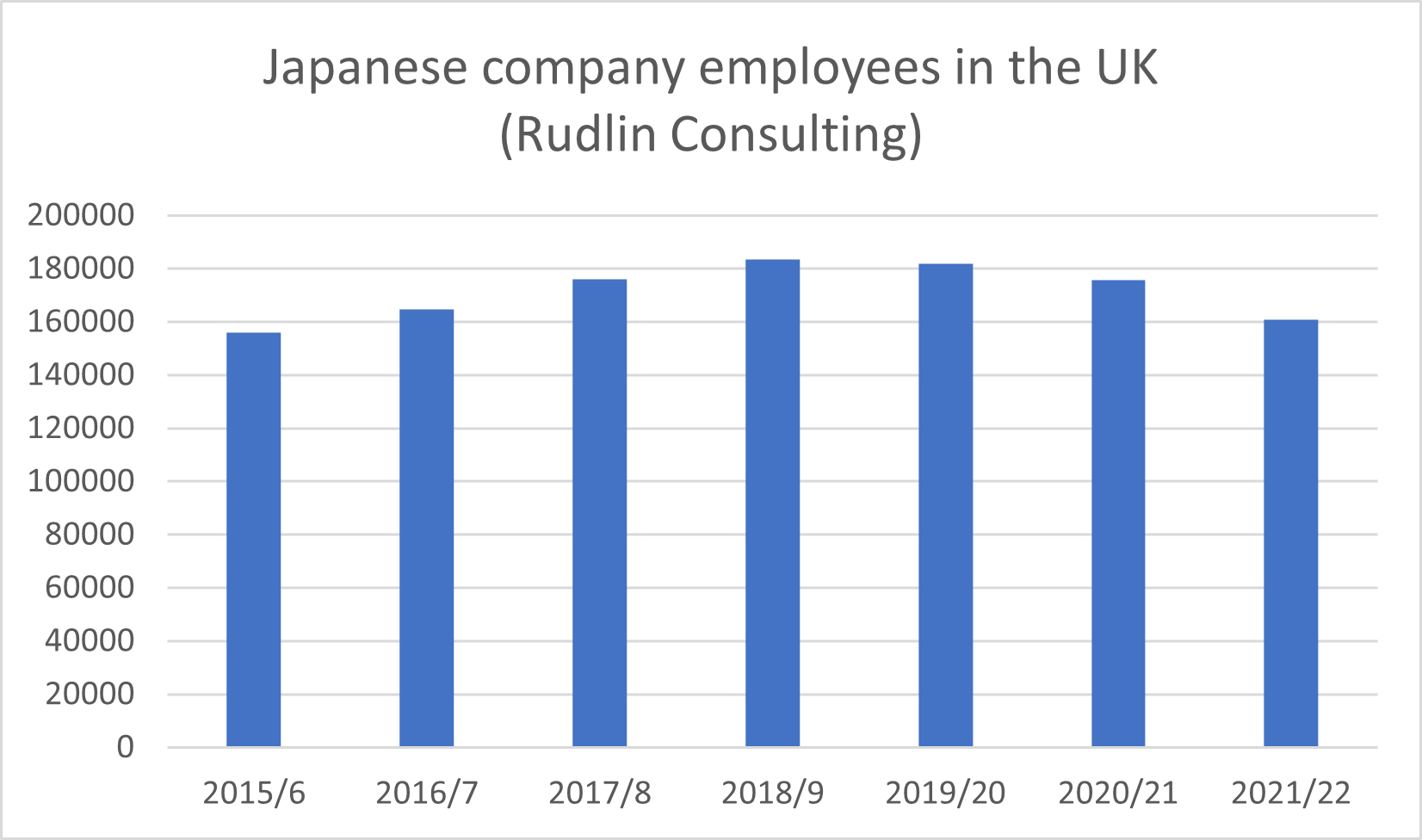
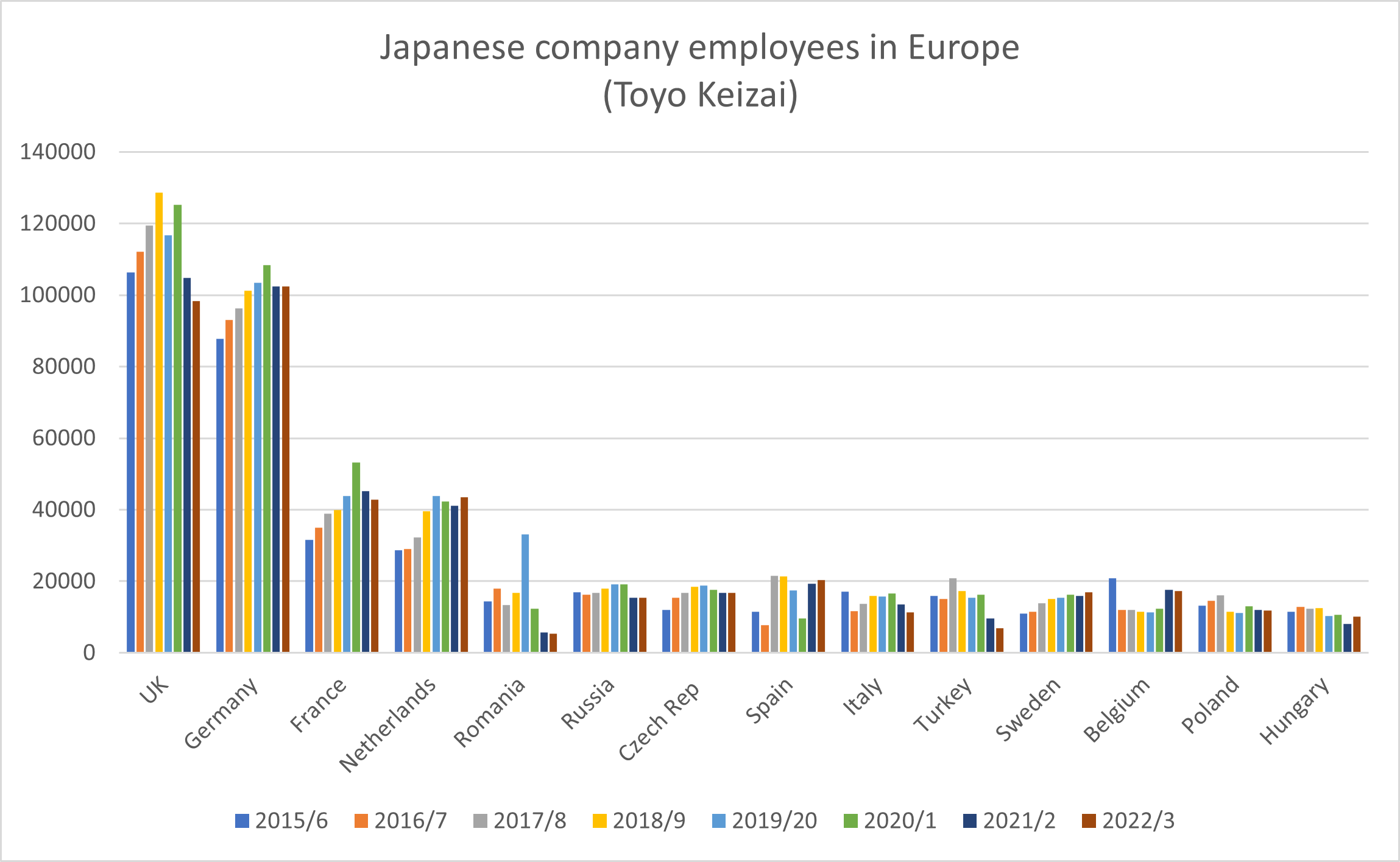
There were 98,000 people employed by Japan owned companies in the UK, according to the Toyo Keizai[1] database published April 2023, compared to 106,000 in 2015/6.
The Rudlin Consulting database, which includes more companies who have a Japanese owner through acquisition, shows around 160,000 employees for 2021/2, up slightly from 156,000 in 2015/6.
Both sets of data show that employee numbers reached a peak in 2018/9 and have fallen since. This is a different pattern to what has happened in France and Germany, where the employee numbers peaked in 2020/1, but have fallen since. The Netherlands shows somewhat bumpy growth.
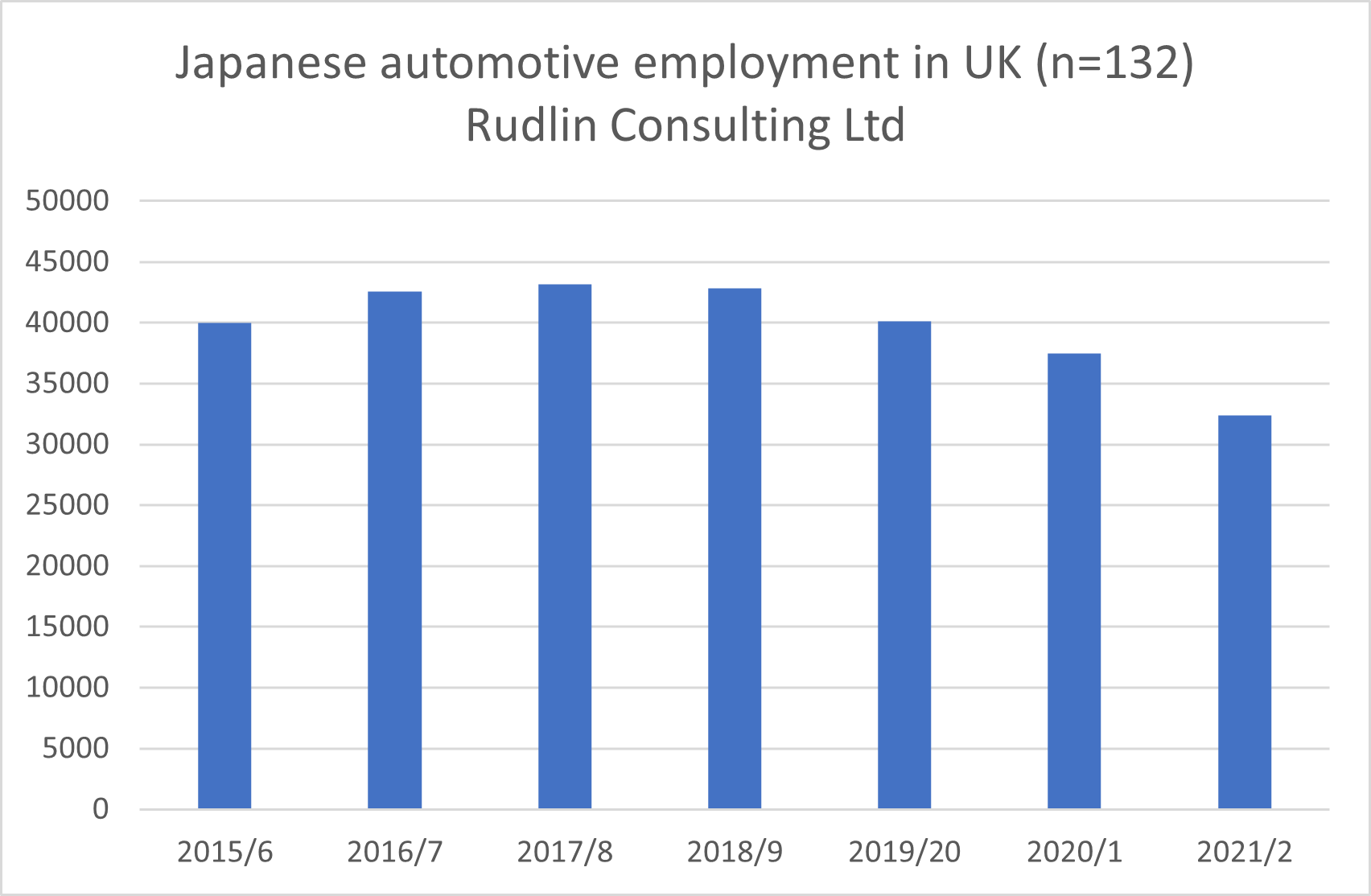
Looking at the employment data by sector, it seems the shrinkage in employment in the UK is almost entirely due to the decline in the automotive sector, where around 11,000 jobs have been lost in manufacturing and wholesale.
Germany has nearly caught up with the UK as a host of Japanese companies
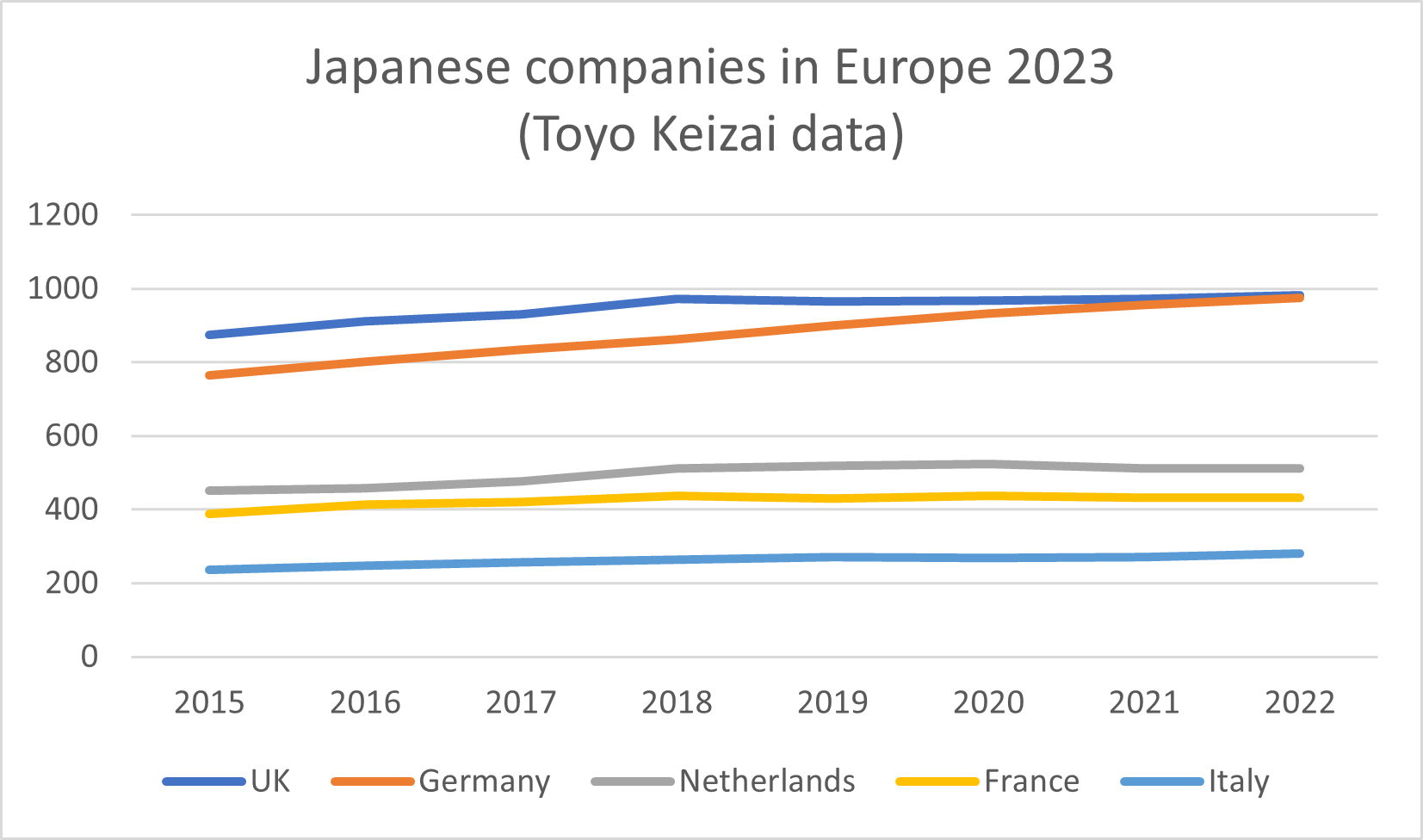
Toyo Keizai estimates there were 875 Japanese incorporated subsidiaries in the UK in 2015/6 compared to 764 in Germany. By 2022/3 there were 982 Japanese incorporated subsidiaries in the UK, compared to 975 in Germany.
Rudlin Consulting estimates also include branches and more subsidiaries acquired through acquisition than Toyo Keizai. As of June 2023, we estimate there are 1,113 Japan owned organisations in Germany, compared to 1,151 in the UK.
More company closures in the UK than in Germany
48 companies closed in Germany since 2018 and 145 closed in the UK since 2017. The biggest sectoral net loss was in wholesale in the UK. A likely explanation is that many companies were dissolved or turned into branches, once they lost their European wholesale coordination functions, with warehousing and logistics focused more on the EU single market.
- 26 of the UK closures were in the automotive sector
- 41 were services
- 39 were wholesale
- 27 were manufacturing companies
- 11 were in the IT sector
- 9 financial
- 8 logistics
- 6 chemicals
- 4 retail
- 4 food
(some companies in multiple categories).
Many of these closures were due to consolidation and mergers, rather than outright withdrawal from the UK.
A similar number of new Japanese companies opened in the UK and Germany since 2017
64 new companies were established in Germany since 2017, compared to 63 new companies in the UK (of which 4 divested or closed since):
Of the 63 new companies in the UK:
- 35 were in the services sector
- 14 in wholesale sector
- 6 in IT
- 6 in the financial services sector
- 3 in manufacturing
- 3 in energy – storage, renewables, production
- 1 in logistics (following merger of container businesses of several Japanese companies)
- 1 in automotive (Highly Marelli, formed from merger with Calsonic Kansei)
(some companies in multiple categories)
UK still the target of Japanese M&A, but on a smaller scale than before
We have tracked 179 companies coming under Japanese ownership in the UK from 2017 to 2023 to date compared to 79 in Germany. These are not exhaustive numbers, and may well reflect a UK bias.
Furthermore, many of the acquisitions were not made directly of British or German companies, but rather of US or other European headquartered companies, which have subsidiaries in the UK or Germany. There may also be recent acquisitions which have not been identified yet.
With those caveats in mind, it does seem to be that majority (123 of the 179 UK acquisitions) were made over the three years from 2017-2019, and since then the rate has been more around 25 companies a year or fewer. There seems to be a similar trend in Germany.
The biggest acquisitions across Europe since 2017 have been:
- Takeda’s acquisition of Irish pharmaceutical company (London listed) Shire for $64bn in 2019
- Hitachi’s acquisition of Swiss company ABB’s Power Grids business for $11bn in 2020/2
- Renesas acquisition of US founded, UK domiciled semiconductor company Dialog in 2021 for $5.9bn
- Mitsubishi Corporation’s acquisition of Dutch energy company Eneco for $4.4bn
- Taisho’s acquisition of French pharmaceutical manufacturer UPSA SAS for $1.6n from Bristol-Myers Squibb.
- Hitachi Rail’s acquisition of Italy’s Ansaldo STS (1.5bn euros) from 2015 to 2019
- Nidec’s $1.2bn 2017 acquisition of Emerson Electric’s motors, drives and power generation businesses, which included the Welsh drives make Control Techniques and the French motor manufacturer, Leroy-Somer.
- Toyota Industries’ acquisition of Dutch logistics company Vanderlande for $1.3bn in 2017
- NEC’s acquisition of Danish IT company KMD in 2018/9 for $1.2bn
- Fujifilm acquisition of US company Biogen’s Hillerod manufacturing in Denmark for $930m in 2019
In the past, British companies have often been the target of the largest M&A deals, such as SoftBank acquiring ARM, NSG acquiring Pilkington Glass and various acquisitions in the financial services sector. This preference does not seem to have continued, apart from the Renesas/Dialog deal, although there have been smaller scale acquisitions in sectors such as recruitment and staffing, drives, tyres, food and paper wholesale in the UK.
Switzerland overtakes the UK as largest net recipient of Japanese investment in Europe
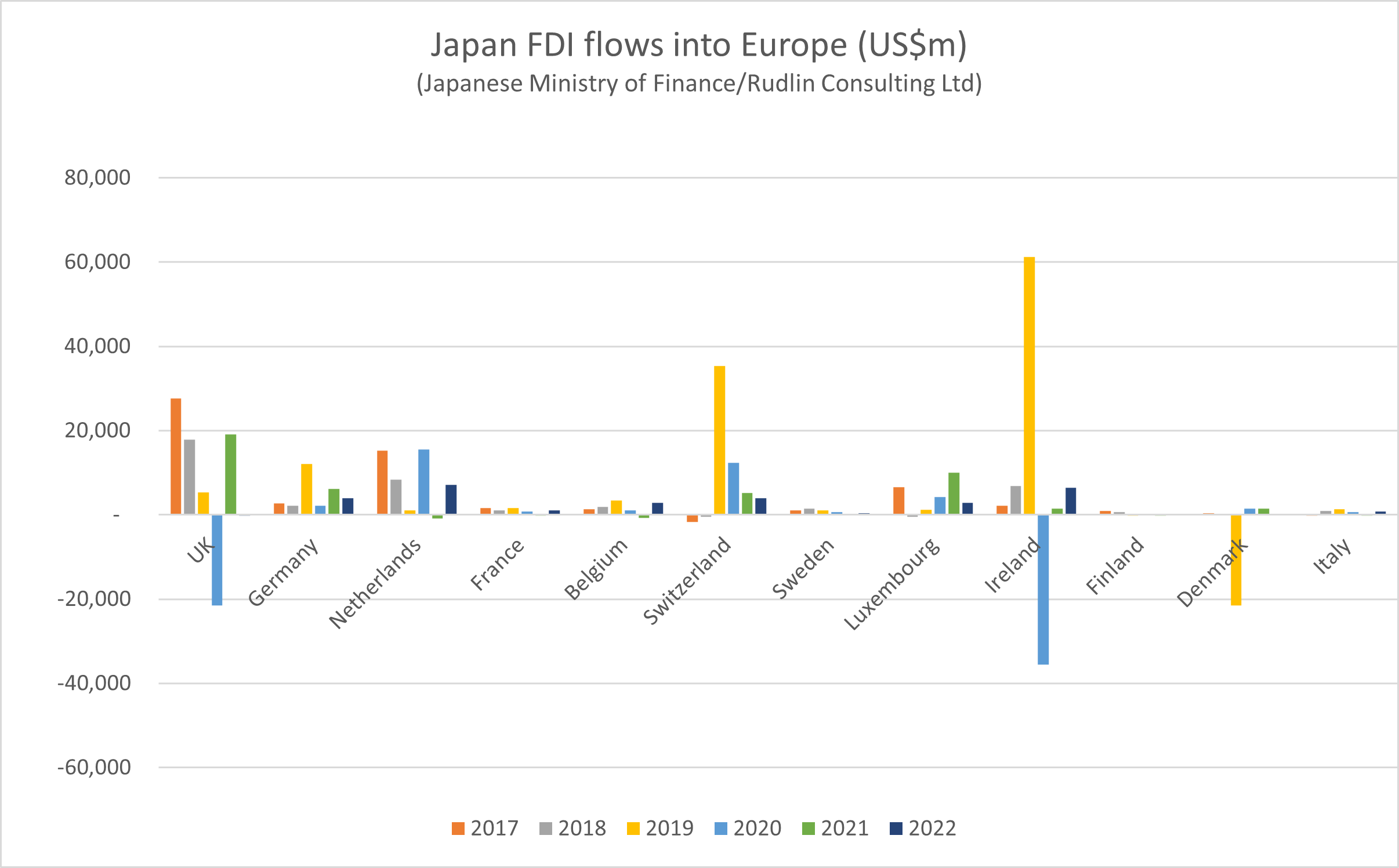
These big deals have of course had an impact on the flow of investment from Japan into Europe, causing lumpiness in year-to-year totals.
Switzerland received more cumulative net direct investment from Japan since 2017 than the UK, which was the largest recipient of Japanese investment in Europe in the past. The large inflow into Switzerland in 2019 in the wholesale and retail sector was presumably related to Hitachi’s acquisition of the ABB power grids business. The Netherlands was the third largest recipient and Ireland the fourth largest recipient.
The net divestment from the UK in 2020 was in the communications sector and may have been related to SoftBank, as much of their investment activities is located in London. There was also net divestment from the services sector in 2018. There were no major divestments by Japanese companies in terms of selling off subsidiaries in that year, so this might represent movement of assets from UK based subsidiaries to EU based subsidiaries as part of companies such as Sony shifting ownership their intellectual property rights.
In manufacturing, investment in UK electrical machinery, food and chemicals has been greater than the investment in transportation equipment (automotive) and substantially more than in German electrical machinery, food and chemicals manufacturing over the same period.
Cumulative Japanese direct investment totals for Germany and the UK in since 2017 are: [2]
Sector Germany UK Food manufacturing $0.8bn $9.8bn Chemicals & pharmaceuticals manufacturing $3.1bn $7.1bn Electrical machinery manufacturing $0.6bn $7.8bn Transportation equipment manufacturing $9.3bn $0.8bn Communications $0.6bn $45.3bn Wholesale and retail $2bn $3.2bn Finance and insurance $8.2bn -$2.3bn Services $1.2bn -$34.5bn 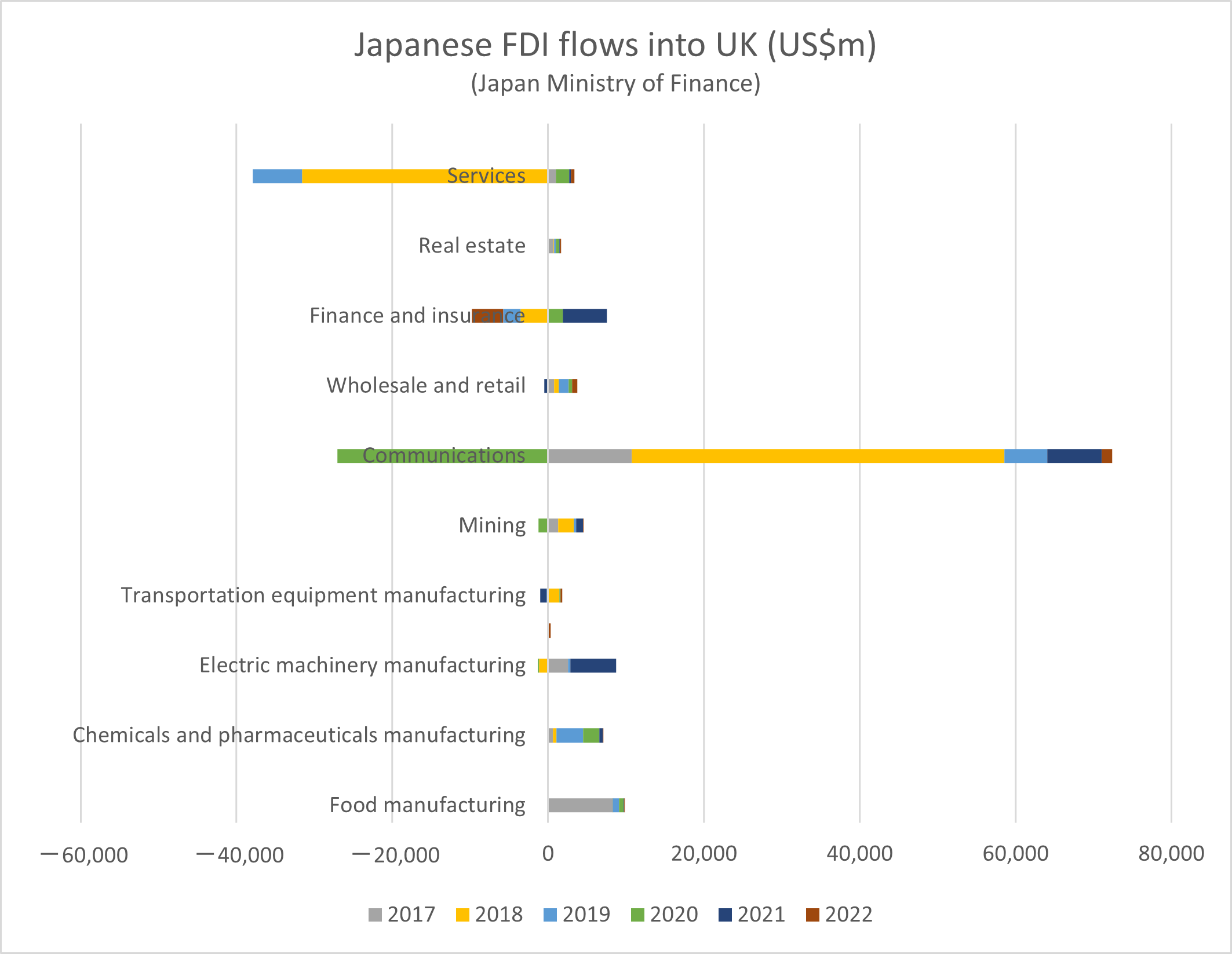
As can be seen below, Ireland has had both inflows and outflows in the chemicals and pharmaceuticals manufacturing sector in 2019 and 2020, presumably related to the Takeda/Shire deal. Denmark had an outflow in 2019, which may have been related to the sale by Takeda of two factories in Denmark to Orifarm.
The data from Japan’s Ministry of Finance needs to be treated with caution, as in many cases (France and financial services sector for example) no data is given, for confidentiality reasons.
Manufacturing employment holding steady, apart from the automotive sector
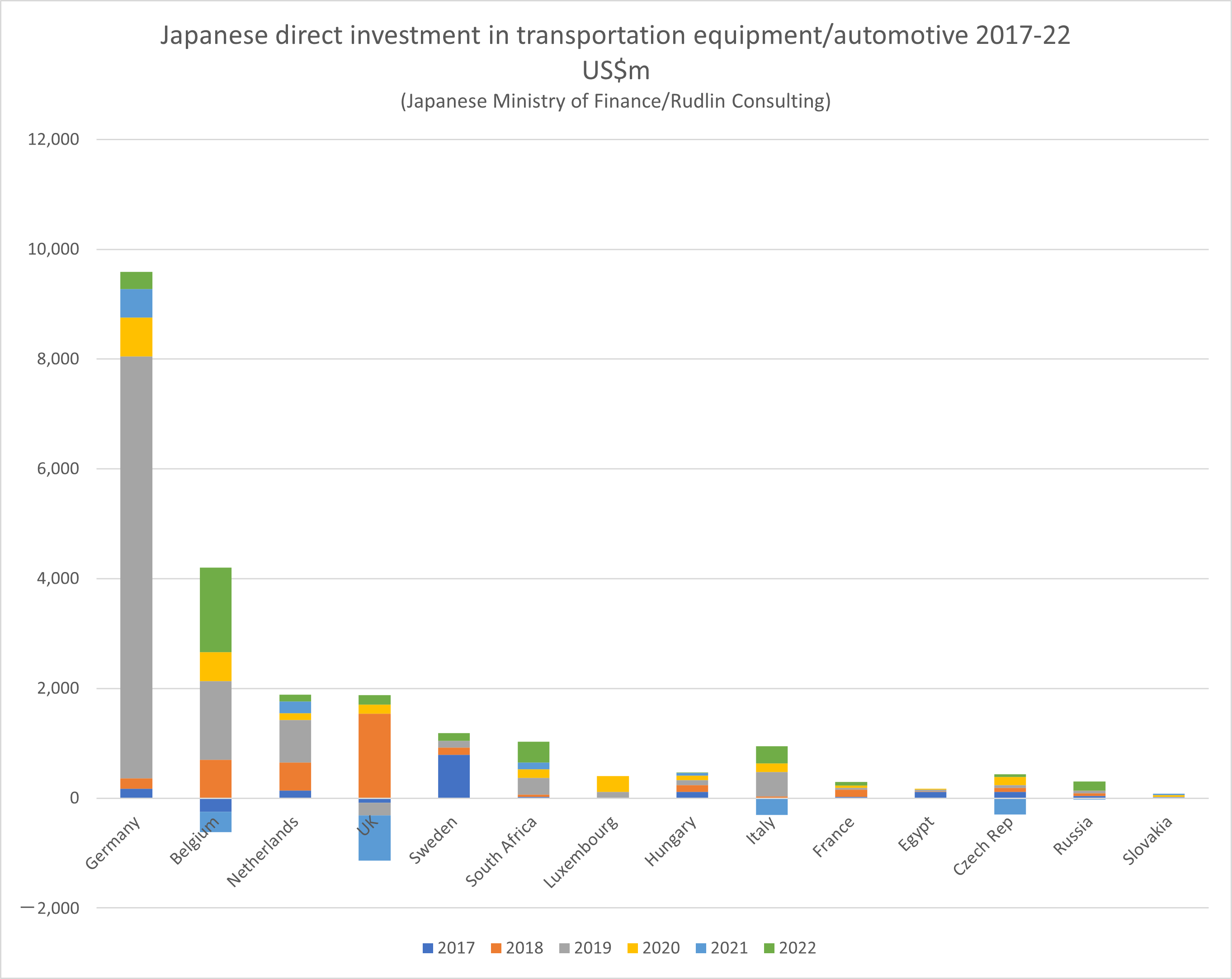
Disinvestment from the UK in the automotive sector in 2019 and 2021 was presumably related to the closure of Honda’s Swindon plant which was announced in February 2019 and finally shut down in July 2021. 20 or so Japanese automotive suppliers also ceased operations in the UK during this period.
Germany has benefited the most from Japanese investment in the automotive sector – the large inflow in 2019 may be related to Sekisui’s acquisition of Proseat’s European operations – with manufacturing in Germany, Poland and Czech Republic. The UK plant was closed in 2021.
There may have been some second hand investment in the UK automotive sector which is not reflected in the data. Belgium’s status as the second largest recipient of investment is almost certainly due to Toyota having their European headquarters there. Some of that investment may well then have made its way to Toyota’s plants in the UK.
The larger inflow of automotive investment into the UK in 2018 may have been related to Nissan starting production of the Juke at Sunderland in 2019 and then the third generation Qashqai.
Non-automotive manufacturing employment grew to 2019/20 and has held steady since. Most of the Japanese manufacturers we looked at set up Brexit committees, planned and invested for various scenarios. They must have come to the conclusion that the cost/benefit analyses showed it made more sense to stay put and invest in mitigation measures than to shut down and transfer manufacturing elsewhere.
Net disinvestment in UK financial services sector, although employment remains steady
Although the cumulative investment by Japan into in the UK financial sector was negative from 2017 to 2022, according to Rudlin Consulting data, employment in this sector has held relatively steady. It is hard to be certain of this, as two of the three main Japanese banks are branches of the European headquarters in the Netherlands or the Japanese headquarters, so employee numbers are not disclosed.
Ireland has been a focus for Japanese aircraft leasing and related financing, which may explain why it has benefited most from Japanese financial services sector investment since 2017. For example, in 2020-2022, Japan Investment Adviser subsidiary JP Leasing Services set up a leasing company in Ireland with Airbus, acquiring several aircraft, which may account for the large investment in 2020.
Germany has overtaken the UK become the largest host to Japanese corporate expatriates in Europe
The general trend in Japanese corporate expatriation across EMEA is downward, and does not seem to have picked up after the pandemic, apart from in the Netherlands and the UAE. The shift of Japanese expatriates (largely based around London) is likely to be an indicator of regional headquarter functions shifting to Germany and the Netherlands, particularly in financial services and trading companies, where the density of Japanese expatriate staff is the highest.
What does it all mean? An acceleration of trends, new and old
I have, over the past seven years, tried to approach the data I gather on Japanese companies in the UK with an open mind. Nonetheless, I admit to having a Big Theory of Brexit (beyond believing it to be an unnecessary waste of time, effort and resources) which is that it accelerates trends which were already there.
So the question I wanted to answer, in looking at the data this time, was what trends were showing through, new and old.
In my history of Mitsubishi Corporation in London, examining how its business developed from 1915,[3] it became apparent that the organization had quite quickly moved from an importer/exporter trading model to a regional coordinator. It was following a well-known model of globalization in business to move from pure export to manufacturing locally and then to some kind of transnational model, with regional centers of excellence.
Japanese trading companies like Mitsubishi Corporation do not directly manufacture, but often invest in manufacturing, as Mitsubishi Corporation did, in acquiring Princes Foods in the UK in 1989. Primarily though, they are in London because they see it as an important global and regional hub, a good training ground for their rising stars to gather information and influence global policy making.
Just after Brexit became a reality, I remember attending a large gathering of senior executives of Japanese companies in the UK. The then head of Mitsubishi Corporation in Europe, Middle East and Africa spoke, making it clear that while he thought Brexit was a negative for Japanese business, the company would not be leaving the UK.
Having worked at Mitsubishi Corporation myself, including in planning and coordination, I instinctively understood this to be about the strategic value that a presence in the UK had for Mitsubishi Corporation, and other zaikai[4] Japanese companies. Nonetheless I worried that the UK’s strategic value to Japanese companies would diminish by no longer having as much influence in the EU once it was on the outside.
The only Japanese trading company to have left the UK since 2017 is Sojitz, which is not one of the top five of Mitsubishi Corporation, Mitsui, Sumitomo Corporation, Itochu and Marubeni. It has clearly decided to focus on chemicals trading, and to put that headquarters in Germany, which has traditionally been seen by Japanese companies as the regional leader in chemicals manufacturing.
Other regional headquarters to have left the UK were part of the earliest phase of globalization – the wholesalers who were importing from Japan. They have moved their regional coordination, warehousing and logistics hubs to the EU – which is why there has been significant growth in employee numbers and expatriate Japanese numbers in the Netherlands. At the same time, the overall drop in the number of Japanese expatriates across the region may well be due to how localized many of the wholesale operations have become in terms of senior management.
The second phase companies – those who opened manufacturing operations in the UK – have also shifted further out of the UK, and taken their supply chains with them. Consumer electronics manufacturing left some time ago, and the main concern had been for the automotive sector. As the analysis above shows, Germany has had by far the greater share of automotive investment in Europe since 2017, although this may be a one off, due to an acquisition. Some of the investment into Belgium may feed through to the UK via Toyota, however, and both Toyota and Nissan have not shown any signs of leaving the UK yet.
The third phase, of having regional coordination and centres of excellence, is showing through more strongly now for the UK. Now that the regional coordination which was more to do with supply chains for manufacturers, or logistics and warehousing for importing from Japan has shifted away from the UK, the UK is left with the geopolitically minded, strategic investors, in energy, transportation and telecommunications infrastructure, defence and R&D in biotech and pharmaceuticals and semiconductors.
These investors are not so influenced by the search for growth overseas which characterized Japanese acquisitions in the UK and elsewhere during the lost three decades of the 1990s to the 2010s. They are driven by geopolitical concerns regarding climate change and reducing dependence on hostile states in sectors such as telecommunications, energy and digital data.
Despite the current British government’s taboo on mentioning industrial policy, it is clear that many British politicians are aware of this new phase and realise that the UK’s concerns align with Japan’s. There has been an embarrassment of former and current prime ministers and ministers at recent UK-Japan events in London. The exhibition stands at the one I attended, as a non-executive director of a Japanese soft-power initiative, Japan House London, were almost exclusively focused on renewable energy.
The recent announcement[5] by the Japanese government that they will harmonise Japanese standards for domestically produced defence equipment with US and European standards, to reduce maintenance costs and increase business opportunities for Japanese defence companies is very much in line with this new third phase. The UK, Italy and Japan have merged their fighter jet programmes and are aiming to develop a next generation fighter jet demonstrator by 2027.
It is not going to be entirely smooth – Japanese trading companies have shown no inclination to disinvest from Russian LNG projects, for example. This will have been the subject of discussions with the Japanese government in terms of impact on Japanese dependency on foreign energy supplies – the Sakhalin 2 project, for example, supplies around 9% of Japan’s LNG imports.[6]
In terms of “making Brexit work” – for phase 1 and 2 companies, this ship has sailed as far as traditional import export, manufacturing related trade is concerned. They made all the contingency plans and moved what needed to moved a long time ago. There have been no new Japanese manufacturers setting up in Britain, and it is unlikely this will happen until the UK joins the single market again.
For phase 3, making Brexit work will be more to do with ensuring that cooperation and synchronisation with the rest of Europe and the UK’s positive influence inside and outside Europe is as strong as possible in the strategic areas of energy, defence, telecommunications and transportation infrastructure and R&D. This will not have the positive populist impact of phase 2 manufacturing projects, which bring thousands of jobs and supply chains in their wake. In fact the impact electorally could be negative, as we have seen with nuclear power, wind farms and high speed rail – there is antagonism towards the disruption to the countryside they cause and the massive investments they require. This is a problem familiar to Japanese companies in their home country too.
Furthermore, this collaboration is not just about Europe, it needs to bring in the neighbouring continents of Africa and the Middle East. Obviously climate change has to be tackled globally, it cannot be “environmentalism in one country”. Successive Japanese governments have worried about Japan’s energy poverty for decades and this has driven much of the investment, particularly by Japanese trading companies, in overseas energy projects. Trading companies have invested in Africa and the Middle East, often through their regional headquarters in the UK, in renewable energy projects ranging from hydroelectric power generation to solar home systems.
Japanese companies like working with other Japanese companies, so once a beachhead of investment is established, others in the supply chain and support system will follow – as the UK saw with Japanese car companies in the 1970s and the 1980s. That ecosystem is still strong in the UK and many of the components suppliers can also supply the energy and infrastructure sectors.
This new third phase of Japanese investment in and via the UK is not going to be attracted by the UK government giving grants to build or re-equip factories, but by it showing a willingness to invest for results which will only be seen in the long term, and to put political energy into building sustainable government policies and community support.
A pdf of this report can be downloaded here
Our latest 2023 directories of Japanese companies in the UK are available here.
[1] https://biz.toyokeizai.net/en/data/service/detail/id=860&academic=1
[2] https://www.mof.go.jp/english/policy/international_policy/reference/balance_of_payments/ebpfdii.htm
[3] The History of Mitsubishi Corporation in London: 1915 to Present Day Routledge Advances in Asia-Pacific Business, 2000 https://www.amazon.co.uk/History-Mitsubishi-Corporation-London-Asia-Pacific/dp/0415228727
[4] Zaikai means the Japanese business and finance community, particularly those companies with power and influence and connections to the political sphere, which are seen as representing Japan in the world.
[5] https://asia.nikkei.com/Business/Aerospace-Defense-Industries/Japan-to-standardize-arms-with-U.S.-Europe-for-joint-maintenance accessed 22 June 2023
[6] https://www.reuters.com/business/energy/japans-mitsui-says-no-plans-exit-russias-sakhalin-2-lng-project-2023-06-21/
-

Saving Britain’s SMEs
I was dismayed to find that the Japanese restaurant in the London station I regularly use to eat at before catching my train, or to buy a bento, has started closing at 6pm, and is for takeaways only. A change in fire and safety regulations had caused it to close down for a month, and only reopen in a limited way.
The previous day I ate at another Japanese restaurant, in Slough, a town an hour west of London. It had changed hands since my last visit, and is now run by Filipinos. The staff at the hotel I was staying in mostly seemed to be Filipino too. Five years ago, such hotel staff were usually East European, but now Brexit has ended freedom of movement of labour, we are seeing more and more Asian and African nationals coming to Britain to work.
I was surprised at all these changes – but the man behind the counter at the London Japanese restaurant told me this was not a recent development. This made me realise that I had not visited them as regularly as in the past. I am not travelling so often as much of my training is now online, so people working from home, or in other countries can join the sessions.
As a result, I am busier than I have been for many years, but other British small-medium size enterprises (employing up to 249 people) are facing a tough time at the moment. A recent survey showed their confidence is the lowest it has been since the start of the pandemic. They don’t have the resources, especially after the pandemic, to cope with changes in regulations, labour supply, trade with the EU or rising energy prices.
The UK’s SMEs employ 60% of the British workforce– the same percentage as in Japan. Like Japan, the UK’s SMEs have had various kinds of government support through the pandemic and now for the energy crisis. But the government’s energy bill support will halve after March.
As a consequence of this, and the train strikes, the hospitality and retail sectors are particularly gloomy. The strikes are, I hope, a short term problem, but in the longer term, SMEs are having to rethink their business.
I sense a return to face to face happening – both at work and socially. Companies want staff to meet each other, for morale and team building and people want to socialize. But this might happen outside the big cities, rather than forcing everyone to commute in.
The local authority in my region wants to implement 20 minute neighbourhoods – communities where people can walk to and from – within twenty minutes – shops, restaurants, schools and healthcare. Perhaps the Japanese restaurant in the London station will return to its roots. I first ate there when it started in Brighton, a town an hour south of London. I am sure it will be welcomed back by the increasing numbers of hybrid workers living there.
This article by Pernille Rudlin first appeared in Japanese in the Teikoku Databank News in March 2023
-

Japanese companies still in Russia
I have just become aware of this “Leave Russia” database, from the Kyiv School of Economics, similar to the Yale project, but with more detail, pointing to 168 Japanese companies who have business connections to Russia – 84 are still continuing operations, 10 are pausing investments, 16 scaling back, 42 suspending, 11 have withdrawn and 5 have completed their exit.
The link is courtesy of Olga Sotnyk, an adviser to the Deputy Prime Minister of Ukraine, in her guest post for Comment is Freed. As she puts it “hundreds of large Western companies continue to operate in Russia, generating profits and paying taxes to the Russian budget, thereby indirectly financing the war in Ukraine. Pragmatic interests are understandable, but the global threat posed by the Russian state today is not just a problem for Ukraine or the region, it is a threat to stability, including economic stability, throughout the world.”
Some of the biggest still operating in Russia in terms of employees are unsurprisingly the trading companies such as Sojitz, Mitsubishi Corporation and Mitsui, involved in energy projects.
Some I had not realised were operating in Russia at such a scale were Kuraray, chemicals and textiles manufacturer with 552 employees, advertising agency Hakuhodo with 455 employees, Kintetsu World Express with 429 employees, A&D – medical instruments, 415 employees and Pioneer (in car audio) 174 employees.
-

Japanese companies who contribute most money to CSR
Toyo Keizai’s ranking of Japanese companies who have contributed the most financially to CSR activities (either donations or “in kind” activities) show that, unsurprisingly, those sectors which most directly impact Japanese citizen’s lives are also those who contribute the most.
Financial services
MUFG is at the top for 2021/2, up from 5th – it hasn’t contributed that much more than the previous year, rather the top 4 from last year (NTT, NTT Docomo, SoftBank and SoftBank Group) have contributed less. The next biggest contributor of Japan’s financial groupings is SMFG at 17. Mizuho is way down the rankings at #77.
The insurers also feature heavily – Nippon Life at 11, Daiichi at 21, Meiji Yasuda at 22, Tokio Marine at 28, and Sompo at 29.
Securities firms Daiwa is at #38 and Nomura at #39.
Real estate, housing, construction
Mitsui Real Estate is in second place, contributing Y8.7bn (US$64m) in 2021/2 compared to Y5.5bn the previous year. Mitsubishi Real Estate just makes it into the top 100 at 98. Daiwa House is at #37 and Obayashi the construction company is at 63.
Electronics/ICT
Sony is at #3, Canon at #20, Fujitsu at #26, Panasonic at #35, Hitachi at #40 and Mitsubishi Electric at #50.
Automotive
Honda is in 4th place, down from 1st in 2019/20. Other automotive companies in the top 50 include Mazda at #23, Nissan at #25 and Aisin at 35. There is no sign of Toyota – the likely explanation is that they do not disclose their contributions, rather than that they do not make any.
Telecommunications
Japan’s telecommunications companies are active in CSR – KDDI is in 5th place, SoftBank, SoftBank Group, NTT Docomo and NTT are all in the top 15.
Pharmaceuticals
Otsuka is at #6, Eisai at #30, Chugai at #32, Daiichi Sankyou at #56 but no sign of Astellas or Takeda.
Alcohol, beverages and tobacco
Suntory is at #7, Japan Tobacco at #10, Kirin at #13
Of course for many of these companies, their turnover is so large, even a small percentage would put them into the top 50. The only trading company, which have turnover inflated by commodities and energy trading, in the top 50 is Mitsubishi Corporation however, at #48.
Toyo Keizai has also calculated the rankings based on percentage contributed of turnover. Mazda still makes it into the Top 50, as does Mitsui Real Estate and Eisai.
-
UK employment by Japanese automotive companies has fallen 25% over 4 years
The statement by Stellantis that it may be forced to shut some of its UK operations if the current local content rules in the Brexit deal continue prompted me to take a look at the current situation for Japanese car companies in the UK.
As The Economist pointed out recently, Japanese car companies are behind in the race to produce electric vehicles – partly due to being victims of their own successes with hybrid vehicles. But there are signs of change with the new president of Toyota‘s announcement of new EV models and Honda‘s electric vehicle joint venture with Sony. Nissan has been focused on electric vehicles from the start but somewhat distracted with wrangles with Renault post-Ghosn.
Despite being laggards, Japanese car companies are still very important to the UK economy. Nissan is the largest UK manufacturer of cars and Toyota the third largest. Announcements are expected by Toyota and Nissan soon on what they are going to do with replacement models for their Corolla and Juke respectively, both currently manufactured in the UK, but I have not seen any leaks yet in the Japanese media on what the plans might be for this. As the spokespeople quoted in The Economist say, it would be helpful to longer term planning if the UK could be seen as a stable partner, and had an industrial policy – or at least acknowledge that not having an industrial policy is in its own way an industrial policy.
The danger is that Japanese car companies and their suppliers just dwindle away in the UK
Without longer term plans in place, the danger is that Japanese car companies and their suppliers just dwindle away in the UK. The latest data I have compiled shows that employment in the UK by Japanese automotive companies has fallen 25% from 2017/8 to 2021/2 from 43,000 to 32,000. These figures exclude what could be a further 7,500 employees, working for companies which have not yet submitted their UK annual reports for FY2021/2 – Itochu’s subsidiaries Kwik-Fit, Stapleton’s Tyre Services and European Tyre Enterprises, GS Yuasa battery sales and manufacturing, Hitachi Astemo and Highly Marelli.Around 4,000 of the jobs lost were from Honda‘s Swindon closure. The remaining 7,000 missing jobs can partly be explained by the closure of other automotive companies:
- Akebono (closed 2021)
- Alps Alpine (2021)
- Calsonic Kansei Sunderland (2020)
- CCI Corporation (2020)
- Futaba Industrial UK (2019)
- Hi-Lex Cable System (2021)
- Honda Trading Europe (2022)
- Johnan UK (2021)
- Kansai Paint Europe (2020)
- Keihin Europe (2021)
- MC Ionic Solutions (2021)
- Mitsuba Europe (2023)
- Nichias Europe (2020)
- Nichirin UK (2022)
- Proseat (2021)
- Senju Manufacturing Europe (2019)
- Showa UK (2022)
- The Colt Car Co (2022)
- TMD Friction (2023)
- Toyo Denso UK (2023)
- Toyoda Gosei (2023)
- TS Tech UK (2021)
- TT Assembly Systems UK (2021)
- UYS (2022)
- Yokowo Europe (2023)
Not all of these were complete closures – some were as the result of a consolidation of subsidiaries.
Toyota Motor Manufacturing UK’s employment levels have stayed relatively stable over the past 4 years at around 2,700. Nissan Motor Manufacturing of the UK’s total employment numbers have dropped by 20% or 1,600 however, from 7,933 in 2017/8 to 6,335 in 2022/3.
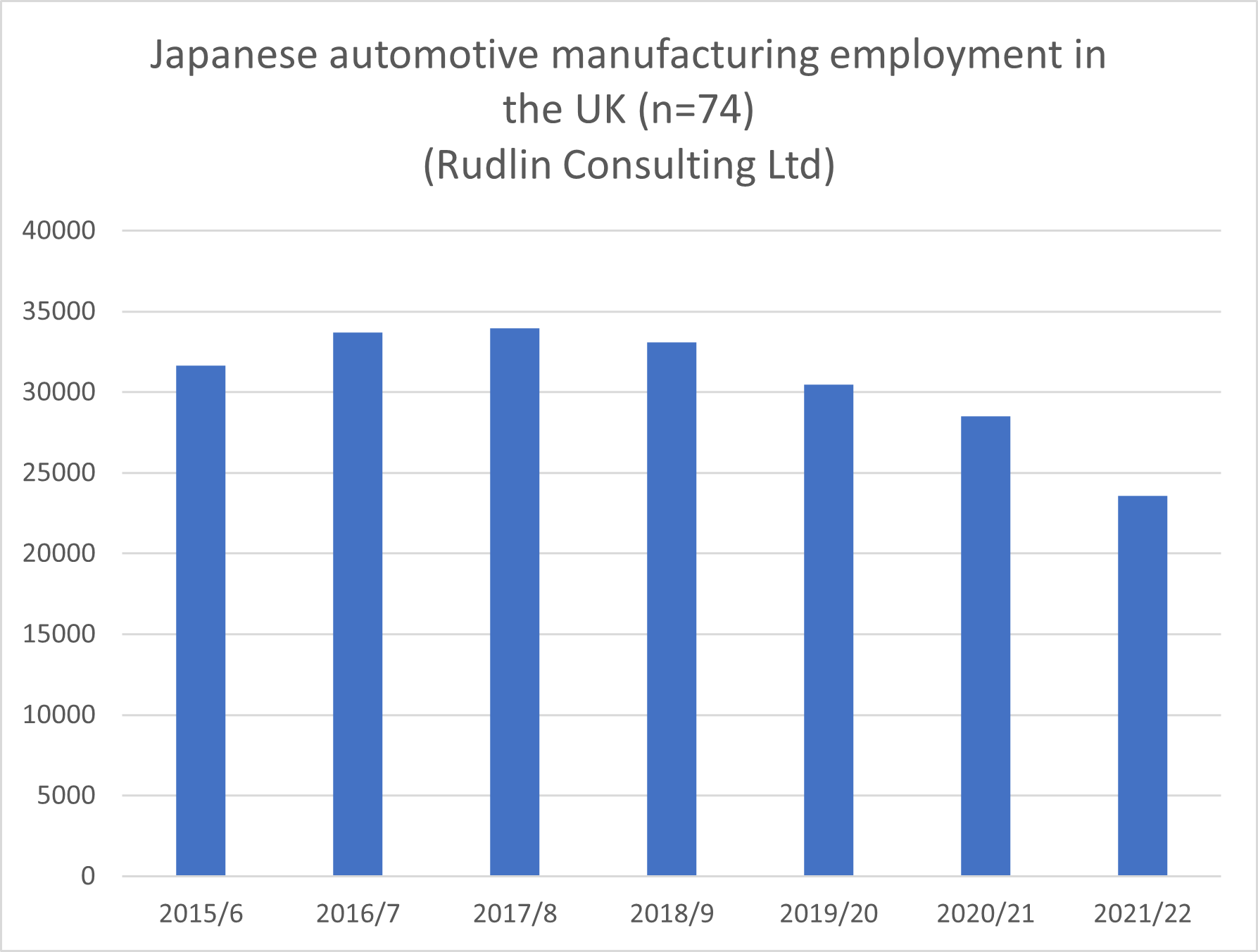 If we just focus on Japanese companies with production in the UK, there was a 26% decline in employment over 2018-2022 – unsurprisingly close to the overall trend – as around 74% of all Japanese automotive employees in the UK are employed in manufacturing operations.
Unpicking what is happening overall with Japanese automotive companies in Europe is for another day. What has been on our radar recently is how many Japanese automotive companies such as Toyota group (which includes Suzuki and Isuzu), Nissan and Honda are showing more interest in manufacturing combustion engine models in Africa, particularly Ghana, for CKD, lightweight models and SUVs.
-

Japan’s Nippon Express acquires Austrian logistics company Cargo Partner
It has been confirmed that Nippon Express will acquire Austria’s Cargo-Partner (subject to regulatory approvals) for around $743m, according to the Nikkei. For Nippon Express, this is their biggest acquisition ever, and yet another Japanese corporate originated M&A drive for international diversification and growth, in reaction to Japan’s ageing and shrinking economy.
Cargo-Partner has 4,000 employees in 40 countries including Europe, USA and Asia, and a turnover of over €2bn. Nippon Express’s turnover is around US$13bn, of which 6.4% is in Europe. Nippon Express has 73,350 employees in 49 countries, of whom 3,480 are in Europe. It is the only Japanese company to rank in the top 10 largest global freight forwarders. The combined entity will be the fifth largest air cargo carrier in the world.
The acquisition of Cargo-Partner will particularly expand Nippon Express’s presence in Central and Eastern Europe. Rival NYK Group, which includes Yusen Logistics, is actually larger than Nippon Express in Europe, with 8,360 employees based in the region out of 35,165 globally, 25% of its employees. The total number of NYK Group employees in EMEA grew over 1,000 in the past three years, particularly in countries such as Romania. Nippon Express clearly felt it was underweight in the EMEA region for some time, and has recently expanded its network here to include Slovakia, Serbia, Morocco and Kenya.
The founder of Cargo-Partner Stefan Krauter will stay on to help with the transition, sitting on the Corporate Supervisory Board and as an advisor to the Corporate Executive Board. He says he “will be focusing on smart partial integration with the new owners as well as on other matters regarding strategy, M&A and ESG.” I am not sure what “smart partial integration” means, but if it’s anything to do with integrating IT systems, unless Nippon Express is the exception to the rule in the Japanese corporate world, this will be prove to be a very long project, and it might even be worth binning any legacy Japanese systems for whatever Cargo-Partner already has.
-

Does Japan really have CXOs?
I started a new project last year, delivering online training on B2B services marketing to Japan based employees of a Japanese IT company. It has been challenging in many ways, not least of which is that I have to get up very early, in order to deliver the modules within Japanese working hours.
I have worked in B2B services most of my career – in Japanese, British and American companies, in both marketing and sales functions. So delivering this course is a natural fit for me, but it has also made me more aware than before of the big gap between Japanese sales and marketing approaches and Western methods. Western methods in turn are mainly influenced by American practices, and as is often the case, Americans tend to assume that their practices are the global standard, much to Europeans’ irritation. Nonetheless, particularly in an industry like IT, American suppliers are so dominant, in order to compete with American suppliers it is necessary to understand and use these methodologies.
Behind these methodologies, there are various assumptions which I realise need to be surfaced, and questioned, if they are to be used by Japanese multinationals.
The first assumption is that the target audience within the customer company is the so-called “C suite” or “CXO”. As far as I am aware, job titles such as CEO, CFO, COO and more recently CHRO, CDXO or CRMO were not commonly used a decade or so ago in Japan. There was of course the President, and then various Fukushachou (Executive Vice President), Senmu (Senior Vice President) and Jomu (Managing Director) – and most of them on a very large board. The Jomu in particular were often “in charge” of a particular business or function, so it has been quite easy for Japanese companies to then add a “CXO” title to the Jomu level people.
But I wonder whether this is not just a superficial change. The real meaning of CXO job titles, and why they are the target for B2B services suppliers, is that they are viewed as senior specialists in a particular field, and have the ultimate decision making authority and control of the budget.
In traditional Japanese companies, most of the senior executives would have been generalists throughout their careers – albeit within a particular business or functional area. Westerners are frequently surprised, however, to discover that a Japanese CFO has no accounting or finance qualifications, or takes a passive view of HR or marketing as a support function, not as something which requires a strategic approach. They may have ultimate authority to approve budgets, but much of what they approve has come from a more bottom up, nemawashi and ringi mechanism, rather than a strategy that they have set.
When Japanese suppliers were primarily selling to Japanese multinational customers, global marketing techniques were not needed. But now Japanese multinationals have themselves localised and globalised, so non-Japanese in CXO positions, even in Japan headquarters, have begun to appear. Which is why I expect I will be having to get up early to deliver marketing training to Japanese people for some time to come.
This article by Pernille Rudlin first appeared in Japanese in the Teikoku Databank News in February 2023
-
Japan and Morocco
According to the Moroccan government, Japan is the largest foreign private employer in Morocco, with 75 Japan owned organisations generating more than 50,000 jobs. These numbers look likely to grow further in the coming years, as in April 2022 the agreements between Japan and Morocco on the promotion and protection of investments and elimination of double taxation came into force.
The lack of such agreements has meant that up until now many Japanese companies’ presence in Morocco had been as branches of their French, Spanish or German subsidiaries. The largest employers are manufacturers, mostly in the automotive sector, with around 30,000 employed by Sumitomo Electric Industries and Yazaki. Sumitomo Electric Industries has 8 plants in Morocco, and is set to increase this as it diverts production from Ukraine. Yazaki is planning to invest Y9bn to increase its output in Morocco by 25%, including a new production facility. Fujikura is about to start its plant there, also shifting production from Ukraine.
Renault and Stellantis (Peugeot) have assembly plants in Morocco, contributing to Morocco becoming the biggest exporter of passenger cars in Africa, 80% of which are sold to Europe – primarily France, Spain, Germany and Italy – supported by the free trade agreement with the European Union.
The Moroccan government has been very insistent on local sourcing but also supportive of foreign companies operating there in terms of incentives and taxation. It has also invested in infrastructure such as a high-speed rail link between Casablanca and Tangier, where Renault’s plant is located. Labour costs in Morocco are about a quarter of those in Spain and lower than in Eastern Europe too.
It is not just the automotive sector that is growing in Morocco, however. NTT Data has recently committed to investing around Y200m, creating 1,000 jobs, after a memorandum of understanding was signed between the telecommunications ministries of Japan and Morocco. The Moroccan government is also keen to increase inward investment in its aerospace and renewable energy sectors.
The King of Morocco introduced democratic reforms after the Arab Spring of 2011, since which a moderate Islamist government has been in power. The Islamist party comprehensively lost in the elections in 2021, however. The new government, led by the RNI party, contains influential members of the Moroccan business community. Human rights and freedom of expression are still a concern, with journalists being imprisoned recently in a crackdown.
From a Japanese business perspective, there is definitely a mood of optimism, as can be seen in the recent JETRO Africa report (link to pdf), where 65% of the Japanese companies in Morocco who responded to their survey expected to expand their operations there.* The size of the market, growth potential and the stable social and political situation all scored highly compared to other African countries. Morocco also scored better than other African countries on infrastructure and the ease of hiring and retaining employees. Morocco is more French speaking than English speaking, however, which may account for the relatively low number of Japanese expatriates based there.
*since this was written, a new JETRO report has come out, which the article above now links to, which showed that there had been a drop in the number of Japanese companies expecting to expand in Morocco, to 54.5% – on the other hand, Morocco was one of the top African countries for current and future profitability.
This article by Pernille Rudlin first appeared in Japanese in the Teikoku Databank News in June 2022
-

Japanese companies in “wait and see mode” for 2023 overseas expansion
Japanese companies are increasingly in “wait and see” mode with regard to expanding their business overseas, according to a JETRO survey at the end of 2022. Although 43.5% of all those who responded to the survey (3,118) who already had operations outside Japan said they were going to invest further in their global business, this was outstripped by the 49.1% who said they would maintain their investment levels overseas “as is” and 5.2% who said they would reduce or withdraw from overseas business. This compares to 2019 where 66.9% who said they would invest more, 28.5% said they would maintain investment levels and 1.7% who were shrinking or withdrawing from overseas. This trend is stronger in larger companies than small and medium sized ones. 51% of those respondents who did not have any overseas operations said they were not intending to invest outside Japan in 2022, compared to 40.9% in 2019.
EU selected by 20.7%, UK by 2.6% for expansion
Chemicals, foods, electrical machinery and software were the bright spots in terms of overseas expansion. Top 3 destinations were USA (selected by 29.6%), Vietnam (26.5%) and China (26.4%), with the EU at number 4 (20.7%). The UK was 16th, selected by 2.6%. Product areas most focused on the EU were textiles and clothing and timber products – furniture and pulp.
Reasons for choosing regions to expand in were primarily around market size and growth potential, that there is a concentration of purchasers there – interestingly there is a clear difference between the USA (most of the sectors being targeted being manufacturing, so presumably Japanese companies B2B sales to other Japanese or US companies) whereas to Vietnam it is non-manufacturing, and more B2C, logistics and construction.
Onshoring
13% of respondents with overseas operations have already onshored or are looking at onshoring, particularly in health and beauty products, petrochemical and plastic products and IT equipment and components. Unsurprisingly, the key reason cited by 60% for doing so was the increased cost of manufacturing outside Japan. Other concerns are the falling yen and the long term the shortage of supplies – however it seems global logistics is becoming easier again.
Business transformation and hiring non-Japanese employees
In terms of changing business strategy or business model to deal with global trends, 30.5% said they were already undertaking business transformation, 39% said there was a need to change their strategy or model but they had not done it yet and 26.8% did not see any need for change.
Those who were transforming their businesses were doing it through acquiring new personnel (both domestic and overseas), or redeploying existing personnel. 51.5% have now hired someone non-Japanese in Japan – the highest level yet. A shortage of domestic personnel was the top reason for doing so, but not far behind were reasons to do with improving overseas marketing, management and negotiation strength, and also to globalise the HQ.
33.5% are undertaking digital transformation in 2022, compared to 28% in 2021, particularly in financial services and IT services. Reducing carbon emissions is well advanced in Japan (78.4% of large companies are undertaking zero carbon initiatives) but not so advanced with their overseas supply chains, with 40.6% of large companies having taken any steps and only 11.6% of small and medium sized companies including their overseas supply chains in any initiatives. Japanese customers are more demanding on carbon emission standards than overseas customers – 17% of Japanese have asked for statements of compliance on carbon emissions, but only 12% of overseas customers have done so.
Only 10% of Japanese companies have been conducting due diligence on human rights, but over 50% intend to do so within the next year. Over 50% of large Japanese companies have been asking for statements of compliance on human rights from their suppliers.