About Pernille Rudlin

Pernille Rudlin was brought up partly in Japan and partly in the UK. She is fluent in Japanese, and lived in Japan for 9 years.

She spent nearly a decade at Mitsubishi Corporation working in their London operations and Tokyo headquarters in sales and marketing and corporate planning and also including a stint in their International Human Resource Development Office.

More recently she had a global senior role as Director of External Relations, International Business, at Fujitsu, the leading Japanese information and communication technology company and the biggest Japanese employer in the UK, focusing on ensuring the company’s corporate messages in Japan reach the world outside.

Pernille Rudlin holds a B.A. with honours from Oxford University in Modern History and Economics and an M.B.A. from INSEAD and she is the author of several books and articles on cross cultural communications and business.

Since starting Japan Intercultural Consulting’s operations in Europe in 2004, Pernille has conducted seminars for Japanese and European companies in Belgium, Germany, Italy, Japan, the Netherlands, Switzerland, UAE, the UK and the USA, on Japanese cultural topics, post merger integration and on working with different European cultures.

Pernille is a non-executive director of Japan House London, an Associate of the Centre for Japanese Studies at the University of East Anglia and she is also a trustee of the Japan Society of the UK.

Find more about me on:

Here are my most recent posts

Pernille Rudlin - Rudlin Consulting - Page 13

Author: Pernille Rudlin

  • Mitsuba appoints liquidator for UK automotive parts business Mitsuba Europe

    Mitsuba appoints liquidator for UK automotive parts business Mitsuba Europe

    Mitsuba, a Japanese manufacturer of automobile parts including electrical components for wiper systems, door mirrors, power window motors, fuel pumps, and pressure regulators, has appointed a liquidator for its UK business, Mitsuba Europe.

    Mitsuba has around 20,000 employees worldwide, of whom 900 are based in Europe, Middle East and Africa. Its biggest operation is its plant in Hungary, employing around 400 people. It also has plants in France, Italy, Morocco, Russia and Turkey and a sales office in Germany.

    Mitsuba Europe in the UK only employed 3 people with a turnover of £364,000 in 2022. Before 2011 it employed 6 people, with a turnover of £18m, but transferred the major part of its business to its subsidiary company in Hungary in 2012.

    For more content like this, subscribe to the free Rudlin Consulting Newsletter. 最新の在欧日系企業の状況については無料の月刊Rudlin Consulting ニューズレターにご登録ください。

    Share Button
  • SEGA confirms it is acquiring Finnish Angry Birds company Rovio

    SEGA confirms it is acquiring Finnish Angry Birds company Rovio

    SEGA is acquiring Finnish game maker Rovio for $775m/706m euros. The purpose of the acquisition isn’t so much to add elderly Angry Birds to their portfolio as to utilize Rovio’s live service expertise to bring current and new games to the mobile gaming market. It’s also about SEGA making sure it isn’t too dependent on its still successful but nonetheless rather 20th century cash cow, pachinko machines.

    Rovio had around 546 employees of 58 different nationalities at the end of 2022.  SEGA Sammy has around 1,300 employees in Europe, out of 7,760 globally, according to our estimates – in Bulgaria, France (SEGA acquired Endless series developer Amplitude in 2016), UK (acquisitions of Sports Interactive (2006), The Creative Assembly (2005) and Two Point Studios (2019)) – where the European companies SEGA Europe Ltd and SEGA Publishing Europe Ltd are also based.

    SEGA Sammy Holdings are aiming to have 50% of their sales outside Japan by 2030. To that end, they have set a target of having 900 “culturally diverse” people in their Japan based workforce (around 21%) – which they define as being a foreign national, or having experience of living overseas, or a certain level of foreign language ability.

    For more content like this, subscribe to the free Rudlin Consulting Newsletter. 最新の在欧日系企業の状況については無料の月刊Rudlin Consulting ニューズレターにご登録ください。

    Share Button
  • Top 30 Japanese companies in Europe, Middle East and Africa 2022

    Top 30 Japanese companies in Europe, Middle East and Africa 2022

    Our top 30 Japanese companies in Europe, Middle East and Africa for 2022 (download available below) shows that there has been a modest growth in total employee numbers to 593,195,* up around 3% from 575,962 in 2021. We estimate over a million people are employed by Japanese companies in the EMEA region, so around 60% of them are working for these large corporate groups.

    This would be a 2% growth if Honda had not dropped out of the Top 30, thanks  to the closure of its Swindon UK factory, and been replaced with NYK Group. Japanese corporate groups where the number of employees in EMEA declined over the year were largely in the automotive sector – not only Honda – including Nissan (-8%), NSG (-6%) and Denso (-5%).

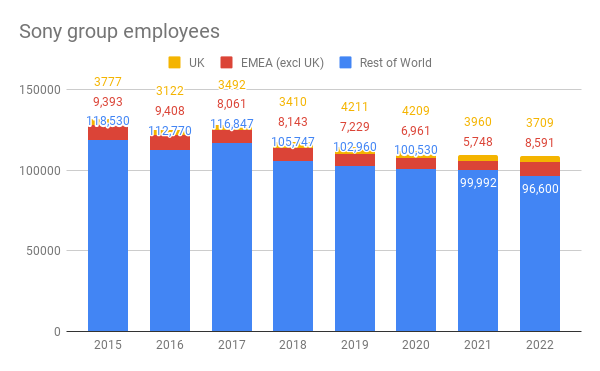
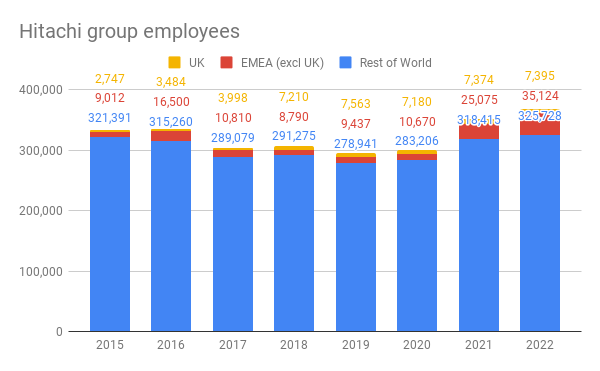
    Some of the growth in employees  was due to acquisitions, for example Hitachi‘s employees in the region expanded by nearly a third after the acquisition of the ABB Power Grids business. Sony has also grown in EMEA by 27% from 2021 to 2022 – this may be the result of multiple acquisitions, mainly of video game companies in the UK, Netherlands and Finland as well as in the  USA.

    This now means 12% of Hitachi‘s global employees and 11% of Sony’s global employees are in the EMEA region, compared to the top 30 average of 14%. The groups with a significantly higher than average proportion of employees in EMEA tend to be those with large manufacturing presence –

    • NSG (46% of global employees in the region), arising from its acquisition of Pilkington Glass
    • Sumitomo Electric Industries (26%), thanks to the labour intensive wire harness factories it has in Eastern Europe and North Africa
    • Toyota Tsusho, who have a significant presence in Africa since their acquisition of the French company CFAO
    • Asahi Glass

    Japan Tobacco, with 38% of its global employees in the EMEA region, has entered the top 10 of the largest Japanese corporate groups, up from number 16 – not necessarily from any expansion, but more due to the fact that previous employee estimates were our own, and proved to be an underestimate, judging by figures that are now given on the website for Europe and the Middle East.  It has not announced anything further about its operations in Russia, where it employs around 4,000 people, other than a suspension of investment.

    Recruit and Asahi also have more than 30% of their global employees in the EMEA – Recruit through its acquisition of USG People as well as Glassdoor and Indeed and Asahi through its acquisitions of various beer brands such as Grolsch and Peroni.

    The corporate groups that have expanded the most in the region since 2014/5 are Hitachi (262%), NTT (157%) and Panasonic (89%). Those groups which have contracted the most are Honda (-55%),  Asahi (-30%), Fujitsu  (-25%) , Nissan (-22%) and Ricoh (-15%).

    Click on this link for a pdf download of the Top 30 Japanese Companies in EMEA 2022

    *This number has been updated to reflect the inclusion of Mitsubishi Electric in the Top 30 (17 April 2023) and the inclusion of NYK Group (16th May 2023)

    For more content like this, subscribe to the free Rudlin Consulting Newsletter. 最新の在欧日系企業の状況については無料の月刊Rudlin Consulting ニューズレターにご登録ください。

    Share Button
  • A second winter of discontent for Britain

    A second winter of discontent for Britain

    Britain is going through another “winter of discontent”, of multiple strikes. The description comes from a soliloquy in Shakespeare’s Richard III and has been used whenever social or political unrest coincides with dark, cold, wet British winters.

    I remember the last, most famous “winter of discontent”, of 1978/9, when there were widespread strikes against government imposed wage restrictions. It was a year or so after my family returned from five years in Japan. Britain felt very inconvenient and full of conflict after the smooth-running life we had in Japan.

    One of the positive impacts that Japanese companies such as Nissan and Toyota had on the UK in the 1980s was to introduce multi-skilling and one company union representation in return for more secure jobs with better working conditions. Many other companies adopted these practices and for decades we had far fewer strikes and disputes.

    It feels like we have regressed back to the 1970s. This time the disputes are primarily about pay but also changes to working practices, and a worry that these will lead (or have led) to worsening working conditions and insecure employment.

    For example, the rail union is concerned that driver-only trains, where the driver has to operate the doors as well as drive the train, will lead to compulsory redundancies. The rail management are saying that there will still be staff on the train, but they will be able to focus more on passenger safety and ticket inspection, if they do not have to operate the doors as well.

    I recently travelled into London on an airport bus (because the trains were on strike) and observed the driver of the bus having to load everyone’s suitcases, check everyone’s tickets and then drive the bus. All tickets had a QR code, but he was checking them manually. Although the digital ticketing system could tell him where passengers were going and where passengers needed to be picked up, he still double-checked our itineraries with us. It seemed to me he was having to do too much, without supporting technology, so missed the fact that one passenger had booked a different bus, and he also placed some of the suitcases in the wrong part of the luggage hold.

    A recent exposé of the UK warehouse of a large online fashion chain revealed similar problems. Employees had a heavy monitor strapped to their wrists telling them where they had to go next. The monitor would also alert managers when an employee was not hitting their targets. Yet the employees were having to walk the equivalent of a half marathon during a gruelling 12-hour shift. This is despite the fact that there are robots which can do a similar job, as I saw in a vast Honda warehouse in Belgium, nearly 30 years’ ago.

    British technology investment has been very short term, focused on cutting labour costs rather than looking at how technology can be used to improve people’s working lives. I hope Japan’s digital transformation fares better, and that again Britain can learn from it.

    This article by Pernille Rudlin first appeared in Japanese in the Teikoku Databank News in January 2023


    For more content like this, subscribe to the free Rudlin Consulting Newsletter. 最新の在欧日系企業の状況については無料の月刊Rudlin Consulting ニューズレターにご登録ください。

    Share Button
  • Daikin continues to expand in Europe with new heat pump plant in Poland

    Daikin continues to expand in Europe with new heat pump plant in Poland

    Daikin has started construction of its new heat pump factory in Poland, its fourth plant in Europe. It will create 1,000 jobs by 2025 and 3,000 by 2030.

    Daikin’s European headquarters, in Belgium, announced last year that sales of heat pumps had increased 170% on the previous year, thanks to a push to reduce dependency on Russian gas.  It will also increase production in Belgium and Czech Republic.

    Daikin has over 11,000 employees in the EMEA region, making it the 24th largest Japanese corporate group in EMEA, up from 27 a year ago.


    For more content like this, subscribe to the free Rudlin Consulting Newsletter. 最新の在欧日系企業の状況については無料の月刊Rudlin Consulting ニューズレターにご登録ください。

    Share Button
  • Mitsubishi Chemical to end methacrylate production in UK

    Mitsubishi Chemical to end methacrylate production in UK

    Mitsubishi Chemical UK has announced in its latest annual report that following a global review of Mitsubishi Chemical’s methacrylate business in October 2022, and a consultation with employees at its Cassell site in Billingham, UK, it will close the methacrylate production at the Cassell site. Over 200 jobs are likely to be affected.

    This is due to the “significant increase in natural gas prices” but also the downturn in the European economy due to high inflation and instability from the war in Ukraine having a detrimental effect on the demand for methacrylate monomers.  Mitsubishi Chemical has 10 other methacrylate monomer plants around the world and has also delayed an investment decision into a new methyl methacrylate plant in Louisiana, USA.

    Workers at Mitsubishi’s separate electrolyte business at the same site, which is used for electric vehicle battery parts, are not affected.

    Mitsubishi Chemical Group’s European HQ is in Germany. The group has 69,784 employees in total – with around 40,000 in Japan and 30,000 outside, of whom around 4,000 are in Europe, according to our estimates.

    For more content like this, subscribe to the free Rudlin Consulting Newsletter. 最新の在欧日系企業の状況については無料の月刊Rudlin Consulting ニューズレターにご登録ください。

    Share Button
  • Japanese automotive supplier Nitto Denko to stop production in UK

    Japanese automotive supplier Nitto Denko to stop production in UK

    Japanese automotive supplier Nitto Denko is to stop production in UK and will turn its UK operation into a satellite office. According to their annual report this is due to the global decline in automotive markets, the pandemic, the semi conductor shortage and Brexit.

    Nitto Denko UK employed 138 people at a 2017/8 peak. This is now down to 50 in 2021/2.

    Nitto Denko’s EMEA headquarters in Belgium, with a turnover of 360 million euro in fiscal year 2019-2020 employing around 1,725 across Europe.

    Nitto Denko has manufacturing and converting operations in Belgium, Czechia, Hungary and Turkey and sales offices elsewhere, manufacturing and selling films, foam, fabric, sealing materials, reinforcing and damping materials and various kinds of industrial adhesive tapes which are used in worldwide markets such as automotive, electronics, furniture, paper production, aerospace and metal processing.

    For more content like this, subscribe to the free Rudlin Consulting Newsletter. 最新の在欧日系企業の状況については無料の月刊Rudlin Consulting ニューズレターにご登録ください。

    Share Button
  • Toridoll expands restaurant business further in Europe

    Toridoll expands restaurant business further in Europe

    Tokyo listed food company Toridoll Holdings (owner of Marugame Udon + Wok to Walk) has acquired The Real Greek + Franco Manca owner Fulham Shore for £93 million.  It acquired 40% of UK based Shoryu Ramen in 2016 and Netherlands based Wok to Walk in 2015.

    Marugame Udon Europe’s headquarters is in the UK, employing around 100 people, with 11 restaurants. It has plans to open 150 restaurant outlets across Europe by 2027, creating 10,000 jobs.

    Marugame Udon had 7 restaurants in Russia, operating as franchises, but these seem to have disappeared from its network.

    Wok to Walk has restaurants in 12 European countries.

    For more content like this, subscribe to the free Rudlin Consulting Newsletter. 最新の在欧日系企業の状況については無料の月刊Rudlin Consulting ニューズレターにご登録ください。

    Share Button
  • Nihon Nohyaku first acquisition in Europe

    Nihon Nohyaku first acquisition in Europe

    Nihon Nohyaku has acquired all shares of Interagro (UK) (13 employees), an agricultural materials manufacturer, through its UK subsidiary, Nichino Europe. The aim is to expand the business portfolio beyond synthetic agrochemicals, to become a leading company in life sciences.

    Nichino Europe is Nihon Nohyaku’s only subsidiary in Europe, employing 20 people in Cambridge. It has other overseas subsidiaries in Korea, Vietnam, Colombia, Brazil, India, Taiwan, China and the USA.

    For more content like this, subscribe to the free Rudlin Consulting Newsletter. 最新の在欧日系企業の状況については無料の月刊Rudlin Consulting ニューズレターにご登録ください。

    Share Button
  • Koyo Bearings Europe changes name to JTEKT Automotive England

    Koyo Bearings Europe changes name to JTEKT Automotive England

    Koyo Bearings Europe in the UK has changed its name to JTEKT Automotive England. It decided in 2021/2 to stop serving European market and transfer some production to continental Europe. UK employees at Koyo Bearings Europe have fallen to 205 from 279 in 2016. Koyo UK has become JTEKT Sales UK and has 20 employees.

    JTEKT ‘s European headquarters is in the Netherlands, coordinating 28 subsidiaries across the region, employing 6,699 people in 2022 – of whom 365 are in the UK, across 4 subsidiaries.

    Koyo was the bearings brand name of JTEKT since Toyoda Machine Works and Koyo Seiko merged in 2006 to form JTEKT. Now all businesses and brands are being rebranded to JTEKT globally.

    For more content like this, subscribe to the free Rudlin Consulting Newsletter. 最新の在欧日系企業の状況については無料の月刊Rudlin Consulting ニューズレターにご登録ください。

    Share Button