Author: Pernille Rudlin

  • Japan’s less equal companies

    Japan’s less equal companies

    I often cite in my seminars that one obvious sign of the ethos gap between Japanese listed companies and the top 350 US companies is that Japanese presidents generally earn a multiple of 10-20 of the average salary in their companies, whereas the multiple for American CEOs is 350 or so.

    There are exceptions of course, but even the board directors of the company at the top of Toyo Keizai’s income gap ranking (Toshin) earn an average of just under 60 times the average salary in the company. Many of the other companies at the top of Toyo Keizai’s rankings have non-Japanese executive directors, who are usually paid closer to American levels, such as Takeda Pharma (#3), SoftBank (#5) but there are other companies whose executives are all Japanese, such as Toyota (#6), JT (#15), Itochu (#16), Horiba (#17) and Canon (#20). Even so, only the top 10 have multiples of over 30, and only the top 25 have multiples of over 20. So the ethos gap is still holds.

  • Impact of Brexit on Japanese companies in the UK, 6 months on

    Impact of Brexit on Japanese companies in the UK, 6 months on

    (This article was first published in Japanese in the Teikoku Databank News in July 2021)

    It has been six months since the UK left the EU and the transition period ended.  According to my research and also a recent survey compiled by METI and MUFJ Research, the impact on Japanese companies in the UK has not been as severe as many were expecting.

    This is partly because Japanese companies have been thorough in their preparations for a worst-case scenario over the five years since the 2016 referendum. The METI survey points out that larger (over Y10bn/$90m revenue companies, which is around 60% of the Japanese companies in the UK) are more positive about further expansion in the UK than smaller ones. They have had the resources and the networks to stockpile, set up logistics and warehousing on the continent and bear the costs of increased paperwork at the customs borders. They still see the UK as an important market and a useful base for regional coordination across Europe, Middle East and Africa.

    Even amongst the larger companies, however, there is some diversion in views. The METI survey summarises the Japanese automotive companies as viewing the outlook for the UK market as bleak  whereas chemicals, pharmaceuticals, foods and electrical machinery manufacturers are more positive. This diversion is clear in the employee totals – Nissan has 11% fewer employees year ending 2020 compared to a year previously. Honda is closing its UK plant in July and its employee numbers were 14% down in the year ending 2020 compared to the year before. Other double digit falls in UK employee numbers were Nomura and Konica Minolta.

    It is becoming increasingly difficult to be accurate about employee trends, however, as one impact of Brexit has been that some of the larger companies such as Sony and Panasonic have moved their incorporated European subsidiaries to the Netherlands and Germany. The UK operations are now branches, so do not have to file their full accounts, including employee numbers, with Companies House.

    Many of the financial services companies such as Mizuho and MUFG were branches of Japan or a European subsidiary anyway, and several others have moved to this model, as well as opened up subsidiaries on the continent, to ensure they are still approved to offer financial services in the EU. The EU has indicated it may put further pressure on financial services companies to move decision making and client facing personnel to the EU.

    The UK is increasingly a services sector economy, and this shows in the Japanese companies where employment is growing – NTT, who have moved their global headquarters to London and Outsourcing, who continue to acquire recruitment companies across Europe.

    According to METI’s survey, the reasons for choosing to continue to expand in the UK were the ability to use English, the presence of other multinationals and a transparent legal system. It would seem that the UK is still going to be the base for coordinating an increasingly dispersed network of people and businesses across the region.

  • What needs to change for Japanese companies to adopt hybrid working

    What needs to change for Japanese companies to adopt hybrid working

    The UK government allowed companies to encourage their staff to return to work from mid-July 2021. There are conflicting views in government, however, about whether flexible working should be the default from now on. Some worry that a permanent reduction in commuting will hit those businesses which rely on commuters for income, such as the train companies, sandwich shops, and office landlords.

    British employees have been able to request flexible working since 2003. I used to work from home 2 or 3 days a week 10 years’ ago. My team was global, so most of them were based in other countries. Our team meetings were via teleconferencing, which I preferred to do from home than having to commute 1.5 hours into the office to start the call at 8:00am.  I still found it important to be in the office at least two if not three days’ a week, however. I needed to interact with my peers, both for gossip on office politics and in order to be creative, to swap ideas and insights.

    A survey by the Institute of Directors shows that 63% of UK business leaders are planning to shift their workforce towards hybrid working – asking employees to work from home anywhere between 1 to 4 days a week.

    British employers are of course concerned about the impact on mental and physical health, data security and productivity that remote working might have. The latter seems to be even more of a concern for Japanese employers. A Lenovo Japan survey shows that 40% Japanese employers think that working from home will reduce productivity, compared to only 11-15% of European employers.

    I suspect this is because Japanese employers are used to the collaborative, co-located way of working where employees can immediately turn to their bosses or colleagues for support or to exchange ideas.

    European teams where there is a lot of creative work also need to be co located. If they have to work remotely, an investment needs to be made in advance in team building events, to develop strong bonds of trust between team members so they can communicate easily with each other.

    Boston Consulting Group recommends such “creative collaborators” should be in the office 50-60% of the time. Other categories they propose include those who require focus without too many interruptions, for example people working in accounts. This group could work remotely 50-80% of the time. Those whose work follows defined processes and patterns, so do not need much support, can work almost entirely from home. And of course there is the group who have to be physically present to do their jobs, in factories or physically interacting with customers, so cannot work remotely.

    If Japanese companies adopt these categories to enable a hybrid approach to flexible working, they will have to adopt what in Japan is being called a “job gata system”, where the job scope, place of work and hours of work are clearly laid out in a contract. Insisting on the same working conditions for all employees, regardless of job content, will not be possible in this new style of work.

    This article by Pernille Rudlin was first published in Japanese in the Teikoku News, 9th June 2021

  • Top 30 Japanese Employers in the Netherlands 2021

    Top 30 Japanese Employers in the Netherlands 2021

    There’s no doubt the Netherlands has done well from Brexit in terms of Japanese investment into Europe. Its strong services sector has made it a useful alternative regional coordination hub to London and there is a longstanding thriving Japanese community in the Amsterdam area. Both the numbers of Japanese nationals living in the Netherlands and the numbers of Japanese companies in the Netherlands have shot up the past few years, in contrast to a clear decline in Japanese companies in the UK, and a rather more bumpy but downward trend in Japanese nationals in the UK.  There have also been some significant acquisitions of Dutch companies by Japanese companies since 2016.


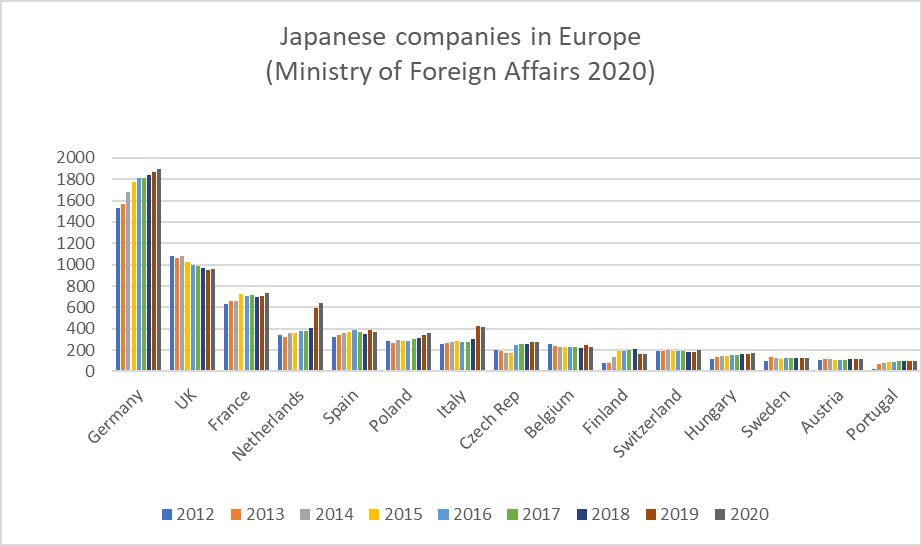
    The number of Japanese companies in Germany, the largest host in Europe, has also grown steadily over the past few years, making the sudden rise in Japanese companies in the Netherlands and Italy in the past two years look somewhat anomalous. The Ministry of Foreign Affairs (MoFA) does not explain what caused this sudden leap but they are sticking to their guns with the recent release of the data for 2020.

    Cross referencing the MoFA data with the Toyo Keizai directory and our own desk research, we think the sudden jump in the number of Japanese companies in the Netherlands and Italy are probably to do with the recent acquisitions – perhaps Outsourcing acquiring Netherlands headquartered Otto Work Force in 2018, supplemented by Mitsubishi Corporation acquiring Dutch energy company ENECO in 2020. In the case of Italy, it could be due to Hitachi acquiring various companies from Ansaldo STS.

    Our database contains 352 Japanese companies in Italy, sitting neatly betwen the 415 registered by MoFA and the 269 recorded in the Toyo Keizai directory.  But our estimate of 503 Japanese companies in the Netherlands is lower than both the 525 in the Toyo Keizai and the 639 in MoFA’s records. We only enter companies which we can verify have employees into our database, which is why we appear to have under-recorded the number. Many of the companies identified by Toyo Keizai and presumably MoFA are brass plate, holding company type entities. As was seen in the acquisition of Otto Work Force, even one company in the Netherlands turns out to have multiple legal entities attached to it – at least 9 different subsidiaries are associated with Otto Work Force in the Netherlands. According to Dun & Bradstreet, Outsourcing’s holding company in the Netherlands now has over 50 companies associated with it.

    Some of the Netherlands based companies we have not recorded may well have employees, but it seems Dutch companies are not obliged to disclose as much information as similar companies in the UK, for example – where employee numbers, even for the smallest company, are disclosed and freely available on Companies House.

    Bearing the lack of data in mind, our Top 30 Japanese companies in the Netherlands needs to be treated with caution, but we can certainly see that Outsourcing and Mitsubishi Corporation‘s recent acquisitions have pushed them into the Top 30. Recruit, another major Japanese recruitment company, also entered the Top 30 with its acquisition of USG People in 2015 and Orix, the Japanese financial services company, acquired Dutch asset manager Robeco in 2013.

    As these acquisitions show,  Japanese companies have mainly been investing in the Netherlands’ services sector. There are some companies with manufacturing operations such as Omron, making control equipment, factory automation systems, electronic components, automotive electronics, ticket vending machines and medical equipment.  Toyota Industries entered the Top 30 with its acquisition of materials handling systems manufacturer Vanderlande in 2017 and Canon manufactures printing production systems, as one of its legacies of acquring Oce more than ten years ago. Other major manufacturers are Astellas (pharmaceuticals) and Teijin (fiber). The notable absences from the Top 30 in terms of manufacturing are from the automotive sector – no Japanese car companies have plants in the Netherlands, and as a consequence, none of their suppliers do either.

    The 30,000 employees who work for the Top 30 largest Japanese employers in the Netherlands represent around 70% of the total number of Netherlands based employees working in Japanese companies. This puts the Netherlands in equal 7th place with the Czech Republic in terms of largest numbers of employees in Europe, after Germany, UK, France, Poland, Italy and Spain. As the Netherlands is host to the fifth largest number of Japanese nationals and fourth largest number of Japanese companies, this is a further indication that the Netherlands has relatively few manufacturers with large numbers of employees and rather more in the way of holding companies with no employees,  and a relatively higher density of Japanese expatriates compared to some other European countries.

    See our 2022 top 30 Japanese employers for the Netherlands for updates.

  • What the vaccination levels tell us about attitudes to risk and innovation in Europe

    What the vaccination levels tell us about attitudes to risk and innovation in Europe

    (This article was published in Japanese for the Teikoku Databank News in May 2021)

    The coronavirus vaccine rollout in Europe is providing many insights into how countries in the region deal with risk.

    The UK has now vaccinated over half its population, at least with a first dose. This is far ahead of other countries such as Germany, France and the Netherlands where less than 20% of the population had been vaccinated by the beginning of April.

    However, EU countries are expected to catch up rapidly over the coming weeks as the supplies of vaccines, including single dose ones, become more available. It is also sobering for me, as a British person celebrating my first vaccination dose, to remind myself that over 127,000 people have died of coronavirus in my country, one of the worst death rates globally. Perhaps we took the risks too lightly at first.

    The UK did not join the EU’s vaccination procurement programme, even though it could have done. Instead, it appointed a venture capitalist who was a bio scientist with experience in investing in biotech and gave her free rein to invest a substantial amount of money in many different vaccination candidates.

    Unsurprisingly, with over 25 member countries, the EU vaccination procurement programme took rather longer to reach decisions, but ultimately the European Medicines Agency has approved 4 vaccination types, more than any other Western agency.

    Germany was cautious about rolling out the vaccinations, as it wanted to make sure that a second dose was going to be available within the time limit for effectiveness, before starting. The UK has not been so cautious and now there are supply difficulties. I hope I will get my second dose in June, but whether many people aged 18 or under will be vaccinated by the summer is unclear.

    There has been some speculation as to whether, if the UK had been in the EU vaccination programme, the EU programme would have moved more quickly. The British tend to march into unknown territory without too much planning and preparation, and then “muddle along”, fixing things pragmatically as problems occur.

    I discussed this with my German business partner and she said that Germans like to come up with a technologically outstanding solution, and then spend a lot of time worrying about how to deal with any risks, before starting on the project. Unfortunately, this is no guarantee that the technologically outstanding solution will actually work. This is how Germany approached the vaccination roll out – building centralized high tech vaccination centres, which meant it started slowly and resulted in a large stockpile of unused vaccinations.

    The UK had a similar issue with the billions of dollars it spent on a supposedly “world beating” coronavirus test and trace app and centralized system, which is still not showing much success. It might have been better for both countries to go for a decentralised, low tech solution. Ultimately all countries were constrained as much by their existing technology infrastructure and processes as their attitude to risk – as companies also discovered as they tried to transform themselves during the pandemic.

    (6 months on from when this was published, I did get my second vaccination in June, and am having my booster in two weeks. It seems Germany is undergoing a fourth wave of the pandemic, with much graver consequences than in the UK so far – one of the causes seems to be that it took Germany much longer to reach a similar vaccination level of its population to the UK. Whether a centralized system was or wasn’t the way forward is difficult to judge, as in a way the German system was decentralized – at a federal level – perhaps federally centralized would be the way to describe it?)

  • Trends in Japanese companies and Japanese nationals in Europe in 2020 – did the pandemic have any impact?

    Trends in Japanese companies and Japanese nationals in Europe in 2020 – did the pandemic have any impact?

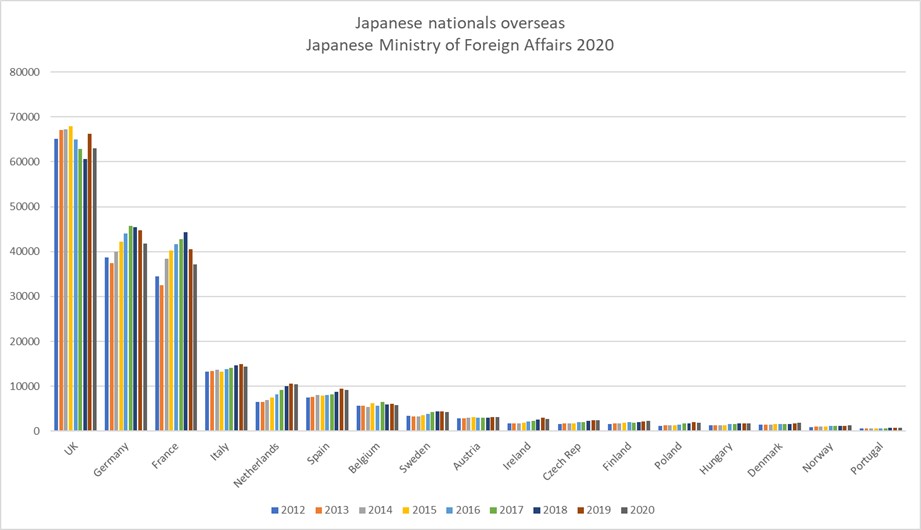
    The number of Japanese nationals resident in Western Europe had grown steadily over the past seven years to reach over 220,000 by 2019. But by October 2020, according to Japan’s Ministry of Foreign Affairs,  that number had dropped 5% to around 212,000. Of course the pandemic may have been an influence on this, evidenced by the fact that the number of Japanese residents overseas fell consistently around the world, with a global decline of 3.7% from October 2019 to 2020. But the latest statistics also show that some longer term trends continue and that the UK, while dominant as a host of Japanese companies and nationals, is also something of an outlier.

    I’m surprised the numbers only fell 5% in Western Europe, as anecdotally I had heard of Japanese managers who were supposed to be moving to Europe staying in Japan, and ending up doing European working hours, trying  to do their coordination job in a Japanese time zone. I have a sinking feeling they were also glued to their laptops during Japanese working hours too.

    The fall in numbers of Japanese nationals resident in the UK had been a long term trend since 2015, but had shot back up in 2019. Since Japan’s Ministry of Foreign Affairs stopped giving breakdowns by visa category in 2017, it’s hard to work out what was behind this decline. It seems likely as I mentioned in previous posts, that it was more to do with how student visas were classified, with a secondary impact of Brexit on corporate expatriation to the UK.

    The number of Japanese nationals in the UK fell 5%, the Western European average, from October 2019 to October 2020, compared to an 6.7% drop for Germany and an 8.4% drop for France.  The UK is still the biggest host of Japanese nationals in Europe, with 63,000, compared to Germany with 42,000 and France with 31,000.

    The Nordics buck the trend?

    Some European countries hosted more Japanese nationals in 2020 compared to 2019 – mostly the Nordics – Finland, Norway, Denmark – and Austria. If this was anything to do with which countries were safer in the pandemic, this must have been more to do with perception than reality, as no country in Europe had been particularly badly affected until November 2020, just after the statistics were collated.


    As the Financial Times charts show, in the winter of 2020, UK, Austria and Denmark all had a higher number of cases and the UK and Austria had a higher number of deaths than the European Union average. But it does seem that Norway and Finland were good choices in terms of staying healthy.

    The rising phenomenon of non-resident Japanese directors

    I’ve also seen a rise in Japanese directors of UK companies, who used to be resident in the UK, now being resident in the Netherlands. Although the Netherlands is still a much smaller host of Japanese nationals than the UK, Germany or France, the trend for Japanese nationals resident there is strongly upwards, with only a slight (-1%) downward turn in 2020.

    Maybe the trends and impact of coronavirus will become clearer when the statistics for October 2021 are published in autumn of next year. It may turn out that COVID-19 accelerated trends that were already there, of consolidating and reducing the number of Japanese corporate expatriates, as Japanese directors and managers of UK and other European Japanese companies decided that they can manage their European subsidiaries remotely.

    Turning to the statistics for Japanese companies in Europe, the rise in the number of Japanese nationals in Netherlands clearly has something to do with the numbers of Japanese companies in the Netherlands shooting up these past two years. I had previously speculated as to what was the cause of the sudden rise in Japanese companies in the Netherlands and also Italy. Both have continued at that level for 2020, so it was clearly not a glitch and more a rebasing or redefinition of what counted as a Japanese company as there is no evidence that a sudden jump in the number of new Japanese entrants happened in either country.

    The UK managed to claw back some of the 12% decline in the number of Japanese companies it hosts since 2012, but is the only country in Europe, along with Belgium, to show a decline over the 9 years, when the numbers rose 23% on average for the whole of Europe.  As we have outlined before, this decline is less about a complete withdrawal from the UK, and more about some long overdue tidying and consolidation, accelerated by Brexit, of shifting European regional bases to the continent and turning UK subsidiaries into branches.

  • Top 30 Japanese employers in France 2021

    Top 30 Japanese employers in France 2021

    It’s been 4 years since we last looked at the top 30 Japanese employers in France. Much of what was true four years’ ago is true today. The top 30 partly reflects France’s traditional strengths, at least in Japanese minds, of food and drink, fashion, beauty and imaging technology – with Ajinomoto and Suntory still in the top 30 along with Shiseido, Fast Retailing (Uniqlo, Princesse Tam Tam and Comptoir des Cotonniers), Canon, Ricoh, Toshiba and Konica Minolta.

    The automotive sector is still a big employer, as you might expect with Toyota having a plant in Onnaing making the Yaris, and Nissan having some of its models made by Renault, supplied by NTN, JTEKT and Nidec.

    Some of the new entries are in the pharmaceuticals sector, including Taisho Pharma, who acquired UPSA from Bristol Myers Squibb in 2018 and Otsuka who have grown and made several acquisitions since they bought Nutrition et Santé in 2009.

    SoftBank is still in the Top 30 as they have a substantial number of employees via ARM, which they still have not managed to get approval to sell. They have also said they are cutting half of the staff in France who were working on robotics, including the not very popular Pepper, brought in with their acquisition of Aldebaran in 2012 and may be planning to sell it to a German company.

    According to our estimates, France is still the third largest base for Japanese company employees in the European region, with 76,000 employees. This is still less than half the employees of Japanese companies in the UK (176,000) or Germany (167,000) however. Around 60% of these employees are working for the top 30 largest Japanese employers (see below).

    The largest employer is Toyota Tsusho, (the trading sister company to Toyota Motor) who shot to the top of the rankings after their acquisition of French company (with a major presence in Africa), CFAO in 2016.  Nidec have also become a substantial presence in France thanks to their acquisition of Leroy-Somer, also in 2016.

    The most recent acquisition in France by a Japanese company is Nippon Paint‘s acquisition of Cromology, Europe’s fourth largest architectural paints manufacturer.  The acquisition was done via a new UK based company, DGL International, which is in turn owned by the DuluxGroup, an Australian paints company acquired by Nippon Paint in 2019. Nippon Paint sees this acquisition as a way of accessing markets across Europe, particularly France, Spain, Italy and Portugal, and then into Central European countries.

    Up until now France has hosted far fewer regional headquarter companies than the UK or Germany. Perhaps these recent acquisitions show the start of a trend towards France becoming a base for Japanese companies to expand into the wider EMEA region.

    Update:

    We have received some more recent data regarding Hitachi’s employee numbers in France, following their acquisition of ABB Power Grids and JR Automation and other growth, so have updated the Top 30 for France accordingly. We welcome such updates so please do get in touch if you think we are missing something.

    You can download the (updated) Top 30 Japanese employers in France below:

    PDF DOWNLOAD OF TOP 30 JAPANESE EMPLOYERS IN FRANCE 2021

  • Japan’s “weak black” companies and the motivation to work

    Japan’s “weak black” companies and the motivation to work

    It has been five years since the “work style reforms” of the Shinzo Abe Cabinet of 2016 were introduced, supposedly making it easier for Japanese employees to have diverse and flexible work styles. The pandemic has given the reforms a further push, but, as the Nikkei Business magazine asks, have these reforms really had the expected positive impact on retention rates?

    The Nikkei asked three masked recruitment agents (masked to conceal their identity rather than for health reasons we assume) for their impressions so far and it seems that because the underlying problem of employee engagement has not been addressed, if anything the reforms have accelerated the rate at which people are leaving their jobs.

    Agent A : Through work style reforms, companies have complied with the new laws by reducing overtime hours and encouraging the use of paid leave. Many people chose larger, stable companies because they were more likely to comply with the requirements to reduce overtime work.

    But at the same time, the pandemic meant that companies started looking more seriously at automation and the use of AI so manufacturers, many of whom who were previously seen as being in the large and stable category, became a riskier bet as they started to restructure and did not seem to be growing as positively as before.

    “When a young person who wants to work more and develop faster is told to “go home at 6 pm”, he or she may feel that “I want to work more but I am being constrained.” There are an increasing number of young people who are daring to commit to a growth environment, such as changing jobs from major companies to new ventures and startups. ”

    Agent B : During the pandemic, the reason for changing jobs switched from focusing on workplace comfort to focusing on personal goals. According to a survey by Doda, a job switching service, the number one reason for changing jobs from January to March 2020 before the declaration of emergency [in Japan] was “because the atmosphere in the company is bad”, but after the declaration of emergency during the period of April to August 2020, it changed to “Because the salary is low and no salary increase can be expected.” Also of note was that “I want to improve my skills” jumped from 6th place before the state of emergency to 2nd place.

    Weak black companies

    Companies which are easy to work in but have no growth are called “Yuru Black” in Japan. Employees in Yuru Black companies have a sense of crisis about whether they are growing and developing as a person. “Black companies” was the name given to companies where there was too much overtime. “Yuru” means weak, so these are “weak black” companies  where there is no overtime, but also no challenge.

    B : Because the future outlook has become uncertain under Corona, many people are switching jobs from major companies in order to feel like they were stepping up to a challenge. There was a woman in her late twenties who changed jobs because the company’s brand power was too strong and she wanted to go to a place where she could use her skills more, even though she was in a high flier role in marketing for a major consumer goods manufacturer. A man in his twenties, who entered a company with the highest annual income in Japan in the electrical industry, where the company had a systematic training system, felt it was too slow in having him be involved in actual work and therefore furthering his own development. So he moved to a startup.

    Agent C: Most people in their 20s and 30s change jobs in search of reward and growth. The main reasons for changing jobs are that they are not evaluated correctly, that they want more chances to use their own judgement, and that they want to do an important job in the metropolitan area. Recently, many people in finance and insurance are flowing into the IT industry.

    Personally, I feel that “a lack of yarigai (rewarding work)” has been increasing mainly amongst people in their 20s and 30s since about 10 years ago. There are various definitions of rewarding work, but the first is whether the work content and compensation are balanced. In other words, whether you are getting paid for your skills, growth, and using your own judgement. Some people find it rewarding just to have a high annual income, such as insurance sales, but that is a minority. Some people choose a company that has a performance-based compensation system such as an annual salary system or a job type system (clear job descriptions). If people are only paid more because they do overtime, then the incentive to work productively and efficiently is lost.

    A : Although the number is not large, the switch from major companies to venture companies is becoming apparent in some groups with good educational background and high needs for personal growth. When you are in your the 20s, there are fewer life events such as child-rearing and long-term care, so we recommend choosing a new job that emphasizes the sense of growth.

    A : As the lifetime employment system collapses, more and more people are thinking that they must have more transferable skills in the long run. In the past, many people chose their place to work because of the short overtime hours and the number of holidays, but more and more people want to use their own judgement and their brains.

    B : The number of people who registered for a job switching service immediately after joining the company seems to have increased more than 20 times compared to 10 years ago.

    C : The number of positions for trainee engineers is increasing, and some people from completely different industries want to become IT engineers. There are also intermediary companies that train engineers and dispatch them to each company.

    B : Even at our company, the number of people who are pursuing skills is increasing, such as young people who have been doing face-to-face sales have changed to be trainee engineers. Recently, during job change consultations, I sometimes get a person saying “I’m thinking of getting a qualification”, but because of the pandemic there is more need for immediately applicable skills, so getting a qualification does not immediately lead to a job.

    Recently, there is an option not only to change jobs but also to have a side job. In the case of a man in his late twenties at a major electronics manufacturer, he was in charge of new business development overseas, but he was not rewarded because the decision-making was so slow, and he gained experience by doing a side job. Since the number of companies that permit it has increased, it is an option to do a side job while having a solid foundation of a main job.

    Motivation to work

    A : With regard to the provision of growth opportunities, efforts are polarized. IT / web companies are advancing, andin  some companies, such as CyberAgent, you can be a president from a young age or get another chance even if you fail. On the other hand, it seems that the manufacturing industry, retail industry, and infrastructure system are lagging behind as a whole, but among them, there are companies such as Aeon and Seven-Eleven Japan that are promoting digital transformation (DX) in retail as well. On the manufacturer side as well, businesses are being reorganized in response to the IoT, finding ways to reduce the number of employees who are just coattail hanging, making the P&L of each department more visible, and creating mechanisms that can properly evaluate whether the business is successful.

    A : The theory of “hygiene and motivational factors” by American psychologist Frederick Herzberg is key. First of all, it is important to promote healthy work style reforms so that people can live a healthy life. Keeping the ease of working within the bounds of common sense has the effect of reducing employee dissatisfaction. Certain regulations make sense in terms of reducing overtime hours, which has been difficult to reduce without regulation.

    On the other hand, “motivation to work” is important in terms of how much employees can demonstrate their abilities. Productivity does not increase just by focusing on workability. It is important to give employees discretion and responsibility and evaluate them appropriately. Long working hours and no discretion are the most stressful, but long working hours and greater discretion can be less stressful. I feel that discretion, the freedom to use your own judgement, will be one of the keys to working styles in the future. Even within the work style reforms,it may be necessary to shift the axis to “motivation to work”.

    I’ve translated the above fairly literally from the Japanese, which is why some of it may sound a little unnatural. But one thing that struck me, even allowing for the rather different ways that opinions are expressed in a more abstract way, is how the role of the manager in both workability and improving team motivation is not directly addressed. If this article had been written in the Western media, there would be much more focus on what you as an individual manager can do. Instead the assumption here seems to be that this is something the company as a whole has to address, in order to avoid being a “weak black” company.

  • Pernille Rudlin on the Japan By River Cruise podcast

    Pernille Rudlin on the Japan By River Cruise podcast

    Pernille Rudlin was the guest on the Japan By River Cruise podcast, hosted by gaijin tarento (foreign celebrities) Bobby Judo (living in Fukuoka) and Ollie Horn (a stand up comedian now based in Bristol, UK).

    Pernille talks about her early experiences living in Japan as a child, the current state of UK Japan trade and how where she currently lives, Norwich, is connected to the RingerHut chain of Nagasaki Chinese noodle restaurants via Norwich native and Victorian merchant Frederick Ringer.


  • Overseas acquisitions by Japanese companies are not to be feared

    Overseas acquisitions by Japanese companies are not to be feared

    A record number of British companies have been sold to overseas buyers in the past two months, according to a report from Refinitiv, a subsidiary of the London Stock Exchange. The targets have mostly been undervalued services companies in sectors such as insurance, gambling and security. These acquisitions have been described more as a corporate raid than a positive investment, as many were carried out by private equity firms and also what are known as Special Purchase Acquisition Companies, or Spacs.

    Special Purchase Acquisition Companies originated in the USA. A group of investors set up a company, raise money on a stock market, and then look for something to acquire, with the intention of then selling it off at a profit. The City of London is currently discussing whether or not to make itself even more attractive to such companies.

    This could end up as just another form of asset stripping, similar to what in Japan would be called Vulture Funds.

    Japanese companies have also started acquiring British and European companies again, after a year when it was difficult to do the required due diligence because of the pandemic. Renesas is looking to acquire the UK-German chip design company Dialog, Nishimoto has just announced the acquisition of Sco-Fro, a Scottish importer of frozen fish and noodles and Ricoh has unveiled its 5 year plan, including funds to acquire companies in Europe.

    These acquisitions are very different to those carried out by private equity or Spacs of course. According to my research, British companies that have been acquired by Japanese companies over the past five years have, on average, expanded their employee numbers by somewhere between 10 to 25%. Japanese companies try to pick companies that will support their profitable growth overseas. They are also willing to invest in new equipment and other forms of expansion, such as further acquisitions.

    The recently announced UK budget provides further incentive for capital investment – a two-year tax break allowing companies to deduct 130% of their investment from their taxable income. This is to cushion the blow of corporation tax rising from 19% to 25% in 2023. Cynics suspect that the timing of this is to coincide with a possible election in 2023, and if the economy has sufficiently recovered, tax cuts will be announced for the future.

    In any case, for Japanese companies, low corporate tax rates are not the primary attraction, particularly given Japan’s revised tax haven laws. They should be welcome investors in the UK and the rest of Europe – so long as they remember to communicate that they are looking to grow and invest for the long term, rather than seeking short term profits from restructuring.

    This article originally appeared in Japanese in the Teikoku Databank News in April 2021.

    Rudlin Consulting and Japan Intercultural Consulting have worked with many Japanese and European companies on post merger integration and corporate culture – please contact Pernille Rudlin for further details.