
Author: Pernille Rudlin

  • The post-Brexit branchification of the UK for Japanese companies in Europe

    The post-Brexit branchification of the UK for Japanese companies in Europe

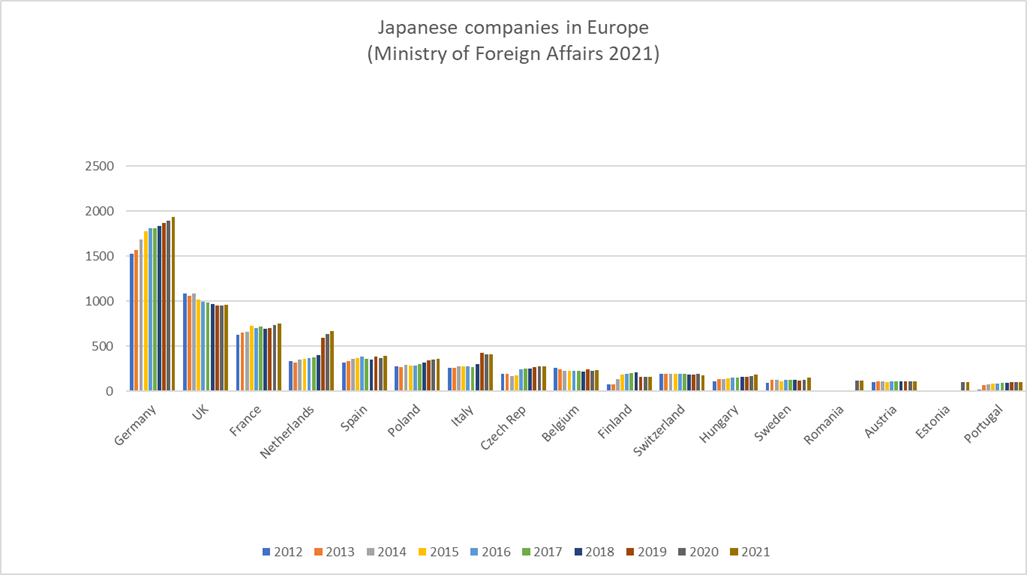
    The latest Japanese Ministry of Foreign Affairs data reveal that the number of Japanese businesses in the EU rose a further 2% from 2020 to 2021, to 8,464, up 28% on ten years ago.  The only EU country to show any decline was Belgium. The picture for the UK is rather different – an 11% decrease on ten years ago, from 1,083 businesses to 960. There has been a slight pick up in the past two years, from a low of 951 in 2019. 
    The branchification of the UK

    Digging further into the detail – and comparing the UK to other major hosts of Japanese companies such as Germany, France and the Netherlands – reveals some possible factors in this divergence. The numbers of businesses started in the UK by Japanese nationals showed the biggest decline. This could be because the businesses were bought out, the founder retired and shut down the company – or perhaps became British.
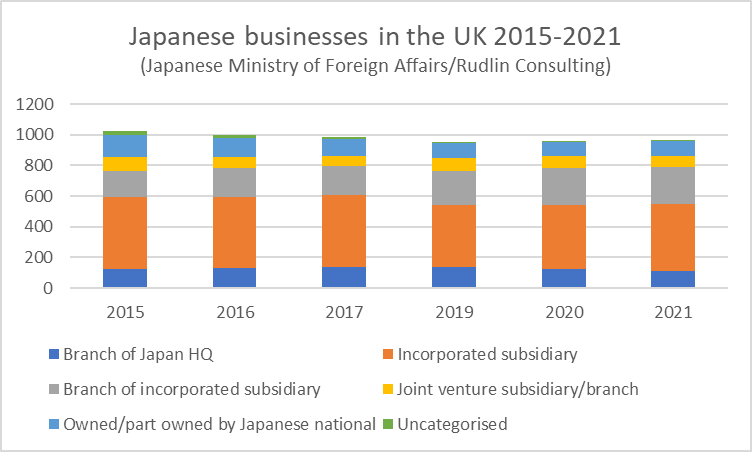
    There is also a confirmation of a trend we noticed previously, that the number of subsidiaries incorporated in the UK has fallen, but at the same time there has been an increase in the number of UK branches of European subsidiaries of Japanese companies. This probably includes those operations which were incorporated subsidiaries but have now become branches of the European HQ in Germany or the Netherlands – such as Sony, Panasonic, Nikon, Bridgestone and Alps Alpine.

    Switching to becoming a branch was partly a reaction to Brexit but in the former two cases may also have been a precautionary measure because of the change in Japanese tax haven laws. As we noted previously, the UK’s 2016 “open for global business” announcement that the corporation tax rate would fall to 17% in 2020 (it didn’t) would have meant that revenue from dividends and royalties received in the UK would be considered as tax avoidance by the Japanese tax authorities.

    The decline in Japanese businesses in the UK had set in as early as 2012, long before Brexit, but accelerated after Brexit – it precipitated trends that were already there, and prompted Japanese companies to do some long overdue regional consolidation and tidying up.
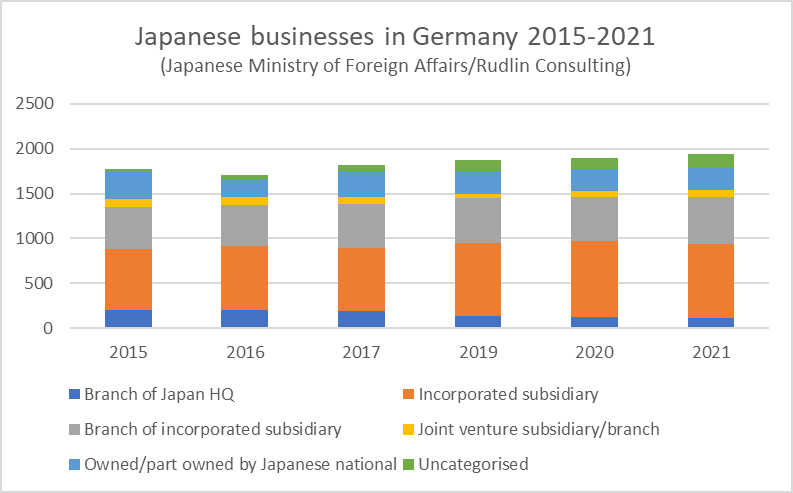
    This branchification of the UK and regional consolidation is reflected in the Ministry of Foreign Affairs data for Germany – the number of branches of Japan HQ in Germany has fallen by 45% and the number of incorporated subsidiaries has risen by 21% over the past 10 years. There has also been a significant decline, as in the UK, of the number of businesses started by Japanese nationals resident in Germany.
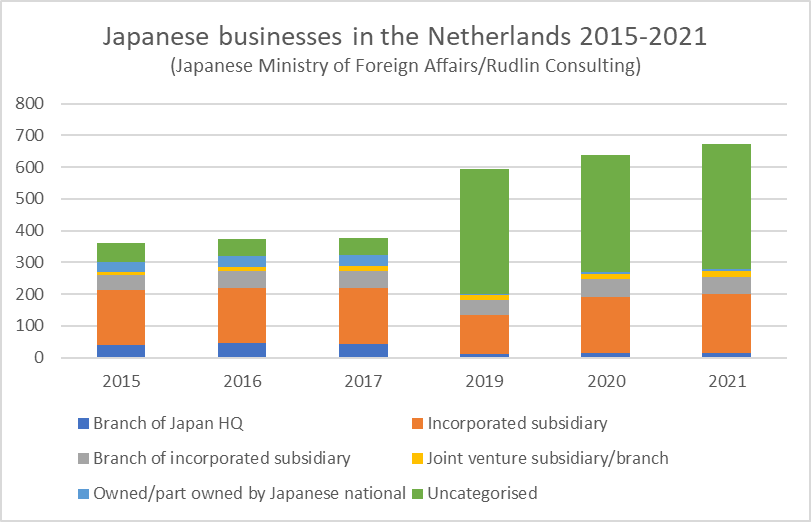
    As for the Netherlands, there has been a quintupling of the number of business classified as “uncategorised” from 61 in 2015 to 393 in 2021. These may be brass plate type holding companies. All other categories (incorporated subsidiaries, branches of regional subsidiaries and joint ventures/investments) have increased as well, apart from branches of Japan HQ (which may have now become subsidiaries) and those started by Japanese nationals in the Netherlands. There was an overall rise of 86% of Japanese businesses in the Netherlands since 2015.

    Cars for cheese?

    The number of Japanese companies in France only increased by 3% since 2015, but this conceals significant changes in the composition of those businesses – the number of branches of Japan HQ has dropped 45%, the number of incorporated subsidiaries has also fallen, by 31%, whereas there has been a significant increase in joint ventures and part investments, as well as businesses started by Japanese nationals in France. This is particularly marked since 2019, when the EU-Japan Economic Partnership agreement entered into force. Perhaps the “cars for cheese” deal encouraged Japanese nationals to set up food exporting businesses in France.
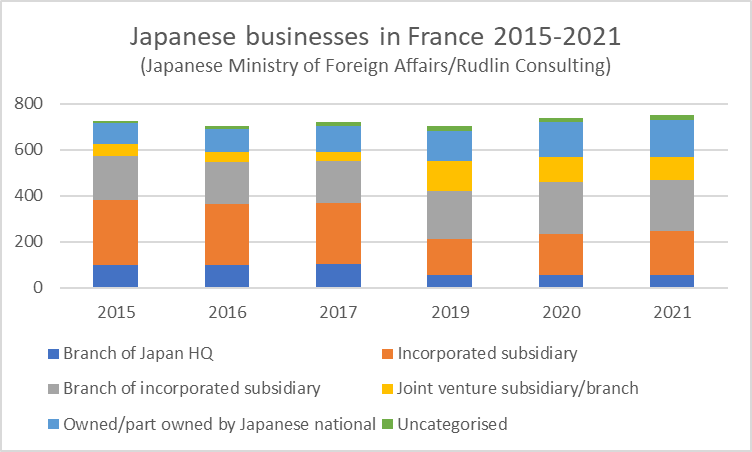


    * Some notes on the Ministry of Foreign Affairs data: “Companies” include branches of the Japanese parent company, subsidiaries incorporated in Europe, branches of those subsidiaries, companies started overseas by Japanese nationals and joint ventures/investments of 10% or more equity stake. There is no detailed break down by type of organisation for 2018, when MoFA changed their methodology.


     

  • Japanese employees don’t want to study or go abroad

    Japanese employees don’t want to study or go abroad

    Japanese employees don’t want to study or go abroad and don’t like their current employer very much either.  But at the same time, very few are considering changing jobs. These were some of the conclusions from a recent Japanese Ministry of Economy, Trade and Industry report (Vision for Human Resources of the Future).

    Further depressing conclusions were:

    • Japan is not attracting highly skilled labour from abroad
    • The level of employee engagement is one of the lowest in the world
    • Japanese general managers are earning less than their Thai peers
    • Japan is bottom of the league with regard to investing in human resources
    • Japan’s workforce is losing its competitiveness
    • The number of Japanese people studying abroad is decreasing
    • The proportion of graduate recruits who do not want to work overseas is increasing
    • Most senior managers worked their way up the company and tend to be very similar to each other
    • The number of women in executive and management positions is still very low

    Consultant Dr Kawai Kaoru criticises this report in the Nikkei Online, asking what the point of it is, and who it is addressed to. The conclusions are well known, and have appeared in previous reports over the years. If the message is how important it is to invest in your people, surely if this is news to any company, that company is on the road to bankruptcy anyway, she argues.

    Kawai thinks the money spent on the 109 page report would have been better used elsewhere. For a start, she thinks the civil service ought to get its own house in order. 50% of the staff at the Ministry of Health, Labour and Welfare are on temporary contracts, and 50% of unemployment counsellors are also on temporary contracts. The civil service is also suffering from low employee engagement.  This, and many of the other issues raised above may sound wearily familiar to readers in the UK.

  • Top Japanese companies for improvement in women in management

    Top Japanese companies for improvement in women in management

    Toyo Keizai has taken a look at which Japanese companies have most improved the percentage of women in management over the past ten years. Unsurprisingly, those companies who had the best existing pipeline of women – in life insurance and retail – have been able to make the biggest strides.

    Life insurance companies in Japan traditionally employed women as salespeople, who were allowed into offices and left fliers, business cards and sweets on your desk if you were absent. Meiji Yasuda, Asahi, Daiichi, and Nippon have all increased the proportion of women in management from only a few percent in 2011 to between a fifth and a third of managers in 2021.

    Other financial services companies such as Resona, the smaller regional banks, Sumitomo Mitsui Trust, Mitsubishi HC Capital, Daiwa Securities, Sumitomo Mitsui Financial Group and MUFG are also in the 50 most improved.  Non-financial companies in the top 50 include Astellas Pharmaceuticals, Sony and Bandai Namco.

    Appearing in the bottom of the top 50 only requires a 10% improvement over the past 10 years, and 20 out of the top 50 most improved companies still have only 10-20% of managers who are female. The pipeline contains only a trickle for many.

  • Top earning executives in Japan 2022

    Top earning executives in Japan 2022

    As in previous years, the top earning executives in Japan over the past year include many non-Japanese people. At number 1 is Shin Jingho, Korean founder of Line (Japanese messaging app), far outstripping all the other big earners, pulling in US$315m to March 2022. He moved to Japan in 2008 to turn around parent company Naver’s websearch business, and somewhat alarmingly, claims to have learnt Japanese by watching gangster movies.

    At number 2 is Kurotsuchi Hajime, the 100 year old chairman of Daiichi Koutsu Sangyo, a taxi and real estate firm in Kyushu. He has just announced he is retiring and intending to start a foundation for small to medium sized businesses. Perhaps that is where some of his US$138 million earnings will be going.

    Yoshida Kenichiro, CEO of Sony, is the third highest earner, on US$137m. Christophe Weber, French CEO of Takeda Pharma is at #4 with US$135m. Kawai Toshiki, CEO of Tokyo Electron is in 5th place with US$121m.

    Nikkei points out that the number of executives earning over Y100m a year (US$728,000) has increased to 652, 105 up on the previous year, the highest number in 3 years. It sees this as proof that Japanese executive compensation is shifting towards Western standards. With the top 5 including two Japanese executives who are not also founders (Yoshida and Kawai), this does seem to show a move away from the usual rule in long standing blue chip companies that the president should only earn around 10 to 20 times the average salary (around US$40,000).

    Hitachi has the highest number of executives (18) earning over Y100m a year, then MUFG with 13, Toshiba also with 13 (presumably danger money for being associated with it), Mitsui & Co (9), Daiwa Securities (9), Tokyo Electron (8),  Mitsui Real Estate (8) and Bandai Namco (8). Companies with 7 Y100m earners are Daikin, Sompo, Fujifilm, Nissan and Nomura.

    Non-Japanese executives resident in Japan in the Y100m club include Simon Segars at SoftBank (British former CEO of ARM), Andrew Plump at Takeda, James Kuffner Chief Digital Officer at Toyota, James Shea at Sompo International, He Xian Han at Ferrotec, Costa Saroukos CFO Takeda Pharma, Stefan Kaufmann, CAO Olympus, Rony Kahan, Recruit (founder of Indeed),  Eric Johnson, CEO of semi conductor company JSR, John Marotta former CEO of PHC (was Panasonic Healthcare) holdings and Alistair Dormer, former board director of Hitachi.

  • Top 30 Japanese Employers in Italy 2022

    Top 30 Japanese Employers in Italy 2022

    The 30 largest Japanese company groups in Italy employ around 30,000 people across 85 companies in 2022, a 4% increase on 2021.  This represents around two-thirds of the total number employed by Japanese companies in Italy.

    Some of this growth was driven by acquisition – for example the Hitachi group of companies (the second largest Japanese employer in Italy) now includes Hitachi Energy, as a result of Hitachi’s acquisition of ABB’s power grids business. Yamaha Motor has also acquired Motori Minarelli.

    The workforce of the largest Japanese employer in Italy, the NTT group of companies, has grown organically by 5.75% and Toyota Industries/Toyota Material Handling also has grown substantially.

    Automotive related companies such as Denso, AGC and NSG (the latter two making automotive glass) have shrunk slightly but tyre manufacturer Bridgestone has grown.  Other manufacturers such as Princes (foods company owned by Mitsubishi Corporation) and Ebara Pumps have cut back their workforce.

    The top 30 company groups can be downloaded for free below. We can provide more detail on the 85 companies within the Top 30 – each company name in full and employee total per company (a truer indicator of size of the company than turnover in our opinion)  for £9.99 – please email us for a PayPal invoice.

    DOWNLOAD FREE PDF OF TOP 30 LARGEST JAPANESE EMPLOYERS IN ITALY

  • Top 30 Japanese Employers in Germany – 2022

    Top 30 Japanese Employers in Germany – 2022

    The latest top 30 Japanese employers for Germany (download available below) show that even in manufacturing centric Germany, services are beginning to dominate. Outsourcing, a recruitment and staffing company are now the largest Japanese company in Germany, replacing Sumitomo Electric Industries, thanks to their acquisition of Orizon in 2017.

    We have shifted Sumitomo Electric Industries from the top spot to #23 – not because they have laid a large number of people off, but because we suspect that previous data regarding employee numbers contained a large proportion who were working in SEI factories outside of Germany.  We have had similar issues with the data for Panasonic and LIXIL.

    NTT has risen from #3 to #2 although it seems to have shed a few employees – conversely, Fujitsu has dropped from #2 to #4 as the consequences of closing the factory in Augsburg and other restructuring have fed through. DMG Mori may have expanded by over a third (but this could be double counting problems again, as there are around 20 DMG Mori subsidiaries in Germany), and is now the third largest Japanese employer in Germany, with 5,800 employees.

    There is an increasing issue with disclosure and therefore verifying employee numbers  – particularly with companies like Sony who have restructured their European organisation so that many of their subsidiaries are branches. We’ve put Sony at #30, with 1000 employees, but it probably has more than that.

    Hitachi has grown by over 1,000 employees due to the acquisition of the power grids business from ABB, now renamed Hitachi Energy and is the 8th biggest Japanese employer in Germany as a result.

    The Top 30 largest Japanese company groupings in Germany can  be downloaded below. If you would like more detail on the 206 companies included in the top 30 company groups of employers, each with full company name and employee number, for £9.99/€12, please contact us.

    PDF DOWNLOAD OF TOP 30 JAPANESE EMPLOYERS IN GERMANY 2022

  • People rather than shareholding unite Japan’s conglomerates

    People rather than shareholding unite Japan’s conglomerates

    I sometimes wonder if I am being a bit “old school” in going into detail on the history and influence of Japan’s keiretsu (conglomerates of companies such as Mitsubishi, Mitsui, Sumitomo) in my training sessions. It’s a legacy of working at Mitsubishi Corporation for nearly 10 years, and also my hobby of researching 19th century Japan-UK relations, in which Mitsubishi, Mitsui and Sumitomo played an important part.

    A recent article in Diamond magazine is reassuring to me in that it shows that the deep relationships within the keiretsu endure – pointing out that the interrelationships between the different companies in each keiretsu are still going strong, but through the mechanism of people rather than cross shareholdings.

    The Mitsubishi power pyramid

    For example, Mitsubishi Motors’ new external directors include Takehiko Kakiuchi – former President, now Chairman of Mitsubishi Corporation. He is taking over from Ken Kobayashi, who had also been President and then Chairman of Mitsubishi Corporation before Kakiuchi. Other candidates are Kanetsugu Mike (that’s MEE-kay, not Mike, as his biographies tetchily point out), formerly President, now Chairman of Mitsubishi UFJ Financial Group who will be joining his predecessor as Chairman of MUFG, Kiyoshi Sono on the Mitsubishi Motors board.

    Diamond magazine puts the “Gosanke” – three honorable families – of MUFG, Mitsubishi Corporation and Mitsubishi Heavy Industries at the top of the “power pyramid”, then the next tier contains Mitsubishi Trust & Banking, Mitsubishi Material, Mitsubishi Real Estate, Mitsubishi Electric, AGC, NYK, Tokio Marine & Fire, Meiji Yasuda Life, Kirin Holdings.

    The tier below that contains Mitsubishi Logistics, ENEOS Holdings, Mitsubishi Chemical Holdings, Mitsubishi Steel, Mitsubishi Paper, Mitsubishi Kakoki, Mitsubishi Gas Chemicals, Nikon, Mitsubishi Motors, Mitsubishi Fuso Truck & Bus,  MA Aluminium, PS Mitsubishi, Mitsubishi Research and Mitsubishi UFJ Securities.

    The above are all in the Kinyokai – Friday Club – a lunch of the heads of all the member companies – fuel for many conspiracy theorists. These three tiers plus a further fourth tier, containing companies such as Lawson and Mitsubishi HC Capital, form the Mitsubishi Public Affairs Committee, which acts the guardian of the Mitsubishi brand.

    Shunichi Miyanaga of Mitsubishi Heavy Industries is an external director of Mitsubishi Corporation, Ken Kobayashi (chairman of Mitsubishi Corporation ) and Nobuyuki Hirano (former chairman of MUFG) are both external directors of Mitsubishi Heavy Industries and Akio Negishi, chairman of Meiji Yasuda and Toshifumi Kitazawa formerly President of Tokio Marine & Fire are both on the board of MUFG.  I could go on, and Diamond does.

    Mitsui’s loose ties

    Diamond magazine show Mitsui’s group interrelations as concentric circles rather than a pyramid. A the heart are Mitsui Real Estate, Mitsui & Co and SMFG.  SMFG is a product of the merger of Sumitomo Bank and Mitsui’s Sakura bank, which is one reason why the ties are looser. Their Monday club includes Mitsui Chemical, Mitsui E&S, Toray, Mitsui Kinzoku and Sumitomo Mitsui Trust. The next ring are also members of the public affairs committee with the first two – Denka, Oji, Mitsui Sumitomo Insurance, Mitsui OSK, Sanki, JSW, Mitsui Sumitomo Construction.

    Then the outer ring are “companies who keep their distance”, most notably Toyota, who Mitsui love to remind were bailed out by Mitsui in the 1960s, Toshiba, Fujifilm and IHI. It also includes the department store group Mitsukoshi Isetan (who have former Mitsui & Co, Toshiba and SMFG executives on their board). Toyota has a female external director from SMFG on its board and Toyota has its chairman on the board of Mitsui.

    Sumitomo’s three peaks

    Diamond characterises the Sumitomo group as having three peaks – financial, mining & manufacturing and the postwar group.  At the top of each peak is SMBC, Sumitomo Metal & Mining/Sumitomo Chemical and Sumitomo Corporation.  Sumitomo Metals used to be the third family, but has recently merged with Nippon Steel, and so is no longer seen as part of the group.  Within the mining and manufacturing group are NEC  (who have external directors from SMFG and Sumitomo Corporation) and NSG (who has an external director from SMBC).

    Reflecting on these lists, I realise that the bulk of my work over the years has come from Mitsubishi group companies, although there have been some notable clients from the Sumitomo group. I don’t think I’ve had a single client from the Mitsui group. That is, apart from Mitsui Sumitomo & Aioi Nissay Dowa, the insurance group who acquire Amlin a while back. Even then it was more via Aioi Nissay Dowa. Aioi Nissay is not mentioned in the three peaks, or the Mitsui rings which makes me wonder whether, despite its partnership with Mitsui Sumitomo, it is not regarded as “outside” both Mitsui and Sumitomo. I wonder also if the Mitsubishi group is more active globally than Mitsui, and with the exception of Sumitomo Electric Industries, the Sumitomo group too, but this could be confirmation bias on my part.

    As Diamond says, each group has its individuality, but maintains cohesion through people – the “external” directors who are really not “outside” at all. Can these arrangements survive the corporate governance headwinds?

  • Pernille Rudlin gives evidence to the UK Trade and Business Commission on UK-Japan trade and business relationships

    Pernille Rudlin gives evidence to the UK Trade and Business Commission on UK-Japan trade and business relationships

    Pernille Rudlin gave evidence on the impact of the UK-Japan Comprehensive Economic Partnership agreement to the June 6th session of UK Trade and Business Commission.

    It was interesting to discover that the trade statistics tracked by Dr Minako Morita-Jaeger, showing a decline in UK exports to Japan since around 2018, with particularly strong decline since 2020 in financial services match our observation that the number of people employed by Japanese companies in the UK has fallen, as have the numbers of Japanese companies and nationals in the UK from around the same time.


  • Japanese manufacturing in the UK – resilient, but not growing

    Japanese manufacturing in the UK – resilient, but not growing

    Excluding automotive production, Japanese manufacturing operations in the UK have been relatively stable since 2015/6.  Out of 200 or so companies, only a handful of companies have closed in the past five years, and much of this was to do with consolidating operations rather than withdrawing entirely from the UK.  Many of the Japanese manufacturers date back to the 1970s, and the oldest established, YKK, has been manufacturing in the UK since 1966.

    There have not been many new entrants either over the past five years – apart from Mechatronics (owned by JTEKT) and other “new” entrants which are the UK subsidiaries of American or Swiss operations acquired by Japanese companies such as Stolle (acquired by Toyo Seikan), Hitachi Energy (was ABB Power Grids) and Avista (acquired by Kurita)

    M&A

    Around two-thirds of the companies in this sector are the product of, or have conducted M&A in the UK. Japanese M&A activity across the UK and Europe has dwindled away in recent years, perhaps because of the difficulty of doing due diligence in a pandemic, or Brexit making acquisition of a UK manufacturing operation that may be part of an EU supply chain less attractive.  There does not seem to be any particular trend to acquisitions in the UK, other than clusters of purchases in packaging, agrochemicals and food processing.

    Notable recent acquisitions of UK companies include:

    • Hitachi Rail acquiring Perpetuum (2021)
    • Olympus acquiring medical device maker ARC Medical Design (2020)
    • Mitsubishi Heavy Industries acquiring the remaining stake in Primetals from Siemens, Hitachi and others (2019)
    • Sumitomo Heavy Industries acquiring Invertek Drives (2019)
    • Nippon Suisan acquiring Caistor Seafoods and Flatfish (2017-2019)
    • Rengo acquiring various packaging companies such as Tri-Wall and Welsh Boxes (2016-2020)
    • Agrovista (owned by Marubeni) acquiring various British agrochemical companies (2016-2019)
    • Sanwa acquiring Bolton Gate Services (2018)
    • Calbee acquiring Seabrook Crisps (2018)
    • Sansetsu (packaging) acquiring Truckwright (2018)
    • Sintokogio acquiring Omega (foundry machinery) (2018)
    • Konica Minolta acquiring Charterhouse and Indicia (printing) (2017-8)
    • Taiyo Nippon Sanso acquiring US company Praxair’s European gas business (2018)

    Employment

    Around 39,500 people were employed in the UK by non automotive Japanese manufacturers in 2015/6 and after a few years of growth to around 42,000, this fell to 39,167 in 2020/21. Judging by the results of the 60 or so companies who have reported for 2021/22, this downward trend is continuing. If automotive manufacturing employment is added back in, there were around 60,600 people employed in Japan-owned manufacturing in the UK in 2020/21, almost the same as were employed in 2015/6. As we explained elsewhere, this number is likely to fall in 2021/22 with the closure of Honda Swindon and other suppliers to Honda.

    UK and Europe

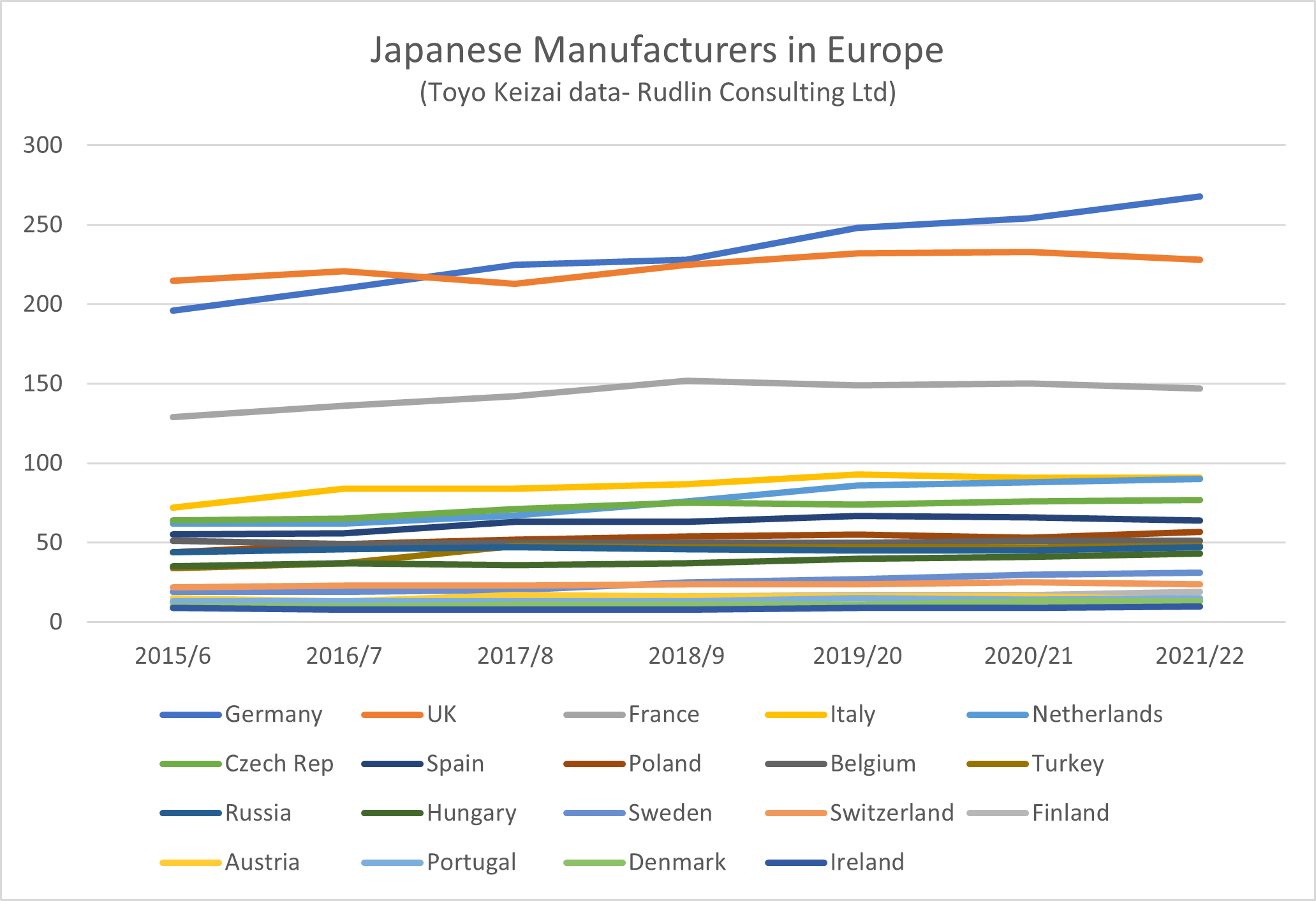
    How this compares with other European countries can be seen in the chart on the left – which shows the numbers of all manufacturing companies in Europe, including automotive. According to Toyo Keizai, the number of Japanese manufacturers in the UK dipped around 2017/8, but recovered, with another more recent fall. But there was growth overall since 2015/6, with 228 companies in 2021/2 compared to 215 in 2015/6  – a 6% increase.  This is much lower than the overall 20% growth in Europe, and as a consequence the UK is no longer the largest host of Japanese manufacturers.

    The number of Japanese manufacturers in Germany has grown 35%, and growth is continuing, widening the gap with the UK. France is a clear third, and is showing signs of growth tailing off. Netherlands, Turkey, Poland and Nordic countries are showing higher than average growth as hosts.

    The growth of the number of Japanese manufacturing operations in Europe of 20% since 2015/6, from 1,147 to 1,381 companies was actually higher than the growth seen in Asia (7% to 9,047) or the USA (13% to 1,563). The number of Japanese manufacturing operations in Africa has grown 25% over the period – but from a much lower base of 57 to 71.

    Japanese manufacturing in the UK “despite” Brexit has remained stable thanks to the resilience built up by those companies through being long established in the UK, benefitting from Japan HQ risk aversion and long term planning and having experienced, local management.  These factors have not attracted the growth seen in other countries in Europe, however.

    A directory of 205 Japan owned companies with production facilities in the UK, giving their full names, parent company, type of business and latest number of employees is available for £20 + VAT. Please contact us for an invoice and payment details via PayPal.

  • A very timely introduction of a new trade compliance diploma from the International Trade Institute

    A very timely introduction of a new trade compliance diploma from the International Trade Institute

    We thought the new trade compliance diploma from the recently-established International Trade Institute would be of interest to Japanese companies operating in Europe, struggling with additional complications post-Brexit. Now that various sanctions are being introduced against Russia, it seems even more timely.

    It is the first University-recognised diploma that is international in scope – recognised as a qualification not only in the UK but also Ireland and at the EU level. The facilitators are trade experts themselves, with many years of consulting on trade compliance around the world.  The course is a programme of seven modules of a high level but practical curriculum, spread over three months at times convenient to participants, with online modules and live sessions.

    The Institute has had early success in attracting participants with job roles such as logistics specialist, trade compliance manager, warehouse supervisor and shipping manager from global brand US and other multinational companies to the Diploma Programme.
    The next course is starting on June 9th, and a further intake is scheduled for September. Further information is available from www.internationaltradeinstitute.com.