Category: Brexit

  • Japanese companies in the UK are shrinking – is Brexit to blame?

    Japanese companies in the UK are shrinking – is Brexit to blame?

    The number of Japanese companies and their employees in the UK is starting to decline. Given that this is against the trend elsewhere in Europe, it is hard to avoid the conclusion that this is a reaction to Brexit.

    Brexit has put up barriers to the UK trading within the Single Market, damaging sectors it used to have a comparative advantage in such as automotive manufacturing and financial services. The UK is now left with its global strength in services such as professional services, IT, design, marketing and education. It remains to be seen how much of this strength was also reliant on being part of the Single Market, in terms of being able to sell those services to the EU and benefit from the freedom of movement of the people providing or benefiting from those services. So far, Japanese companies seem to be happy to continue to access these services by basing their regional head offices in the UK, regardless of Brexit, or through acquiring British companies in the services sector.

    The decline is from a high base. The UK has the highest stock of Japanese foreign direct investment, the highest number of employees of Japanese companies, and the most resident Japanese nationals in Europe.

    The decline in numbers of Japanese companies in the UK is mainly due to a reduction in Japanese companies in the manufacturing and financial sectors. There has also been a drop in the number employed in automotive manufacturing. On top of this, the main driver of the past few years behind the rising employee and company numbers – big-ticket M&As followed by expansion in employee numbers – has been less of a force more recently.

    To understand more about the trends in Japanese companies in the UK in terms of investment and employee numbers, how this compares with Germany, France, the Netherlands and Italy and what this might mean for the UK in future years, please download our report below:

    [download_after_email id=”5842″]

    For more content like this, subscribe to the free Rudlin Consulting Newsletter. 最新の在欧日系企業の状況については無料の月刊Rudlin Consulting ニューズレターにご登録ください。

    Share Button
  • Authenticity and food

    Authenticity and food

    I often ask participants in my cross-cultural training sessions what symbolises home to them. This acts as an ice breaker and allows them to talk about their diverse cultural backgrounds – their Guyanese mother’s curry or Moroccan grandmother’s tagines, even if their own nationality is New Zealander or French.

    At a recent session, the Japanese participant said ramen most reminded him of home. We agreed that although it is possible to buy ramen and make it in the UK, ramen at a yatai – in Japan – was what he really meant.

    The ramen you can buy in England is made by Nissin, but manufactured in Hungary. I also checked the udon brands available online at Sainsbury’s – one of the UK’s biggest supermarket chains – three were made in China and one in Thailand.

    Japanese food is so popular in the UK, there was a Japanese themed week in the current TV series of Great British Bake Off – where someone made a matcha cake and another chef used soy sauce in their cooking.

    This caused a controversy on Twitter because the Department for International Trade used the programme as an opportunity to claim that soy sauce would be cheaper in the UK thanks to the UK-Japan Comprehensive Economic Partnership Agreement. It turned out, however, that Japan-made soy sauce would only be cheaper in the sense that without the UK-Japan deal, the WTO tariff of 6% would have applied. Now that there is a UK-Japan trade deal, there will be a 0% tariff, as there was between the EU and Japan anyway.

    In fact, a large proportion of UK imports of soy sauce comes from the Netherlands – Kikkoman has a factory there – or from Poland, where Associated British Foods brand Blue Dragon has a factory. If there is no UK-EU trade deal, these will be 6% more expensive. Soy sauce from other countries such as China and Malaysia will be cheaper even with a 6% tariff, as previously they attracted the 7.7% EU tariff.

    There is a manufacturer of soy sauce in the UK too – Shoda Shoyu acquired a British company Speciality Sauces, with a factory in Wales, in 2000, where they also make miso and mirin.

    There are plenty of food snobs in Europe who claim that only soy sauce made in Japan tastes truly authentic, but obviously for every day cooking of the hybrid culture kind that British enjoy, cost performance is important too.

    Europeans, including the British, are keen to impose “Geographic Indicators” in their trade deals – that Parma ham must come from Parma, Champagne from Champagne, Stilton cheese from Stilton. But for many of these items, like ramen at a yatai, it is not just the location of manufacture, but the location of consumption that makes it a truly authentic, delicious experience – the atmosphere, the climate, the other food. I did not really appreciate the taste of Guinness until I drank it in a pub by the sea in Ireland, with soda bread, butter and mussels.

    This article was originally published in Japanese in the Teikoku Databank News on 2nd December 2020

    For more content like this, subscribe to the free Rudlin Consulting Newsletter. 最新の在欧日系企業の状況については無料の月刊Rudlin Consulting ニューズレターにご登録ください。

    Share Button
  • Japanese companies in Ireland

    Japanese companies in Ireland

    I have been visiting Ireland about once a year recently for business, but also for family reasons. The business side is to provide training for companies there that have been acquired by a Japanese company, or in one case, had acquired a company in Japan via its US parent.

    My parents also now live in Ireland. After 25 years’ working in Japan, they initially retired to France but never felt completely at home there.  My stepfather’s father was Irish, so he has family in Ireland. It was also easy for my stepfather to get an Irish passport, as an insurance against Brexit so that he can continue to receive free healthcare and a state pension.  My mother has become Danish for the same reason – and was able to do so because her father was Danish.

    They now live close to my cousins, near the city of Cork, which has become a hotspot for technology companies, particularly American ones.  Trend Micro and Alps have factories there, with the latter employing around 850 people making electronic components.

    Cork also has a pharmaceuticals and biotech cluster, as does the capital of Ireland, Dublin, which is where Astellas and Takeda* have plants.  Astellas employs over 400 people manufacturing raw materials and immunosuppressants and Takeda employs around 300 people making cancer therapies and active ingredients for various drugs. Ireland is the biggest net exporter of pharmaceuticals to the EU.

    Multinationals are attracted to Ireland because of the young, well-educated, English speaking workforce, and also the very low corporate tax rate of 12.5%.  

    Aircraft leasing in particular has benefitted from Ireland’s low tax policies. Nine out of the ten top aircraft lessors are based in Ireland, and over half the world’s airplanes are owned and managed there.  Japanese companies such as Orix Aviation and SMBC Aviation Capital have substantial operations in Dublin.

    Locating operations in Ireland purely for tax reasons may turn out to be unsustainable in the long term however, as the EU, the OECD and Japan are all taking steps towards international tax cooperation and clamping down on tax avoidance.

    The other risk to consider is of course Brexit.  The UK forms a “land bridge” to the EU for Ireland. Around 85% of Ireland’s freight trade goes to British ports, and about 40% (around 190,000 freight containers a year) of that is re-exported to elsewhere in the EU.

    Pharmaceuticals and electronic components are often shipped by air and various EU shipping companies have started up new routes connecting Ireland to the EU recently. So the main concern is any friction caused to trade that is only between the UK and Ireland.

    This is partly why the land border between Northern Ireland and the Republic of Ireland has become the key issue for resolving Brexit.  But the most important concern has nothing to do with business – there are many more families like mine, living in both countries, who do not want to lose the peaceful coexistence that the open border has brought with it.

    This article by Pernille Rudlin was originally published in Japanese in the Teikoku Databank News on November 13 2019

    *Takeda acquired Shire for $62bn in 2019, who relocated their HQ from the UK to Ireland in 2008 for tax reason. Takeda is now liquidating Shire Holdings in Ireland and transferring the assets to Takeda Ireland, to make repatriation of dividends to Japan easier – presumably avoiding Japan’s tax haven laws.

    For more content like this, subscribe to the free Rudlin Consulting Newsletter. 最新の在欧日系企業の状況については無料の月刊Rudlin Consulting ニューズレターにご登録ください。

    Share Button
  • Video: the Brexit agreement one month on

    Video: the Brexit agreement one month on

    Pernille Rudlin, Managing Director of Rudlin Consulting and David Henig, Director, UK Trade Policy Project at European Centre for International Political Economy participated in a Japan Society webinar on February 4th 2021, talking and answering questions about the Brexit agreement one month on, the impact on Japanese companies in the UK so far and what the future might hold. A video of the whole session is available below:

    For more content like this, subscribe to the free Rudlin Consulting Newsletter. 最新の在欧日系企業の状況については無料の月刊Rudlin Consulting ニューズレターにご登録ください。

    Share Button
  • Are there 10% or 1% fewer Japanese companies in the UK than five years’ ago? And why?

    Are there 10% or 1% fewer Japanese companies in the UK than five years’ ago? And why?

    We covered in a previous post how Japan originated companies continued to increase their presence in Europe – apart from in the UK and Switzerland – over the past 5 years.  We used the Japanese Ministry of Foreign Affairs annual data, which showed an 11% decline from 1,064 Japan originated companies in the UK to 951 in 2019.

    The other source of data on Japanese investment overseas is the Toyo Keizai annual directory. This shows a 1% decline in Japanese companies in the UK from 2018-9, from 972 to 966. It’s the first drop since at least 2015, numbers having risen 11% 2015-2018, according to the Toyo Keizai totals for the UK. We analysed this further in this post, noting that it’s hard to work out where Toyo Keizai derives the net drop of 6 Japanese companies in the UK from. Their list of the 7 companies which have closed down in the UK 2019 shows that this was mainly due to reorganization of holding companies or merging of companies rather than full withdrawal from the UK. Of the 8 new Japanese companies in the UK in 2019, 5 were indirect investments into energy companies by Nippon Koei, a civil engineering company and 2 were indirect investments by WDI, a Hong Kong originated Dim Sum chain which is registered in Japan.

    Subsidiaries turning into branches

    The Ministry of Foreign Affairs only breaks down its figures by organisational type and sector, but this does provide further clues. The biggest absolute decrease in numbers is amongst those categorized as a subsidiary incorporated in the UK. There were 480 such companies in the UK in 2014 – this fell 16% to 404 in 2019. Conversely branches of local subsidiaries rose 31% from 179 to 226. This seems to indicate that a fair number of UK incorporated subsidiaries unincorporated and became branches over this period, particularly over 2018-9.  This tallies with what we have observed empirically – most famously with Sony Europe and Panasonic Europe becoming branches of EU subsidiaries but also a dozen or so others such as Takeda, Shionogi, Sanden, Fujitsu General, Murata and Alps becoming EU branches.

    It looks like Brexit also provided an excuse to do a bit of tidying up, – consolidating multiple subsidiaries into one, for example. The Ministry of Foreign Affairs data also include companies established by a Japanese national with over 10% share in equity in its figures. This number has shrunk by 68 since 2014 to 96. We suspect this may be in part to do with those Japanese nationals becoming permanent residents in the UK or British citizens (other MoFA figures show this group has grown considerably) and therefore no longer included.

    Manufacturing turning into wholesaling

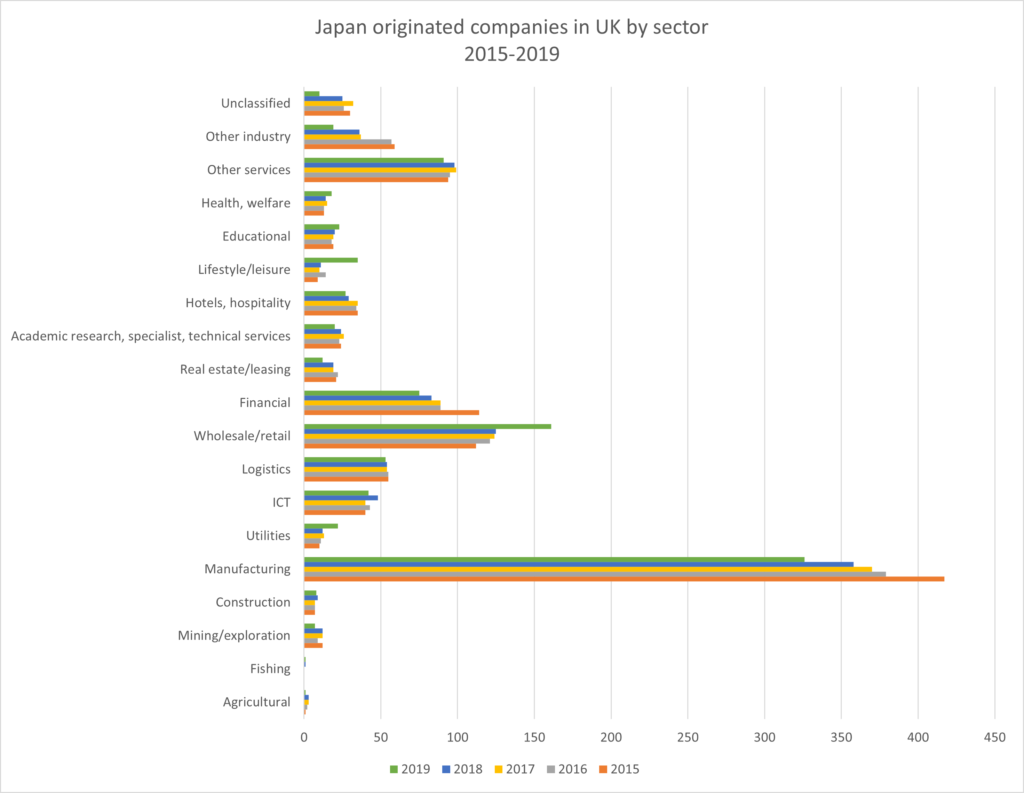
    Breaking the number down by sector also provides some insights. Japanese companies in the UK who are manufacturers are the biggest group, despite the UK’s heavily services oriented economy.  Their numbers have dropped 22% from 2014 to 2019, from 417 to 326. Conversely, the number in the wholesale and retail sector has increased 44% from 112 to 161. The changes in the two sectors may be related, as Oki, Sony DADC, Tamura, Keihin, Nicera, Zeon Chemicals and Maruwa stopped production in the UK during this period but remained as wholesalers in the UK. Financial services companies, traditionally a UK strength,  fell by a third from from 114 to 75, which is surprising considering they were active pre-Brexit in acquisitions, but perhaps again reflects some Brexit-related consolidation and divestment. Closures we are aware of include MC Asset Management, Speedloan Finance, Okasan Securities, Nomura Alternative Investment Management, Sumitomo Mitsui Asset Management.

    The sectors where there have been significant jumps in investors show where Japanese corporate interest in the UK now is. The number of Japanese utilities companies investing in the UK rose 120% from 10 to 22 and in the lifestyle and leisure sector by 289% from 9 to 35 – some new entrants we have been aware of the past couple of years in these two categories have been Hakutsuru Sake, MTG, Asahi Premium Brands, JERA Power, Nippon LP Resources, DTM Renewables and Sojitz Energy. The majority of “new” Japanese companies in the UK over the past five years were the result of acquisitions.


    For more content like this, subscribe to the free Rudlin Consulting Newsletter. 最新の在欧日系企業の状況については無料の月刊Rudlin Consulting ニューズレターにご登録ください。

    Share Button
  • Anglo-Japanese partnerships, new and old

    Anglo-Japanese partnerships, new and old

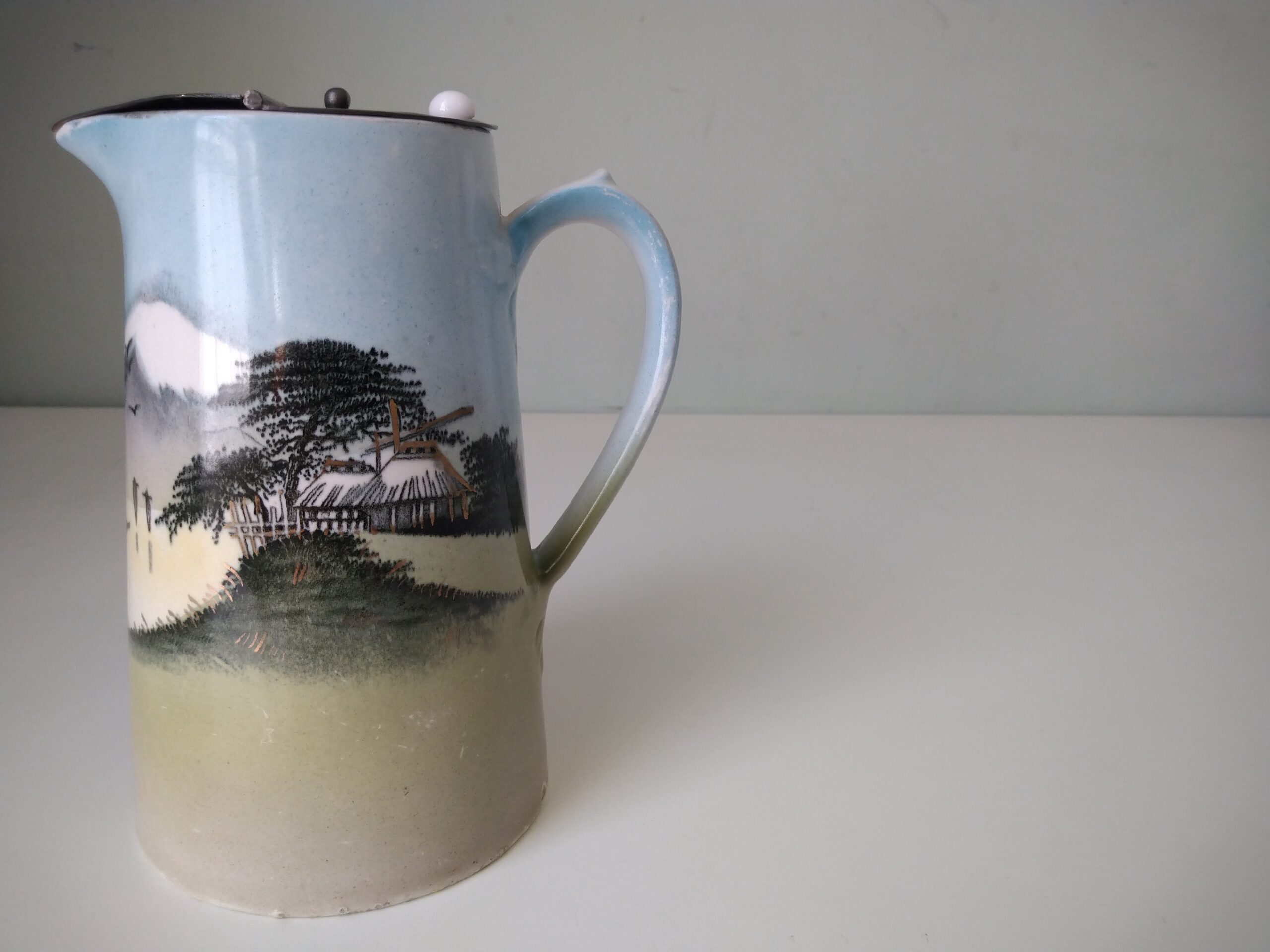
    I occasionally buy objects in local antiques shops which are a hybrid of Japanese and British design and manufacturing. Most of these date from the late 19th or early 20th century when Japonaiserie was at its peak in Europe.

    Last year I bought a milk jug decorated with a picture of Mount Fuji, junk boats and thatched houses on it. It’s a very simple traditional British shape and most of the decoration apart from the gold highlights are transfer printed rather than hand decorated.

    What caught my eye most of all was that the jug had an unusual metal hinged lid. Inside the lid is stamped “Clarke’s Patented”. It seems the lid had a design patented in the UK by a Mr Clarke, to allow the jug to pour or be filled, while keeping the lid on.

    It shows that even in the 19th century, trade between Japan and the UK wasn’t just a bilateral shipping of objects entirely made and designed in one country. Maybe the mould for the jug was exported to Japan. Was the transfer print made and designed in Japan or the UK? Was the gold highlighting applied in Japan or the UK? Was the metal lid added after the jugs arrived in the UK? It’s possible the entire jug was designed and manufactured in the UK – but was heavily influenced by Japanese export ceramics.

    This long history of interaction is why the Free Trade Agreement being negotiated between Japan and the UK is likely to be fairly basic and without much additional positive impact. A deal also needs to be reached quickly to ensure there are no new tariffs after January 1st 2021 when the Brexit transition period ends. The sector likely to produce the most gains in terms of reducing tariffs is food and agriculture, which usually causes the most difficulties and prolongs trade negotiations – so it seems likely this part will not roll over from the EU Japan EPA for the time being.

    The UK proposal reflects this, emphasising British small and medium enterprises exporting to Japan, access to Japanese government procurement and the free flow of data.

    Government procurement can also be very controversial. Many people in the UK are nervous about a trade agreement with the USA resulting in American healthcare companies being able to push for the privatisation of the UK’s national health service. There is also plenty of concern about data flows and Chinese investment in UK ICT infrastructure.

    The chief of the UN has said the world is facing the biggest crisis since World War II. For Japan and the UK the post-war period was one of austerity but also innovation. Companies such as Sony and Honda were founded in Japan and the UK established the welfare state – the nationalisation of the health service, transport and energy.

    So let us hope this crisis will bring about mutually beneficial new Japan-UK partnerships in social infrastructure and services, as well as in technology start-ups.

    This article was originally published in Japanese in the Teikoku News, on 8th July 2020.

    For more content like this, subscribe to the free Rudlin Consulting Newsletter. 最新の在欧日系企業の状況については無料の月刊Rudlin Consulting ニューズレターにご登録ください。

    Share Button
  • What is the deal with Nissan?

    What is the deal with Nissan?

    The wave of Japanese investment into UK after NSK’s first step in 1974, feared by many in the UK, did not happen immediately. Under the Labour government of 1974-79, there was double digit inflation, unemployment of over 1 million, the IMF bail out in 1976 and the Winter of Discontent, which may have been something of a disincentive to invest in the British economy. Although NSK did prove correct about a weak sterling, which at least ensured their British made exports were cheap.

    Japanese concerns over Britain’s economic, political and social stability did not end with the advent of a Conservative government in 1979, however.  It took nearly 3 years of feasibility studies, Mrs Thatcher visiting Tokyo and a visit by Nissan to NSK in Peterlee for reassurance, from the first announcement in January 1981 to when agreement was reached that Nissan could go ahead with building its UK factory in Washington, Sunderland in 1983. There were also predictions by unions and other car manufacturers of “devastation” if Nissan in the UK was just an assembly operation using cheap Japanese components.

    “Better for the British people to buy Japanese cars made by British workers than to buy German cars assembled by Turks”

    The argument made by Norman Tebbitt, then Secretary of State for Employment in April 1981 that “surely it is better for the British people to buy Japanese cars made by British workers than to buy German cars assembled by Turks” had finally won through domestically, but Nissan had also had its own misgivings which caused the delay – both from its experience in Europe and pressures in Japan from its union.

    Nissan had already dipped several toes into manufacturing in Europe. It took a stake in Moto Iberica, Spain‘s largest commercial vehicle manufacturer in 1980. The tractor division was spun off to form a new company, with Kubota taking a 55% stake and assuming managerial control. Nissan took a 67.67% stake in the rest of Motor Iberica, renaming it Nissan Motor Iberica in 1987. Manufacturing of vans and commercial vehicles continued at the plant through to the present – but not always profitably – and finally Nissan announced that it will be shut down in December 2021.

    Nissan had also in 1980 started a joint venture with Alfa-Romeo, building a plant in Italy which started production in 1982, marketed as the Alfa Romeo Arna in Italy and Germany, and the Nissan Cherry Europe in the UK. However, this venture was not a success and production was suspended in 1986.

    Nissan concluded an agreement with Volkswagen in 1987 to produce and market the Volkswagen Santana in Japan, hoping to counter criticism that the Japanese market was difficult to penetrate. Santana production was terminated in 1989, to be replaced by the Passat. Sales of imported Passats in Japan were so poor, however, Nissan cancelled the assembly agreement.

    The 1984 Nissan deal

    The Nissan union in Japan had been concerned that the size of the investment in the UK plant meant that funds would be diverted from investment in Japan, and there was no guarantee that the project would be successful. If it failed, it might even affect the security of employment within Japanese factories. Consequently, the scale of the investment was reduced from the initial announcement of a £200-£300 million investment to a two phase project, starting with a pilot plan of a £50 million investment to assemble 24,000 Bluebird cars from knockdown kits imported from Japan. This was justified as being needed to gain first-hand knowledge of operating and marketing in the UK and obtain information on local sourcing of components.

    The second phase was to be a build up from 60% local sourcing to 80% by 1991, expanding to a 100,000 units per year capacity, 30-40% of which was to be exported to Continental Europe. The total cost was put at £350 million with the British governement expected to provide selective financial assistance up to 10% of the total investment.

    Keeping to the deal in a Single Market

    Production of the Bluebird began on schedule in 1986, and the second phase began in 1987. Initially the plant made low value added models with high value-added quality cars exported from Japan, but from 1990 the Primera hatchback was manufactured in Sunderland as the sole global production source, exported back to Japan and into Taiwan. The cost of the Nissan project had risen to about £900 million by the beginning of the 1990s and output rose to 124,000 units per year in 1991.

    Whereas around 80% of the components of UK made cars were sourced in the UK when the 1984 Nissan deal was struck, by the 1990s and early 2000s the proportion had dropped to around 30-40%. Even UK components in turn contained components from elsewhere, as this comment from a supplier in the comments section of the Financial Times explains:

    “We manufacture part of one component for the Nissan Qashqai. We purchase raw materials from Taiwan, we manufacture in the UK in a Japanese owned factory. Our customer is in Germany, where our product is bonded together with products from other countries. Our customer’s customer is in France, where the bonded component is integrated into a car component. The component is shipped to Sunderland and becomes a part of a “British” car.

    How Mrs May and her merry band are going to sort this mess out is beyond me, and I suspect beyond them.

    The development time lines for the most basic of automotive components is two to three years, which means that we are already “post Brexit” for new business development. How do I persuade customers to invest in new product development with us when nobody has a clue on what basis I might sell eventually sell my product to them, and given rules of origin, in some cases on what basis they might sell their product to their customer. We have good relationships with our customers, but at the end of the day they are running their business for their benefit and may well decide its just not worth the uncertainty and risk.”

    Even if Nissan did not keep to the local sourcing part of the 1984 deal (presumably superseded by the European Single Market, so that local meant EU wide), they did expand production way beyond the 100,000 promised, peaking at 519,000 units produced in 2016/7. The 470 strong 1986 workforce grew to around  7,000 people by 2019, around 10% of whom were designers and engineers working in a design facility in Cranfield.
    Nissan also exceeded its promise of exporting 30-40% of production to Continental Europe. By 2016 nearly 1/3 of UK car production was made by Nissan, 80% exported, 55% to the EU.

    Nissan has tried to increase the proportion of locally made parts to 40% and even to 80%, to avoid tariffs and delays in the supply chain after Brexit, supported by a British government policy to reach 50%. It has encouraged suppliers to set up in a new industrial park in the North East  in order to do so, but our data does not show any move by Japanese suppliers to increase their UK presence.

    In fact the shift seems to be more towards setting up additional factories in Continental Europe. Of the 29 new automotive manufacturing operations started in Europe in 2015-2018, according to the Teikoku Databank and our researches, 8 were in Germany, 4 in France, 4 in Slovakia, 3 in Spain, 3 in Italy, 3 in Hungary and 2 in the Czech Republic but none in the UK. For the first time there are now more Japanese automotive manufacturers in Germany than in the UK.

    The 2016 Nissan deal – to Infiniti and beyond

    Even if the long term solution to a hard Brexit is to increase the number of automotive suppliers in the UK, some short term shoring up had to be done to ensure that manufacturers didn’t conclude that the safest bet was to shift all supply chains and manufacturing to continental Europe.

    Greg Clark, the former Business Secretary, revealed in 2019 that the content of  his letter to former Nissan CEO Carlos Ghosn in October 2016 included “a package of support in areas such as skills, R&D and innovation” which “could amount to additional support of up to £80m”. This was modified to £61m by 2018 due to reduced production costs. It was conditional upon Nissan continuing with plans to manufacture the new X-Trail and a new model Qashqai in the UK. Clark revealed the terms of the letter after Nissan announced that it had decided to manufacture the X-Trail in Japan in 2019, thus invalidating the deal.

    There were rumours that the government would therefore pull the aid package, but Business Minister Richard Harrington said in 2019 that the deal would still stand, and be tied to electric vehicle development, which in Nissan’s case would be the LEAF, which only represents around 10% of its production in Sunderland.

    Nissan announced in 2019 that it would no longer produce the Infiniti in Sunderland for Western Europe. It was supposed to start production of both the new Qashqai and X-Trail in Sunderland in 2019, then it said it would start the Qashqai production in October 2020, and then announced it will delay the start to mid 2021, due to the uncertainty caused by COVID-19, and – although it did not say this – by what kind of EU-UK deal there might be.  Nissan has already spent £400m readying Sunderland for the new Qashqai, supported by £11m from the UK government.

    Nissan Next and the alliance

    In May 2020 President Uchida Makoto announced Nissan Next, a a four year medium term plan, aiming to downsize and close plants such as Spain and Indonesia.  Nissan will focus on “our highly competitive midsize segment, electrification and driver assistance technology” and increase the ratio of common electric parts across the alliance of Mitsubishi, Renault and Nissan. Nissan is seeing the Ariya as its new big hope for electric vehicles after the Leaf. The Leaf was manufactured in Sunderland, whereas the Ariya is being manufactured in Japan.

    The three companies also announced the plan for the alliance in May 2020, where each will take the lead in their main sales regions, the models and technologies under development.  Nissan is to take the lead as the “reference” for China, North America and Japan. Renault will be the reference for Europe, Russia, South America and North Africa and Mitsubishi in ASEAN and Oceania. Renault has already said it would be willing to manufacture Nissan cars in its European factories if needs be, and presumably if there is a no deal Brexit and/or lack of diagonal cumulation whereby Japanese parts are not accepted as “British” by the EU, then Renault can help out Nissan in terms of sourcing EU parts.

    Clark’s 2016 letter promised to Ghosn it would “be a critical priority of our negotiation to support UK car manufacturers and ensure that their ability to export to and from the EU is not adversely affected by the UK’s future relationship with the EU”. Clark and Ghosn are both gone, so it’s unsurprising, 4 years’ on, Nissan feels the need for more reassurance that the UK government will keep to their side of the deal, whatever that turns out to be this time. If not, Renault is waiting in the wings.

    For more content like this, subscribe to the free Rudlin Consulting Newsletter. 最新の在欧日系企業の状況については無料の月刊Rudlin Consulting ニューズレターにご登録ください。

    Share Button
  • Should Japanese companies be compensated by the British government for Brexit?

    Should Japanese companies be compensated by the British government for Brexit?

    There has been some talk of whether Japanese companies who invested in the UK might seek compensation from the UK government, should the UK leave the EU in such a way as to materially damage their investments.

    To understand the basis for such a claim, we need to travel back to the early 1970s to understand what lay behind Japanese manufacturing investment in the UK, and what promises were made. Japan had recovered from the devastation of WWII to become a successful economy and trading nation.

    The oil crisis of 1973 revealed, however, that Japan was a nation that had to keep pedalling to stay on the bicycle. Over 90% of its oil was imported and 70% of its energy needs depended on oil. Exports were a means to buy this essential import, but agressive exporting had led to trade friction with western Europe and the USA.

    Investing in manufacturing bases abroad was one way to mitigate this friction and the USA, Asia and Latin America were the main beneficiaries of this from the 1950s, with western Europe joining rather later.

    The UK had just become a member of the European Economic Community, and the British government was looking at ways to give regional support to areas in the North East where coal, steel, shipbuilding and heavy engineering were in decline. The North of England Development Council opened  one of the first UK regional offices in Japan in 1975 to attract inward investment.

    NSK – one of the first Japanese manufacturers to invest in the UK

    The first major automotive related manufacturing investment in the UK was by NSK (Nippon Seiko Kaisha), Japan’s leading ball bearings and steering column manufacturer, in 1974. NSK had begun a feasibility study of European production in 1971 and considered other locations such as Ireland and the Netherlands, all of whom offered generous aid and grants. In the end the UK was chosen because of proximity of supply industries, cultural similarities, moderate industrial relations and the view that sterling would be weak over the long term.

    Although NSK’s investment in the UK was supported by the Minister for Industrial Development, Chris Chataway, the UK bearing industry sought assurances regarding the threat posed by Japanese competition. The joint communique promoted reciprocal investment in Britain and Japan, although there is no record of British ball bearing investment in Japan happening since. Instead NSK ended up acquiring the main British competitor, United Precision Industries in 1990, in addition to establishing a £7 million factory in Peterlee, County Durham, employing 220 people, which began production in 1976.

    The 1974 deal was that NSK should invest in an assisted area, and at least one half of the output should exported, with one half of the value of the product to be added in Britain, and that there should be considerable substitution of the current Japanese imports of bearings.  Chataway pointed out that it was “better for Britain that we should have investment in the UK serving the European market, rather than investment in Europe, from where the goods would be exported to Britain”.

    The official reasons for choosing Peterlee were given by NSK as being the availability of skilled labour and a good factory site and a good communications network and local amenities. Government grants and loans of £1.4 million were also provided.

    46 years later, NSK has to stockpile

    Rolling on 46 years, NSK Bearings Europe now employs over 900 people in factories in Peterlee and Newark. It acts as a contract manufacturer to NSK Europe Ltd, with a turnover of over 1 billion euros, which sells 14% of its production to the UK and 70% to the EU, to the automotive and industrial sectors. NSK has had anti-dumping duties imposed on it by the EC but an EC investigation into it found that less than 60% of imported parts were used in its finished bearings, so it was cleared of being a “screwdriver” operation. So NSK has kept its side of the bargain.

    NSK acquired Amatsuji in Japan (AKS Precision Ball in the UK) and expanded further in Europe – with factories in Poland and Germany as well as sales subsidiaries across the Continent. It has stockpiled on the assumption that there will be a no deal Brexit.  If there is a no deal Brexit, the standard third country tariff on bearings is 8%.

    So, although NSK’s investment deal was done over 40 years’ ago, a no deal Brexit would mean that the UK government has chosen to put a large obstacle in the way to NSK fulfilling the promise of that investment deal to export more than half of its UK production. It would be understandable if NSK felt this invalidated its commitment to invest in the UK. Presumably this kind of issue is why Japan has asked for some kind of investor state dispute mechanism to be put in place between Japan and the UK.

    This post draws heavily on ‘Japan and the North East of England: From 1862 to the Present Day’, Marie Conte-Helm, The Athlone Press, 1989 and ‘Japanese Manufacturing Investment in Europe: Its impact on the UK Economy’, Roger Strange, Routledge, 1993.

    For more content like this, subscribe to the free Rudlin Consulting Newsletter. 最新の在欧日系企業の状況については無料の月刊Rudlin Consulting ニューズレターにご登録ください。
    Share Button
  • Pork for cars and a fog lamp

    Pork for cars and a fog lamp

    As the UK-Japan Free Trade Agreement is in its final stages, it seems a good moment to revisit our Top 30 Japanese companies in the UK. Although the headlines seem to be heading towards “pork for cars”, the most important win-win for the UK and Japan should be protecting Japan’s investments in the UK. Japanese companies employ around 170,000 people in the UK by our estimates, and many thousands more indirectly.

    The EU-UK deal is still the biggest source of concern for Japanese companies

    There is a limit to what the UK-Japan deal can do to protect those investments, however. For Japanese companies in the UK, the EU-UK trade deal is the bigger source of concern. Many of them have their regional headquarters in the UK or have invested in the UK as their base for exporting to the rest of Europe.

    The shape (or non-existence) of a UK-EU trade deal will determine not only whether it is worth continuing with manufacturing in the UK for Japanese companies but also whether Japanese companies will continue to coordinate services regionally out of the UK such as finance, legal, IT, HR, engineering, R&D etc. These services account for why the UK has a trade surplus in services exports to Japan – it’s largely due to Japan HQ sending money to their UK based regional operations to fund professional support services needed both for acquisitions and day to day operations.

    If the barriers between the UK and the EU to mutual regulatory recognition and movement of people become too high to run European operations from the UK effectively, and as a consequence UK companies are no longer attractive investment targets, Japanese regional HQs and acquisitions will begin to drift to the continent. In fact, they already have started to shift piecemeal to the EU. No amount of bilateral recognition of services and data regulations between the UK and Japan is going to help stem this.

    According to our estimates, the number of people employed by Japanese companies in the UK levelled off comparing 2018/9 to 2017/8 – rising by only 0.2% to 170,187, having risen around 6% a year in the previous two years.

    Japanese automotive sector dominates Japanese jobs in UK, but is declining

    Our Top 30 Japanese employers in the UK employment total has also levelled out at around 94,000 or 55% of the 170,000 people employed by Japanese companies in the UK.

    Nissan (#1), Honda (#5) and Toyota (#8) employ around 18,400 – 11% or so of the total. If other Japanese automotive suppliers are added such as Denso (#20) and Unipres (#30), the total number employed is 37,489 (22% of the total employed by Japanese companies), down 2.8% on 2017/8.

    Making sure that there are tariff free automotive components from Japan for manufacturing in the UK will help sustain Japanese manufacturing in the UK at least in the short term, if tariffs are imposed on EU automotive imports as part of the UK-Japan FTA or there’s a no deal. But the shift in automotive production to eastern Europe has been going on for some time.

    Japanese trading companies growing steadily in the UK but no acquisitions

    The UK, or more especially London, has been the commercial and trading location of choice for Japanese companies in Europe for over 100 years. At the heart of this are Japan’s trading companies – Mitsubishi Corporation, Mitsui & Co, Sumitomo Corporation, Itochu, Marubeni and Sojitz. They are still involved in commodity trading but also financing and more recently acquisitions – although there have not been any UK acquisitions since 2017. The most notable recent European acquisition was Mitsubishi Corporation acquiring Dutch energy company Eneco in 2019 for €4.1bn.

    Japanese trading companies currently employ around 14,700 people in the UK, and this has grown just under 2% a year over the past couple of years

    Japanese financial services holding steady in the UK

    The next biggest Japanese sector in the UK is financial services, including MS&AD (#15), MUFG (#16), Nomura (#17), SMFG (#22), Mizuho (#29). It accounts for around 13,000 employees and growth has been around 1% to 2% a year.

    All Japanese financial services companies that are impacted by Brexit have set up or strengthened their subsidiaries in the EU, but the scale of these organisations is still far smaller than their UK operations. There may be an issue eventually not so much about the quantity as the quality of these EU subsidiaries for the EU – they will want to see the decision makers based in the EU as a condition for regulatory approval. But as most decisions are ultimately made by multiple people in Japan headquarters, it is not clear how Japanese companies can respond to such a demand. In the meantime, Japanese financial groups are repositioning their London operations as EMEA (Europe, Middle East and Africa) headquarters.

    Electronics, ICT and acquisitions

    Fujitsu (#3), the pioneer of big acquisitions in the UK (ICL in 1990) is no longer the biggest Japanese employer in the UK, having shrunk its workforce by 38% since 2014/5. Sony (#9) has also cut its workforce by 11% over the past four years. Canon (#12) and Ricoh (#7) have grown by less than 10%, Brother (#28) grew around 15%, Mitsubishi Electric (#27) by 17%. Konica Minolta (#24) has grown over 40% in the past 4 years through acquisitions but seems to be shifting more towards the Czech Republic recently.

    NTT (#11) and Hitachi (#2), both with ex Japan global HQ in the UK, have grown 60% and 175% respectively over the past 4 years, partly through acquisitions but also in Hitachi’s case through organic growth, with the investment in the rail manufacturing and assembly plant in Newton Aycliffe.

    Other new entrants over the past four years have been through acquisitions too – Outsourcing (#26) in recruitment, Sumitomo Rubber (#19) through its acquisition of Micheldever in 2017 and SoftBank acquiring (and soon to be disposing of) ARM.

    A holding pattern until the fog clears

    The years of double digit growth and acquisitions by Japanese companies in the UK seems to be coming to an end, or at least is on hold until the picture is clearer after the fog lifts from the UK-EU negotiations and the coronavirus pandemic. The UK-Japan FTA does not clear this fog, but at least lays out a path for the UK, which Japan very much would like it to follow, of reintegrating itself back into the rules based international order, towards joining the CPTPP and continuing to be one of Japan’s closest allies in terms of digital security and strategic interests.

    [download_after_email id=”5842″]

    For more content like this, subscribe to the free Rudlin Consulting Newsletter. 最新の在欧日系企業の状況については無料の月刊Rudlin Consulting ニューズレターにご登録ください。

    Share Button
  • Are Japanese companies leaving the UK because of Brexit yet?

    Are Japanese companies leaving the UK because of Brexit yet?

    I asked this question just over a year ago and the answer is still yes and no. To which I would add, it’s more a case that Japanese companies aren’t investing in or coming to the UK as much as they used to, replacing the ones that are leaving or downsizing.

    Asia continues to dominate as location for Japanese companies overseas

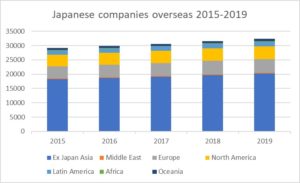
    The number of Japanese companies overseas is, according to Toyo Keizai*, continuing to increase – up 65% from 2008, but the rate of increase has been slowing since 2013. The number of Japanese companies overseas grew 2% from 2018 to 2019, with growth in all regions –  higher growth in Africa/Oceania (from a small base) but only 1% growth in Europe compared to 3% in North America and Asia.

    63% of Japanese companies overseas are in ex-Japan Asia – up from 62% in 2018 and 69% of the employees of Japanese companies abroad are in Asia. Around 15% of Japanese companies abroad are in Europe and 14% in North America, with both regions having around 11% of employees. As pointed out last year, the obvious factor in why there are proportionately more employees to number of companies in Asia compared to Europe and North America is the greater number of manufacturing operations in Asia, with larger workforces.

    The number of UK employees of Japanese companies has fallen for the first time, by 9%

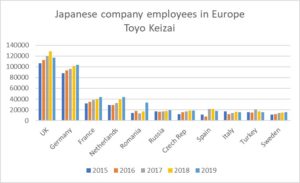
    Within Europe, the number of people employed by Japanese companies rose 18% from 2015 to 2019. Those countries where the number of Japanese company employees has fallen are countries where there has been a rise in populism, civic unrest and political risk. UK employee numbers fell 9% 2018-9 (the first decline since at least 2015), Spanish employee numbers fell 19% 2018-9, Hungary’s fell 18%, Turkey’s 10%, Poland and Italy also showed small decreases in employee numbers.

    Countries where Japanese employee numbers are growing are the Netherlands (up 11% 2018-9), France (10%), Germany (2%) and the Czech Republic (2%).  Employee numbers in Romania doubled from 2018-9 but this is largely due to Toyo Keizai recording employee numbers at Alcedo (acquired by Sumitomo Corporation in 2011) as being 20,284, having been 318 in 2018. The 2018 number is more in line with other available data.

    Number of Japanese companies in UK has fallen for first time

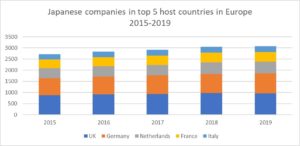
    The number of Japanese companies in the UK has fallen by 1% 2018-9, from 972 to 966, the first drop since at least 2015, having risen 11% 2015-2018. France also saw a 2% drop in the number of Japanese companies, even though employee numbers are up. Germany attracted a 4% increase in Japanese companies from 2018-9, having risen 13% 2015-8. Netherlands had a 1% increase 2018-9 (13.5% 2015-8) and Italy had a 2% rise in Japanese companies 2018-9, and an increase of 11.8% 2015-8.

    It’s hard to work out where Toyo Keizai derives the net drop of 6 Japanese companies in the UK from. Their list of the 7 companies which have closed down in the UK 2019 shows that this was mainly due to reorganization of holding companies or merging of companies rather than full withdrawal from the UK.  Of the 8 new Japanese companies in the UK in 2019, 5 were indirect investments into energy companies by Nippon Koei, a civil engineering company and 2 were indirect investments by WDI, a Hong Kong originated Dim Sum chain which is registered in Japan.

    Germany now hosts more Japanese automotive companies than the UK

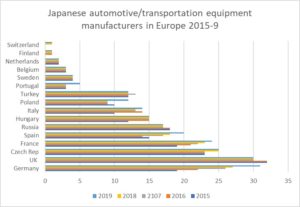
    The Japanese automotive sector is of course the sector being most carefully watched for Brexit impact. Japanese automotive manufacturers are continuing to set up overseas – the total number globally has increased 10% in 2019 on 2015.  And “despite” the EU-Japan EPA, 15 more Japanese transportation equipment manufacturers set up in Europe in 2019, a 20% cumulative increase  on 2015.  Of the 15 new companies, 4 are in Germany, 3 in Poland, 2 in Spain, 2 in Portugal, 1 in France, 1 in Italy, 1 in Slovakia and 1 mystery one.  This means Germany now hosts more automotive/transportation equipment companies than the UK – 31 to the UK’s 30.

    Japanese acquisitions of UK companies reduced in scale and number

    Toyo Keizai’s data is reliant on companies filling in their surveys, so tends to underreport and often misses acquisitions. From my database, I estimate 20 British companies were acquired by Japanese companies in 2019-2020, although some of them were indirect acquisitions through acquiring a parent company with a subsidiary in the UK. Dentsu and Sony continued to acquire UK based companies, and other acquisitions were of British companies in software, gaming, hotels, seafood, recruitment, a manufacturer of drives for electric motors and paper wholesale.  The scale is far less than in previous years, both in terms of numbers of acquisitions and value of the deals.

    Even adding these acquisitions in shows a 3% drop in the number of people employed by Japanese companies in the UK from 2018/9 to 2019/20 according to my database – the first drop since I started tracking these numbers in 2015.

    * Toyo Keizai Data Bank: Directory of Japanese Companies Abroad 2020

    For more content like this, subscribe to the free Rudlin Consulting Newsletter. 最新の在欧日系企業の状況については無料の月刊Rudlin Consulting ニューズレターにご登録ください。
    Share Button