



The spring 2022 Santander Bank Trade Barometer survey showed that 33% of UK businesses who were only domestic in focus up until now have ambitions to internationalise in the next three years – a greater proportion than in any previous survey. It was also the first time that overseas markets were seen as the most important driver of business recovery from the pandemic.
With growth prospects looking dim in the UK and trade with the EU having become more difficult thanks to Brexit, British companies are seeing overseas markets as their main source of growth, just as Japanese businesses did when the economic bubble burst.
This conclusion is illustrated in the Santander report with a photograph of a geisha in a taxi, looking at a mobile phone, but according to the survey, the main non-EU overseas markets that British companies are interested in are the US and Australia, EU countries such as Germany and France, and then India and China – ahead of Japan.
The survey was of around 1000 UK businesses with a minimum £1m turnover. Those companies who already had business overseas said they are selling more into non-EU markets than before Brexit. They saw the main operational challenges in most markets as shipping costs and bureaucracy. It was only for Japan that language and culture and having to adapt products and services accordingly were seen as the primary challenges. Perhaps deregulation in Japan and smoothing of inward investment has had an impact – bureaucracy in Japan was far less of a concern than for China, USA, India, Germany, UAE, Spain, Italy and France.
Of those British business who are currently domestic only, 42% are expecting to use online marketplaces and 40% are expecting use their own ecommerce site to sell their products. They will no doubt find that language and culture will indeed be an issue, even virtually, if they want to do business with Japanese customers. Their website will not only have to be translated, but their offering needs to be adapted to Japanese customer preferences. My belief is that physical presence in Japan is necessary for success, but only 20% are considering physical presence in the overseas markets.
Those businesses who are UK domestic but are now looking overseas also say their primary source of advice on overseas business is the internet. Whereas those who already have experience of overseas business say their main source of advice is a business partner in the target market.
I suspect many of these internet searches for advice will end up on our Japan Intercultural Consulting website, but it is notable that the only serious consulting enquiries we get are from companies who already have a physical presence or are about to set up an office in Japan. They have all been service sector companies – in recruiting, IT, advertising and financial services.
For them, the key challenge in Japan is recruiting, managing and retaining good quality employees – which may be why partnering with a Japanese company is still a preferred route.
This article by Pernille Rudlin first appeared in the Teikoku Databank News on 10th August 2022



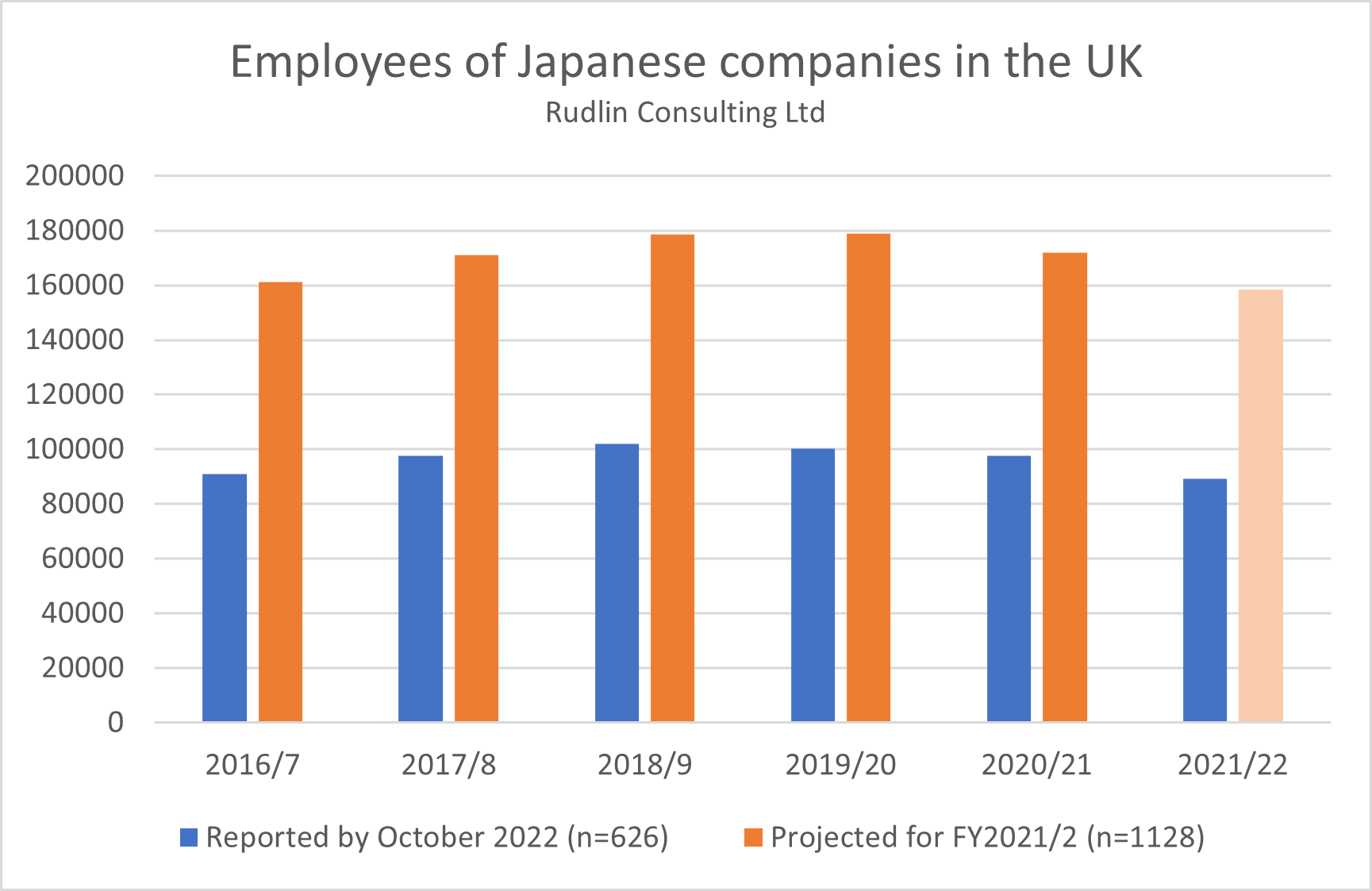 Overall, the total number employed by those Japanese companies in the UK who have reported their results has fallen by 8% over the past year. This is an acceleration of a decline which started three years ago – employee numbers had fallen 3% the previous year, and 2% the year before that. This was preceded by a couple of years of growth from 2016/7 to 2018/9. Projected, this suggests that the number of people employed by Japanese companies in the UK will fall to 158,000 by the end of the financial year 2021/2, below the 161,000 that were employed by Japanese companies in 2016/7 and a 14,000 drop on the numbers employed in 2020/1.
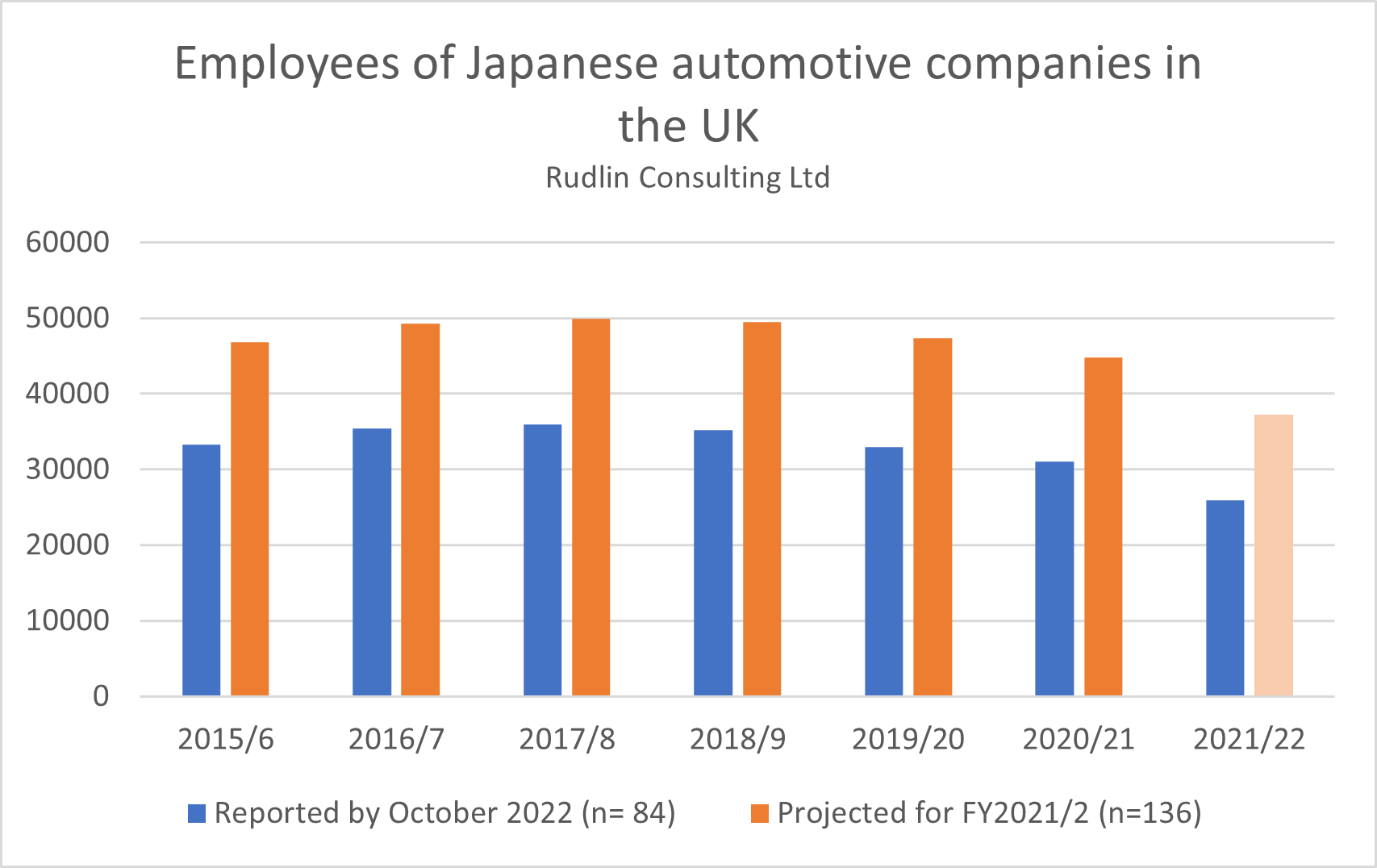 It is certainly partly due to the impact of Honda closing its Swindon factory in July 2021. That meant the loss of nearly 3,000 jobs and it looks likely a further 5,000 jobs will have been lost in the automotive sector over the past year – many of which were dependent on Honda. The decline in employment in the automotive sector began in 2018/9, a year or two before other sectors began to lose jobs.




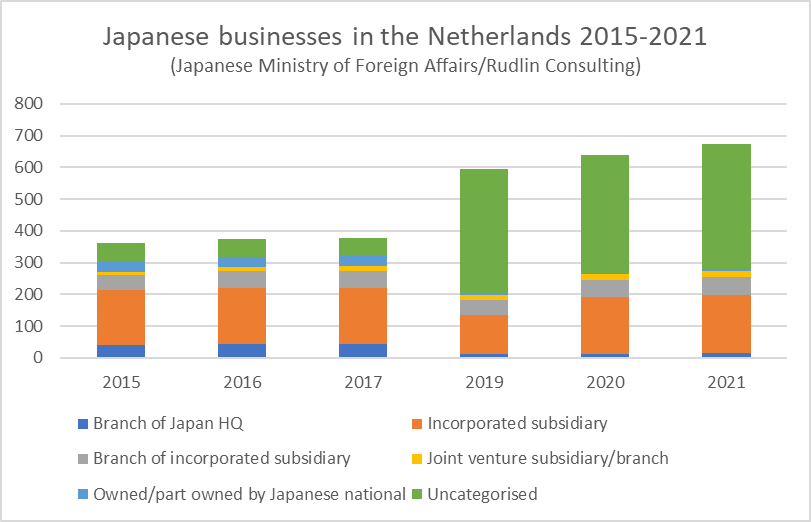 Partly this is due to the large proportion of potentially “brass plate” type Japanese companies, with no employees in the Netherlands – often the regional holding company for a group of companies. Partly it is due to the lack of disclosure – information on companies in the Netherlands does not seem to be as readily available as it is in the UK, where data on
 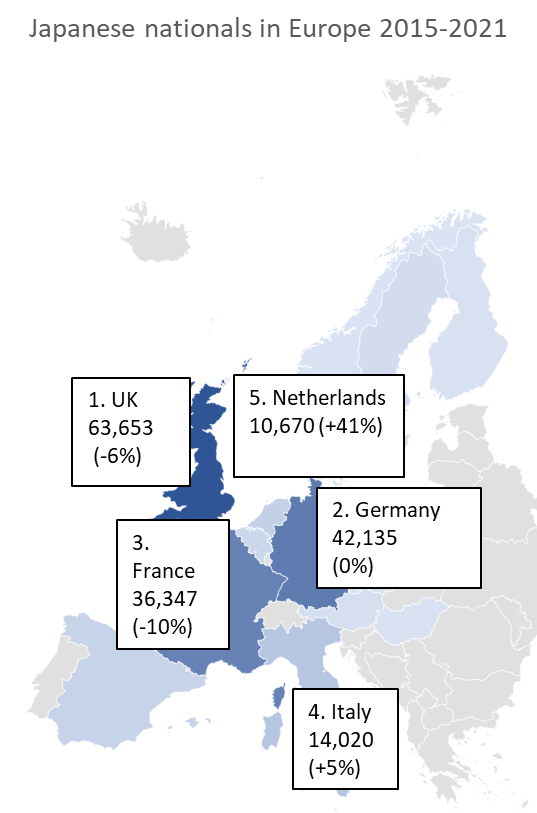 potential customers or employers, it is important to understand this, as the regional headquarters tend to be where the decision makers, big budgets and the most interesting career paths will be based. The number of Japanese expatriates in the country is also an indication of where the decision making influencers are. Although the Netherlands is only the 5th largest host of Japanese nationals in Europe, after the UK, Germany, France and Italy, this number has grown 41% since 2015.
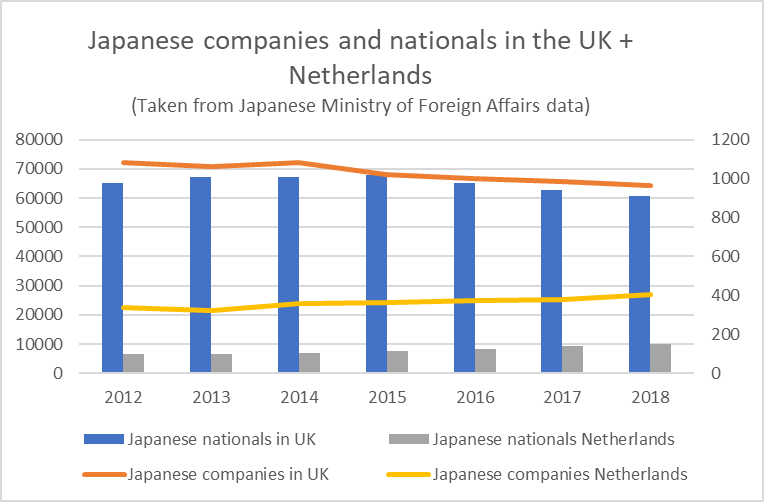 The companies we have identified employ around 48,000 people, a 29% increase on 2017/8 – the vast majority (39,000) of whom work for the Top 30 employers in the Netherlands. Japanese companies in the UK, by comparison, employ around 170-180,000 people, and there has been a slight decline in numbers over the past 5 years.