Rudlin Consulting Rudlin Consulting
  • About
  • Services
  • Blog
  • Clients
  • Publications
  • Contact us
  • Privacy
  • English
  • About
  • Services
  • Blog
  • Clients
  • Publications
  • Contact us
  • Privacy
  • English
  •  

Japanese business in Europe

Home / Archive by Category "Japanese business in Europe" ( - Page 14)

Category: Japanese business in Europe

Video: the Brexit agreement one month on

Pernille Rudlin, Managing Director of Rudlin Consulting and David Henig, Director, UK Trade Policy Project at European Centre for International Political Economy participated in a Japan Society webinar on February 4th 2021, talking and answering questions about the Brexit agreement one month on, the impact on Japanese companies in the UK so far and what the future might hold. A video of the whole session is available below:

For more content like this, subscribe to the free Rudlin Consulting Newsletter. 最新の在欧日系企業の状況については無料の月刊Rudlin Consulting ニューズレターにご登録ください。

Share Button
Read More
Are there 10% or 1% fewer Japanese companies in the UK than five years’ ago? And why?

We covered in a previous post how Japan originated companies continued to increase their presence in Europe – apart from in the UK and Switzerland – over the past 5 years.  We used the Japanese Ministry of Foreign Affairs annual data, which showed an 11% decline from 1,064 Japan originated companies in the UK to 951 in 2019.

The other source of data on Japanese investment overseas is the Toyo Keizai annual directory. This shows a 1% decline in Japanese companies in the UK from 2018-9, from 972 to 966. It’s the first drop since at least 2015, numbers having risen 11% 2015-2018, according to the Toyo Keizai totals for the UK. We analysed this further in this post, noting that it’s hard to work out where Toyo Keizai derives the net drop of 6 Japanese companies in the UK from. Their list of the 7 companies which have closed down in the UK 2019 shows that this was mainly due to reorganization of holding companies or merging of companies rather than full withdrawal from the UK. Of the 8 new Japanese companies in the UK in 2019, 5 were indirect investments into energy companies by Nippon Koei, a civil engineering company and 2 were indirect investments by WDI, a Hong Kong originated Dim Sum chain which is registered in Japan.

Subsidiaries turning into branches

The Ministry of Foreign Affairs only breaks down its figures by organisational type and sector, but this does provide further clues. The biggest absolute decrease in numbers is amongst those categorized as a subsidiary incorporated in the UK. There were 480 such companies in the UK in 2014 – this fell 16% to 404 in 2019. Conversely branches of local subsidiaries rose 31% from 179 to 226. This seems to indicate that a fair number of UK incorporated subsidiaries unincorporated and became branches over this period, particularly over 2018-9.  This tallies with what we have observed empirically – most famously with Sony Europe and Panasonic Europe becoming branches of EU subsidiaries but also a dozen or so others such as Takeda, Shionogi, Sanden, Fujitsu General, Murata and Alps becoming EU branches.

It looks like Brexit also provided an excuse to do a bit of tidying up, – consolidating multiple subsidiaries into one, for example. The Ministry of Foreign Affairs data also include companies established by a Japanese national with over 10% share in equity in its figures. This number has shrunk by 68 since 2014 to 96. We suspect this may be in part to do with those Japanese nationals becoming permanent residents in the UK or British citizens (other MoFA figures show this group has grown considerably) and therefore no longer included.

Manufacturing turning into wholesaling

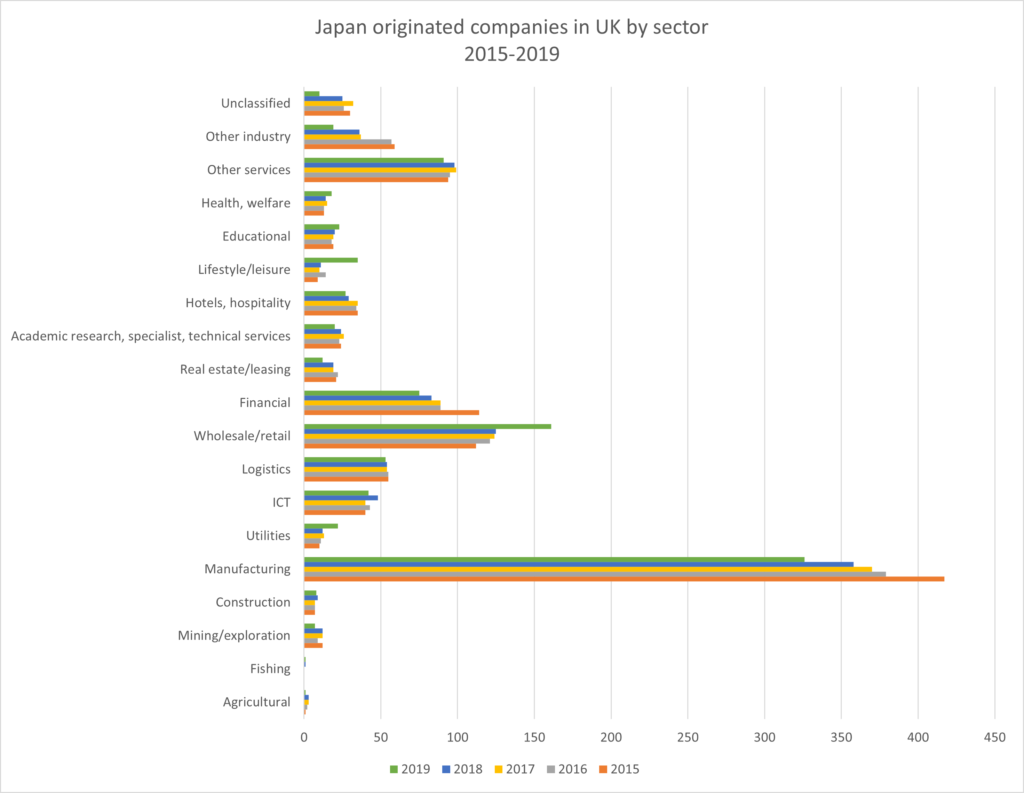
Breaking the number down by sector also provides some insights. Japanese companies in the UK who are manufacturers are the biggest group, despite the UK’s heavily services oriented economy.  Their numbers have dropped 22% from 2014 to 2019, from 417 to 326. Conversely, the number in the wholesale and retail sector has increased 44% from 112 to 161. The changes in the two sectors may be related, as Oki, Sony DADC, Tamura, Keihin, Nicera, Zeon Chemicals and Maruwa stopped production in the UK during this period but remained as wholesalers in the UK. Financial services companies, traditionally a UK strength,  fell by a third from from 114 to 75, which is surprising considering they were active pre-Brexit in acquisitions, but perhaps again reflects some Brexit-related consolidation and divestment. Closures we are aware of include MC Asset Management, Speedloan Finance, Okasan Securities, Nomura Alternative Investment Management, Sumitomo Mitsui Asset Management.

The sectors where there have been significant jumps in investors show where Japanese corporate interest in the UK now is. The number of Japanese utilities companies investing in the UK rose 120% from 10 to 22 and in the lifestyle and leisure sector by 289% from 9 to 35 – some new entrants we have been aware of the past couple of years in these two categories have been Hakutsuru Sake, MTG, Asahi Premium Brands, JERA Power, Nippon LP Resources, DTM Renewables and Sojitz Energy. The majority of “new” Japanese companies in the UK over the past five years were the result of acquisitions.


For more content like this, subscribe to the free Rudlin Consulting Newsletter. 最新の在欧日系企業の状況については無料の月刊Rudlin Consulting ニューズレターにご登録ください。
Share Button
Read More
Hitachi in the UK – from TVs to trains (part 1)

Hitachi’s first foray into manufacturing the UK in the 1970s was extremely fraught. Undeterred, 10 years later, it established its European headquarters in the UK, where it has been located since. It has kept faith with the UK through turbulent times, establishing the global headquarters for its rail business in the UK in 2014.

Hitachi had a sales arm in the UK since 1970, marketing “portable monochrome television receivers, radios and record-players”. This was heralded in The Times as “another challenge on the home market from a Japanese rival” (1) noting that this was the third Japanese group to enter the UK home market in recent months (the other two being Sony and Matsushita).

The enemy within the walls

As with much of Japanese manufacturing investment overseas at the time, setting up production within the European Community (EC) was done to avoid accusations of dumping, and to ensure there was enough local content to satisfy the European Commission. Hitachi initially considered a greenfield site in Washington in the North East of England for manufacturing TVs in 1975, shortly after Sony and Matsushita had established manufacturing in the UK. This attracted such hostility from UK domestic competitors worried about overcapacity that Hitachi shelved the idea.

Hitachi was hoping to source cathode ray tubes from British firm Mullard, the only UK manufacturer of colour TV tubes, who were initially very reluctant. They maintained in 1977 that they were not ready to accept a Hitachi offer to buy 25,000 of its tubes a year from 1980. Jack Akerman, Mullard’s managing director, sounded positively sniffy about Hitachi’s technology. “We must be absolutely satisfied that our merchandise is going to be used in a technical environment where it will perform well and live well. If all the technical points are answered and we are satisfied, then it would be acceptable for Mullard and Hitachi to trade together in the event that Hitachi’s new factory were welcomed to this country by the Government.”(2)

The Times ran an opinion piece by the commercial editor Derek Harris asking if Hitachi was going to become “the enemy within the walls”. (3) It detailed a rumour that Finnish made TV tubes (from a partly Hitachi owned company) might supply Hitachi in the UK instead, in return for British fighter aircraft exports to Finland, in an offset deal between governments. It described how Mullard’s real concern was not technological compatibility so much that the British TV industry had substantial overcapacity, so Mullard supplying Hitachi would simply result in damage to existing UK customers of Mullard such as Rank, Thorn and Mullard’s sister company Pye (both were owned by the Dutch company Philips).

Harris quotes Akerman as saying “those first few years will be as smooth as silk. But then – watch out. In Japan they are planning for the year 2000, They want to dominate the electronic equipment business and, as we have said consistently, we don’t blame them.”

“Critically endangered” by tube imports from Japan

Derek Harris wrote a further piece in The Times in October 1978 (4) noting the warning from the European Electronic Component Manufacturers’ Association that the European electronics industry was being critically endangered by cheap imports from Japanese TV component makers.  The tubes represented a third of the value of a TV set, and out of every 100 colour sets sold in the EEC, 33 contained tubes made in Japan. This was to intensify in the early 1980s when licensing agreements expired, opening the EEC to the larger colour TV sets made in Japan. UK TV manufacturers had an informal agreement with the Japanese industry on import restraint, but nonetheless, it was estimated that Britain’s TV and audio industry was operating at only 50% capacity.

The UK government then introduced Hitachi to the General Electric Company (the UK company that eventually became Marconi, not the US company General Electric) and the two companies formed a joint venture, GEC-Hitachi Television Ltd,  in December 1978 and adopted an existing GEC television factory in Aberdare, Wales, along with a workforce of over 2,000.

Hitachi takes over GEC factory

The British continued to manage the plant, and Hitachi invested nearly £3m in new plant and equipment, and provided technical support. At first sales were good, building up a 10% UK market share. By the early 1980s, overmanning and industrial strife led to losses. GEC sold its half of the company to Hitachi in March 1984 and it became Hitachi Consumer Products Ltd. Hitachi instituted a one union policy and reduced the workforce to 800. The plant also began to manufacture hi-fi equipment. Mullard was a supplier to Hitachi, along with Tabuchi Electric who had set up production in the UK in 1985. Philips changed the Mullard name to Philips Components in 1988.

Hitachi also started a video cassette recorder plant in Germany and eventually the German plant also manufactured TVs and the Wales plant also manufacturered VCRs, with German made cylinder heads and chassis being shipped to the UK and British made PCBs being exported to Germany. This meant the local content for both TVs and VCRs were around 80-90%.(5)

The bubble bursts

In the 1990s competition from cheaper TVs and VCRs made in developing countries made it difficult for Hitachi and other UK based Japanese manufacturers to compete. The Aberdare plant was closed in 2001, with the loss of 700 jobs. Hitachi said it would focus on higher value added products in Europe such as plasma screens, projectors for home cinema, DVD camcorders and in-car navigation systems.  After several years of losses, Hitachi Consumer Products UK Ltd was wound up in 1995-1997 and the business transferred to Hitachi Home Electronics, until it too was liquidated in 2003, with remaining assets and business transferred to Hitachi Europe.

(1) The Times, 21 August 1970, p 20

(2) The Times, 10 November 1977, p 20

(3) The Times, 18 November 1977, p 21

(4) The Times, 4 October 1978, p 22

(5) Much of this post is based on pages 304-9 of Japanese Manufacturing Investment in Europe, Its impact on the UK Economy, Roger Strange, Routledge 1993

For more content like this, subscribe to the free Rudlin Consulting Newsletter. 最新の在欧日系企業の状況については無料の月刊Rudlin Consulting ニューズレターにご登録ください。
Share Button
Read More
Takiron – first Japanese company in Wales

Takiron was one of the first Japanese manufacturers to set up in the UK, in 1972. It was the first Japanese company to come to Wales and the third to start production in the UK, in 1974, after YKK and Nittan. It manufactured PVC corrugated sheeting after acquiring an existing factory in Bedwas, Gwent, mostly for export to Europe and America.

The Times in 1972 saw this investment as Japanese chemical and trading companies (Itochu and Chugai Boeki were also investors) “launching a big attack” on the European PVC sheet market through a UK subsidiary. (1) Just before it started operations, a spokesman for Takiron said they had been able to hire British workers at 10%-30% lower rates than they would in Japan, thanks to the current exchange rate, so even with the high cost of raw materials in the UK, it would be possible to export to Europe and America at a competitive price. The president of Takiron at the time, Matsui Yanosuke, even thought exports to Japan from the UK would be a possibility. (2)

One of the first employees was also one of the first Japanese people to be “locally hired” in the UK by a Japanese company – Midori Matsui. She had been visiting the UK on a break from teaching English at junior high school in Japan when a childhood friend at Takiron called her to offer her a job at the new company, teaching English to the new expatriates and helping them to set up the business.

She ended up staying at Takiron for 29 years, becoming a director of the company,  until retiring in 2000. According to an interview with her in the Japan Times in 2001, she was thinking of returning to Japan, but was expecting to keep visiting Wales, as she said she would miss the warmth of the Welsh people, and the green fields and open skies. Clearly their appeal was too strong, and she continued to live in Wales, until her death in 2016 at the age of 80.  She helped to organise the Japan 2001 celebrations and other local Japan related activities, and was awarded an MBE and a Japanese Foreign Minister’s commendation.

Although she says in the interview that the British lack of commitment to deadlines and work was “different now”, it’s a comment still heard regularly from Japanese working in the UK. But so is her point that the British are forgiving of mistakes and differences, unlike in Japan.

Former Wales rugby player Ken Jones was managing director and then chairman in the 1980s and 1990s. When the pound began to strengthen so that by January 1980 it was around Y550 compared to Y350 in 1979, and the UK went into recession, Jones was upbeat in a Daily Mirror interview: “we have invested £120,000 in new machinery” and added that the staff identified themselves closely with the company – “there’s a high degree of participation here. ” (3)

By 1991 Takiron UK employed 68 people (3) but from the mid 1990s it began to lose money and had shrunk to 57 employees by 2001. Takiron blamed the strong pound and continued high price of raw materials for its difficulties and decided to close in 2001.

The plant was supposed to be taken over by a manufacturer of roller doors in 2006 but was still empty in 2007, when it was taken over for the “biggest rave in South Wales.”

Takiron started as Takigawa in 1919, changing its name to Takiron in 1959. It is owned by the Japanese trading house Itochu and in 2017 it merged with C.I. Kasei (itself a merger between Hama Kasei and Kobe Resin) to form C.I. Takiron. C.I. Kasei had invested 32m euros in setting up a factory in Treviso, Italy in 2007, under the name of Bonlex Europe. The local vocational school was one of the key factors for choosing the location, providing courses in woodworking and automotive, relevant to the plastic films to decorate wood panels and car interiors that the factory produces.

Bonlex is the only subsidiary C.I. Takiron now has in Europe.

(1) The Times, October 4 1972 p 20

(2) The Times, June 7 1973 p 25

(3) The Daily Mirror, 27 November 1980 p 6

(3) Japanese Manufacturing Investment in Europe: Its impact on the UK economy, Roger Strange, Routledge, 1993


For more content like this, subscribe to the free Rudlin Consulting Newsletter. 最新の在欧日系企業の状況については無料の月刊Rudlin Consulting ニューズレターにご登録ください。

Share Button
Read More
Mitsubishi Electric in the UK – 1979 to present

In January 1979 Mitsubishi Electric UK took over a colour TV plant in Haddington, East Lothian from bankrupt Norwegian company Tandberg, saving 120 jobs. Exports of colour TVs from Japan to the EU and particularly the UK had risen rapidly in the early 1970s, even though they were restricted to small screen sets. Then demand in the UK came to a sudden end and TV manufacturing in the UK had excess capacity. So the British government encouraged Japanese companies to take over existing plants. Japanese companies also chose the UK for manufacturing in Europe because there were no domestic manufacturers with government connections as there were in France (Thomson-Brandt) and the Netherlands (Philips). (1)

Mitsubishi Electric already had a representative office in London from 1969 and had turned it into subsidiary in 1972. This then became a branch of Mitsubishi Electric BV in the Netherlands in 1996. It has continued as a branch of the Netherlands based European regional HQ since.

By 1987 Mitsubishi Electric had established video recorder production facilities in Livingston, along with many other Japanese manufacturers starting production in Europe, in response to pressure and anti dumping proceedings from the European Commission. (2)

It acquired Britain’s Apricot Computers in April 1990, with a plant in Glenrothes and R&D in Birmingham, employing 442 in 1991. PC production was scheduled to treble to 100,000 per annum in 1993, with exports accounting for 25% of production, half to Japan. (3) Glenrothes was shut in 1999, blaming cheap competition in Asia.

The Haddington plant continued to make  colour TVs and also microwave ovens, but when the price of TVs dropped, it was no longer profitable. In 1998 production ended, with 500 jobs lost. Production was transferred to Turkey.

Alister Jack, the then Scottish Tory spokesman on economic affairs, who later became Secretary of State for Scotland, attacked the Labour government on the closure: “There is little point of introducing a New Deal programme if they cannot hold on to existing jobs.”

Mitsubishi Electric hoped to focus on video recorder production and air conditioning at their Livingston plants. However, in 1999 it announced it would cut 6.100 jobs overseas and 8,400 jobs in Japan due to losses caused by falling semi-conductor prices and weak demand for consumer products.

The Livingston operation entirely focused on air conditioning and R&D for Europe moved there in 2013, with Mitsubishi Electric investing £20 million into the operation.

In 2017 air conditioner production started at Mitsubishi Electric’s new factory in Turkey.  Thanks to the customs union with the EU, air conditioning exports from Turkey to the EU are tariff free.

Mitsubishi Electric Air Conditioning UK employed over 1000 people In 2019. 77% of  its sales of £200m were to non-UK EU countries, 20% to the UK. The plant was profitable despite a large increase in gas and  transportation costs.

The UK is seen as a growing market, despite any Brexit impact, because of the need for green, affordable public sector housing.  Mitsubishi Electric is dependent on imported components, but it is standard industry practice to hold 2.5 months of inventory, so it is hoping to weather any post Brexit logistics impact.


(1) Japanese Manufacturing Investment in Europe: Its impact on the UK economy” Roger Strange, Routledge, 1993 p 196

(2) ibid p 201

(2) ibid p 264

Photograph of Campbell Gill ~ Personnel Manager and Eric Murray the General Manager with the joint Managing Director Yoshio Noguchi  1984, credit: Angus N Bathgate https://www.facebook.com/groups/oldeastlothain/permalink/2402751853280700

For more content like this, subscribe to the free Rudlin Consulting Newsletter. 最新の在欧日系企業の状況については無料の月刊Rudlin Consulting ニューズレターにご登録ください。

Share Button
Read More
Japanese companies and nationals are continuing to come to Europe, but…

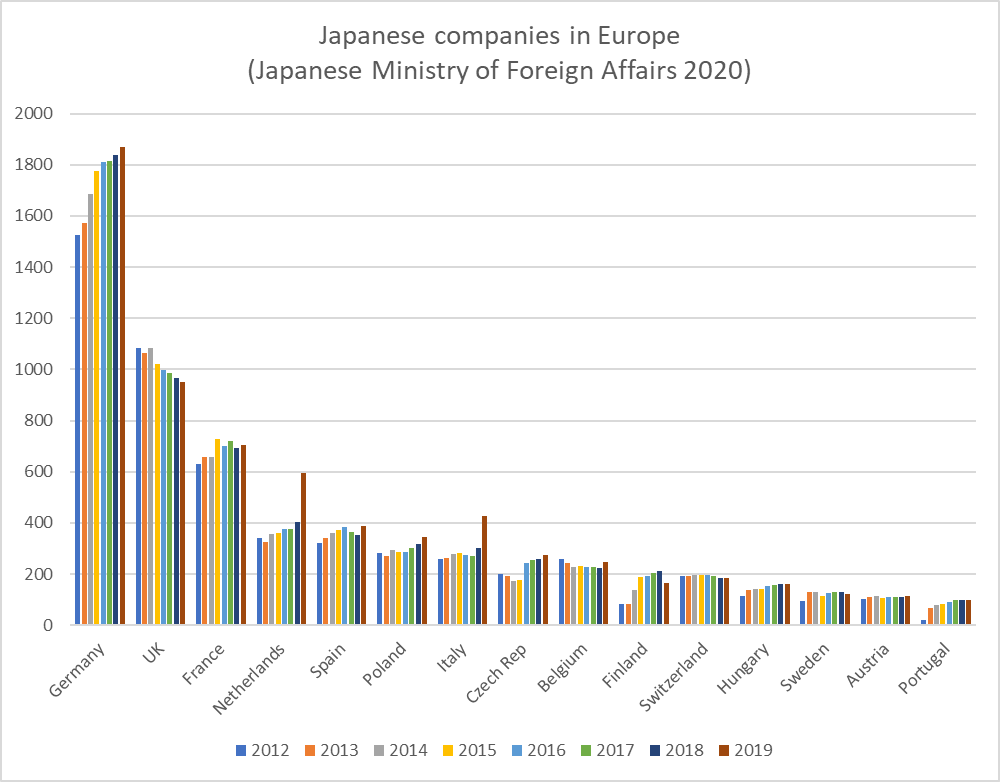
The chart below tells the main story of recent movements in the presence of Japanese companies in Europe pretty clearly. An ever increasing number of Japanese companies (including branch offices and joint ventures) are appearing in Europe, whether through greenfield investment or acquisition. The only two countries in the top 15 hosts of Japanese companies which have seen a decline over the past five years in the number of Japanese operations on their territory are the UK and Switzerland. 

Italy and the Netherlands have seen big leaps in the numbers of Japanese companies operating within their borders. Germany continues to dominate, hosting over 1800 Japanese operations, nearly double the next biggest host, the UK.  France is the third largest host, but seems stuck around the 700 mark.

Although they were not released until September 2020, the Ministry of Foreign Affairs (MOFA) figures are for October 2019. However they tally in some ways with the story told by the December 2020 JETRO survey of Japanese companies in Europe which we blogged about here. According to that survey Poland, Germany and Hungary and the Czech Republic are seen as the most promising sales destinations and importing from Japan under the EPA was particularly focused in the Czech Republic, Netherlands, Belgium, Italy and Germany for 2021.  Italy’s 2019 leap may be squashed back down in 2020, as Italy, UK, Sweden, France and Hungary were the countries in which Japanese companies thought their business would shrink. For Italy this may be to do with the impact of the coronavirus epidemic.

Unfortunately MOFA has changed the way it compiles – and it would seem classifies – these numbers. Digging into the detail of why numbers in Italy and the Netherlands shot up from Oct 2018-Oct 2019 shows that in Italy there was a large rise in the number of locally incorporated subsidiaries and branches (as opposed to branches of the Japan HQ or joint ventures). In the Netherlands there was a decrease in the number of headquarter owned branches and locally incorporated companies and their branches, and a rise in the number of “unclassified” from zero to 394.

The sudden rise in the number of companies and branches owned by Japanese companies may have something to do with Hitachi acquiring various Ansaldo rail businesses from Finmeccanica in Italy. Similarly, MItsubishi Corporation acquired Dutch energy company Eneco, which may have entailed taking on a large number of subsidiaries and branches. It seems clear the Netherlands was the favoured destination for Japanese companies looking to relocate headquarters functions, particularly in services, sales and logistics, as a Brexit back up.

Japanese nationals in Europe

MOFA have also changed the way it compiles statistics on Japanese nationals overseas. Until 2017 the data included categories for permanent residents, intra company transferees, media, entrepreneurs, academics and students etc. But from 2018 the number is only broken down into long term residents and permanent residents.

How students are categorised also seems to have changed, and this has impacted the UK in particular – possibly because the UK itself also changed visa categories recently, particularly how students or trainees studying in the UK for less than a year are treated. For the last available year, 2017, the numbers of students and other academia related Japanese nationals had fallen by nearly 5,000 since a peak of 21,035 in 2014 in the UK. But student numbers had increased over the same period for other European locations and in Australia, New Zealand and Canada, with a small decline in the USA.

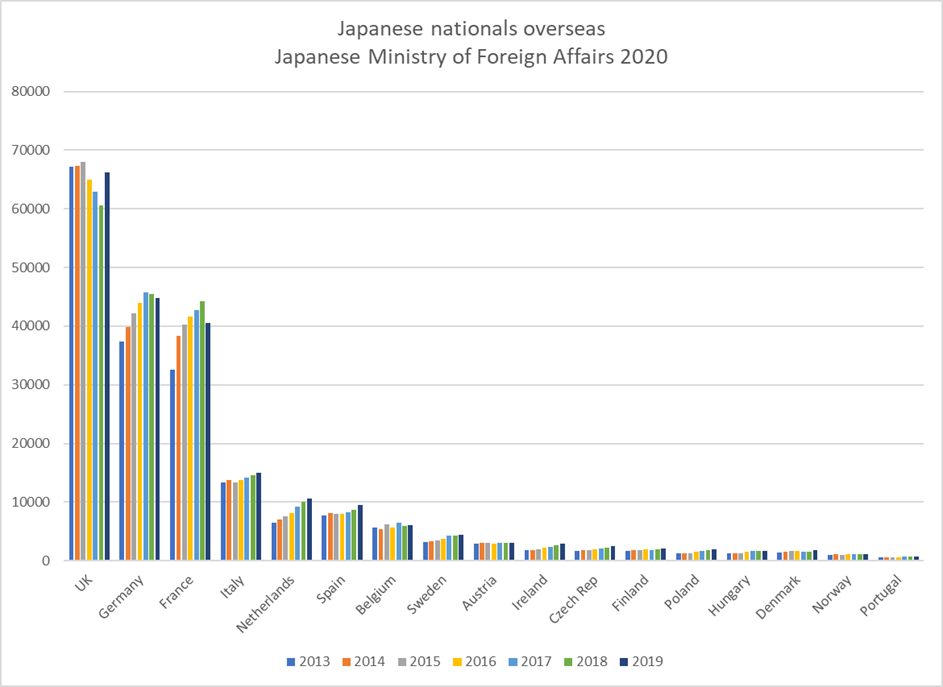
This fall in the number of students was a major contributor to the overall decline in the numbers of Japanese nationals in the UK from a peak of around 68,000 in 2015 to 62,887 in 2017. Intracompany transfers had also been declining since a peak of 19,552 in 2013, to 17,752 in 2017.

The surprise of the 2019 data released by MOFA in October 2020 is that the number of Japanese nationals in the UK has shot up again, after 3 years of decline. In October 2018 there were 60,620 Japanese nationals in the UK but this rose to 66,192 as of October 2019.  As no further detail is provided, it could be that some students and company trainees are now being counted as long term residents again. As the number of Japanese companies has declined, the only other explanation is that 6,000 more Japanese students decided to come to the UK in 2019 compared to the previous three years or so.

Conversely there has been a decline in the number of Japanese nationals in Germany for the second year running and a significant drop in the number of Japanese in France, whereas Italy, Netherlands and Spain have all showed a rise in the number of Japanese resident there.

The overall trend for Europe is positive – a 15% rise in the number of Japanese nationals resident in the region since 2013 to around 234,000 (95% of them in Western as opposed to Eastern Europe) and a 19% increase in the number of Japan owned companies in Europe to around 8,000 since 2013. The rate of increase has been the same for both Western and Eastern Europe. In the past three years the rate of increase has been slightly faster in Eastern Europe. 79% of  Japanese companies in Europe continue nonetheless to be based in Western Europe, suggesting that the trend is for existing Japanese companies in Western Europe to open additional operations in Eastern Europe.

For more content like this, subscribe to the free Rudlin Consulting Newsletter. 最新の在欧日系企業の状況については無料の月刊Rudlin Consulting ニューズレターにご登録ください。

Share Button
Read More
Germany, Netherlands and Eastern Europe favoured in Japanese companies’ plans for in Europe

The annual JETRO (Japan External Trade Organisation) 2020 survey of Japanese companies in Europe has just been published and shows the impact of the EU-Japan and UK-Japan EPAs  – largely in increasing Europe-based Japanese companies’ procurement from Japan.

Japanese companies’ view of the next couple of years show that growth is expected in Eastern Europe and Germany, with Germany increasingly providing a regional coordination function. It looks like the number of employees and Japanese expatriates may be reduced over the next couple of years and there will be more  investment in digital transformation and interest in green technology and digital technology state supported projects.

Of the 949 companies who responded, 286 were in Germany, 162 in the UK, 111 in the Netherlands.

Brexit

The biggest concern for Japanese companies in Europe regarding Brexit is the impact on the UK economy.  Other concerns  are potential changes in UK regulations and laws and how this will differ from the EU. For manufacturing, the use of the CE mark and for services, the movement of people between the UK and the EU were of particularly concern.

60% of Japanese companies in Europe felt no impact of Brexit during the transition period. 40% of Japanese companies in the UK expect a negative impact from Brexit in 2021 whereas only 19.6% of Japanese companies in the EU expected a negative impact.  More than a third of Japanese companies in the UK and the EU were not sure what the impact would be.  Unsurprisingly, 70% of Japanese manufacturers in the UK were worried about their exports to the EU and of those nearly 90% were most concerned about customs processes. 80% of Japanese companies in the UK and the EU were worried about delays in logistics. Around 50% had made preparations for no deal, including increasing stocks, changing transportation routes, restructuring their organisations, changing procurement and setting up new locations.

EU-Japan EPA and UK-Japan EPA and procurement

The impact of the EU-Japan EPA and future impact of the UK-Japan EPA has also become apparent. The proportion of materials/components (particularly plastic components/automotive parts) sourced from Japan by Japanese companies in the EU has risen 5.2% to 36.6% from before the EU-Japan EPA and more than 70% of Japanese companies in the UK are considering or are using the UK Japan EPA to procure from Japan.  Importing from Japan under the EPA was particularly focused in the Czech Republic, Netherlands, Belgium, Italy and Germany.  Exporters to Japan that have been most keen to make use of the EPAs are in the chemicals/petrochemicals sector.  Around 30% of Japanese companies in the UK see some merit in the UK-Japan EPA.

Nonetheless, there is a clear trend towards procuring more within the EU, particularly in Central and Eastern Europe. However procurement from the UK by EU based Japanese companies looks set to continue, with only 10% planning to decrease their purchasing from the UK. Conversely, 25% of Japanese manufacturers in the UK are expecting to decrease their procurement from the EU.  I wonder whether this will change now the rules of origin in the UK-EU FTA have become clear.

Sales and profitability

Only 48.5% of Japanese companies in Europe expect to be profitable in 2020/1, the lowest proportion since 2012. Falling sales is the main cause, along with cross border restrictions and a drop in consumer demand because of the coronavirus. Unsurprisingly, Japanese hotels and travel companies are particularly hard hit.

The average proportion of sales of Japanese companies in Europe to EU countries is 73%.  25.4% of UK based Japanese companies say the proportion of EU sales of their total turnover has shrunk, but this is 8.1% lower than last year. Respondents were significantly more optimistic in Central and Eastern Europe than in Western Europe.  In particular 45.2% of manufacturers in Central and Eastern Europe expected to expand in the next 1-2 years. Poland was most cited as a promising sales destination, along with Germany, Hungary and the Czech Republic.

Forecasts and plans for 2021-2

30% expect business activity to normalize in the second half of 2021, 26.6% in the first half of 2021.  The most cited plans for 2021 are reduction of personnel and expatriates from Japan, as well as reviewing the product range, digital transformation (particularly in Italy, UK and Belgium) and reviewing of suppliers. Japanese companies are also showing interest in the green investment support and digital investment support being offered in European countries, particularly in Italy, UK and Belgium for digital and Spain, Ireland and Czech Rep for green investment.

Overall, more Japanese companies in Europe than ever are expecting business to continue “as is” over the next 1-2 years, with 14.5% of UK based Japanese manufacturers expecting business to shrink, 5.3% more than last year.  Japanese companies in Netherlands, Switzerland, Portugal and Germany are more likely to expect to expand over the next couple of years than in other countries, and there was a significant increase in the number of Japanese companies in Germany who said they were performing regional coordination functions in Europe compared to the previous year. More than 10% of Japanese companies in Hungary, Sweden, Italy, France and the UK were expecting their business to shrink.


For more content like this, subscribe to the free Rudlin Consulting Newsletter. 最新の在欧日系企業の状況については無料の月刊Rudlin Consulting ニューズレターにご登録ください。

Share Button
Read More
Anglo-Japanese partnerships, new and old

I occasionally buy objects in local antiques shops which are a hybrid of Japanese and British design and manufacturing. Most of these date from the late 19th or early 20th century when Japonaiserie was at its peak in Europe.

Last year I bought a milk jug decorated with a picture of Mount Fuji, junk boats and thatched houses on it. It’s a very simple traditional British shape and most of the decoration apart from the gold highlights are transfer printed rather than hand decorated.

What caught my eye most of all was that the jug had an unusual metal hinged lid. Inside the lid is stamped “Clarke’s Patented”. It seems the lid had a design patented in the UK by a Mr Clarke, to allow the jug to pour or be filled, while keeping the lid on.

It shows that even in the 19th century, trade between Japan and the UK wasn’t just a bilateral shipping of objects entirely made and designed in one country. Maybe the mould for the jug was exported to Japan. Was the transfer print made and designed in Japan or the UK? Was the gold highlighting applied in Japan or the UK? Was the metal lid added after the jugs arrived in the UK? It’s possible the entire jug was designed and manufactured in the UK – but was heavily influenced by Japanese export ceramics.

This long history of interaction is why the Free Trade Agreement being negotiated between Japan and the UK is likely to be fairly basic and without much additional positive impact. A deal also needs to be reached quickly to ensure there are no new tariffs after January 1st 2021 when the Brexit transition period ends. The sector likely to produce the most gains in terms of reducing tariffs is food and agriculture, which usually causes the most difficulties and prolongs trade negotiations – so it seems likely this part will not roll over from the EU Japan EPA for the time being.

The UK proposal reflects this, emphasising British small and medium enterprises exporting to Japan, access to Japanese government procurement and the free flow of data.

Government procurement can also be very controversial. Many people in the UK are nervous about a trade agreement with the USA resulting in American healthcare companies being able to push for the privatisation of the UK’s national health service. There is also plenty of concern about data flows and Chinese investment in UK ICT infrastructure.

The chief of the UN has said the world is facing the biggest crisis since World War II. For Japan and the UK the post-war period was one of austerity but also innovation. Companies such as Sony and Honda were founded in Japan and the UK established the welfare state – the nationalisation of the health service, transport and energy.

So let us hope this crisis will bring about mutually beneficial new Japan-UK partnerships in social infrastructure and services, as well as in technology start-ups.

This article was originally published in Japanese in the Teikoku News, on 8th July 2020.

For more content like this, subscribe to the free Rudlin Consulting Newsletter. 最新の在欧日系企業の状況については無料の月刊Rudlin Consulting ニューズレターにご登録ください。

Share Button
Read More
“Japanese companies are weak at the top” – Horiba’s CEO

I was recently asked what Japanese company’s mission statement I most admired and I said Horiba’s “Omoshiro okashiku” which is translated into English as “Joy and Fun” (but the fun also means quirky, or as Horiba says “interesting” which is what I think many Japanese companies are to Western eyes, and that’s a good thing).  I know from reports from our consultants in Germany that this ethos is transmitted to the overseas subsidiaries too. This interview with the President of Horiba in Nikkei Business by Higashi Masaki, the Editor, is so interesting, I have not made a precis, rather with big help from Google Translate, have left it pretty much as is.

——————

Since Horiba Atsushi took office as president, sales have increased more than five times, and overseas employees are now the majority, transforming it into a global company. He has also developed a unique corporate culture, including calling employees “Horibarians” regarding them as part of the family. We asked about Japan’s challenges as seen by companies competing globally in technology development.

(Interviewer: Masaki Higashi, Editor-in-Chief of Nikkei Business)

PROFILE

Atsushi Horiba was born in 1948 in Kyoto Prefecture. After graduating from Konan University Faculty of Science in 1971, he joined Olson Horiba, Inc. of the United States. He then joined HORIBA, Ltd. in 1972. He is also graduated from the Department of Electronic Engineering, Faculty of Engineering, University of California, USA in 1977. After that, he directed the overseas expansion of the group, and after working as a director in 1982 and managing director in 1988, became president in 1992. He has also served as chairman since 2005. He has been in his current position for18 years. He is also the face of the local business community, such as serving as the vice chairman of the Kansai Economic Federation. He is the eldest son of Masao Horiba, the founder of HORIBA, Ltd.

The automobile industry is greatly affected by the new coronavirus.

It was a difficult time for car makers even without the coronavirus. This is because there is a dramatic switch towards  “CASE” (Connected, Autonomous, Sharing, Electric). It is necessary to move from the “hard” industry, which competes through productivity gains to steadily manufacture high-quality cars, to the “light” industry, which has become IT (information technology) intensive. What was a simultaneous equation with one variable has now become treble the pain.

HORIBA has the largest share of car exhaust gas inspection equipment in the world. The main business is conventional car-related products.

Electric vehicles will be the mainstream in urban areas. However, the combustion type will not disappear in areas with harsh climates. Regulations will also become stricter. However, it is not a growing market, so I would like to expand the CASE field.

How to secure human resources is very important. In 2015, we acquired a British company called Mira (which supports the development of automobiles). We wanted the excellent R & D unit of about 600 people, but it also had test equipment related to CASE. Mira’s test track has research bases for automobile manufacturers such as Toyota (automobile) and major parts manufacturers, so tests and research can be done together.

The company motto is “Joy and Fun”, but is that feeling the same even with the coronavirus?

Now more than ever is the time to have “joy and fun”. All managers are at a loss now. Even so, we don’t feel so sad because we are working in various fields under this company motto. “Fun” does not mean “funny” but “interesting”. With that idea, we shifted our direction. It’s not absolute, but I feel that this helps us be responsive.

It is necessary to strike a good balance between being extremely advanced in a specific field and expanding the range in order to foster new businesses?

To be honest, I don’t think this is managed properly. But that’s what’s interesting, and it’s made up of the enthusiasm of each unit. Trust is at the base. For example, if you are studying optics, you can think of many people who would be good to consult with within the company.

It is unreasonable to expect people who are developing the products that are profitable now think about what the future needs will be. There is no Superman in the world. In many cases, human resources are crushed in search of Superman.

What kind of human resources are you looking for?

I often say that I don’t want a guy who has a good memory, that is, a guy who just graduated from a good university with good grades. Some of the students who are considered to be excellent in the world outside join us, but from our point of view, they are also “stupid” children (laughs). I often join in on the quiz shows for highly educated people on TV, but they are just competing for memory and have no sense.

What does ‘sense’ mean?

Whether you are interested. That is, whether you can do “joy and fun” However, if only “sharp angled” human resources are hired, the company will collapse. That is the balance.

In order to maximize the breadth of the business, it is necessary to have an organizational structure for that purpose.

Now, the biggest issue is the wall between each department. In a pyramid-type organization, individual departments do their best, but there is no interface to connect the results. But if the organization is flat, it’s not necessary. It’s in a mixed state. Instead, the person above needs to be a Superman who can figure out where and what is going on (laughs).

Is the solid financial structure with an equity ratio of over 50% also a factor that guarantees the realization of “interesting and funny”?

Companies with weak internal reserves will have a hard time during coronavirus. When it was said that it was bad to retain earnings, I thought that retained earnings should definitely be increased. This is to ensure that opportunities for M & A (merger / acquisition) are not missed. If you have to ask the bank for money, it may be too late and the target is acquired by someone else.

What do you see as the challenges facing the Japanese economy now?

We manufacture all the key products such as detectors, filters and electronic boards in-house. The problem with Japan is that we have go outside to get the basic science for these key products. You cannot apply knowledge if you do not have the basic science. Nevertheless, Japanese industry and academia are only doing applied science.

We have R & D units in France, Germany and the United States because the academia of these countries never let go of the basic science. Not only is China accumulating product know-how, but it is also conducting basic research. China is the best-selling market for the latest optical analyzer developed in France. It’s neither Japan nor the United States. We need to be aware of the fact that China is doing this very thoroughly.

It is a worry that China’s technological capabilities are rising rapidly.

Japan has not lost yet. I just don’t know after 4-5 years where we’ll be. They are thinking very clearly about the combination of academia and industry. The winners and losers in a battle of comprehensive strength are becoming clear. How do you get around this? I don’t like the word “niche,” but we’ve survived because we’ve put more people and money into a specialty than a giant company.

The Japanese, and Japanese technology and schools are excellent. However, various regulations and past shackles are in the way. For example, why does the faculty council have personnel rights even at universities? At Tsinghua University in China, the top management is steadily being replaced with excellent human resources. But in Japan, once you get tenure, you stay in academia until retirement. This is such an unfair situation.

Are there any other obstacles to your competitiveness?

If I weren’t Japanese, I would have headquartered in California, USA, and the company would have been three times as large as it is now. Taxes are high and fixed costs are high in Japan. Our main medical base is located in France because of problems with Japanese regulations. We just pay lip service to “deregulation” and in the meantime Japan declines.

Industry-academia-government must think about industrial policy and decide what to make a strength.

Even if the government and others hold meetings to gather the top executives of large companies, they cannot take the plunge because they have a company. When I first became President I was called by the Ministry of International Trade and Industry (currently the Ministry of Economy, Trade and Industry), and when I talked about what I thought, I wasn’t called on again. The people around me just gave textbook answers.

However, the current Ministry of Economy, Trade and Industry is different from that time. What is worrisome is that bureaucrats who are trying to reform in line with our opinion tend to be off the career track.

Do they not want to change?

Perhaps they prioritize their own lives rather than the country. The sense of life or death of officials and politicians of the Meiji era is not there. I’m afraid that there is no sense of crisis about the fact that Japan is buying in more and more technology now.

China’s “brain” is talented people educated in the United States. There is no brain in Japan. People who are active (at the forefront) don’t end up leading government councils. Even if the technology and the times change, Japan still has excellent human resources, but they cannot “overtake” the incumbents. It’s the same with the top executives of large companies.

Because the term of office is fixed, the number of “salarymen” in top management has increased.

There is absolutely no business that will produce results in 6 years [the usual stint as President of a Japanese company] after investing from zero. It just means continual losses.

It takes at least two years for our products to be researched, tested, designed and finalized. It will be five years if the basic research is redone. It will take another 2-3 years to make a profit from it. Many things can be done with technology and machines, but this is useless if you do not develop people as well.

When the top executive who started a growth business retires after six years, and that business is making losses, he is said to be the “worst executive”, and when the next top executive harvests from what his predecessor has sown, he is celebrated as “great”. That shouldn’t be the case.

Don’t avoid developing leaders

What does it take to enable top management to think about things in the long run?

Japan is overwhelmingly strong in terms of both technology and human resources. The only weakness is the top. The United States and China are working hard on how to raise the elite. If we don’t train leaders, society won’t progress. On the other hand, in Japan, “elite” is a forbidden concept. In Japan, both politicians and business owners are a disorderly mob.

Japan is in a very dangerous state now. It has become a bogus democracy. True democracy has competition, and everyone is different. In the United States, they first educate elementary school pupils about how different each person is. But in Japan, it’s like “stop it, you’re annoying the old guy.” The responsibility of the media is also heavy.

It’s rare for a person at the top of a listed company to have a beard.

I nearly died of hepatitis when I was about 35 years old. Until then, I was just being the diligent president’s son. But at that time, I thought this is a turning point and I thought I would live a life where I do what I think is best, no matter what others say. My beard is a proof of that. From then on it became a lot easier.

You don’t know what works and how it works.

It feels like God only knows the future (laughs). However, there is a belief that we will make the best decision at that time by listening directly to the stories of people on the front line. I’ve done my best so I can’t help if it doesn’t work. However, people end up worrying about seeking more than the best.

You end up just wanting the correct answer.

The difficulty of management is that there is no correct answer. Everyone has the illusion that there is a correct answer, but there isn’t. The answer will come.

Side note from the interviewer Higashi Masaki

I don’t know if it’s because Japan has become richer or there is more inequality now, but as Mr. Horiba points out, “how individuals live” rather than the desirable way of organizations such as countries and companies should be has become increasingly the priority. It is important to note that the pursuit of personal well-being can sometimes be inconsistent with the interests of the organization.

For example, there is a tendency for top management to change and quickly write off assets of unprofitable businesses to generate a deficit. Then their predecessor has not made a loss, and the successor is certain to recover in a V shape during his term. The rewards for the two executives may be good, but is the timing as an organization optimal? As the mobility of talent increases, the relationship between individuals and organizations can become more difficult.

For more content like this, subscribe to the free Rudlin Consulting Newsletter. 最新の在欧日系企業の状況については無料の月刊Rudlin Consulting ニューズレターにご登録ください。

Share Button
Read More
Japanese companies need a strong employee brand to attract globally minded employees

I spoke to a group of Japanese managers in London last year on the topic of my last article “I love Japan but I don’t want to work in a Japanese company” – an attitude I have heard from young Europeans who have studied Japanese at university, or worked in Japan for a couple of years on the JET scheme, or simply became fans of Japanese culture through a love of anime and computer games.

They don’t want to work for Japanese companies because they think they won’t have a fun and fulfilling career. They worry that there will be lots of overtime, bureaucracy and an oppressive hierarchy – and that Japanese companies in Europe are mostly dull, engineering sales subsidiaries.

My recommendation to the Japanese managers in the audience was to strengthen the “employee brand” in Europe, to make it more appealing to those young people.  Many European veterans of Japanese companies have told me that they like working for Japanese companies because they are different, interesting, quirky, more “human” and long term in orientation rather than the standardised, numbers driven, short termist culture of many Western multinationals.  Japanese companies should also offer short term secondments to Japan, so that their non-Japanese graduate hires can build networks and participate in decision-making and so develop their careers.

I realise it is tough for Japanese managers in Europe to ask their Japanese headquarters to adjust their employee brand just to appeal to overseas recruits, when Japan headquarters probably think their priority is to hire the best globally minded Japanese graduates.

So I showed them some research from Japanese recruitment company DISCO’s Caritas Research 2020 survey of Japanese students graduating from foreign and Japanese universities. It illustrates that the needs of Japanese students from foreign universities are similar to those of European students.

Whereas graduates from Japanese universities preferred a job which will provide them a secure lifestyle, would rather work in Japan rather than overseas and to work for one company for a long time, the preference of Japanese graduates of foreign universities was for a job which helped them realise their dreams, paid well, and would prefer to work overseas rather than stay in Japan.

Apart from strengthening the employee brand and offering more attractive career paths, another recommendation I made was that management training was needed for Japanese expatriates in leadership, giving feedback, managing diversity and being inclusive when managing Europeans.

I was of course hoping this would lead to more business for my company, but judging by one of the managers who approached me afterwards, it might not be for the reasons I expected.  The managing director said his company was 80% Japanese, but there were big communication gaps between the younger generation and the older, between those who had graduated from foreign universities or lived abroad, and those who had mainly worked, lived and studied in Japan.  Clearly Japanese companies are having to adjust to different mindsets amongst Japanese employees too.

A video of Pernille Rudlin’s presentation on this topic is available on the Rudlin Consulting YouTube channel here in English and here in Japanese.

The original version of this article was published in Japanese in the Teikoku Databank News.  Pernille Rudlin’s new book  “Shinrai: Japanese Corporate Integrity in a Disintegrating Europe” is available as a paperback and Kindle ebook on  Amazon.

For more content like this, subscribe to the free Rudlin Consulting Newsletter. 最新の在欧日系企業の状況については無料の月刊Rudlin Consulting ニューズレターにご登録ください。

Share Button
Read More

Search

Recent Posts

  • Japan – EMEA business update April 2026
  • Data and trust in Japan and Europe
  • Japan – Europe, Middle East & Africa business update
  • Japan in the UK – The Brexit Agreement 5 and 10 years on
  • Biggest European companies in Japan

Categories

  • Africa
  • Brexit
  • China and Japan
  • Corporate brands, values and mission
  • Corporate culture
  • Corporate Governance
  • cross cultural awareness
  • CSR
  • customer service
  • Digital Transformation
  • Diversity & Inclusion
  • European companies in Japan
  • European identity
  • Foreign companies in Japan
  • Foreign Direct Investment
  • Globalization
  • History of Japanese companies in UK
  • Human resources
  • Innovation
  • Internal communications
  • Japanese business etiquette
  • Japanese business in Europe
  • Japanese customers
  • M&A
  • Management and Leadership
  • Marketing
  • Middle East
  • negotiation
  • Presentation skills
  • Reputation
  • Seminars
  • speaker events
  • Sustainability
  • Trade
  • Uncategorized
  • Virtual communication
  • webinars
  • Women in Japanese companies
  • Working for a Japanese company

RSS Rudlin Consulting

  • Japan – EMEA business update April 2026
  • Data and trust in Japan and Europe
  • Japan – Europe, Middle East & Africa business update
  • Japan in the UK – The Brexit Agreement 5 and 10 years on
  • Biggest European companies in Japan
  • Two swallows make a summer?
  • Biggest foreign companies in Japan
  • Japanese financial services in the UK and EMEA
  • The puzzle of Japanese foreign direct investment in the UK
  • What is a Japanese company anyway?

Search

Affiliates

Japan Intercultural Consulting

Cross cultural awareness training, coaching and consulting. 異文化研修、エグゼクティブ・コーチング と人事コンサルティング。

Subscribe to our newsletter

Recent Blogposts

  • Japan – EMEA business update April 2026
  • Data and trust in Japan and Europe
  • Japan – Europe, Middle East & Africa business update
  • Japan in the UK – The Brexit Agreement 5 and 10 years on
  • Biggest European companies in Japan

Meta

  • Log in
  • Entries feed
  • Comments feed
  • WordPress.org

Posts pagination

« 1 … 13 14 15 … 27 »
Privacy Policy

Privacy Policy

Web Development: counsell.com

We use cookies to personalize content and ads, to provide social media features, and to analyze our traffic. We also share information about your use of our site with our social media, advertising, and analytics partners.