Rudlin Consulting Rudlin Consulting
  • About
  • Services
  • Blog
  • Clients
  • Publications
  • Contact us
  • Privacy
  • English
  • 日本語
  • About
  • Services
  • Blog
  • Clients
  • Publications
  • Contact us
  • Privacy
  • English
  • 日本語
  •  
The perils of car hire in Europe

Travelling around the UK and Ireland in the past couple of months has been an insight into the unpredictable impacts of the pandemic and the disruption of global supply chains on people’s everyday lives. I went to Ireland in August, to see my family in Cork, spending the first few days in Dublin. There was a very prosperous buzz there, but many young people were complaining about the cost of living, particularly rent and house prices.

Dublin was full of American tourists but in the holiday area on the coast of county Cork, there were very few Americans and most of the tourists seemed to be British.  Usually, American tourists like to hire a car from Dublin airport and then tour around Ireland, often in search of their Irish ancestry. But this year they were quoted such high prices for car hire that they decided to stay in Dublin and travel by train or go on a coach tour to other locations.

The high price of car hire is due to the car hire firms being unable to take delivery of new cars at the rate they would normally expect, so there is a shortage of cars to hire if they retire old stock. Similarly, individual drivers are waiting longer for new cars so have to keep to their old cars longer, which then break down, and parts cannot be obtained easily for repair. They then have to hire a car while they wait for their old car to be fixed – putting further pressure on supply.

When I hired a car last month to drive to Kent, in the southeast of England, it broke down. The repair man was immediately able to spot the problem. The car needed a new battery as the existing one was too old to recharge properly. He also noticed that the coolant had completely run out. The car had clearly not been valeted as there were stains on the seats and dirt on the floor. The repair man told us that car hire firms are having to re-hire their cars so quickly, they do not have time to give them a proper service or clean.

Back in Ireland, my cousin, who is a conveyancer, told me that although there were fewer American tourists in Cork, she was selling more properties to Americans than before the pandemic. Cork has been a popular location for American IT and pharmaceutical companies for some years, but more recently American employees have relocated from the USA to work from Ireland.  Now remote or hybrid working has become more acceptable, they felt happier about their families being raised and educated in Ireland, than having to endure active shooter drills at schools in the USA.

I am about to hire a car in France, where apparently second-hand cars are selling for the same price as new, and some people are resorting to hiring cars from individuals rather than car hire firms. I am bracing myself for what I might be about to experience.

This article by Pernille Rudlin first appeared in Japanese in the Teikoku Databank News in November 2022

For more content like this, subscribe to the free Rudlin Consulting Newsletter. 最新の在欧日系企業の状況については無料の月刊Rudlin Consulting ニューズレターにご登録ください。

Read More
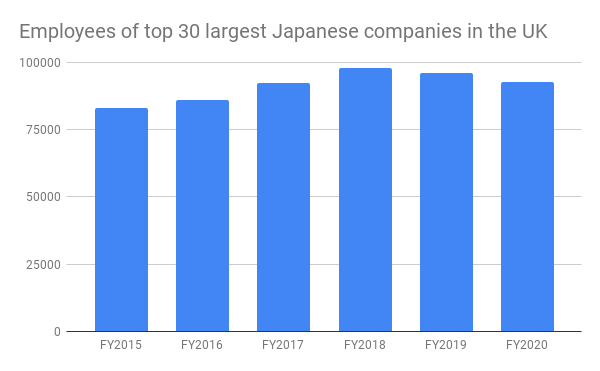
Top 30 Japanese companies in the UK – what’s changed over five years

The total number of UK employees of the top 30 Japanese company groups fell 2.6% from 2019/20 to 2020/2021 – a strengthening of the downward trend in employee numbers since 2018/9. The peak of employment by the 30 largest Japanese company groupings in the UK was 97,827 in 2018/9 and this has now fallen by 5,000 to 92,851 employees. The top 30 represent around two thirds of the 137,000 people employed by 1,200+ Japanese companies in the UK.
It’s taken longer than usual to compile the top 30 Japanese companies in the UK for FY 2020, because some of the biggest employers have been very late in filing their accounts at Companies House. Like their Japanese parents, most Japanese companies in the UK run their financial year from April to March.  We are defining the financial year as the year in which the majority of trading took place. So if FY2020 ended in the first half of 2021, companies then have nine months to file with Companies House, which would mean filing at the beginning of 2022. Some companies (we are looking at you NEC) did not file until the beginning of 2023, however.  In most cases this seem to have been due to a mixture of the impact of the pandemic, coinciding with major acquisitions and restructuring.

2020/21 was the first year after the UK left the EU, on January 31 2020, so it may seem too early to assess the impact of Brexit. But as has been noted in this blog many times before, Japanese companies are risk averse, long term planners, so actually many of the plans were already in place and in progress, largely based on worst case scenarios. There is also a longer term trend of a shift from manufacturing (particularly automotive manufacturing) to services, in terms of who is in or out, or up or down the top 30.

Who’s shrinking

The company groups with above average decreases in employee numbers were MUFG (-21.91%), Konica Minolta (-20.13%)  and Denso (-18.8%). MUFG Bank is a branch of MUFG Bank Europe NV, however, so there is no official figure for the number of employees in London. The decrease is largely based on the reports that MUFG offered 500 managers of its 1500 staff redundancy in 2019 and that this would have fed through by FY2020.  It’s perfectly possible, however, that MUFG were simultaneously hiring more staff in other areas. There are another 670 or so employees at MUFG Securities, which is incorporated in the UK and shares an office with MUFG Bank. There are a further 250 so in a separate London office housing Mitsubishi UFJ Trust, Trust and Banking and Asset Management. MUFG usually says it has “around 2000” employees in London.

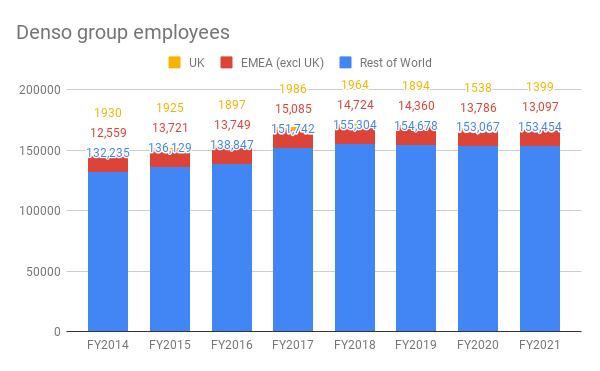
Konica Minolta acquired various UK companies before Brexit, but since Brexit has shrunk down and consolidated its operations in the UK and is focusing more on their European HQ in Germany and also the Czech Republic.  The longer term trend of shifting away from manufacturing in the UK, to manufacturing elsewhere in Europe is seen at Denso, the Toyota group automotive parts manufacturer – UK employee numbers peaked in FY2018, and have been falling since, and are now 27.5% below the FY2014 level, whereas employment in the rest of the region is up 4.3% and global employee numbers, excluding UK, have risen 16% since FY2014.
Who’s growing

Company groups with the strongest growth over FY2019/20 to FY2020/21 were SoftBank, Mitsubishi Electric and Panasonic. SoftBank was fulfilling its promise to the Takeover Panel to double its UK workforce to 3,500 people in the UK after acquiring ARM in 2016, but it has recently become clear that it has since lost 40% of those it hired and there are now around 2,800 people at ARM in the UK. This will not be reflected until the 2021/22 reports.

Mitsubishi Electric is also, like MUFG, a branch of a European HQ in the Netherlands, so the employee total is an estimate, but it employs nearly 1,500 people at its air conditioning company and factory in Scotland, which is a UK incorporated company.  Air conditioning has been a high growth area for several Japanese manufacturers in Europe.

Panasonic‘s growth is due to the acquisition of American software company Blue Yonder, which has around 300 employees in the UK. The bulk of Panasonic’s employees are in Panasonic UK and Panasonic Business Support Europe, which are both branches of Panasonic Marketing Europe in Germany – in Panasonic UK’s case since 2011. The European HQ was moved from the UK to the Netherlands in 2018 and it has not been disclosed what the trends in employment in these UK operations has been since then. The website says it employs over 400 people in its Bracknell offices, which is considerably lower than the 1,389 employees it had in 2018/9. If these figures can be regarded as comparable, then Panasonic has actually shrunk in the UK over the past few years, despite the Blue Yonder acquisition.

The top 3

Less significant changes in employee totals have resulted in a reshuffle of the top 3. The Hitachi group was the largest employer in the UK in FY2020, taking over from Nissan, which dropped to #3. Itochu moved up from #3 to #2. In Hitachi’s case, the growth was at Hitachi Energy (the recently acquired ABB power grids business), Hitachi Solutions and what was Hitachi Capital. The latter may have to be dropped from the total in future years as Hitachi now only owns 27% of it, and it has been renamed Mitsubishi HC Capital.  Similarly 51% of Hitachi Construction Machinery is being sold to Itochu and Japan Industrial Partners, so it will leave the Hitachi group.

Itochu has considerable presence in the UK thanks to its acquisition of Kwik-Fit, with over 5,000 employees in FY2020 and Stapleton’s Tyres, with over 1,000 employees. There were rumours that Itochu was considering the sale of Stapleton’s and Kwik-Fit in 2020, but nothing seems to have developed since.

Key changes compared to FY2015

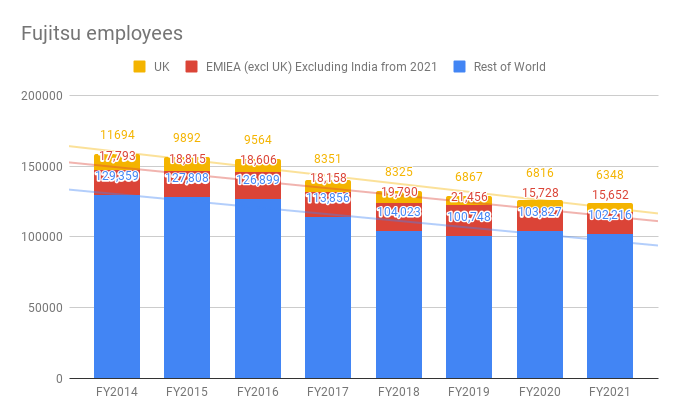
Five years’ ago, Fujitsu was the largest Japanese corporate group in the UK, with 9,892 people. It has lost 3,000 employees since, and was the fourth largest Japanese group in the UK in FY2020. As of FY2021, Fujitsu has 6,348 employees in the UK, 45% down on FY2016, compared to a 21% decrease globally, excluding the UK.  Growth at Fujitsu has been in India (and Fujitsu’s CTO is Indian) and in its global delivery centres in countries such as Poland and the Philippines.

Honda was at #3 in FY2015 and had already fallen to #5 by FY2020 – before Swindon closed in July 2021. The closure of the Swindon plant will mean that Honda drop out of the top 30.

Companies that have dropped out of the top 30 since FY2015 include Calsonic Kansei, which is now Marelli, since merging with Italy’s Magneti Marelli, with KKR as the main shareholder. KKR is American, but it is KKR Japan that has the stake. Marelli has over 1,700 employees in the UK, so maybe we should keep it in the top 30. The Marelli website indicates the global headquarters is in Japan – but the management team has plenty of non-Japanese on it. It’s another example of how it has become increasingly complex to define what a Japanese company is.

Another automotive company to drop out of the top 30 is Yazaki. It had 1,345 employees in the UK in FY2015, and now has 890. Olympus has just dropped out of the top 30, not due to shrinkage so much (it had 1,362 employees in FY2015 and now has 1,389) as other companies growing more. JTI (Japan Tobacco International) has also dropped out of the top 30, since the closure of its Gallaher factory in Northern Ireland in 2017.

Newcomers to the top 30 over the past five years are:

  • NTT following their acquisition and consolidation of many IT services companies including Dimension Data, itelligence, Everis and Keane
  • Outsourcing, who have acquired various recruitment and outsourcing companies in the UK 
  • NEC, who acquired Northgate Public Services
  • Mizuho – who expanded organically – but total employees are an estimate, as Mizuho Bank is a branch of Japan

Predictions for 2021/2

Around two-thirds of the 1200+ Japanese companies in the UK have filed their annual reports for 2021/2.  The data from these reports suggests a further 10,000 drop (-7.6%) in employment numbers, from 137,000 to 126,000.  4,000 of this will be due to the closure of Honda’s Swindon plant, and a further 750 or so due to the closure of related automotive companies.  For the top 30, there looks to be an overall decline in employee numbers, apart from Toyota.

There have been no major acquisitions in the past couple of years so we do not expect there to be any new entrants to the Top 30. The shift to services will continue, as will the increasing lack of transparency as to how many people are actually employed in the UK by Japanese companies, thanks to many of the UK operations becoming branches, with the shift of the regional headquarter functions to the EU.

Click the link below for a pdf of the Top 30 Japanese employers in the UK:

DOWNLOAD OF TOP 30 JAPANESE EMPLOYERS IN UK

For more content like this, subscribe to the free Rudlin Consulting Newsletter. 最新の在欧日系企業の状況については無料の月刊Rudlin Consulting ニューズレターにご登録ください。

Read More
Japanese with foreign MBAs are beginning to change corporate Japan

One swallow does not make a summer, and I am not entirely convinced by Nikkei Business’s assertion that there is an upcoming group of Japanese who did MBAs overseas in the 1990s and 2000s and are now taking over and changing corporate Japan.

The examples cited are:

  • Minato Koji (University of South California Business School MBA 2003), formerly of Oracle Japan, who was headhunted for a CEO position at Itoki, an office furniture manufacturer
  • Takahashi Hidehito (Columbia MBA 1992), President of Resonac Holdings (formerly Showa Denko)
  • Matsuoka Yoko (known as Yoky) who is founder of Yohana, a Panasonic subsidiary – who hasn’t got an MBA, but went out to the USA when younger, to become a tennis pro.

Nikkei Business characterises them as familiar with technology, having learned Western-style management through study abroad, including an understanding of how to take risks, and having had the experience of putting this knowledge into practice at foreign-affiliated companies.

Another example is Morimoto Masaru, now chairman of Showa Aircraft, who gained an MBA at Harvard in 1993 when he was working at Sumitomo Trust Bank. He says that in the 1990s, around 20 people a year were sent to study abroad from Sumitomo Trust Bank. “Large companies were competing to see who could send students.” Students studying abroad surged in the 1990s, reaching 83,000 in 2004.

As I was working in Japan in the 1990s (and was sponsored by my Japanese company, the first ever non-Japanese, to do an MBA at INSEAD, in 1997) I saw this for myself. The issue then was that companies did not know what to do with their newly minted MBAs when they returned. Corporate finance, or maybe send them to the USA, was the usual offer – MBAs were jokingly known as Managing Business in America. Many of the MBAs became frustrated and joined foreign companies – which is exactly what Morimoto (Club Med, Coca Cola), Minato (Sun Microsystems, Oracle), Matsuoka (Google) and Takahashi (GE, GKN) all did.

I do agree, however, that it would be positive for Japanese companies if more Japanese employees and young people studied abroad – so long as Japanese companies can work out what to do with them afterwards – perhaps the new job-type systems will help with this. The Japanese government has just announced that it wants the numbers studying abroad to reach 100,000 a year by 2027. This was achieved before, but even in 2019, before the pandemic hit, there were only 77,953 Japanese students abroad, compared to the record high of 115,146 in 2018.

For more content like this, subscribe to the free Rudlin Consulting Newsletter. 最新の在欧日系企業の状況については無料の月刊Rudlin Consulting ニューズレターにご登録ください。

Read More
Which companies pay women the best in Japan?

I thought the top companies paying 30 year old women the most in Japan would be mainly foreign companies, but actually over two thirds of the top 30 companies are Japanese,  according to OpenWork – and in sectors that are traditionally male dominated such as IT, finance, pharmaceuticals and automotive. In the past, ambitious Japanese women generally preferred to join foreign companies as the perception was they would be treated more fairly, and remunerated on the same terms as the men, for performance rather than seniority.

The highest paying Japanese company is the misleadingly named Nomura Research Institute, which is affiliated with Nomura Securities, but is actually a management consulting and IT services company. Women there are earning around US$65K at the age of 30, and can expect to earn around US$87K by the time they are 40. None of the other big Japanese ICT companies appear in the Top 30 apart from NTT Data (19) and NTT Docomo (25). Whereas foreign companies Oracle, Salesforce and IBM are all in the top 30.

The second highest paying is the advertising and marketing giant Dentsu. I hope this is not related to them continuing to overwork their young female graduate recruits to the point where they take their own lives, as in the past.  One Dentsu respondent to the OpenWork survey says “The rank determined at the annual evaluation meeting is reflected in the base salary. Bonuses are basically linked to performance. A few years ago, a new evaluation system was introduced, and some young people have become managers.”

P&G Japan is third, then PwC is fourth and Deloitte fifth, with other foreign professional services companies such as EY (10th) and Accenture (12th) also in the top 30, but no sign of KPMG.  Nomura Securities are 7th and other Japanese financial services companies such as MUFJ Trust and Banking, Daiwa Securities and SMBC Nikko Securities are all in the top 30. Also surprising to me is that pharmaceutical companies Astellas and Eisai are ranked 8th and 9th. My impression had been that Japanese pharmaceutical companies were very traditional, hierarchical, male dominated organisations, and many Japanese women therefore joined Pfizer, Johnson & Johnson (who are ranked 17th)  or GSK in Japan instead.

Similarly, Nissan (at #30 with average pay of US$47K at age 30 rising to $64K by 40) and Toyota also appear in the top 30 – although Honda does not.

The data that is lacking from this ranking, which could possibly explain more, is what the proportion of women in the workforce is for each of the companies – perhaps the high remuneration reflects a very small number of women, who are outstanding enough to succeed in very male dominated sectors. It would also be interesting to see to what extent there is a gender pay gap.

For more content like this, subscribe to the free Rudlin Consulting Newsletter. 最新の在欧日系企業の状況については無料の月刊Rudlin Consulting ニューズレターにご登録ください。

Read More
“Job type system” not the cure-all for Japanese employee engagement

Fast Retailing (Uniqlo) has caused quite a stir in Japan by announcing that it will raise salaries by up to 40%. It claims this is in order to bring the Japanese salaries more into line with what Uniqlo is paying staff overseas, so that staff can be transferred to and from Japan HQ more easily. Japanese companies have been under pressure from the government for some time to increase salaries and this seems to some extent a typically punchy move by Fast Retailing CEO and founder Yanai-san, who has always favoured being provocative and going against the mainstream.

As any global compensation expert will tell you, it’s not quite as simple as paying people the same for the same job around the world, given the very different living standards and cost of living. Nonetheless, if Japanese companies want to introduce the “job type” system, where the compensation is defined by a job description, rather than a seniority based generalist track with no job description, which has been the tradition in Japan, they are going to have to consider some kind of parity in remuneration, to make it attractive and easy for their employees to move around the world.

As Dr Kawai Kaoru, workplace health scientist, has pointed out in a recent article for Nikkei Business, the reality of the uptake of the “job type system” has not lived up to the media hype. The same names keep coming up – Hitachi, Fujitsu, Astellas, KDDI, Mitsubishi Chemical, Shiseido and Kagome. According to Dr Kawai’s research “an overwhelming number of companies said they had no plans to introduce a job-based system.”

Those who are introducing a job type system are expecting it to re-energise their staff, improving autonomy, empowerment and engagement. Kawai cautions against seeing the job type system as being a cure-all for employee motivation. Her worry is that too much emphasis on the individual may ignore the fact that what really energises employees in their work is a sense of interdependency – that other people rely on them and they can rely on others, in order to get things done.

She points out that the five factors needed for high employee engagement (which I have seen appear in many an employee engagement survey) are

  1. Sufficient resources to do the job
  2. Discretionary power to make decisions, get things done
  3. Being recognised and rewarded for good work
  4. Fairness – being respected and able to express opinions, regardless of age, gender, nationality etc.
  5. Community – that staff members help each other and trust each other

Japanese companies have always been strong on the last point – Dr Kawai and I are both hoping it is not lost in the quest for a more global standard.

For more content like this, subscribe to the free Rudlin Consulting Newsletter. 最新の在欧日系企業の状況については無料の月刊Rudlin Consulting ニューズレターにご登録ください。

Read More
Has the time come for Japan’s Nadeshiko Brand to include overseas female employees?

The Japanese Ministry of Economy, Trade and Industry announced in October last year that they are revamping their their Nadeshiko* Brand – the annual selection of Japanese companies that are outstanding in their encouragement of the success of women in the workplace. As well as quantitative questions, this time they are asking more qualitative questions, on areas such as “whether the systems and measures to promote [women’s success in the workplace] are linked to management strategies.” The aim is to evaluate “whether each company has visualized a consistent story whether they are conveying information effectively throughout Japan and overseas”. The background to this change seems to be the increasing pressure on Japanese and other multinationals to be more transparent – for example making more disclosures of information such as the gender pay gap reporting requirement in the UK.

I am wondering whether this evaluation will cover more than the communication of initiatives overseas. Will they also be including their overseas employees in their quantitative questions, and also in the systems and measures?  It has been a longstanding bugbear of mine that many Japanese companies publish plenty of information about the diversity of their Japanese workforce, but very little detail about their overseas employees. In the case of Japanese trading companies, they do not publish any figures on the numbers of people that are working at their overseas subsidiaries. It would seem they literally do not count.

When I last took a look at the boards of the largest Japanese companies in the UK, in 2016, it was clear there were fewer women on the boards of Japanese companies in the UK than there were even in Japan.  I also found differences in the degree of national diversity – some boards in the UK were all Japanese (and almost all men), and some hardly had any Japanese on the board.

Seven years on, there has undoubtedly been progress, of sorts. The pressures that I pointed to in 2016, such as the stricter demands from UK and other financial regulatory authorities on Japanese financial services companies to have more diverse boards or for Japanese companies who are public sector suppliers (Hitachi, Fujitsu) to be more diverse have worked.

Fujitsu UK proudly points out on its website that it was one of the first companies to report on its gender pay gap, in 2017, since when, there has been a 44% reduction in the median gap to 10% and a 43% reduction in the mean to 9.6%. They have also published their first ever ethnicity pay gap, even though this is not a government mandated requirement.  They also have a female Managing Director for the UK, a first I believe. She and the former UK MD and the head of Global Legal (both male) are the three board members – there are no Japanese board directors. In 2016 there were 6 people on the board, all male, one of whom was Japanese. The board in Japan has also undergone an overhaul, as have many Japanese boards, with the governance laws mandating them to appoint external directors. Fujitsu Japan has only two representative directors, both Japanese males, and 6 external directors, two of whom are female and one is an American male (albeit a fluent Japanese speaker and permanent resident in Japan).  Fujitsu was a Nadeshiko brand in 2016, but not since.

Daiwa Capital Markets Europe also recently appointed its first ever female CEO – who is dual nationality British/South African. There are nine members of the DCME board in the UK, five of whom are non executive directors and the majority of whom are not Japanese. Of the non-executive directors, 3 are female non-Japanese, 2 are male Japanese. The other three members of the board besides the CEO are one Japanese male in the UK, 1 Japanese male in Japan and one South African/British male in the UK, who is the Chair. The holding company for Daiwa Capital Markets Europe, Daiwa Securities, has been a Nadeshiko brand every year since 2013. Its gender pay gap in the UK is nonetheless quite high for 2021, above the financial institutions average of 32% for the mean, at 38.8% mean, 37.9% median. Perhaps this will change with the new CEO in place.

The services sector has rather different challenges to the automotive manufacturing sector both in Japan and in the UK. In Japan, only Toyota group member Aisin is a Nadeshiko brand in the transportation equipment category. Nissan points out that 92% of its 7,342 employees, across manufacturing, design, parts and sales and marketing in the UK are male. Looking at their gender pay gap numbers, it’s clear that there is a higher proportion of women in bonus attracting, presumably white collar jobs and middle management, and a higher percentage of men than women are in lower paid blue collar jobs. Nonetheless, a gender pay gap of 6.4% median and 8.7% mean was identified. The UK boards of both the manufacturing and the sales and marketing side are 100% non-Japanese in composition, but no female representation. Nissan was named as a Nadeshiko brand in 2017 but not since.

Presumably, as in previous years, the announcement of the FY2022 Nadeshiko brands will be made in March 2023. It will be interesting to see what has changed.

* Nadeshiko is a Japanese flower that is also native to northern Europe  – “pink”, of course. 

For more content like this, subscribe to the free Rudlin Consulting Newsletter. 最新の在欧日系企業の状況については無料の月刊Rudlin Consulting ニューズレターにご登録ください。

Read More
Agritech – Japan and UK

I attended a celebration recently at the Japanese Embassy in London, to mark the ending of the British ban on the import of food and drink originating from Fukushima. Plenty of Fukushima sake and peach juice was served but it seemed to me that the large crowd of people who were attended were more keen to get their hands on the Fukushima food that was served. 

Although Japanese food has become so popular in the UK, I doubt, given the distances and size of population, that the UK is going to become a significant market for Fukushima. The Japanese ambassador admitted as much in his speech, saying that the lifting of the ban by the UK had more of a symbolic significance, which he hoped would be noted by the EU and China.

Similarly, it seems unlikely that British food is going to sell in any greater quantity to Japan than it did before the UK Japan Economic Partnership Agreement went into effect in 2021.

Nonetheless, as two island nations, who are not as self-sufficient in food as we would like to be, we have challenges in common, which means we could find solutions together too. It is becoming urgent, as our currencies have weakened, causing imported food, fertilisers and energy to fuel food price inflation.

There are differences, however. The UK is more self-sufficient than Japan, with about 54% of food needs met by domestic production, compared to 38% in Japan. Our main imports are of fresh fruit and vegetables, from the EU – much of it from the Netherlands – grown hydroponically and vertically in huge greenhouses.

The UK could develop its own hydroponic vertical farming further, but the high energy costs of this are a barrier. Energy costs are also a barrier for Japan if it wants to grow its main food imports – wheat, soybeans and oilseeds – in this way. Japan has developed hydroponic vertical technology, for growing food such as lettuce – particularly in Fukushima to avoid having to use contaminated soil – and is now working on low energy solutions.

Another area for collaboration is robotics. I noticed at the Japan embassy event that asparagus – considered to be a speciality of where I live in Norfolk – is also a speciality of Fukushima. Harvesting asparagus has become a problem in post Brexit UK – we can no longer easily hire cheap seasonal workers from the EU to do it. There are labour shortages in Japan too, and also in the Netherlands. As a result, all three nations are developing asparagus harvesting robots. The same technology can then be adjusted to cope with more complex produce.   

A final challenge is to address the issue that hydroponically grown, robot harvested fruit and vegetables are not as tasty as traditionally grown and hand-picked fruit and vegetables. Agrichemicals and breeding of new strains may provide solutions to this. This may explain why, at the embassy event, I kept bumping into representatives of Japanese trading companies who have invested in these sectors in Europe.

This article by Pernille Rudlin first appeared in Japanese in the Teikoku Databank News in October 2022

For more content like this, subscribe to the free Rudlin Consulting Newsletter. 最新の在欧日系企業の状況については無料の月刊Rudlin Consulting ニューズレターにご登録ください。

Read More
Hitachi expands “job type” system to cover all employees, domestic + overseas

Hitachi has been heading in the direction of unifying its Japan and ex-Japan human resources systems for some years now, so switching all Japan-hired staff to the more Western style “job type” system, away from seniority based promotion, was to be expected. But it is nonetheless a radical step for one of Japan’s biggest companies. If other Japanese companies are able to follow suit, this would help remove one of the most significant hidden barriers to non-Japanese and other “diverse” people being able to rise to more senior roles in the headquarters.

Most Japanese multinationals make a distinction between “proper” staff – hired in Japan, straight from university, with no job descriptions, on a general track which is influenced by seniority and the promise of lifetime employment and possibility to reach the very top of the company –  and “contract” staff – those with job descriptions who are usually hired mid-career and have no job security or prospects of promotion. Those employees hired outside Japan are seen as being in the latter category.

Fujitsu has applied the “job type” system to 90% of its Japanese employees from April 2022. NEC is introducing the system to its senior management from April 2023 and expanding to the rest of the Japan hired staff from 2024. NTT finished introducing it to all management staff in 2021/2.

In Hitachi‘s case it became a necessity to do this, because of its major overseas acquisitions of ABB power grids and GlobalLogic, bringing in more than 100,000 overseas employees into the group. As of October 2022 the ratio of non-Japanese in Hitachi’s board of directors was 18% and the company aims to increase this to 30% in the mid to long term.

It’s not surprising that it is Japan’s technology and IT companies that are pioneering this. Such a move is an important precondition for digital transformation – it will make it easier to hire specialists such as AI engineers and data scientists, who would expect higher remuneration than would be available under the old generalist track, seniority based system.

For more content like this, subscribe to the free Rudlin Consulting Newsletter. 最新の在欧日系企業の状況については無料の月刊Rudlin Consulting ニューズレターにご登録ください。

Read More
Mitsubishi Corporation – dealing with the Black Ship of digital transformation

Miura Hiroaki, the General Manager of Mitsubishi Corporation’s IT department (and formerly in charge of IT in the Europe, Middle East and Africa region), has a series in the Nikkei Business magazine on digital transformation at Mitsubishi Corporation. He joined Mitsubishi Corporation in 1996 and like me, was trained as a new member of staff to pick up the group fixed line phone within two rings and answer it correctly – with the team name, not your own. “Fixed-line phones were not just a means of communication, but also played a part in employee education and guidance. The mentality of abolishing this was unthinkable” he says. But Mitsubishi Corporation did, in 2019.

The only way to deal with the anger that followed the abolition of fixed line phones was to build trust, he explains. He remembered what one of his mentors had told him about building trust – to take someone’s feelings seriously, and to laugh together. So he listened patiently to all the anger, which gradually dissipated.

As well as remembering the words of his mentor, he also found revisiting Prince Shotoku’s 17 article constitution, drafted in the 7th century, useful. He sees the statement in it that “harmony is valuable” as being misinterpreted by him and others in Japanese society – that people should try to understand the other person’s point of view, without arguments. Instead, it proposes the idea that “we should always build solid trust so that we can argue with each other in times of crisis”. Miura’s view is that Japan has suffered as a national power in the 1990s and 2000s  from not discussing important issues enough.

IT departments should be at the forefront of change and debate, but “the reality is Japanese corporate IT departments are being overwhelmed by having to maintain obsolete systems, suffering from a shortage of human resources, and being driven into a difficult position in terms of their relationships with employees.”

Miura also found Mitsubishi’s corporate principles an important touchstone, and driving force for change –  social contribution, fair play, and a global perspective. They have more absolute value, he argues, than just blindly adopting global standards. Bezo’s view that “good intentions don’t work, mechanisms do”, are not appropriate for Japanese companies. Mitsubishi Corporation’s predecessors faced up to and adapted to the disruptive Black Ships of Western globalization before, in the Meiji Era, and will do so again.

For more content like this, subscribe to the free Rudlin Consulting Newsletter. 最新の在欧日系企業の状況については無料の月刊Rudlin Consulting ニューズレターにご登録ください。

Read More
Who’s getting the biggest pay rises in Japanese companies in Europe?

If you’re in Hungary, Poland or Romania and you’re working in construction or engineering or in IT for a Japanese company, you’re in luck.

According to a survey by JETRO of Japanese companies in Europe, of the 857 organisations who responded, employees in Romania, Hungary and Poland are seeing pay rises of well over 7.5% to 8.5%, whereas employees  in Western European countries such as Italy, Finland and Sweden are getting less than 3%. Those countries with the largest numbers of Japanese companies – Germany, UK, France – are seeing pay rises ranging between 3.5 to 4.5%.

The top three sectors with the highest pay rises were:

  • 2022/23: Construction/Plant/Engineering (6.25%), Communication/IT/Software/Information system/Digital services (5.95%), Rubber products (5.87%)
  • 2023/24: Other manufacturing industries (7.50%), Non-banking financial institutions (7.17%), Non-ferrous metals (6.00%)

These seem to be indicators of where demand is the strongest and therefore competition for employees. We’ve heard quite a few cases of Japanese companies expanding in Romania recently, not only in manufacturing but also IT services and logistics. Hungary has been a hotspot for a while now, particularly in automotive manufacturing.

For more content like this, subscribe to the free Rudlin Consulting Newsletter. 最新の在欧日系企業の状況については無料の月刊Rudlin Consulting ニューズレターにご登録ください。

Read More

Search

Recent Posts

  • Japan – EMEA business update April 2026
  • Data and trust in Japan and Europe
  • Japan – Europe, Middle East & Africa business update
  • Japan in the UK – The Brexit Agreement 5 and 10 years on
  • Biggest European companies in Japan

Categories

  • Africa
  • Brexit
  • China and Japan
  • Corporate brands, values and mission
  • Corporate culture
  • Corporate Governance
  • cross cultural awareness
  • CSR
  • customer service
  • Digital Transformation
  • Diversity & Inclusion
  • European companies in Japan
  • European identity
  • Foreign companies in Japan
  • Foreign Direct Investment
  • Globalization
  • History of Japanese companies in UK
  • Human resources
  • Innovation
  • Internal communications
  • Japanese business etiquette
  • Japanese business in Europe
  • Japanese customers
  • M&A
  • Management and Leadership
  • Marketing
  • Middle East
  • negotiation
  • Presentation skills
  • Reputation
  • Seminars
  • speaker events
  • Sustainability
  • Trade
  • Uncategorized
  • Virtual communication
  • webinars
  • Women in Japanese companies
  • Working for a Japanese company

RSS Rudlin Consulting

  • Japan – EMEA business update April 2026
  • Data and trust in Japan and Europe
  • Japan – Europe, Middle East & Africa business update
  • Japan in the UK – The Brexit Agreement 5 and 10 years on
  • Biggest European companies in Japan
  • Two swallows make a summer?
  • Biggest foreign companies in Japan
  • Japanese financial services in the UK and EMEA
  • The puzzle of Japanese foreign direct investment in the UK
  • What is a Japanese company anyway?

Search

Affiliates

Japan Intercultural Consulting

Cross cultural awareness training, coaching and consulting. 異文化研修、エグゼクティブ・コーチング と人事コンサルティング。

Subscribe to our newsletter

Recent Blogposts

  • Japan – EMEA business update April 2026
  • Data and trust in Japan and Europe
  • Japan – Europe, Middle East & Africa business update
  • Japan in the UK – The Brexit Agreement 5 and 10 years on
  • Biggest European companies in Japan

Meta

  • Log in
  • Entries feed
  • Comments feed
  • WordPress.org

Posts pagination

« 1 … 13 14 15 … 57 »
Privacy Policy

Privacy Policy

Web Development: counsell.com

We use cookies to personalize content and ads, to provide social media features, and to analyze our traffic. We also share information about your use of our site with our social media, advertising, and analytics partners.