Rudlin Consulting Rudlin Consulting
  • About
  • Services
  • Blog
  • Clients
  • Publications
  • Contact us
  • Privacy
  • English
  • 日本語
  • About
  • Services
  • Blog
  • Clients
  • Publications
  • Contact us
  • Privacy
  • English
  • 日本語
  •  
Mitsubishi Electric in the UK – 1979 to present

In January 1979 Mitsubishi Electric UK took over a colour TV plant in Haddington, East Lothian from bankrupt Norwegian company Tandberg, saving 120 jobs. Exports of colour TVs from Japan to the EU and particularly the UK had risen rapidly in the early 1970s, even though they were restricted to small screen sets. Then demand in the UK came to a sudden end and TV manufacturing in the UK had excess capacity. So the British government encouraged Japanese companies to take over existing plants. Japanese companies also chose the UK for manufacturing in Europe because there were no domestic manufacturers with government connections as there were in France (Thomson-Brandt) and the Netherlands (Philips). (1)

Mitsubishi Electric already had a representative office in London from 1969 and had turned it into subsidiary in 1972. This then became a branch of Mitsubishi Electric BV in the Netherlands in 1996. It has continued as a branch of the Netherlands based European regional HQ since.

By 1987 Mitsubishi Electric had established video recorder production facilities in Livingston, along with many other Japanese manufacturers starting production in Europe, in response to pressure and anti dumping proceedings from the European Commission. (2)

It acquired Britain’s Apricot Computers in April 1990, with a plant in Glenrothes and R&D in Birmingham, employing 442 in 1991. PC production was scheduled to treble to 100,000 per annum in 1993, with exports accounting for 25% of production, half to Japan. (3) Glenrothes was shut in 1999, blaming cheap competition in Asia.

The Haddington plant continued to make  colour TVs and also microwave ovens, but when the price of TVs dropped, it was no longer profitable. In 1998 production ended, with 500 jobs lost. Production was transferred to Turkey.

Alister Jack, the then Scottish Tory spokesman on economic affairs, who later became Secretary of State for Scotland, attacked the Labour government on the closure: “There is little point of introducing a New Deal programme if they cannot hold on to existing jobs.”

Mitsubishi Electric hoped to focus on video recorder production and air conditioning at their Livingston plants. However, in 1999 it announced it would cut 6.100 jobs overseas and 8,400 jobs in Japan due to losses caused by falling semi-conductor prices and weak demand for consumer products.

The Livingston operation entirely focused on air conditioning and R&D for Europe moved there in 2013, with Mitsubishi Electric investing £20 million into the operation.

In 2017 air conditioner production started at Mitsubishi Electric’s new factory in Turkey.  Thanks to the customs union with the EU, air conditioning exports from Turkey to the EU are tariff free.

Mitsubishi Electric Air Conditioning UK employed over 1000 people In 2019. 77% of  its sales of £200m were to non-UK EU countries, 20% to the UK. The plant was profitable despite a large increase in gas and  transportation costs.

The UK is seen as a growing market, despite any Brexit impact, because of the need for green, affordable public sector housing.  Mitsubishi Electric is dependent on imported components, but it is standard industry practice to hold 2.5 months of inventory, so it is hoping to weather any post Brexit logistics impact.


(1) Japanese Manufacturing Investment in Europe: Its impact on the UK economy” Roger Strange, Routledge, 1993 p 196

(2) ibid p 201

(2) ibid p 264

Photograph of Campbell Gill ~ Personnel Manager and Eric Murray the General Manager with the joint Managing Director Yoshio Noguchi  1984, credit: Angus N Bathgate https://www.facebook.com/groups/oldeastlothain/permalink/2402751853280700

For more content like this, subscribe to the free Rudlin Consulting Newsletter. 最新の在欧日系企業の状況については無料の月刊Rudlin Consulting ニューズレターにご登録ください。

Read More
Bringing the company into the home

Under normal circumstances, British companies would be welcoming their new graduate recruits in September. This year (2020), many big employers have cancelled or delayed their recruitment schemes and internships because of the coronavirus pandemic. More than a quarter of British companies will be hiring fewer graduates, according to a survey in March 2020 by the Institute of Student Employers.

Nonetheless, some companies are still hiring or making plans on how to welcome new staff.  There is a high likelihood many of the new employees will have to work from home, so companies are having to think creatively about how to make them feel like a member of the team.

A new employee at a British law firm was delighted that her employer sent her not only a laptop and other equipment for working from home, but also a welcome pack that contained items such as a company branded water bottle and backpack. She said it made her feel part of the team when she saw other employees drinking from the same bottle or pulling files out of the same backpack on a conference call. Another company sent a new recruit branded face masks, a home baking kit and a pot plant.

Companies are also being creative about the content of the induction for new staff. They show videos of the office or send employees lunch vouchers so they can have an informal lunch with their new boss over a video call.

This could be a great opportunity to make employees across the world feel part of their Japanese company.  Japanese headquarters could show new hires videos of their offices in Japan or aspects of Japanese culture.

The lunch with colleagues could be bought with a voucher for a delivery bento box. Maybe there could be some global virtual karaoke sessions – although with the different time zones this could be an uncomfortable experience if some are joining in early in the morning and others late at night after a few drinks.

It’s also a business opportunity for Japanese manufacturers. Some of the best designed and made pens, diaries and notebooks I have owned during my career have been Japanese corporate ones. Japanese mascots and plushies are loved worldwide – so this could be the time to design a friendly company mascot that employees can place on top of their desk. Some employees might even welcome company uniform items like shirts, T shirts, ties and scarves. It could help them draw a clearer boundary between their work lives and their private lives, even when they are working from home.

Virtual designs for use on the computer would be good too – not just screensavers and wallpaper but also virtual backgrounds for conference calls. However, this means the technology welcome kit will also have to include a green screen for placing behind the head, otherwise employees’ hairstyles will merge into the corporate branding, which might be going a step too far in making new recruits feel part of the company.

This article was originally published in Japanese in the Teikoku Databank News on 9th September 2020

For more content like this, subscribe to the free Rudlin Consulting Newsletter. 最新の在欧日系企業の状況については無料の月刊Rudlin Consulting ニューズレターにご登録ください。

Read More
Japanese companies and nationals are continuing to come to Europe, but…

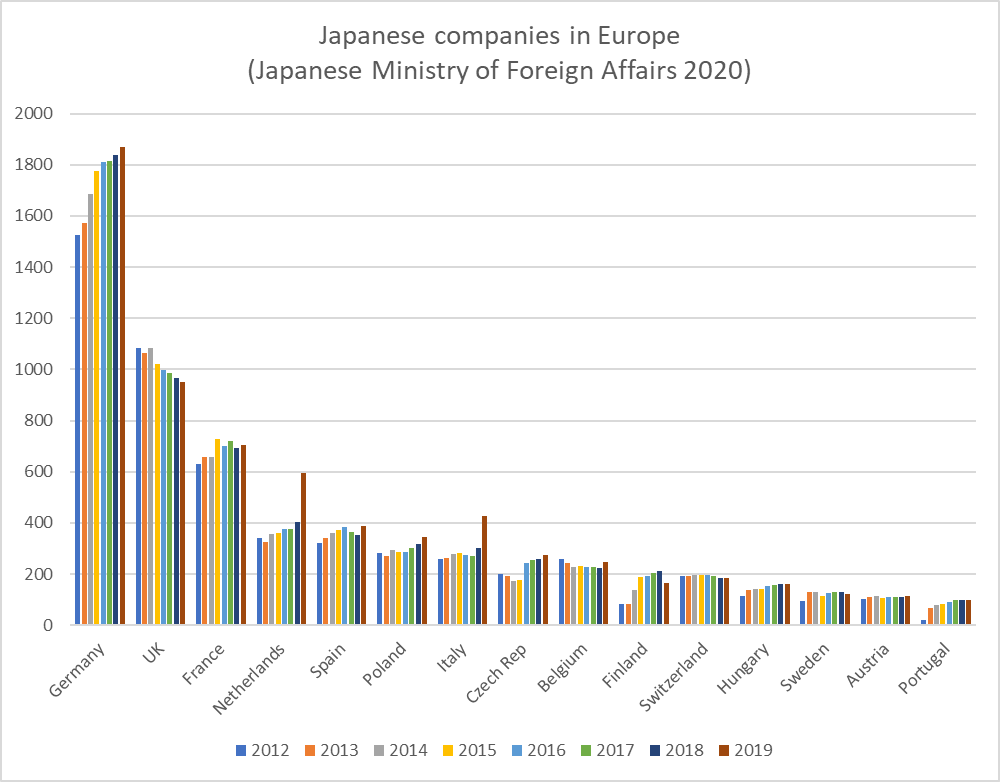
The chart below tells the main story of recent movements in the presence of Japanese companies in Europe pretty clearly. An ever increasing number of Japanese companies (including branch offices and joint ventures) are appearing in Europe, whether through greenfield investment or acquisition. The only two countries in the top 15 hosts of Japanese companies which have seen a decline over the past five years in the number of Japanese operations on their territory are the UK and Switzerland. 

Italy and the Netherlands have seen big leaps in the numbers of Japanese companies operating within their borders. Germany continues to dominate, hosting over 1800 Japanese operations, nearly double the next biggest host, the UK.  France is the third largest host, but seems stuck around the 700 mark.

Although they were not released until September 2020, the Ministry of Foreign Affairs (MOFA) figures are for October 2019. However they tally in some ways with the story told by the December 2020 JETRO survey of Japanese companies in Europe which we blogged about here. According to that survey Poland, Germany and Hungary and the Czech Republic are seen as the most promising sales destinations and importing from Japan under the EPA was particularly focused in the Czech Republic, Netherlands, Belgium, Italy and Germany for 2021.  Italy’s 2019 leap may be squashed back down in 2020, as Italy, UK, Sweden, France and Hungary were the countries in which Japanese companies thought their business would shrink. For Italy this may be to do with the impact of the coronavirus epidemic.

Unfortunately MOFA has changed the way it compiles – and it would seem classifies – these numbers. Digging into the detail of why numbers in Italy and the Netherlands shot up from Oct 2018-Oct 2019 shows that in Italy there was a large rise in the number of locally incorporated subsidiaries and branches (as opposed to branches of the Japan HQ or joint ventures). In the Netherlands there was a decrease in the number of headquarter owned branches and locally incorporated companies and their branches, and a rise in the number of “unclassified” from zero to 394.

The sudden rise in the number of companies and branches owned by Japanese companies may have something to do with Hitachi acquiring various Ansaldo rail businesses from Finmeccanica in Italy. Similarly, MItsubishi Corporation acquired Dutch energy company Eneco, which may have entailed taking on a large number of subsidiaries and branches. It seems clear the Netherlands was the favoured destination for Japanese companies looking to relocate headquarters functions, particularly in services, sales and logistics, as a Brexit back up.

Japanese nationals in Europe

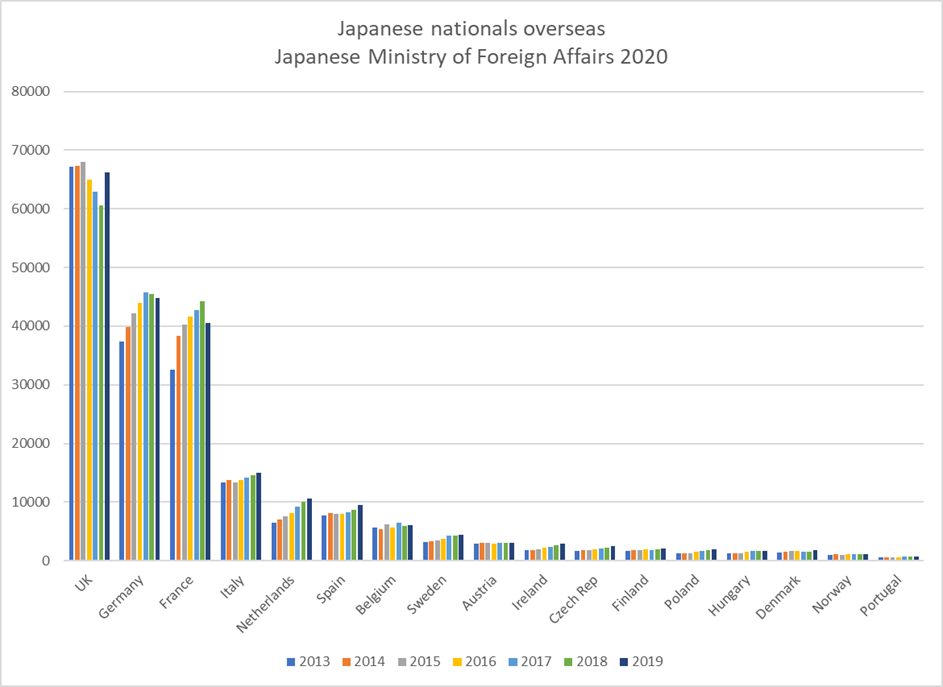
MOFA have also changed the way it compiles statistics on Japanese nationals overseas. Until 2017 the data included categories for permanent residents, intra company transferees, media, entrepreneurs, academics and students etc. But from 2018 the number is only broken down into long term residents and permanent residents.

How students are categorised also seems to have changed, and this has impacted the UK in particular – possibly because the UK itself also changed visa categories recently, particularly how students or trainees studying in the UK for less than a year are treated. For the last available year, 2017, the numbers of students and other academia related Japanese nationals had fallen by nearly 5,000 since a peak of 21,035 in 2014 in the UK. But student numbers had increased over the same period for other European locations and in Australia, New Zealand and Canada, with a small decline in the USA.

This fall in the number of students was a major contributor to the overall decline in the numbers of Japanese nationals in the UK from a peak of around 68,000 in 2015 to 62,887 in 2017. Intracompany transfers had also been declining since a peak of 19,552 in 2013, to 17,752 in 2017.

The surprise of the 2019 data released by MOFA in October 2020 is that the number of Japanese nationals in the UK has shot up again, after 3 years of decline. In October 2018 there were 60,620 Japanese nationals in the UK but this rose to 66,192 as of October 2019.  As no further detail is provided, it could be that some students and company trainees are now being counted as long term residents again. As the number of Japanese companies has declined, the only other explanation is that 6,000 more Japanese students decided to come to the UK in 2019 compared to the previous three years or so.

Conversely there has been a decline in the number of Japanese nationals in Germany for the second year running and a significant drop in the number of Japanese in France, whereas Italy, Netherlands and Spain have all showed a rise in the number of Japanese resident there.

The overall trend for Europe is positive – a 15% rise in the number of Japanese nationals resident in the region since 2013 to around 234,000 (95% of them in Western as opposed to Eastern Europe) and a 19% increase in the number of Japan owned companies in Europe to around 8,000 since 2013. The rate of increase has been the same for both Western and Eastern Europe. In the past three years the rate of increase has been slightly faster in Eastern Europe. 79% of  Japanese companies in Europe continue nonetheless to be based in Western Europe, suggesting that the trend is for existing Japanese companies in Western Europe to open additional operations in Eastern Europe.

For more content like this, subscribe to the free Rudlin Consulting Newsletter. 最新の在欧日系企業の状況については無料の月刊Rudlin Consulting ニューズレターにご登録ください。

Read More
Germany, Netherlands and Eastern Europe favoured in Japanese companies’ plans for in Europe

The annual JETRO (Japan External Trade Organisation) 2020 survey of Japanese companies in Europe has just been published and shows the impact of the EU-Japan and UK-Japan EPAs  – largely in increasing Europe-based Japanese companies’ procurement from Japan.

Japanese companies’ view of the next couple of years show that growth is expected in Eastern Europe and Germany, with Germany increasingly providing a regional coordination function. It looks like the number of employees and Japanese expatriates may be reduced over the next couple of years and there will be more  investment in digital transformation and interest in green technology and digital technology state supported projects.

Of the 949 companies who responded, 286 were in Germany, 162 in the UK, 111 in the Netherlands.

Brexit

The biggest concern for Japanese companies in Europe regarding Brexit is the impact on the UK economy.  Other concerns  are potential changes in UK regulations and laws and how this will differ from the EU. For manufacturing, the use of the CE mark and for services, the movement of people between the UK and the EU were of particularly concern.

60% of Japanese companies in Europe felt no impact of Brexit during the transition period. 40% of Japanese companies in the UK expect a negative impact from Brexit in 2021 whereas only 19.6% of Japanese companies in the EU expected a negative impact.  More than a third of Japanese companies in the UK and the EU were not sure what the impact would be.  Unsurprisingly, 70% of Japanese manufacturers in the UK were worried about their exports to the EU and of those nearly 90% were most concerned about customs processes. 80% of Japanese companies in the UK and the EU were worried about delays in logistics. Around 50% had made preparations for no deal, including increasing stocks, changing transportation routes, restructuring their organisations, changing procurement and setting up new locations.

EU-Japan EPA and UK-Japan EPA and procurement

The impact of the EU-Japan EPA and future impact of the UK-Japan EPA has also become apparent. The proportion of materials/components (particularly plastic components/automotive parts) sourced from Japan by Japanese companies in the EU has risen 5.2% to 36.6% from before the EU-Japan EPA and more than 70% of Japanese companies in the UK are considering or are using the UK Japan EPA to procure from Japan.  Importing from Japan under the EPA was particularly focused in the Czech Republic, Netherlands, Belgium, Italy and Germany.  Exporters to Japan that have been most keen to make use of the EPAs are in the chemicals/petrochemicals sector.  Around 30% of Japanese companies in the UK see some merit in the UK-Japan EPA.

Nonetheless, there is a clear trend towards procuring more within the EU, particularly in Central and Eastern Europe. However procurement from the UK by EU based Japanese companies looks set to continue, with only 10% planning to decrease their purchasing from the UK. Conversely, 25% of Japanese manufacturers in the UK are expecting to decrease their procurement from the EU.  I wonder whether this will change now the rules of origin in the UK-EU FTA have become clear.

Sales and profitability

Only 48.5% of Japanese companies in Europe expect to be profitable in 2020/1, the lowest proportion since 2012. Falling sales is the main cause, along with cross border restrictions and a drop in consumer demand because of the coronavirus. Unsurprisingly, Japanese hotels and travel companies are particularly hard hit.

The average proportion of sales of Japanese companies in Europe to EU countries is 73%.  25.4% of UK based Japanese companies say the proportion of EU sales of their total turnover has shrunk, but this is 8.1% lower than last year. Respondents were significantly more optimistic in Central and Eastern Europe than in Western Europe.  In particular 45.2% of manufacturers in Central and Eastern Europe expected to expand in the next 1-2 years. Poland was most cited as a promising sales destination, along with Germany, Hungary and the Czech Republic.

Forecasts and plans for 2021-2

30% expect business activity to normalize in the second half of 2021, 26.6% in the first half of 2021.  The most cited plans for 2021 are reduction of personnel and expatriates from Japan, as well as reviewing the product range, digital transformation (particularly in Italy, UK and Belgium) and reviewing of suppliers. Japanese companies are also showing interest in the green investment support and digital investment support being offered in European countries, particularly in Italy, UK and Belgium for digital and Spain, Ireland and Czech Rep for green investment.

Overall, more Japanese companies in Europe than ever are expecting business to continue “as is” over the next 1-2 years, with 14.5% of UK based Japanese manufacturers expecting business to shrink, 5.3% more than last year.  Japanese companies in Netherlands, Switzerland, Portugal and Germany are more likely to expect to expand over the next couple of years than in other countries, and there was a significant increase in the number of Japanese companies in Germany who said they were performing regional coordination functions in Europe compared to the previous year. More than 10% of Japanese companies in Hungary, Sweden, Italy, France and the UK were expecting their business to shrink.


For more content like this, subscribe to the free Rudlin Consulting Newsletter. 最新の在欧日系企業の状況については無料の月刊Rudlin Consulting ニューズレターにご登録ください。

Read More
Makihara Minoru

I was sad to hear of the death of Makihara Minoru, former president of Mitsubishi Corporation, on 13th December 2020.  He was my daisempai (most senior mentor) – both tough and supportive to work for. A wise visionary on globalization, he was progressive in his attitude towards women and non-Japanese employees in Mitsubishi Corporation and spoke elegant, fluent mid-Atlantic English. He was the ultimate Mitsubishi shinshi (gentleman).

I have taken some extracts from my book on the history of Mitsubishi Corporation in London as a tribute to him:

London – 1959 – “If you were your father, you would not have done this”

In 1959 Makihara Minoru was posted to London to take over the tinned salmon, crab and mandarin orange business. He was the son of Makihara Satoru, who was the General Manager of the London branch from 1939 to 1940 and also was in charge of the tinned salmon and crab business in London from 1927 to 1937. ‘I did business with many of the people that my father did business with. They remembered my father very fondly and were always telling me “if you were your father, you would not have done this…”‘ One such business partner was Dan Tobey, of Unilever, the largest single customer of Mitsubishi for tinned salmon. The rest of the tinned salmon was done through the same brokers as before the war, Anderson & Colman. Mr Colman had also been a friend of Makihara senior. One of Anderson & Colman’s largest customers was Princes Foods, whom Mitsubishi Corporation was to acquire in the 1980s.

Mitsubishi Corporation was the dominant supplier from Japan to the UK of tinned salmon and Japan was still the main supplier of tinned salmon to the UK in the 1960s.

The Japanese community in London in the 1960s

Makihara Minoru was in London until 1967. Despite the tripling of the number of Japanese resident in the UK during the 1960s, according to Makihara “there were still too few Japanese in London to feel that there was a community.” The 1000 residents barrier was broken by the late 1960s, and just as before the war, Japanese restaurants began to appear in London. The lifting of travel restrictions by the Japanese government also stimulated tourism and business travel from Japan to London. Up until then, Mitsubishi’s Japanese employees had to improvise, trying to find Chinese restaurants that most suited Japanese tastes.

Despite the lifting of travel restrictions Makihara only returned to Japan once in the eight years he lived in the UK, and made an international phone call to Japan just once a year.

Half of the Japanese Mitsubishi staff lived in South London and half in the North.  Hampstead (where the Makiharas had lived before the war) and Finchley had become popular amongst Japanese, known  as J&J town (Jewish and Japanese) but Makihara chose Purley. “Because my superior Mr Itoh had decided to seek other directions and had moved to East Croydon. I thought this was a very good choice – the rent was reasonable and the surroundings were much better. We moved twice but always stayed in Purley – the houses had nice gardens and were very superior by Japanese standards. The travelling time was about the same as from Hampstead.”  They sent their two children to St David’s School, a small co-educational school in Purley.

Bridging the division between local and Japanese staff

According to Makihara Minoru, there was no clear division of roles between Japanese and British staff in Marine Products Department and the Japanese and British staff would visit the brokers together.

There was, however, inevitably some friction between the Japanese and British staff. In Makihara’s view, this arose for two reasons: differences in style of work and differences in native language.

“As far as style of work was concerned, while the Japanese staff tend to work together and share information, which is the basic foundation of a general trading company, the British staff would tend to guard their territory and, on occasion, be unwilling to share information with others, even when that would have enhanced the business. This fact was aggravated by the language barrier. Even when Japanese staff were carrying out a normal conversation in Japanese, some suspicious British staff would imagine that they were being talked about behind their backs. Telexes used to come from Japan mainly in Japanese, which was another source of friction. I frequently requested Tokyo that telexes be sent in English but this was mostly in vain, and as a result, a lot of the time of the Japanese staff was taken up by translating telexes into English.”

In order to overcome the language barrier, Makihara started a japanese class for the British staff, but most of the senior men dropped out, leaving Makihara with five of the female staff. His efforts lasted for about two years. “I was finding it increasingly difficult to prepare material and texts for the British staff. Japanese is virtually without grammar, and it is an extremely difficult language to learn.”

Makihara Minoru, born 1930 Hampstead, London. Harvard University BA 1954. Joined Mitsubishi Corporation in 1956. President of Mitsubishi Corporation 1992-1998

For more content like this, subscribe to the free Rudlin Consulting Newsletter. 最新の在欧日系企業の状況については無料の月刊Rudlin Consulting ニューズレターにご登録ください。

Read More
The generation gap in working from home in Japan and UK

Despite the UK government’s announcement that companies can allow employees to return to their workplaces from August 1st 2020, the Royal Bank of Scotland told 50,000 of its staff to continue working from home until 2021.  A friend who travels into their City of London office once a week tells me it is still eerily quiet and only essential staff are coming in. Lifts can only take 1 person at a time and half of the toilet cubicles have been shut down.  A British architect has predicted that this will mean the end of the high-rise office building in London as many firms are making changes for the long-term. Some smaller City firms have shut their office permanently, and others are sub-letting their office space to other businesses.

I see similar trends in Japan too, judging by announcements from banks such as Mizuho or ICT companies such as Fujitsu, wanting to accelerate their digital transformation.

When I was a UK-based employee of Fujitsu ten years’ ago, I used to work from home quite regularly. My team was scattered across the world anyway, so most meetings were done by teleconferencing. Working from home is already well embedded in Europe. For people with children where both parents are working, it is often the only practical solution.

Most people who work in London and have children cannot afford to live centrally, so have long, crowded commutes – just like in Japan. They have no intention of being made to ride on a packed train until a coronavirus vaccine is commonly available.

But there is a generation gap in Europe with regard to working from home, which companies will have to address. Younger, single employees, despite being “digital natives”, are finding working from home very stressful. Partly it is to do with loneliness – for young singles, the workplace represents a vital social life. It is also to do with trust. More senior employees have already built relationships with their co-workers and are confident in their own abilities. Younger people lack that confidence and have not had enough time to prove themselves to their colleagues.

There is also the problem of the environment for working from home. More senior workers have bigger houses. Whereas many young Londoners share houses and flats with other young people. They may have a very small bedroom and no communal rooms apart from a kitchen.

This issue is true for city dwellers in Japan as well of course – a 1 bedroom apartment may have no space for a desk or the possibility of shutting the door on noise and distractions.

But it seems there is one dissimilarity between Japan and Europe – which is that middle aged people in Japan find working from home stressful too. As managers, they have been used to evaluating staff on the amount of effort put in, rather than results, and communicating through horenso and ishindenshin. None of these approaches work well remotely.  Digital transformation is going to be as much about managing people as managing ICT.

This article originally appeared in Japanese in The Teikoku Databank News on 12 August 2020

For more content like this, subscribe to the free Rudlin Consulting Newsletter. 最新の在欧日系企業の状況については無料の月刊Rudlin Consulting ニューズレターにご登録ください。

Read More
Hospitality in a time of coronavirus

Although President of the International Olympic Committee Thomas Bach kept reiterating that the Tokyo Olympics would go ahead in 2021 when he visited Japan recently, it’s hard to see how Japan will deliver on the promise it made when it won the Olympics bid, of omotenashi (wholehearted hospitality), if coronavirus waves keep surging.

We made a 3 minute video for Japan Intercultural Consulting unpicking what omotenashi actually means.  The reality looks more like visitors being made to undergo regular temperature checks, policed for mask wearing and cheering too loudly and being regularly advised what areas to avoid due to overcrowding or too much particle dispersal.

It’ll feel like you never got past the jumpy guys yelling at you about filling in your forms and where to stand at the immigration queue in Narita Airport. Omotenashi and going the extra mile to please only really works when processes and expectations are predictable in the first place.

As this article in Wired points out, 70% of Japanese think the Olympics should be cancelled or postponed according to a recent poll, and it may also be that most of us have become too jumpy about being in a crowd to want to attend such an event anyway. It may come down to whether a reliable vaccine has become widespread enough for everyone to regain confidence before hosts can revert to old traditions of excellent Japanese customer service.

For more content like this, subscribe to the free Rudlin Consulting Newsletter. 最新の在欧日系企業の状況については無料の月刊Rudlin Consulting ニューズレターにご登録ください。

Read More
Medium Term Plan Disease

Many Japanese companies have a Mid or Medium Term Plan, usually covering three years, announced by incoming Presidents, with a second one issued half way through their 6 year term. It is sometimes translated into English, but often in a way that does not resonate with employees outside Japan.  This lack of awareness or sense of connection to the MTP outside of Japan HQ is a problem for Japanese companies who want to be truly global.

The difference between a world class company and Japanese companies is reflected in the way the Mid Term Plan is developed, says Hioki Keisuke, a partner at Boston Consulting Group Japan,  in a recent series in Diamond business magazine on “Reasons why Japanese companies cannot compete globally”.

He looks at various definitions of global, world class companies and notes that only two Japanese companies can be seen as global – Canon and Sony – by Alan Rugman’s definition of having less than half of their sales in their home region with two other regions representing 20% or more of sales.

Three tests of global maturity

Hioki adds three tests of being truly global:

  1. Can your company count its global cash holdings?  How much, in what currency and where, by subsidiary?
  2. Is global talent visible? Is the information needed for discovering, training and promoting talented employees globally available, showing their experience and skills?
  3. Is the direction of the company clear? Are management aware of the environment in which it operates, the strengths, the uniqueness and the businesses to focus on?

He points out that many Japanese multinationals still operate on the old international model, where there is a headquarters, which sits above the business divisions, who in turn control the domestic and international subsidiaries. He calls this the “Group company” model, operating on an “entity base” where there is “a castle in every domain”  – a reference to the Edo feudal era in Japan.

The transnational model

World class companies are “one company” operating on a function base. There is a corporate function, but not specifically located in any one geographic region. The business units report into it, and the finance, HR, Legal, R&D, marketing and IT functions supply services across the subsidiaries, and also report into the corporate function.

When I was at Mitsubishi Corporation in the 1990s, I remember getting excited about the transnational model which Sumantra Ghoshal and Christopher Bartlett had outlined in their “Managing Across Borders” book of 1989. Hioki points out that although that seemed a far away ideal then, it is the reality now for most world class global companies.

As well as trying to promote that model internally as an organisational structure for Mitsubishi Corporation, I became involved in helping the Corporate Planning Office turn the Medium Term Plan into something that made sense in English. It was then that I realised that there was something about the Japanese language itself, as well as the way the Medium Term Plan was compiled that meant it was both extremely vague, and yet based on a huge amount of detail, gathered “bottom up”.  What was lacking was what a Western company would recognise as a strategy, to link the detailed plans to the vision for the future.

Scenario planning vs vague vision

According to Hioki, the Mid Term Plan in a world class company should be seen as “guidance” across 2-3 years, and a link between the megatrends or scenarios and the annual commitment plans. It should be revised every year and then a commitment plan and forecast for the year and each quarter developed from it.

I remember about 10 years’ ago the bafflement expressed by a group of senior managers working at a German automotive company when their counterparts in a Japanese automotive company said they had never heard of scenario planning. Hioki says many Japanese companies are now working on scenarios and megatrends, but the long term, medium term and short term plans are still independent events.  This was not quite the case at Mitsubishi Corporation, but certainly the Corporate Planning Office had an unenviable task in trying to tie what they were told was the plan by each business unit into something that cohered with the vision that the President had.

The origins of the Mid Term Plan

Hioki says the Mid Term Plan has its origins in 1956 when Panasonic’s founder, Matsushita Konosuke first introduced the Matsushita Electric 5 Year plan. “More than 60 years have passed since then. It’s not that a mid term plan is bad, but I think it’s time to adopt a way that suits the present times.”

The transnational model was meant to provide a way to trade off globally efficient integration and regional localisation and optimisation.  Production is decentralised, and each region develops its own specialities and differentiated value add, but global management is integrated, knowledge is centralised but R&D and development is done through collaboration and shared around the world.

Functions first, not as an afterthought

Hioki also argues that accounting & finance, HR and legal functions should be actively involved in planning and strategy, rather than coming after the business divisions, cleaning and tidying up.  Hashimoto Katsunori, former CFO of DuPont Japan and now professor at Tokyo Metropolitan Business School points out that another difference between world class and Japanese companies is “cash awareness”. The response to the coronavirus crisis should be to stash as much cash as possible to ride it out, but Japanese companies were not quick to do this.  Japanese companies tend to be cash rich anyway, but also they do not see their cash reserves as belonging to the shareholders, the way world class companies do.  And as a consequence, they prioritise sales over profits.  They do not understand that cash flow contributes to corporate value.

Hioki describes traditional HR in Japanese companies as behaving like teachers with a grade book, pulling people up for mistakes and spending their whole time creating systems. In a world class company, HR should be about ensuring that the vision, mission and values of the company permeate throughout the organisation, as well as contributing to the development and growth of the company and its employees.


For more content like this, subscribe to the free Rudlin Consulting Newsletter. 最新の在欧日系企業の状況については無料の月刊Rudlin Consulting ニューズレターにご登録ください。

Read More
The soft power of Japanese content

From time to time clients have requested that I show videos in my seminars for Europeans on how to work with Japanese counterparts.  I usually try to dissuade them from this. Partly because the technology never works well – I either have to try to get a DVD player to work on the client’s system, or if I try to stream something from YouTube, there is a problem with the firewall or internet connection.

Also, there used to be a lack of good content to show.  There are films like Karate Kid or Lost in Translation but they are either rather stereotyped or it’s difficult to find a clip that makes sense on its own without seeing the whole film.

We thought about making our own videos of Japanese and European actors interacting in typical business situations, but not only is this costly, it dates very quickly, and can look awkward and artificial.

I can understand why it would be good to show some videos. They would not only bring variety to the training, but also to help people feel empathy with other cultures through watching emotionally engaging films of people from those cultures, behaving in a way that they can relate to.

Recently I’ve noticed a huge improvement in the amount of video content available on Japan. I have been crying with laughter at Aggretsuko, the anime from Sanrio about a red panda office lady which is currently showing on Netflix in the UK. I assumed it would not be appealing to people who did not know the Japanese workplace, but actually my 18-year-old son, and our Hong Kong Chinese homestay student both really enjoy it too.

It led to an interesting conversation with my son who compared it to the Japanese manga Beastars which also had anthropomorphic characters. It turns out this will be shown as an anime on Netflix in 2020, joining other “made in Japan” series like Midnight Diner, The Naked Director and Terrace House.

My son’s generation get most of their content from Netflix, YouTube and Amazon Prime, to the extent that we hardly ever watch live TV together any more. The UK public broadcasting service, the BBC, is beginning to see its license fee revenue decline because younger people are watching these channels on their laptops and smartphones, and so do not have TVs.

This means that for businesses, the way to reach the younger generations is not through live TV advertising or news stories on TV or newspapers, but through online videos.

What seems to work best is either an authentic rather than scripted conversation, between real people rather than actors, or a short “how to” or story telling style narration of a video.  These kinds of videos are much easier and cheaper to make than the older style feature film type videos. So I have started to record my own – but they will be to advertise my business rather than to use in a training session.

This article was originally published in Japanese in the Teikoku Databank News on 11th March 2020

For more content like this, subscribe to the free Rudlin Consulting Newsletter. 最新の在欧日系企業の状況については無料の月刊Rudlin Consulting ニューズレターにご登録ください。

Read More
“Why is our Japan sales team so useless?”

I am asked a variant of this question, several times a year, by Western companies with sales subsidiaries in Japan.  They may not say “useless” as such, rather complain about the passivity, and lack of interest in trying something new in their Japanese team.

The Western managers feel obliged to visit Japan once or twice a year. They make visits to the same prospects, where they present their thoughts on what is going on in the industry and new offerings from their company. They are listened to politely but no business results from it. Or they explain the marketing strategy and new approaches to the Japan sales team and there is no engagement at all.  Instead they receive a list of what seem like trivial customer complaints.

Of course if you talk to the Japan sales team, they have their own frustrations about the lack of understanding on the Western side about how sales and marketing works in Japan.

So here are the 3 issues that face sales and marketing teams of Western companies in Japan and what to do about it:

1 – They’re not as elite as their customers

Unless it’s a very well known company like an American tech company or one of the big consultants, a Western company in Japan is unlikely to be able to attract people who have graduated from Japan’s top universities. This means their employees cannot access an old boys’ network to open doors. And even if they do manage to get in front of a potential blue chip client, they are probably already feeling pretty intimidated, added to which, in Japan, the customer is not just king, but god.

2 – The dead hand of eigyō

Eigyō is the term used to describe the sales function in Japan, but it tends to be more about relationship building with existing customers – which means regular visits to customers for no particular reason, passive and predictable “order taking” and a lot of hospitality.  It’s difficult to acquire new customers, as most established companies are in long term supplier relationships. A top salesperson in Japan is traditionally considered to be the person who is out of the office all day, doorstepping and cold calling, no matter how hopeless the situation, leaving their business card and brochures with icy receptionists in the hope that one day, maybe, they’ll be invited in.

So there is nothing very strategic behind targeting and acquiring new customers other than dogged persistence. This means that many marketing concepts that are commonly used in the West are not common knowledge in Japan, such as value proposition, USP or the 5Ps.

3 – Over-servicing

Japanese customers would expect a Western company to be sticklers for sticking to the contract, and delivering only what is paid for. There’s also a nervousness that if things go wrong, a Western supplier will sue, or disappear. Japanese suppliers are meant to stick with their customers through thick and thin, customising when asked, continuing with products and services that are unprofitable because the customer wants them and over-servicing in the hope that the cost can be recouped, some time in the far distant future.

So what can Western companies do about this?

Hire the rebels and treat them as equals

Many Japanese women are attracted to working in foreign companies because they assume they will be treated more fairly, and indeed many have reached senior positions in foreign companies such as Microsoft, Boston Consulting Group and Accenture. Unfortunately Japanese companies have woken up to this and are now trying to lure them back.  But Japanese women will be well aware of the barriers they will face to being treated as equals to lifetime employees in such companies. So making sure that your Western company is as inclusive of them as possible in terms of career development, including international postings and training (particularly in marketing), and ensuring their voice is heard at top level meetings, will be key to retaining them and reminding them of what attracted them to a foreign company in the first palce.

And this goes for the older male employees too.  They may have been lifetime employees at a big name company and were hired by a Western company for their connections and industry knowledge. They were probably frustrated in their careers at their Japanese company and saw joining a foreign company as a risk, but a chance to start again. You may discover there were some valid reasons why they were not successful in their careers in their Japanese company, but there will still be a value in their knowledge and experience, and their rebellious mindset might offer some creative solutions.

Be innovative

About the only acceptable reason in Japan for taking on a new supplier, especially a foreign one, is that they offered something that existing Japanese suppliers did not – Salesforce.com is an example of this. Being radically cheaper, like Amazon Web Services, can also work, but is not an avenue open to all companies. Japanese companies are very risk averse, so will assume the cheapness comes with a price in terms of quality.

But this still requires putting the effort in – such as the seemingly pointless regular visits to Japan give your sales team a reason to set up a meeting with potential clients, on the promise of a new perspective or innovative offering.

Break the rules

You can also use the ugly foreigner technique. Japan has a long history of letting the foreigner say the thing that everyone knew, but didn’t want to say out loud for fear of upsetting the rest of the group. Foreigners also get a certain number of get out of jail free passes for ignoring local protocols, so long as it was done from open hearted enthusiasm rather than malign intent.

One British Japan market entry expert told me he spotted a prospective customer from the signs on the office building his taxi had stopped outside. He persuaded the terrified Japanese sales person he was in the taxi with to accompany him into the building, and made his pitch in good Japanese to the receptionist, who was sufficiently impressed that she contacted the person in charge, and a few meetings later they had a new customer.

Japanese companies such as Fujitsu are also losing patience with the old eigyō, over-servicing ways. Fujitsu has renamed employees in eigyō “business producers” and are encouraging them to take a more consultancy based approached, banning them from taking systems engineers with them to client meetings.  “Business producer” may not be a common term in Western sales but Fujitsu has chosen to render it as “Bijinesu purodyu-sa-” ビジネスプロデューサー in katakana, which is the alphabet reserved for borrowed foreign words. The foreign-ness presumably makes it seem like a necessary break from the past.

For more content like this, subscribe to the free Rudlin Consulting Newsletter. 最新の在欧日系企業の状況については無料の月刊Rudlin Consulting ニューズレターにご登録ください。

Read More

Search

Recent Posts

  • Data and trust in Japan and Europe
  • Japan – Europe, Middle East & Africa business update
  • Japan in the UK – The Brexit Agreement 5 and 10 years on
  • Biggest European companies in Japan
  • Two swallows make a summer?

Categories

  • Africa
  • Brexit
  • China and Japan
  • Corporate brands, values and mission
  • Corporate culture
  • Corporate Governance
  • cross cultural awareness
  • CSR
  • customer service
  • Digital Transformation
  • Diversity & Inclusion
  • European companies in Japan
  • European identity
  • Foreign companies in Japan
  • Foreign Direct Investment
  • Globalization
  • History of Japanese companies in UK
  • Human resources
  • Innovation
  • Internal communications
  • Japanese business etiquette
  • Japanese business in Europe
  • Japanese customers
  • M&A
  • Management and Leadership
  • Marketing
  • Middle East
  • negotiation
  • Presentation skills
  • Reputation
  • Seminars
  • speaker events
  • Sustainability
  • Trade
  • Uncategorized
  • Virtual communication
  • webinars
  • Women in Japanese companies
  • Working for a Japanese company

RSS Rudlin Consulting

  • Data and trust in Japan and Europe
  • Japan – Europe, Middle East & Africa business update
  • Japan in the UK – The Brexit Agreement 5 and 10 years on
  • Biggest European companies in Japan
  • Two swallows make a summer?
  • Biggest foreign companies in Japan
  • Japanese financial services in the UK and EMEA
  • The puzzle of Japanese foreign direct investment in the UK
  • What is a Japanese company anyway?
  • Largest Japan owned companies in the UK – 2024

Search

Affiliates

Japan Intercultural Consulting

Cross cultural awareness training, coaching and consulting. 異文化研修、エグゼクティブ・コーチング と人事コンサルティング。

Subscribe to our newsletter

Recent Blogposts

  • Data and trust in Japan and Europe
  • Japan – Europe, Middle East & Africa business update
  • Japan in the UK – The Brexit Agreement 5 and 10 years on
  • Biggest European companies in Japan
  • Two swallows make a summer?

Meta

  • Log in
  • Entries feed
  • Comments feed
  • WordPress.org

Posts pagination

« 1 … 22 23 24 … 57 »
Privacy Policy

Privacy Policy

Web Development: counsell.com

We use cookies to personalize content and ads, to provide social media features, and to analyze our traffic. We also share information about your use of our site with our social media, advertising, and analytics partners.