Rudlin Consulting Rudlin Consulting
  • About
  • Services
  • Blog
  • Clients
  • Publications
  • Contact us
  • Privacy
  • English
  • 日本語
  • About
  • Services
  • Blog
  • Clients
  • Publications
  • Contact us
  • Privacy
  • English
  • 日本語
  •  
Choice, constraint and creativity

COVID-19 is forcing us all to rethink our business models. For many larger companies I suspect it will be a good cover for undertaking some of the more drastic measures that they may have been considering before the pandemic took hold.  I am even less optimistic about the future of car manufacturing in the UK than I was when there was just the impact of Brexit to consider, for example.

Many of the small retailers in my city have shut down and moved online.  They are taking orders through their Facebook pages and posting lists of the products that they have available.

The supermarkets are mostly delivering only to elderly and vulnerable people, so the rest of us are having to drive or carry home staples from the supermarket – trying to buy in bulk to keep the number of shopping trips to the minimum.

I already anticipated that we would have to focus on buying staples, and that treats would be welcome so I signed up for subscriptions to monthly cheese deliveries and weekly healthy snack deliveries. You do not have much choice over what you get, but you can tell the company your preferences and dislikes. I am also getting creative with food which has been in my store cupboard for a while but I have never tried to cook with before.

It reminds me of the time when I used to have organic vegetable boxes delivered once a week – there was anticipation and enjoyment in seeing what had been delivered and finding a recipe to fit the ingredients. But in wintertime this became more depressing, when faced with nothing but root vegetables.

Human beings around the world need to be in control of their food supply to feel secure, but after a certain point, want to be able to choose so they can enjoy what they cook and eat. So I predict the food market stalls will all be back once the pandemic is over, but with a new customer base of people who have the staple foods delivered to them.

I’ve also been subscribing to more on Amazon – pet food, coffee, tea, laundry liquid. Amazon has just announced that it is prioritizing these kinds of basic supplies over its original business of books and music.

So content providers (of which I am one) are also having to rethink how to get their products to their customers digitally. I have been a big fan of political satire – on TV and on radio. Most of these shows were filmed in front of a live audience. Initially, when they tried to record the shows without an audience, in the usual format, the result was very boring. But now they are becoming more creative with the format and are funny again.

I am using my time at home to revise our eLearning, put sample modules up on YouTube and make new videos. This is our challenge whatever business we are in – to work with the constraints to innovate.

This article was originally published in Japanese in the Teikoku Databank News on 24th June 2020

For more content like this, subscribe to the free Rudlin Consulting Newsletter. 最新の在欧日系企業の状況については無料の月刊Rudlin Consulting ニューズレターにご登録ください。

Read More
Pork for cars and a fog lamp

As the UK-Japan Free Trade Agreement is in its final stages, it seems a good moment to revisit our Top 30 Japanese companies in the UK. Although the headlines seem to be heading towards “pork for cars”, the most important win-win for the UK and Japan should be protecting Japan’s investments in the UK. Japanese companies employ around 170,000 people in the UK by our estimates, and many thousands more indirectly.

The EU-UK deal is still the biggest source of concern for Japanese companies

There is a limit to what the UK-Japan deal can do to protect those investments, however. For Japanese companies in the UK, the EU-UK trade deal is the bigger source of concern. Many of them have their regional headquarters in the UK or have invested in the UK as their base for exporting to the rest of Europe.

The shape (or non-existence) of a UK-EU trade deal will determine not only whether it is worth continuing with manufacturing in the UK for Japanese companies but also whether Japanese companies will continue to coordinate services regionally out of the UK such as finance, legal, IT, HR, engineering, R&D etc. These services account for why the UK has a trade surplus in services exports to Japan – it’s largely due to Japan HQ sending money to their UK based regional operations to fund professional support services needed both for acquisitions and day to day operations.

If the barriers between the UK and the EU to mutual regulatory recognition and movement of people become too high to run European operations from the UK effectively, and as a consequence UK companies are no longer attractive investment targets, Japanese regional HQs and acquisitions will begin to drift to the continent. In fact, they already have started to shift piecemeal to the EU. No amount of bilateral recognition of services and data regulations between the UK and Japan is going to help stem this.

According to our estimates, the number of people employed by Japanese companies in the UK levelled off comparing 2018/9 to 2017/8 – rising by only 0.2% to 170,187, having risen around 6% a year in the previous two years.

Japanese automotive sector dominates Japanese jobs in UK, but is declining

Our Top 30 Japanese employers in the UK employment total has also levelled out at around 94,000 or 55% of the 170,000 people employed by Japanese companies in the UK.

Nissan (#1), Honda (#5) and Toyota (#8) employ around 18,400 – 11% or so of the total. If other Japanese automotive suppliers are added such as Denso (#20) and Unipres (#30), the total number employed is 37,489 (22% of the total employed by Japanese companies), down 2.8% on 2017/8.

Making sure that there are tariff free automotive components from Japan for manufacturing in the UK will help sustain Japanese manufacturing in the UK at least in the short term, if tariffs are imposed on EU automotive imports as part of the UK-Japan FTA or there’s a no deal. But the shift in automotive production to eastern Europe has been going on for some time.

Japanese trading companies growing steadily in the UK but no acquisitions

The UK, or more especially London, has been the commercial and trading location of choice for Japanese companies in Europe for over 100 years. At the heart of this are Japan’s trading companies – Mitsubishi Corporation, Mitsui & Co, Sumitomo Corporation, Itochu, Marubeni and Sojitz. They are still involved in commodity trading but also financing and more recently acquisitions – although there have not been any UK acquisitions since 2017. The most notable recent European acquisition was Mitsubishi Corporation acquiring Dutch energy company Eneco in 2019 for €4.1bn.

Japanese trading companies currently employ around 14,700 people in the UK, and this has grown just under 2% a year over the past couple of years

Japanese financial services holding steady in the UK

The next biggest Japanese sector in the UK is financial services, including MS&AD (#15), MUFG (#16), Nomura (#17), SMFG (#22), Mizuho (#29). It accounts for around 13,000 employees and growth has been around 1% to 2% a year.

All Japanese financial services companies that are impacted by Brexit have set up or strengthened their subsidiaries in the EU, but the scale of these organisations is still far smaller than their UK operations. There may be an issue eventually not so much about the quantity as the quality of these EU subsidiaries for the EU – they will want to see the decision makers based in the EU as a condition for regulatory approval. But as most decisions are ultimately made by multiple people in Japan headquarters, it is not clear how Japanese companies can respond to such a demand. In the meantime, Japanese financial groups are repositioning their London operations as EMEA (Europe, Middle East and Africa) headquarters.

Electronics, ICT and acquisitions

Fujitsu (#3), the pioneer of big acquisitions in the UK (ICL in 1990) is no longer the biggest Japanese employer in the UK, having shrunk its workforce by 38% since 2014/5. Sony (#9) has also cut its workforce by 11% over the past four years. Canon (#12) and Ricoh (#7) have grown by less than 10%, Brother (#28) grew around 15%, Mitsubishi Electric (#27) by 17%. Konica Minolta (#24) has grown over 40% in the past 4 years through acquisitions but seems to be shifting more towards the Czech Republic recently.

NTT (#11) and Hitachi (#2), both with ex Japan global HQ in the UK, have grown 60% and 175% respectively over the past 4 years, partly through acquisitions but also in Hitachi’s case through organic growth, with the investment in the rail manufacturing and assembly plant in Newton Aycliffe.

Other new entrants over the past four years have been through acquisitions too – Outsourcing (#26) in recruitment, Sumitomo Rubber (#19) through its acquisition of Micheldever in 2017 and SoftBank acquiring (and soon to be disposing of) ARM.

A holding pattern until the fog clears

The years of double digit growth and acquisitions by Japanese companies in the UK seems to be coming to an end, or at least is on hold until the picture is clearer after the fog lifts from the UK-EU negotiations and the coronavirus pandemic. The UK-Japan FTA does not clear this fog, but at least lays out a path for the UK, which Japan very much would like it to follow, of reintegrating itself back into the rules based international order, towards joining the CPTPP and continuing to be one of Japan’s closest allies in terms of digital security and strategic interests.

Japanese companies in the UK

FREE DOWNLOAD

Send download link to:

I confirm that I have read and agree to the Privacy Policy.

I would like to subscribe to the free monthly Rudlin Consulting newsletter on Japanese companies in Europe. Rudlin Consultingの在欧日系企業についての最新リサーチとレポートを掲載した無料月間ニュースレターに登録したい。

For more content like this, subscribe to the free Rudlin Consulting Newsletter. 最新の在欧日系企業の状況については無料の月刊Rudlin Consulting ニューズレターにご登録ください。

Read More
The American/British language barrier through Japanese eyes

I visited Japan last year, to conduct a couple of training sessions for the subsidiaries of British companies on how to work effectively with their UK headquarters.  Listening to the issues brought up by the Japanese employees, and also having heard the perspectives on those issues from the UK side, I realised yet again how often a language barrier is at the heart of many misunderstandings.

But it is not the obvious language barrier between the very different languages of Japanese and English. It is the language barrier between American English and British English, which is more rooted in cultural differences than linguistic differences.

Not only were the employees at these British subsidiaries taught American English at their Japanese schools, but several had also lived in the US or worked for American companies.  British companies hired them because they assumed their linguistic ability and experience would make it easier for them to work in a multinational.

As many of the Japanese employees pointed out, however, the British and the Japanese are similar in the way they are so vague and indirect in giving direction and feedback, particularly negative feedback.  “I can’t tell whether my British colleagues are angry or not”, said one Japanese participant.  “I assume they are, when their emails are very long”.

The British were praised for making an effort to understand, forgiving bad English and being courteous, even when they were senior to the Japanese employee.  Germans and Americans were seen as rather less gentle and standing more on their dignity. Those British who had experience of working in Asia were able to express themselves more clearly and slowly, but other British were very talkative, yet not at all clear in what they were trying to say.

I explained how the British management style is consultative and casual – preferring to give a vague, general guidance and ask team members for their input. Whereas the US leadership style is built for speed – setting targets, standardising reporting and directing individuals on what to do.

A Japanese manager, fluent in American English who had been working for American multinationals previously, was very frustrated that he kept having to repeat himself in emails, because of the lack of clear responses from the UK. “Don’t they understand what I am asking for or are they deliberately ignoring me?”

We agreed that the solution to this might be to have agreed timeframes for responses and processes on how to communicate urgency, negative feedback and whether a request had been understood and was being worked on.

I thought back to my early days at Mitsubishi Corporation, where we communicated by telex, even though email was available.  The good thing about telexes was that there was a standardised way to write them, using simple, clear English which every new employee was trained in.

I wonder whether British and Japanese multinationals might need to introduce something similar, for email communication, to overcome their mutually polite, vague, miscommunications.

This article was originally published in Japanese in the Teikoku Databank News on 12th June 2019

For more content like this, subscribe to the free Rudlin Consulting Newsletter. 最新の在欧日系企業の状況については無料の月刊Rudlin Consulting ニューズレターにご登録ください。

Read More
What Japanese expatriates should do if they don’t get on with their local boss

A 28 year old Japanese female writes to the Nikkei Business Online: “I didn’t get along well with my boss when I was posted overseas and ended up with mental health issues and returned to Japan.”

“My boss only cared about a big project that would be of benefit to them, that Japan headquarters had no chance of approving. My boss kept making me do the negotiations and aggressively asking me if it was done yet. I couldn’t get my Japan HQ boss to intervene. I explained as clearly as I could to my boss that Japan headquarters had told me when I was there that there was no chance this project would be adopted. My boss refused to listen and would not even join me in negotiating with Japan HQ.

“I told them there was another project I was working on which was more urgent but my boss told me to prioritize their project. I became stressed and could not go into the office any more. My boss made out that I was the problem and my boss in Japan eventually accepted this and I was returned to Japan. I really cannot accept the way I was treated – or should I just have accepted it? How should I have dealt with this?”

Ueda Junji, formerly of Itochu and President of Family Mart: “First of all, you are still young, so try to see this as a useful experience for the future. You say you had mental health problems, and actually being an expatriate is mentally very stressful. So having experienced this at an early stage should be of help to you later on in your career.

“Secondly, in trying to think what is behind that boss’s behaviour, just seeing it as them wanting to do it entirely for their own ambitions may be too harsh. Managers in any country want to pursue projects that they think are beneficial. And of course if it goes well it may lead to their promotion.”

“On the other hand, you say you had another project which  you thought was more urgent, but since you are a member of a team, you have to accept the decision of your boss, if they say another project is higher priority.”

“I wonder whether being told by Japan HQ before you were posted that this project had no chance of being adopted already sowed seeds of distrust in your mind?  Then explaining this to your local boss, however carefully, will have got the relationship off to a bad start. They may have seen you as just a spy from headquarters and hard to tolerate.”

“It might have been better to try to see it from the local perspective – Japan headquarters don’t really understand what is going on overseas. Try to be more like an ally to your local boss and come to your own judgement as to whether or not the project is workable. Maybe first of all ask the boss what their aims and objectives are with the project, then get them to explain this again to Japan headquarters and then see how Japan headquarters reacts, before coming to any conclusion.”

Ueda’s somewhat unsympathetic comments may come as a surprise but is an example of the tough love that Japanese bosses can be capable of. It’s reassuring that he was able to see the perspective of the local boss so clearly.  It’s also also understandable how a Japanese junior expatriate, whose ultimate career lies back in Japan, will see it as their job just to comply with Japan headquarters rather than ally with the local management.

If you’re a boss to Japanese expatriate employees and/or trying to persuade Japan headquarters to accept your proposal, you may find our online coaching on building relations with Japan HQ a useful resource. More details and registration here.

For more content like this, subscribe to the free Rudlin Consulting Newsletter. 最新の在欧日系企業の状況については無料の月刊Rudlin Consulting ニューズレターにご登録ください。

Read More
Time for a logistics revolution in Europe

(This article was published in Japanese in the Teikoku Databank News in November 2018, but it seems even more relevant now)

Now I am back working in my home office, I have become much more conscious of the activities in the street in front of my office window. Once a week, a massive, noisy refrigerated lorry backs itself up against my house, to deliver food to the Italian restaurant three doors down from me. The lorry comes from a food wholesaler with depots the nearest of which is 300km away.

The reason the lorry parks right outside my house is that there are vehicles blocking the road outside the restaurant, caused by the building works which are converting offices into 50 student apartments.  Huge trucks reverse up our 16th century street, damaging the ancient buildings, in order to deliver 50 sets of kitchen or bathroom units. I realise it is cheaper to deliver 50 bathroom units at once in a big truck, but actually the builders did not need all those units at once, as they were fitting out the apartments in phased batches.

When I heard a loud howling noise just after I woke up at around 6:45 one morning I thought it was from the building site again, but it turned out to be from an even bigger refrigerated lorry making deliveries to a chain restaurant in the square at the end of our street.

Chain restaurants have had a bad year in the UK – shutting down a third of their outlets in some cases.  Many of these chains are owned by private equity firms, who saw a way to scale up a small chain of restaurants with a distinctive brand into a much bigger, national chain, and reduce costs through bulk purchasing.

The decline of these chain restaurants is partly to do with the economy, but also that the quality of food deteriorated as they expanded. The cooking had become reheating days’ old readymade ingredients.

The quality of the food and the impact on the environment could be improved by more frequent deliveries, in smaller, eco-friendly trucks. Most trucks in Europe run on diesel, and although diesel produces less CO2 than petrol, a huge concern now across Europe is the air pollution diesel causes. French and British governments are banning petrol and diesel cars (but not trucks) from 2040 as a consequence.

But this will require governments to invest much more in electric vehicle charging points and a revolution in logistics. Cities might need to set up hubs in their outskirts for consolidation of deliveries per customer into smaller electric trucks. Logistics companies will need to work with AI specialists like the British company Prowler, whose software is used in logistics to optimise decision making amongst multiple agents.

I realised Japanese companies could be part of this revolution when I saw in my neighbourhood a small electric truck (Isuzu – partly owned by Itochu) belonging to a British tyre wholesaler (owned by Itochu), quietly make a delivery to the city centre outlet of a UK-wide garage chain (also owned by Itochu).

The original version of this article was published in Japanese in the Teikoku Databank News and can also be found in  “Shinrai: Japanese Corporate Integrity in a Disintegrating Europe” available as a paperback and Kindle ebook on  Amazon.

For more content like this, subscribe to the free Rudlin Consulting Newsletter. 最新の在欧日系企業の状況については無料の月刊Rudlin Consulting ニューズレターにご登録ください。

Read More
Are Japanese companies leaving the UK because of Brexit yet?

I asked this question just over a year ago and the answer is still yes and no. To which I would add, it’s more a case that Japanese companies aren’t investing in or coming to the UK as much as they used to, replacing the ones that are leaving or downsizing.

Asia continues to dominate as location for Japanese companies overseas

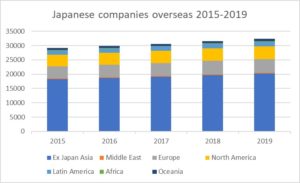
The number of Japanese companies overseas is, according to Toyo Keizai*, continuing to increase – up 65% from 2008, but the rate of increase has been slowing since 2013. The number of Japanese companies overseas grew 2% from 2018 to 2019, with growth in all regions –  higher growth in Africa/Oceania (from a small base) but only 1% growth in Europe compared to 3% in North America and Asia.

63% of Japanese companies overseas are in ex-Japan Asia – up from 62% in 2018 and 69% of the employees of Japanese companies abroad are in Asia. Around 15% of Japanese companies abroad are in Europe and 14% in North America, with both regions having around 11% of employees. As pointed out last year, the obvious factor in why there are proportionately more employees to number of companies in Asia compared to Europe and North America is the greater number of manufacturing operations in Asia, with larger workforces.

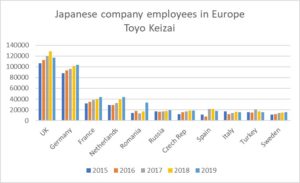
The number of UK employees of Japanese companies has fallen for the first time, by 9%

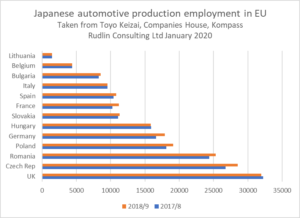
Within Europe, the number of people employed by Japanese companies rose 18% from 2015 to 2019. Those countries where the number of Japanese company employees has fallen are countries where there has been a rise in populism, civic unrest and political risk. UK employee numbers fell 9% 2018-9 (the first decline since at least 2015), Spanish employee numbers fell 19% 2018-9, Hungary’s fell 18%, Turkey’s 10%, Poland and Italy also showed small decreases in employee numbers.
Countries where Japanese employee numbers are growing are the Netherlands (up 11% 2018-9), France (10%), Germany (2%) and the Czech Republic (2%).  Employee numbers in Romania doubled from 2018-9 but this is largely due to Toyo Keizai recording employee numbers at Alcedo (acquired by Sumitomo Corporation in 2011) as being 20,284, having been 318 in 2018. The 2018 number is more in line with other available data.

Number of Japanese companies in UK has fallen for first time

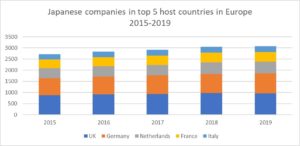
The number of Japanese companies in the UK has fallen by 1% 2018-9, from 972 to 966, the first drop since at least 2015, having risen 11% 2015-2018. France also saw a 2% drop in the number of Japanese companies, even though employee numbers are up. Germany attracted a 4% increase in Japanese companies from 2018-9, having risen 13% 2015-8. Netherlands had a 1% increase 2018-9 (13.5% 2015-8) and Italy had a 2% rise in Japanese companies 2018-9, and an increase of 11.8% 2015-8.
It’s hard to work out where Toyo Keizai derives the net drop of 6 Japanese companies in the UK from. Their list of the 7 companies which have closed down in the UK 2019 shows that this was mainly due to reorganization of holding companies or merging of companies rather than full withdrawal from the UK.  Of the 8 new Japanese companies in the UK in 2019, 5 were indirect investments into energy companies by Nippon Koei, a civil engineering company and 2 were indirect investments by WDI, a Hong Kong originated Dim Sum chain which is registered in Japan.

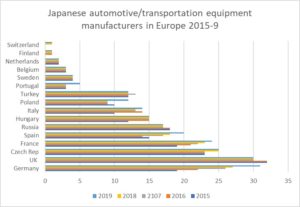
Germany now hosts more Japanese automotive companies than the UK

The Japanese automotive sector is of course the sector being most carefully watched for Brexit impact. Japanese automotive manufacturers are continuing to set up overseas – the total number globally has increased 10% in 2019 on 2015.  And “despite” the EU-Japan EPA, 15 more Japanese transportation equipment manufacturers set up in Europe in 2019, a 20% cumulative increase  on 2015.  Of the 15 new companies, 4 are in Germany, 3 in Poland, 2 in Spain, 2 in Portugal, 1 in France, 1 in Italy, 1 in Slovakia and 1 mystery one.  This means Germany now hosts more automotive/transportation equipment companies than the UK – 31 to the UK’s 30.
Japanese acquisitions of UK companies reduced in scale and number

Toyo Keizai’s data is reliant on companies filling in their surveys, so tends to underreport and often misses acquisitions. From my database, I estimate 20 British companies were acquired by Japanese companies in 2019-2020, although some of them were indirect acquisitions through acquiring a parent company with a subsidiary in the UK. Dentsu and Sony continued to acquire UK based companies, and other acquisitions were of British companies in software, gaming, hotels, seafood, recruitment, a manufacturer of drives for electric motors and paper wholesale.  The scale is far less than in previous years, both in terms of numbers of acquisitions and value of the deals.

Even adding these acquisitions in shows a 3% drop in the number of people employed by Japanese companies in the UK from 2018/9 to 2019/20 according to my database – the first drop since I started tracking these numbers in 2015.

* Toyo Keizai Data Bank: Directory of Japanese Companies Abroad 2020

For more content like this, subscribe to the free Rudlin Consulting Newsletter. 最新の在欧日系企業の状況については無料の月刊Rudlin Consulting ニューズレターにご登録ください。

Read More
UK’s priority in Japan trade agreement is not increasing exports, it’s protecting Japan’s investments in UK

[playht_player width=”100%” height=”175″ voice=”Lily”]My view on Brexit was that it was accelerating trends that were already there for Japanese business in Europe, and gave them cover to do things they were already wanting to do.

The COVID-19 pandemic seems set to provide similar cover and if the UK is not careful, this will mean a further withdrawal of Japanese investment from the UK.

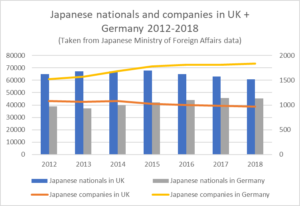
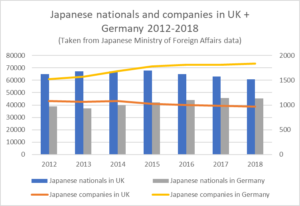
Japanese companies are still in search of growth outside the ageing, declining population of the Japanese market, and this includes in Europe. According to Japanese Ministry of Foreign Affairs data, the number of Japanese companies in Europe grew 16% from 2012-2018 and the number of Japanese nationals in Europe also grew over the same period by 12%.

At the same time Japanese companies are very risk averse.  Brexit was seen as a risk from around 2013 onwards, and this is reflected in the number of Japanese companies and nationals in UK falling by 11% and 7% respectively over 2012-2018 – the only country in Europe to show such significant decreases. Germany already hosts more Japanese companies than the UK and is catching up in terms of hosting Japanese nationals too.

Although Japan is still more of a manufacturing, exporting nation than the UK is, both the UK and Europe are just as – if not more – important to Japan as a destination for investment than as a market for exports of finished goods. As the DIT itself estimates, around 59% of Japanese exports to the UK are intermediate goods, used in supply chains.  So in other words, a large number of Japan’s investments in the UK and the Europe boost Japanese exports to the UK and Europe.

The trends in current Japanese trade and investment in Europe and the UK need to be examined for their impact in the four areas where Japan has influence over the UK economy

1. Existing UK jobs reliant on Japanese companies

The Japanese automotive sector is a key source of existing jobs for the UK as it accounts for around a quarter of the 163,000 people I estimate are employed in the UK by Japanese companies. There was a 3% decline from 2017/8 to 2018/9 in employment in the Japanese automotive sector in the UK, however, whereas employment in Japanese automotive companies grew elsewhere in Europe, particularly in Eastern Europe.

So while zero tariffs on automotive parts from Japan to the UK will help –  this might just be trying to hold back the tide. The possibility of tariffs on exports of cars made in the UK to the EU is obviously a concern for Japanese companies too. Maybe sterling will fall far enough or there will be sufficient government subsidies to mitigate this extra cost but ultimately Japanese companies will choose to manufacture where there they can access not just the lowest costs but also a market sufficiently large to ensure full production capacity.

Obviously there is a strong need to focus on electric vehicle development, and the UK has strength in automotive design, but Japanese car manufacturers will be wanting to develop EVs in line with EU regulations and to be able to influence EU regulations – which is easier done from inside the EU than outside.

    2. Where the new Japanese jobs are in the UK

Hitachi is the most significant recent contributor to organic job growth in Japanese companies in the UK  – largely due to Hitachi Rail. Hitachi has also invested in Horizon Nuclear Power, which is currently “on ice”. Hitachi’s focus is on social infrastructure, and various commitments by UK governments on investing in transportation and energy are key to this. Many other Japanese companies are also interested in social infrastructure business in Europe.

A UK Japan trade agreement can support further job growth by facilitating the export of parts for these industries from Japan. Hitachi has also invested in rail manufacturing in Italy so if there are any tariffs making exports from the UK to the EU uncompetitive, they have an alternative manufacturing location within the EU.

Other Japanese companies that are expanding in the UK include NTT, the ICT/telecommunications giant, who have put their non-Japan global HQ in London and SoftBank, who acquired ARM and committed to expand the workforce. Presumably this is why DIT is emphasizing free data flows between Japan and the UK, which would be welcomed by Japanese ICT companies and Japanese regional headquarter functions based in the UK.

I’m seeing some positive impacts of the EU-Japan EPA on investment elsewhere in Europe. There have been quite a few acquisitions by Japanese companies of food businesses in France for example.  Japanese trade statistics show that food and alcohol exports to Japan from Europe have risen after the EPA came into force. If a similar agreement on food, textiles and leather goods to the EU Japan EPA is reached between Japan and the UK as the DIT is asking, there may be similar acquisitions by Japanese companies in the UK – as well as the growth in exports for UK SMEs that the DIT seems to be focusing on. There already have been a few food related acquisitions by Japanese companies in the UK. This might see some increase in new jobs in the UK as a result. But this is marginal compared to the jobs that could be created by Japanese investment in the UK infrastructure sector.

    3. UK exports of services to Japan are M&A driven

It seems likely that Japanese companies will continue to use their piled-up cash to acquire – perhaps in Asia initially as it is opening up first after COVID-19. In the past, Japan established companies in the UK as gateway to EU but recent Japanese acquisitions in the UK have been increasingly pure domestic (recruitment, car parking, outsourcing, advertising) or pure global (SoftBank, financial services).

These acquisitions do not necessarily create more jobs, but financial, legal and other services around the acquisitions is, I would guess, a large component of UK services exports to Japan. Allowing UK professionals to operate in Japan is not a key driver – it is more that UK based professionals are supporting Japanese companies in Europe and globally. I even know of one UK based, American owned advertising agency that deals directly with the Japan HQ of a Japanese sports brand on their global campaigns, even though the advertising agency have a Japanese office.

Japanese companies may well buy up more British companies in the near future, as they will be cheap. However, there does seem to be a decline in big ticket acquisitions in the UK – the most recent major European acquisition by a Japanese company that I am aware of is Mitsubishi Corporation acquiring the Dutch Energy company ENECO – my understanding is that Netherlands based services companies mainly supported this.

    4. Export of services because of UK as European/EMEA hub

Another element in the UK’s export of services to Japan is that the UK subsidiaries of Japanese companies often perform a regional headquarters function for Japanese firms – and receive management fees for this. Brexit (but also changes in Japanese laws on treatment of offshore profits) has caused some Japanese companies to move their regional HQ from UK (Panasonic, Sony) in a legal and financial sense. But there is still a critical mass of people in the UK working for such companies, because the UK provides marketing, IT, design, engineering, legal, financial, accounting services that are of a high, globally accepted standard.

This is why, as the JETRO survey of 2019 of Japanese companies in Europe pointed out, the biggest regulatory concern of Japanese companies is that the UK or the EU might change regulations regarding the freedom of movement between the UK and EU for their employees. Continuing that regional coordination role requires regional employees to move around the region – or can this all now be done by web conferencing?

The UK is still seen by Japan as an attractive place to send students but also employees for education and development. Japanese students only want short term, under 1 year courses, however and many are looking at cheaper, nearer options. Both students and Japanese professionals would want ease of acquiring visas, including work visas and a safe, stable environment to live in.

UK offensive interests

Looking at the recent DIT paper on the UK-Japan FTA, clearly there are some non-tariff barriers to the UK accessing the Japanese market – as there have been for decades. But my overwhelming impression is that most British companies have not been very proactive in approaching the Japanese market – it’s a big commitment, opening an office in Japan is needed, not just exporting from afar. It’s relatively easy to set up a company in Japan but not so easy to hire the right people. There is a labour shortage, particularly of capable salespeople who are English speakers.  This is not something that can be solved in a trade agreement.

A final point regarding the DIT paper’s claim that the UK is a “technology superpower” – not in Japanese eyes I’m afraid – possibly in fintech and there have been some Japanese investments in that sector in the UK. But they’re fairly small scale. Japanese technology companies such as Panasonic are basing their innovation arms in Silicon Valley.  The US, China and the EU are more important to Japan than the UK – in many ways.

For more content like this, subscribe to the free Rudlin Consulting Newsletter. 最新の在欧日系企業の状況については無料の月刊Rudlin Consulting ニューズレターにご登録ください。

Read More
Japanese business mysteries explained in 5 minutes #3 Antiquated technology

Non-Japanese people who work in Japanese companies are often shocked at how antiquated the IT is in Japanese companies, considering how much Japanese people love new technologies.

Why is this, and will COVID-19 force change?

The next in our series “Japanese Business Mysteries Explained in 5 Minutes”

For more content like this, subscribe to the free Rudlin Consulting Newsletter. 最新の在欧日系企業の状況については無料の月刊Rudlin Consulting ニューズレターにご登録ください。

Read More
Japanese Business Mysteries Explained – Falling Asleep in Meetings

We’ve revamped our Rudlin Consulting YouTube channel, and posted our latest Japanese Business Mysteries Explained in 5 minutes video screencast – this edition is on falling asleep in meetings.

Why do Japanese people fall asleep in meetings? Is it you? Is it OK to do it in Japan? What can you do about it?

For more content like this, subscribe to the free Rudlin Consulting Newsletter. 最新の在欧日系企業の状況については無料の月刊Rudlin Consulting ニューズレターにご登録ください。

Read More
Japanese shift to Germany continues

[playht_player width=”100%” height=”175″ voice=”Lily”]Germany has historically been the main rival to the UK in Europe for Japanese investment.  The UK absorbs about 40% of total Japanese investment into the EU but according to the Japanese Ministry of Foreign Affairs, there are actually 50% more Japan originated companies (703) in Germany compared to the UK (471).* 

The reason for this discrepancy in numbers may be to do with the difference in the sectors that are investing in Germany and the UK and also the scale of the companies that are being acquired. According to my own research there are more employees on average at Japan affiliated companies in the UK than there are for Japan affiliated companies in Germany.

More Japanese employers in Germany but fewer employees than UK

This may be because the big employers – Japanese car manufacturers – do not have production in Germany – unlike the UK with Nissan, Honda and Toyota. There are plenty of Japanese automotive component manufacturers in Germany, but they tend to be what is known in German as “Mittelstand” or medium sized companies.

Manufacturing represents around 20% of German GDP, similar to Japan. Germany has of course always had a strong reputation for engineering and German cultural values such as risk aversion and process orientation fit well with Japanese corporate mindsets.

Japanese expats in UK mostly in regional HQ and services roles

By contrast, only 11% of the UK’s GDP is derived from manufacturing and 80% of UK GDP is services, particularly financial services such as banking and insurance. This sector accounts for quite a few of the Japanese companies who have multiple subsidiaries in the UK, as well as trading companies, holding companies and services companies providing financing and other functions across Europe.

This might explain why UK has more Japanese residents than Germany – presumably acting as liaison and coordinators with Japan HQ for the region – around 63,000 compared to 46,000 in Germany.  However, this number is falling for the UK, and increasing for Germany.

A drop in Japanese students and intra company transferees in UK since 2015

Does this mean that the UK is losing its role as the services centre for the region to Germany? Looking at the detail, it seems the main factor behind the drop in the number of Japanese in the UK is that there are 3,000 fewer Japanese students and academics in the UK compared to a year ago.**

Intra company transferees to the UK fell by 1% from 2015 to 2017 whereas there are now many hundreds more Japanese transferees living in Germany, the Netherlands and Eastern Europe than three years’ ago.

As Japanese manufacturing shifts eastwards in Europe, sales hubs are moving with them

Looking at the recent investments into the UK and Germany, the trends of the past few years still seem to hold. Investments into the UK are in the form of establishing regional holding companies, or M&A in biotech, information technology and services for the UK market such as car parking.   Investments into Germany are mainly for the wholesale of electronic components and machinery.  Sometimes these are German sales offices for Japanese companies who already have sales or manufacturing in the UK.  As manufacturing shifts eastward in Europe, so the sales hubs are moving with them.

Update for 2019-2020

The above article was written for the Teikoku Databank News in October of 2018.  Since then, the Ministry of Foreign Affairs has published further data on Japanese nationals resident in Europe and Japanese companies operating in Europe, but unfortunately without the level of detail that was available previously.

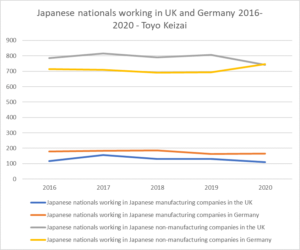
The chart below summarises the data available for the UK and Germany – showing the continuing long term trend of  an increase in Japanese companies and nationals in Germany, and a decline in Japanese companies and nationals in the UK.  Overall across Europe, the number of Japanese companies and nationals has increased in the past five or so years, but more in Eastern Europe recently.


This is reinforced by the data collected by Toyo Keizai of Japanese expatriates working for Japanese companies, which also shows that the increase in Japanese nationals in Germany is primarily in non-manufacturing, with a corresponding decline in Japanese nationals working in non-manufacturing in the UK.


*This is the number of individual incorporated companies in 2018 – if you include all branches, and multiple subsidiaries, the figure is 966 Japanese entities in the UK compared to 1,839 in Germany as of Oct 2018 MOFA report

** Based on later conversations with the British Council, this steep drop in Japanese students coming to the UK may well be to do with changes in visa categories that are being monitored rather than an actual decline – most Japanese students prefer to study abroad for less than a year.

The original version of this article can be found in  “Shinrai: Japanese Corporate Integrity in a Disintegrating Europe” available as a paperback and Kindle ebook on  Amazon.

For more content like this, subscribe to the free Rudlin Consulting Newsletter. 最新の在欧日系企業の状況については無料の月刊Rudlin Consulting ニューズレターにご登録ください。

Read More

Search

Recent Posts

  • Data and trust in Japan and Europe
  • Japan – Europe, Middle East & Africa business update
  • Japan in the UK – The Brexit Agreement 5 and 10 years on
  • Biggest European companies in Japan
  • Two swallows make a summer?

Categories

  • Africa
  • Brexit
  • China and Japan
  • Corporate brands, values and mission
  • Corporate culture
  • Corporate Governance
  • cross cultural awareness
  • CSR
  • customer service
  • Digital Transformation
  • Diversity & Inclusion
  • European companies in Japan
  • European identity
  • Foreign companies in Japan
  • Foreign Direct Investment
  • Globalization
  • History of Japanese companies in UK
  • Human resources
  • Innovation
  • Internal communications
  • Japanese business etiquette
  • Japanese business in Europe
  • Japanese customers
  • M&A
  • Management and Leadership
  • Marketing
  • Middle East
  • negotiation
  • Presentation skills
  • Reputation
  • Seminars
  • speaker events
  • Sustainability
  • Trade
  • Uncategorized
  • Virtual communication
  • webinars
  • Women in Japanese companies
  • Working for a Japanese company

RSS Rudlin Consulting

  • Data and trust in Japan and Europe
  • Japan – Europe, Middle East & Africa business update
  • Japan in the UK – The Brexit Agreement 5 and 10 years on
  • Biggest European companies in Japan
  • Two swallows make a summer?
  • Biggest foreign companies in Japan
  • Japanese financial services in the UK and EMEA
  • The puzzle of Japanese foreign direct investment in the UK
  • What is a Japanese company anyway?
  • Largest Japan owned companies in the UK – 2024

Search

Affiliates

Japan Intercultural Consulting

Cross cultural awareness training, coaching and consulting. 異文化研修、エグゼクティブ・コーチング と人事コンサルティング。

Subscribe to our newsletter

Recent Blogposts

  • Data and trust in Japan and Europe
  • Japan – Europe, Middle East & Africa business update
  • Japan in the UK – The Brexit Agreement 5 and 10 years on
  • Biggest European companies in Japan
  • Two swallows make a summer?

Meta

  • Log in
  • Entries feed
  • Comments feed
  • WordPress.org

Posts pagination

« 1 … 24 25 26 … 57 »
Privacy Policy

Privacy Policy

Web Development: counsell.com

We use cookies to personalize content and ads, to provide social media features, and to analyze our traffic. We also share information about your use of our site with our social media, advertising, and analytics partners.