How to hire and retain top staff in Japan – send them abroad
The most frequent complaint I hear from British and other multinationals with subsidiaries in Japan is around staffing. They can’t get the staff they want and they are not sure the employees they have are really the best for the job. This complaint is particularly focused on sales, as most “gaishi” (foreign multinationals) in Japan are primarily sales focused.
Many suspect that this is a cultural issue and contact me because they want to understand how sales and marketing work in Japan. They are aware that customer relationships are all important, and far more long term and personal rather than transactional. So expecting an instant result from a sales call to a new prospect is unrealistic. Incentivising aggressive sales behaviour with bonuses does not seem to work either.
I confirm that sales and marketing are different in Japan but I also explain that it is going to be tough for them to hire the “elite” from Japan’s top universities, who might have the necessary status and connections to approach blue chip Japanese prospects. This elite usually want to join Japanese blue chip companies, and view gaishi as high risk, low status employers.
Good staff can be found amongst those alienated by traditional Japanese companies
Good staff can be found amongst the groups that feel rejected or alienated by the Japanese blue chip companies – the salaryman who has worked in a Japanese company for 25 years and now finds himself being given a madogiwazoku (window gazing) job or young female graduates who understandably feel that a foreign owned company is more likely to reward them and promote them on merit rather than on how much overtime or drinking with the boss and customers they do.
Another promising group are those Japanese who have been educated outside of Japan. A recent survey by DISCO – a Japanese recruitment company – of most popular choices for Japanese graduate recruits shows the clear contrast in mindset between the top 10 for graduates of Japanese domestic universities and those who graduated from an overseas university.
Japanese graduates of foreign universities prefer to work for foreign companies
The top 7 choices for Japanese graduates of foreign universities are Deloitte Tohmatsu, PwC, Amazon, Google, Goldman Sachs and McKinsey. Mitsubishi Corporation and All Nippon Airlines are the only Japanese companies in the top 10, at number 8 and number 9, with KPMG bringing up the rear at number 10.
Mitsubishi Corporation and All Nippon Airlines are also in the top 10 choices for Japanese graduates of domestic Japanese universities – at number three for Mitsubishi Corp after fellow trading company Itochu at #1 and Toyota at #2 and at #6 for All Nippon Airlines. All the other Top 10 choices are Japanese too – Suntory, MUFG (financial services), Shiseido, JTB (travel), Japan Airines and Tokio Marine and Fire Insurance.
My old employee Mitsubishi Corporation made a conscious effort to target Japanese graduates of foreign universities and schools more than 20 years’ ago. In fact I was asked to help interview such graduates – whether to make them feel more at ease or to show that Mitsubishi Corp really was global in mindset, I’m not sure.
Twenty years’ on, many Japanese companies are scrabbling to recruit “global human resources”, but as the DISCO survey points out, Japanese graduates of foreign universities have very different ideas of what they are looking for in a career, compared to domestic graduates.
Japanese graduates of foreign universities want a job which helps realise their dreams and pays well, over stability and long term employment
When asked whether they felt a job should be a way to realise your dreams or a way to make sure you have a secure lifestyle, 40% of graduates of foreign universities chose the former with a further 25% saying they had some preference for the former, whereas for the domestic graduates, nearly 60% said they preferred the secure lifestyle.
As for wanting high pay versus wanting a secure lifestyle regardless of high pay, nearly 80% of foreign graduates strongly or somewhat preferred high pay, compared to under 60% of domestic graduates. Only 40% or so of foreign graduates wanted to work for one company for a long time, compared to 70% of graduates of Japanese universities.
Foreign companies in Japan need to offer overseas opportunities to Japanese graduates
And as Japanese companies have long suspected, most Japanese graduates of Japanese universities prefer to work in Japan rather than overseas. Whereas 70% of the graduates of foreign universities want to work outside Japan.
So for foreign companies in Japan, as well as offering higher pay and work which is more engaging, offering a chance to transfer to an operation outside Japan may also be needed to attract and retain foreign university graduates. That is the card which Mitsubishi Corporation and other trading companies have been playing for decades now and it has paid off for them.
For more content like this, subscribe to the free Rudlin Consulting Newsletter. 最新の在欧日系企業の状況については無料の月刊Rudlin Consulting ニューズレターにご登録ください。
Read More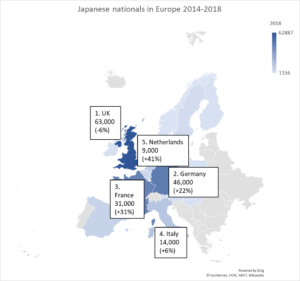 In fact all other major EU countries have more Japanese people living in them than four years’ ago. It is only the UK that has shown a net fall in numbers. The Netherlands has had the biggest proportionate rise in Japanese residents since 2014 – 41% from 6,532 to 9,223.
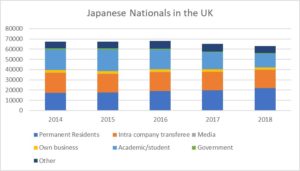 But looking more closely at the different categories used by the Ministry of Foreign Affairs for classifying Japanese nationals reveals some other non-business factors too. The biggest proportional decrease is in Japanese people in the government related category – a 44% fall from 1,286 to 722. In a further indication of the UK’s drop in global prestige perhaps, the number of media related Japanese nationals has dropped 26% from 371 to 273. The largest drop in numbers is in the academic/student category – down nearly 7,000 from 20,000 in 2014 – peaking at 21,000 in 2015 and declining since.
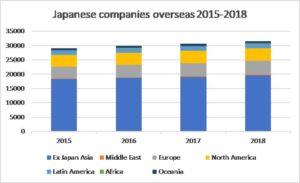 Growth in the number of Japanese companies overseas has been more muted in the past 4 years – a 7.9% increase 2015-2018. But the increase in the number of Japanese companies in Europe was above average – at 12.5%. The increases in companies in Asia (7.6%) and Latin America (5.6%) were below average – so there was a boom in Japanese investment in developing countries during the 2008-2014 period, but this died down in the past 4 years.
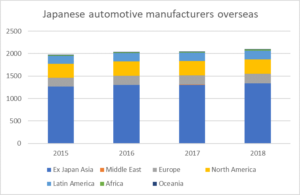 So how about investment in automotive manufacturing – the sector that has made the most noise in Brexit UK? The number of Japanese companies overseas in the “transportation machinery manufacturing” category that Toyo Keizai uses (which presumably corresponds to automotive manufacturing) rose 6% 2015-2018, so significantly slower growth than overall. Again, Europe showed above average growth of 13%, but only represents 10% of transportation machinery manufacturers overseas operations. Over 64% of automotive manufacturer sites are in ex-Japan Asia. So although Japanese automotive companies are not pulling out of Europe – rather the reverse – the major part of Japanese automotive investment is and continues to be in Asia. So no surprises really that Honda and others are choosing to focus on Asia for electric vehicle development – that is where the largest ecosystems and supply chains are based.
 UK is the birthplace of innovation and will not sink, despite Brexit,