Rudlin Consulting Rudlin Consulting
  • About
  • Services
  • Blog
  • Clients
  • Publications
  • Contact us
  • Privacy
  • English
  • 日本語
  • About
  • Services
  • Blog
  • Clients
  • Publications
  • Contact us
  • Privacy
  • English
  • 日本語
  •  
5 types of Japanese colleagues who are “workstyle reform” blockers

I was surprised to see this explanation of  five generations of “workstyle reform” blockers in the Nikkei Business magazine came with a big red caution notice to readers not to take offence. The categories are not to be taken as hurtful stereotypes but based in research, and do not apply to all people of a particular age group, they explain.

So with that in mind, here’s a precis of the 5 types identified. Even though I’m not Japanese, I’m afraid I do recognise aspects of myself in the “middle manager” category, and am trying not to take offence. Although some of the characteristics are obviously derived from each age group’s experiences of the Japanese domestic economy and society, I am also reminded that there is plenty of evidence each generation around the world has complained about the other generation for the past thousand years or more.

1. The Veteran

Born between 1947-1951, so 66-71 years’ old

  • Work comes first
  • Believes in the virtue of hardship
  • Over strong sense of competition
  • Clings to past experiences of success
  • No intention of changing how they work
  • Gets angry if their way of working is rejected
  • Will oppose competitors’ opinions regardless of content
  • Caught up with “how things were” in the past.

2. The Executive

Born between 1952-1960 so 57-66 years’ old

  • Don’t rock the boat – doesn’t want to challenge
  • Laissez-faire
  • Always talks about “ideally”
  • People are people, I am what I am
  • Rather than change workstyle, is interested in what happens after retirement
  • Uninterested in reform, regardless of content
  • Just wants results, doesn’t make concrete proposals
  • Won’t listen, as retiring soon anyway

3. The middle manager

Born between 1961 and 1970, so 47 to 57 years’ old

  • Superficial
  • Thinks too highly of self
  • Extremely hedonistic
  • Sees everything in cost/benefit, mercenary terms
  • Reform should be done cheerfully, enjoyably without trying too hard
  • Won’t do it if not fun
  • Will oppose anything which increases own workload
  • Tells everyone to do their best and doesn’t do anything themselves
  • Will change the content of any reforms on a whim

4. The shop floor leader

Born between 1971 and 1986, so 31-47 years’ old

  • Pessimistic
  • Not good at interacting with other people
  • Prioritize risk avoidance
  • Strong sense of resignation – “they won’t understand”
  • “If this reform fails, there is no future for me”
  • Won’t promote reform if don’t trust the company
  • Too busy watching others’ reactions to say own conclusions

5. The staff member

Born between 1987 and 1994, so 23 to 31 years’ old.

  • Little sense of crisis
  • Not good at making an extra effort
  • Prioritizes personal life
  • Everything in moderation
  • “Is reform really necessary?” Won’t do it unless feels it’s necessary
  • Let other people take up new challenges or jobs requiring some thought
  • No empathy with the reasons behind the reforms
  • Doesn’t take the company so seriously, ignores directions

For more content like this, subscribe to the free Rudlin Consulting Newsletter. 最新の在欧日系企業の状況については無料の月刊Rudlin Consulting ニューズレターにご登録ください。

Read More
Brexit brings turning point for Japanese automotive suppliers in the UK

“We don’t have any room to store increased stocks” says Hiroshi Seko, the UK MD of G-TEKT, a Japanese automotive supplier. According to the Nikkei newspaper, BMW have asked the automotive body work supplier stock 3 months’ worth of supplies for the Mini because of concerns about the impact of Brexit on supply chains, when normally they only hold around a week’s worth. G-TEKT imports 60% of the raw materials from France but does not actually have anywhere in their factories’ grounds to store these raw materials.
G-TEKT has just started up its fourth factory in the UK (2 in Gloucester, 2 in Wales), to supply Jaguar Land Rover and Toyota.  It has increased employees from 568 to 808 over the past 3 years but is struggling to hire all it needs, particularly from continental EU, because of Brexit.

UK sales represent around 7% of G-TEKT’s global turnover, most of its sales in Europe. It has also just started to build a factory in Slovakia, again to supply JLR, from 2019.

Similarly, Takayuki Furuuchi the UK MD of Japanese automotive supplier Faltec, whose only production in Europe is their factory in Sunderland to supply Nissan, is also wondering if current lead times are sustainable. Faltec imports more than half of its metal materials from outside the UK and is worried that with a no deal Brexit, ithere will be difficulties in the logistics of supply of stainless steel from France and other EU supplier countries.  These supply trucks pass through the Channel Tunnel to Dover. The Dover port authority estimates that a two minute inspection time would lead to a 27 mile tail back of traffic.

Faltec currently has a 2 day lead time from when Nissan orders the parts to when they expect delivery.  Faltec is wondering whether it needs to adjust its procurement, but it has taken many years to build up a supply chain which meets car manufacturers’ rigorous standards and it will likely take a long time to make any changes to this.

According to a Japanese automotive supplier executive, “if there are logistical hold ups, then suppliers will just have to hold more stock”. Faltec is currently investigating holding stock at its own risk and whether there are any warehouses available nearby.

Nissan is starting production of its next generation SUV Qashqai for the European market from 2020.  Expecting that suppliers will be expanding production as a consequence, the local authorities have given the go ahead for a new industrial park near the Nissan factory in Sunderland. But if chaos after Brexit affects the supply chain, there will be an impact on companies’ European strategy.  Both Faltec and G-TEKT have been successfully expanding in the UK for over 20 years – Faltec increased employee numbers over the past few years in the UK, from 341 to 396.  With UK sales at around 6-7% of turnover for both companies, they are not facing a huge hit on a global scale from Brexit, but as suppliers, they have to accommodate whatever car manufacturers request.

“It has been 40 years since Japan’s automotive industry first set up shop in the UK. The British automotive industry is facing a turning point, not just for car manufacturers but for parts suppliers who have invested so much time and money into the UK”, concludes the Nikkei.


For more content like this, subscribe to the free Rudlin Consulting Newsletter. 最新の在欧日系企業の状況については無料の月刊Rudlin Consulting ニューズレターにご登録ください。

Read More
“We will stick with the UK as a global supply base, despite Brexit” says Honda President

“Europe is the heart of global car culture” says Takahiro Hachigo, Honda’s President since 2015. Although Honda has less than 1% market share in Europe, it competes with European car brands in its main markets of the USA and China. The UK factory has been streamlined, and production lines consolidated as a global production centre, exporting Civics to Europe and the USA.  Hachigo says that they are therefore committed to the Swindon factory as a global supply base, regardless of Brexit. “If there is a no deal Brexit, there will be temporary disruption, so I am very much hoping that this disruption will be avoided and outstanding issues resolved”, says Hachigo.

However, as the Nikkei points out in their interview with Hachigo, if there is a no deal Brexit, without a transition period to 2020, Honda’s exports to Europe will be affected immediately and supply chain issues may make it difficult to export so easily to the USA too.

Honda has committed to a 30 year plan with a goal of “pursuit of quality” – to develop cars that will still sell at a high price, in an age of car sharing and electric vehicles. Hachigo also seems very keen in the interview to keep participating in Formula 1 (another UK strength). UK has that “luxury car maker” image, with Rolls Royce and Bentley, so it is understandable that Honda still wants to keep a base there, but as the Nikkei says “difficult management decisions will be needed in the future” to realise this strategy.  I also wonder whether Honda’s current brand image, in Europe at least, really is convincing as a luxury, higher price positioning.

For more content like this, subscribe to the free Rudlin Consulting Newsletter. 最新の在欧日系企業の状況については無料の月刊Rudlin Consulting ニューズレターにご登録ください。

Read More
Brexit watch – Top 30 Japanese companies in the UK

We’ve been tracking the 30 biggest Japanese employers in the UK for over 3 years now, so it seems a good moment as Brexit draws nearer to see what changes they have made over the past three years, explicitly or implicitly, to prepare for Brexit and beyond. Overall, the top 30 Japanese companies in the UK have had a good 3 years’ in the UK, with total number employed increasing by nearly 15% to just under 90,000, out of the 140,000 employed by 1000 Japanese companies that is usually cited. I even wonder whether that 140,000 ought to be revised substantially upwards, as I believe the estimate dates from 2015.

However the average increase conceals some hefty drops (Fujitsu, Nomura and Yazaki) and substantial increases – the latter largely due to acquisitions.

Nearly every annual report from the companies that make up the 30 biggest Japanese employers mentions Brexit, but few state explicitly what actions they have taken to deal with the risk, unless they are financial services companies facing regulatory issues.  Most note that the outcome is uncertain, and that they are monitoring and planning.

No tax haven please we’re Japanese

As well as Brexit, another factor that some Japanese companies in the UK have to take into account is the tightening of the Japanese tax haven law.  Passive income such as dividends and royalties, if received in a country with a corporate tax below 20%, will be subject to charges from the Japanese tax authorities.  The UK corporation tax rate is 19%, due to go down in stages to 17% and Theresa May has recently promised “whatever your business, investing in a post-Brexit Britain will give you the lowest rate of corporation tax in the G20.”

As I stated in my speech to the UK Tax Forum, because of their long term, stakeholder oriented, risk averse ethos, Japanese companies are not really interested in the UK as a tax haven. Panasonic, seen as a bellwether in terms of corporate governance in Japan, cited the tax law as the reason to move its headquarter function from the UK to the Netherlands, where the headline rate of corporate tax is 25% (although sweetheart deals can be done). I also think that the decision of the European headquarters in the UK of trading companies Sumitomo Corporation and Mitsubishi Corporation to sell their shares in investments such as Princes and Triland Metals in the UK to their Japan headquarters is part of this drive – to avoid being seen as using the UK as a tax haven for their dividend earnings.

Whose standards are they anyway?

Japanese companies would be more interested in the second part of May’s statement – “you will access service industries and a financial center in London that are the envy of the world, the best universities, strong institutions, a sound approach to public finance and a consistent and dependable approach to high standards but intelligent regulation”.

But of course the question they will be asking is “whose high standards?”

There are around 200 Japanese companies with manufacturing in the UK, and we estimate around 50% of their production on average goes to the EU (excluding the UK). 30% is to the UK and the remainder to the rest of the world. In Toyota’s case, over 80% of their production in the UK is exported to the EU. So it’s no surprise that, as repeatedly stated, including in the Japanese Ministry of Finance’s “Message to the UK and the EU” of a couple of years’ ago, Japanese business want harmonised regulations and standards across the UK and the EU.

All the Japanese financial services companies affected by EU regulation have taken action – Hitachi Capital and MUFG have strengthened or set up bases in Amsterdam, MS&AD in Brussels, Sompo International in Luxembourg, SMFG, Mizuho and Nomura in Frankfurt.

The rise of the pure UK plays

Looking at who’s in and who’s out of the Top 30, the rise of “pure services” is noticeable, largely through acquisitions such as MS&AD acquiring Lloyds underwriters Amlin and InsureTheBox, Dentsu acquiring multiple advertising and marketing agencies in the UK, Outsourcing acquiring recruitment agencies and government debt collectors. Bubbling under are Park24, now the owner of National Car Parks. Many of these investments are very domestic UK market oriented, so Brexit proof in the sense that they are not reliant on the European single market in terms of supply chains, regulation or freedom of movement.

Conversely manufacturing companies have dropped out – such as JTI, with the closure of its Gallaher factory in Northern Ireland last year and Fujifilm, who have three different production sites in the UK.

Freedom of movement and solutions

As well as emphasising the need to harmonise regulations and standards, and ensure tariff free trade, the Japanese government “Message to the UK and the EU” of two years ago also pointed out that Japanese companies in all sectors employ large numbers of non-British EU nationals in the UK.  Because many of them have UK -based regional headquarters, or have design and engineering or customer support centres in the UK, they rely on the freedom of movement of these non-British EU nationals as well as the freedom of movement of British employees themselves, to visit or be seconded to client sites to provide pre sales, installation and aftercare support.  This also applies to Japanese engineers visiting the UK from Japan who at the moment are finding themselves being turned away because they gave the wrong answer at the border, saying they have come to the UK “to work”.

This last issue is likely to be raised quite insistently in any post Brexit trade deal between Japan and the UK, and if not solved, I would expect to see the numbers employed by the Top 30 in the UK to fall in the years to come.

FREE PDF DOWNLOAD OF TOP 30 JAPANESE EMPLOYERS IN THE UK 2021

For more content like this, subscribe to the free Rudlin Consulting Newsletter. 最新の在欧日系企業の状況については無料の月刊Rudlin Consulting ニューズレターにご登録ください。

Read More
How Japanese risk aversion explains reactions to Brexit and whether UK should join the CPTPP

I was a panellist for the UK Trade Forum on 25th September 2018, on Japanese business and government viewpoints in response to the UK’s request to join the Comprehensive and Progressive Agreement for the Trans-Pacific Partnership (CPTPP, TPP as was, often known in Japan as the TP11)

The Chatham House rule was invoked, but I believe that I am allowed to report what I said, so long as I don’t attribute any comments to the other speakers.

As I only had 10 minutes, I decided to focus on risk aversion to explain Japanese reactions to Brexit and the UK joining the CPTPP.  Even so, I had to drop the final part of my speech, so I will add this back in at the end:

“I have spent more than 45 years now living in or visiting Japan and working with or for more than 200 Japanese companies, and one generalisation I feel I can make, even though I am well aware of the dangers of stereotyping, is that Japan as a nation – as well as Japanese companies – are highly risk averse.

The geopolitical angle

I was reminded of this when I attended a lecture by Koji Tsuruoka last week, the current Japanese Ambassador to the UK, who was also the chief negotiator for Japan for the TPP. He gave a very powerful, thought-provoking speech, tackling head-on controversial subjects like Japan’s behaviour in WWII, whaling, defending Big Pharma IP interests in trade negotiations and so on, in a way that didn’t seem strictly necessary given it was an audience of Japanophiles, but I think his message, on reflection, was very clear.  Japan feels very vulnerable, with neighbours such as China and North Korea and Russia, and supposed allies and defenders such as the USA now behaving unpredictably, and it needs a rules based international order because it is energy and resource poor and relies on other countries for imports of these things.  WIthout a rules based international order being adhered to, countries behave unpredictably, and this can lead to war.

So this is why Tsuruoka and other Japanese government representatives and ministers have been very positive and welcoming of the UK wanting to join the CPTPP or roll over the EU-Japan EPA, even if the practicalities of this are not clear. They worry that the UK leaving the EU means the UK is also leaving that rules based international order, so needs to be roped back in somehow.

Why are Japanese companies so risk averse?

So that’s the geopolitical side to this – for the rest of my ten minutes I want to look at the Japanese business side, and three sectors in particular, what kind of trends we are seeing and how they are reacting to Brexit and what TPP might contribute in terms of mitigation or otherwise.

So why are Japanese companies so risk averse?  I think it’s because they operate on a very different model to the Anglo Saxon, short term, shareholder value model. It could be called a stakeholder model, but primarily the motivation is not to make a quick profit, but long term survival. So they don’t want to do anything so risky as to jeopardise that, and they are very hot on ESG – Environmental, Social and Governance – issues.  It’s one of the really good things about Japanese companies, why I am still a fan.

So when the Japan bashing started happening in the 1980s, and many Japanese remember Americans taking hammers to Japanese cars, Japanese companies decided that foreign direct investment was the way forward, and started up factories in the USA and of course also in the UK, with Nissan, and then Honda and Toyota.

They chose the UK – and the UK is the recipient of 40% of Japan’s cumulative FDI into the EU, and has the largest Japanese population in the EU, including intra-company transferees – (but both those numbers are declining these past couple of years – I leave that to you to conclude why, but a hostile environment certainly isn’t helping) – because the UK was seen as a stable, rules based system, low risk place to invest, and of course because we were then members of the EU and a gateway into the EU.

So what is happening now with Brexit in terms of Japanese risk aversion, is that it is tipping them into making decisions and directions they were going in anyway.  Looking at the three main sectors of Japanese investment in the UK – automotive and supply chains, IT and electronics and “pure” services – these sectors make up the bulk of the around 1000 Japanese companies in the UK, employing around 140,000 people.  Actually many of the 1000 don’t really count because they are paper companies, brass plates, or several versions of the same company, but there are 30 or so really big employers who make up more than half of those 140,000 employees.

Automotive supply chains – a pivot to a new chain of right hand driving nations?

So for Japanese companies, trade negotiations aren’t really about trade in products so much any more, more about protecting their foreign investments.  Even then, to be realistic, the EU only makes up around 10% of Japanese companies’ turnover.  Asia is still the really big market outside of Japan, and within that, China, and then secondly the US.  And the UK is probably only around 10% of the EU total.  But the UK is also host to a lot of regional HQs and of course the three car plants.

The main trends you see in the automotive supply chains is that they are shifting eastwards in Europe, to the Czech Republic, Slovakia, and Japanese car manufacturers also have factories in Russia and Turkey, and the suppliers – of wire harnesses for example – have factories in Africa.  So Brexit is accelerating that shift.

Can the CPTPP help with this?  Well I suppose there are a large number of CPTPP members who are right hand driving like the UK, but when you look at what sells in Australasia for Toyota, it’s pick up trucks like the Hilux, whereas Toyota in the UK is manufacturing the Auris/Corolla.  I suppose that shift could happen – at least then there is access to a market of over 100 million, which is supposed to be the minimum to sustain an automotive supply chain.  Honda is already trying to sell half of its Civic production from Swindon to the US, so it could happen, despite the distance.

Information technology and electronics – integrated disintegration

You’re also seeing a shift in the power balance in those supply chains, towards the components suppliers, and IT, because of Big Data, the Internet of Things and so on.  Which brings me to the second major sector – information & communication technology, electronics etc.  Here you’re seeing what I call an integrated disintegration. Japanese companies are becoming more B2B, solutions based, and trying to integrate back office functions, but also customer support, technical support into low cost locations with multilingual educated workforces – so in Europe this would be Portugal, or Poland.

But at the same time, the regional management and sales are becoming more dispersed.  Anyone who has worked in a multinational as I did working at Fujitsu will know what this means – endless fights about who gets what in terms of money or actually doing the work, and whereas the UK often won those fights, I am beginning to see signs that Japanese companies are reverting back to the country model, are finding the matrix system just too tough.  If you’ve ever run a global or regional virtual team, as I did, you can understand why.  So there is a drift away from the UK and to Germany or the Netherlands, as we’ve seen with Panasonic, and it would seem also Sony now, accelerated by Brexit. And that’s bad news for UK suppliers of services to those Japanese companies.

Pure services also need a rule based international order

But Panasonic did not just cite Brexit as a reason for moving its headquarters to the Netherlands. It was also to do with the tightening of Japan’s tax haven rules from April of this year. Dividends and other “passive income” in Japan’s overseas subsidiaries will be the subject of attention of Japanese tax authorities, regardless of how much real business activity they are undertaking, if the corporate tax rate is below 20%.  And of course the UK’s is 19% and due to decrease further – reiterated by the Chancellor after the referendum to show that the UK is still open for business.

But actually this is not appealing to Japanese companies.  Nor is the “chlorinated chicken” approach about deregulating or having looser environmental or other regulations of much interest to Japanese companies. They want to maintain high standards, and like robust, thorough rules – again, because of the risk aversion.

But there are cultural issues beyond the need for a rules based international order

Although Japanese companies really like being in the UK and I think a lot of the commercial and financial sector companies, like Japanese banks, or trading companies like Mitsubishi Corporation that I used to work for, have no intention of entirely shifting their regional headquarters out of the the UK despite Brexit, if they can help it, one thing that keeps me in business is the cultural gap between Japan’s very process and rule oriented way of managing and the more principles based, some might say “winging it” approach of British management.

I believe Japan is still very reluctant to open up its public procurement and professional services sector, even to the UK, and I can see why. There is not really a developed set of professional specialists the way we have in the UK.  Most Japanese employees follow a generalist track.  So in trade negotiations, such as the CPTTP or the EPA, it must be very difficult to find common terminology in order to agree any rules for recognition of qualifications, or mutual understanding of governance principles for services, much more difficult than defining standards for products.  “Risk” in Japanese is the same word that is used for “crisis”. So it has a very negative meaning, and the neutral concept of risk management is not translatable into Japanese as a result.

For more content like this, subscribe to the free Rudlin Consulting Newsletter. 最新の在欧日系企業の状況については無料の月刊Rudlin Consulting ニューズレターにご登録ください。

Read More
No surprise it’s the Netherlands as the Japanese preferred alternative to the UK post Brexit

The choice of the Netherlands for Panasonic’s new financial and tax base for its pan European business, to be shifted out of the UK  in October of this year to prepare for Brexit comes as no surprise – even though most of Panasonic’s regional business coordination is in Germany.  In fact I even predicted Amsterdam would be a top choice for Japanese companies in 2013 when Brexit proofing strategies were first being discussed.

As pointed out in a previous post, the Netherlands has a relatively high density of Japanese company transferees, 4th in Europe after Luxembourg, UK and Belgium. This population has been expanding rapidly since 2015 too – 23% more Japanese people on company transfers in 2017 compared to 2015. The number of Japanese companies in the Netherlands has not risen much over the three years, however.  So most of these transfers will have been in order to strengthen presence there, rather than start up a new operation.

The attractions of the Netherlands as an alternative to the UK over Germany are not only that is easy to function in English, but also that Amsterdam/Amstelveen area has long had a good infrastructure of networking opportunities with an active Japanese Chamber of Commerce and the Dutch & Japanese Trade Federation, and plenty of lawyers and financial services companies with experience of supporting Japanese companies (who have been busy recently offering Brexit seminars and advice).  The Amsterdam lifestyle is congenial, and there is a long history of mostly good relations between the Netherlands and Japan.

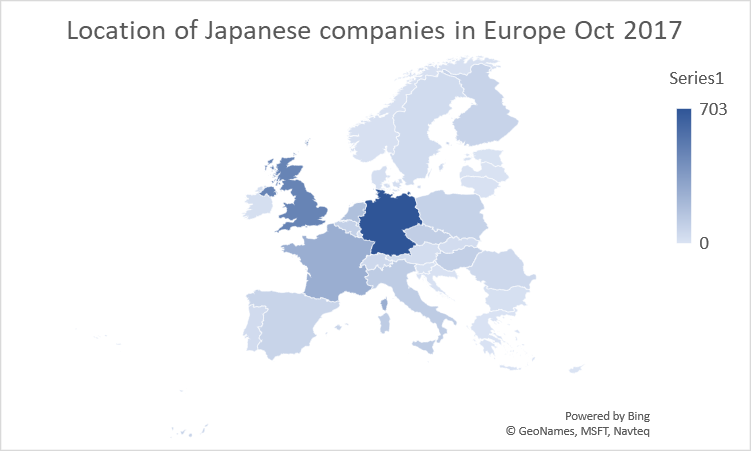
Which is not to say that Germany has been left out either – according to Japanese Ministry of Foreign Affairs figures, Germany still has the most number of Japanese companies in Europe – 703, if only incorporated subsidiaries are counted, rather than branches.  This represents a net increase of 20 companies over the past three years,with 8% more Japanese company expats in Japan in 2017 compared to 2015.

The UK is home to the second largest number of Japanese companies in Europe – 471*, and this has remained more or less unchanged in the past three years, and there has been a small decline in the number of Japanese expats posted there.  As can be seen in the map below, Japanese companies are still most concentrated in the big Western European economies:

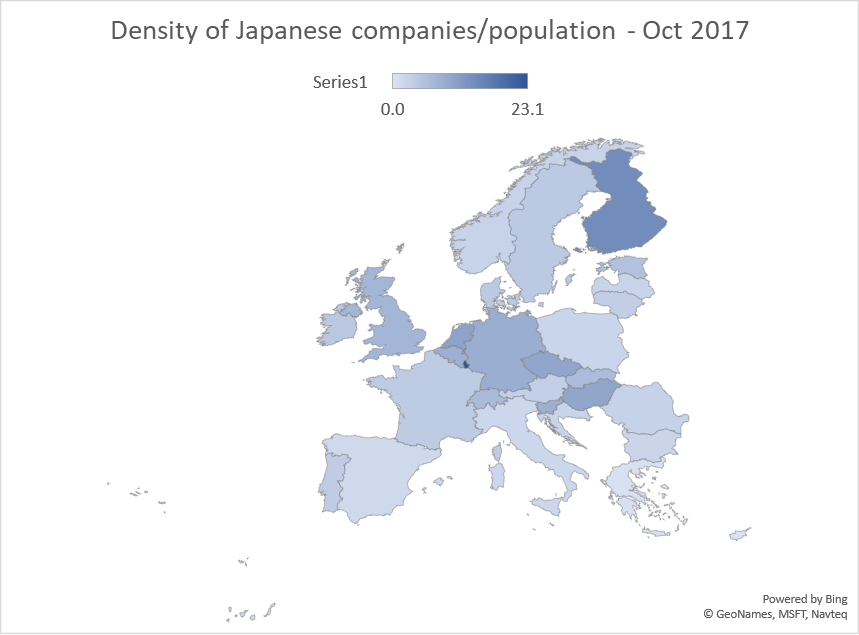
Crunching the numbers against population size reveals some interesting results – Netherlands has a high density, as you might expect, but Finland turns out to have a higher density – with a  larger number of Japanese companies than you would expect, given the size of its market.  Most of the 46 Japanese companies in Finland in our database are technology or machinery sector, often with production in Finland.  The highest density country, just as it was with numbers of Japanese expats, is Luxembourg – but of course it only has a half million population.  The Czech Republic and Hungary also have a high density of Japanese companies – again a large proportion being manufacturing.  Of the big Western European economies, Spain and Italy have relatively fewer Japanese companies than you might expect.

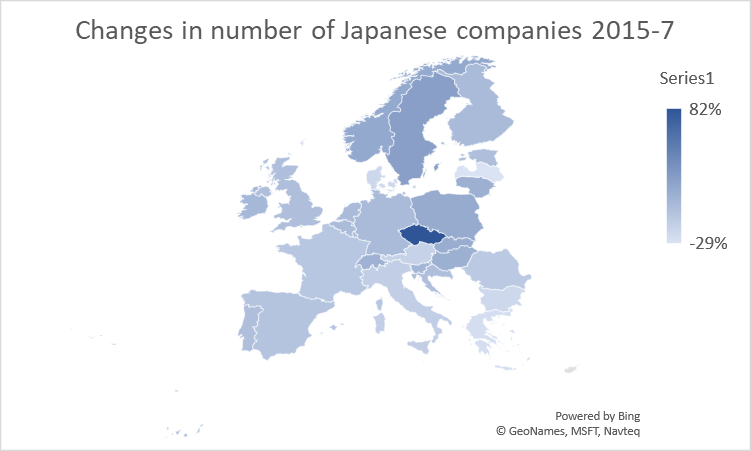
The really interesting story is where the shifts have been over the past three years – there is one clear winner – Czech Republic – it is home to 82% more Japanese companies than three years’ ago.  Other growth spots are Sweden, Norway, Poland, Slovakia, Hungary, Lithuania and Switzerland. Big losers have been Italy, Austria, Bulgaria, Denmark, Greece and Latvia (although admittedly, some of these did not have many Japanese companies to start with).

Newcomers to the Czech Republic that we are aware of have mostly been in the automotive industry: Central Glass, Linical (clinical research organisation), Nippon Paint Automotive Coatings, Hakuto (trading company), Obara (automotive welding products) and Tsubaki Automotive.

So the growth in company numbers is to the east and Nordics, mainly in manufacturing.  The consolidation and integration of services sector business and functions across Europe is benefitting the Netherlands most of all.


*The commonly used figures for Japanese companies in the UK are 800 or 1000.  There at least that many Japanese entities in the UK but some of them are multiple branches, or joint ventures or brass plate only.  I have used the narrow definition of what is called “honten” in Japanese – the main organisation/parent company, to aid accuracy and comparisons.

The original version of this article can be found in  “Shinrai: Japanese Corporate Integrity in a Disintegrating Europe” available as a paperback and Kindle ebook on  Amazon.

For more content like this, subscribe to the free Rudlin Consulting Newsletter. 最新の在欧日系企業の状況については無料の月刊Rudlin Consulting ニューズレターにご登録ください。

Read More
German workstyle versus Japanese customer convenience

You can’t have German workstyles and Japanese customer convenience, says Shion Amemiya, a 26 year old Japanese woman who has been living and working in Germany for 4 years and has now written a book about it.  The book hits a nerve in Japan because of the pressure companies are under to reform their workplace cultures and cut back on overtime.  Germany is often pointed to as an example of a thriving economy where people don’t do overtime and take plenty of holidays.

Germany has one of the highest overtime rates in the EU, she says in an article in the Toyo Keizai. Actually, looking at Eurostat’s 2018 figures, the UK has the highest number of hours worked per week per full time worker and Germany is somewhere in the middle.

She points out that Germans will do overtime, if there is work that needs to be finished, although there are more Germans who will stick to their rights and leave on time regardless then there are in Japan.  But as she notes, those kinds of people will not be well evaluated by bosses or colleagues.

Overtime is worked in order to finish a job, and there is a lot less “face time” overtime in Germany than in Japan.  Also, if overtime is worked on one day, Germans will then work fewer hours to compensate for this the next day, she observes.

As for holidays – she says what is great for the holiday taker is not so wonderful for the end user. She notes how in the summer, offices are empty, but that also meant that the local government officials, dentists and doctors she wanted appointments with were also away on holiday, and her favourite cafe was shut. Often, the person away is the person in charge, and nobody else can take care of their work while they are gone, and you are told to wait a month.

In Japan customers will insist on the person in charge being contacted even if they are on holiday, but in Germany she notes, customers and suppliers are seen as equals, with mutual rights – “I take a holiday, so I must accommodate other people taking holidays.”

Because people don’t take much holiday in Japan, it is a convenient country – shops are always open, the person in charge is always available.  Just copying another country without realising the drawbacks is pointless.  Japan needs to come up with workstyle changes that are appropriate to Japan, she concludes.

For more content like this, subscribe to the free Rudlin Consulting Newsletter. 最新の在欧日系企業の状況については無料の月刊Rudlin Consulting ニューズレターにご登録ください。

Read More
Hard Brexit alternatives for Japanese service sector companies in the UK

The UK government’s “soft” Brexit proposal, to allow freedom of movement of goods between the UK and the EU, is unlikely to be acceptable by the EU or even a practical solution for the UK economy.  It’s politically understandable why the government is trying to protect the just-in-time delivery of manufacturing supply chains, in which many Japanese companies are involved. The manufacturing regions mainly voted in favour of leaving the EU but it might be possible to persuade those voters to accept a soft Brexit if they realise their jobs are under threat from a hard Brexit.  However, 80% of the UK economy is in the services sector – predominantly in cities and in the south east – where the vote was largely to remain in the EU.

It’s not so easy these days to make a distinction between services and manufacturing for the purposes of customs checks and regulatory compliance, even in the car industry. 10% of Nissan’s workforce in the UK work in a technology design center in the south east, not in the factory in the north east, developing software and services, not just components for cars.

Fujitsu – the largest Japanese employer in the UK – may be a manufacturer in Japan, but only provides IT services in the UK. The number of Fujitsu staff in the UK has been falling over the past few years, whereas it has been increasing in Global Delivery Centers in Portugal and Poland. Fujitsu is now the largest Japanese employer in Portugal – employing around 1000 people who provide technical support to global customers by phone and internet.

Both Poland and Portugal can provide the low cost, multilingual, well-educated workforces needed by the services sector.  Although it is not a big market in its own right, the Portuguese economy has recovered since the euro zone crisis – the budget deficit is the lowest in 40 years, the unemployment rate has improved and it is politically stable.

For my own business, as an insurance against a “hard Brexit” for services, I might register for “e-residency” in Estonia. This will allow me to set up a company in Estonia and open a euro denominated bank account there so we can easily send and receive euros, within the eurozone.  It will also allow me – under EU data protection regulation and the new deal with Japan – to share client data freely with my colleagues in the EU and in Japan.

Similarly, any UK based companies in strongly regulated sectors such as financial and legal services are making sure they have credible presence in the EU, so they can continue to do business there.

Nobody is expecting the service export sector to move entirely away from the UK if there is a hard Brexit.  Alternatives to the UK have other disadvantages – political instability in Eastern Europe, or high costs and scarcity of good office locations and employees in Western Europe – but I predict this current trend of dispersed locations across Europe will accelerate.

This article by Pernille Rudlin originally appeared in Japanese in the Teikoku Databank News August 8 2018 and also appears in “Shinrai: Japanese Corporate Integrity in a Disintegrating Europe”  – available as a paperback and Kindle ebook on  Amazon.

For more content like this, subscribe to the free Rudlin Consulting Newsletter. 最新の在欧日系企業の状況については無料の月刊Rudlin Consulting ニューズレターにご登録ください。

Read More
Hard Brexit alternatives for services

The UK government’s “soft” Brexit proposal, to allow freedom of movement of goods between the UK and the EU, is unlikely to be acceptable by the EU or even a practical solution for the UK economy.  It’s politically understandable why the government is trying to protect the just-in-time delivery of manufacturing supply chains, in which many Japanese companies are involved. The manufacturing regions mainly voted in favour of leaving the EU. It might be possible to persuade those voters to accept a soft Brexit if they realise their jobs are under threat from a hard Brexit.  But 80% of the UK economy is in the services sector – predominantly in cities and in the south east, where the vote was largely to remain in the EU.

It’s not so easy these days, however, to make a distinction between services and manufacturing for the purposes of customs checks and regulatory compliance, even in the car industry.  10% of Nissan’s workforce in the UK work in a technology design center in the south east, not in the factory in the north east, developing software and services, not just components for cars.

Fujitsu, the largest employer in the UK, may be a manufacturer in Japan, but only provides IT services in the UK.  The number of Fujitsu staff in the UK has been falling over the past few years, whereas it has been increasing in Global Delivery Centers in Portugal and Poland. Fujitsu is now the largest Japanese employer in Portugal – employing around 1000 people who provide technical support to global customers by phone and internet.

Both Poland and Portugal can provide the low cost, multilingual, well-educated workforces needed by the services sector.  Although it is not a big market in its own right, the Portuguese economy has recovered since the euro zone crisis – the budget deficit is the lowest in 40 years, the unemployment rate has improved and it is politically stable.

For my own business, as an insurance against a “hard Brexit” for services, I might register for “e-residency” in Estonia.  This will allow me to set up a company in Estonia and open a euro denominated bank account there so we can easily send and receive euros, within the eurozone.  It will also allow me – under EU data protection regulation and the new deal with Japan – to share client data freely with my colleagues in the EU and in Japan.

Similarly, any UK based companies in strongly regulated sectors such as financial and legal services are making sure they have credible presence in the EU, so they can continue to do business there.

Nobody is expecting the service export sector to move entirely away from the UK if there is a hard Brexit.  Alternatives to the UK have other disadvantages – political instability in Eastern Europe, or high costs and scarcity of good office locations and employees in Western Europe – but I predict this current trend of dispersed locations across Europe will accelerate.

For more content like this, subscribe to the free Rudlin Consulting Newsletter. 最新の在欧日系企業の状況については無料の月刊Rudlin Consulting ニューズレターにご登録ください。

Read More
Brexit proofing has already started for Japanese manufacturers

On the face of it, it looks to have been a good couple of years’ for Japanese manufacturers in the UK, despite concerns over Brexit. 214 Japanese companies with production sites in the UK employ around 63,000 people, generating revenues of around £23.8bn. More increased their employee numbers than cut back, and overall employee numbers rose by around 5% on the previous year.

The Brexit risks

Although there are 214 companies, a handful dominate, and their reactions to Brexit will impact other Japanese companies who are suppliers to them. Nissan, Sony, Honda, Toyota and Princes (a food processor owned by Mitsubishi Corp) account for over 50% of the revenues, and over a quarter of the employees of Japanese manufacturers in the UK.  Increased recruitment by Honda, Nissan and Hitachi Rail (the 6th largest Japanese manufacturer in the UK, which has just started production) and various automotive suppliers account for most of the rise in employment over the past couple of years, whereas Toyota had the biggest reduction in workforce.

It’s clear from the breakdown in sales by region (where given) that the UK is indeed a gateway to Europe for Japanese manufacturers.  More than half of their combined turnover derives from sales to Europe (excluding the UK) and UK sales account for around a third of revenues. Any damage to their ability to export to Europe will therefore impact 50% or more of their revenues.

A third of the 214 companies are involved in the automotive supply chain and their fortunes are tied up in not only what Japanese car makers are doing but also other car makers such as Jaguar Land Rover and PSA (Peugeot, Citroen, Vauxhall etc). Japanese automotive suppliers have been keen to diversify over the past few years, to avoid over reliance on one customer or supplier or geography.

What the car makers do in response to Brexit in the long run is obviously key for them, but there are a couple of shorter term risks. One which has already had an impact is exchange rate volatilty. The cheaper £ can of course be a benefit, if they are exporting, and for most the exchange rate risk is manageable.  As half of the parts in a UK made car are imported, mainly from Europe, and around 80% of cars are exported, again mostly to Europe, there is a natural hedge. Some Japanese UK companies even report in euros, as they are selling and purchasing in euros.

Disruption to the supply chain from Brexit is another risk also mentioned in annual reports.  Although they are mostly manufacturing in the UK for UK based car companies, so should be able to maintain just-in-time delivery even if there is a hard Brexit, Japanese automotive suppliers still have to take account of the whole supply chain and likely reaction of the car manufacturers should there be prolonged problems.

Brexit-proofing has started

It’s clear some contingency plans are already being enacted.  Japanese companies have been warned since at least 2013 to my knowledge that Brexit could happen, so I suspect many of them have made plans with that in mind. These plans might well be something they would have considered doing anyway, but the added risk of Brexit tipped them towards it.  For example:

  • G-TEKT, which designs and manufactures pressed steel bodies and coachwork, primarily for Honda, had no other production in Europe apart from 3 plants in Gloucester, Ebbw Vale and Tredegar employing around 800 people. 90% of its sales are to UK customers. Production will start in Slovakia in 2019 – presumably it’s no coincidence that JLR is also building a factory in Slovakia.
  • Tsubakimoto, manufacturing automotive timing systems in Nottingham with around 100 employees, is transferring some of its existing business to a new plant in the Czech Republic. 72% of its sales are to non-UK European customers, 27% to UK customers.
  • Daido Industrial Bearings, employing around 180 people in Somerset, is transferring the sales function for its automotive and polymer accounts to Germany. 84% of its sales are currently to non UK European customers.  It also has plants in Montenegro, Czech Republic and Germany.
  • Senju Manufacturing, who make solder for the automotive and electronics industries, have started manufacturing in the Czech Republic in 2017, as requested by a customer, presumed to be Toyota, who have a joint manufacturing facility with Peugeot and Citroen there.
  • Kasai, who make interior components for Nissan, Honda and JLR for the UK only, have set up a plant in Slovakia, to add to their existing UK plants in Washington and Merthyr Tydfil, which employ 793 people, down 31 from the previous year.
  • TS Tech who make car seats for Honda, with 100% of sales to UK customers, started production in Germany in 2016 for VW, in addition to their Swindon UK (where employee totals rose by over 200 from 2015/6 to 2016/7)  and Czech Republic plants.

Some examples in the non-automotive sector include:

  • Sony DADC, who manufacture DVD and other digital products in Southwater, West Sussex, employing around 300 people. The organisation has been merged with Sony’s Austria branch, and will cease manufacturing in the UK and transfer all production to the Austrian plant.
  • Olympus Keymed have transferred sales to the Middle East and Africa region from the UK to its Germany based regional HQ
  • Sun Chemical has closed its plant in Orpington in 2017.  It has plants in Germany, France, Spain, Italy, Denmark, Austria and Poland.
  • Sekisui Alveo is transferring production of polyolefin foams from its plant in Merthyr to the Netherlands.

I estimate there are around 70 Japanese companies whose only production in Europe is in the UK.  Many of these are relatively Brexit-proof – they are highly specialised, or local unique brands (whiskey, fashion etc).  There are around 150 Japanese manufacturers in the UK who have production elsewhere in Europe, so can be considered relatively Brexit-proof already.

New investment into UK from Japan, but no sign of on-shoring in manufacturing

There are also examples of companies who are expanding in the UK – such as Graphic Controls, Hitachi Rail and various automotive companies, as outlined above.  However I am not seeing a lot of “onshoring” going on, despite encouragement from the UK government and car manufacturers such as Nissan. I estimate there are around 35 Japanese automotive suppliers who do not have production in the UK, but not one of them has started manufacturing in the UK.  There have been no acquisitions or newcomers into the UK in the automotive industry for the past three years.  The new Japan-owned companies that have arrived over that period are mostly in the services (financial, recruitment), food distribution, hi tech or pharma/biotech sector.

A more detailed version of this post is available as a free pdf here.

If you are interested in purchasing a spreadsheet giving full details of the 214 companies, or the 70 companies who might be looking for alternative production locations in the EU (address, ownership/M&A history, European HQ, business sector, European structure, turnover broken down by UK vs Europe, employee figures for past 2 years, constituency and MP), please contact Pernille Rudlin.

For more content like this, subscribe to the free Rudlin Consulting Newsletter. 最新の在欧日系企業の状況については無料の月刊Rudlin Consulting ニューズレターにご登録ください。

Read More

Search

Recent Posts

  • Biggest European companies in Japan
  • What’s going on in Japanese HR? – online seminar 24 September 15:00-16:30 BST/10:00-11:30 EST
  • Two swallows make a summer?
  • Biggest foreign companies in Japan
  • Japanese financial services in the UK and EMEA

Categories

  • Africa
  • Brexit
  • China and Japan
  • Corporate brands, values and mission
  • Corporate culture
  • Corporate Governance
  • cross cultural awareness
  • CSR
  • customer service
  • Digital Transformation
  • Diversity & Inclusion
  • European companies in Japan
  • European identity
  • Foreign companies in Japan
  • Foreign Direct Investment
  • Globalization
  • History of Japanese companies in UK
  • Human resources
  • Innovation
  • Internal communications
  • Japanese business etiquette
  • Japanese business in Europe
  • Japanese customers
  • M&A
  • Management and Leadership
  • Marketing
  • Middle East
  • negotiation
  • Presentation skills
  • Reputation
  • Seminars
  • speaker events
  • Sustainability
  • Trade
  • Uncategorized
  • Virtual communication
  • webinars
  • Women in Japanese companies
  • Working for a Japanese company

RSS Rudlin Consulting

  • Biggest European companies in Japan
  • What’s going on in Japanese HR? – online seminar 24 September 15:00-16:30 BST/10:00-11:30 EST
  • Two swallows make a summer?
  • Biggest foreign companies in Japan
  • Japanese financial services in the UK and EMEA
  • The puzzle of Japanese foreign direct investment in the UK
  • What is a Japanese company anyway?
  • Largest Japan owned companies in the UK – 2024
  • Japanese companies in the UK 20 years on
  • Australia overtakes China as second largest host of Japanese nationals living overseas

Search

Affiliates

Japan Intercultural Consulting

Cross cultural awareness training, coaching and consulting. 異文化研修、エグゼクティブ・コーチング と人事コンサルティング。

Subscribe to our newsletter

Recent Blogposts

  • Biggest European companies in Japan
  • What’s going on in Japanese HR? – online seminar 24 September 15:00-16:30 BST/10:00-11:30 EST
  • Two swallows make a summer?
  • Biggest foreign companies in Japan
  • Japanese financial services in the UK and EMEA

Meta

  • Log in
  • Entries feed
  • Comments feed
  • WordPress.org

Posts pagination

« 1 … 31 32 33 … 57 »
Privacy Policy

Privacy Policy

Web Development: counsell.com

We use cookies to personalize content and ads, to provide social media features, and to analyze our traffic. We also share information about your use of our site with our social media, advertising, and analytics partners.