Top earning executives in Japan 2022
As in previous years, the top earning executives in Japan over the past year include many non-Japanese people. At number 1 is Shin Jingho, Korean founder of Line (Japanese messaging app), far outstripping all the other big earners, pulling in US$315m to March 2022. He moved to Japan in 2008 to turn around parent company Naver’s websearch business, and somewhat alarmingly, claims to have learnt Japanese by watching gangster movies.
At number 2 is Kurotsuchi Hajime, the 100 year old chairman of Daiichi Koutsu Sangyo, a taxi and real estate firm in Kyushu. He has just announced he is retiring and intending to start a foundation for small to medium sized businesses. Perhaps that is where some of his US$138 million earnings will be going.
Yoshida Kenichiro, CEO of Sony, is the third highest earner, on US$137m. Christophe Weber, French CEO of Takeda Pharma is at #4 with US$135m. Kawai Toshiki, CEO of Tokyo Electron is in 5th place with US$121m.
Nikkei points out that the number of executives earning over Y100m a year (US$728,000) has increased to 652, 105 up on the previous year, the highest number in 3 years. It sees this as proof that Japanese executive compensation is shifting towards Western standards. With the top 5 including two Japanese executives who are not also founders (Yoshida and Kawai), this does seem to show a move away from the usual rule in long standing blue chip companies that the president should only earn around 10 to 20 times the average salary (around US$40,000).
Hitachi has the highest number of executives (18) earning over Y100m a year, then MUFG with 13, Toshiba also with 13 (presumably danger money for being associated with it), Mitsui & Co (9), Daiwa Securities (9), Tokyo Electron (8), Mitsui Real Estate (8) and Bandai Namco (8). Companies with 7 Y100m earners are Daikin, Sompo, Fujifilm, Nissan and Nomura.
Non-Japanese executives resident in Japan in the Y100m club include Simon Segars at SoftBank (British former CEO of ARM), Andrew Plump at Takeda, James Kuffner Chief Digital Officer at Toyota, James Shea at Sompo International, He Xian Han at Ferrotec, Costa Saroukos CFO Takeda Pharma, Stefan Kaufmann, CAO Olympus, Rony Kahan, Recruit (founder of Indeed), Eric Johnson, CEO of semi conductor company JSR, John Marotta former CEO of PHC (was Panasonic Healthcare) holdings and Alistair Dormer, former board director of Hitachi.
For more content like this, subscribe to the free Rudlin Consulting Newsletter. 最新の在欧日系企業の状況については無料の月刊Rudlin Consulting ニューズレターにご登録ください。
Read More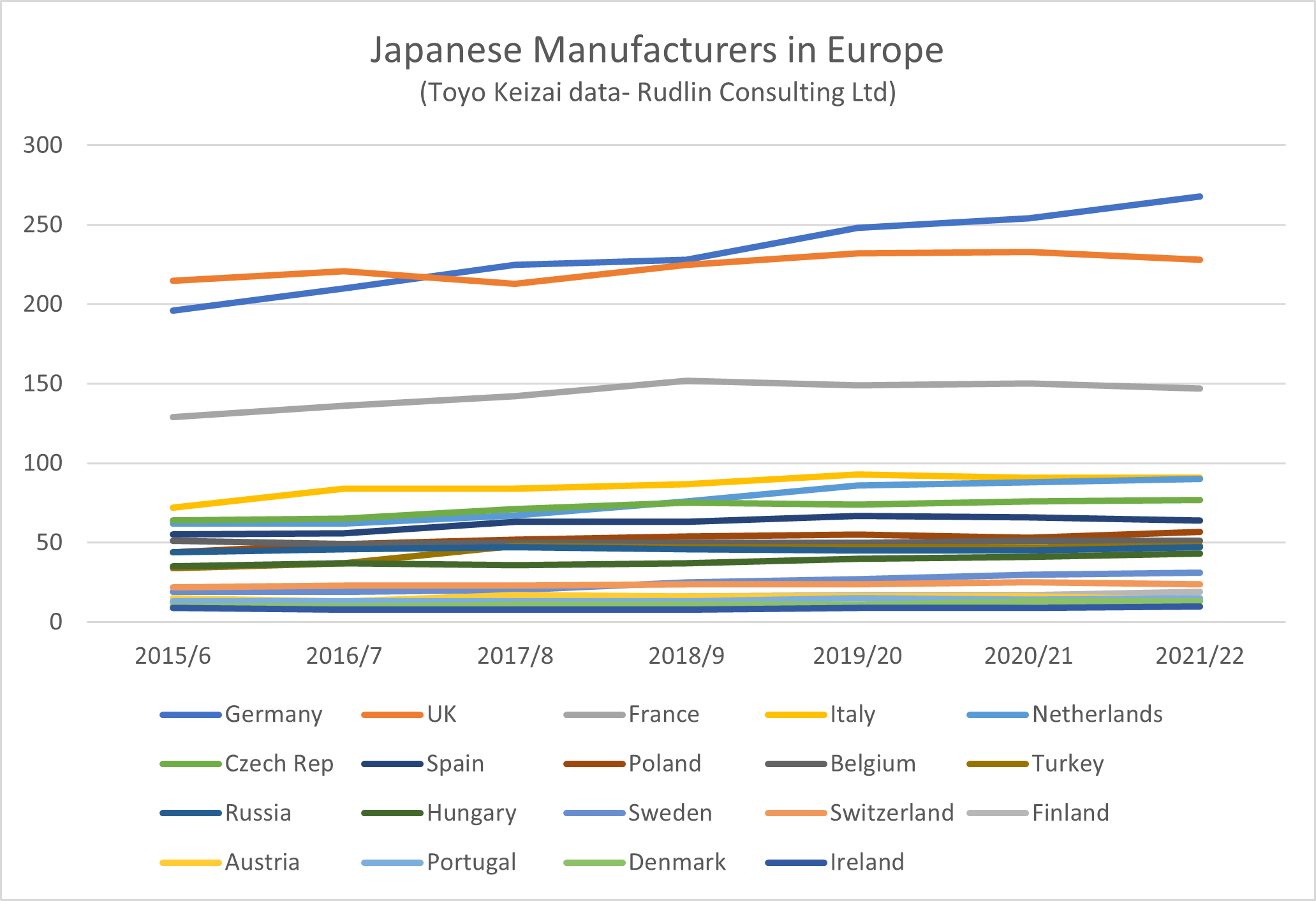 How this compares with other European countries can be seen in the chart on the left – which shows the numbers of all manufacturing companies in Europe, including automotive. According to Toyo Keizai, the number of Japanese manufacturers in the UK dipped around 2017/8, but recovered, with another more recent fall. But there was growth overall since 2015/6, with 228 companies in 2021/2 compared to 215 in 2015/6 – a 6% increase. This is much lower than the overall 20% growth in Europe, and as a consequence the UK is no longer the largest host of Japanese manufacturers.
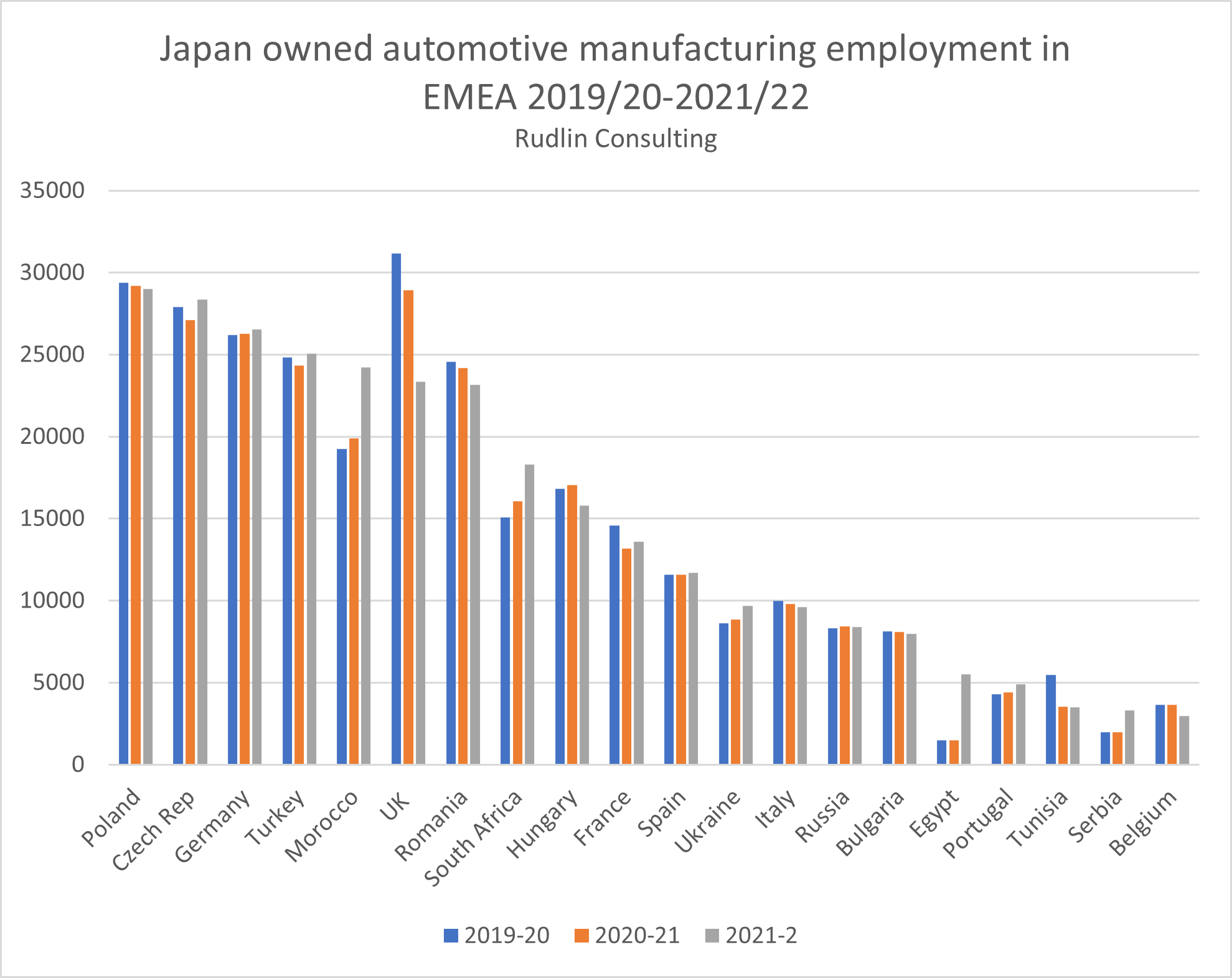 numbers of Japanese automotive manufacturing employees in the EMEA region. According to our estimates, the UK will slip to 6th position in 2021-2022, due to the closure of Honda‘s Swindon plant, along with many of its suppliers shutting down operations. It will be overtaken by Czech Republic, Germany, Turkey and Morocco.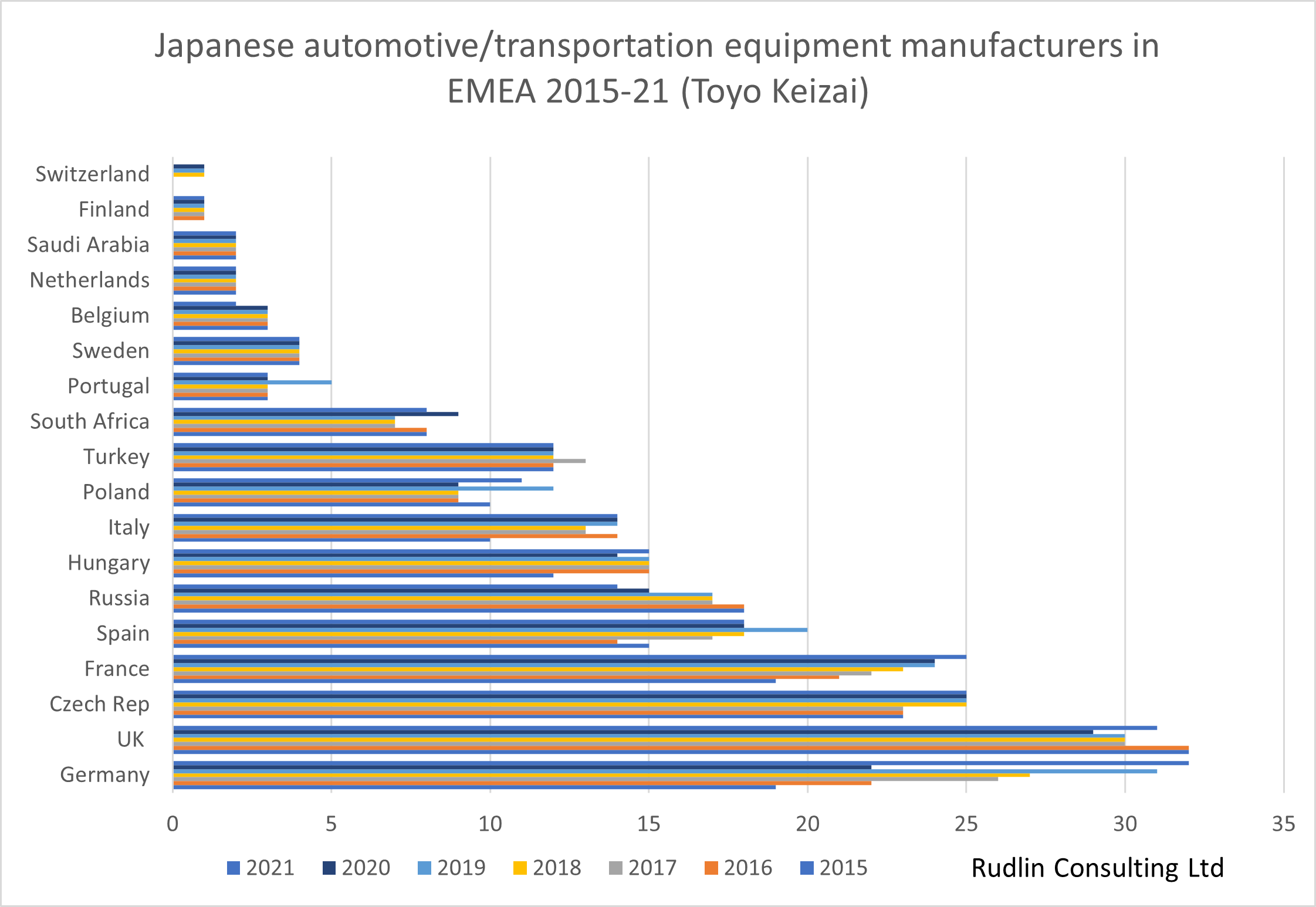
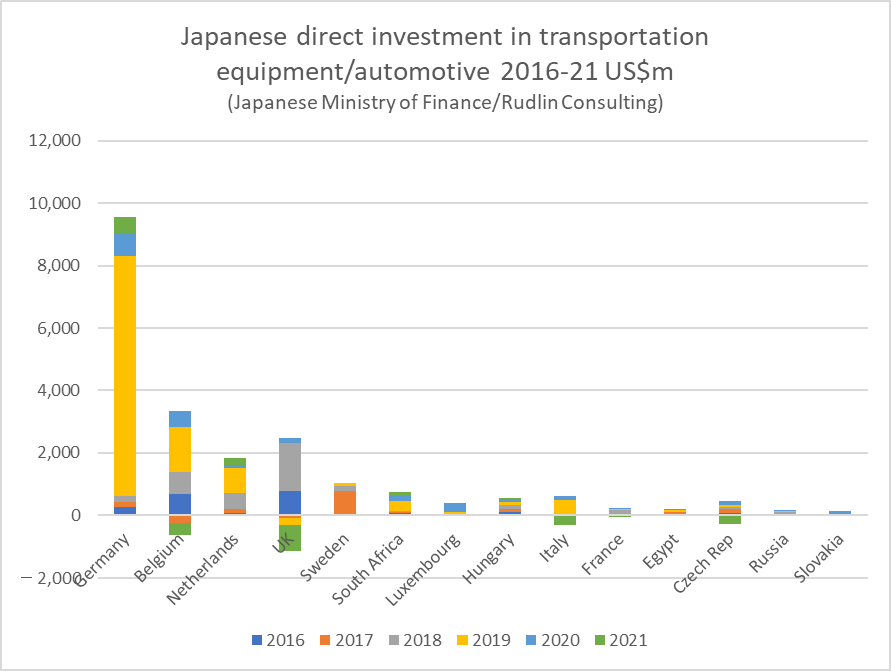
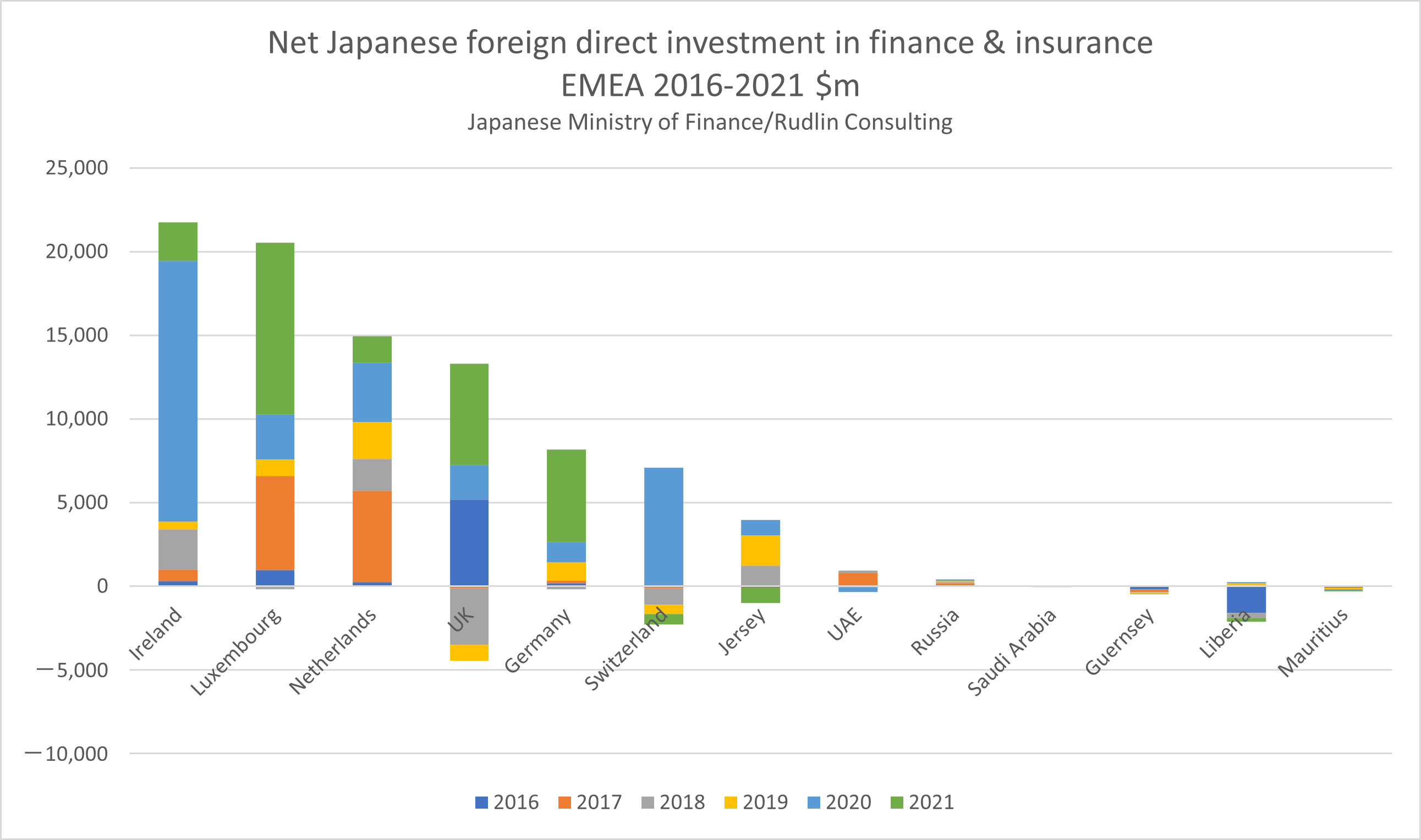 Examining the statistics from Japan’s Ministry of Finance on direct investment flows, it seems the UK benefitted from a big inward investment from Japan into the finance and insurance sector in 2016, then there was net disinvestment in 2017-2019, and then increasing net investment in 2020-21. Conversely, there was little investment into Ireland, Luxembourg or the Netherlands in 2016, but major investments into their finance and insurance sectors in 2017, 2018 and 2020-21.