Rudlin Consulting Rudlin Consulting
  • About
  • Services
  • Blog
  • Clients
  • Publications
  • Contact us
  • Privacy
  • English
  • 日本語
  • About
  • Services
  • Blog
  • Clients
  • Publications
  • Contact us
  • Privacy
  • English
  • 日本語
  •  
The opportunity for Japan to help Europe with its housing shortage

One of the few new Japanese companies to join the Japanese Chamber of Commerce & Industry in the UK in 2020 was Sekisui House. Daiwa House also announced at the end of 2020 that they were going to acquire Dutch modular housing builder Jan Snel.

Both companies cite the housing shortage and scarcity of skills across Europe as a reason for their expansion. We have certainly been suffering from a housing shortage in the UK for many years. When I studied the problem 30 years’ ago at university, I remember being told that one issue was not so much a lack of housing, but a lack of adequate housing. There were and still are a lot of older houses, even dating back to the 19th century, which are not fit for modern day living.

Another issue which has become more acute is that these houses, even if refurbished, are not where people want to live. We still have an economic north/south divide in the UK, thanks to the decline of industry. Big northern towns and cities have no jobs, but plenty of empty, dilapidated housing. Cities in the south are not building enough new housing for the increase in population. As a result, young people are having to share crowded houses and apartments and cannot afford the mortgage needed to buy anywhere.

Building more new houses in those cities is the obvious solution, except that there is a lack of land on which to do so. There was an attempt to allow old office blocks to be turned into apartments, but this resulted in some very low quality, unhealthy housing.

Land is available in the commuter zones outside London, but this has been protected for many years by a so-called Green Belt, which tries to preserve green fields and woodland. Although this may seem a worthy ecological cause, it has mostly been exploited by the residents of those areas who do not like the idea of new houses and newcomers and a consequent hit to the value of their own homes.

I used to live in one of those areas, near a train station which took me directly into central London in 47 minutes. It was right by the M25 orbital motorway, and there was a constant noise from nearby Heathrow and Gatwick airports. I thought at the time that claiming this was green belt and refusing to build more homes in the area was not only selfish, but a denial of reality.

For the first time in the UK, and possibly in the world, air pollution has been ruled as the cause of death of little girl who had asthma and lived in London. I thought back to our time living in the “green belt” and the air pollution we tolerated there. If Sekisui and Daiwa are going to be able to build housing in those areas, their low carbon technology, with effective air conditioning systems,  should be much welcomed.

This article originally appeared in Japanese in the Teikoku Databank News

For more content like this, subscribe to the free Rudlin Consulting Newsletter. 最新の在欧日系企業の状況については無料の月刊Rudlin Consulting ニューズレターにご登録ください。

Read More
Top 30 Japanese companies in Poland 2021

Poland and other Eastern European nations are a forgotten economic success story, according to Ruchir Sharma of Morgan Stanley Investment Management in a recent Financial Times opinion piece. The Czech and Slovak Republics, Lithuania, Latvia, Estonia, and Slovenia have all made it into the advanced economies, as defined by the IMF, and have a per capita income of $17,000, with Poland not far behind at a per capita income of $15,000. Hungary is even closer, with per capita income of $16,000 and Romania is also catching up, on $13,000.  Quality of institutions and other more subjective factors are included in the IMF criteria, so it may be that if some of these countries are judged to have deteriorated under a populist government, then promotion to the premier division will be delayed.

Sharma argues that consistent long term growth is the key to economic success, and manufacturing prowess lies behind this for Eastern Europe. Poland has grown at an average of 4% a year over the past three decades, without a single year of negative growth. Japanese companies do seem to have been attracted to this economic stability. According to our research, Japanese companies in Poland now employ around 53,000 people, making it the fourth largest base for Japanese company employees in the European region after the UK (176,000), Germany (167,000) and France (75,000).

The largest Japanese employers in Poland are indeed manufacturers such as Sumitomo Electric Industries (Sumitomo Electric Wiring/Bordnetze producing harnesses and Sumitomo Riko producing hoses for the automotive industry) and other automotive suppliers such as NGK Insulators, NSG (automotive glass), Toyota Motor, NSK, Bridgestone and Yazaki.

Beer and cigarette manufacturers also feature – Asahi after their acquisition of Polish beer brands Tyskie and Lech, and Japan Tobacco has a factory in Poland manufacturing Winston and Camel. A further vice, chocolate, is also manufactured by a Japan headquartered company Lotte, via their 2010 acquisition of Wedel.

There are some large services sector employers as well – Fujitsu has around 3,000 employees working in its global delivery centres in Katowice and Łódź. However, we estimate around a third of the 200 Japanese companies in Poland have plants there, compared to 16% of the 1000+ Japanese companies in the UK or Germany.

We may still be missing a few Japanese companies in Poland. There are relatively fewer Japanese expatriates in Poland compared to other countries which host larger numbers of Japanese companies. This may cause some underreporting to database survey companies such as Toyo Keizai, which only records around 130 Japanese companies in Poland, and less than 20,000 employees, compared to our estimates of over 200 companies and 53,000 employees.  There is still a tendency by Japanese companies to locate their Japanese expatriates in Germany, to manage Eastern European subsidiaries and branches from there. The Polish investment agency says there are 300 companies in Poland employing over 40,000, in 2019.

Cornel Ban, of the Copenhagen Business School, responded to Sharma’s piece by arguing that a high risk of stagnation in countries such as Poland is “baked in”, if they only rely on low labour costs. There is a lack of investment in training and R&D and that “the multinational manufacturing firms that dominate these countries’ export-led growth regimes have few incentives to relocate significant technical innovation systems in the region.”  As far as we can ascertain, there are only a few Japanese companies that are conducting R&D in Poland – Canon Ophthalmic Technologies, Fujitsu‘s FQS in computational chemistry systems and Rigaku in thin films and materials.

PDF DOWNLOAD OF TOP 30 JAPANESE EMPLOYERS IN POLAND 2021

For more content like this, subscribe to the free Rudlin Consulting Newsletter. 最新の在欧日系企業の状況については無料の月刊Rudlin Consulting ニューズレターにご登録ください。

Read More
Top 30 Japanese employers in Italy 2021

We’ve just compiled our first ever Top 30 for Japanese employers in Italy (see below for updated 2022 version). We’ve thought for a while that Tōyō Keizai underreported the number of employees in Italy, and that it probably ranked fourth after the UK, Germany and France in terms of numbers employed. Tōyō Keizai records 16,500 employees at 270 companies.  We estimate it’s more like 50,000 employees at 350 or so companies. We were also wondering what might be behind the Japanese Ministry of Foreign Affairs data showing a sudden rise from 300 Japanese companies in Italy in 2018 to 425 to 2019.

The answer to both puzzles might lie in the fact that the Hitachi group, which was the largest Japanese employer in Italy, acquired various rail businesses from Ansaldo in 2019 and one of its subsidiaries, Hitachi Chemical, acquired FIAMM in 2020.  Hitachi has now dropped one rank, to the second largest Japanese employer in Italy, behind the NTT group, as Hitachi Chemical was acquired by Showa Denko in 2020. Another factor is that the NTT group has also grown substantially in Italy recently, mainly thanks to acquisitions by NTT Data.

Other large Japanese employers in Italy are the result of earlier acquisitions: Denso has some of its major manufacturing operations in Italy, deriving from acquisitions from Magneti Marelli more than 20 years’ ago. Denso Thermal Systems S.p.A. is now the regional headquarters for the air conditioning manufacturing business.

Mitsubishi Electric at #5 acquired Italian firm Climaveneta in 2015. Nidec, the 6th largest Japanese employer in Italy, acquired Ansaldo Sistemi Industriali S.p.A. in 2012. Sumitomo Heavy Industries acquired Lafert (electric motors and drives) in 2018.

So it seems likely the underestimation of Italy lies more in acquisitions unaccounted for than a sudden influx of Japanese greenfield investment.

Half of the Top 30 Japanese employers in Italy are also in the EMEA region top 30, so would be expected to have substantial presence in Italy too. The acquisitions detailed above show that Italy’s strengths, as far as Japanese companies are concerned, are in engineering – particularly rail and air conditioning. Judging by the companies that are only in the Italy Top 30,  textiles (Toray) and pharmaceuticals (CBC and Takeda) are still attractive sectors for Japanese investment – and of course food – such as the Princes tomato processing plant, owned by Mitsubishi Corporation.

New 2022 edition

The 2022 Top 30 has just been published – it can be downloaded from our website here.
 We can provide more detail on the 85 companies within the Top 30 – each company name in full and employee total per company (a truer indicator of size of the company than turnover in our opinion)  for £9.99 – please email us for a PayPal invoice.

For more content like this, subscribe to the free Rudlin Consulting Newsletter. 最新の在欧日系企業の状況については無料の月刊Rudlin Consulting ニューズレターにご登録ください。

Read More
Top earning foreign executives at Japanese companies in 2021

Seven out of the ten best paid executives in Japan are not Japanese, according to Tokyo Shoko Research. It’s been more than ten years since Japanese companies were obliged to disclose the details of executives earning more than ¥100m (around $900K) and was cited as one of the reasons that Nissan got themselves into such a twist about their CEO Carlos Ghosn’s pay.

No Nissan executives appear in the Top 30 this year, unsurprisingly. The number of executives paid over ¥100m has risen for the first time in two years, and Hitachi has the most – with 15 executives including the British head of the rail division, Alistair Dormer. Dormer is not, however, being paid more than his Japanese boss, Mr Higashihara, although this has happened in the past at companies such as NSG.

The financial group MUFG has 11 executives earning over ¥100m and Mitsui, the trading house conglomerate and Daiwa Securities both have 9. Tokyo Electron and SoftBank both have 8 executives earning over ¥100m. SoftBank’s Simon Segars, British CEO of ARM is the highest paid executive of a Japanese company, earning ¥1,880m (around $17m) and SoftBank’s COO Marcelo Claure is the third highest paid, with SoftBank’s Rajeev Misra, Ronald Fisher, Miyauchi Ken and Goto Yoshimitsu at #6, #7, #12 and #21 respectively.

FANUC, Daikin, Toyota Motor, LIXIL, Sony, ENEOS and Mitsubishi Electric all have 7 executives earning more than ¥100m. I would be surprised if the latter was in the rankings next year, however, given its current difficulties.

Other high earning foreign executives include Christophe Weber at #2 and two other executives at Takeda Pharma, Didier Leroy at Toyota Motor (#4) , Bijoy Mohan at LIXIL (transferred with LIXIL’s Grohe acquisition) and Stefan Kaufman at Olympus.

So if you want to be a high paid foreign executive at a Japanese company, work for a Japanese company that has a high proportion of its business overseas either through organic growth (Toyota) or more likely through acquisition – Hitachi Rail, Takeda, LIXIL, Olympus, SoftBank.

For more content like this, subscribe to the free Rudlin Consulting Newsletter. 最新の在欧日系企業の状況については無料の月刊Rudlin Consulting ニューズレターにご登録ください。

Read More
UK still number one in Europe for Japanese automotive manufacturing – just

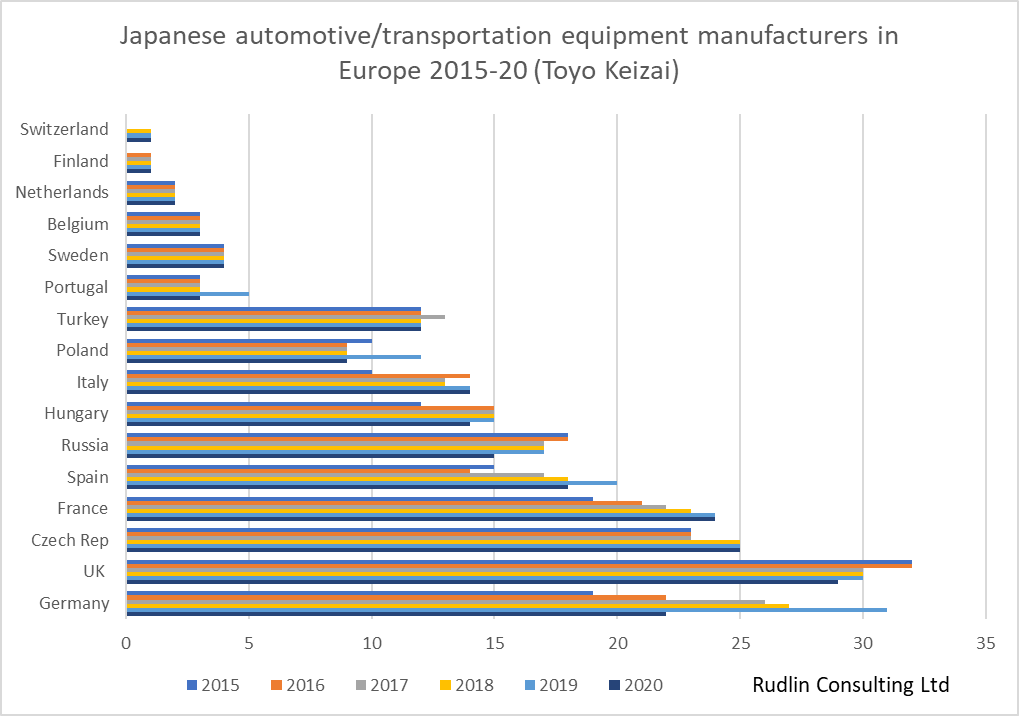
The recent news about Nissan and its Chinese battery manufacturing partner Envision deciding to go ahead with expanding the battery plant in Sunderland, to supply a new electric vehicle model, led me to revisit my researches on trends on the Japanese automotive sector in the Europe, Middle East and Africa region. I had blogged in October 2020 that for the first time in at least five years, according to Toyo Keizai data, there were more Japanese automotive manufacturers in Germany than in the UK.
Toyo Keizai’s new directory came out this April, and adding in their more recent data, it seems that the number of Japanese automotive manufacturers in Germany actually dropped by 11, from 31 to 22. So the UK is back in the top spot. Cross checking this against all data for Japanese companies in Germany, it seems that this is more that those 11 companies switched categories rather than left Germany. Many automotive suppliers of parts supply parts for other industries, so they may have decided that the bulk of their business was no longer automotive, or preferred not to be classified as automotive.  There were also falls in the numbers of Japanese automotive manufacturers in Spain, Russia, Poland and Portugal.

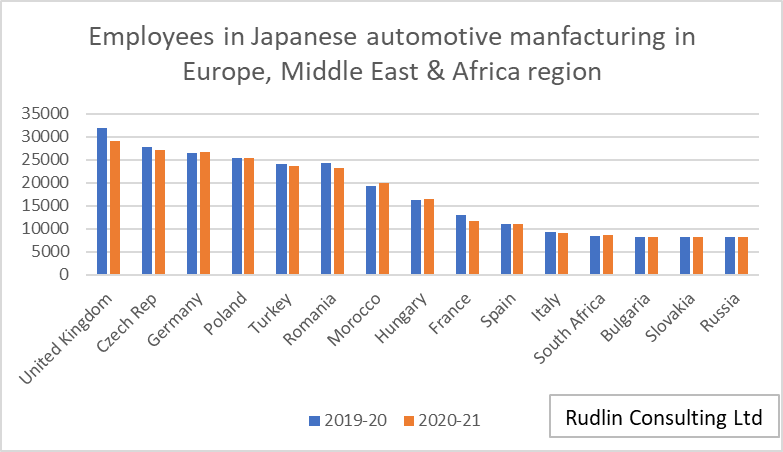
The number of people employed by Japanese automotive manufacturers is perhaps a better indicator of general health than self classified numbers of companies. The numbers employed by Japanese automotive manufacturers in the UK has dropped by 12% comparing 2015/6 to 2020/21 and by around 8% over the year 2019/20 to 2020/2021.  I only have comparable employee numbers for the rest of the region for the past two years,  and these show that there has been a 2% drop employee numbers from 2019/20 to 2020/2021. The only other notable decrease was in France, where employment fell by 11%. The most growth was in Morocco, but only by 3%.

So the UK still has the most employees of Japanese automotive manufacturers in the region, but the number of employees has dropped below 30,000 for the first time in five years. The Czech Republic, Germany and Poland are not far behind in terms of employee numbers, and it’s possible Germany still does have more Japanese automotive related manufacturers than the UK, it’s just that they have chosen not to classify themselves as being in the automotive sector. The closure of Honda Swindon and other suppliers to the Swindon plant this month will probably result in the UK losing its top spot both in terms of employees and companies hosted.

The biggest Japanese automotive employers, apart from the actual car assemblers themselves, are the wire harness suppliers- Yazaki and Sumitomo Electric being the dominant Japan owned companies. Unsurprisingly, they base most of their factories in lower labour cost countries in Eastern Europe and North Africa.

Overall, Japanese automotive manufacturers employ around 280,000 people in the region, not including those in the supply chain who are wholesale/importing rather than manufacturing.  So it is no wonder that any investment by them is welcome news, but it may take a little more than the recent Nissan announcement to reverse the trends in the UK and across the region.

For more content like this, subscribe to the free Rudlin Consulting Newsletter. 最新の在欧日系企業の状況については無料の月刊Rudlin Consulting ニューズレターにご登録ください。

Read More
The prime minister of the Japanese business world

We were very sorry to hear of the passing of Nakanishi Hiroaki, Chairman Emeritus of Hitachi.  There was a nice tribute to him in the Nikkei Business magazine (JPNS), calling him the prime minister of the Japanese business world, who was not afraid to speak out.  Not only was he instrumental in turning around Hitachi, along with Kawamura Takashi, but he was a champion of making sure the voices of women and younger people were heard.

He was highly critical of Keidanren (the Japanese business association)’s resistance to increasing external directors on boards, and urged Japanese companies to pay higher wages to their employees. He was also insistent that if Japanese companies did not tackle environmental problems immediately, they would lose their competitiveness. As the head of Keidanren, he fought for  Namba Tomoko of DeNA to become the first female vice president of Keidanren, accusing it of being overconcerned about the size and seniority of companies in its hierarchy, saying that to younger people it had become a fossil. He pushed for targets for women in management, declaring that the Japanese economy would sink if its male oriented society was not changed.

Even as he struggled with his illness, he continued to speak out, unafraid of criticism, and wanted not just his successor at Keidanren, but also Japan as a whole to feel free to express their opinions.

For more content like this, subscribe to the free Rudlin Consulting Newsletter. 最新の在欧日系企業の状況については無料の月刊Rudlin Consulting ニューズレターにご登録ください。

Read More
Latest Top 30 Japanese companies in UK shows significant divergence

Our latest Top 30 Japanese companies in the UK shows a 1.3% drop overall in employee numbers from 2019 to 2020*, the first fall we have seen in the seven years we have been tracking the Top 30. As most Japanese companies in the UK use an April 1 to March 31 financial year, the fall in employee numbers dates to before COVID-19 pandemic began to have an impact. The small drop masks significant divergences – there were companies whose workforce shrank by over 10% such as Nissan, Honda and Nomura, and also companies which grew significantly, such as NTT and SoftBank.

This tallies with a recent report from Japan’s Ministry of Economy, Trade and Industry (METI) which reported in March 2021 that whereas automotive sector companies have a bleak outlook on the UK market, manufacturers in sectors such as chemicals, pharmaceuticals, electrical machinery and foods are far more positive about future expansion in the UK. According to METI, manufacturers represent around 39% of Japanese companies in the UK, the remainder being in the services and wholesale sectors.  Services sectors, particularly IT related, would seem to be positive too from our researches, apart from Fujitsu, which has slipped down a further place to being the 4th largest Japanese employer in the UK, having been the largest for many years previously, to 2017/8.

The 96,000 who work for the Top 30 Japanese companies in the UK represent around 55% of the 176,000 (down from 179,000 the previous year) or so people who work for over a 1,000 Japanese companies in the UK, according to our estimates.  The METI survey shows that despite the small drop in the numbers employed by the Top 30, larger companies (defined by METI as having over £600m turnover) will have weathered Brexit far more easily than smaller ones, having the resources and networks to set up agents in the EU, stockpile and open up new logistics and warehousing hubs on the Continent.

Certainly the 50 or so Japanese companies that have withdrawn from the UK over 2019-20 have been smaller in size (under 50 employees) and the larger ones who have shut down operations have usually not withdrawn entirely but rather turned their subsidiaries into branches or merged them with another UK based operation.

As we have said for some years now, Brexit has brought about an acceleration of trends which were happening anyway, and precipitated some long overdue tidying up.

FREE PDF DOWNLOAD OF TOP 30 JAPANESE EMPLOYERS IN THE UK 2021

*2020 defined as the year ending 2020, where most of the year was in 2019, ie April 2019 to March 2020 or January 2019 to December 2019.

For more content like this, subscribe to the free Rudlin Consulting Newsletter. 最新の在欧日系企業の状況については無料の月刊Rudlin Consulting ニューズレターにご登録ください。

Read More
Who are the Biggest Foreign Companies in Japan in 2020?

Toyo Keizai has not, as far as we are aware, issued another ranking of the biggest foreign companies in Japan since the one we blogged about in 2018. So for an update, we are relying on the analysis of a Japanese blogger working for a publisher in Tokyo, going by the name of Naganasu (long aubergine, ahem), who has done the number crunching from the Toyo Keizai directory for 2020.

Naganasu has not included minority foreign owned companies such as Nissan, who were top of the rankings last time. This means Accenture (headquartered in Ireland) has shot to the top, with a 70% increase in employee numbers from 7,600 in 2018 to 13,000 in 2020. Gibraltar Life Insurance,  a Japan only brand, formerly known as Kyoei, acquired by US company Prudential Holdings in 2001 is still at #2 with 12,731 employees. Naganasu has also not included Sharp, 65% owned by Taiwanese Hon Hai, which was at #3 before.

The largest European-owned Japanese company is Bosch, at #6 with 5,333 employees.  VSN (a staffing company acquired by Swiss company Adecco in 2012) has risen to #10 from #31 with 4, 271 employees, a third larger than in 2018. IKEA has also grown in Japan, from 2,700 employees to 3,200, up from #36 to #16.

As in 2018, there is a lack of British owned companies in the top 50.  The only one included by Naganasu is AstraZeneca at #19 with 3,000 employees. What happened to GSK, which was at #28 with 3,300 employees in 2018 is not clear. Perhaps they have shrunk to below 2,000 employees, so were not in the top 50. Alternatively, as we’ve often noticed with Toyo Keizai, if you don’t respond to their questionnaires, you don’t get included.

Other European companies in the 2020 top 50 are Adecco, L’Oreal, Bayer, Nestle, Philips, Valeo (French automotive supplier), Triumph (Swiss underwear company) and Autoliv (Swedish automotive company).

For more content like this, subscribe to the free Rudlin Consulting Newsletter. 最新の在欧日系企業の状況については無料の月刊Rudlin Consulting ニューズレターにご登録ください。

Read More
Japanese values prevent digital transformation

Kimura Takeshi, a Nikkei IT journalist has a self-styled hard hitting rant in Nikkei Business about Showa values such as omoiyari and how they should be ditched if Japanese IT companies are to compete globally.  I have to admit he shocked me, as I even titled my book about how to provide Japanese style customer service “Omoiyari”, but then I was brought up in Japan during the Showa era (1926-1989).

He says omoiyari (consideration for others, forethought) and being close to the customer is still important in hospitality or medicine but is plain creepy and useless when it comes to IT.  He points out that all it means is that you are close to other humans in the customer company, who are running the IT department, and who will not necessarily tell you or know the full picture of what is going on in their company.

Other Showa values he gives a good kicking to include gembaryoku – or onsite capability, meaning that suppliers are there working at the customer site and “we never give up, never run away.”  As he points out (and I’ve often warned suppliers to Japanese companies of this too) this leads to over-servicing and all kinds of work being done which were not in the original project spec, tipping profits into losses.

He also points out that Japanese companies that boast of these values are usually homogeneous organisations with a strong sense of companionship and self sacrifice, where employees are working for the organisation and colleagues, as well as having a budget busting customer entertainment allowance. Not only will this not be competitive globally, but it also means the company is a closed organisation without diversity. High performers are disliked by others. Deference and consensus based decision making (nemawashi) are the norm.

He says this is why foreigners coming to Japan as tourists love it so much, because there is such a strong urge to be considerate and hospitable towards others. But once they live in Japan,  they are expected to be members of the community and learn how to read the air and be considerate of others around them, but find this difficult to do as they have been brought up to be self assertive and individualistic. As a result they are excluded from the community and treated as strangers, causing unhappiness and confusion.

Kimura says it feels uncomfortable to have to tell Japanese people to deny their compassionate natures, but he worries that if they don’t, then Japan will not be able to ride the wave of digital revolution and will not only be underdeveloped in IT but an underdeveloped country in a more fundamental sense. IT companies need to include foreigners so that they can thoroughly discuss and create new digital services without having to read the air or worry about whether it would mean a loss of jobs for people who have supported you on the client side.

Instead of omoiyari based closeness to a customer he recommends “がっぷり四つに組む” (Gappuri yotsu ni kumu – be locked together in 4 ways) which was a new expression to me. It comes from Japanese martial arts, meaning to grab each other’s belts with both hands.


I talk further about omoiyari and Japanese customer service with Rochelle Kopp, founder of Japan Intercultural Consulting, in a podcast available here.

For more content like this, subscribe to the free Rudlin Consulting Newsletter. 最新の在欧日系企業の状況については無料の月刊Rudlin Consulting ニューズレターにご登録ください。

Read More
Top Japanese companies for CSR in UK

Only around 10% of Japanese companies in the UK mention any charitable donations in their annual reports, and yet according to Toyo Keizai, many of the largest Japanese companies in the UK top the rankings for contributions to corporate social responsibility, measured in Yen.*

Top of the ranking is Honda, which spent Y9.57bn ($87m) on contributing to society in 2019/20. Activities included a national robot contest and the Honda Eco Mileage Challenge – a competition to see how far a car can be driven on a liter of gasoline, as well as beach cleanups.  CSR outside Japan is also included, such as Honda’s professional training course in South America, a Dream Riding Program for women in India and tree planting in Inner Mongolia.

Pharmaceutical companies have always been big corporate givers, unsurprisingly. Takeda is the second largest CSR donor in Japan, spending Y8.55bn (a significant increase on previous years) on the Takeda Science Foundation awards, research grants etc as well as volunteer activities. Third is NTT DoCoMo who have created a DoCoMo forest in 49 locations in Japan and provide scholarships for Asian students.

Other companies in the top 50 who also have substantial presence in the UK include Suntory, SECOM, MUFG, Canon, Panasonic, SoftBank, Sony, Aisin, Eisai, Komatsu, Nomura, Hitachi, Mitsubishi Corporation, Nissan, MS&AD, Daikin, SMFG, Mitsubishi Chemical, Fujitsu, Marubeni, Asahi Chemical, Asahi Breweries, Mitsubishi Heavy and Denso.

By contrast, the largest declared donations in money and “in kind” by Japanese companies in the UK are Toyota who donated £1.3m, Dentsu who donated £900,000 (but this might be across the global network) and Ricoh who donated £500m. None of these appear in Toyo Keizai’s rankings.

Honda of the UK donated £24,000 to charities in the UK last year as well as investing in various sustainability initiatives in education and community, safety, environment and diversity and inclusion.

Fujitsu was also a top 50 donor in the UK, along with MS Amlin (part of MS&AD), Sony Music Entertainment and Sony Interactive Entertainment, Mitsubishi Corp via its subsidiary Princes and Eisai.

As for the other big donors in Japan who don’t seem to be giving much in the UK, it’s either because they are but not reporting it, or it’s an opportunity for their employees to encourage them to contribute to UK CSR activities as well as in Japan.

*Toyo Keizai counts both direct contribution to CSR and business activities which have a social purpose.

For more content like this, subscribe to the free Rudlin Consulting Newsletter. 最新の在欧日系企業の状況については無料の月刊Rudlin Consulting ニューズレターにご登録ください。

Read More

Search

Recent Posts

  • Data and trust in Japan and Europe
  • Japan – Europe, Middle East & Africa business update
  • Japan in the UK – The Brexit Agreement 5 and 10 years on
  • Biggest European companies in Japan
  • Two swallows make a summer?

Categories

  • Africa
  • Brexit
  • China and Japan
  • Corporate brands, values and mission
  • Corporate culture
  • Corporate Governance
  • cross cultural awareness
  • CSR
  • customer service
  • Digital Transformation
  • Diversity & Inclusion
  • European companies in Japan
  • European identity
  • Foreign companies in Japan
  • Foreign Direct Investment
  • Globalization
  • History of Japanese companies in UK
  • Human resources
  • Innovation
  • Internal communications
  • Japanese business etiquette
  • Japanese business in Europe
  • Japanese customers
  • M&A
  • Management and Leadership
  • Marketing
  • Middle East
  • negotiation
  • Presentation skills
  • Reputation
  • Seminars
  • speaker events
  • Sustainability
  • Trade
  • Uncategorized
  • Virtual communication
  • webinars
  • Women in Japanese companies
  • Working for a Japanese company

RSS Rudlin Consulting

  • Data and trust in Japan and Europe
  • Japan – Europe, Middle East & Africa business update
  • Japan in the UK – The Brexit Agreement 5 and 10 years on
  • Biggest European companies in Japan
  • Two swallows make a summer?
  • Biggest foreign companies in Japan
  • Japanese financial services in the UK and EMEA
  • The puzzle of Japanese foreign direct investment in the UK
  • What is a Japanese company anyway?
  • Largest Japan owned companies in the UK – 2024

Search

Affiliates

Japan Intercultural Consulting

Cross cultural awareness training, coaching and consulting. 異文化研修、エグゼクティブ・コーチング と人事コンサルティング。

Subscribe to our newsletter

Recent Blogposts

  • Data and trust in Japan and Europe
  • Japan – Europe, Middle East & Africa business update
  • Japan in the UK – The Brexit Agreement 5 and 10 years on
  • Biggest European companies in Japan
  • Two swallows make a summer?

Meta

  • Log in
  • Entries feed
  • Comments feed
  • WordPress.org

Posts pagination

« 1 … 19 20 21 … 57 »
Privacy Policy

Privacy Policy

Web Development: counsell.com

We use cookies to personalize content and ads, to provide social media features, and to analyze our traffic. We also share information about your use of our site with our social media, advertising, and analytics partners.