Rudlin Consulting Rudlin Consulting
  • About
  • Services
  • Blog
  • Clients
  • Publications
  • Contact us
  • Privacy
  • English
  • 日本語
  • About
  • Services
  • Blog
  • Clients
  • Publications
  • Contact us
  • Privacy
  • English
  • 日本語
  •  
UK is the only top 10 European economy where the number of Japanese residents has fallen – why?

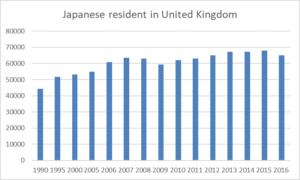
The UK is the only top 10 European economy where the number of Japanese residents has declined from 2015 to 2016.

The number of Japanese residents in the UK hit an all time high in 2015 of just under 68,000, according to Japan’s Ministry of Foreign Affairs. This fell by 4.5% in 2016. The last time there was a significant fall in Japanese residents in the UK was 2007-9.  Presumably this can be attributed to the Lehman Shock, and numbers have been climbing steadily since 2010.  So why has there been another drop?  Brexit might be the easy answer, but the referendum vote was in June 2016, so it seems a rather immediate impact.

There are more Japanese in the UK than anywhere else in Europe, both in absolute and relative terms. The second highest population of Japanese in Europe is in Germany (44,027) and the third highest is France (41,641), with other countries having substantially less Japanese presence (4th is Italy, with 13,808).

I was surprised there were that many Japanese people in France as there are fewer large Japanese companies and regional headquarters in France relative to Germany or the UK. Fortunately, the Ministry of Foreign Affairs breaks down the total by whether they are permanent residents or long term residents – broken down by intra company transfers, self-employed and students/academic related.  France has a relatively larger proportion of students, self employed and government related people, whereas the UK has relatively more permanent residents and Germany relatively more intra company transferees.

Number of permanent Japanese residents in the UK has risen, but academic, corporate and diplomatic residents have fallen

The number of permanent Japanese residents in the UK has risen by 4.5% to 19,785 (30% of all Japanese in the UK) and the number of long term residents has dropped 7.9% to 45,813.

The UK still has the highest number of intra company transfers in Europe – 17,841 – but this is 4% down on 2015.  The bigger falls were in students/academics/researchers – 13.8% (from 19,100 to 16,461) and government related – a 25.7% decrease from 934 people to 743.  So is this due to young Japanese becoming more reluctant to study overseas?  Is the UK losing its centrality as a diplomatic posting?

Comparing the UK to trends in Germany and France shows that Japanese are still studying in Europe, just increasingly more in Germany or France (also large Japanese student populations in Italy, Spain and Switzerland and significant increases in the Netherlands and Ireland).  Diplomats and other government officials are also gravitating more towards Germany and France (there are also a large number of Japanese government people in Switzerland).

Germany hosts almost double the number of Japanese companies than the UK does (1811 compared to 998) so the other key difference between Germany and the UK is the density of Japanese people on intra company transfers per Japanese company.  The UK has by far the highest density – of around 18 Japanese residents per company, then Belgium with 12, then France with 11, Germany, Netherlands and UAE with 9.  This is due to the large number of regional headquartered financial services and trading companies in London.

So what has changed since 2015 that has not impacted the other European countries so much, apart from Brexit?  I conclude it must be the increasing difficulty of obtaining Tier 2 intra company transfer visas (as I mentioned in my comments to the Financial Times recently) and also student visas (as explained in this 2016 report).  Government agency/diplomatic visas are dealt with separately I assume – maybe this is an element which can be explained by the UK’s declining international influence and more a question of reduced demand rather than reduced supply?  Either way, Brexit and visa restrictions will be a combination precipitating further rebalancing away from the UK and to the continent, I predict.

For more content like this, subscribe to the free Rudlin Consulting Newsletter. 最新の在欧日系企業の状況については無料の月刊Rudlin Consulting ニューズレターにご登録ください。

Read More

What is a Japanese company?

I had anticipated the “do you have any questions for us?” at a recent final interview for a non-executive directorship for an investment trust focused on Japan.  I was advised by another experienced non-executive director to think of a thought provoking question, to show the board I was capable of bringing a different perspective, something they had not thought of before.

On reflection, I probably erred too far on the “thought provoking”.  It was a genuine question, however, and I was genuinely interested in their answer.  As the fund’s strategy was to invest only in Japanese companies, how do you define a Japanese company?

Listed in Japan or majority of business in Japan?

The fund defined it as being listed on a Japanese stock exchange.  This may seem a clear enough definition, but does this mean Sharp, now owned by a Taiwanese company, Hon Hai, is a still a Japanese company?  How about Hitachi Power Tools and Calsonic Kansei, now both owned by American buyout firm KKR?

Other Japan focused funds also invest in companies that are listed outside Japan, so long as a significant majority of their business is in Japan.  But if percentage of sales in Japan is the criterion, then there are plenty of Japanese companies who are listed in Japan, for whom a majority of their business is outside Japan – Takeuchi for example exports 95% of its diggers to overseas markets and 68% of Sony’s business is outside Japan.

Avoiding ‘country risk’

Why does it matter?  It matters to the boards of such funds, because if they define “Japanese” as Japan listed or majority of business in Japan, then clearly they need to consider the “country risk” of Japan and ensure the strategy is adjusted, or mitigation is put in place accordingly. 

They need an expert in Japanese economics or politics to read the entrails on whether Prime Minister Abe will be re-elected as leader of the LDP in September, and if so whether he will be in a strong enough position to carry on with his “Three Arrows” of reform.  They need to be able to judge whether the recent dip in Japan’s GDP growth is temporary, or likely to be revised upwards in June, as often happens. They might need some inside track on trade friction around the world and how this might affect the Yen.

But if the strategy is to invest in specific Japanese companies with long term growth potential, then this is not the same as investing in the Japanese economy or a Japanese index tracker.  The aim should be to look for companies that will succeed no matter what happens to the Yen or Abe.

Managed by Japanese executives?

Specifying that those companies should be Japanese indicates to me that there is thought to be something unique to Japanese companies that makes them worthy of special attention.  So should it be that the management of the company is Japanese?  In which case, how should Takeda be classified – likely to become even more dominated by non-Japanese executives after the acquisition of Shire?

What about other companies who, like Takeda, have substantial overseas business acquired through acquisition, but manage it mostly through an international HQ based outside Japan, such as Japan Tobacco (Swiss HQ) or Dentsu (Dentsu Aegis Network in the UK)?

Or how about SoftBank, founded and run by Masayoshi Son, ethnically Korean and educated in the USA?  The original telecoms business is clearly Japanese, but what about ARM in the UK and Sprint in the US – not to mention Softbank’s massive Vision Fund which notably is not investing much into Japanese companies at all?

Where Japanese companies have the edge…

I propose some further, admittedly fuzzier definitions of “Japanese”. Firstly, the business should reflect an aspect where Japan has an “edge” – a comparative advantage.  For example, any business that is focused on the elderly, as Japan has the most rapidly ageing population in the world, with over 25% over the age of 65.  Or a business which has evolved from Japan’s traditional manufacturing and craftsmanship strengths, what is known as monozukuri in Japanese – highly sophisticated machine tools, robotics and components.

But I think there is something more than that to being “Japanese”.  It’s about the corporate culture and governance – a different model to the Anglo-Saxon shareholder value maximization model.  Investing in a Japanese company should be for long term capital growth rather than a quick dividend, as well as some satisfaction that the investment is going into a company which does not engage in creative destruction type capitalism. 

…is also where the risks lie

And this is where the risks also lie.  Japan’s stakeholder capitalist model means job security, but also hidden underemployment and low productivity.  Jealous guarding of corporate reputation can mean cover ups when something goes wrong.  Strong loyalty to other members of the corporate family can mean deference to seniors without questioning or challenging orders given.  Extreme risk aversion can mean opportunities missed.

Understanding and mitigating these risks is not something that can be resolved by an informal chat with a contact in a ministry, nor by looking at exchange rate forecasts and putting some hedges in place.

This was the conversation I wanted to have, and where I thought I could add value, but that’s the trouble with the “any questions for us” coming at the end of the interview.  As the board chair said – fascinating question, but you’d need a whole afternoon or a seminar to thrash it out.  And no, I did not get the job.

For more content like this, subscribe to the free Rudlin Consulting Newsletter. 最新の在欧日系企業の状況については無料の月刊Rudlin Consulting ニューズレターにご登録ください。

Read More
Data visualisation depersonalizes discussions, but you still need the people to make a judgement

I often advise Europeans who are trying to communicate a proposal, or want to have a discussion with Japanese counterparts to try to put their idea into a visual format. This has several benefits. One is that it should reduce the amount of English text that the Japanese person has to plough through to understand what is being proposed.  A second reason is that it depersonalizes the discussion if there is a graphical representation – a “thing” that can be pointed at and disagreed with during the argument, rather than having to argue with someone’s abstract idea.

Thirdly, Japanese written language – kanji – is highly graphical as a communication method, so Japanese people are more receptive to complex concepts being communicated in a graphical and holistic way rather than the textual, linear form common in the West.

So I was quite surprised to hear a young Japanese expatriate woman tell me that her colleagues in the UK based market research agency she works for are much more accustomed to representing their findings in a graphical way than she was used to in Japan.  Specifically, she said that they use infographics and sometimes even send the report to clients as a video, using the infographics and clips of customers being interviewed.

With the advent of “Big Data”, data visualization is a growing industry.  So should Japanese companies be acquiring companies or hiring people who have those skills, or is this another area which will simply be automated, and all that is needed is to buy in or develop some software?

Automation tools already exist for data visualization, but the key is to think about why you want to put the data into a visual format in the first place.  It is usually to give insights which will then provoke a discussion.  An infographic does not of itself provide the solution.  Discussions require human beings to provide their different interpretations of the infographics and ideas about how to act on them.  The infographic provides the “thing” that can be pointed at and disagreed with, but also allows people of diverse backgrounds and native languages to have a more equal chance of contributing to the debate, because there is less of a language or technical barrier.

The market research agency at which the Japanese woman worked was founded in the UK and acquired by a Japanese company in 2014. But it also has offices across Asia, multinational staff who travel across Europe and a call centre based in the UK covering over 30 languages.

The UK is the obvious location for global marketing services, not just because it is the home of English language communication, but because of its multinational workforce, who can ensure the data is interpreted appropriately for different cultures. This is why Japanese marketing and advertising agencies have been acquiring many British companies recently. I just hope Brexit does not damage this advantage by putting up too many barriers to immigration and free movement across Europe.

This article by Pernille Rudlin originally appeared in Japanese in the Teikoku Databank News and also appears in Pernille Rudlin’s new book  “Shinrai: Japanese Corporate Integrity in a Disintegrating Europe”  – available as a paperback and Kindle ebook on  Amazon.


For more content like this, subscribe to the free Rudlin Consulting Newsletter. 最新の在欧日系企業の状況については無料の月刊Rudlin Consulting ニューズレターにご登録ください。

Read More
Gender pay gap in UK’s largest Japanese employers is lower than average

Any company in the UK that employs over 250 people is supposed to have submitted their gender pay gap estimates by 4th April 2018.  We ran our Top 30 Japanese companies through the Companies’ House database and found that all have submitted data for those subsidiaries which qualify.

The average pay gap of their 50 subsidiaries is around 15%, slightly lower than the national average of 18.4%.  There are some interesting patterns in that there is a gender pay gap in women’s favour in the automotive and tyre businesses – Kwik-Fit and Stapletons (both owned by Itochu) and Micheldever (acquired by Sumitomo Rubber in 2017) and also Toyota Motor Manufacturing and NSG Pilkington Automotive.  Looking at the detail, it seems this is to do with there being a lot of men in the lower paid jobs (presumably tyre fitting, shopfloor, delivery) and some well paid women in the higher paid, presumably managerial/executive jobs.

The gender pay gap is particularly bad in finance, although no worse for Japanese banks than for other UK based investment and retail banks.

The wooden spoon goes to Hitachi subsidiary Horizon Nuclear Power with a 41.9% pay gap, closely followed by Fujifilm, with a 41% pay gap.

Top 30 Japanese employers in the UK (April 2018) & gender pay gap
Rank Company UK employees 2016-7* Gender gap
1 Fujitsu Services 9,326 17.9%
2 Nissan 7,755 -11.3%
3 Honda Motor Europe (sales) 6,539 27.1%
Honda of the UK Manufacturing 4.5%
4 Itochu 6,515
Kwik-Fit -15.2%
Stapleton’s (Tyre Services) -24.9%
5 Hitachi Hitachi Consulting 3,998 30.3%
Horizon Nuclear 41.9%
Hitachi Capital 33.5%
Hitachi Vantara 27.0%
Hitachi Rail -0.9%
6 Mitsubishi Corp Princes Foods 3,532 8.7%
7 Ricoh UK 3,484 17.4%
Ricoh UK Products 10.4%
Ricoh Europe 32.2%
8 Sony Europe 3,143 27.2%
Sony Music 22.7%
Sony DADC 8.7%
Sony Interactive 12.8%
9 Toyota Motor Manufacturing 3,098 -6.4%
Toyota (GB) (sales) 29.7%
9 Marubeni (Agrovista) 2,294 36%
10 Dentsu Aegis London 2,757 14.5%
Dentsu Aegis Manchester 1.8%
11 Canon 2,693 15.8%
12 SoftBank (ARM) 2,173 15.5%
13 Nomura 2,166 36.9%
14 NSG Pilkington Automotive 2,128 -12.1%
Pilkington Technology Management 31.7%
Pilkington UK 8.3%
15 Mitsubishi UFJ Financial Goup 1,987 35.6%
16 Denso Manufacturing 1,897 24.2%
Denso Marston 6.6%
17 NYK Group (Yusen Logistics) 1,855 4.0%
18 Mitsui Sumitomo & Aioi Nissay Dowa (Insure The Box) 1,809 19.0%
19 Calsonic Kansei UK 1,778 3.6%
Calsonic Kansei Sunderland 3.6%
20 Konica Minolta 1,572 18.2%
21 Sumitomo Rubber (Micheldever Tyre Services) 1,543 -19.9%
22 Brother Industries (Domino UK) 1,384 15.1%
23 Olympus Keymed 1,348 27.7%
24 Fujifilm UK 1,257 41.0%
Fujifilm Speciality Ink Systems 8.7%
Fujifilm Diosynth 16.0%
25 Sumitomo Corporation (Howco Group) 1,249 17.5%
26 Unipres 1,237 3.1%
27 JT Group (Gallaher) 1,086 14.0%
28 Sumitomo Mitsui Banking Corporation 1019 34.9%
29 Toyoda Gosei 1,192 0.9%
30 Mitsubishi Heavy Industries (Primetals) 1,152 38.1%
TOTAL 84,966 15.1%


For more content like this, subscribe to the free Rudlin Consulting Newsletter. 最新の在欧日系企業の状況については無料の月刊Rudlin Consulting ニューズレターにご登録ください。

Read More
Mitsubishi Corp alumnus toasts the Suntory spirit

When I left Mitsubishi Corporation after 9 years, I felt guilty that I had not found a way to repay (in business development rather than money) the MBA they sponsored me through and worried that the wonderful sempai (mentors) who had supported my career would now be angry with me.  I was delighted and relieved therefore, when one of the sempai, very senior in the company, invited me for a drink when I was in Japan on a business trip, and explained to me and the other team members at the table that Mitsubishi Corporation should regard people who leave as alumni, just as McKinsey do.  “We may end up doing business together one day,” he predicted.

Indeed Mitsubishi Corporation is now a valued customer of mine, and I have seen many other MC alumni rise to some of the top positions in the Japanese business world.  Probably the most well known one is Takeshi Niinami.  A graduate of Keio University, as so many MC people are, he was sponsored by MC through a Harvard MBA. He eventually became President of Lawson, the convenience store chain that MC had invested in, leading its turn around.

He is now the President of Suntory Holdings and was interviewed in Nikkei Business magazine about recent developments there, including the acquisition of Beam Inc (but not its acquisitions in Europe of Lucozade, Ribena and Orangina) and the “Suntory Way”.

What Beam got from Suntory

“The Suntory Way means that we develop products that our competitors do not have”, says Niinami.  “When I explained this to the Jim Beam factory in Kentucky they were very supportive.  Beam Inc headquarters people all had MBAs. American marketers get a sense of consumer trends from consultant’s reports and decided their strategy based on that, they never went to the gemba (shopfloor) the way we do in Japan.  They just told the Kentucky factory what to do, top down, from afar.  If you told them to go to the gemba they’d probably quit. There wasn’t one single person in the executive team who came from manufacturing and they weren’t investing in the factory.  But the Kentucky people loved making things.  So when we told them we saw manufacturing as the most important thing and appointed someone from manufacturing to the board, their motivation shot up.”

“When they came to see our factories in Japan, they became aware of the need to improve their Kentucky factory.  Beam is even older than Suntory – more than 200 years of history.  We were able to revive their DNA.”

What Suntory learnt from Beam

“Beam are really good at managing profitability.  Suntory got heavily into debt to buy Beam and we are all focused on reducing this debt.  Suntory was not as good at managing cash flow as Beam but we have learnt.”

What’s next for Suntory and Niinami

Niinami was brought in by the previous President and now CEO and Chairman, Nobutada Saji (also from the founding family) in 2014. Niinami thinks his successor is likely to be another member of the founding family – current COO NobuhiroTorii – and seems in favour of this, as a way of maintaining Suntory’s spirit.  He also expects Suntory to remain a privately held company, despite discussions to the contrary when he first became President. The advantage, he says, is that Suntory is able to contribute to society, through the Suntory Hall (a famous concert venue in Tokyo) and also a water sustainability initiative, without having to justify this to shareholders.

As an outsider, Niinami feels he was able to see objectively how good the Suntory spirit was, and how to roll it out globally.  He has set up a Suntory University to help with this.  Although Niinami is only 59, he says he is willing to finish his career at Suntory.  “I am already “of age” and I don’t think anyone will be asking this “odd fish” to join them.”

For more content like this, subscribe to the free Rudlin Consulting Newsletter. 最新の在欧日系企業の状況については無料の月刊Rudlin Consulting ニューズレターにご登録ください。

Read More
GDPR

The EU’s General Data Protection Regulation (GDPR) comes into force on May 25th 2018, after which date, organizations which hold personal data on EU citizens which are not compliant with the GDPR may face heavy fines.

Many small companies like mine are struggling to comply. The regulation is clearly aimed at the larger business-to-consumer companies who hold a lot of very personal data about their customers, such as their age, sexuality, political affiliations and so on, and could use this to target them in a way that could be seen as intrusive or offensive.

I have decided, however, to make sure the personal data we hold is compliant, partly because I want my customers to feel confident that their suppliers are trustworthy, but also because I see this as a chance to improve the service we provide and slim down our customer database and mailing lists.

Japanese companies in Europe are undoubtedly feeling particularly nervous about the GDPR, as Honda Motor Europe was already fined by the UK’s Information Commissioner’s Office in 2017 for violating a UK regulation which has very similar requirements to the GDPR regarding consent.

Consent is the key issue with GDPR.  There needs to be informed, positive consent by the customer for their data to be processed.  The nature of the data (what kind of personal details) which the company will hold, and what it will be used for (emails, newsletters, postal mailing etc) have to be clearly explained.  A double opt in is recommended – whereby people fill in the form, and then receive an email asking them to confirm that they do want to share their data.  A clear process for them to ask to be deleted from a database also needs to be in place.

It is not possible to “grandfather” (allow old conditions to continue even if they are against the new rules) previously held personal data, so it might be safest to reconfirm with people on your database that they still consent to you processing their data.  Of course, the risk with this is that many people will not consent and your mailing list will shrink.

But this brings me on to my second reason for deciding to comply as thoroughly as possible with the GDPR.  I want to make sure that my newsletters are really valued by my customers.  Our newsletters are not marketing our training so much as part of the after-service we provide.  They help our customers refresh and add to what they learnt in the classroom.

Manufacturers are also moving away from just selling a product, to selling a solution – hardware plus surrounding services such as maintenance and support, using the Internet of Things and Big Data to provide a more customised product.

Which is of course why the GDPR has become necessary.  Personal data can be used in a good way, to meet customer needs more completely, but, as we know in Europe, particularly in former dictatorships and communist regimes, personal data can be abused.

This article appears in Pernille Rudlin’s latest book “Shinrai: Japanese Corporate Integrity in a Disintegrating Europe” available as a paperback and Kindle ebook on Amazon.

For more content like this, subscribe to the free Rudlin Consulting Newsletter. 最新の在欧日系企業の状況については無料の月刊Rudlin Consulting ニューズレターにご登録ください。

Read More
Hybrid food cultures and the EU Japan Economic Partnership Agreement

The EU-Japan Economic Partnership Agreement (EPA) has been characterised in Europe as “cars for cheese”.  As a cheese loving North European, I did indeed miss being able to buy reasonably priced good quality cheese when I was living in Japan.  It was a kind of comfort food for me – either hunks of cheese on bread, or sometimes I would have what I called my “spaghetti Bolognese” moment, where I would crave the umami of a tomato and beef sauce smothered with parmesan cheese.

But because I also lived in Japan as a child, traditional Japanese foods are comfort food for me too.  Now I am living in the UK – I sometimes make miso soup (particularly the red miso I remember from when I was a child in Sendai), or okonomiyaki, or curry rice or tonkatsu to cheer myself up.

The EPA now has to be approved by various local European parliaments, and one of the ways of persuading them to accept the agreement is to point out that it will ensure the geographical designation of over 200 European food and drink products are protected in the Japanese market, such as Polish vodka or Parma ham.

If this argument is sufficiently persuasive to local parliaments, the agreement is expected to be ratified in 2018 and implemented in 2019. 

Europeans get very passionate about the authenticity of local food – particularly the Italians.  There is even a Twitter account called “Italians mad at food” (@Italiancomments) which retweets comments from Italians outraged – mostly at Americans – for putting mushrooms or garlic in carbonara sauce or pineapple on pizza. 

Italians would not be impressed with my spaghetti Bolognese either – there is no such dish as spaghetti Bolognese in Italy.  There is ragu alla Bolognese, which means simply a meat sauce – and is meant to be eaten with tagliatelle, not spaghetti.

The British have a long history of adopting foods from other cultures – our favourite national dish is Chicken Tikka Masala – which is a curry which does not exist in India – and the second or third generation British Chinese who run our takeaway food shops have become resigned to putting sweet and sour sauce on fries.

The British have become far more sophisticated about foreign food these days.  Multicultural street food has become fashionable across Europe – most major cities have markets full of “yatai” – one in my town has a Chilean stall and a falafel (Middle Eastern food) stall which is actually run by a couple of Koreans.

Japanese people are somewhat dismayed to see fast food chains selling “sushi” in the UK which have little resemblance to the authentic Japanese version but of course curry rice, tempura and tonkatsu are actually hybrid Japanese/European/Indian foods themselves.

So the EPA seems likely to herald another chapter of hybridization.  Japan and Europe will trade in each other’s authentic, local foods, and create new hybrids that will be the comfort foods for the next generation.  It’s a business opportunity both for traditional farmers and adventurous cooks. 

For more content like this, subscribe to the free Rudlin Consulting Newsletter. 最新の在欧日系企業の状況については無料の月刊Rudlin Consulting ニューズレターにご登録ください。

Read More
Situational leadership for Japanese managers in Europe

One of the issues that Japanese people who come to work in Europe find most challenging is the multiple nationalities of people they have to work with.  Whether you are based in London, Duesseldorf or Amsterdam, it is highly likely that your colleagues will be a mixture of not just British, German or Dutch but also Romanian, Lithuanian, Polish, Spanish or indeed Indian or Chinese.

Much of the global leadership or management training that is offered in Japan is based on American models. Europeans are used to American management styles so they will tolerate them – at least superficially. However, many of these “one size fits all” models are not ultimately effective in getting Europeans to go beyond superficial compliance.  In fact, they can have quite a demotivating effect, particularly if they are too rigidly focused on quantitative targets and objectives.

European managers themselves find that the American model which works the best is known as “situational leadership”.  This is not a new theory – it was developed in the 1960s and 1970s by the Americans Dr Paul Hersey and Ken Blanchard. It suits the European context because the key idea is that there is no one best style of leadership, and situational leaders are those who are able to diagnose the situation, adjust their leadership style and communicate accordingly.   They also need to be able to take account of the “performance readiness” – in other words the ability and willingness – of the various members of the team.

National cultural differences are not specifically mentioned in the model, but in my training I always relate situational leadership to what is known about the preferences in each European country for top down or consensus oriented decision making styles, as well as direct or indirect and formal or informal communication in the ways of giving feedback or direction.

Of course, this can be somewhat overwhelming for someone who is new to the European workplace. It is particularly tough for Japanese people who have worked in the more traditional Japanese companies, where people just do as best they can whatever their bosses tell them, whether they are willing or able or not.

But I think Japanese managers have two big advantages.  Although this is a generalization and may not apply to all Japanese managers, in my twenty-five years’ experience of working with or in Japanese companies, most of the Japanese people I have met have been humble about their own abilities and also curious about other cultures. This means they are willing to learn and to accept that their usual way of working may have to be adjusted.

This article originally appeared in Japanese in the Teikoku Databank News and also appears in Pernille Rudlin’s new book  “Shinrai: Japanese Corporate Integrity in a Disintegrating Europe”  – available as a paperback and Kindle ebook on  Amazon.

For more content like this, subscribe to the free Rudlin Consulting Newsletter. 最新の在欧日系企業の状況については無料の月刊Rudlin Consulting ニューズレターにご登録ください。

Read More
Why Japan’s salaries should rise

Prime Minister Abe has been pressurising Japanese companies to increase wages for some years now, and yet Japanese companies are still sitting on piles of cash.  Japanese wages have not increased more than 5% a year since the early 1990s, mostly averaging around 2-3% wage rises a year.  The Japanese economy has been in a period of deflation since the late 1990s until the past year or so, so these are real wage increases.  Nonetheless, there is a vicious circle between deflation and low pay increases, which Abe wants to break as part of his 3 Arrows for reforming the Japanese economy.

Low Japanese salary levels

Although I knew Japanese salary levels were not that high relative to other developed economies, I was surprised to see in the Nikkei Business magazine that average British salaries for the head of  R&D at a pharmaceuticals company (£400K) or a CFO of a multinational (£390K) are so much higher than Japan (less than £200K) and even the USA (£200K to £250K).  I wonder if these figures are net of any bonuses. Traditionally, Japanese companies paid 1/18 of salaries monthly, retaining the remaining 6/18 for twice yearly bonuses.  Increasingly these bonuses are performance related, particularly at management levels.

Earnings distributed to shareholders or retained

Nikkei Business then goes on to analyse how earnings are distributed in Japanese companies, between labour, retained earnings and shareholders.  The proportion paid to shareholders has been steadily increasing for Japanese companies, recently outstripping the proportion paid to labour (which has been in decline since 2008), but still below the retained proportion, which has been fairly steady these past 10 years.  In the US retained earnings is the lowest proportion, declining since 2009, whereas shareholders have the highest share, increasing since 2008, with labour’s share declining since 2000, with a slight bump upwards around 2007/8.

Root causes of labour’s declining share

Root causes for this might be that labour’s negotiating power has fallen – unionization in Japan has fallen from nearly 60% of the workforce in the immediate postwar period to under 20% by 2017.  Also thanks to Abe’s labour reforms, companies are not paying out so much for overtime – theoretically at least there is less overtime being done – but this is not being replaced by increases in base salaries.

Who could pay their employees more?

The juiciest bit of Nikkei Business’s feature is in the listing up and analysis of companies who have the biggest potential for increasing salaries:

1 . Tokyo Electron (scores highest on Return on Equity 10, net cash 9 and revenue growth 9 with a 3/10 on returns to labour

2. Nintendo (Dividend payouts 9, capital to asset ratio 9, net cash 10, returns to labour 2)

3. Kakaku.com (ROE 10, capital to asset ratio 9, revenue growth 9, returns to labour 4)

4. Subaru (net cash 10, revenue growth 8, dividend payouts 8, returns to labour 2)

=5. Start Today (revenue growth 10, ROE 10, dividend payouts 7, returns to labour 3)

=5. Chugai Pharma (capital to asset ratio 9, net cash 9, dividend payouts 8, returns to labour 3)

=5. Yahoo, Recruit, with MonotaRO and Fanuc at =9.

Other companies in the top 30 who are also active in Europe include Murata, Kao, Keyence, Shimano, Astellas and Hoya.

It’s an intriguing mix of new internet companies, growing fast, but perhaps preferring to pass on success to shareholders rather than employees and traditional, older companies who are preferring to retain earnings for a rainy day.

The special feature concludes with an interview with Hideto Fujino of Rheos Capital Works, in which he says investors want to hold shares in Japanese companies who raise salaries, if this is to attract more motivated, talented employees.  “We don’t see payroll as a cost, but an investment”.

For more content like this, subscribe to the free Rudlin Consulting Newsletter. 最新の在欧日系企業の状況については無料の月刊Rudlin Consulting ニューズレターにご登録ください。

Read More
March of Japanese labour reforms stalled

March has always been a stressful, uncertain month in Japan.  Most companies, schools and universities start their new year around April 1st and this is also when corporate promotions and restructurings are announced.

Prime Minister Abe has been adding to the stress by trying to push through various labour market reforms, aimed at expanding “discretionary labour” by the end of the parliamentary session in June, but has had to row back on some of them due to the data on which they were based turning out to be severely flawed.

Status conversion rule

One piece of legislation which will be enacted from April this year is the new status conversion rule.  This will allow fixed term employees renewing contracts for more than five years – usually temporary workers dispatched from staffing companies, or part time workers or contract workers – the right to switch to indefinite employment with no fixed period.  In other words, the kind of lifetime employment, regular contract that Japan’s seishain (proper staff – see other posts on this here) have.

The gap in status, job security and benefits between seishain and” irregular workers” has been an enduring sore in Japanese society since the immediate postwar period of labour shortages in Japan when the lifetime employment system became established.  The proportion of irregular workers in the Japanese workforce has grown since the 1990s, to around 37.3% of the workforce – 10% up on 10 years’ ago.

Irregular workers will disappear – maybe

Toyo Keizai magazine has an article headlined “Irregular workers are disappearing” saying the new status conversion rule will be a big shock to companies that rely on non-permanent employees.  However surveys show very few employees and even HR managers are aware or understand the new rule, and companies are not making much effort to stimulate interest in it, unsurprisingly.

Japanese recruitment agencies go global – again

Presumably it will also be a shock to staffing agencies in Japan too, who have done rather well out of the rise in this sector of the workforce.  There is a further rule imposing a three year deadline for temporary employment from a temping agency, after which the company will have to hire the employee directly – which will come into force from September.

No wonder recruitment agencies have started a second bout of acquisitions overseas – recent acquisitions in Europe include Outsourcing acquiring JBW, Liberata and Ntrinsic in the UK and Orizon in Germany and Recruit acquiring USG People in the Netherlands.


For more content like this, subscribe to the free Rudlin Consulting Newsletter. 最新の在欧日系企業の状況については無料の月刊Rudlin Consulting ニューズレターにご登録ください。

Read More

Search

Recent Posts

  • Data and trust in Japan and Europe
  • Japan – Europe, Middle East & Africa business update
  • Japan in the UK – The Brexit Agreement 5 and 10 years on
  • Biggest European companies in Japan
  • Two swallows make a summer?

Categories

  • Africa
  • Brexit
  • China and Japan
  • Corporate brands, values and mission
  • Corporate culture
  • Corporate Governance
  • cross cultural awareness
  • CSR
  • customer service
  • Digital Transformation
  • Diversity & Inclusion
  • European companies in Japan
  • European identity
  • Foreign companies in Japan
  • Foreign Direct Investment
  • Globalization
  • History of Japanese companies in UK
  • Human resources
  • Innovation
  • Internal communications
  • Japanese business etiquette
  • Japanese business in Europe
  • Japanese customers
  • M&A
  • Management and Leadership
  • Marketing
  • Middle East
  • negotiation
  • Presentation skills
  • Reputation
  • Seminars
  • speaker events
  • Sustainability
  • Trade
  • Uncategorized
  • Virtual communication
  • webinars
  • Women in Japanese companies
  • Working for a Japanese company

RSS Rudlin Consulting

  • Data and trust in Japan and Europe
  • Japan – Europe, Middle East & Africa business update
  • Japan in the UK – The Brexit Agreement 5 and 10 years on
  • Biggest European companies in Japan
  • Two swallows make a summer?
  • Biggest foreign companies in Japan
  • Japanese financial services in the UK and EMEA
  • The puzzle of Japanese foreign direct investment in the UK
  • What is a Japanese company anyway?
  • Largest Japan owned companies in the UK – 2024

Search

Affiliates

Japan Intercultural Consulting

Cross cultural awareness training, coaching and consulting. 異文化研修、エグゼクティブ・コーチング と人事コンサルティング。

Subscribe to our newsletter

Recent Blogposts

  • Data and trust in Japan and Europe
  • Japan – Europe, Middle East & Africa business update
  • Japan in the UK – The Brexit Agreement 5 and 10 years on
  • Biggest European companies in Japan
  • Two swallows make a summer?

Meta

  • Log in
  • Entries feed
  • Comments feed
  • WordPress.org

Posts pagination

« 1 … 33 34 35 … 57 »
Privacy Policy

Privacy Policy

Web Development: counsell.com

We use cookies to personalize content and ads, to provide social media features, and to analyze our traffic. We also share information about your use of our site with our social media, advertising, and analytics partners.